
 Download PDF
Market Overview
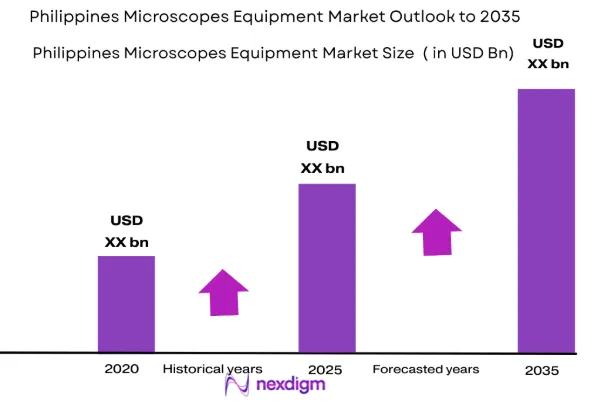
The Philippines microscopes equipment market is valued at approximately USD ~ billion in 2024, driven by the growing demand for advanced research tools and diagnostic equipment in sectors such as healthcare, education, and industrial applications. The rise in academic research funding and healthcare infrastructure developments is propelling the market. Furthermore, government support for scientific research and development programs, along with a greater emphasis on biotechnology and healthcare, contributes to the robust growth trajectory of the market in recent years.
Metro Manila, the capital region, is the major contributor to the Philippines microscopes equipment market. As the center of economic, academic, and medical advancements, Metro Manila’s demand for microscopes is driven by the concentration of top universities, research institutions, and diagnostic laboratories. In addition, other regions like Cebu and Davao, with expanding healthcare and industrial sectors, are also seeing a steady rise in demand. The local government’s continuous investment in research and education further strengthens the position of these cities as dominant players in the market.
Market Segmentation
By Technology Type
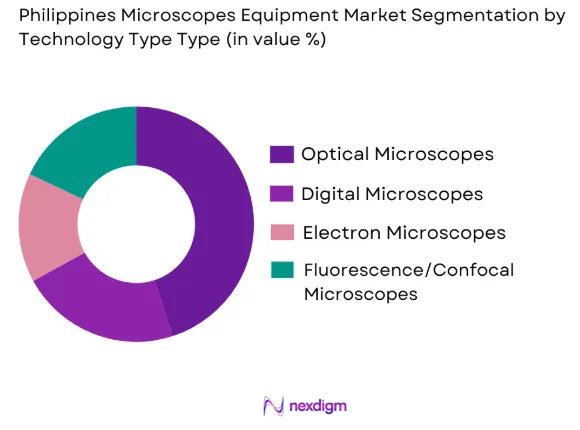
The Philippines microscopes market is divided into different technology types, including optical microscopes, digital microscopes, electron microscopes (SEM/TEM), and fluorescence/confocal microscopes. Among these, optical microscopes currently dominate the market due to their wide use in educational and clinical applications. Optical microscopes, being more cost-effective, are preferred by academic institutions, research laboratories, and hospitals. These instruments’ ease of use and the ability to achieve sufficient magnification for various routine applications make them indispensable in educational and medical fields.
By End-Use Industry
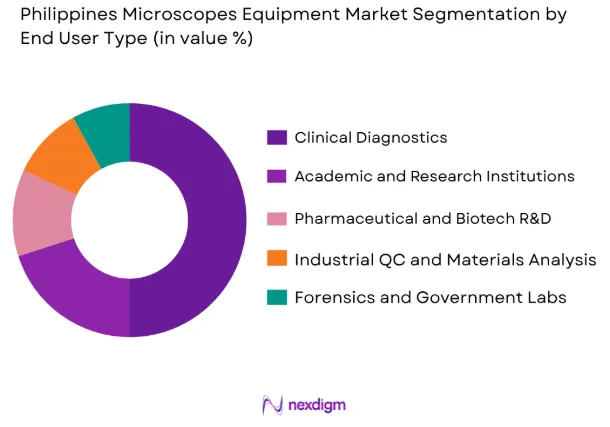
The end-use industries of the Philippines microscopes equipment market are categorized into clinical diagnostics, academic and research institutions, pharmaceutical and biotech R&D, industrial QC and materials analysis, and forenics and government labs. The clinical diagnostics sector holds the largest share, driven by the increasing adoption of advanced microscopes in pathology and medical testing. Diagnostic centers, hospitals, and healthcare facilities are keen on upgrading their equipment to enhance the accuracy of test results, especially in pathology and microbiology, making this segment the dominant player in the market.
Competitive Landscape
The Philippines microscopes equipment market is dominated by both local distributors and international manufacturers. Major global players such as Leica Microsystems, Olympus Corporation, and Nikon Instruments, along with local entities like Dyna-Image Philippines, dominate the competition. These companies lead due to their strong distribution networks, advanced technological offerings, and well-established brand recognition in the Philippines market. Their ability to provide both high-end and entry-level products across various sectors contributes to their stronghold.
| Company Name | Establishment Year | Headquarters | Technology Focus | Market Reach | Key Products | Revenue | Additional Parameter |
| Olympus Corporation | 1919 | Tokyo, Japan | ~ | ~ | ~ | ~ | ~ |
| Nikon Corporation | 1917 | Tokyo, Japan | ~ | ~ | ~ | ~ | ~ |
| Leica Microsystems | 1849 | Wetzlar, Germany | ~ | ~ | ~ | ~ | ~ |
| Zeiss Group | 1846 | Oberkochen, Germany | ~ | ~ | ~ | ~ | ~ |
| Thermo Fisher Scientific | 1956 | Waltham, USA | ~ | ~ | ~ | ~ | ~ |
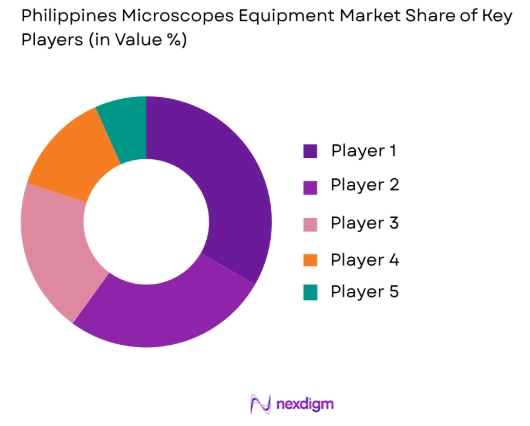
Philippines Microscopes Equipment Market Analysis
Growth Drivers
Rising Institutional Research Investment (R&D Intensity)
The Philippines has seen an increase in government and private sector investments in research and development (R&D). In 2022, the Philippine government allocated around PHP 2.5 billion to science and technology, aimed at strengthening local research capabilities and improving laboratory infrastructure. The country’s focus on developing biotech and pharmaceutical sectors has been reinforced by the Department of Science and Technology (DOST) initiatives, which saw significant funding allocated towards R&D facilities and collaborative research programs. Additionally, universities and academic institutions have been receiving increased funding, with the University of the Philippines’ National Institute of Molecular Biology and Biotechnology receiving PHP 1.5 billion in 2023 for advanced research. This shift in investment is likely to continue driving the demand for high-end microscopes in both public and private institutions.
Healthcare Modernization & Diagnostic Expansion
The Philippine healthcare system is undergoing rapid modernization, especially in diagnostic and clinical technologies. The Department of Health (DOH) allocated PHP 11.4 billion in 2022 for the expansion of diagnostic services and infrastructure. This funding is expected to bolster the demand for advanced diagnostic equipment, including microscopes, to improve accuracy in diagnostics. With a growing healthcare sector and a focus on disease detection and management, the government has been upgrading regional and provincial hospitals, providing them with state-of-the-art medical devices. Additionally, the Philippines’ healthcare spending in 2022 increased by 5.3% from the previous year, highlighting the importance of expanding diagnostic services across the nation.
Market Opportunities
Digital Imaging Analytics & AI Integration
Digital imaging analytics and AI integration are revolutionizing microscopy across industries. The Philippine government has actively supported the integration of AI in research and diagnostics, with a notable investment of PHP 1.5 billion in 2023 to enhance healthcare facilities’ digital infrastructure. This initiative promotes the use of AI-powered microscopes that can assist in automated image analysis for quicker and more accurate diagnostics. The application of AI in digital microscopy is transforming industries such as diagnostics and research, where the integration of real-time image analysis helps streamline workflows and improve precision. As the Philippines continues to push for digital transformation in science and healthcare, the market for AI-integrated microscopes is expected to grow significantly.
Local Calibration & Support Service Growth
With the expansion of advanced microscope technology in the Philippines, there is an increasing demand for local calibration and support services. As more sophisticated microscopes are adopted by research institutions and medical facilities, the need for on-site technical support and calibration services grows. In 2023, the Philippine government supported the development of local tech support services by providing grants for technician training and certification, totaling PHP 350 million. These grants are aimed at improving the service infrastructure required to maintain and calibrate advanced equipment like microscopes. With increasing reliance on high-tech equipment, the local service and calibration market will grow, offering an opportunity for businesses providing such services.
Future Outlook
The Philippines microscopes equipment market is poised for substantial growth over the next several years. This expansion is expected to be driven by the growing research and educational investments, as well as advancements in diagnostic technologies. Government initiatives in healthcare and education, coupled with the increasing demand for cutting-edge research equipment, will continue to foster market growth. Additionally, the expanding biotechnology and pharmaceutical industries are expected to further propel the adoption of high-performance microscopes, particularly in drug development and research laboratories.
Major Players
- Leica Microsystems
- Olympus Corporation
- Nikon Instruments
- Dyna-Image Philippines
- Thermo Fisher Scientific
- Zeiss Group
- Hitachi High-Technologies Corporation
- JEOL Ltd.
- Motic Instruments
- Bruker Corporation
- Keyence Corporation
- Labomed Inc.
- Meiji Techno Co., Ltd.
- Beckman Coulter
- Carl Zeiss AG
Key Target Audience
- Investments and Venture Capitalist Firms
- Government and Regulatory Bodies
- Hospitals and Healthcare Institutions
- Pharmaceutical Companies
- Biotechnology Firms
- Research Institutions and Laboratories
- Industrial Manufacturers
- Medical Device Distributors
Research Methodology
Step 1: Identification of Key Variables
The research begins with the identification of critical market variables, such as key technologies (optical, electron, and digital microscopes), end-use industries (healthcare, education, R&D), and distribution channels. Extensive desk research utilizing secondary data sources such as industry reports, academic publications, and market studies will form the foundation of this step.
Step 2: Market Analysis and Construction
Historical market data will be compiled and analyzed to estimate current market size and growth potential. The market dynamics, including supply chains, product trends, and technological developments, will be thoroughly examined to derive accurate forecasts. This analysis will help build a comprehensive market model for the Philippines microscopes equipment market.
Step 3: Hypothesis Validation and Expert Consultation
In this phase, hypotheses regarding market trends and future directions will be validated through expert consultations. Industry professionals, academic leaders, and company executives will be interviewed to gather insights into technological advancements, consumer behavior, and future market directions. This expert consultation will provide further context and verification for the findings.
Step 4: Research Synthesis and Final Output
The final report will synthesize all collected data and insights to create a clear picture of the Philippines microscopes equipment market. This step includes a review of the competitive landscape, market drivers, trends, and segmentation. The final output will provide actionable insights and strategic recommendations based on in-depth data analysis.

- Executive Summary
- Research Methodology (Market Definitions and Equipment Categorization; Abbreviations; Philippine Market Sizing Methodology; Demand‑Side vs Supply‑Side Data Integration; Primary Research Framework; Data Normalization Procedures; Quality Control & Sampling Accuracy; Limitations & Opportunities for Continuous Update)

- Market Definition and Scope
- Geological and Operational Genesis of Local Microscopy use
- Sector Genesis: Research, Diagnostics, Education, Industry
- Technology Evolution
- Philippines Research & Lab Infrastructure Mapping
- Value Chain and Supply Chain Structure
- Regulatory and Certification Framework

- Growth Drivers
Rising Institutional Research Investment (R&D Intensity)
Healthcare Modernization & Diagnostic Expansion
Government Grants for STEM Infrastructure
Private Pharma & Biotech Lab Build‑Out - Market Opportunities
Digital Imaging Analytics & AI Integration
Local Calibration & Support Service Growth
Educational Microscope Penetration in STEM Schools - Market Trends
Subscription Models for Software & Digital Imaging
Shift to Remote/Connected Microscopy Platforms - Regulatory Environment
Import Tariffs & Equipment Registration
Quality Assurance Standards (ISO, DOH Compliance) - Competitive Forces (Porter’s Five Forces)
- Demand Elasticity & Price Sensitivity Analysis
- Buyer Behavior & Procurement Cycles (Institution, Lab Type)

- Market Definition and Scope
- Geological and Operational Genesis of Local Microscopy use
- Sector Genesis: Research, Diagnostics, Education, Industry
Technology Evolution - Philippines Research & Lab Infrastructure Mapping
- Value Chain and Supply Chain Structure
- Regulatory and Certification Framework

- By Technology Type (In Value %)
Optical Microscopes
Digital Microscopes
Electron Microscopes
Fluorescence & Confocal Microscopes
Stereo/Binocular Microscopes - By End‑Use Industry (In Value %)
Clinical Diagnostics & Pathology Labs
Academic & Research Institutions
Pharmaceutical & Biotech R&D
Industrial QC & Materials Analysis
Forensics & Government Labs - By Sales Channel (In Value %)
Direct OEM Sales
Authorized Distributors & Dealers
Online / E‑Commerce Procurement
Government Tender Contracts
Secondary / Refurbished Market - By Price Tier (In Value %)
Entry‑Level Systems
Mid‑Tier Systems
Premium / High‑End Systems - By Geographic Segments (In Value %)
NCR
Luzon
Visayas
Mindanao

- Market Share of Key Competitors
- Cross Comparison Parameters
(Company Overview, Product Portfolio Breadth, Technology Footprint, Sales Reach & Channel Network, Installed Base, R&D Spend, Service Infrastructure, Price Competitiveness, Warranty & After‑Sales, Certifications & Local Approvals, Key OEM Partnerships, Digital Capabilities, Distribution Coverage, Brand Equity, Lead Time & Logistics Capability) - SWOT Analysis of Leading Competitors
- Pricing Matrix
- Competitive Profiles
Global OEM)
Global Microscope Specialist
Multinational Imaging Provider
Regional Distributor
Scientific Instrument Conglomerate
Optical Microscope Leader
Electron Microscopy Specialist
Digital Imaging Innovator
Local Dealer & Service Provider
Academic Equipment Supplier
Life Sciences OEM
Industrial Microscopy Vendor
Refurbished Equipment Provider
Custom Integration / Automation Partner
Software Analytics Provider for Microscopy

- Adoption Rates by Institution Type
- Procurement Budget Allocations
- Utilization Patterns & Repeat Purchase Index
- Technical Support & Service Expectations
- Decision Criteria (Features, Warranty, Local Support)

- By Unit Shipments, 2026 -2035
- By Value per Technology Category, 2026-2035
- By Average Selling Price Metrics, 2026-2035


 Request a Sample
 Ask for Customization
 Get a Quote
 Enquire Now