
 Download PDF
Market Overview
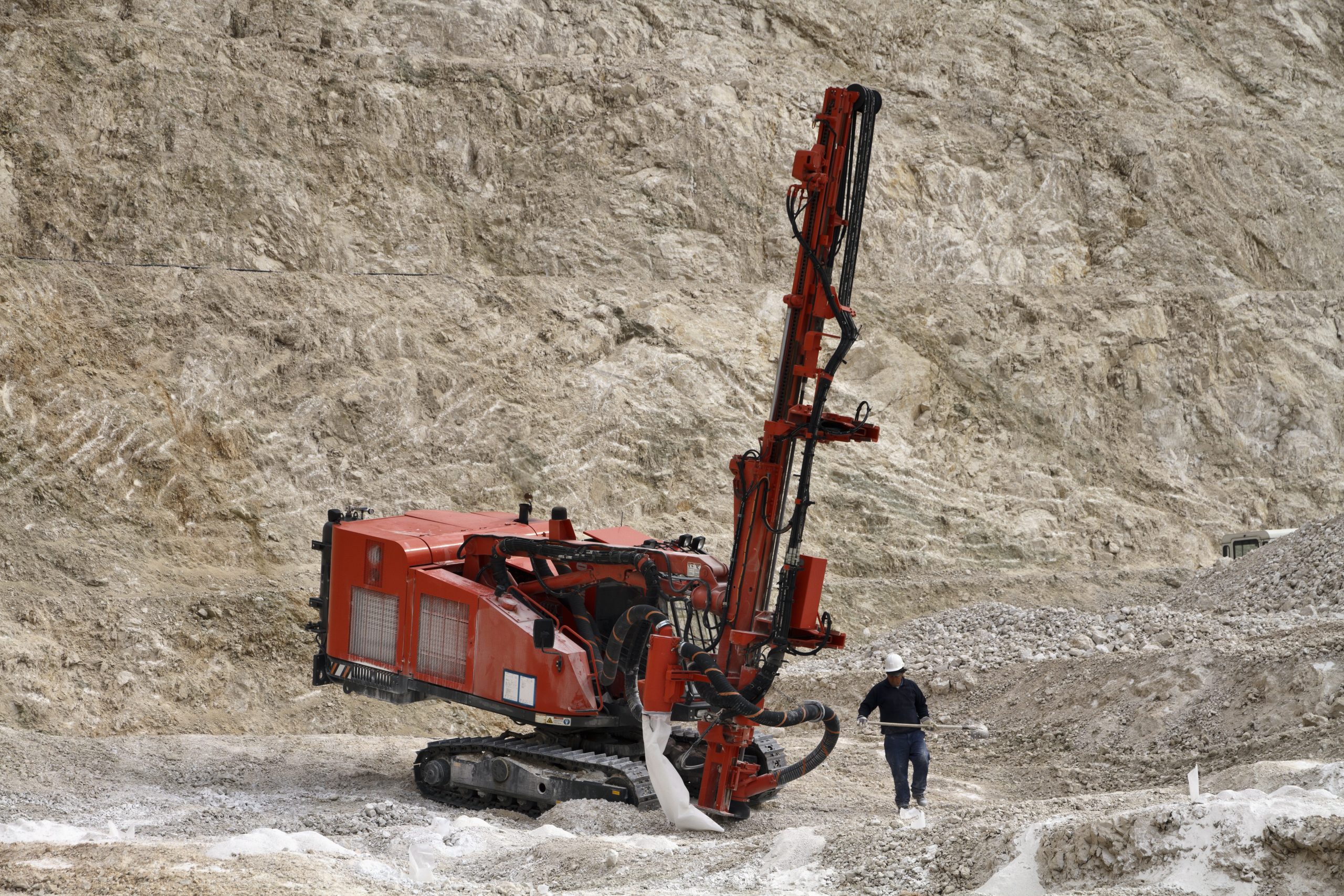
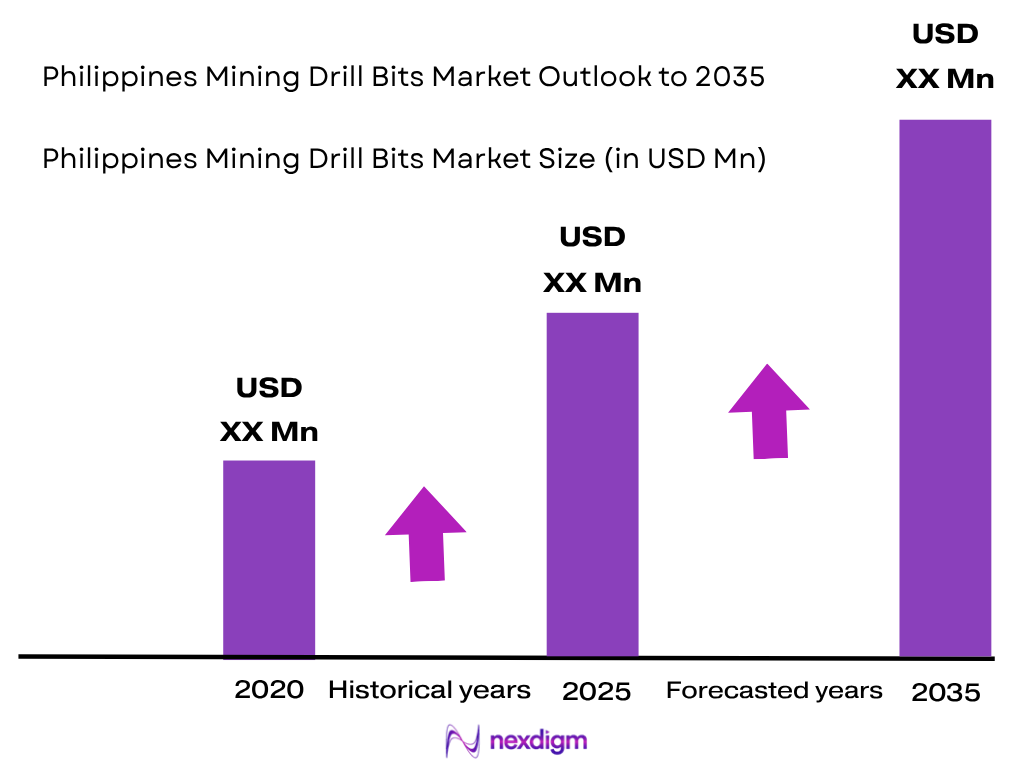
The Philippines Mining Drill Bits Market is estimated at ~USD ~ million in 2024, with a projected ~% CAGR during 2026–2035. Demand is closely linked to the country’s active metallic-mining base, exploration activity, drilling intensity, and replacement requirements. The Mines and Geosciences Bureau reported 58 operating metallic mines, including 36 nickel, 11 gold, 3 copper, 4 chromite and 4 iron mines, while metallic-mineral production value reached PHP 252.90 billion, compared with PHP 249.71 billion in the preceding reporting period.
Mining-drill-bit demand is concentrated around established mineral-producing areas, particularly Caraga, MIMAROPA, Northern Mindanao, Cordillera, and parts of the Davao and Zamboanga regions. Caraga is particularly relevant because of its extensive nickel-mining activity, while Cordillera has an established gold and copper mining ecosystem. The country’s mineral industry employed 291,672 workers, and mineral exports reached USD 7.38 billion, supported by gold, nickel and nickel products, and copper. The concentration of operating mines, exploration contractors, and mineral-processing infrastructure creates recurring requirements for DTH, diamond-core, rotary and other drilling consumables.
Market Segmentation
By Drill Bit Type
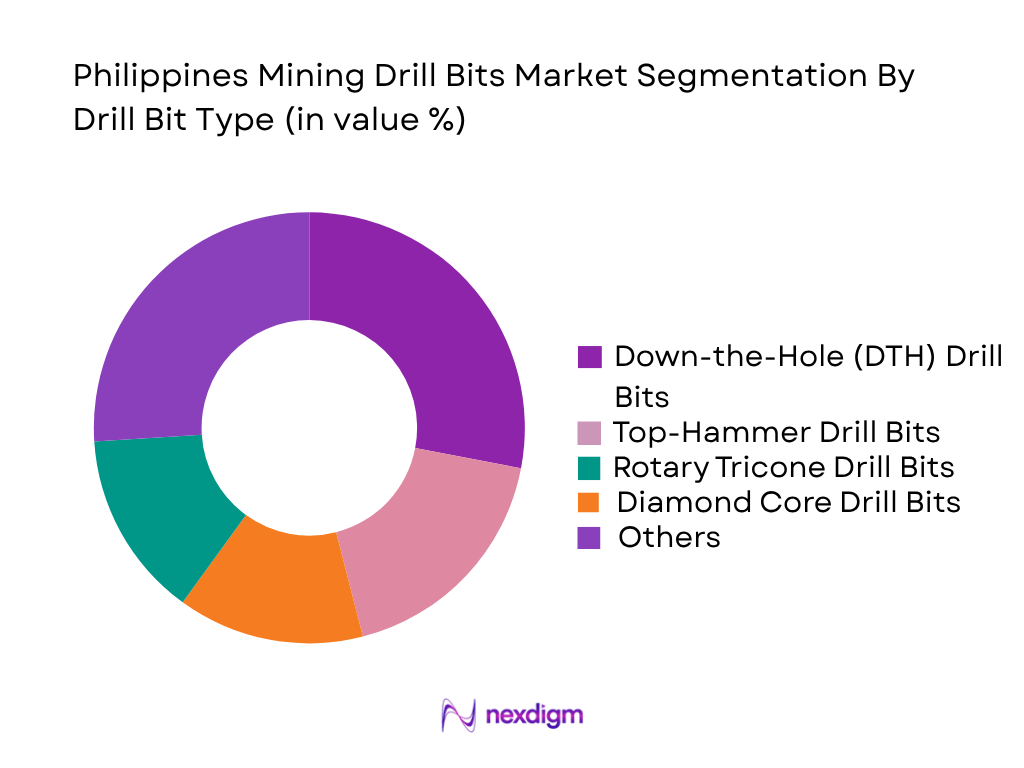
The Philippines Mining Drill Bits Market is segmented by drill bit type into Down-the-Hole (DTH) drill bits, tricone drill bits, rotary drill bits, diamond core drill bits, PDC drill bits, carbide button bits, roller-cone drill bits, reverse-circulation drill bits, top-hammer drill bits and drag bits. DTH drill bits represent the leading segment in the market model because surface mining, blast-hole drilling, quarrying and hard-rock applications require controlled penetration, hole accuracy and efficient flushing. Their relevance is reinforced by the Philippines’ operating metallic-mining base, which includes 36 nickel mines, 11 gold mines, 3 copper mines, 4 chromite mines and 4 iron mines. Diamond-core bits remain critical for exploration because mineral-resource definition requires continuous core recovery and geological characterization. Tricone and rotary bits serve production and larger-diameter drilling requirements, while RC tooling supports exploration programs. Bit selection is consequently influenced by formation hardness, drilling depth, hole diameter, penetration rate, flushing conditions, wear resistance and rig compatibility.
By Mining Application
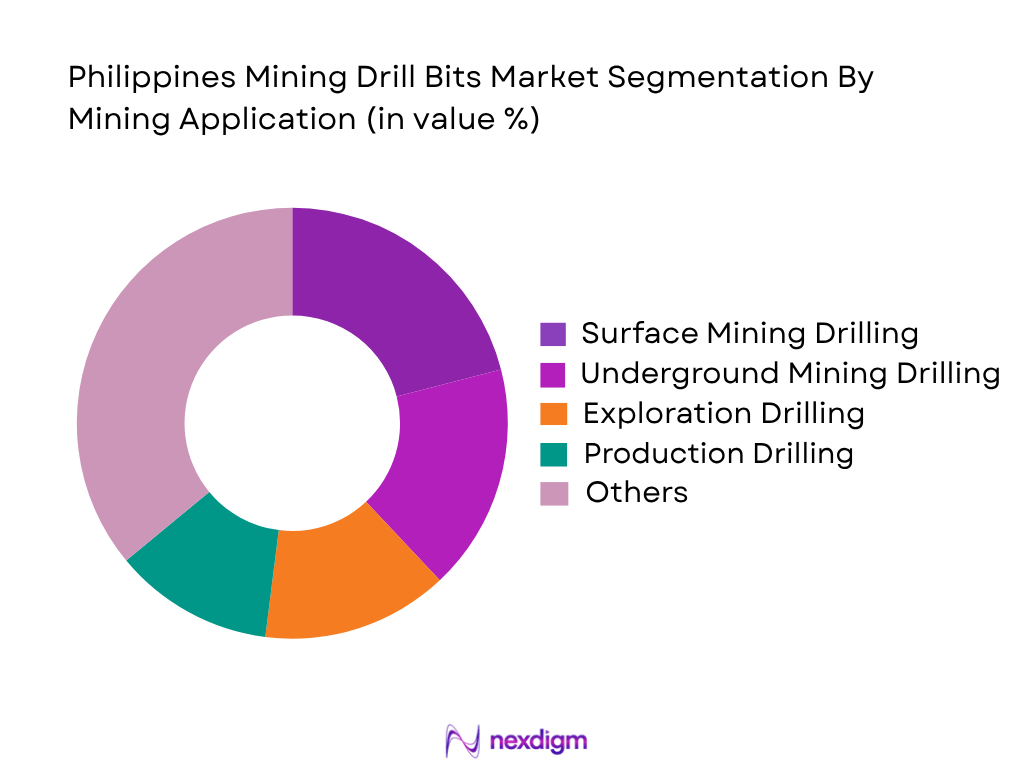
The Philippines Mining Drill Bits Market is segmented by mining application into surface mining drilling, underground mining drilling, exploration drilling, production drilling, blasting drilling, grade-control drilling, resource-definition drilling, mine-development drilling, quarry drilling and geotechnical and geological drilling. Exploration drilling is a major demand area because the country maintains a substantial pipeline of mineral agreements, exploration permits and resource-definition activities. Production and blasting drilling generate recurring consumable requirements at operating mines, particularly across nickel, gold, copper and chromite operations. The scale of the underlying industry is demonstrated by 58 operating metallic mines and 59 operating non-metallic mines, alongside 813 exploration-permit applications under process in the latest MGB statistics. Metallic-mineral production included 33.43 million DMT of nickel direct-shipping ore, 256,769 DMT of copper concentrate and 28,870 kg of gold, creating a substantial operational base for drilling-related consumables.
Competitive Landscape
The Philippines Mining Drill Bits Market comprises international drilling-tool manufacturers, mining-equipment suppliers and specialized drilling-technology companies serving mining operators through direct sales, distributors, contractors and aftermarket networks. Competition is shaped by DTH and rotary technology coverage, diamond-core capability, drill-rig compatibility, bit durability, technical support and product availability. Companies with established relationships across mining equipment, exploration drilling and consumables can address both recurring production requirements and project-based exploration demand.
| Major Player | Establishment | Headquarters | DTH Capability | Diamond Core Capability | Tricone/Rotary Capability | Aftermarket Support | Mining Application Coverage | Philippines Presence |
| Epiroc AB | 1873 | Stockholm, Sweden | ~ | ~ | ~ | ~ | ~ | ~ |
| Sandvik AB | 1862 | Stockholm, Sweden | ~ | ~ | ~ | ~ | ~ | ~ |
| Caterpillar Inc. | 1925 | Irving, Texas, USA | ~ | ~ | ~ | ~ | ~ | ~ |
| Boart Longyear | 1890 | Salt Lake City, Utah, USA | ~ | ~ | ~ | ~ | ~ | ~ |
| Mincon Group plc | 1977 | Shannon, Ireland | ~ | ~ | ~ | ~ | ~ | ~ |
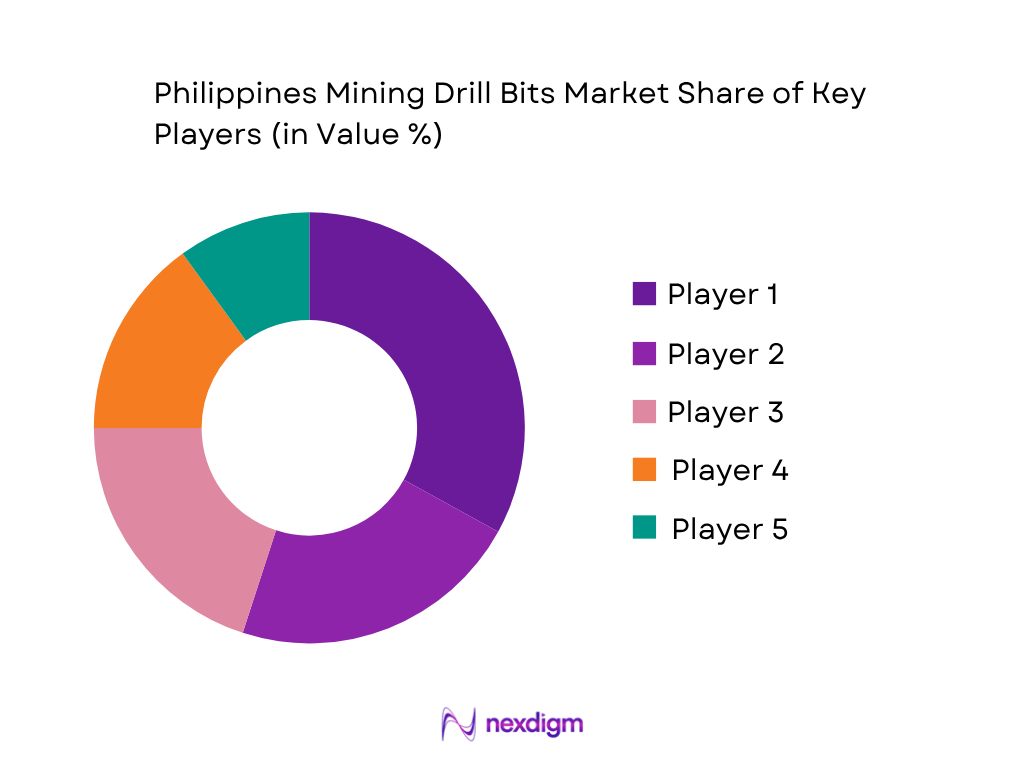
Philippines Mining Drill Bits Market Analysis
Growth Drivers
Expansion of Nickel Mining and Mineral Production
The Philippines Mining Drill Bits Market is supported by the country’s substantial nickel-mining activity, with nickel remaining one of the principal sources of drilling demand for surface extraction, grade control, blast-hole preparation and mine development. The country recorded 33.43 million dry metric tons of nickel direct-shipping ore in 2024, compared with 35.48 million dry metric tons in 2023. Nickel content of ore reached 354,132 metric tons in 2024, while mixed nickel-cobalt sulfide production reached 71,801 dry metric tons. The broader mining and quarrying industry generated PHP 234.17 billion in gross value added at current prices in 2024, compared with PHP 232.17 billion in 2023. The sector therefore provides a sizeable operating base for drilling-equipment and consumables demand. Nickel mines require repeated drilling activity for production development, blasting, bench preparation and geological control, creating recurring requirements for DTH, rotary, carbide-button and other hard-rock drill bits. The concentration of nickel operations in mineral-rich areas also supports demand from drilling contractors that service multiple mine sites. Continued activity across nickel extraction and associated mineral processing should therefore sustain requirements for durable drilling tools capable of handling abrasive formations and high-volume drilling cycles.
Gold and Copper Mining Activity Supporting Specialized Drilling
Gold and copper mining provide another important demand base for the Philippines Mining Drill Bits Market because these commodities require both exploration drilling and production-oriented drilling. Gold production reached 28,870 kilograms in 2024, while copper-concentrate output reached 256,769 dry metric tons. The corresponding 2023 production levels were 31,046 kilograms of gold and 266,532 dry metric tons of copper concentrate. The return of the Toledo Copper Operations to production also strengthened the country’s copper-mining activity, with the operation contributing approximately 79,914 dry metric tons of copper and 382 kilograms of gold during the first three quarters of 2024. These activities require diamond-core drilling for geological characterization, reverse-circulation drilling for exploration and DTH or rotary tooling for production and blasting applications. The country’s mining and quarrying gross value added reached PHP 157.27 billion at constant 2018 prices in 2024, compared with PHP 155.25 billion in 2023. The combination of exploration requirements and operating mine production creates demand across several drill-bit categories rather than relying on a single drilling technology. Gold and copper operations also require accurate grade-control and resource-definition drilling, increasing the importance of penetration consistency, core recovery, bit durability and compatibility with specialized exploration rigs.
Market Challenges
Dependence on Imported Drilling Equipment and Specialized Technologies
Dependence on imported drilling equipment represents a structural challenge for the Philippines Mining Drill Bits Market because advanced DTH, diamond-core, tricone, PDC and reverse-circulation products are largely supplied through international manufacturers and regional distribution networks. The country’s mining and quarrying sector generated PHP 234.17 billion in current-price gross value added in 2024, creating substantial underlying industrial activity but also requiring specialized equipment to support geographically dispersed mining operations. Metallic-mineral production included 33.43 million dry metric tons of nickel ore, 256,769 dry metric tons of copper concentrate and 28,870 kilograms of gold during the same period. Remote mining locations can make the availability of replacement tooling particularly important because drilling interruptions can affect production schedules and contractor utilization. Specialized drill bits also require appropriate shank configurations, carbide grades, flushing arrangements and rig compatibility, which limits the ability of operators to substitute products without technical evaluation. The challenge is consequently not limited to product procurement; it also encompasses technical servicing, inventory planning, product selection and replacement management. For mining contractors operating across multiple geological environments, maintaining appropriate bit inventories can become more complex when different rigs and drilling applications require different tooling configurations.
Geological Variability and Operational Requirements Across Mining Regions
Geological variability creates a significant operational challenge for the Philippines Mining Drill Bits Market because drilling conditions differ substantially between nickel, gold, copper, chromite, iron and quarrying operations. Official production data recorded 127,613 dry metric tons of chromite and 130,161 dry metric tons of iron ore in 2024, alongside 33.43 million dry metric tons of nickel direct-shipping ore. Such differences in mineralization, rock hardness, abrasiveness, fracture characteristics and moisture conditions require operators to select drill bits according to formation and drilling method. A bit optimized for one application may not deliver comparable penetration or service life in another formation. The challenge is compounded by the need for production drilling, blasting, exploration, grade control and resource-definition drilling across different mine sites. The national mining and quarrying industry recorded PHP 157.27 billion in gross value added at constant 2018 prices in 2024, demonstrating the scale of the sector that must manage these operating conditions. Drill-bit performance is therefore closely connected with flushing efficiency, penetration rate, button configuration, carbide grade, gauge protection and wear characteristics. Mining contractors must continuously balance drilling productivity against premature wear, bit replacement frequency and equipment compatibility, making technical selection and field-level support important components of the purchasing process.
Market Opportunities
Expansion of Mineral Exploration and Resource-Definition Drilling
Expansion of mineral exploration creates an opportunity for the Philippines Mining Drill Bits Market because exploration programs require specialized tooling throughout target generation, resource definition and feasibility-stage drilling. The country’s established production base includes 28,870 kilograms of gold, 256,769 dry metric tons of copper concentrate and 33.43 million dry metric tons of nickel direct-shipping ore, demonstrating the breadth of commodities for which additional geological investigation can support future mine development. Exploration-oriented activity creates demand for diamond-core bits, reverse-circulation tooling, DTH systems and specialized drilling accessories depending on the geological objective. Gold and copper exploration generally places particular emphasis on core recovery and geological information, while nickel exploration can require drilling across extensive lateritic and ultramafic formations. The mining and quarrying sector generated PHP 234.17 billion in current-price gross value added in 2024, providing an established industrial ecosystem of mine operators, contractors and equipment-service providers. Opportunities therefore extend beyond initial drill-bit sales into reaming tools, drilling accessories, refurbishment, technical support and replacement programs. Suppliers capable of matching bit designs to Philippine geological conditions can address the requirements of both established mines and exploration-stage projects. Increasing resource-definition activity can consequently broaden demand for specialized, high-durability drilling consumables.
Development of High-Performance and Productivity-Oriented Drill-Bit Solutions
The Philippines Mining Drill Bits Market presents opportunities for higher-performance drilling technologies that improve penetration, durability and drilling productivity across nickel, gold, copper, chromite and other mineral operations. The country produced 54,073 kilograms of silver, 127,613 dry metric tons of chromite and 130,161 dry metric tons of iron ore in 2024 in addition to its larger nickel, gold and copper production base. The diversity of mineral commodities creates different drilling requirements and supports demand for application-specific tooling rather than standardized products. Mining and quarrying gross value added at constant 2018 prices reached PHP 157.27 billion in 2024, while the wider industry sector generated PHP 6.47 trillion of gross value added, indicating a substantial industrial environment in which productivity-enhancing equipment can be deployed. Opportunities include optimized carbide-button configurations, advanced DTH designs, improved diamond-impregnated core bits, high-performance tricone tooling and drill-bit monitoring systems. Digital tracking of meterage, penetration performance and wear can further help contractors determine replacement timing and improve drilling efficiency. Suppliers that combine drilling tools with technical field support, bit selection services and performance monitoring can address operational requirements beyond the initial consumable transaction, creating opportunities for recurring aftermarket demand across Philippine mining operations.
Future Outlook
Over the forecast period, the Philippines Mining Drill Bits Market is expected to be influenced by continued mineral exploration, nickel-resource development, gold and copper mining, quarrying and replacement demand from operating drilling fleets. The country’s existing mining base provides a recurring consumption platform, while exploration permits and mineral-development projects create additional drilling requirements. Technology adoption is expected to increasingly focus on penetration performance, extended bit life, drilling productivity, digital monitoring and application-specific bit designs. Demand should remain differentiated by mineral type, formation characteristics, drilling method and mine-development stage.
Major Players
- Epiroc AB
- Sandvik AB
- Caterpillar Inc.
- Boart Longyear
- Mincon Group plc
- Furukawa Rock Drill Co., Ltd.
- Komatsu Ltd.
- Robit Plc
- Rockmore International
- Halco Rock Tools
- Mitsubishi Materials Corporation
- Kennametal Inc.
- Center Rock Inc.
- Drill King International L.P.
- Sai Deepa Rock Drilling Tools
Key Target Audience
- Mining Companies and Mine Operators
- Mineral Exploration and Drilling Contractors
- Mining Equipment and Drill-Bit Distributors
- Mining Equipment Manufacturers and OEMs
- Investments and Venture Capitalist Firms
- Government and Regulatory Bodies (Department of Environment and Natural Resources – Mines and Geosciences Bureau, Department of Energy)
- Mineral Processing and Mining Services Companies
- Quarrying and Construction-Materials Producers
Research Methodology
Step 1: Identification of Key Variables
The initial phase involves mapping the Philippine mining-drilling ecosystem across mining companies, exploration contractors, drilling contractors, equipment distributors and drill-bit suppliers. Variables include operating mines, mineral commodities, drilling methods, rig types, drilling meterage, bit consumption, replacement frequency, geological conditions and exploration activity. MGB mining statistics and official mineral-production datasets are used to establish the underlying industry structure.
Step 2: Market Analysis and Construction
Historical market construction combines mining production, exploration activity, operating-mine counts, drilling requirements and drill-bit replacement patterns. The analysis separates consumption associated with exploration, production, blasting, grade control and quarrying. Bottom-up calculations are developed from mine-level requirements and drilling applications, while top-down validation uses the Philippine mining industry’s production and activity indicators.
Step 3: Hypothesis Validation and Expert Consultation
Market hypotheses are validated through discussions with mining operators, drilling contractors, equipment distributors and technical personnel. Interviews focus on DTH versus rotary requirements, diamond-core consumption, bit-life expectations, formation-specific tooling, rig compatibility, replacement intervals and procurement practices. These inputs are used to validate assumptions concerning product mix, application mix and supplier positioning.
Step 4: Research Synthesis and Final Output
The final research stage integrates official mining statistics, mineral-production information, exploration activity and industry-level supply analysis. Company-level assessments are used to evaluate technology coverage, distribution capability, aftermarket support and mining application exposure. The resulting market model is triangulated across product type, drilling method, application, mineral commodity, customer type and geographic concentration.

- Executive Summary
- Research Methodology (Market Definition and Scope, Philippines Mining Drill Bits Market Classification, Drill Bit Technology Mapping, Rock Formation Assessment, Down-the-Hole (DTH) Drill Bit Evaluation, Tricone Drill Bit Assessment, Rotary Drill Bit Analysis, Diamond Core Drill Bit Evaluation, PDC Drill Bit Assessment, Carbide Button Bit Analysis, Roller-Cone Drill Bit Evaluation, Reverse-Circulation Drill Bit Assessment, Top-Hammer Drill Bit Evaluation, Drill String Compatibility Analysis, Tungsten-Carbide Grade Assessment, Drill Bit Material Evaluation, Penetration Rate Assessment, Bit Life and Wear Analysis, Drilling Meterage Assessment, Exploration Drilling Evaluation, Production Drilling Assessment, Blasting Drilling Analysis, Quarry Drilling Assessment, Mining Contractor Demand Assessment, Import Dependency Assessment, Supply-Side Assessment, Demand-Side Assessment, Primary Industry Interviews, Data Triangulation, Forecasting Framework)

- Definition and Scope
- Philippines Mining Drill Bits Industry Evolution and Development of Mineral Exploration, Nickel Mining Expansion, Gold Mining Development, Copper Mining Expansion, Chromite Mining Activity, Surface Mining Development, Quarrying Expansion, Exploration Drilling Development, Production Drilling Advancement, Mining Contractor Ecosystem Development, Imported Drilling Consumables Adoption, Mining Equipment Modernization
- Mining Drill Bits Value Chain Analysis
- Mining Drill Bits Supply Chain Analysis
- Tungsten-Carbide Material Suppliers, Steel and Alloy Suppliers, Drill Bit Manufacturers, DTH Tool Manufacturers, Tricone Bit Manufacturers, Diamond Core Tooling Suppliers, Drilling Rig Manufacturers, Mining Equipment Distributors, Mining Equipment Dealers, Exploration Drilling Contractors, Production Drilling Contractors, Mining Companies, Quarry Operators, Aftermarket Service Providers

- Growth Drivers (Expansion of Nickel Mining, Mineral Exploration Activity, Gold and Copper Mine Development, Growth of Mining Investments, Increasing Drilling Requirements, Expansion of Surface Mining, Development of New Mineral Projects, Growth of Quarrying Activity)
- Market Challenges (Dependence on Imported Drill Bits, Remote Mine Locations, Complex Geological Formations, High Drill Bit Wear, Replacement Lead-Time Constraints, Specialized Technical Expertise Requirements, Equipment Compatibility Issues, Mining Permit Dependencies, Supply-Chain Disruptions, Environmental Compliance Requirements)
- Market Opportunities (Expansion of Mineral Exploration Programs, Nickel Resource Development, Gold and Copper Exploration, Advanced DTH Technologies, High-Performance Diamond Core Bits, Automated Drilling Systems, Digital Drill-Bit Performance Monitoring, Local Distribution and Inventory Hubs, Advanced Carbide Technologies, Expansion of Mining Contractor Services)
- Market Trends (Increasing DTH Adoption, Growth of Exploration Drilling, Advanced Diamond Core Tooling, Digital Drilling Optimization, Automated Drilling Equipment, Extended Bit-Life Technologies, Condition-Based Bit Replacement, High-Penetration Drill Bit Designs, Integrated Drill-Rig and Bit Systems, Increasing Demand for Specialized Exploration Tools)
- Government Regulations and Standards (Philippine Mining Act, DENR-MGB Mining Regulations, Mineral Exploration Permit Requirements, Mineral Agreements, Environmental Compliance Certificate Requirements, Mine Safety and Health Standards, Explosives and Blasting Regulations, Mineral Processing and Environmental Regulations, Import and Customs Requirements, Mine Rehabilitation and Closure Requirements)
- SWOT Analysis
- Porter’s Five Forces Analysis
- PESTLE Analysis
- Stakeholder Ecosystem
- Competition Ecosystem

- By Market Value (2020-2025)
- By Volume Consumption (2020-2025)
- By Average Selling Price (2020-2025)
- By Drill Bit Consumption Volume (2020-2025)
- By DTH Drill Bit Consumption Volume (2020-2025)
- By Tricone Drill Bit Consumption Volume (2020-2025)
- By Diamond Core Drill Bit Consumption Volume (2020-2025)
- By Rotary Drill Bit Consumption Volume (2020-2025)
- By Exploration Drilling Consumption Volume (2020-2025)
- By Production and Blasting Drilling Consumption Volume (2020-2025)

- By Drill Bit Type (In Value %)
Down-the-Hole (DTH) Drill Bits
Tricone Drill Bits
Rotary Drill Bits
Diamond Core Drill Bits
PDC Drill Bits
Carbide Button Bits
Roller-Cone Drill Bits
Reverse-Circulation Drill Bits
Top-Hammer Drill Bits
Drag Bits - By Drilling Method (In Value %)
DTH Drilling
Rotary Drilling
Rotary-Blasthole Drilling
Top-Hammer Drilling
Diamond Core Drilling
Reverse-Circulation Drilling
Air-Core Drilling
Percussion Drilling - By Mining Application (In Value %)
Surface Mining Drilling
Underground Mining Drilling
Exploration Drilling
Production Drilling
Blasting Drilling
Grade-Control Drilling
Resource-Definition Drilling
Mine-Development Drilling
Quarry Drilling
Geotechnical and Geological Drilling - By Mineral Commodity (In Value %)
Nickel Mining
Gold Mining
Copper Mining
Chromite Mining
Iron Ore Mining
Coal Mining
Limestone and Cement Minerals
Aggregates and Quarry Minerals
Industrial Minerals
Other Metallic Minerals - By End-User Type (In Value %)
Mining Companies
Mineral Exploration Companies
Mining Drilling Contractors
Quarrying Companies
Construction Material Producers
Government-Owned Mining Enterprises
Private Mining Operators
Geological Survey and Exploration Contractors
Small-Scale Mining Operators
Industrial Mineral Producers - By Region (In Value %)
Caraga
MIMAROPA
Northern Mindanao
Davao Region
Cordillera Administrative Region
Cagayan Valley
Central Luzon
Western Visayas
Eastern Visayas
Zamboanga Peninsula

- Market Share of Major Players (By Philippines Revenue, Drill Bit Product Portfolio, DTH Technology Coverage, Rotary Drilling Capability, Diamond Core Tooling Coverage, Mining Application Coverage, Exploration Drilling Capability, Production Drilling Capability, Manufacturing Capacity, Distribution Network, Aftermarket Service Coverage, Technical Support Capability, Mining Contractor Relationships, Regional Presence)
- Cross Comparison Parameters (Drill Bit Portfolio Breadth, DTH Bit Technology Capability, Tricone and Roller-Cone Technology Coverage, Diamond Core Bit Capability, Hard-Rock Drilling Performance, Exploration Tooling Capability, Aftermarket and Technical Service Reach, Philippines Mining Customer Coverage)
- SWOT Analysis of Major Players
- Competitive Positioning Matrix
- Drill Bit Technology and Mining Application Benchmarking
- DTH and Rotary Drilling Technology Assessment
- Exploration and Diamond Core Drilling Technology Assessment
- Nickel, Gold, Copper and Chromite Drilling Application Assessment
- Drill Bit Wear, Penetration and Productivity Assessment
- Mining Contractor and Aftermarket Service Ecosystem Assessment
- Detailed Profiles of Major Companies
Epiroc Philippines
Sandvik Mining and Rock Solutions Philippines
Caterpillar Philippines
Boart Longyear
Mincon Group plc
Furukawa Rock Drill Co., Ltd.
Komatsu Philippines
Robit Plc
Rockmore International
Halco Rock Tools
Mitsubishi Materials Corporation
Kennametal Inc.
Center Rock Inc.
Drill King International L.P.
Sai Deepa Rock Drilling Tools

- Nickel Mining Drilling Requirement Assessment
- Gold Mining Drilling Demand Analysis
- Copper Mining Drilling Requirement Assessment
- Chromite Mining Drilling Application Evaluation
- Mineral Exploration Contractor Demand Analysis
- Underground Mining Drilling Requirement Assessment
- Surface Mining and Blasting Requirement Analysis
- Quarry Drilling Demand Assessment
- Grade-Control Drilling Requirement Evaluation
- Resource-Definition Drilling Assessment
- Mining Equipment Distributor Procurement Analysis
- Drill Bit Replacement and Aftermarket Demand Assessment
- Drill Bit Performance and Bit-Life Preference Analysis
- Technical Service and Field-Support Requirement Assessment

- By Market Value (2026-2035)
- By Volume Consumption (2026-2035)
- By Average Selling Price (2026-2035)
- By Drill Bit Consumption Volume (2026-2035)
- By DTH Drill Bit Consumption Volume (2026-2035)
- By Tricone Drill Bit Consumption Volume (2026-2035)
- By Diamond Core Drill Bit Consumption Volume (2026-2035)
- By Rotary Drill Bit Consumption Volume (2026-2035)
- By Exploration Drilling Consumption Volume (2026-2035)
- By Production and Blasting Drilling Consumption Volume (2026-2035)


 Request a Sample
 Ask for Customization
 Get a Quote
 Enquire Now