
 Download PDF
 Download PDF
Market Overview
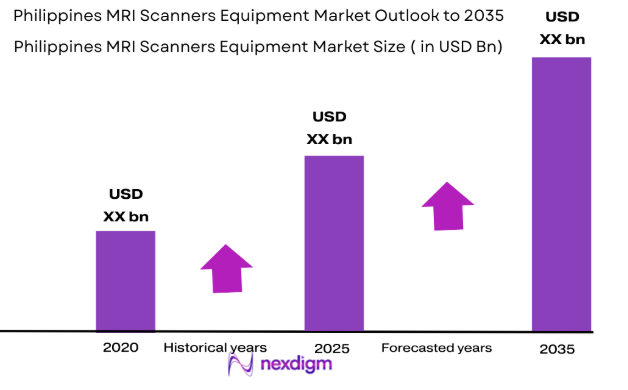
The Philippines MRI scanners equipment market is currently valued at approximately USD ~ million based on a recent historical assessment. Driven by advancements in diagnostic imaging technology, the market has seen steady growth, with increasing demand from hospitals, diagnostic centers, and academic research institutes. The healthcare sector’s expansion and rising adoption of non-invasive diagnostic tools are primary contributors to market growth. The high demand for advanced imaging solutions further boosts MRI scanner sales, fostering growth in both urban and rural regions across the Philippines.
Key cities such as Metro Manila and Cebu dominate the market due to their high population density, advanced healthcare infrastructure, and a concentration of medical research centers. Metro Manila, in particular, is a hub for medical advancements, housing numerous private and public healthcare facilities equipped with state-of-the-art MRI technology. The government’s ongoing efforts to improve healthcare accessibility and infrastructure in major urban areas also contribute to the dominance of these regions. This concentrated demand is expected to continue, further solidifying the importance of these urban centers in the MRI scanner market.
Market Segmentation
By Product Type
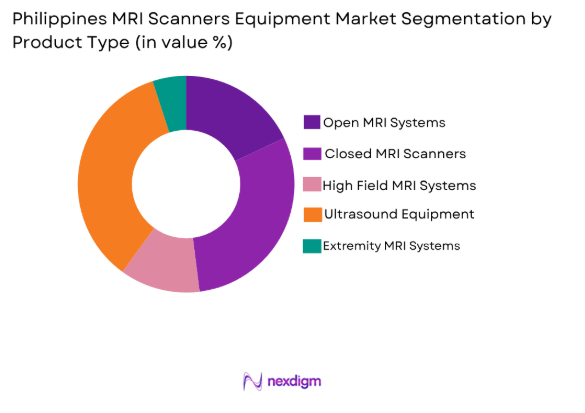
The Philippines MRI scanners equipment market is segmented by product type into Open MRI Systems, Closed MRI Systems, Low Field MRI Systems, High Field MRI Systems, and Extremity MRI Systems. Recently, High Field MRI Systems have a dominant market share due to factors such as their superior image resolution, faster scanning times, and the rising demand for high-precision diagnostics. These systems are favored in both large healthcare facilities and specialized diagnostic centers that prioritize patient care and operational efficiency.
By Platform Type
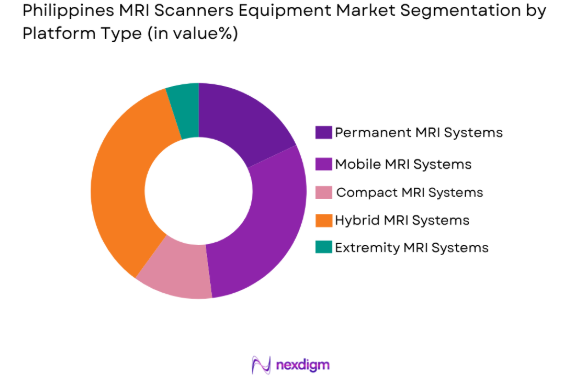
The Philippines MRI scanners equipment market is segmented by platform type into Permanent MRI Systems, Mobile MRI Systems, Compact MRI Systems, Hybrid MRI Systems, and Extremity MRI Systems. Recently, Permanent MRI Systems have a dominant market share due to their superior image quality, operational reliability, and extended durability, making them ideal for large healthcare facilities with high patient volumes. These systems are favored by hospitals and diagnostic imaging centers that prioritize long-term performance. While Mobile MRI Systems offer flexibility and are suitable for remote locations, they are less commonly used in larger hospitals due to higher operational costs and limitations in imaging capabilities compared to permanent systems.
Competitive Landscape
The competitive landscape of the Philippines MRI scanners equipment market is characterized by both global and local players, with major international companies consolidating their positions in the market. The presence of well-established players who provide technologically advanced MRI systems plays a significant role in the market dynamics. Additionally, local companies contribute by providing maintenance, service contracts, and localized support. The competition remains intense, with constant innovations and product offerings being tailored to meet the increasing demand for high-performance imaging solutions in the healthcare sector.
| Company Name | Establishment Year | Headquarters | Technology Focus | Market Reach | Key Products | Revenue | Additional Parameter |
| Philips Healthcare | 1891 | Amsterdam, Netherlands | ~ | ~ | ~ | ~ | ~ |
| Siemens Healthineers | 1847 | Erlangen, Germany | ~ | ~ | ~ | ~ | ~ |
| GE Healthcare | 1892 | Chicago, USA | ~ | ~ | ~ | ~ | ~ |
| Canon Medical Systems | 1937 | Tokyo, Japan | ~ | ~ | ~ | ~ | ~ |
| Hitachi Medical Systems | 1910 | Tokyo, Japan | ~ | ~ | ~ | ~ | ~ |
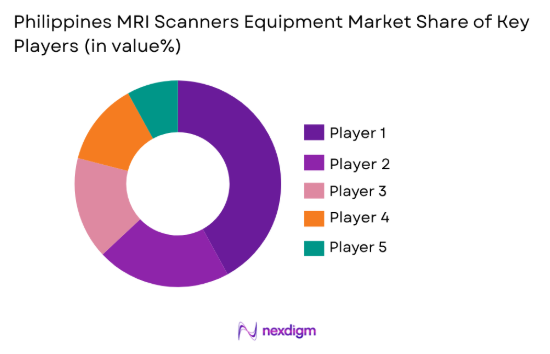
Philippines MRI Scanners Equipment Market Analysis
Growth Drivers
Technological Advancements in MRI Systems
Technological advancements in MRI systems are significantly driving the growth of the Philippines MRI scanners equipment market. Innovations such as the development of high-field MRI machines with superior image resolution, shorter scan times, and increased comfort for patients are attracting healthcare providers. The integration of artificial intelligence (AI) and machine learning (ML) into MRI systems is improving diagnostic accuracy and operational efficiency, offering better outcomes for both patients and healthcare providers. The advancements not only cater to the growing demand for high-quality diagnostic imaging but also enhance the overall effectiveness and accessibility of MRI scans in various healthcare settings. These innovations position the market for substantial growth over the next several years.
Increasing Healthcare Infrastructure Development
The continuous development of healthcare infrastructure in the Philippines is another growth driver for the MRI scanners equipment market. Government investments and initiatives aimed at improving healthcare access, especially in rural areas, are pushing the demand for advanced diagnostic equipment, including MRI scanners. Public and private sector collaborations, such as the establishment of new hospitals and healthcare centers, also contribute to the increasing adoption of MRI technology. Furthermore, the growing focus on healthcare quality, coupled with the rising number of medical tourists seeking advanced treatments in the Philippines, is accelerating the market growth.
Market Challenges
High Cost of MRI Systems
One of the major challenges faced by the Philippines MRI scanners equipment market is the high cost associated with acquiring MRI systems. These systems, particularly high-field MRI machines, can be prohibitively expensive for many healthcare facilities, particularly in rural areas where budgets are constrained. The installation and maintenance costs of MRI systems add another layer of financial burden, making it difficult for small and medium-sized healthcare providers to invest in such equipment. Although financial incentives and government schemes exist, the high upfront costs remain a barrier to widespread adoption.
Limited Skilled Workforce for MRI Systems
The shortage of skilled professionals trained to operate and maintain MRI scanners poses a significant challenge for the growth of the market. In many regions of the Philippines, there is a lack of adequately trained MRI technologists and radiologists, which hampers the effective use of MRI systems. This shortage can lead to operational inefficiencies, incorrect diagnoses, and increased downtime of MRI equipment, further exacerbating the challenges faced by healthcare providers in delivering timely and accurate diagnostics.
Opportunities
Government Support for Healthcare Expansion
The Philippine government’s continued focus on improving healthcare accessibility presents a significant opportunity for the MRI scanners equipment market. Various government initiatives and policies aimed at enhancing healthcare infrastructure, such as the Universal Health Care Act, are expected to drive the demand for advanced diagnostic equipment. This includes funding for healthcare facilities to acquire state-of-the-art MRI systems. Additionally, as more hospitals and diagnostic centers are built, the need for MRI scanners will grow, creating opportunities for companies operating in the market to expand their reach and offerings.
Increase in Medical Tourism
The Philippines is becoming a popular destination for medical tourism, particularly for treatments that require advanced diagnostic imaging. As the number of international patients seeking medical care in the country grows, there will be an increased demand for high-quality MRI systems. Medical tourists often seek comprehensive diagnostic services, including MRI scans, before undergoing treatment. This trend offers a significant opportunity for both local and international manufacturers of MRI systems to target medical institutions catering to foreign patients.
Future Outlook
The Philippines MRI scanners equipment market is expected to experience steady growth over the next five years. This growth will be driven by increasing healthcare investments, technological advancements in MRI systems, and the rising demand for high-quality diagnostic imaging. The government’s continued focus on improving healthcare infrastructure, combined with advancements such as AI integration in MRI machines, is expected to accelerate the market’s development. Additionally, as the Philippines becomes a hub for medical tourism, demand for MRI systems in both public and private healthcare facilities is set to rise, ensuring the market’s positive trajectory.
Major Players
- Philips Healthcare
- Siemens Healthineers
- GE Healthcare
- Canon Medical Systems
- Hitachi Medical Systems
- Fujifilm Medical Systems
- Samsung Medison
- Esaote S.p.A
- United Imaging Healthcare Co., Ltd.
- Neusoft Medical Systems Co., Ltd.
- Mindray Bio-Medical Electronics Co., Ltd.
- Toshiba Medical Systems Corporation
- Carestream Health
- Hologic, Inc.
- Shimadzu Corporation
Key Target Audience
- Investments and venture capitalist firms
- Government and regulatory bodies
- Healthcare providers and hospitals
- Diagnostic imaging centers
- Medical equipment distributors
- Hospitals’ purchasing departments
- Private healthcare clinics
Research Methodology
Step 1: Identification of Key Variables
Identification of critical market variables such as technology trends, regulatory requirements, and key drivers influencing demand.
Step 2: Market Analysis and Construction
Analysis of the MRI equipment market, including historical data, market segmentation, and growth potential.
Step 3: Hypothesis Validation and Expert Consultation
Engagement with industry experts to validate assumptions, review forecasts, and incorporate insights into the research framework.
Step 4: Research Synthesis and Final Output
Consolidation of data, analysis, and expert inputs into the final report, with actionable insights and market forecasts.

- Executive Summary
- Research Methodology (Definitions, Scope, Industry Assumptions, Market Sizing Approach, Primary & Secondary Research Framework, Data Collection & Verification Protocol, Analytic Models & Forecast Methodology, Limitations & Research Validity Checks)

- Market Definition and Scope
- Value Chain & Stakeholder Ecosystem
- Regulatory / Certification Landscape
- Sector Dynamics Affecting Demand
- Strategic Initiatives & Infrastructure Growth

- Growth Drivers
Increased Healthcare Spending
Technological Advancements in MRI Systems
Rising Prevalence of Chronic Diseases - Market Challenges
High Cost of MRI Systems
Limited Accessibility in Rural Areas
Lack of Skilled Professionals - Market Opportunities
Expansion of Healthcare Infrastructure
Government Initiatives to Improve Healthcare Access
Rising Demand for Non-invasive Diagnostic Solutions - Trends
Miniaturization of MRI Systems
Integration of AI and Machine Learning in MRI Systems - Government Regulations
- SWOT Analysis
- Porter’s Five Forces

- By Market Value, 2020-2025
- By Installed Units, 2020-2025
- By Average System Price, 2020-2025
- By System Complexity Tier, 2020-2025

- By System Type (In Value%)
Open MRI Systems
Closed MRI Systems
Low Field MRI Systems
High Field MRI Systems
Extremity MRI Systems - By Platform Type (In Value%)
Permanent MRI Systems
Mobile MRI Systems - By Fitment Type (In Value%)
Fixed MRI Systems
Portable MRI Systems - By End User Segment (In Value%)
Hospitals
Diagnostic Imaging Centers
Research and Academic Institutes

- Market Share Analysis
- Cross Comparison Parameters (System Type, Platform Type, End User, System Complexity, Fitment Type, Region, Price Tier)
- SWOT Analysis of Key Competitors
- Pricing & Procurement Analysis
- Key Players
Philippine MRI Solutions Inc.
Philips Healthcare
Siemens Healthineers
GE Healthcare
Canon Medical Systems
Hitachi Medical Systems
Fujifilm Medical Systems
Samsung Medison
Esaote S.p.A
United Imaging Healthcare Co., Ltd.
Neusoft Medical Systems Co., Ltd.
Mindray Bio-Medical Electronics Co., Ltd.
Toshiba Medical Systems Corporation
Carestream Health
Hologic, Inc.

- Hospitals and Clinics Demand
- Growth of Diagnostic Imaging Centers
- Research and Academic Institutes
- Adoption in Rural Healthcare Centers

- Forecast Market Value, 2026-2035
- Forecast Installed Units, 2026-2035
- Price Forecast by System Tier, 2026-2035
- Future Demand by Platform, 2026-2035


 Request a Sample
 Ask for Customization
 Get a Quote
 Enquire Now