

 Download PDF
Market Overview
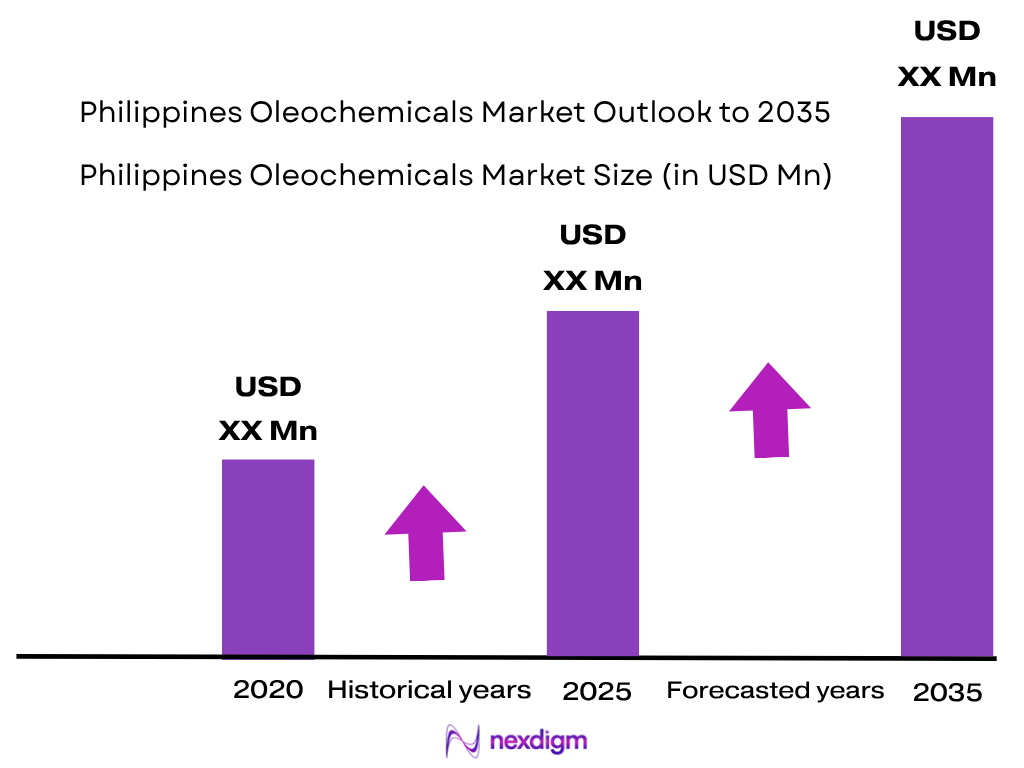
The Philippines oleochemicals market is valued at approximately USD ~XXX million for the requested base period, supported by its coconut-based feedstock advantage, downstream demand for fatty alcohols, fatty acids, glycerine, surfactants and coco methyl ester. Philippine oleochemical exports declined from 66,370 MT in the preceding full year to 59,522 MT in the latest full year, while coconut oil exports increased from 1,090,418 MT to 1,626,206 MT, demonstrating the scale and volatility of the underlying feedstock ecosystem. Metro Manila, CALABARZON—particularly Quezon, Lucena and Batangas—and Northern Mindanao are the principal oleochemical clusters because they combine processing assets, coconut-oil access, ports and downstream industrial infrastructure. PCA records historically identified 1,573,030 MT/year of national oleochemical capacity, while coconut oil exports expanded by more than 535,000 MT between the two latest annual observations. Jasaan hosts Pilipinas Kao, Lucena supports JNJ and Tantuco operations, while Batangas contains the established Cocochem/Sakamoto oleochemical industrial ecosystem.
Market Segmentation
By Product Type
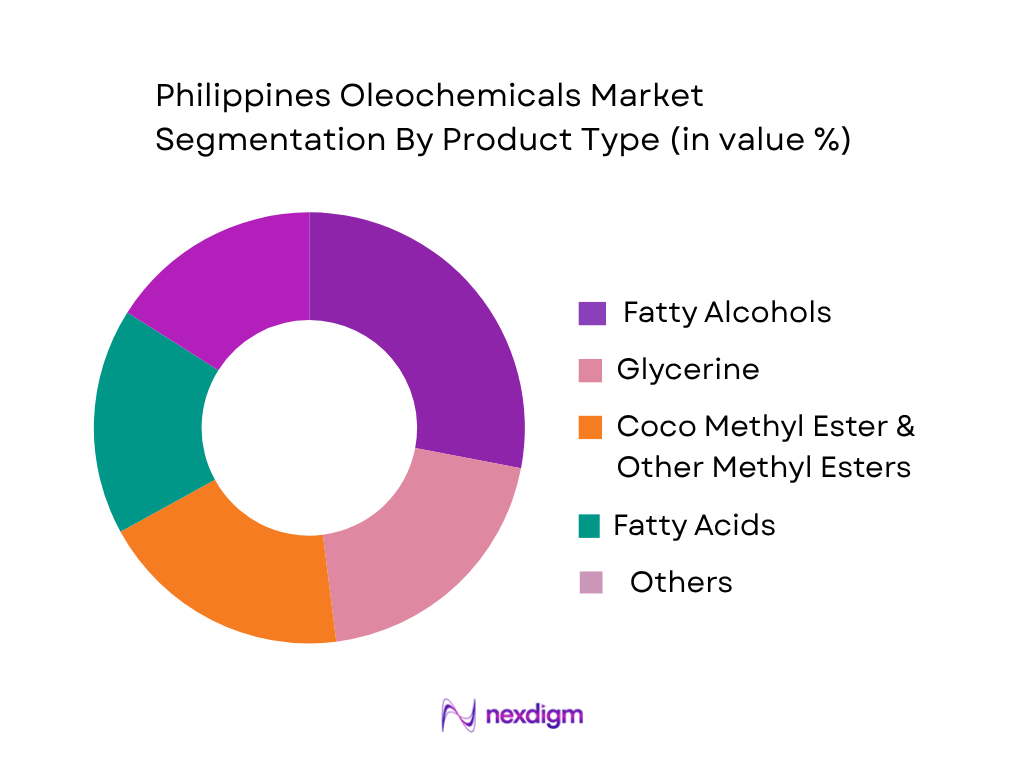
The Philippines Oleochemicals Market is segmented by product type into fatty alcohols, glycerine, coco methyl ester and other methyl esters, fatty acids, surfactants and specialty derivatives, and other oleochemicals. Fatty alcohols form one of the strategically dominant value pools because the Philippines has a structural advantage in lauric chemistry derived from coconut oil. These alcohols are important intermediates for detergents, shampoos, personal-care formulations and surfactants. Pilipinas Kao is an established domestic producer of high-grade coconut-derived chemicals, while the country’s wider processing ecosystem supports the conversion of coconut oil into higher-value derivatives rather than exporting only raw feedstock. PCA has specifically identified fatty alcohols among the important products manufactured by domestic oleochemical plants. The segment also benefits from export-oriented demand and from the increasing preference of international formulators for renewable plant-derived raw materials.
By Application
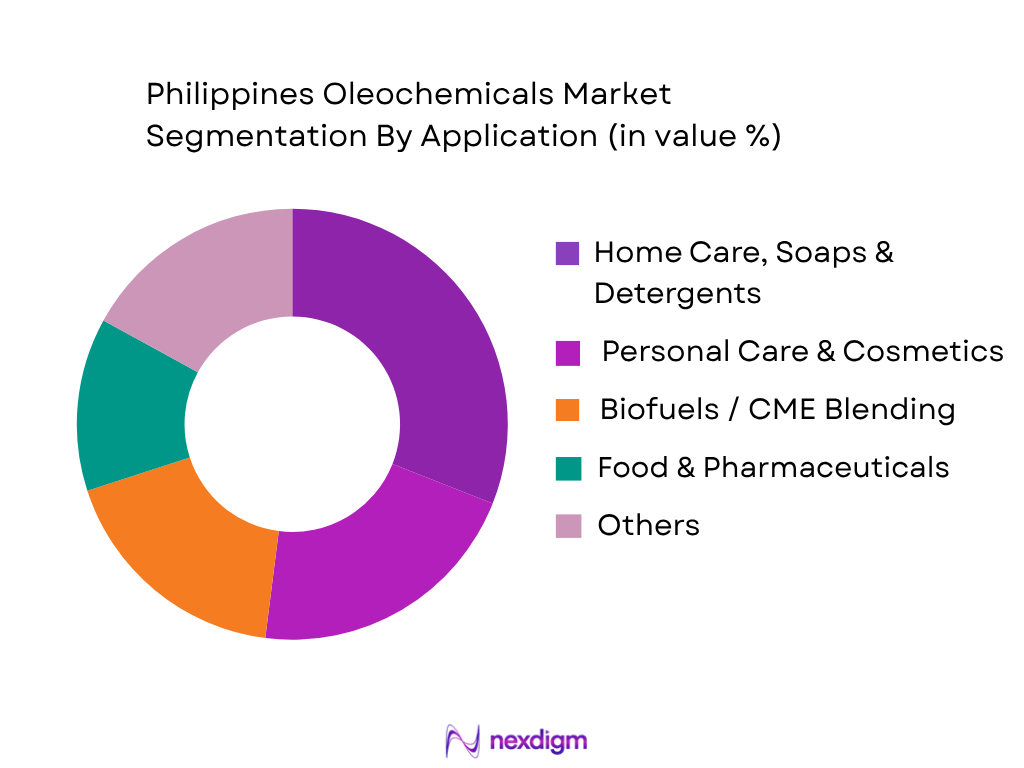
The Philippines Oleochemicals Market is segmented by application into home care and detergents, personal care and cosmetics, biofuels, food and pharmaceutical applications, industrial chemicals, and plastics, coatings and lubricants. Home care and detergents represent the dominant application pool because coconut-derived fatty alcohols, fatty acids, alkanolamides and surface-active agents are core ingredients in soap, laundry and household-cleaning formulations. PCA specifically notes strong demand for coco chemicals in soaps and detergents and highlights coconut-derived surfactants for their functional and biodegradable characteristics. Personal care provides an adjacent demand base through shampoos, moisturizers and cosmetics. Biofuel consumption has also become strategically more important as mandatory CME blending increases. Consequently, Philippine producers can address consumer-care, industrial and fuel demand from the same coconut-oil value chain, supporting plant utilization and diversification across multiple end markets.
Competitive Landscape
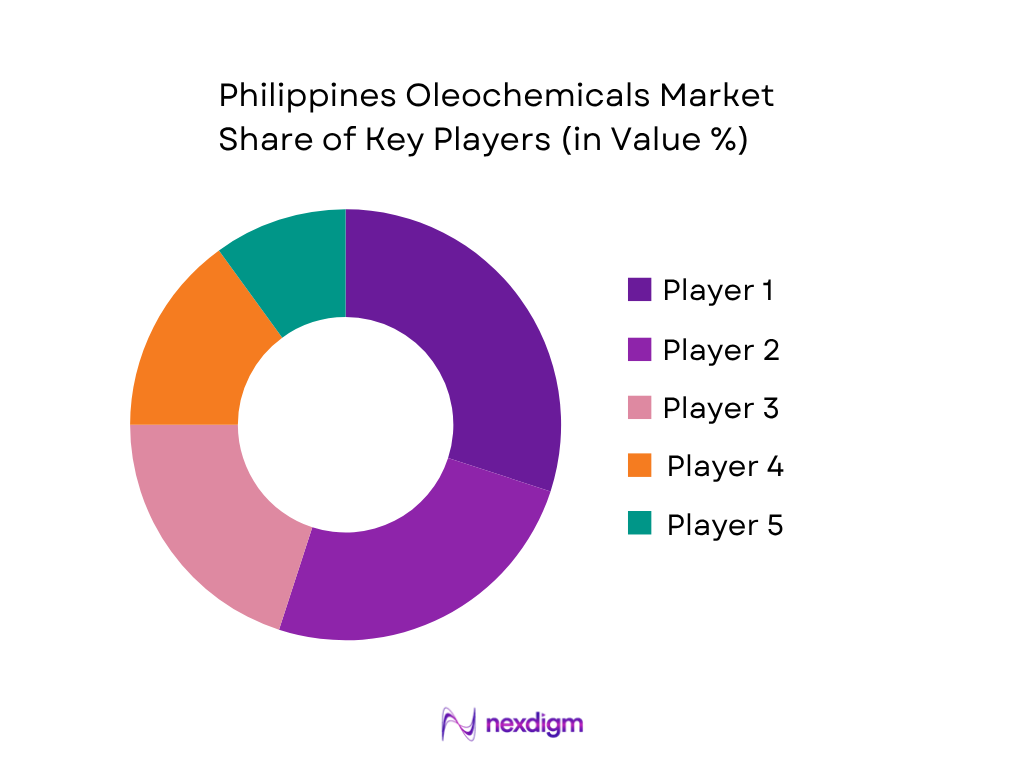
The Philippines oleochemicals competitive landscape combines large integrated coconut processors, specialized glycerine and fatty-alcohol manufacturers, CME producers and specialty chemical companies. The competitive structure is relatively concentrated around firms with reliable coconut-oil procurement, processing scale and export capabilities. PCA historically identified Chemrez Technologies as the largest domestic oleochemical plant and also cited Pilipinas Kao, Tantuco Enterprises, Philippine International Development and United Coconut Chemicals among significant manufacturers. POMA membership further demonstrates the role of Chemrez, JNJ, Pan Century, Sakamoto Orient and Cocochem in the industry ecosystem.
| Company | Establishment | Headquarters / Philippine Base | Core Oleochemicals | Feedstock Position | Manufacturing Location | Capacity Indicator | Downstream Exposure | Competitive Position |
| Chemrez Technologies, Inc. | 1989; oleochemical expansion in 2006 | Quezon City | ~ | ~ | ~ | ~ | ~ | ~ |
| Pilipinas Kao, Inc. | 1977 | Jasaan, Misamis Oriental | ~ | ~ | ~ | ~ | ~ | ~ |
| JNJ Oleochemicals, Inc. | Oleochemical business acquired in 2010 | Quezon/Lucena operations | ~ | ~ | ~ | ~ | ~ | ~ |
| Sakamoto Orient Chemicals Corp. | 1988; operations commenced around 1990 | Makati City | ~ | ~ | ~ | ~ | ~ | ~ |
| Tantuco Enterprises, Inc. | 1965 | Mandaluyong City | ~ | ~ | ~ | ~ |
Philippines Oleochemicals Market Analysis
Growth Driver
Strong Coconut Feedstock and Lauric-Oil Processing Base
The Philippines oleochemicals market is structurally supported by one of Asia’s largest coconut feedstock systems, providing domestic manufacturers with coconut oil for fatty alcohols, fatty acids, glycerine, surfactants, amides and other lauric derivatives. Philippine Statistics Authority data show national coconut-with-husk production of 6,421,634.11 metric tons during the first half of 2024. Major production centers provide substantial industrial feedstock availability: Davao Region produced 1,969,491.77 metric tons of coconut during 2024, Quezon produced 1,270,090.33 metric tons, and Zamboanga Peninsula recorded 1,819,935.58 metric tons. These production clusters connect directly with established coconut-oil mills, refineries and oleochemical facilities in Luzon and Mindanao, strengthening domestic raw-material access and supply-chain integration. The wider macroeconomic environment also supports downstream chemical demand: World Bank data place Philippine GDP at USD 461.67 billion in 2024, GDP per capita at USD 3,984.8, and population at 115,843,670, providing a sizeable manufacturing and consumption base for detergents, personal-care products and industrial formulations. This combination of agricultural scale and domestic demand gives Philippine producers a differentiated coconut-based position relative to palm-dominated regional competitors.
Expansion of Coco Methyl Ester and Bio-Based Chemical Demand
Coco methyl ester is an important demand driver because the Philippine biodiesel framework directly converts coconut oil into a regulated domestic oleochemical application. Department of Energy records show that the country had 13 accredited biodiesel production plants with 639.33 million liters of annual rated capacity as of February 2024, with coconut identified as the existing first-generation biodiesel feedstock. Facilities include Chemrez Technologies with 90 million liters, JNJ Oleochemicals with 63.3 million liters, Mt. Holly Coco Industrial with 60 million liters, Tantuco Enterprises with 90 million liters, and Bioenergy 8 with 30 million liters of annual capacity. The transition to the B3 biodiesel blend began in October 2024, strengthening the structural connection between transport-fuel consumption and domestic coconut-derived methyl ester production. This industrial demand operates within an economy that generated USD 461.67 billion of GDP in 2024, according to the World Bank, while the IMF recorded Philippine nominal economic output at approximately PHP 26,432 billion in its 2024 Article IV framework. A larger industrial economy, together with regulated CME utilization, supports plant throughput, glycerine co-production and broader development of renewable, coconut-derived chemical intermediates.
Market Challenge
Coconut Feedstock Volatility and Regional Production Disruptions
Feedstock availability remains a critical operating challenge because Philippine oleochemical plants depend heavily on agricultural coconut output that can fluctuate across major producing regions. Philippine Statistics Authority data show that Quezon, one of the country’s most important coconut-processing locations, produced 1,270,090.33 metric tons of coconut in 2024, down from 1,335,707.11 metric tons in 2023, a reduction of more than 65,600 metric tons. Davao Region produced 1,969,491.77 metric tons in 2024 compared with approximately 1,987,000 metric tons in the preceding period, while Zamboanga Peninsula recorded 1,819,935.58 metric tons. These variations matter directly to fatty-acid, fatty-alcohol, glycerine and CME manufacturers because coconut oil is their principal domestic lauric feedstock. Agricultural disruption can therefore reduce refinery throughput, constrain oleochemical conversion and intensify competition among food, export and fuel users. The issue exists within a large national economy: World Bank data record 115,843,670 people and GDP of USD 461.67 billion in 2024, while IMF data place gross international reserves at USD 113.3 billion. Maintaining reliable industrial feedstock supply is consequently essential for protecting value-added coconut processing within the broader Philippine manufacturing economy.
Competition Between Oleochemical Processing and Coconut-Oil Exports
Philippine oleochemical manufacturers face significant competition for coconut oil because the same feedstock can be exported directly, consumed by food processors, converted into biodiesel or processed into higher-value chemicals. Philippine Statistics Authority trade data reported through the United Coconut Association of the Philippines show 1,626,206 metric tons of coconut oil exports in 2024, compared with 1,090,418 metric tons in 2023, an increase of 535,788 metric tons. During the same period, oleochemical exports measured in copra terms fell from 66,370 metric tons to 59,522 metric tons. The divergence illustrates a central structural issue: strong overseas demand for coconut oil can redirect feedstock away from domestic fatty-acid, fatty-alcohol, surfactant, glycerine and CME facilities. The national coconut-products export system handled 2,904,333 metric tons in copra terms during 2024, underscoring the scale of international demand competing with domestic conversion. The World Bank places Philippine GDP at USD 461.67 billion and GDP per capita at USD 3,984.8 in 2024, while the IMF recorded gross reserves of USD 113.3 billion. For oleochemical producers, securing long-term coconut-oil supply is therefore a strategic requirement for capacity utilization and export competitiveness.
Market Opportunity
Higher-Value Specialty Coconut Oleochemicals
The Philippines has a significant opportunity to shift more coconut feedstock from basic commodity processing toward higher-value glycerine, fatty-acid derivatives, specialty surfactants and other functional oleochemicals. Existing trade flows demonstrate established overseas demand for these products. Philippine Statistics Authority data reported by UCAP show that 3,243 metric tons of glycerine were exported in December 2024, compared with 1,772 metric tons in the corresponding prior period. During the same month, the country exported 1,814 metric tons of fatty-acid distillates, 586 metric tons of biodiesel, and 604 metric tons of coconut acid oil. Earlier in October 2024, glycerine shipments reached 3,929 metric tons, including 1,710 metric tons to China and 1,209 metric tons to Japan, demonstrating established demand channels for refined coconut-derived intermediates in major Asian manufacturing markets. These trade flows sit within an economy of 115,843,670 people and USD 461.67 billion of GDP in 2024, according to the World Bank. Expanding refining, purification, esterification and specialty-derivative capability would allow producers to capture more value from existing coconut throughput while reducing dependence on direct crude coconut-oil exports.
Deeper Integration of Biodiesel, Glycerine and Oleochemical Manufacturing
Greater integration between CME production and downstream oleochemical processing creates a strong development opportunity because transesterification generates both biodiesel and glycerine streams that can support additional value-added manufacturing. Department of Energy data show 639.33 million liters per year of accredited biodiesel capacity across 13 plants as of February 2024, providing an established industrial base for coconut-oil conversion. Individual facilities already operate at meaningful scale, including Chemrez Technologies at 90 million liters per year, Tantuco Enterprises at 90 million liters, JNJ Oleochemicals at 63.3 million liters, Pure Essence International at 72 million liters, and Mt. Holly Coco Industrial at 60 million liters. Current export activity confirms that downstream co-products have international outlets: Philippine glycerine shipments reached 3,243 metric tons in December 2024, including 1,824 metric tons delivered to China and 672 metric tons to Japan. The opportunity is reinforced by the Philippines’ USD 461.67 billion GDP, USD 3,984.8 GDP per capita, and 115,843,670 population in 2024, according to the World Bank. Integrating CME production with glycerine refining, surfactants and specialty derivatives can therefore increase domestic value addition from the same coconut feedstock base.
Future Outlook
The Philippines Oleochemicals Market is expected to expand through the forecast period at approximately ~X.X% CAGR, supported by downstream substitution toward bio-based chemicals, increasing value addition to coconut oil, specialty surfactant demand, glycerine applications and higher-value personal-care ingredients. The market’s growth trajectory will nevertheless remain closely tied to coconut production, copra prices, climatic disruptions and the opportunity cost of allocating coconut oil between export, food, oleochemical and biodiesel applications. Specialty chemistry represents an important long-term direction. Commodity fatty acids and glycerine provide scale, but high-purity glycerine, specialty fatty alcohol derivatives, amines, polyglycerols, surfactants and functional esters provide stronger differentiation. Sakamoto’s Philippine operation, for example, produces glycerine, diglycerine and polyglycerol and maintains food/pharmaceutical manufacturing capabilities, demonstrating the opportunity to progress beyond first-stage coconut-oil conversion.
Major Players
- Chemrez Technologies, Inc.
- Pilipinas Kao, Inc.
- JNJ Oleochemicals, Inc.
- Sakamoto Orient Chemicals Corporation
- Pan Century Surfactants, Inc.
- Tantuco Enterprises, Inc.
- United Coconut Chemicals, Inc. (COCOCHEM)
- Philippine Biochem Products, Inc.
- Pure Essence International, Inc.
- Mt. Holly Coco Industrial, Inc.
- Golden Asia Oil International, Inc.
- Bioenergy 8 Corporation
- Freyvonne Milling Services
- Econergy Corporation
- Philippine International Development, Inc.
Key Target Audience
- Oleochemical Manufacturers and Coconut Chemical Producers
- Coconut Oil Millers, Refiners and Copra Processors
- Personal Care, Home Care and Detergent Manufacturers
- Biodiesel and Renewable Fuel Producers
- Chemical Distributors, Importers and Exporters
- Investments and Venture Capitalist Firms
- Government and Regulatory Bodies (Philippine Coconut Authority, Department of Energy, Department of Agriculture, Department of Environment and Natural Resources, Philippine, Economic Zone Authority, Food and Drug Administration Philippines, Department of Trade and Industry, Bureau of Customs)
- Food, Pharmaceutical, Lubricant, Plastics and Industrial Chemical Manufacturers
Research Methodology
Step 1: Identification of Key Variables
The initial phase involves constructing the Philippines Oleochemicals Market ecosystem covering coconut farmers, copra traders, oil millers, refiners, oleochemical manufacturers, CME producers, distributors, exporters and downstream industrial users. Secondary research is used to identify production capacity, coconut-oil availability, product mix, trade flows, pricing, biodiesel requirements and major end-use industries. PCA, PSA, DOE and corporate records form core inputs.
Step 2: Market Analysis and Construction
Historical supply-demand data are assembled using domestic production, installed oleochemical capacity, plant utilization, coconut-oil availability, imports, exports and downstream consumption. A top-down model evaluates the country’s coconut and chemicals value chain, while a bottom-up model aggregates producer-level capacity, product output, pricing and revenues. Product-level trade statistics are used to cross-check implied consumption and export orientation.
Step 3: Hypothesis Validation and Expert Consultation
Market hypotheses are validated through CATIs and structured interviews with oleochemical producers, coconut-oil processors, CME manufacturers, chemical distributors, procurement managers and downstream formulators. Interviews focus on plant utilization, feedstock sourcing, contract structures, selling prices, customer industries, product specifications and export exposure. Conflicting observations are reconciled through source hierarchy and triangulation.
Step 4: Research Synthesis and Final Output
The final phase combines primary interviews, company-level intelligence, government statistics, customs data and industry-association information. Top-down and bottom-up market estimates are compared and adjusted for captive consumption, inter-company transfers, imports, exports and by-product production. Forecast scenarios then incorporate coconut supply, capacity expansion, biodiesel regulations, specialty-chemical penetration, downstream demand and expected industry investment.

- Executive Summary
- Research Methodology (Market Definition and Scope, Oleochemicals Industry Classification, Market Boundary Assessment, Coconut-Based Oleochemical Classification, Abbreviations, Market Sizing Methodology, Top-Down Market Estimation, Bottom-Up Market Validation, Demand-Side Assessment, Supply-Side Assessment, Domestic Production Capacity Assessment, Coconut Oil and Copra Feedstock Availability Assessment, Plant Utilization Assessment, Import-Export Trade Analysis, HS/AHTN/PSCC Code Mapping, Domestic Consumption Estimation, Producer Revenue Assessment, Primary Interviews with Oleochemical Manufacturers, Coconut Oil Millers, CME Producers, Traders, Distributors and Downstream Industrial Buyers, Secondary Research Framework, Data Triangulation, Price-Volume Validation, Forecasting Framework, Scenario Analysis, Assumptions and Limitations)

- Definition and Scope
- Evolution of the Philippines Oleochemicals Industry
- Philippines Oleochemicals Industry Genesis and Development
- Philippines Coconut-to-Oleochemicals Industry Ecosystem
- Philippines Oleochemicals Value Chain Analysis
- Coconut/Copra Procurement and Coconut Oil Milling Landscape
- Coconut Oil Refining and Oleochemical Conversion Landscape
- Philippines Oleochemicals Manufacturing and Processing Landscape
- Domestic Sales and Export-Oriented Oleochemical Ecosystem
- Oleochemical Manufacturing Cluster Analysis
- Industry Stakeholder Ecosystem

- Market Growth Drivers (Abundant Coconut and Copra Feedstock Availability, Strong Domestic Coconut Oil Processing Base, Expansion of Coconut-Derived Fatty Alcohol and Fatty Acid Production, Rising Demand for Bio-Based and Renewable Chemical Ingredients, Growth of Personal Care and Home Care Manufacturing, Increasing Demand for High-Purity Glycerine, Mandatory Coco Methyl Ester Biodiesel Blending, Growing Export Demand for Coconut-Based Oleochemicals, Expansion of Specialty Surfactant Applications, Increasing Preference for Biodegradable and Plant-Derived Ingredients)
- Market Challenges (Volatility in Coconut Oil and Copra Prices, Seasonal and Weather-Related Coconut Supply Fluctuations, Aging Coconut Tree Population and Farm Productivity Constraints, Competition from Malaysian and Indonesian Palm-Based Oleochemical Producers, Feedstock Competition between Food, Export, Biodiesel and Oleochemical Applications, High Energy and Processing Costs, Commodity Oleochemical Margin Pressure, Logistics Costs across the Archipelagic Supply Chain, Limited Scale of Specialty Derivative Production, Increasing Sustainability Certification and Feedstock Traceability Requirements)
- Market Opportunities (Expansion of High-Purity Fatty Alcohol Production, Refined and Pharmaceutical-Grade Glycerine Development, Specialty Coconut-Derived Surfactants, Fatty Amines and Amide Derivatives, Coconut-Based Personal Care Ingredients, Bio-Lubricant and Green Chemical Applications, Higher Coco Methyl Ester Demand from Biodiesel Blending, Polyglycerine and Functional Glycerine Derivatives, Specialty Fatty Acid Esters, Export Market Diversification, Import Substitution of Specialty Oleochemicals, Higher-Value Processing of Coconut Oil, Low-Carbon and Traceable Coconut-Based Chemical Manufacturing)
- Market Trends (Commodity-to-Specialty Oleochemical Shift, Increasing Coconut-Based Surfactant Adoption, Growth of Natural and Plant-Derived Personal Care Ingredients, Higher Demand for Pharmaceutical and Food-Grade Glycerine, Expansion of Coco Methyl Ester Production, Greater Feedstock Traceability, Sustainability Certification Adoption, Development of High-Purity Oleochemical Grades, Product Carbon Footprint Measurement, Downstream Integration by Coconut Processors, Growing Export Orientation for Specialty Coconut Chemicals, Increasing Use of Renewable Feedstocks in Industrial Formulations)
- Philippines Oleochemicals SWOT Analysis
- Philippines Oleochemicals Porter’s Five Forces Analysis
- Philippines Oleochemicals PESTLE Analysis
- Stakeholder Ecosystem Analysis
- Competition Ecosystem Analysis

- By Market Value (2020-2025)
- By Domestic Production Volume (2020-2025)
- By Domestic Consumption Volume (2020-2025)
- By Installed Production Capacity (2020-2025)
- By Capacity Utilization (2020-2025)
- By Average Selling Price (2020-2025)

- By Product Type (In Value %)
Coco Methyl Ester (CME)
Fatty Alcohols
Fatty Acids
Coconut Fatty Acid Distillates
Crude Glycerine
Refined Glycerine
Diglycerine and Polyglycerine
Fatty Amines and Tertiary Amines
Coconut Monoethanolamide
Coconut Diethanolamide
Soap Noodles
Sulfonates
Esterquats
Surfactants and Surfactant Intermediates
Specialty Esters and Glycerides
Acid Oil and Other Oleochemical By-products
Other Specialty Coconut-Derived Oleochemicals - By Feedstock Source (In Value %)
Coconut Oil-Based Oleochemicals
Copra-Derived Oleochemicals
Palm Oil-Based Oleochemicals
Palm Kernel Oil-Based Oleochemicals
Imported Lauric Oil-Based Oleochemicals
Other Vegetable Oil-Based Oleochemicals
Animal Fat-Based Oleochemicals
Waste-Lipid and Circular Feedstock-Based Oleochemicals - By Application (In Value %)
Personal Care and Cosmetics
Home Care and Household Cleaning
Soaps and Detergents
Coco Biodiesel and Fuel Blending
Food Processing and Food Ingredients
Pharmaceuticals and Healthcare
Industrial and Institutional Cleaning
Agricultural Chemicals and Crop Protection Formulations
Plastics and Polymer Additives
Paints, Coatings, Adhesives and Inks
Lubricants and Metalworking Fluids
Textile and Leather Chemicals
Emulsifiers and Specialty Formulations
Other Industrial Chemical Applications - By Grade and Purity (In Value %)
Technical Grade
Industrial Grade
Refined Grade
Food Grade
Pharmaceutical/USP Grade
Cosmetic and Personal Care Grade
High-Purity Specialty Grade - By Regional Manufacturing Cluster (In Value %)
National Capital Region
CALABARZON
Northern Mindanao
Zamboanga Peninsula
Davao Region
SOCCSKSARGEN
Other Regions

- Market Share Analysis of Major Players
- Cross Comparison Parameters (Product Portfolio Breadth, Coconut Feedstock and Upstream Integration, Philippines Oleochemical/CME Installed Production Capacity, Coconut-Based Specialty Derivative Capability, High-Purity and Pharmaceutical/Food Grade Capability, Sustainability and Feedstock Traceability Certifications, Domestic End-Use Industry Coverage, Export Market and International Distribution Reach)
- Competitive Benchmarking Analysis (Product Positioning, Feedstock Cost Position, Capacity Utilization, Manufacturing Scale, Product Purity, Technical Capability, Customer Base, Export Orientation)
- Production Capacity Benchmarking (CME Capacity, Fatty Alcohol Capacity, Fatty Acid Capacity, Glycerine Capacity, Surfactant Capacity, Specialty Derivative Capacity)
- Technology and Innovation Benchmarking (Fat Splitting, Fractionation, Hydrogenation, Transesterification, Glycerine Refining, Fatty Alcohol Processing, Specialty Derivatization, Application Development)
- Feedstock Integration Benchmarking
- Sustainability Benchmarking
- Export Competitiveness Benchmarking
- SWOT Analysis of Major Players
- Pricing Analysis
- Detailed Profiles of Major Companies
Chemrez Technologies, Inc.
Pilipinas Kao, Inc.
JNJ Oleochemicals, Inc.
Sakamoto Orient Chemicals Corporation
Pan Century Surfactants, Inc.
Tantuco Enterprises, Inc.
United Coconut Chemicals, Inc. (COCOCHEM)
Philippine Biochem Products, Inc.
Pure Essence International, Inc.
Mt. Holly Coco Industrial, Inc.
Golden Asia Oil International, Inc.
Bioenergy 8 Corporation
Freyvonne Milling Services
Econergy Corporation
Philippine International Development, Inc.

- End-User Industry Demand Assessment
- Application-Based Consumption Analysis
- Personal Care and Cosmetics Demand Analysis
- Home Care and Detergent Demand Analysis
- Biodiesel and Renewable Fuel End-User Analysis
- Food and Pharmaceutical End-User Analysis
- Industrial Application Demand Analysis
- Procurement Behavior Analysis

- By Market Value (2026-2035)
- By Domestic Production Volume (2026-2035)
- By Domestic Consumption Volume (2026-2035)
- By Installed Production Capacity (2026-2035)
- By Capacity Utilization (2026-2035)
- By Average Selling Price (2026-2035)


 Request a Sample
 Ask for Customization
 Get a Quote
 Enquire Now