

 Download PDF
Market Overview
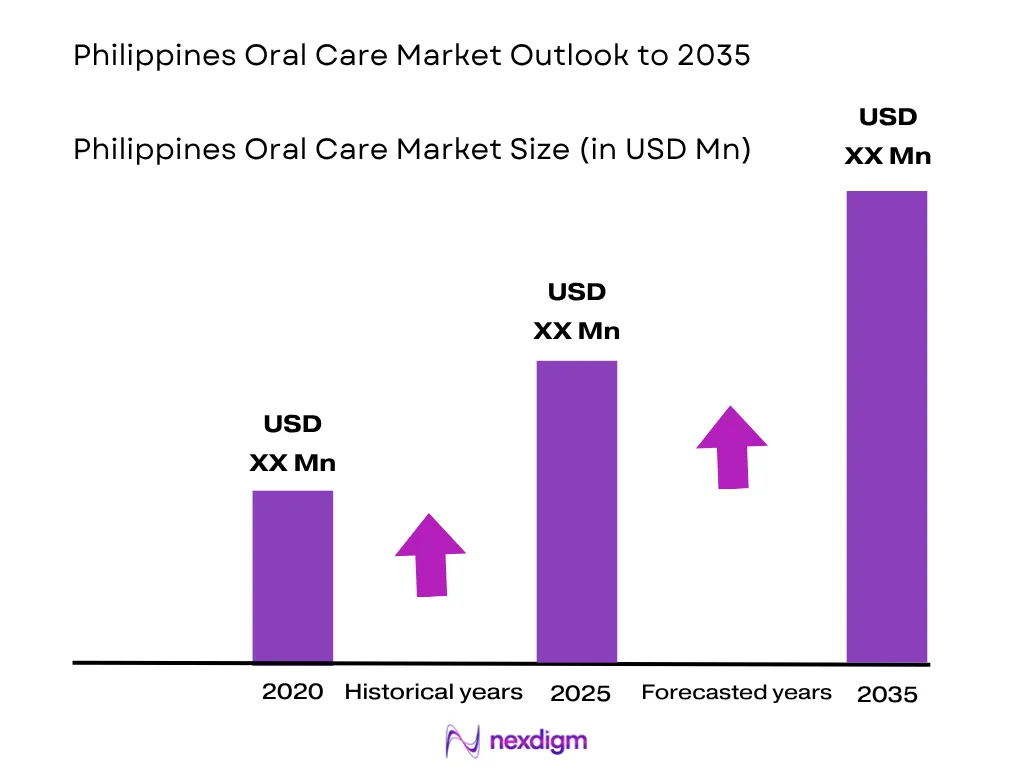
The Philippines Oral Care Market is valued at USD ~ million, based on Nexdigm Research, and is forecast to expand at a 4.45% CAGR; no credible public source was found for a Philippines-specific 2026–2035 CAGR, so this report uses the latest published national forecast as the market benchmark. Growth is driven by urbanization, higher hygiene awareness, wider pharmacy and modern-trade access, and rising GNI per capita from USD ~ to USD ~.
The market is dominated by National Capital Region, Metro Manila, Cebu, Davao, Central Luzon and Southern Tagalog because these locations concentrate modern retail, pharmacies, dental clinics, higher-income households, and online fulfilment infrastructure. NCR is identified as the largest regional market, while the Philippines’ population base of 115.84 million and GNI per capita of USD ~ support recurring consumption of toothpaste, toothbrushes, mouthwash, whitening and sensitivity products.
Market Segmentation
By Product Type
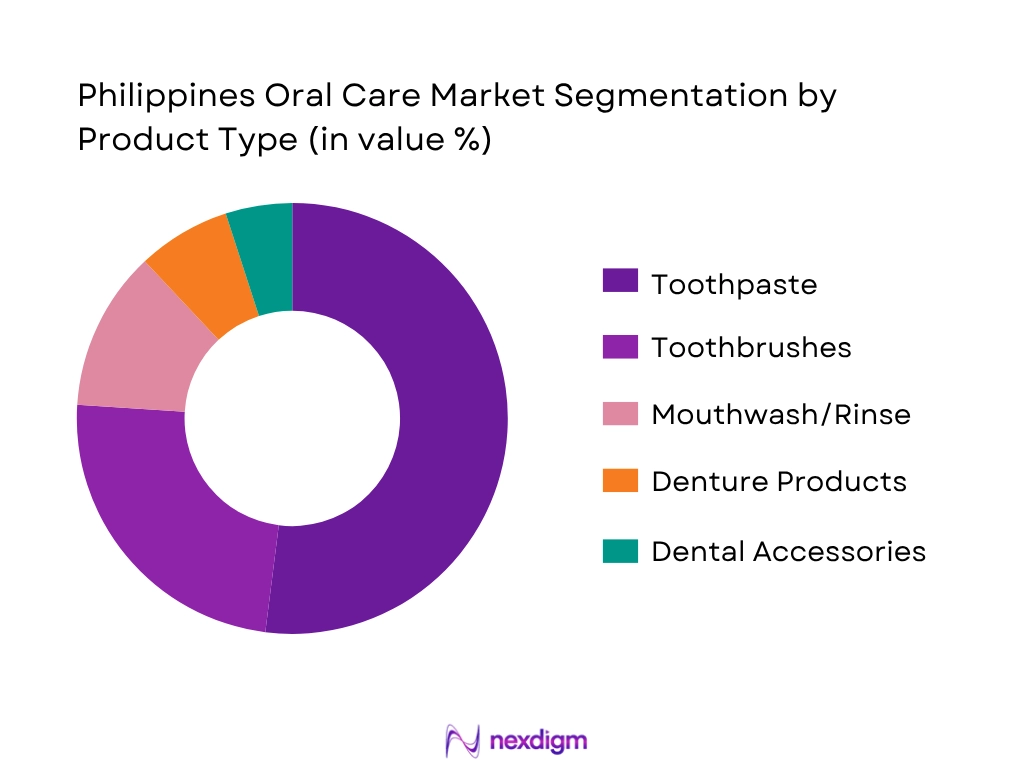
The Philippines Oral Care Market is segmented by product type into toothpaste, toothbrush, mouthwash/rinse, denture products and dental accessories. Toothpaste holds the dominant market share because it is the most frequently replenished oral care product across Filipino households and has the widest price-pack coverage, from value tubes to family packs and premium variants. Colgate, Hapee, Closeup, Sensodyne and Oral-B have created strong shelf visibility across supermarkets, sari-sari-linked wholesalers, drugstores and online marketplaces. Toothpaste also benefits from multiple consumer need states, including cavity protection, whitening, fresh breath, gum care, sensitivity relief and kids’ fluoride formulations. Toothbrushes remain essential but have longer replacement cycles, while mouthwash, floss and denture care remain more urban, pharmacy-led and premium-skewed categories.
By Distribution Channel
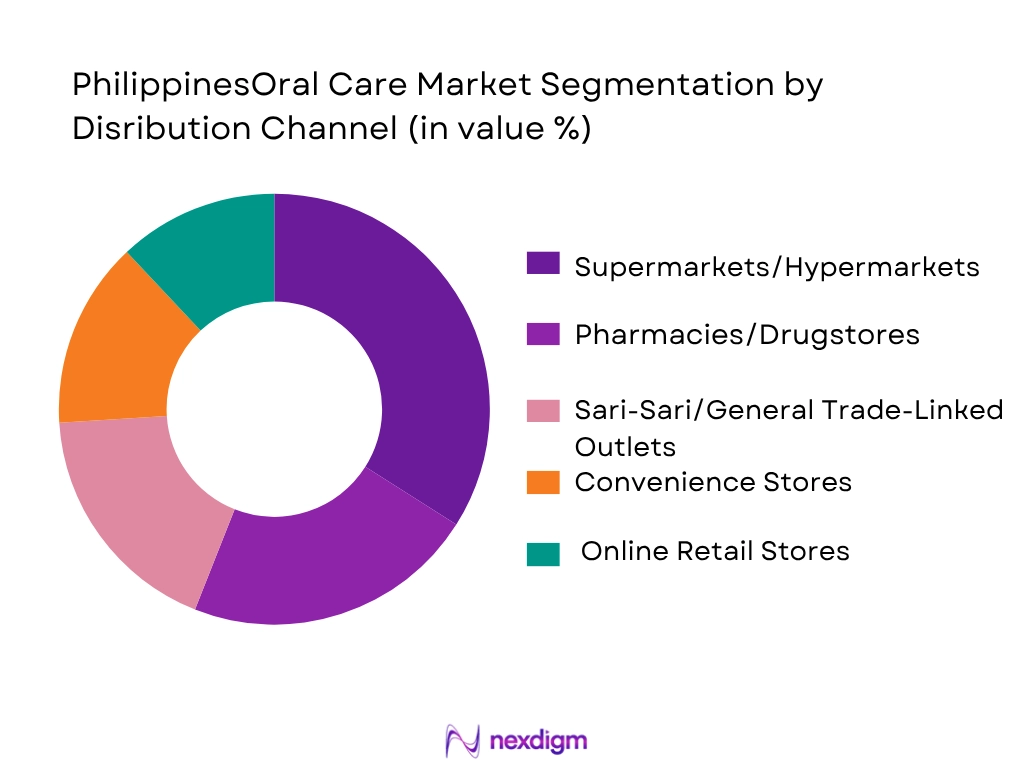
The Philippines Oral Care Market is segmented by distribution channel into supermarkets/hypermarkets, convenience stores, online retail stores, pharmacies/drugstores and sari-sari/general trade-linked outlets. Supermarkets and hypermarkets dominate because oral care is frequently purchased as part of monthly grocery baskets, where consumers compare brands, pack sizes, promo bundles and family-value SKUs. Modern trade also provides stronger visibility for premium toothpaste, whitening formats, mouthwash and electric toothbrushes. Pharmacies are especially important for sensitivity, gum care, denture care and dentist-recommended products, while online channels are growing through bundle discounts and marketplace campaigns. Sari-sari and general trade outlets remain critical for affordable toothpaste and basic manual toothbrush availability in neighborhood catchments.
Competitive Landscape
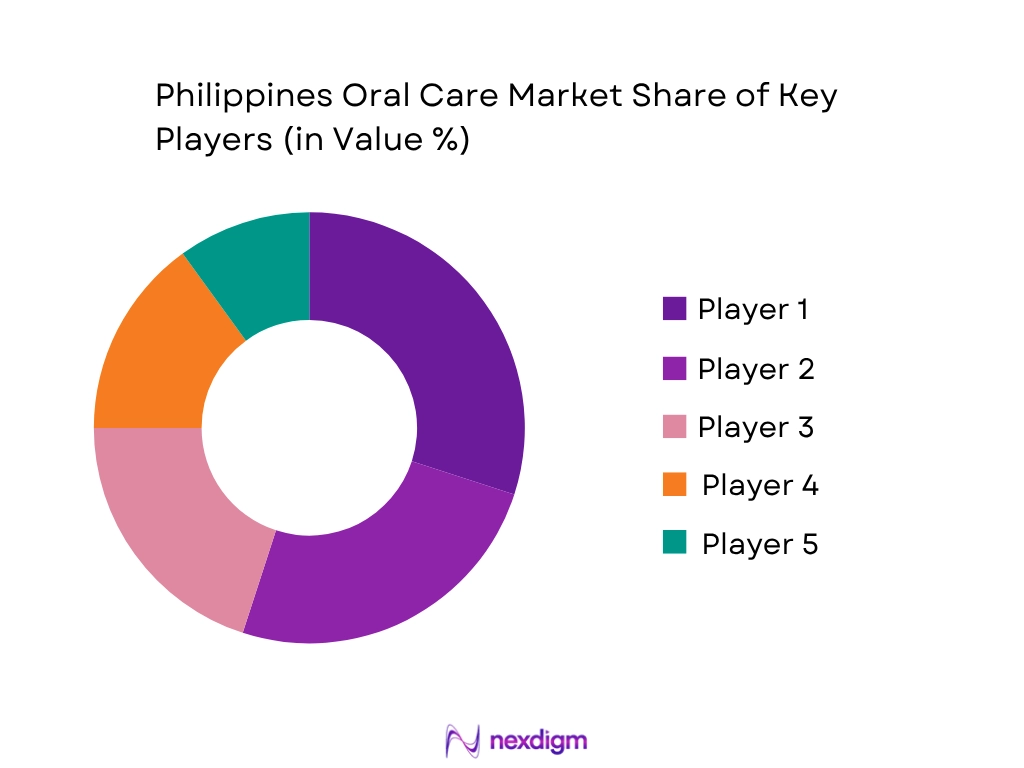
The Philippines Oral Care Market is led by multinational FMCG companies and strong local value brands. Colgate-Palmolive leads mass toothpaste and toothbrush visibility, while P&G, Unilever, Haleon/GSK and Johnson & Johnson compete across whitening, freshness, sensitivity, gum care and mouthwash-led propositions. Lamoiyan’s Hapee remains strategically important because of local manufacturing, Filipino brand recall and value-tier access.
| Company | Establishment Year | Headquarters | Core Philippines Oral Care Brands | Product Strength | Channel Strength | Price Positioning | Key Consumer Platform | Local Market Advantage |
| Colgate-Palmolive | 1806 | New York, USA | ~ | ~ | ~ | ~ | ~ | ~ |
| Procter & Gamble | 1837 | Cincinnati, USA | ~ | ~ | ~ | ~ | ~ | ~ |
| Unilever | 1929 | London, UK | ~ | ~ | ~ | ~ | ~ | ~ |
| Haleon / GSK Consumer Healthcare | 2022 | Weybridge, UK | ~ | ~ | ~ | ~ | ~ | ~ |
| Lamoiyan Corporation | 1988 | Parañaque, Philippines | ~ | ~ | ~ | ~ | ~ | ~ |
Philippines Oral Care Market Analysis
Growth Drivers
High Dental Caries Burden
The Philippines oral care market is strongly supported by the country’s visible caries burden, particularly among young children, where preventive products such as fluoride toothpaste, kids’ toothpaste, soft-bristle toothbrushes and mouthrinse can address daily oral-hygiene gaps. A Philippine study published in BMC Oral Health examined 703 children aged 4–24 months in Caloocan City and found early childhood caries prevalence at 29.2 cases per 100 children, with children having an average of 6.7 erupted teeth; this confirms that oral care demand begins early in the household lifecycle. The Philippine Statistics Authority also cleared a nationwide oral health survey with a budget of PHP 3.4 million, covering all regions, with data collection scheduled from 18 August 2025 to 30 October 2025 and release expected on 03 April 2026, showing active government attention to dental caries and periodontal disease. The macro base further supports recurring oral care consumption: the IMF lists the Philippines’ population at 115.299 million, while the World Bank reports GNI per capita at USD 4,470 and GDP growth at 5.6 in 2024. A large population with rising income capacity increases the addressable base for routine toothpaste and toothbrush purchases.
Fluoride Toothpaste Adoption
Fluoride toothpaste adoption is a major growth driver because the Philippines lacks broad systemic water fluoridation, making topical fluoride products the practical daily preventive route for households. The Philippine Pediatric Dental Society states that there is no water fluoridation in the Philippines except certain areas in Cavite, and recommends fluoridated toothpaste use twice daily as a primary preventive procedure. Its guidance specifies toothpaste containing 1,000 ppm fluoride for children under 2 years, 1,350–1,500 ppm for children aged 2 years and above, and 1,500 ppm for children aged 6 years and above, which directly supports demand for regulated fluoride toothpaste across family and kids’ oral care portfolios. WHO also states that twice-daily brushing with fluoride toothpaste of 1,000–1,500 ppm should be encouraged. Macroeconomic conditions reinforce adoption: World Bank data shows household final consumption expenditure at USD 351.5 billion, urban population at 56,316,242, and GNI per capita at USD 4,470, creating a large urban and semi-urban consumer base for repeat-use oral hygiene products sold through supermarkets, pharmacies, sari-sari-linked channels and online retail.
Market Challenges
Price Sensitivity
Price sensitivity restrains the Philippines oral care market because basic toothpaste and toothbrushes compete with essential food, transport, utility and healthcare spending in lower-income households. The World Bank notes that the country remains lower-middle-income, with GNI per capita at USD 4,470, while poverty stood at 15.5 persons per 100 population in 2023 and was projected at 15.7 persons per 100 population in 2024 under the lower-middle-income international poverty line. This limits trading-up into premium whitening, sensitivity, electric toothbrush and mouthwash formats. The Philippines also had 17.54 million people below the national poverty line in the latest PSA-reported poverty round, showing a large base of households likely to prioritize value packs, basic cavity-protection toothpaste and manual toothbrushes over specialist oral care. Household consumption is large, at USD 351.5 billion, but this spending is spread across a population of 115.299 million, creating strong competition for wallet share. For oral care brands, this makes affordability, small-pack availability, promo bundles and mass-market fluoride variants critical to volume resilience, while constraining premiumization outside NCR, Cebu, Davao and other higher-income urban locations.
Sachet-to-Tube Affordability Gap
The sachet-to-tube affordability gap restrains market value expansion because many Filipino households remain anchored to small, low-cash-outlay purchases rather than larger family tubes, multipacks, mouthwash bottles or premium therapeutic SKUs. This is structurally linked to income distribution and daily cash-flow behavior in neighborhood retail. World Bank data shows the Philippines’ urban population at 56,316,242, but the country also retains a large non-urban base outside dense modern-trade catchments; these consumers often rely on sari-sari and small-format stores where small packs and entry-level oral care dominate. The affordability challenge is reinforced by GNI per capita of USD 4,470, GDP per capita of USD 3,985, and 17.54 million people living below the national poverty line. In this environment, large toothpaste tubes, electric toothbrushes, sensitivity toothpaste and mouthwash face a higher purchase barrier than basic sachets or small tubes. The result is a dual-market structure: high-frequency consumption exists, but conversion into higher-value oral care routines depends on pack-price architecture, promotions, refill economics and retailer credit cycles rather than product need alone.
Opportunities
Premium Sensitivity Care
Premium sensitivity care represents a clear opportunity as the Philippines combines a large adult population, rising income capacity and expanding pharmacy-led oral health access. World Bank data shows 77,198,220 people aged 15–64 and 6,362,058 people aged 65 and above, creating a sizable consumer base for sensitivity relief, gum care, denture-linked products and dentist-recommended therapeutic toothpaste. Sensitivity products benefit from aging, enamel wear, gum recession, whitening use and higher dental awareness, especially in NCR, Cebu, Davao and other urban centers with stronger pharmacy and clinic networks. The macro backdrop supports gradual trading-up: the World Bank reports GNI per capita at USD 4,470, household final consumption expenditure at USD 351.5 billion, and personal remittances received at USD 40.28 billion, giving many households additional spending capacity for health and personal care. IMF data also places the country population at 115.299 million, making even niche therapeutic oral care a substantial opportunity when distributed through drugstores, supermarkets, online marketplaces and dentist-influenced channels. Brands can build growth through sensitivity repair, enamel protection, gum care, fluoride assurance and bundled toothbrush-toothpaste regimens.
Whitening Toothpaste
Whitening toothpaste offers a future-growth opportunity because it sits between basic cavity protection and premium cosmetic oral care, allowing brands to upgrade consumers without requiring adoption of high-ticket devices or clinical procedures. The opportunity is strongest in urban and digitally influenced households: World Bank-backed data reports 56,316,242 urban residents, while the country’s consumer base is supported by USD 351.5 billion in household final consumption expenditure and GNI per capita of USD 4,470. Whitening products are especially relevant for working-age consumers because the Philippines has 77,198,220 people aged 15–64, a large base exposed to workplace grooming, social media-led beauty standards, foodservice consumption and personal-care premiumization. The World Bank also notes that the Philippines’ economic dynamism is supported by strong consumer demand, services activity, remittances and urbanization, all of which help cosmetic oral care move beyond core hygiene. Unlike mouthwash or electric toothbrushes, whitening toothpaste fits existing brushing behavior, uses familiar pack formats and can be positioned through freshness, stain removal, enamel-safe fluoride and confidence-led messaging, making it a scalable premium bridge in modern trade, pharmacy and e-commerce channels.
Future Outlook
The Philippines Oral Care Market is expected to maintain steady expansion as oral hygiene becomes more closely linked with preventive healthcare, cosmetic appearance and family wellness. Growth will be supported by premium toothpaste, sensitivity relief, whitening products, alcohol-free mouthwash, electric toothbrushes and online bundle sales. Modern trade and pharmacies will remain the core value channels, while e-commerce will influence discovery and promotional pricing. NCR, Cebu, Davao, Central Luzon and Southern Tagalog will remain priority demand clusters.
Major Players
- Colgate-Palmolive Philippines
- Procter & Gamble Philippines
- Unilever Philippines
- Haleon / GSK Consumer Healthcare Philippines
- Johnson & Johnson Philippines
- Lamoiyan Corporation / Hapee
- Lion Corporation
- Church & Dwight
- Sunstar Philippines
- Darlie / Hawley & Hazel
- Perrigo / Ranir
- Dr. Fresh
- Watsons Private Label Oral Care
- Human Nature
- Oral Essentials / The Natural Dentist
Key Target Audience
- Oral care product manufacturers
- FMCG and personal care companies
- Pharmacy and drugstore chains
- Supermarket and hypermarket operators
- E-commerce marketplaces and D2C oral care brands
- Dental clinic chains and oral healthcare service providers
- Investments and venture capitalist firms
- Government and regulatory bodies: Food and Drug Administration Philippines, Department of Health, Department of Trade and Industry
Research Methodology
Step 1: Identification of Key Variables
The initial phase involves mapping the Philippines Oral Care Market ecosystem across manufacturers, importers, distributors, pharmacies, supermarkets, sari-sari-linked wholesalers, dental clinics and online marketplaces. Key variables include product category, price tier, pack size, consumer age group, retail channel, regional demand and therapeutic claim positioning.
Step 2: Market Analysis and Construction
Historical market data is compiled using company disclosures, trade interviews, retail audits, product listings, SKU price checks and secondary market databases. The analysis evaluates category penetration, average selling price, channel contribution, product replenishment cycles and brand portfolio breadth to construct market revenue estimates.
Step 3: Hypothesis Validation and Expert Consultation
Market hypotheses are validated through interviews with distributors, retail category managers, dentists, pharmacists, e-commerce sellers and FMCG sales teams. These discussions help verify category growth, channel margins, promotional intensity, product availability and the relative strength of toothpaste, toothbrush, mouthwash and therapeutic oral care products.
Step 4: Research Synthesis and Final Output
The final stage triangulates top-down market sizing with bottom-up SKU and channel-level validation. Findings are synthesized into market size, segmentation, competitive benchmarking, outlook and strategic recommendations for companies targeting the Philippines Oral Care Market.

- Executive Summary
- Research Methodology (Market Definitions and Assumptions, Oral Care Product Boundary, Toothpaste/Toothbrush/Mouthwash Inclusion Criteria, Primary Interviews with Distributors/Dentists/Retailers, Retail Audit Approach, E-commerce SKU Tracking, Price-Pack Architecture Mapping, Bottom-Up Channel Build-Up, Top-Down FMCG Validation, Limitations and Forecast Assumptions)

- Definition and Scope
- Market Genesis and Evolution
- Timeline of Major Players
- Oral Hygiene Adoption Curve
- Supply Chain and Value Chain Analysis
- Regulatory Ecosystem
- Retail and Pharmacy Route-to-Market Structure
- Consumer Oral Health Behaviour Overview

- Growth Drivers (High Dental Caries Burden, Fluoride Toothpaste Adoption, Urban Retail Expansion, Middle-Class Personal Care Spend, E-commerce Promotions, Dentist-Recommended Sensitivity Products)
- Market Restraints (Price Sensitivity, Sachet-to-Tube Affordability Gap, Low Dental Visit Frequency, Counterfeit/Unnotified Products, Rural Distribution Fragmentation)
- Opportunities (Premium Sensitivity Care, Whitening Toothpaste, Alcohol-Free Mouthwash, Kids Fluoride Products, Eco-Friendly Toothbrushes, Bundled Oral Care Kits)
- Trends (Multi-Benefit Formulations, Charcoal/Whitening Claims, Gum Health Positioning, Natural/Herbal Ingredients, Twin-Pack Discounts, Pharmacy-Led Therapeutic Oral Care)
- Government Regulations (FDA Cosmetic Product Notification, ASEAN Cosmetic Directive Compliance, Fluoride Content Claims, Labeling Requirements, Importer/Distributor Licensing)
- SWOT Analysis (Demand Resilience, Premiumization Gap, Local Brand Price Advantage, Channel Fragmentation)
- Stakeholder Ecosystem (Manufacturers, Importers, Modern Trade, Sari-Sari Wholesalers, Pharmacies, Dentists, Online Marketplaces, Regulators)
- Porter’s Five Forces (Brand Loyalty, Retailer Bargaining Power, Private Label Threat, Therapeutic Product Substitution, Promotional Rivalry)
- Pricing and Promotion Analysis (Twin Packs, Buy-One-Take-One, Sachet Economics, Pharmacy Premium SKUs, Marketplace Flash Sales)

- By Value (2020-2025)
- By Volume (2020-2025)
- By Average Selling Price (2020-2025)
- By Per Capita Oral Care Spend (2020-2025)
- By Toothpaste Penetration and Replacement Frequency (2020-2025)

- By Product Type (In Value%)
Toothpaste
Manual Toothbrush
Electric Toothbrush
Mouthwash/Rinse
Dental Floss
Interdental Brushes
Denture Care
Teeth Whitening Products
Kids Oral Care - By Toothpaste Benefit Platform (In Value%)
Cavity Protection
Whitening
Gum Care
Sensitivity Relief
Herbal/Natural
Fresh Breath
Multi-Benefit
Kids Fluoride Toothgel - By Toothbrush Type (In Value%)
Manual
Battery-Powered
Rechargeable Electric
Kids Toothbrush
Orthodontic Toothbrush
Soft-Bristle Premium Brush - By Consumer Age Group (In Value%)
Toddlers
Kids
Teens
Adults
Seniors
Denture Users - By Price Tier (In Value%)
Mass
Value-for-Money
Mid-Premium
Premium
Dentist-Recommended Therapeutic - By Pack Size (In Value%)
Sachet/Trial Pack
Small Tube
Standard Tube
Family Pack
Twin Pack
Multipack
Travel Pack - By Distribution Channel (In Value%)
Supermarkets/Hypermarkets
Convenience Stores
Sari-Sari Stores
Pharmacies/Drugstores
Personal Care Chains
Dental Clinics
Online Marketplaces
Brand D2C Stores - By Region (In Value%)
NCR
Luzon excluding NCR
Visayas
Mindanao - By Purchase Occasion (In Value%)
Monthly Household Replenishment
Promo-Driven Basket Purchase
Dental Recommendation
Back-to-School Kids Purchase
Travel/Convenience Purchase

- Market Share of Major Players (Value Share, Volume Share, Product Category Share, Channel Share)
- Cross Comparison Parameters (Toothpaste SKU Breadth, Fluoride/Sensitivity Claim Portfolio, Whitening and Gum Care Range, Pack-Size Architecture, Pharmacy Presence, Sari-Sari/General Trade Reach, E-commerce Visibility, Dentist-Endorsement/Clinical Credibility)
- SWOT Analysis of Major Players (Brand Equity, Local Manufacturing Advantage, Premium Portfolio Depth, Channel Execution, Promotion Intensity)
- Pricing Analysis by SKU (Toothpaste Tube, Twin Pack, Kids Toothgel, Mouthwash Bottle, Manual Toothbrush, Electric Toothbrush, Denture Care)
- Competitive Benchmarking (Mass Oral Care, Therapeutic Oral Care, Local Value Brand, Premium Imported Brand, Marketplace-Led Brand)
- Detailed Profiles of Major Companies
Colgate-Palmolive Philippines
Procter & Gamble Philippines
Unilever Philippines
Haleon / GSK Consumer Healthcare Philippines
Johnson & Johnson Philippines
Lamoiyan Corporation / Hapee
Lion Corporation
Church & Dwight
Sunstar Philippines
Darlie / Hawley & Hazel
Perrigo / Ranir
Dr. Fresh
Watsons Private Label Oral Care
Human Nature
Oral Essentials / The Natural Dentist

- Household Demand and Utilization (Brushing Frequency, Family Consumption, Tube Replacement Cycle, Mouthwash Penetration)
- Purchasing Power and Basket Behaviour (Modern Trade Basket Size, Sari-Sari Replenishment, Pharmacy Premium Basket, E-commerce Bundling)
- Needs and Pain Points (Cavities, Bad Breath, Sensitivity, Gum Bleeding, Whitening, Kids Compliance, Denture Hygiene)
- Decision-Making Process (Brand Trust, Dentist Recommendation, Price-Off Promotions, Flavor Acceptance, Fluoride Claim, Pack Affordability)
- Consumer Cohorts (Mass Family Buyers, Whitening-Led Young Adults, Sensitivity-Care Users, Kids Oral Care Buyers, Senior Denture Users)

- By Value (2026-2035)
- By Volume (2026-2035)
- By Average Selling Price (2026-2035)
- By Per Capita Spend (2026-2035)
- By Premiumization Contribution (2026-2035)


 Request a Sample
 Ask for Customization
 Get a Quote
 Enquire Now