

 Download PDF
Market Overview
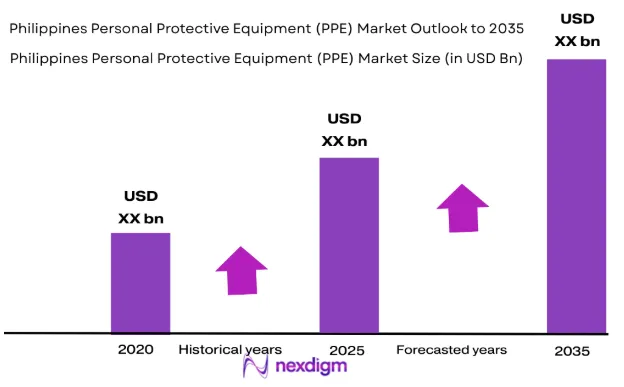
The Philippines Personal Protective Equipment (PPE) market is valued at approximately USD ~ billion based on a recent historical assessment, supported by data from industry trade bodies and national manufacturing reports. Market expansion is driven by strong demand from construction, healthcare, and manufacturing sectors, where compliance with occupational safety standards is mandatory. Increasing infrastructure investments and industrial output further accelerate consumption of safety gear, particularly in urban economic zones. Additionally, rising awareness of worker safety and corporate risk mitigation strategies continues to reinforce consistent procurement of PPE across enterprises.
Metro Manila, Cebu, and Davao dominate the Philippines PPE market due to their concentration of industrial activity, healthcare infrastructure, and construction projects. Metro Manila serves as the primary hub for large-scale manufacturing and corporate headquarters, leading to higher institutional procurement of PPE. Cebu and Davao benefit from expanding industrial parks and infrastructure investments, which increase demand for safety equipment. These cities also host major distribution networks and import channels, enabling faster product availability and stronger supplier presence compared to smaller regional markets.
Market Segmentation
By System Type
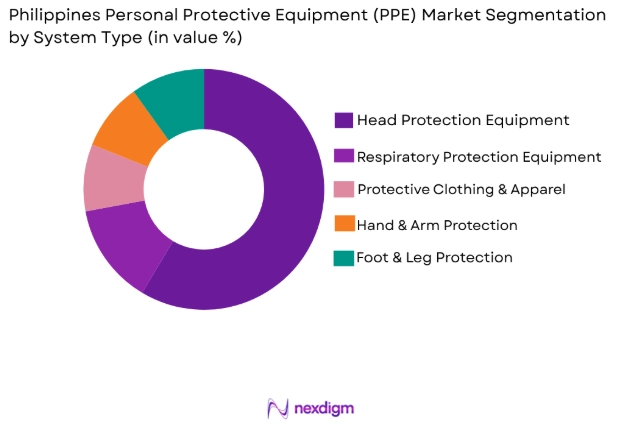
Philippines Personal Protective Equipment (PPE) market is segmented by system type into head protection equipment, respiratory protection equipment, protective clothing & apparel, hand & arm protection, and foot & leg protection. Recently, respiratory protection equipment has a dominant market share due to sustained demand from healthcare institutions and industrial environments requiring protection from airborne contaminants. Strict workplace safety regulations and increased awareness of respiratory hazards have reinforced its adoption. Additionally, continuous usage in hospitals and high-risk industrial operations ensures stable procurement, making it the leading segment across the market.
By End User Type
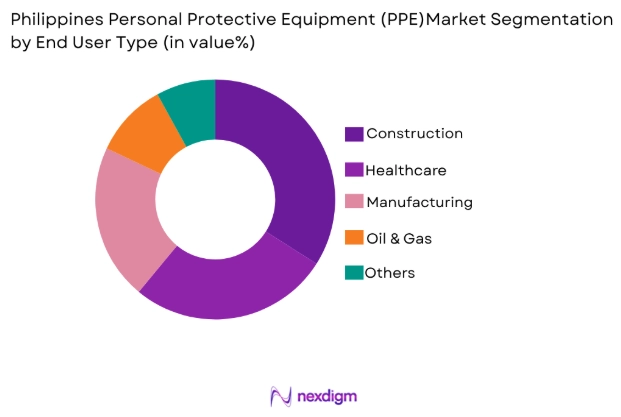
Philippines Personal Protective Equipment (PPE) market is segmented by end user industry into construction, healthcare, manufacturing, oil & gas, and others. Recently, construction has a dominant market share due to ongoing infrastructure expansion and urban development projects. Government-backed construction initiatives and private real estate developments have significantly increased demand for helmets, gloves, and safety footwear. The sector’s labor-intensive nature requires continuous PPE usage, while regulatory enforcement ensures compliance. Additionally, large-scale infrastructure pipelines across major cities further sustain procurement demand, reinforcing construction as the leading end-user segment.
Competitive Landscape
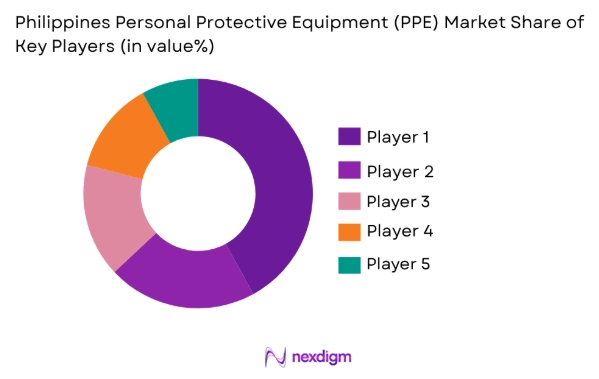
The Philippines PPE market exhibits moderate consolidation, with global manufacturers holding strong positions in premium and technologically advanced product categories, while local companies compete in cost-sensitive segments. Major players leverage extensive distribution networks, product innovation, and compliance certifications to strengthen market presence. Strategic partnerships with industrial firms and healthcare providers further enhance competitive positioning, while price competitiveness remains a key differentiator in procurement decisions.
| Company Name | Establishment Year | Headquarters | Technology Focus | Market Reach | Key Products | Revenue | Distribution Strength |
| 3M Philippines | 1902 | USA | ~ | ~ | ~ | ~ | ~ |
| Honeywell Safety | 1906 | USA | ~ | ~ | ~ | ~ | ~ |
| DuPont | 1802 | USA | ~ | ~ | ~ | ~ | ~ |
| Ansell | 1893 | Australia | ~ | ~ | ~ | ~ | ~ |
| Kimberly-Clark | 1872 | USA | ~ | ~ | ~ | ~ | ~ |
Philippines Personal Protective Equipment (PPE) Market Analysis
Growth Drivers
Expansion of Infrastructure and Construction Activities
Expansion of infrastructure and construction activities significantly drives demand for personal protective equipment across the Philippines due to increasing labor deployment in urban and semi-urban regions. Large-scale government initiatives focusing on transportation, housing, and public infrastructure have intensified the need for safety compliance on project sites. Construction companies are mandated to equip workers with helmets, gloves, and protective footwear, ensuring steady procurement cycles. Additionally, private real estate development contributes to sustained demand for PPE across residential and commercial projects. The continuous inflow of investments into infrastructure further strengthens market growth momentum. Increased enforcement of safety regulations ensures that companies adhere strictly to PPE usage guidelines. Moreover, rising awareness among workers about occupational hazards supports consistent adoption. Supply chain improvements have also enhanced availability across regions. These combined factors establish construction-driven demand as a critical growth driver for the PPE market.
Strengthening Occupational Safety Regulations and Compliance Enforcement
Strengthening occupational safety regulations and compliance enforcement plays a crucial role in expanding the PPE market by mandating the use of protective equipment across industries. Regulatory authorities enforce strict workplace safety standards that require companies to provide certified PPE to employees. Compliance inspections and penalties for violations encourage businesses to invest in high-quality safety gear. Additionally, multinational corporations operating in the Philippines follow global safety protocols, further boosting demand for advanced PPE solutions. The presence of formal guidelines ensures uniform adoption across industrial sectors. Increasing awareness campaigns and training programs reinforce adherence to safety standards. Furthermore, the integration of international certification standards enhances product quality expectations. Continuous regulatory updates ensure that PPE remains essential across sectors. These factors collectively drive sustained market expansion.
Market Challenges
High-Cost Sensitivity Among Small and Medium Enterprises
High cost sensitivity among small and medium enterprises limits the widespread adoption of advanced personal protective equipment in the Philippines market. Many SMEs operate with constrained budgets, making it difficult to invest in high-quality or technologically advanced PPE solutions. This often leads to reliance on lower-cost alternatives that may not meet international safety standards. Additionally, inconsistent enforcement of regulations among smaller firms further exacerbates the issue. Limited financial resources also restrict bulk procurement, increasing per-unit costs. The absence of strong awareness programs in certain regions contributes to underutilization. Moreover, fluctuations in raw material prices impact overall product pricing. Distribution challenges in remote areas further increase costs. These factors collectively hinder uniform market penetration across all enterprise segments.
Supply Chain Disruptions and Import Dependency
Supply chain disruptions and import dependency pose significant challenges to the Philippines PPE market by affecting product availability and pricing stability. A substantial portion of PPE products and raw materials are imported, making the market vulnerable to global trade fluctuations. Delays in shipping and logistics can lead to shortages, particularly during periods of high demand. Additionally, currency fluctuations impact import costs, influencing final product prices. Limited domestic manufacturing capacity further exacerbates dependency issues. Distribution inefficiencies in rural areas also contribute to inconsistent supply. Furthermore, geopolitical factors can disrupt international trade flows. The lack of diversified sourcing strategies increases vulnerability. These challenges collectively impact market stability and growth potential.
Opportunities
Adoption of Smart and Technology-Integrated PPE Solutions
Adoption of smart and technology-integrated PPE solutions presents a significant opportunity for market expansion by enhancing safety and operational efficiency. Advanced PPE equipped with sensors and communication systems allows real-time monitoring of worker conditions. This technology improves hazard detection and reduces workplace accidents. Additionally, industries are increasingly investing in digital safety solutions to enhance productivity. The integration of IoT and wearable technology further supports data-driven decision-making. Companies adopting smart PPE gain competitive advantages in safety compliance. Growing awareness of technological benefits encourages adoption across sectors. Furthermore, innovation in product design enhances user comfort and usability. These advancements position smart PPE as a key growth opportunity.
Expansion of Sustainable and Eco-Friendly PPE Materials
Expansion of sustainable and eco-friendly PPE materials offers a promising opportunity as environmental concerns influence procurement decisions. Companies are increasingly seeking biodegradable and recyclable PPE options to reduce environmental impact. Regulatory pressures and corporate sustainability goals further drive this transition. Additionally, innovation in material science enables the development of durable yet eco-friendly products. Consumers and organizations are becoming more conscious of waste management associated with disposable PPE. This shift encourages manufacturers to invest in sustainable solutions. The adoption of green materials also enhances brand reputation. Furthermore, partnerships with environmental organizations support product development. These factors collectively create growth opportunities in sustainable PPE segments.
Future Outlook
The Philippines PPE market is expected to experience steady expansion over the next five years, supported by ongoing industrialization and infrastructure development. Technological advancements in smart PPE and sustainable materials will shape future product innovation. Regulatory enforcement is likely to strengthen further, ensuring consistent demand across sectors. Additionally, increasing awareness of workplace safety and corporate responsibility will continue to drive procurement. Growing healthcare investments and industrial diversification will reinforce long-term market growth.
Major Players
- 3M Philippines
- Honeywell Safety Products Philippines
- DuPont Philippines
- Ansell Philippines
- Kimberly-Clark Philippines
- MSA Safety Philippines
- Delta Plus Group Philippines
- Uvex Safety Philippines
- Lakeland Industries Philippines
- Dräger Philippines
- Sioen Industries Philippines
- Alpha Pro Tech Philippines
- JSP Safety Philippines
- KARAM Safety Philippines
- Supermax Corporation Philippines
Key Target Audience
- Industrial manufacturing companies
- Construction and infrastructure firms
- Healthcare institutions
- Oil and gas companies
- Investments and venture capitalist firms
- Government and regulatory bodies
- PPE distributors and wholesalers
Research Methodology
Step 1: Identification of Key Variables
Key variables influencing the Philippines PPE market were identified through industry reports and regulatory frameworks. These included demand drivers, pricing trends, and supply chain factors. Both macroeconomic and sector-specific indicators were analyzed to establish baseline assumptions.
Step 2: Market Analysis and Construction
Comprehensive market modeling was conducted using historical data and sectoral demand patterns. Data from industrial output, healthcare consumption, and construction activity were integrated. This helped construct a reliable market size and segmentation framework.
Step 3: Hypothesis Validation and Expert Consultation
Initial findings were validated through consultations with industry experts and stakeholders. Feedback from manufacturers, distributors, and regulatory authorities refined assumptions. This ensured accuracy and relevance of market insights.
Step 4: Research Synthesis and Final Output
All validated data and insights were synthesized into a structured report format. Analytical models were applied to ensure consistency across segments. Final outputs were reviewed for accuracy, completeness, and reliability.

- Executive Summary
- Research Methodology (Definitions, Scope, Industry Assumptions, Market Sizing Approach, Primary & Secondary Research Framework, Data Collection & Verification Protocol, Analytic Models & Forecast Methodology, Limitations & Research Validity Checks)

- Market Definition and Scope
- Value Chain & Stakeholder Ecosystem
- Regulatory / Certification Landscape
- Sector Dynamics Affecting Demand
- Strategic Initiatives & Infrastructure Growth

- Growth Drivers
Rising enforcement of occupational safety regulations across industries
Expansion of construction and infrastructure development projects
Increased awareness of workplace safety and employee welfare - Market Challenges
High cost of advanced PPE limiting adoption among SMEs
Supply chain disruptions affecting raw material availability
Inconsistent compliance levels across informal sectors - Market Opportunities
Adoption of smart and wearable PPE technologies
Growing demand for eco-friendly and sustainable PPE materials
Expansion of healthcare infrastructure and emergency preparedness - Trends
Shift towards ergonomic and user-friendly PPE designs
Integration of digital monitoring and IoT-enabled safety equipment - Government Regulations
- SWOT Analysis
- Porter’s Five Forces

- By Market Value, 2020-2025
- By Installed Units, 2020-2025
- By Average System Price, 2020-2025
- By System Complexity Tier, 2020-2025

- By System Type (In Value%)
Head Protection Equipment
Respiratory Protection Equipment
Protective Clothing & Apparel
Hand & Arm Protection
Foot & Leg Protection - By Platform Type (In Value%)
Industrial Safety Applications
Healthcare & Medical Use
Construction & Infrastructure Projects
Oil & Gas Operations
Manufacturing & Electronics Sector - By Fitment Type (In Value%)
Disposable PPE
Reusable PPE
Custom-Fitted PPE
Smart & Integrated PPE - By End User Segment (In Value%)
Construction
Healthcare
Manufacturing
Oil & Gas
Others

- Market Share Analysis
- Cross Comparison Parameters (Product Quality, Pricing Strategy, Distribution Network, Regulatory Compliance, Product Innovation, Brand Reputation, After-Sales Support, Manufacturing Capability, Supply Chain Efficiency, Customization Capability, Sustainability Practices, Certification Standards Compliance, Technology Integration, Customer Support Responsiveness, Market Presence & Coverage)
- SWOT Analysis of Key Competitors
- Pricing & Procurement Analysis
- Key Players
3M Philippines
Honeywell Safety Products Philippines
DuPont Philippines
Ansell Philippines
Kimberly-Clark Philippines
MSA Safety Philippines
Delta Plus Group Philippines
Uvex Safety Philippines
Lakeland Industries Philippines
Dräger Philippines
Sioen Industries Philippines
Alpha Pro Tech Philippines
JSP Safety Philippines
KARAM Safety Philippines
Supermax Corporation Philippines

- Increasing PPE adoption in large-scale manufacturing facilities
- Rising demand from healthcare institutions for disposable PPE
- Growth in construction sector driving bulk procurement of safety gear
- Emerging demand from SMEs due to regulatory compliance pressures

- By Market Value, 2026-2035
- By Installed Units, 2026-2035
- By Average System Price, 2026-2035
- By System Complexity Tier, 2026-2035


 Request a Sample
 Ask for Customization
 Get a Quote
 Enquire Now