
 Download PDF
Market Overview
The Philippines Plastics Market is valued at approximately USD ~XX billion, based on a five-year historical analysis, supported by packaging, construction, consumer products, electronics and industrial conversion. The wider economic base expanded from USD 437.1 billion to USD 461.7 billion across the latest two annual observations, while GDP per capita increased from USD 3,804.1 to USD 3,985.3, strengthening manufactured-goods consumption. Domestic polymer availability is supported by JG Summit Olefins’ 320,000-tonne polyethylene and 300,000-tonne polypropylene annual capacities.
Batangas, Bataan, Metro Manila, Bulacan and CALABARZON dominate the Philippines Plastics Market because they combine petrochemical production, resin distribution, conversion plants and proximity to FMCG, construction and export manufacturers. JG Summit Olefins operates a Batangas complex with more than 1 million tonnes of petrochemical-product capacity, while NPC Alliance’s Bataan facility occupies 187,200 square metres and can manufacture 250,000 tonnes of polyethylene annually. MOLDEX operates a 20-hectare Bulacan manufacturing facility, reinforcing Luzon’s converter concentration.
Market Segmentation
By Polymer Type
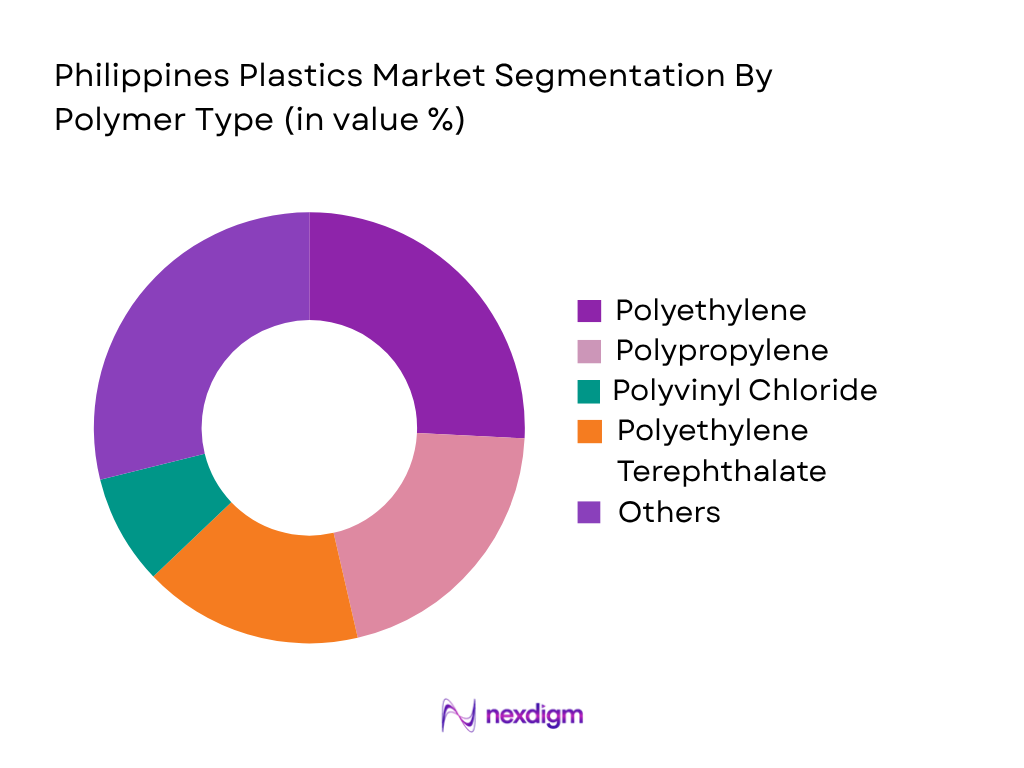
The Philippines Plastics Market is segmented into polyethylene, polypropylene, polyvinyl chloride, polyethylene terephthalate, polystyrene, engineering plastics and recycled plastics. Polyethylene holds the dominant position because flexible packaging, bottles, liners, films, household articles and pipe applications create a broad conversion base for HDPE, LDPE and LLDPE grades. Domestic availability further strengthens polyethylene adoption. JG Summit Olefins operates 320,000 tonnes per annum of PE production capacity, while NPC Alliance operates 250,000 tonnes per annum and produces both HDPE and LLDPE using two production trains. This provides local converters with access to important film, blow-molding and injection-molding grades. NPC Alliance’s facility covers 187,200 square metres, reflecting the industrial scale of domestic resin production. JG Summit’s Batangas petrochemical complex also produces 480,000 tonnes of polymer-grade ethylene annually, providing upstream feedstock for downstream PE production. Polyethylene therefore benefits from both diversified applications and an established domestic supply infrastructure rather than dependence solely on imported material.
By End-Use Industry
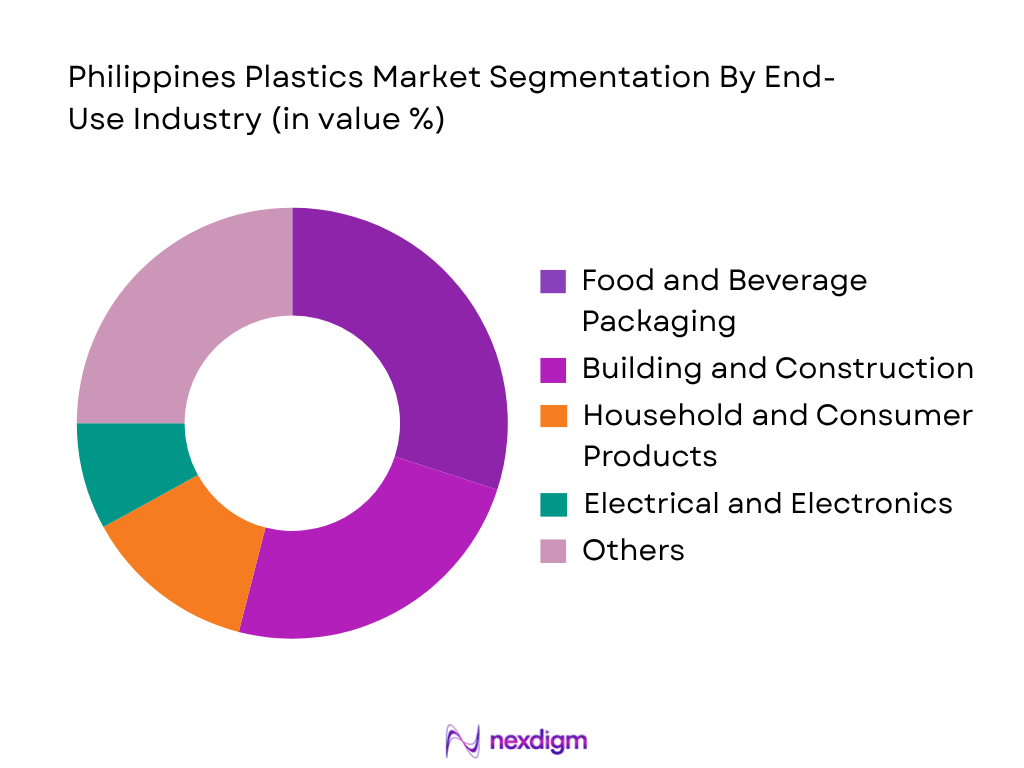
The Philippines Plastics Market is segmented into food and beverage packaging, building and construction, household and consumer products, electrical and electronics, automotive and transportation, healthcare and pharmaceuticals, agriculture, industrial packaging and logistics applications. Food and beverage packaging represents the dominant sub-segment because the domestic economy relies heavily on flexible sachets, pouches, PET bottles, HDPE containers, caps, closures and other low-weight packaging formats. The importance of packaging is also evident in the EPR system: DENR reported an unaudited plastic packaging footprint of 624,547 tonnes, of which 124,986 tonnes had already been recovered or diverted during the initial compliance period. Covered products specifically include sachets, labels, laminates, rigid containers, beverage packaging, food containers, plastic bags and polystyrene. San Miguel Yamamura Packaging maintains Philippine operations in Mandaluyong, Calamba, Mandaue and Davao and supplies plastic and PET packaging alongside flexible and other packaging formats. This widespread converter infrastructure supports packaging’s position as the largest plastics-consuming application group.
Competitive Landscape
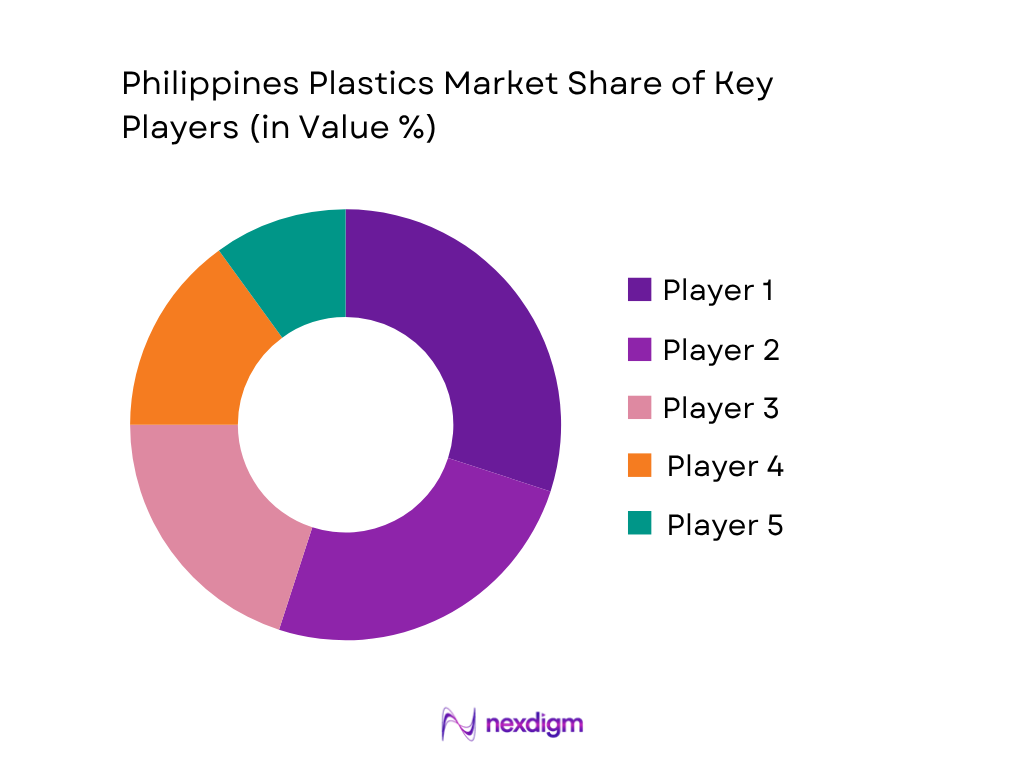
The Philippines Plastics Market has a fragmented but vertically differentiated competitive structure. JG Summit Olefins and NPC Alliance occupy important positions in domestic polyolefin resin manufacturing, while San Miguel Yamamura Packaging participates across multiple packaging formats. MOLDEX Products and Crown Asia Chemicals compete strongly in pipes, PVC products and construction-related plastic systems. Competitive advantage depends on resin integration, manufacturing scale, processing technology, product certification, customer relationships, geographic distribution and capability to respond to EPR-driven circularity requirements.
| Company | Establishment Year | Headquarters | Core Plastic Portfolio | Resin Integration | Processing Capability | Manufacturing Footprint | Key End-Use Exposure | Circularity / Technical Capability |
| JG Summit Olefins Corporation | 1998 | Pasig City | ~ | ~ | ~ | ~ | ~ | ~ |
| NPC Alliance Corporation | 2005 | Makati City | ~ | ~ | ~ | ~ | ~ | ~ |
| San Miguel Yamamura Packaging Corporation | 1938 | Mandaluyong City | ~ | ~ | ~ | ~ | ~ | ~ |
| MOLDEX Products, Inc. | 1967 | Quezon City | ~ | ~ | ~ | ~ | ~ | ~ |
| Crown Asia Chemicals Corporation | 1989 | Guiguinto, Bulacan | ~ | ~ | ~ | ~ | ~ | ~ |
Philippines Plastics Market Analysis
Growth Drivers
Strong Domestic Polymer Production and Downstream Manufacturing Base
The Philippines Plastics Market is supported by an established domestic polyolefin production base that supplies converters serving flexible packaging, rigid containers, household products, pipes and industrial applications. The country’s integrated petrochemical infrastructure includes annual capacities of 480,000 tonnes of polymer-grade ethylene, 240,000 tonnes of polymer-grade propylene, 320,000 tonnes of polyethylene and 300,000 tonnes of polypropylene, giving downstream manufacturers access to locally produced commodity resins. Another major domestic facility contributes 250,000 tonnes of polyethylene production capacity from a 187,200-square-metre manufacturing site, including HDPE and LLDPE grades used in films, blow molding and injection molding. The broader manufacturing environment also remains substantial, with 255 approved economic-zone projects in 2024, including 122 export-manufacturing projects, while the approved project portfolio was associated with more than 72,000 direct jobs. Philippine GDP stood at approximately USD 461.67 billion in 2024, GDP per capita reached approximately USD 3,984.8, and the population stood at 115,843,670. These industrial and macroeconomic fundamentals strengthen domestic resin offtake and support continued development of plastic conversion activities.
Expanding Packaging, Electronics and Export-Manufacturing Demand
Packaging and export-oriented manufacturing provide a broad demand platform for the Philippines Plastics Market because plastic films, trays, bottles, containers, protective packaging and molded components are extensively used across food, beverages, electronics and industrial supply chains. Philippine electronic-product exports reached USD 39.09 billion in 2024, while exports of manufactured goods amounted to USD 58.39 billion, demonstrating the scale of industries requiring plastic components and protective packaging. Raw materials and intermediate goods imports reached USD 46.47 billion, reflecting substantial manufacturing-input requirements across domestic processing industries. The country also recorded 255 approved economic-zone projects, including 122 export-manufacturing projects, with the approved portfolio associated with more than 72,000 direct jobs. Total merchandise trade reached USD 200.87 billion in 2024, comprising USD 127.60 billion of imports and USD 73.27 billion of exports. These manufacturing activities operate within an economy of approximately USD 461.67 billion and a population of 115,843,670, creating substantial underlying demand for flexible packaging, industrial films, electronic-component plastics, transport packaging, plastic containers and other converted polymer products.
Market Challenges
Dependence on Imported Industrial Inputs and Specialty Polymer Grades
The Philippines Plastics Market faces a structural challenge from continued dependence on imported industrial inputs, particularly specialty polymers, engineering plastics, additives, masterbatches and grades that are not manufactured domestically at sufficient scale. Total Philippine imports reached USD 127.60 billion in 2024, including USD 46.47 billion of raw materials and intermediate goods and USD 35.73 billion of capital goods, demonstrating the manufacturing sector’s considerable dependence on international supply chains. China supplied USD 32.83 billion of imports, followed by Indonesia with USD 10.64 billion, Japan with USD 10.11 billion, South Korea with USD 9.63 billion and the United States with USD 8.17 billion. Although domestic facilities provide significant polyethylene and polypropylene production capacity, processors requiring specialty engineering resins, advanced barrier materials, performance additives and application-specific compounds remain exposed to overseas sourcing. The country simultaneously recorded a USD 54.33 billion merchandise trade deficit in 2024. With GDP of approximately USD 461.67 billion and a population of 115,843,670, maintaining reliable access to specialized polymer inputs remains important for packaging, electronics, automotive, healthcare and other plastics-consuming industries.
Fragmented Plastic Recovery and Recycling Infrastructure
Plastic waste recovery remains a major challenge for the Philippines Plastics Market because compliance obligations require manufacturers and brand owners to establish traceable collection, diversion and recycling channels across a geographically fragmented archipelago. The registered plastic packaging footprint under the country’s extended producer responsibility framework reached 624,547 tonnes, while 124,986 tonnes of plastic packaging had been recovered or diverted during the initial implementation period. The material footprint covers flexible packaging, sachets, rigid containers, beverage bottles, plastic bags, food containers and polystyrene products, creating considerable requirements for collection, segregation, transportation and material processing. Building adequate sorting, washing, pelletizing and recycled-resin quality-control infrastructure is particularly difficult for multilayer flexible packaging and contaminated post-consumer polyolefins. The operational challenge is magnified by a national population of 115,843,670 in 2024, distributed across an archipelago of more than 7,600 islands, creating logistical complexity for waste consolidation and recycling. National GDP stood at approximately USD 461.67 billion, reflecting substantial economic and packaged-goods activity. Plastic converters therefore require increasingly dependable recycled feedstock while simultaneously meeting performance, processing, traceability and product-quality requirements.
Market Opportunities
Expansion of Recycled Plastics and EPR-Compliant Packaging Solutions
The Philippines Plastics Market has a significant future opportunity in recycled PET, recycled polyethylene, recycled polypropylene and packaging structures designed for improved recovery because the existing extended producer responsibility framework is already creating substantial material flows for collection and recycling. The registered plastic packaging footprint reached 624,547 tonnes, while 124,986 tonnes had already been recovered or diverted during the initial compliance period. This material base provides opportunities for investments in sorting, washing, shredding, pelletizing, bottle-to-bottle recycling and higher-quality post-consumer resin manufacturing. The opportunity also extends toward mono-material flexible packaging, recyclable rigid containers and packaging incorporating recycled polymers. The industrial customer base is expanding simultaneously, with 255 economic-zone projects approved in 2024, including 122 export-manufacturing projects, while the approved project portfolio was associated with more than 72,000 direct jobs. The Philippines had a population of 115,843,670 and GDP of approximately USD 461.67 billion in 2024, providing a substantial consumer and manufacturing base that generates recoverable plastic materials. These existing conditions provide a platform for future investment in domestic recycling capacity, recycled-polymer production and circular packaging technologies serving consumer and industrial applications.
Localization of High-Value Plastic Components for Electronics and Industrial Manufacturing
Higher-value plastic conversion represents a future opportunity for the Philippines Plastics Market as electronics, semiconductor and export-manufacturing activities require engineering-plastic housings, precision-molded parts, connectors, trays, protective packaging and technical polymer components. Electronic-product exports reached USD 39.09 billion in 2024, while manufactured-goods exports totaled USD 58.39 billion, demonstrating a substantial existing customer base for technical plastics. The country approved 255 economic-zone projects in 2024, including 122 export-manufacturing projects, while manufacturing accounted for approximately PHP 149.3 billion of approved economic-zone investments. During June alone, 25 new projects were approved, including 11 export-manufacturing projects, with 15 projects located across Batangas, Cavite and Laguna, reinforcing the industrial concentration of CALABARZON where plastics converters can operate near electronics and industrial customers. A semiconductor-device manufacturing project in Cebu also carried an investment commitment of approximately PHP 3.9 billion, supporting opportunities outside Luzon. Philippine GDP stood at approximately USD 461.67 billion in 2024, while GDP per capita reached approximately USD 3,984.8. These existing manufacturing conditions create future opportunities for engineering-plastic compounding, masterbatches, precision injection molding and localized technical components.
Future Outlook
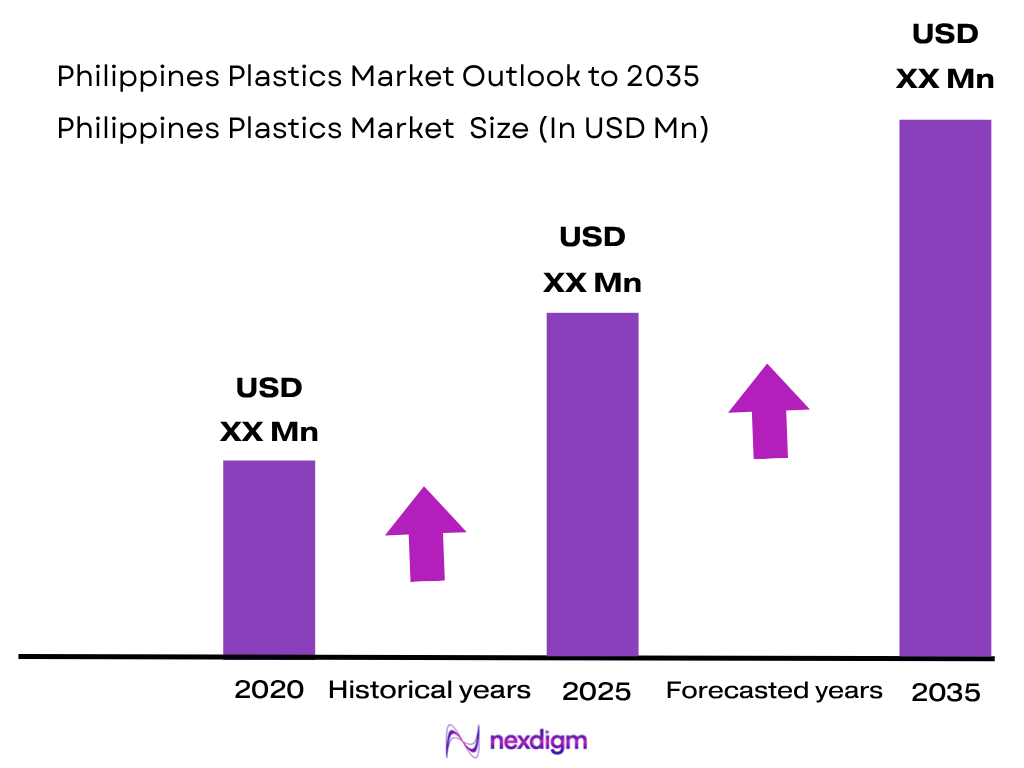
The Philippines Plastics Market is forecast to expand at approximately ~XX% CAGR during 2026-2035. Future development will increasingly depend on domestic manufacturing recovery, flexible and rigid packaging requirements, infrastructure construction, electronics manufacturing and higher-value plastic conversion. At the same time, regulation is expected to reshape resin selection and product design. Recycling, post-consumer resin, mono-material structures and EPR-compliant packaging are likely to become more influential in investment decisions across the value chain.
Domestic resin availability will remain strategically important. JG Summit Olefins has installed capacity of 480,000 tonnes of ethylene, 240,000 tonnes of propylene, 320,000 tonnes of polyethylene and 300,000 tonnes of polypropylene annually, while NPC Alliance adds 250,000 tonnes of polyethylene capacity. These facilities provide an important platform for local film, bottle, household-product and industrial converters.
Major Players
- JG Summit Olefins Corporation
- NPC Alliance Corporation
- San Miguel Yamamura Packaging Corporation
- MOLDEX Products, Inc.
- Neltex Development Co., Inc.
- Crown Asia Chemicals Corporation
- Emerald Vinyl Corporation
- Phil-Top Industries, Inc.
- Filpet, Inc.
- Liquid Packaging Corporation
- Lacko Plastic Products, Inc.
- Hydro Phil Asia Inc.
- Central Negros Fujipipes Industries Inc.
- Jovan Packaging International Co. Ltd. Inc.
- CTEMS Inc. / ECPack
Key Target Audience
- Petrochemical and Polymer Resin Producers
- Plastic Converters and Finished Plastic Product Manufacturers
- Flexible and Rigid Packaging Manufacturers
- Pipe, Fittings and Construction Plastic Manufacturers
- FMCG, Beverage, Pharmaceutical and Industrial Packaging Buyers
- Plastic Recyclers, Waste Recovery Operators and Producer Responsibility Organizations
- Investments and Venture Capitalist Firms
- Government and Regulatory Bodies (Department of Environment and Natural Resources, Environmental Management Bureau, Department of Trade and Industry, Board of Investments, Philippine Economic Zone Authority, Bureau of Philippine Standards, Food and Drug Administration)
Research Methodology
Step 1: Identification of Key Variables
The research begins with an ecosystem map covering petrochemical producers, PE and PP manufacturers, resin importers, distributors, plastic converters, packaging companies, pipe manufacturers, recyclers and major end-use industries. Key variables include domestic resin production, imported resin availability, processing capacity, finished-product demand, end-use consumption, EPR obligations and recycled-material availability. This framework defines the Philippines Plastics Market across upstream and downstream activities.
Step 2: Market Analysis and Construction
Historical industry data are assessed through both top-down and bottom-up approaches. The top-down framework examines domestic polymer production, resin imports, exports and manufacturing activity, while the bottom-up framework analyzes resin consumption across flexible packaging, rigid packaging, pipes, household plastics, electronics and industrial components. Supply and consumption flows are reconciled to avoid double counting and build segment-level market estimates.
Step 3: Hypothesis Validation and Expert Consultation
Market hypotheses are validated through CATIs and structured interviews with resin manufacturers, distributors, plastic converters, packaging manufacturers, recyclers, FMCG procurement teams and infrastructure-product suppliers. Discussions examine resin-grade preferences, domestic versus imported sourcing, capacity utilization, customer qualification, processing technology and recycled-content requirements. Primary findings are cross-checked against company filings, regulatory disclosures and government industrial statistics.
Step 4: Research Synthesis and Final Output
The final stage integrates polymer supply, conversion capacity, end-use consumption, competitive positioning and regulatory factors into one consolidated market model. Findings are triangulated across resin producers, converters and end users to establish consistency between domestic polymer availability and finished-product output. Future scenarios then incorporate EPR compliance, recycling development, manufacturing localization, infrastructure demand and changes in resin sourcing to generate the final Philippines Plastics Market outlook.

- Executive Summary
- Research Methodology (Market Definition and Scope, Philippines Plastics Market Classification, Polymer Resin Supply Assessment, Plastic Conversion Capacity Evaluation, Plastic Processing Technology Analysis, End-Use Industry Mapping, Domestic Resin Production Assessment, Imported Polymer Dependence Analysis, Plastic Packaging Ecosystem Evaluation, Plastic Recycling and Circularity Assessment, Extended Producer Responsibility Compliance Analysis)

- Definition and Scope
- Philippines Plastics Industry Evolution and Development of Domestic Resin-to-Finished-Product Conversion Ecosystem
- Petrochemical Feedstock, Polymer Resin and Downstream Plastic Manufacturing Structure
- Philippines Plastics Market Value Chain Analysis
- Philippines Plastics Market Supply Chain Analysis
- Polyethylene, Polypropylene, PVC, PET, Engineering Plastics, Plastic Conversion and Recycling Ecosystem Analysis
- Plastic Manufacturing Integration Assessment Across Packaging, Construction, Automotive, Electronics, Healthcare, Agriculture and Consumer Applications

- Growth Drivers (Expansion of Food and Beverage Packaging Demand, Growth of Domestic Manufacturing, Increasing Construction and Water Infrastructure Requirements, Expansion of Electronics Manufacturing Base, Rising Consumer Product Demand, Growth of E-Commerce and Logistics Packaging, Availability of Domestic Polyethylene and Polypropylene Resin, Expansion of Plastic Conversion Capacity)
- Market Challenges (Domestic Petrochemical Supply Disruptions, Dependence on Imported Specialty and Engineering Resins, Global Resin Supply Volatility, Fragmented Plastic Waste Collection, Flexible Packaging Recycling Complexity, Extended Producer Responsibility Compliance Requirements, Imported Finished Plastic Product Competition, Inconsistent Recycled Resin Quality)
- Market Opportunities (Recycled PET and Polyolefin Production, Mono-Material Flexible Packaging, Food-Grade Recycled Packaging, High-Barrier Plastic Packaging, Engineering Plastics Conversion, Water Infrastructure Pipes and Fittings, Medical Plastic Products, Electronics Plastic Components, Biodegradable Plastics, Finished Plastic Product Import Substitution)
- Market Trends (Packaging Lightweighting, Mono-Material Packaging Structures, Post-Consumer Recycled Content Integration, EPR-Driven Packaging Redesign, Local Resin Sourcing, High-Performance Polyolefin Grades, PET Conversion Expansion, Design-for-Recycling, Flexible Packaging Innovation, Circular Polymer Adoption)
- Regulatory and Standards Landscape (Extended Producer Responsibility Act, Ecological Solid Waste Management Act, DENR EPR Implementing Rules and Regulations, Food-Contact Plastic Packaging Requirements, Bureau of Philippine Standards Product Certification, Plastic Waste Import Controls, Local Single-Use Plastic Ordinances, Environmental Compliance Certificate Requirements, Plastic Waste Transport and Treatment Regulations)
- SWOT Analysis
- Porter’s Five Forces Analysis
- PESTLE Analysis
- Stakeholder Ecosystem
- Competition Ecosystem

- By Market Value (2020-2025)
- By Plastic Consumption Volume (2020-2025)
- By Domestic Resin Consumption Volume (2020-2025)
- By Plastic Conversion Volume (2020-2025)
- By Finished Plastic Product Output Volume (2020-2025)
- By Virgin Polymer Consumption Volume (2020-2025)
- By Recycled Polymer Consumption Volume (2020-2025)

- By Polymer Type (In Value %)
Polyethylene
High-Density Polyethylene
Low-Density Polyethylene
Linear Low-Density Polyethylene
Polypropylene
Homopolymer Polypropylene
Random Copolymer Polypropylene
Impact Copolymer Polypropylene
Polyvinyl Chloride
Rigid PVC
Flexible PVC
Polyethylene Terephthalate
Bottle-Grade PET
Sheet-Grade PET
Recycled PET
Polystyrene
General Purpose Polystyrene
High Impact Polystyrene
Expanded Polystyrene
Engineering and Specialty Plastics
Recycled Polyolefins - By Plastic Product Type (In Value %)
Flexible Plastic Films
PE Films
BOPP Films
Stretch Films
Shrink Films
Laminated Flexible Packaging
Sachets and Pouches
Rigid Plastic Packaging
PET Bottles and Preforms
HDPE Bottles and Containers
PP Containers, Cups and Tubs
Caps and Closures
Plastic Pipes and Fittings
Plastic Sheets and Profiles
Household Plasticware
Industrial Plastic Components
Plastic Compounds and Masterbatches - By Processing Technology (In Value %)
Film and Sheet Extrusion
Blown Film Extrusion
Cast Film Extrusion
Pipe and Profile Extrusion
Injection Molding
Extrusion Blow Molding
Injection Blow Molding
Injection Stretch Blow Molding
Thermoforming
Rotational Molding
Compression Molding
Woven Sack Extrusion and Weaving
Printing and Lamination
Compounding and Masterbatch Production
Plastic Recycling and Reprocessing - By End-Use Industry (In Value %)
Food and Beverage Packaging
Personal Care and Cosmetics
Household and Consumer Products
Building and Construction
Water and Sanitation Infrastructure
Electrical and Electronics
Automotive and Transportation
Agriculture and Fisheries
Healthcare and Pharmaceuticals
Industrial and Chemical Packaging
Retail and E-Commerce
Logistics and Warehousing
Textile and Woven Applications - By Resin Source (In Value %)
Domestically Produced Virgin Resin
Imported Virgin Resin
Post-Industrial Recycled Resin
Post-Consumer Recycled Resin
Mechanically Recycled Resin
Food-Grade Recycled PET
Recycled Polyethylene
Recycled Polypropylene
Mass-Balance Circular Polymers
Biodegradable and Bio-Based Plastics - By Region (In Value %)
National Capital Region
CAMANAVA Industrial Cluster
CALABARZON
Central Luzon
Metro Cebu
Western Visayas
Northern Mindanao
Davao Region
Other Luzon Markets
Other Visayas Markets
Other Mindanao Markets

- Market Share of Major Players (By Revenue, Production Capacity, Polymer Category, Plastic Product Type, Processing Technology, End-Use Industry, Manufacturing Footprint, Customer Segment Distribution)
- Cross Comparison Parameters (Polymer and Plastic Product Portfolio Breadth, Installed Resin and Conversion Capacity, Plastic Processing Technology Capability, Domestic Resin Integration and Feedstock Access, End-Use Industry Coverage, Manufacturing and Distribution Footprint, Recycling and EPR Capability, Product Certification and Technical Standards)
- SWOT Analysis of Major Players
- Competitive Positioning Matrix
- Product and Technology Portfolio Benchmarking
- Pricing and Plastic Product Category Benchmarking
- Manufacturing and Processing Technology Assessment
- Customer and End-Use Industry Integration Assessment
- Detailed Profiles of Major Companies
JG Summit Olefins Corporation
NPC Alliance Corporation
San Miguel Yamamura Packaging Corporation
MOLDEX Products, Inc.
Neltex Development Co., Inc.
Crown Asia Chemicals Corporation
Emerald Vinyl Corporation
Phil-Top Industries, Inc.
Filpet, Inc.
Liquid Packaging Corporation
Lacko Plastic Products, Inc.
Hydro Phil Asia Inc.
Central Negros Fujipipes Industries Inc.
Jovan Packaging International Co. Ltd. Inc.
CTEMS Inc.

- Flexible Packaging Converter Resin Procurement Assessment
- Rigid Packaging Manufacturer Resin Requirement Analysis
- PET Bottle and Preform Manufacturer Assessment
- Pipe and Fittings Manufacturer Polymer Demand Analysis
- FMCG and Beverage Packaging Buyer Assessment
- Electronics Plastic Component Manufacturer Analysis
- Automotive Plastic Component Manufacturer Assessment
- Healthcare and Pharmaceutical Plastic Requirement Analysis
- Industrial Plastic Product Buyer Assessment
- Recycled Polymer Buyer Qualification Analysis

- By Market Value (2026-2035)
- By Plastic Consumption Volume (2026-2035)
- By Domestic Resin Consumption Volume (2026-2035)
- By Plastic Conversion Volume (2026-2035)
- By Finished Plastic Product Output Volume (2026-2035)
- By Virgin Polymer Demand Volume (2026-2035)
- By Recycled Polymer Demand Volume (2026-2035)
- By Flexible Plastic Packaging Demand Volume (2026-2035)


 Request a Sample
 Ask for Customization
 Get a Quote
 Enquire Now