

 Download PDF
Market Overview
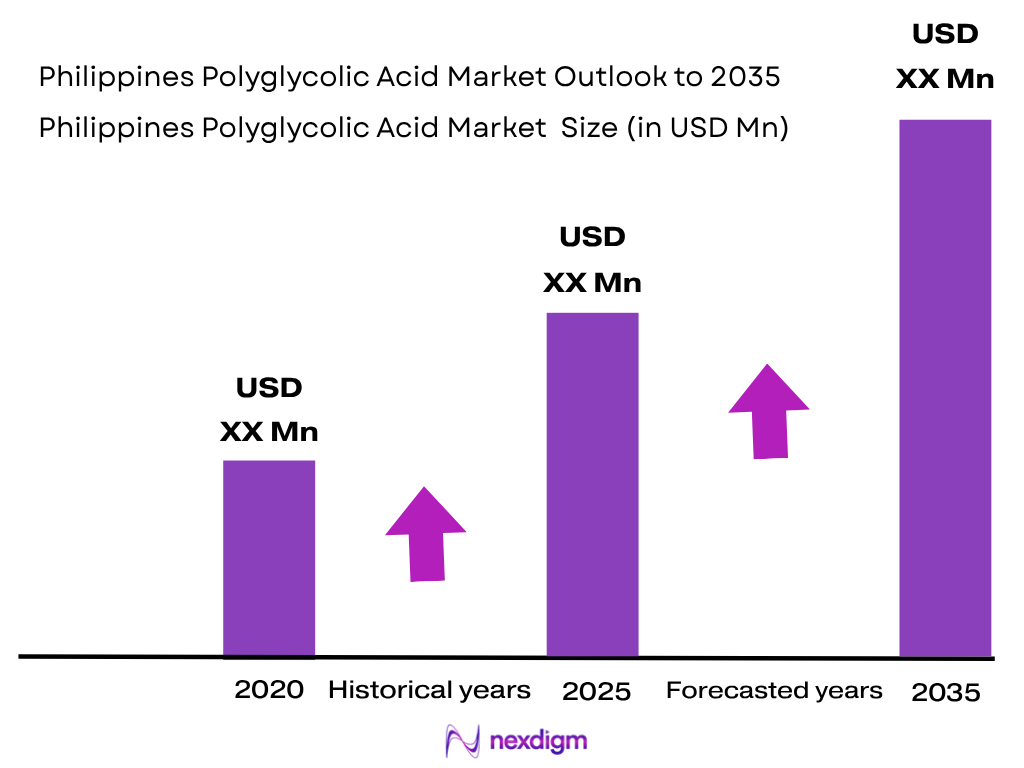
The Philippines Polyglycolic Acid Market was valued at ~USD [XX million] in 2024, compared with ~USD [XX million] in 2023, and is forecast to expand at a CAGR of ~[XX]% during 2026–2035. Market development is primarily associated with the country’s expanding healthcare expenditure, surgical-material requirements, medical-device distribution network and adoption of synthetic absorbable sutures. Philippine total health expenditure reached PHP 1.56 trillion in 2024, compared with PHP 1.33 trillion in 2023, providing a broader demand environment for medical products and consumables. Medical goods represented PHP 487.20 billion of current health expenditure in 2024, strengthening the relevance of specialized materials such as PGA for surgical applications.
The Philippines Polyglycolic Acid Market is concentrated around Metro Manila, Cebu and Davao, reflecting the country’s concentration of tertiary hospitals, specialty surgical facilities, medical-device distributors and private healthcare providers. Metro Manila remains the principal commercial and healthcare hub because major corporate offices, distributors and advanced hospitals are concentrated within the National Capital Region. B. Braun Philippines, for example, maintains its corporate office in Bonifacio Global City, Taguig, while Medtronic Philippines also operates from Bonifacio Global City and distributes products through partners across the archipelago. This concentration supports PGA-based surgical-product availability and hospital procurement.
Market Segmentation
By Product Form
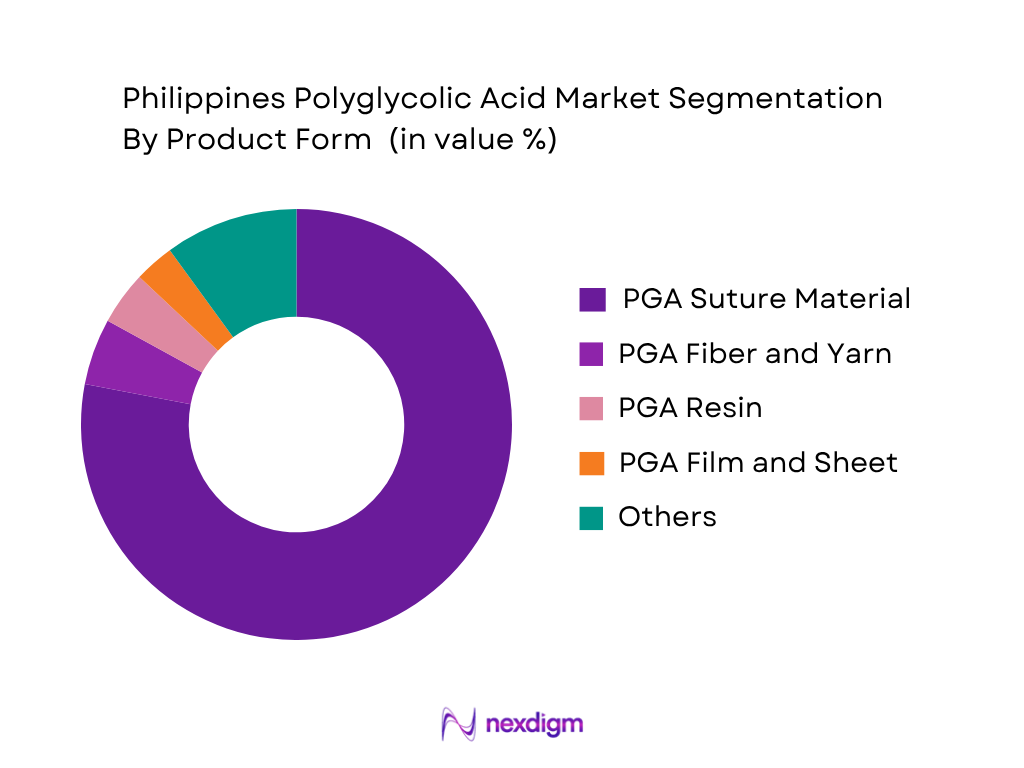
The Philippines Polyglycolic Acid Market is segmented by product form into PGA resin, PGA fiber, PGA yarn, PGA film, PGA sheet, PGA tubing, PGA suture material and PGA-based medical components. Among these, PGA suture material is estimated to hold the dominant share of ~[XX]% in 2024, primarily because absorbable surgical sutures represent the most established commercial application of polyglycolic acid in healthcare. PGA provides a combination of biodegradability, tensile strength and predictable absorption characteristics that makes it suitable for wound closure following surgical procedures. The Philippine procurement ecosystem demonstrates direct demand for PGA sutures: a 2025 government procurement notice from Amang Rodriguez Memorial Medical Center specified violet braided absorbable polyglycolic-acid sutures, while a 2026 Manila hospital procurement notice included polyglycolic-acid 6-0 and 7-0 braided sutures for retinal surgery. The presence of PGA sutures across government and specialty surgical procurement supports their leading position within the country’s PGA product landscape.
By Application
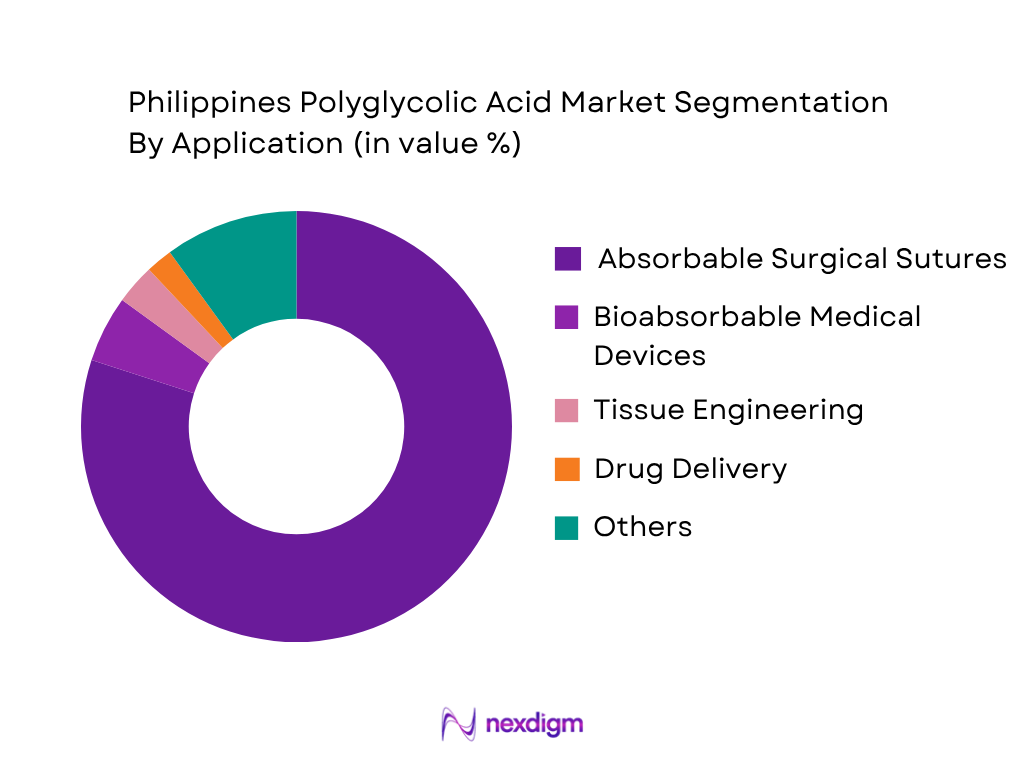
The Philippines Polyglycolic Acid Market is segmented by application into absorbable surgical sutures, bioabsorbable medical devices, tissue engineering, drug delivery, orthopaedic applications, dental applications, ophthalmic applications and biomedical research. Absorbable surgical sutures are estimated to account for ~[XX]% of the market in 2024, supported by their established clinical use and established procurement channels. PGA is particularly relevant where temporary wound-support material is required because the polymer gradually hydrolyzes after implantation, eliminating the need for routine removal associated with permanent sutures. Demand extends across general surgery, ophthalmology, dental procedures, obstetrics and gynaecology, gastrointestinal procedures and plastic surgery. Government procurement records provide evidence of PGA suture purchasing within Philippine hospitals, including ophthalmic surgery requirements. The broader healthcare expenditure environment also supports the application base, with Philippine current health expenditure reaching PHP 1.44 trillion in 2024 and medical goods expenditure reaching PHP 487.20 billion.
Competitive Landscape
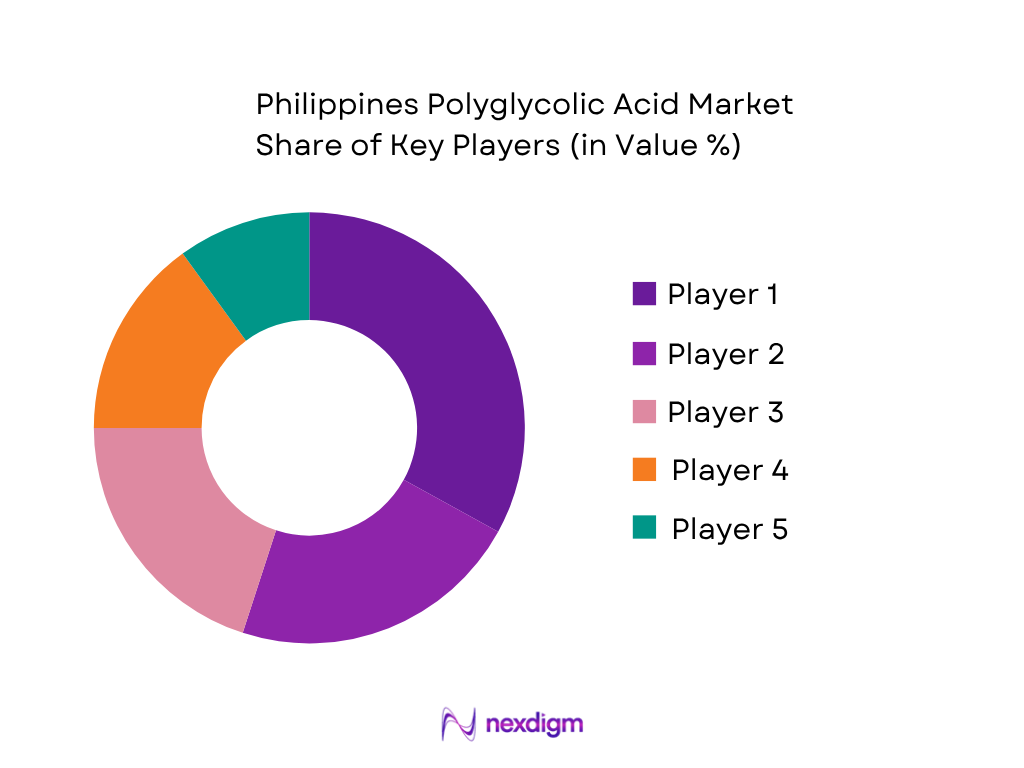
The Philippines Polyglycolic Acid Market is characterized by international medical-device manufacturers, surgical-suture suppliers, specialty polymer producers and local distribution organizations rather than a large domestic PGA resin-manufacturing base. Competition is therefore influenced by product registration, distributor reach, hospital relationships, surgical-product breadth, manufacturing quality and access to medical-grade PGA materials. B. Braun has operated in the Philippines for more than three decades and maintains a broad surgical portfolio, while Medtronic Philippines operates through distributors serving government and private healthcare accounts across the archipelago.
| Major Player | Establishment Year | Headquarters | PGA / Absorbable Suture Portfolio | Philippines Market Presence | Manufacturing Strength | Distribution Reach | Key Competitive Parameter |
| B. Braun Melsungen AG | 1839 | Melsungen, Germany | ~ | ~ | ~ | ~ | ~ |
| Medtronic plc | 1949 | Galway, Ireland | ~ | ~ | ~ | ~ | ~ |
| Johnson & Johnson / Ethicon | 1886 | New Brunswick, USA | ~ | ~ | ~ | ~ | ~ |
| Healthium Medtech Limited | 1992 | Bengaluru, India | ~ | ~ | ~ | ~ | ~ |
| Samyang Corporation / Samyang Biopharm | 1924 | Seoul, South Korea | ~ | ~ | ~ | ~ | ~ |
Philippines Polyglycolic Acid Market Analysis
Growth Drivers
Medical Device Consumption and Surgical Procedure Volumes
The Philippines Polyglycolic Acid Market is supported by expanding healthcare utilization and increasing expenditure on medical goods, which directly strengthens the addressable base for PGA-based absorbable sutures and other bioabsorbable medical products. Philippine Total Health Expenditure reached PHP 1.56 trillion in 2024, compared with PHP 1.33 trillion in 2023, according to the Philippine Statistics Authority. Per-capita health spending reached PHP 12,751 in 2024, up from PHP 10,840 in 2023, indicating a larger economic flow through healthcare services and products. Primary healthcare expenditure reached PHP 748.80 billion, while medical goods represented PHP 487.20 billion of current health expenditure. These indicators are directly relevant to PGA demand because surgical sutures and other implantable consumables are purchased through the medical-goods and hospital-procurement ecosystem. Healthcare demand is also supported by human health and social work activities, which recorded 10.9% growth in 2024, the highest growth among major Philippine industries. The combination of higher healthcare expenditure, expanding medical-goods utilization and stronger healthcare-sector activity supports recurring requirements for absorbable wound-closure materials. Consequently, hospitals, specialty surgical centres and medical-device distributors provide an expanding commercial base for PGA products, particularly where synthetic absorbable sutures are preferred for tissue approximation and postoperative wound management.
Healthcare Infrastructure Expansion and Biomedical Manufacturing Development
Healthcare infrastructure expansion and strengthening industrial activity create a broader operating environment for the Philippines Polyglycolic Acid Market by increasing the number of facilities capable of adopting specialized surgical materials and supporting domestic medical-product conversion. The Philippine Statistics Authority reported PHP 563.89 billion in total construction value in 2024, compared with PHP 515.30 billion in 2023, while reported construction floor area reached 42.84 million square meters. Non-residential construction alone accounted for PHP 250.86 billion, providing an important indicator of continued investment in commercial and institutional infrastructure. Healthcare facilities form part of this wider institutional construction ecosystem. At the same time, Philippine industry recorded 5.7% GDP growth in 2024, with manufacturing contributing 1.3 percentage points to national economic growth. Manufacturing activity is relevant to PGA because greater industrial capability can support medical-device assembly, polymer conversion, sterile-product packaging and specialized component manufacturing. International trade also reinforces the manufacturing environment: total Philippine imports reached USD 127.60 billion in 2024, including USD 35.73 billion of capital goods and USD 46.47 billion of raw materials and intermediate goods. Together, these indicators support investment in healthcare facilities, medical-product distribution and industrial capabilities that can expand the practical ecosystem for PGA-based surgical and biomedical products.
Market Challenges
Limited Domestic PGA Production and Imported Resin Dependence
The Philippines Polyglycolic Acid Market faces a structural challenge from limited domestic production and the country’s reliance on international supply chains for specialized polymer materials and medical-device inputs. Philippine merchandise imports reached USD 127.60 billion in 2024, increasing from USD 126.21 billion in 2023, according to the Philippine Statistics Authority. Raw materials and intermediate goods represented USD 46.47 billion of imports, while capital goods reached USD 35.73 billion, demonstrating the scale of external sourcing across industrial value chains. For PGA specifically, this import-oriented environment can increase dependence on overseas suppliers for polymer-grade feedstock, medical-grade PGA materials, specialized suture inputs and processing technologies. The challenge is particularly relevant because medical-grade PGA requires controlled polymerization, molecular-weight management, processing consistency, sterilization compatibility and stringent quality assurance. Philippine manufacturing recorded only 0.9% average growth in production volume in 2024, according to the Philippine Statistics Authority, indicating a relatively measured industrial expansion despite stronger overall economic growth. Domestic manufacturing therefore does not automatically translate into domestic production of highly specialized biomaterials. For PGA manufacturers and distributors, imported inputs can create exposure to international logistics, customs procedures, supplier qualification and availability disruptions. Building local conversion capabilities would require specialized equipment, technical expertise and validated medical-device manufacturing processes, making supply-chain localization a significant challenge.
Medical Qualification Requirements and Limited Local PGA Conversion Capacity
Medical qualification requirements create a significant barrier to expanding the Philippines Polyglycolic Acid Market into higher-value applications because PGA products intended for implantation or surgical use must satisfy stringent requirements for material consistency, biocompatibility, sterility, mechanical performance and controlled degradation. The broader Philippine medical-goods ecosystem is substantial, with PHP 487.20 billion spent on medical goods in 2024, while retailers and other providers of medical goods accounted for PHP 453.88 billion in current health expenditure, according to the Philippine Statistics Authority. However, the scale of healthcare consumption does not eliminate the technical requirements associated with introducing new PGA-based products. Domestic manufacturers must develop validated processing, sterilization, packaging and quality-control systems, while imported products must satisfy Philippine medical-device regulatory and registration requirements. The country’s industrial structure also presents a constraint: manufacturing’s average volume-of-production growth was 0.9% in 2024, compared with 4.9% in 2023, indicating a slower manufacturing environment during the period. For PGA, this can limit the availability of specialized local converters capable of transforming polymer into medical-grade fibers, films, tubes or implantable components. Consequently, suppliers seeking to expand beyond established absorbable sutures may face longer qualification cycles, specialized equipment requirements and dependence on international technical capabilities. Source: Philippine Statistics Authority, Philippine National Health Accounts 2024 and Monthly Integrated Survey of Selected Industries 2024.
Market Opportunities
Absorbable Surgical Sutures and Bioabsorbable Medical Devices
The Philippines Polyglycolic Acid Market presents opportunities in absorbable surgical sutures and other bioabsorbable medical devices because healthcare expenditure, medical-goods consumption and clinical infrastructure provide an established demand platform for synthetic biodegradable materials. Philippine Total Health Expenditure reached PHP 1.56 trillion in 2024, while medical goods expenditure reached PHP 487.20 billion, according to the Philippine Statistics Authority. Primary healthcare expenditure also reached PHP 748.80 billion, demonstrating the breadth of healthcare-related economic activity. PGA is particularly suited to applications where temporary mechanical support is required because its polymer structure permits hydrolytic degradation after implantation. This makes PGA relevant to absorbable sutures and potentially to selected bioabsorbable medical-device applications where controlled degradation is clinically desirable. The opportunity is reinforced by healthcare-sector activity: human health and social work activities expanded by 10.9% in 2024, while overall Philippine GDP increased by 5.7%. Government healthcare financing schemes also represented PHP 695.60 billion of current health expenditure, creating a substantial institutional purchasing environment. For manufacturers, opportunities therefore extend from conventional PGA sutures into specialized gauges, needle configurations, coated structures and other bioabsorbable components. The combination of established medical-product expenditure and increasing healthcare activity provides a current commercial foundation for broader PGA adoption.
Biomedical R&D, Tissue Engineering and Domestic PGA Conversion
The Philippines Polyglycolic Acid Market has an opportunity to expand into biomedical research, tissue engineering, drug-delivery systems and domestic PGA conversion as healthcare and industrial capabilities develop. The country’s total health expenditure reached PHP 1.56 trillion in 2024, while health capital formation expenditure represented PHP 121.96 billion, according to the Philippine Statistics Authority. This capital formation provides an important indication of investment in healthcare infrastructure and durable healthcare assets that can support increasingly sophisticated medical applications. The industrial environment also provides a platform for polymer-conversion development. Philippine industry generated PHP 6.47 trillion in gross value added in 2024, increasing from PHP 6.13 trillion in 2023, with manufacturing forming a major component of the industrial economy. In addition, imports of raw materials and intermediate goods reached USD 46.47 billion, demonstrating substantial demand for industrial inputs that could support future local processing ecosystems. For PGA, domestic conversion could encompass fiber spinning, extrusion, film formation, medical-device component fabrication and specialized processing for controlled-degradation applications. Tissue engineering and drug delivery remain technically demanding fields, but PGA’s biodegradability provides a relevant material platform for research and product development. Greater collaboration between medical-device manufacturers, polymer processors and healthcare institutions could therefore strengthen local capabilities while reducing dependence on imported finished components.
Future Outlook
The Philippines Polyglycolic Acid Market is expected to benefit from continued development of hospital infrastructure, increasing utilization of surgical procedures, expansion of medical-device distribution and greater demand for bioabsorbable materials. The opportunity extends beyond conventional sutures toward bioabsorbable devices, tissue-engineering materials and controlled-degradation biomedical products.
The country’s healthcare expenditure base provides a supportive environment for medical consumables. Total health expenditure increased from PHP 1.56 trillion in 2024 to PHP 1.63 trillion in 2025, while per-capita health spending increased from PHP 13,356 in 2024 to PHP 15,223 in 2025. Future market development is likely to remain concentrated initially in surgical sutures and other established medical applications before expanding into higher-value biomedical applications. Greater localization of medical-device manufacturing, technology partnerships and specialist polymer processing could further broaden the addressable application base.
Major Players
- B. Braun Melsungen AG
- Medtronic plc
- Ethicon
- Johnson & Johnson
- Smith+Nephew
- Corza Medical
- Teleflex Incorporated
- Peters Surgical
- Advanced Medical Solutions Group
- Kureha Corporation
- Corbion
- Samyang Biopharm
- Meta Biomed
- Healthium Medtech
- DemeTECH Corporation
Key Target Audience
- Medical Device Manufacturers and Surgical Product Manufacturers
- Hospitals and Specialty Surgical Centres
- Medical Device Importers and Distributors
- Pharmaceutical and Biomedical Product Manufacturers
- Investments and Venture Capitalist Firms (Healthcare, Medical Technology and Advanced Materials Investors)
- Government and Regulatory Bodies (Philippine Food and Drug Administration, Department of Health, Department of Trade and Industry)
- Biomedical Technology Developers and Bioabsorbable Implant Manufacturers
- Healthcare Procurement and Hospital Supply Organizations
Research Methodology
Step 1: Identification of Key Variables
The initial phase involves defining the Philippines Polyglycolic Acid Market ecosystem, covering PGA resin suppliers, medical-device manufacturers, surgical-suture suppliers, importers, distributors, hospitals and regulatory stakeholders. Secondary research is used to identify product forms, medical applications, import channels, healthcare expenditure indicators and relevant regulatory requirements.
Step 2: Market Analysis and Construction
Historical market information is structured around PGA resin consumption, PGA-based medical-product demand, absorbable surgical sutures and emerging biomedical applications. Supply-side assessment evaluates imported materials, local conversion capabilities, distributor networks and medical-device procurement, while demand-side analysis assesses healthcare expenditure, surgical applications and hospital purchasing patterns.
Step 3: Hypothesis Validation and Expert Consultation
Market hypotheses are validated through interviews with medical-device manufacturers, surgical-product distributors, hospital procurement personnel and polymer specialists. Discussions focus on PGA product adoption, application requirements, regulatory qualification, sourcing patterns, product substitution and technical specifications.
Step 4: Research Synthesis and Final Output
The final analysis integrates primary insights with government healthcare statistics, procurement records, company disclosures, regulatory information and industry data. Bottom-up estimates are reconciled against top-down healthcare and medical-device indicators to establish a consistent market framework covering product form, application, competitive positioning and future opportunity areas.

- Executive Summary
- Research Methodology (Market Definition and Product Boundary, PGA Resin and PGA-Based Product Scope, Market Sizing Methodology, Top-Down Market Assessment, Bottom-Up Market Reconstruction, Demand-Side Analysis, Supply-Side Analysis, Import-Export Reconciliation, Medical Device Consumption Mapping, Primary Interviews, Expert Validation, Data Triangulation, Forecasting Model, Scenario Assessment, Assumptions and Limitations)

- Definition and Scope
- Polyglycolic Acid Chemistry and Material Characteristics
- PGA Commercialization and Application Evolution
- Philippines PGA Industry Ecosystem
- Domestic Production Versus Import Dependency
- PGA Import and Distribution Infrastructure
- Philippines Medical Device Manufacturing Ecosystem

- Growth Drivers (Medical Device Consumption, Surgical Procedure Volumes, Healthcare Infrastructure Expansion, Demand for Absorbable Sutures, Biomedical Manufacturing Development, Specialty Polymer Applications)
- Market Challenges (Limited Domestic PGA Production, Imported Resin Dependence, Glycolide Supply Dependence, Specialty Processing Requirements, Medical Qualification Requirements, Limited Local PGA Conversion Capacity, Technical Expertise Requirements)
- Market Opportunities (Absorbable Surgical Sutures, Bioabsorbable Medical Devices, Biomedical R&D, Tissue Engineering, Drug Delivery, Domestic PGA Conversion, Specialty Filtration, High-Barrier Polymer Applications)
- Market Trends (Medical Device Localization, Bioabsorbable Material Adoption, Advanced Suture Development, PGA Copolymerization, Controlled Degradation, Biomedical Polymer Innovation, Specialty Polymer Substitution)
- Government and Regulatory Framework (Philippine Food and Drug Administration, Medical Device Registration, Product Classification, Importation Requirements, Medical Device Establishment Licensing, Quality Management, Biocompatibility, Sterilization, Post-Market Surveillance)
- SWOT Analysis
- Porter’s Five Forces Analysis
- PESTLE Analysis

By Market Value (2020-2025)
By Volume Consumption (2020-2025)
By PGA Resin Consumption (2020-2025)
By PGA Fiber Consumption (2020-2025)
By PGA Film Consumption (2020-2025)
By PGA-Based Medical Product Consumption (2020-2025)
By Medical-Grade PGA Consumption(2020-2025)

- By Product Form (In Value %)
PGA Resin
PGA Fiber
PGA Yarn
PGA Film
PGA Sheet
PGA Tubing
PGA Suture Material
PGA-Based Medical Components
PGA Composites - By Application (In Value %)
Absorbable Surgical Sutures
Bioabsorbable Medical Devices
Tissue Engineering
Drug Delivery
Orthopaedic Applications
Dental Applications
Ophthalmic Applications
Biomedical Research
High-Barrier Packaging
Filtration and Specialty Industrial Applications - By Medical Application (In Value %)
General Surgery
Gastrointestinal Surgery
Obstetrics and Gynaecology
Dental Surgery
Ophthalmic Surgery
Orthopaedic Surgery
Plastic and Reconstructive Surgery
Cardiovascular and Vascular Procedures
Veterinary Surgery
Other Surgical Applications - By Processing Technology (In Value %)
Ring-Opening Polymerization
Melt Polymerization
Solid-State Polymerization
Extrusion
Fiber Spinning
Film Extrusion
Injection Molding
Compression Molding
Composite Processing - By Grade (In Value %)
Medical Grade
Suture Grade
Biomedical Grade
Packaging Grade
Industrial Grade
High-Performance Grade
Specialty Grade

- Market Share of Major Players (By Value, Volume, Product Form, Grade, Medical Application, Suture Application, End-Use Industry)
- Cross Comparison Parameters (PGA Product Portfolio Breadth, Medical-Grade Manufacturing Capability, Absorbable Suture Portfolio Breadth, PGA Processing Technology, Biomedical Application Coverage, Regulatory and Certification Capability, Local Distribution Network Strength, R&D and Product Innovation Capability)
- SWOT Analysis of Major Players
- Detailed Profiles of Major Companies
Kureha Corporation
Corbion
BMG Incorporated
Teleflex Incorporated
Ethicon
Medtronic
B. Braun Melsungen AG
Smith+Nephew
Peters Surgical
Advanced Medical Solutions Group
Samyang Biopharm
Meta Biomed
Poly-Med, Inc.
DemeTECH Corporation
Healthium Medtech

- Healthcare Consumption and Surgical-Procedure Demand
- Hospital and Specialty-Care Purchasing Behaviour
- Surgeon and Clinical-User Preferences
- Government and Public-Hospital Procurement
- Private Hospital and Specialty-Clinic Demand

- By Market Value (2026-2035)
- By Volume Consumption (2026-2035)
- By PGA Resin Consumption (2026-2035)
- By PGA Fiber Consumption (2026-2035)
- By PGA Film Consumption (2026-2035)
- By PGA-Based Medical Product Consumption (2026-2035)
- By Medical-Grade PGA Consumption (2026-2035)


 Request a Sample
 Ask for Customization
 Get a Quote
 Enquire Now