
 Download PDF
Market Overview
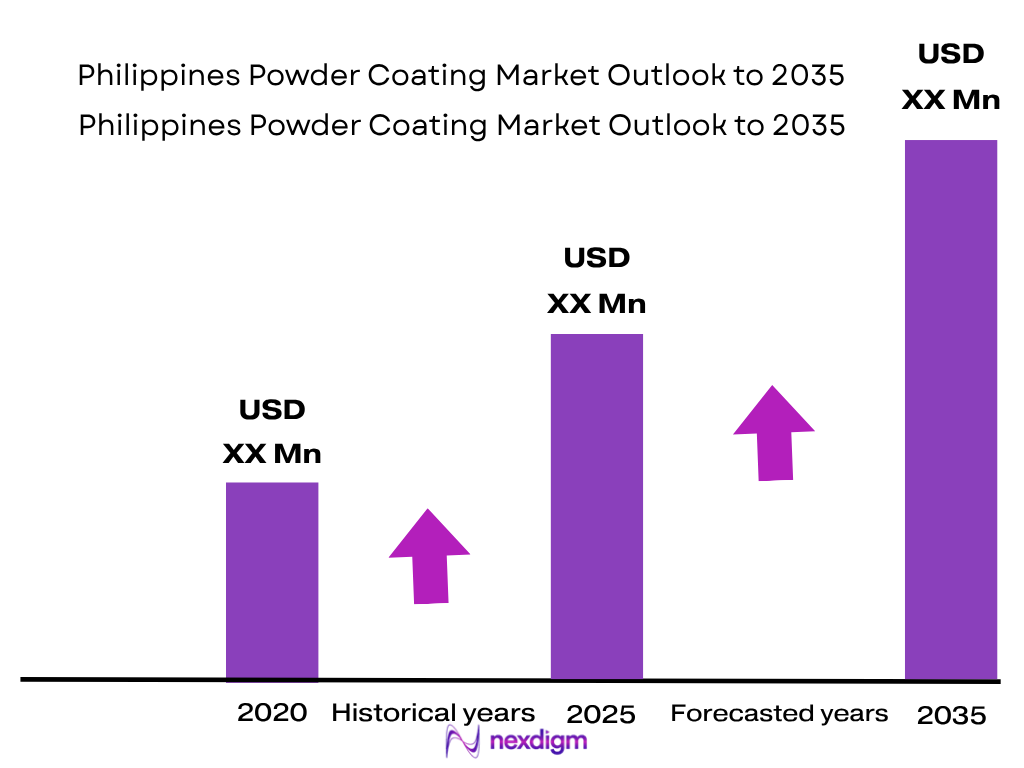
The Philippines Powder Coating Market is valued at approximately USD ~ million, with the forecast CAGR for 2026–2035 placed at ~% as a placeholder. Demand is supported by construction, electronics, metal fabrication, appliances and industrial equipment. Total construction value increased from PHP 515.30 billion to PHP 563.89 billion, while manufactured-goods exports reached USD 58.39 billion. Electronic products alone generated USD 39.09 billion, sustaining powder-coatable equipment, cabinets, frames and industrial components.
CALABARZON, National Capital Region and Central Luzon dominate the Philippines Powder Coating Market because they combine construction, industrial parks, electronics, automotive suppliers and metal fabrication. Construction value reached PHP 118.37 billion in CALABARZON, PHP 112.84 billion in NCR and PHP 76.50 billion in Central Luzon. CALABARZON also accounted for the largest regional share of Philippine industry activity, reinforcing its position as the principal cluster for powder-coated building components, machinery and fabricated products.
Market Segmentation
By Resin Chemistry
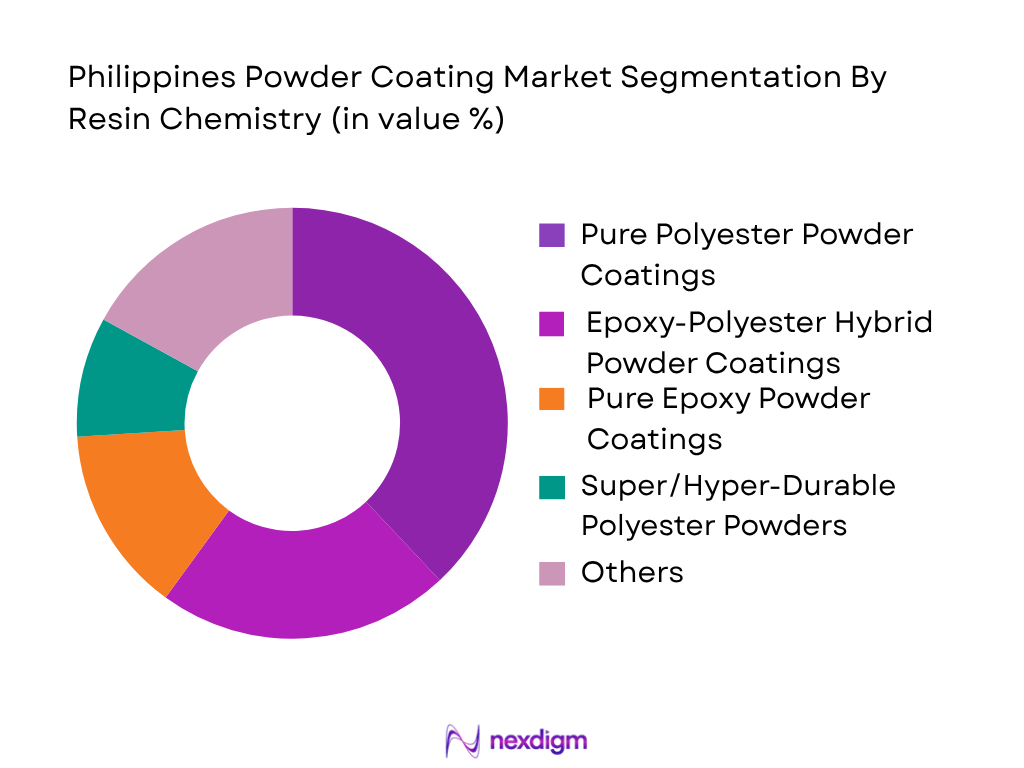
The Philippines Powder Coating Market is segmented into pure polyester, epoxy-polyester hybrid, pure epoxy, super-durable polyester, polyurethane, acrylic, fluoropolymer and thermoplastic powder coatings. Pure polyester powder coatings dominate because the Philippines has substantial demand from architectural aluminum, roofing accessories, furniture, appliances, outdoor equipment and fabricated building products exposed to high humidity, ultraviolet radiation and coastal conditions. Polyester chemistry provides better exterior weatherability than epoxy-dominant systems while maintaining color flexibility and application efficiency. The country’s construction value reached PHP 563.89 billion, including PHP 250.86 billion of non-residential construction, creating a large substrate base for windows, doors, railings, façades, HVAC housings and other powder-coated components. Epoxy-polyester hybrids remain important for indoor furniture, appliances and electrical enclosures, while pure epoxy powders serve corrosion-protection and functional applications. Super-durable polyester and fluoropolymer systems occupy smaller but increasingly strategic positions in premium architectural projects requiring extended gloss and color retention.
By End-Use Industry
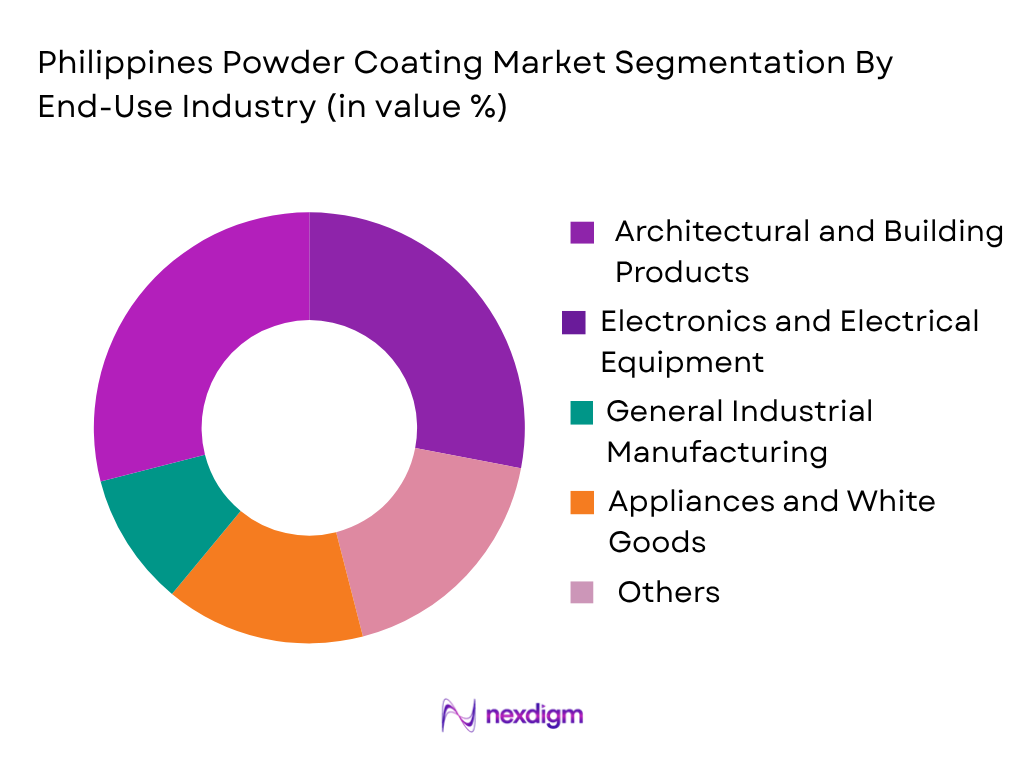
The Philippines Powder Coating Market is segmented into architectural and building products, electronics and electrical equipment, general industrial manufacturing, appliances, furniture, automotive components, HVAC, marine, machinery and renewable-energy equipment. Architectural and building products dominate the end-use segment because construction activity creates recurring demand for powder-coated aluminum extrusions, railings, gates, window systems, façade components, metal roofing accessories and structural fixtures. The country recorded 180,341 construction projects covering 42.84 million square meters of floor area, with total construction value of PHP 563.89 billion. Non-residential construction accounted for PHP 250.86 billion, while residential construction contributed PHP 248.65 billion. Electronics also represents a strategically important application base because exports of electronic products reached USD 39.09 billion, supporting coated racks, frames, housings, cabinets and production equipment. The Philippines’ combination of building activity and export-oriented manufacturing therefore gives powder coatings a diversified end-use structure.
Competitive Landscape
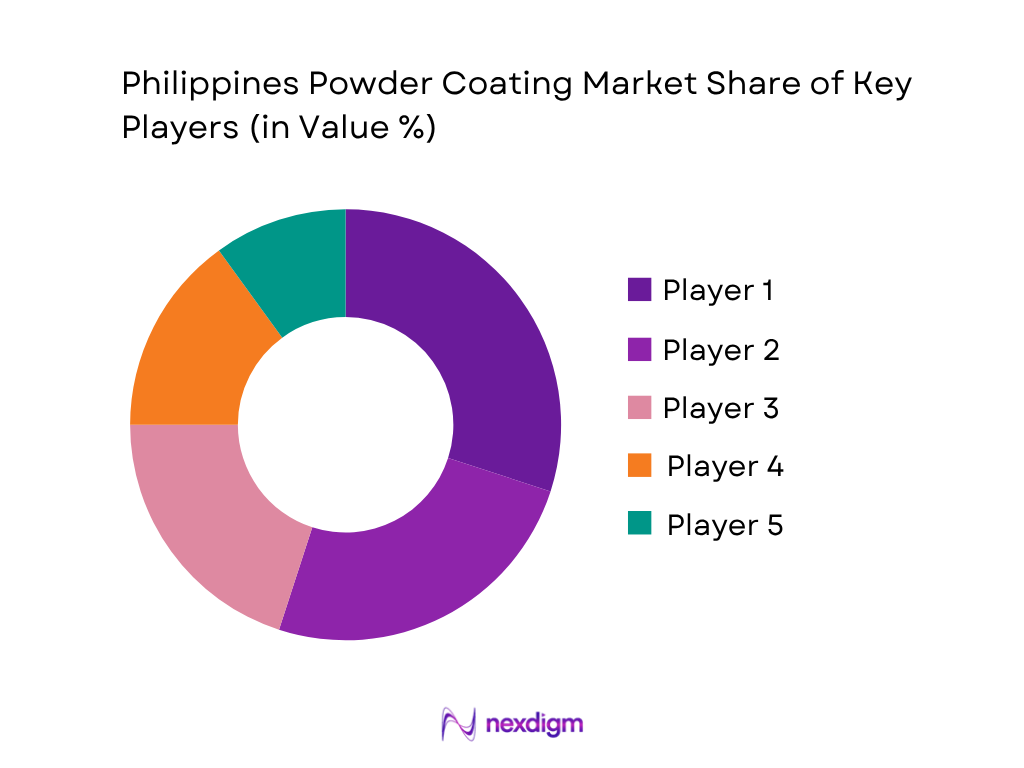
The Philippines Powder Coating Market is served by global powder-coating manufacturers, regional Asian suppliers, local paint companies and industrial distributors. AkzoNobel Interpon, Jotun, PPG, Nippon Paint and Axalta are positioned around architectural durability, industrial protection, functional coatings and technical support. Competition is shaped by local inventory, access to ASEAN production facilities, color-matching capability, OEM approvals and service support rather than powder chemistry alone. Suppliers able to provide super-durable polyester, low-bake systems, corrosion-protection powders and small-batch custom colors have stronger differentiation in the country’s fragmented applicator ecosystem.
| Major Player | Establishment Year | Headquarters | Resin Chemistry Breadth | Key Applications | Philippines / ASEAN Supply | Architectural Capability | Functional Powder Capability | Technical Support |
| AkzoNobel – Interpon | 1994 | Amsterdam, Netherlands | ~ | ~ | ~ | ~ | ~ | ~ |
| Jotun | 1926 | Sandefjord, Norway | ~ | ~ | ~ | ~ | ~ | ~ |
| PPG | 1883 | Pittsburgh, US | ~ | ~ | ~ | ~ | ~ | ~ |
| Nippon Paint | 1881 | Tokyo, Japan | ~ | ~ | ~ | ~ | ~ | ~ |
| Axalta Coating Systems | 2013* | Glen Mills, US | ~ | ~ | ~ | ~ | ~ | ~ |
Philippines Powder Coating Market Analysis
Growth Drivers
Construction and Architectural Metal Finishing Expansion
The Philippines Powder Coating Market is supported by expanding construction activity that generates demand for powder-coated aluminum extrusions, windows, doors, railings, façades, roofing accessories, gates, HVAC housings and fabricated structural components. Philippine Statistics Authority data show 180,341 approved construction projects in 2024, covering 42.84 million square meters and representing PHP 563.89 billion in construction value, compared with PHP 515.30 billion in 2023. Non-residential construction alone reached PHP 250.86 billion, while residential projects contributed PHP 248.65 billion. CALABARZON recorded PHP 118.37 billion of construction, followed by the National Capital Region at PHP 112.84 billion and Central Luzon at PHP 76.50 billion, aligning powder demand with the country’s major industrial and fabrication corridors. The World Bank places Philippine GDP at USD 461.67 billion in 2024, compared with USD 437.06 billion in 2023, while GDP per capita reached USD 3,984.8. This expanding construction and economic base supports polyester and super-durable powder coatings that provide weatherability, color retention and corrosion resistance for tropical exterior applications.
Electronics, Electrical Equipment and Industrial Manufacturing Base
The Philippines Powder Coating Market benefits from a sizeable manufacturing ecosystem supporting metal enclosures, machinery frames, electronics-production equipment, electrical cabinets, racks, appliance components and fabricated industrial products. Philippine Statistics Authority data show manufacturing gross value added at current prices increasing from PHP 3.946 trillion in 2023 to PHP 4.146 trillion in 2024, while constant-price manufacturing GVA increased from PHP 3.781 trillion to PHP 3.921 trillion. The country’s electronic-product exports reached USD 39.09 billion in 2024, while total manufactured-goods exports reached USD 58.39 billion, highlighting the scale of export-oriented industrial activity requiring machinery, support equipment and coated metal components. The Board of Investments approved PHP 31.67 billion of manufacturing investments in 2024, and manufacturing approvals increased to PHP 62.16 billion in 2025, demonstrating continued additions to the industrial asset base. World Bank data place Philippine GDP at USD 461.67 billion in 2024 and USD 487.09 billion in 2025. These conditions sustain demand for epoxy, hybrid, polyester, dielectric and corrosion-resistant powder technologies across electronics, appliances, machinery and industrial fabrication.
Market Challenges
High Dependence on Imported Raw Materials and Industrial Inputs
The Philippines Powder Coating Market faces substantial supply-chain exposure because polyester resins, epoxy resins, crosslinkers, titanium dioxide, pigments, specialty additives, application equipment and certain finished powders are sourced through international supply channels. Philippine Statistics Authority data show total merchandise imports of USD 127.60 billion in 2024, compared with USD 126.21 billion in 2023. Imports of raw materials and intermediate goods alone reached USD 46.47 billion, while capital-goods imports amounted to USD 35.73 billion. China supplied USD 32.83 billion of imported goods, followed by Indonesia at USD 10.64 billion, Japan at USD 10.11 billion and South Korea at USD 9.63 billion, demonstrating concentration across regional supply networks. Iron and steel imports also recorded an annual value increase of USD 520.26 million, reflecting continued dependence on imported industrial inputs serving metal-processing markets. World Bank data place Philippine GDP at USD 461.67 billion in 2024 and GDP per capita at USD 3,984.8. For powder manufacturers and applicators, this import structure increases exposure to shipping disruptions, longer replenishment cycles and qualification constraints for specialty resin and additive systems.
Energy-Intensive Curing and Coating-Line Efficiency Constraints
Powder coating requires pretreatment, compressed air, spray-booth ventilation, material recovery and thermal curing, making electricity and oven productivity important operational challenges for Philippine applicators. Department of Energy statistics show industrial electricity consumption increasing from 29,493 GWh in 2023 to 31,074 GWh in 2024, while commercial electricity consumption rose from 26,236 GWh to 28,033 GWh. Luzon alone accounted for 20,305,933 MWh of industrial electricity consumption in 2024, which is particularly relevant because Metro Manila, CALABARZON and Central Luzon contain dense concentrations of metal fabricators, electronics manufacturers and industrial coating operations. Conventional thermoset powders require components to reach prescribed metal temperatures for adequate curing, creating additional energy requirements for thick steel parts, large frames and batch-loaded ovens. The challenge occurs within a substantial manufacturing economy: Philippine Statistics Authority data place manufacturing gross value added at PHP 4.146 trillion in 2024, while World Bank data record national GDP of USD 461.67 billion. These operating conditions increase the need for low-bake formulations, shorter cure cycles, improved oven loading, infrared-assisted curing and automated powder recovery to enhance finishing-line productivity.
Market Opportunities
Low-Bake, Automated and High-Efficiency Powder Coating Systems
Low-bake and automated powder coating technologies present a significant future opportunity because the Philippines already has a large manufacturing and investment base requiring higher finishing productivity. Industrial electricity consumption reached 31,074 GWh in 2024, while manufacturing gross value added stood at PHP 4.146 trillion, providing a sizeable installed base of factories where curing efficiency and throughput improvement can create operational value. The Board of Investments approved PHP 1.62 trillion of investments during 2024, including PHP 31.67 billion in manufacturing projects. Manufacturing approvals subsequently reached PHP 62.16 billion in 2025, while another PHP 5.3 billion was approved during January-February 2026. These current investments create future demand for powder booths, automated reciprocators, recovery systems and low-temperature formulations across newly established or expanded production lines. The World Bank records Philippine GDP at USD 461.67 billion in 2024 and USD 487.09 billion in 2025, reinforcing the economy’s expanding industrial base. Powder suppliers that combine low-cure temperature, reliable corrosion performance, thinner film capability and technical line support can target manufacturers seeking greater production throughput without proportionately increasing curing and finishing energy requirements.
Renewable Energy, Electrical Infrastructure and Functional Powder Applications
The Philippines’ expanding energy and infrastructure investment pipeline creates future opportunities for powder coatings used on electrical cabinets, switchgear, inverter housings, solar mounting components, battery enclosures, control equipment and other fabricated systems. The Board of Investments approved PHP 1.38 trillion of renewable-energy investments in 2024, within total approvals of PHP 1.62 trillion. In 2025, energy-sector investment approvals reached PHP 970.09 billion, while transportation and storage attracted PHP 230.06 billion and manufacturing secured PHP 62.16 billion. During January-November 2025, 78 strategic projects valued at PHP 1.92 trillion received Green Lane certification, and the first half of 2026 produced PHP 461.8 billion of BOI-approved investment. These existing project commitments provide an industrial base for future demand for corrosion-resistant polyester, dielectric epoxy, heat-resistant and other functional powder systems. Electronic-product exports of USD 39.09 billion in 2024 further demonstrate the country’s electrical and electronics capabilities. World Bank data place Philippine GDP at USD 461.67 billion in 2024, providing the macroeconomic foundation for continued infrastructure investment and higher-value finishing technologies serving renewable-energy and electrical-equipment applications.
Future Outlook
The Philippines Powder Coating Market is expected to expand at approximately ~% CAGR during 2026–2035, using the requested placeholder forecast. Growth is likely to be driven by construction, electronics, industrial parks, appliance manufacturing and improved coating-line automation. Construction remains a substantial underlying demand base. Final PSA data show total construction value of PHP 563.89 billion, with CALABARZON, NCR and Central Luzon jointly accounting for PHP 307.70 billion. These regions should continue supporting architectural polyester powders, durable exterior systems and powder-coated aluminum components.
Electronics offers another high-value pathway. Philippine electronic-product exports reached USD 39.09 billion, while manufactured-goods exports totaled USD 58.39 billion. Powder suppliers can therefore target semiconductor-related equipment, electrical enclosures, racks, machine frames and industrial cabinets with dielectric, corrosion-resistant and thin-film technologies.
Regional localization also creates opportunity. CALABARZON represents the largest industrial contribution among Philippine regions, followed by NCR and Central Luzon, making these locations logical priorities for warehousing, color-matching, technical service and distributor expansion. Low-temperature cure, super-durable polyester and high-efficiency application systems should become increasingly relevant as applicators modernize finishing operations.
Major Players
- Akzo Nobel Philippines, Inc. – Interpon
- Jotun Philippines, Inc.
- PPG Philippines
- Nippon Paint Philippines, Inc.
- Axalta Coating Systems Philippines
- TIGER Coatings Philippines
- Kansai Paint Philippines
- Berger Powder Coatings
- Asian Coatings Philippines
- Pulver Kimya
- ST Powder Coatings
- Neokem
- IFS Coatings
- TCI Powder Coatings
- Protech Group / Oxyplast
Key Target Audience
- Powder Coating Manufacturers
- Polyester Resin, Epoxy Resin, Pigment and Additive Suppliers
- Architectural Aluminum Extruders and Metal Fabricators
- Electronics, Appliance and Industrial OEMs
- Powder Coating Applicators and Job-Coating Companies
- Industrial Coating Distributors and Equipment Suppliers
- Investments and Venture Capitalist Firms
- Government and Regulatory Bodies (Department of Trade and Industry, Department of Environment and Natural Resources, Environmental Management Bureau, Board of Investments, Philippine Economic Zone Authority, Bureau of Philippine Standards)
Research Methodology
Step 1: Identification of Key Variables
The initial phase constructs an ecosystem map covering powder manufacturers, ASEAN suppliers, distributors, applicators, aluminum fabricators, electronics companies and industrial OEMs. Key variables include resin chemistry, powder consumption volume, coated surface area, curing technology, regional demand clusters, import dependency, technical specifications and end-use application intensity.
Step 2: Market Analysis and Construction
Historical demand is developed through top-down and bottom-up approaches. Top-down analysis evaluates construction activity, electronics exports, appliance production, industrial output and regional manufacturing concentration. Bottom-up analysis assesses powder suppliers, distributor throughput, job-coater consumption, captive OEM coating lines and imported powder volumes to establish market value and volume estimates.
Step 3: Hypothesis Validation and Expert Consultation
Market hypotheses are validated through structured interviews and CATI discussions with powder suppliers, distributors, coating applicators, metal fabricators, OEM procurement teams and equipment providers. These consultations evaluate resin preferences, color requirements, powder recovery, curing conditions, supplier qualification, stock availability and switching behavior across major end-use industries.
Step 4: Research Synthesis and Final Output
The final phase triangulates primary interviews with PSA construction data, trade statistics, industrial activity and supplier information. Powder consumption is reconciled with coated surface area, average film thickness and application efficiency. Forecast scenarios incorporate construction activity, industrial localization, electronics manufacturing, architectural demand, low-bake technology adoption and liquid-to-powder conversion.

- Executive Summary
- Research Methodology (Market Definition and Scope, Philippines Powder Coating Taxonomy, Thermoset and Thermoplastic Powder Classification, Resin Chemistry Mapping, Functional and Decorative Powder Classification, Substrate Mapping, Surface Pretreatment Assessment, Electrostatic Application Technology Assessment, Cure Technology Assessment, Film Thickness Assessment, Powder Recovery and Reclaim Assessment, Market Sizing Framework)

- Definition and Scope
- Philippines Powder Coating Industry Evolution and Technology Development
- Powder Coating Manufacturing and Formulation Process
- Powder Coating Value Chain Analysis
- Philippines Powder Coating Supply Chain Analysis
- Resin, Pigment, Additive and Filler Ecosystem Analysis
- Philippines Powder Coating Import Dependency and Localization Assessment
- OEM Powder Coating Application Architecture and Job-Coater Solution Framework

- Growth Drivers (Expansion of Residential and Commercial Construction, Growth of Aluminum Extrusion Manufacturing, Rising Automotive and Auto Component Production, Expansion of Appliance Manufacturing, Increasing Industrial Metal Fabrication, Infrastructure Development, Liquid-to-Powder Conversion, Increasing Demand for Corrosion-Resistant Finishes)
- Market Challenges (Dependence on Imported Polyester and Epoxy Resins, Raw Material Supply Volatility, Limited Domestic Powder Manufacturing Scale, Energy-Intensive Cure Requirements, Pretreatment Quality Variation, Fragmented Job-Coater Ecosystem, Price Competition from Imported Powders, Skilled Applicator Constraints)
- Market Opportunities (Super-Durable Architectural Powders, Low-Bake and Fast-Cure Powders, EV Battery and Electrical Insulation Powders, Marine Corrosion-Protection Powders, Antimicrobial Powder Coatings, Automated Powder Application Systems, Localized Specialty Powder Manufacturing, Liquid-to-Powder Line Conversion)
- Market Trends (TGIC-Free Polyester Adoption, Low-Bake Fast-Cure Systems, Super-Durable Architectural Powders, Metallic and Textured Finishes, Functional Powder Coatings, Robotic Powder Application, Powder Recovery Systems, Sustainable Solvent-Free Finishing)
- Regulatory and Standards Landscape (Department of Environment and Natural Resources Environmental Requirements, Environmental Management Bureau Air Quality Standards, Department of Trade and Industry Product Standards, Bureau of Philippine Standards Requirements, Occupational Safety and Health Standards, Philippine Green Building Code Requirements, Hazardous Chemical Handling Requirements, ASTM and ISO Powder Coating Test Standards)
- SWOT Analysis
- Porter’s Five Forces Analysis
- PESTLE Analysis
- Stakeholder Ecosystem
- Competition Ecosystem

- By Market Value (2020-2025)
- By Powder Coating Consumption Volume (2020-2025)
- By Coated Surface Area (2020-2025)
- By Domestic Production Volume (2020-2025)
- By Import Volume (2020-2025)
- By Export Volume (2020-2025)
- By Average Selling Price (2020-2025)
- By Thermoset Powder Consumption (2020-2025)
- By Thermoplastic Powder Consumption (2020-2025)

- By Resin Chemistry (In Value %)
Pure Polyester Powder Coatings
TGIC Polyester Powder Coatings
TGIC-Free Polyester Powder Coatings
Super-Durable Polyester Powder Coatings
Epoxy Powder Coatings
Epoxy-Polyester Hybrid Powder Coatings
Polyurethane Powder Coatings
Acrylic Powder Coatings
Fluoropolymer Powder Coatings
Silicone Polyester Powder Coatings
Nylon Powder Coatings
Polyethylene Powder Coatings
Other Specialty Thermoplastic Powders - By Coating Technology (In Value %)
Thermosetting Powder Coatings
Thermoplastic Powder Coatings
Low-Temperature Cure Powder Coatings
Low-Bake Fast-Cure Powder Coatings
Ultra-Low-Bake Powder Coatings
UV-Curable Powder Coatings
Thin-Film Powder Coatings
High-Temperature Resistant Powder Coatings - By Functional Performance (In Value %)
Decorative Powder Coatings
Corrosion-Resistant Powder Coatings
Super-Durable Architectural Powders
High-Temperature Powder Coatings
Electrical Insulation and Dielectric Powders
Antimicrobial Powder Coatings
Anti-Graffiti Powder Coatings
Scratch-Resistant Powder Coatings
Chemical-Resistant Powder Coatings
Marine Corrosion-Protection Powders
Fire-Retardant Powder Coatings
Fusion-Bonded Epoxy Powders
Rebar Powder Coatings
Zinc-Rich and Zinc-Free Powder Primers - By End-Use Industry (In Value %)
Architectural Aluminum and Building Products
General Industrial Manufacturing
Automotive and Auto Components
Appliances and White Goods
Electrical and Electronics
Furniture and Metal Fabrication
HVAC and Refrigeration Equipment
Marine and Shipbuilding
Industrial Machinery and Equipment
Infrastructure and Construction
Agricultural Equipment
Oil and Gas Equipment
Renewable Energy Equipment
Telecommunication Equipment - By Distribution Channel (In Value %)
Direct Powder Manufacturer-to-OEM Sales
Direct Manufacturer-to-Job Coater Sales
Authorized Powder Coating Distributors
Industrial Paint and Coating Distributors
Regional Stocking Warehouses
Dealer and Reseller Networks
Equipment and Powder Bundled Distribution
Project-Specific Supply Contracts
Online B2B Industrial Platforms
Custom Color and Small-Batch Channels - By Region (In Value %)
Luzon
Metro Manila
Central Luzon
CALABARZON
Ilocos Region
Bicol Region
Visayas
Central Visayas
Western Visayas
Eastern Visayas
Mindanao
Davao Region
Northern Mindanao
SOCCSKSARGEN
Zamboanga Peninsula

- Market Share of Major Players (By Revenue, Volume, Resin Chemistry, Powder Technology, End-Use Industry, Application Type, Market Type, Distribution Channel)
- Cross Comparison Parameters (Resin Chemistry and Powder Technology Breadth, Philippines and ASEAN Supply Footprint, Low-Temperature and Fast-Cure Technology Capability, Super-Durable Architectural Powder Portfolio Strength, Functional and High-Performance Powder Capability, Marine and High-Corrosion Protection Capability, Custom Color Matching and Technical Application Support, Sustainable and TGIC-Free Low-Energy Powder Portfolio)
- SWOT Analysis of Major Players
- Competitive Positioning Matrix
- Product and Technology Portfolio Benchmarking
- Pricing and Distribution Network Benchmarking
- Market Entry Strategy Assessment
- Detailed Profiles of Major Companies
Akzo Nobel Philippines, Inc. – Interpon
Jotun Philippines, Inc.
PPG Philippines
Nippon Paint Philippines, Inc.
Axalta Coating Systems Philippines
TIGER Coatings Philippines
Kansai Paint Philippines
Berger Powder Coatings
Asian Coatings Philippines
Pulver Kimya
ST Powder Coatings
Neokem
IFS Coatings
TCI Powder Coatings
Protech Group / Oxyplast

- Buyer Segmentation
- OEM Procurement Behaviour
- Supplier Selection Criteria
- Buyer Pain Points
- Technology Adoption Assessment
- Replacement and Repurchase Behaviour

- By Market Value (2026-2035)
- By Powder Coating Consumption Volume (2026-2035)
- By Coated Surface Area (2026-2035)
- By Domestic Production Volume (2026-2035)
- By Import Volume (2026-2035)
- By Export Volume (2026-2035)
- By Average Selling Price (2026-2035)
- By Thermoset Powder Consumption (2026-2035)
- By Thermoplastic Powder Consumption (2026-2035)


 Request a Sample
 Ask for Customization
 Get a Quote
 Enquire Now