
 Download PDF
Market Overview
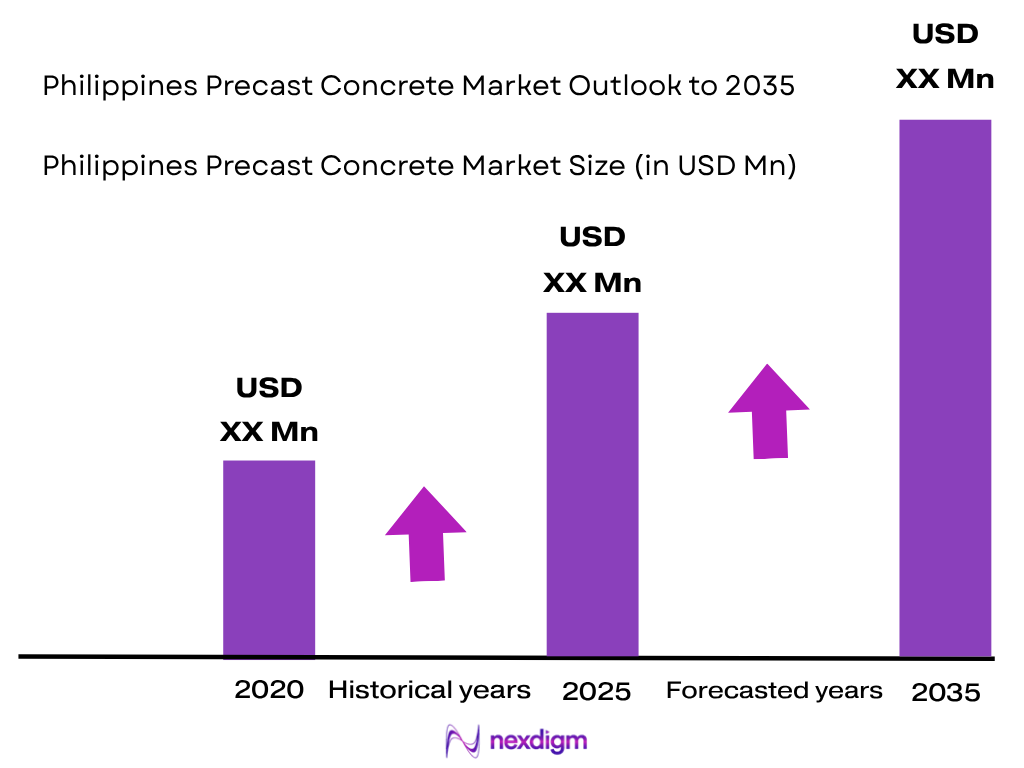
The Philippines Precast Concrete Market is valued at approximately USD ~ million, supported by expanding building and infrastructure activity. Approved constructions increased from 171,268 to 180,341, while associated floor area increased from 41.47 million square meters to 42.84 million square meters. Residential floor area increased from 18.13 million to 19.75 million square meters, strengthening demand for precast piles, structural components, wall systems and flooring products.
CALABARZON, Metro Manila and Central Luzon represent the principal precast demand and production corridor because of concentrated residential, industrial, commercial and infrastructure construction. CALABARZON recorded 41,471 approved constructions, while Central Luzon registered 22,824. Residential construction floor area reached 4.33 million square meters in CALABARZON and 3.57 million square meters in NCR, supporting precast demand around Rizal, Cavite, Laguna, Batangas, Bulacan, Pampanga and metropolitan Manila.
Market Segmentation
By Product Type
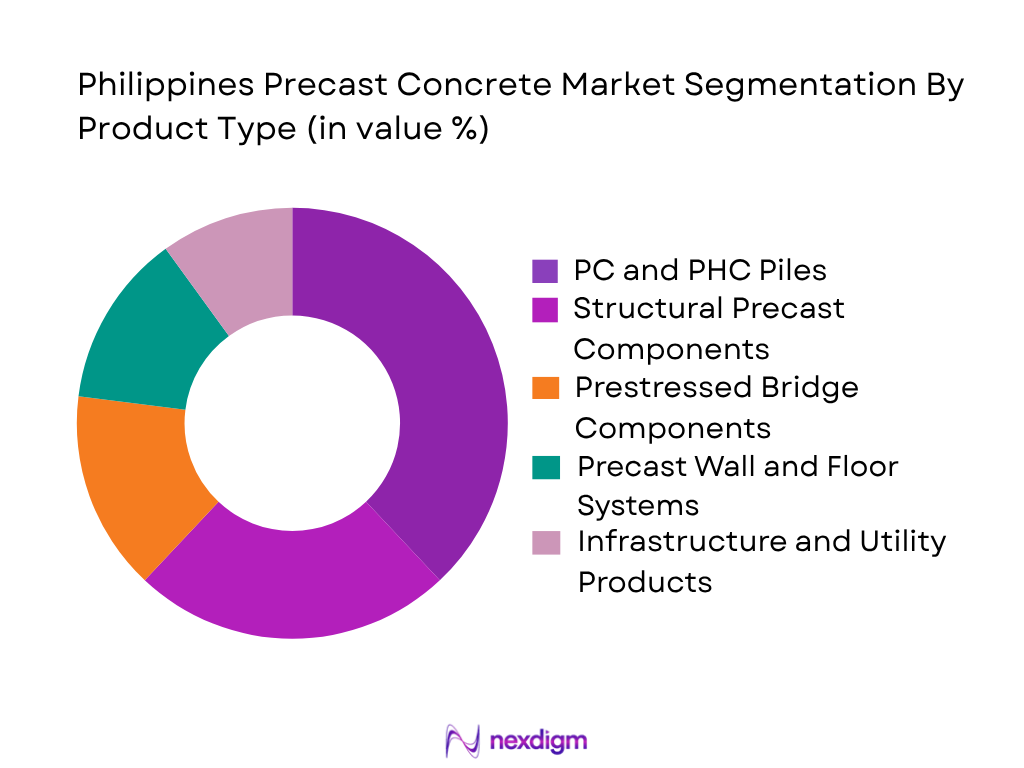
The Philippines Precast Concrete Market is segmented into PC and PHC piles, structural precast components, prestressed bridge components, wall and floor systems, and infrastructure and utility products. PC and PHC piles hold a dominant position because foundation requirements across high-rise buildings, industrial facilities, bridges, warehouses, ports and infrastructure projects create substantial demand for factory-produced piling systems. The Philippines’ challenging soil conditions in several major urban and coastal development areas further support deep-foundation solutions. Prestressed piles provide controlled concrete strength, dimensional consistency and rapid installation compared with constructing equivalent structural components entirely on-site. Structural precast beams, columns and girders constitute another important category as contractors seek faster construction cycles. Bridge components benefit from road and transport investment, while wall and floor systems are gaining relevance through industrialized building construction. Box culverts, pipes and drainage structures provide an additional demand stream linked to flood-control, drainage, water and road-development programs.
By Application
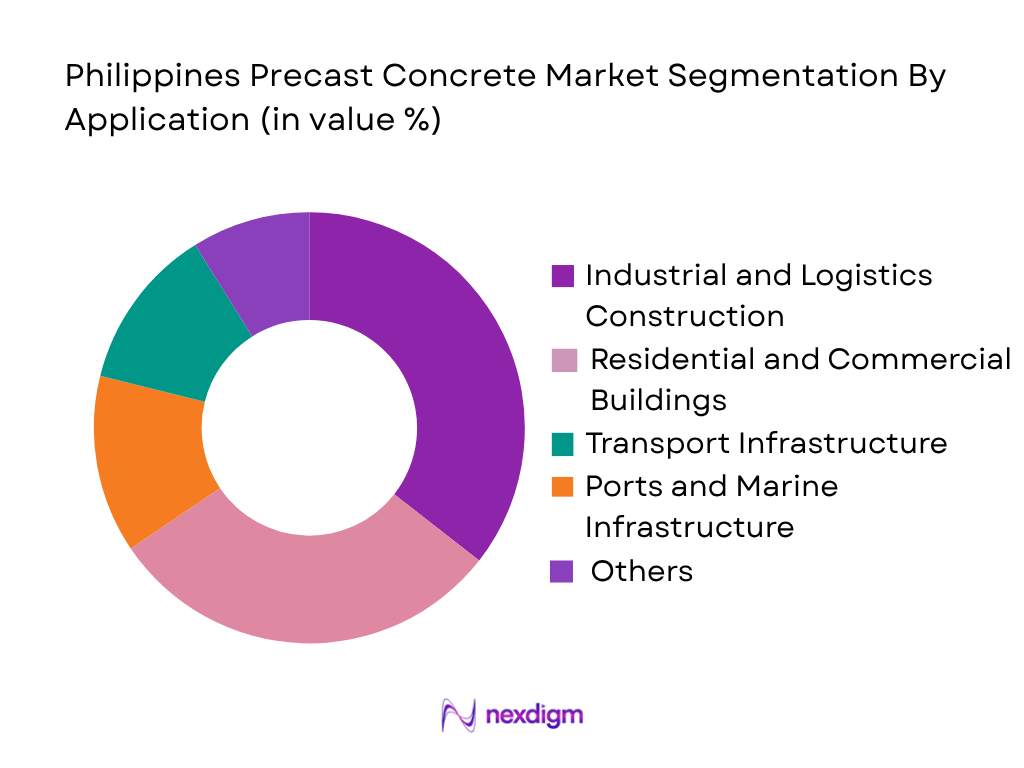
The Philippines Precast Concrete Market is segmented into industrial and logistics construction, residential and commercial buildings, transport infrastructure, ports and marine structures, and water, drainage and utility infrastructure. Industrial and logistics construction holds the leading position because factories, warehouses, logistics parks and industrial estates require repetitive structural elements, pile foundations and rapid construction schedules that are well suited to precast technology. CALABARZON and Central Luzon are particularly important because they combine industrial development with proximity to Metro Manila’s consumer and logistics network. Residential and commercial projects create demand for precast walls, columns, beams, slabs and piles, while transportation projects require girders, piles and bridge elements. Ports and marine projects favor prestressed piling because of structural and durability requirements. Flood-control and drainage programs support demand for standardized box culverts, concrete pipes, manholes and related precast components, broadening the market beyond conventional building construction.
Competitive Landscape
The Philippines Precast Concrete Market comprises dedicated precast producers, large construction groups with captive manufacturing capabilities and concrete-product companies supplying infrastructure components. Competition is influenced by manufacturing capacity, prestressing technology, structural engineering capability, casting-yard location, heavy-haul logistics and access to major contractors and developers. Megawide represents an important industrialized-construction participant, operating a large precast and construction-solutions facility in Rizal Province. Its precast operations illustrate the increasing integration of factory manufacturing with construction delivery.
| Major Player | Establishment Year | Headquarters / Main Base | Core Precast Capability | Piling Capability | Structural Precast Capability | Infrastructure Exposure | Manufacturing Technology | Project Delivery Capability |
| Megawide Construction Corporation | 1997 | Quezon City | ~ | ~ | ~ | ~ | ~ | ~ |
| EEI Corporation | 1931 | Quezon City | ~ | ~ | ~ | ~ | ~ | ~ |
| First Balfour, Inc. | 1969 | Metro Manila | ~ | ~ | ~ | ~ | ~ | ~ |
| Monocrete Construction Philippines, Inc. | 1993 | Philippines | ~ | ~ | ~ | ~ | ~ | ~ |
| Pacific Concrete Products, Inc. | 1966 | Philippines | ~ | ~ | ~ | ~ | ~ | ~ |
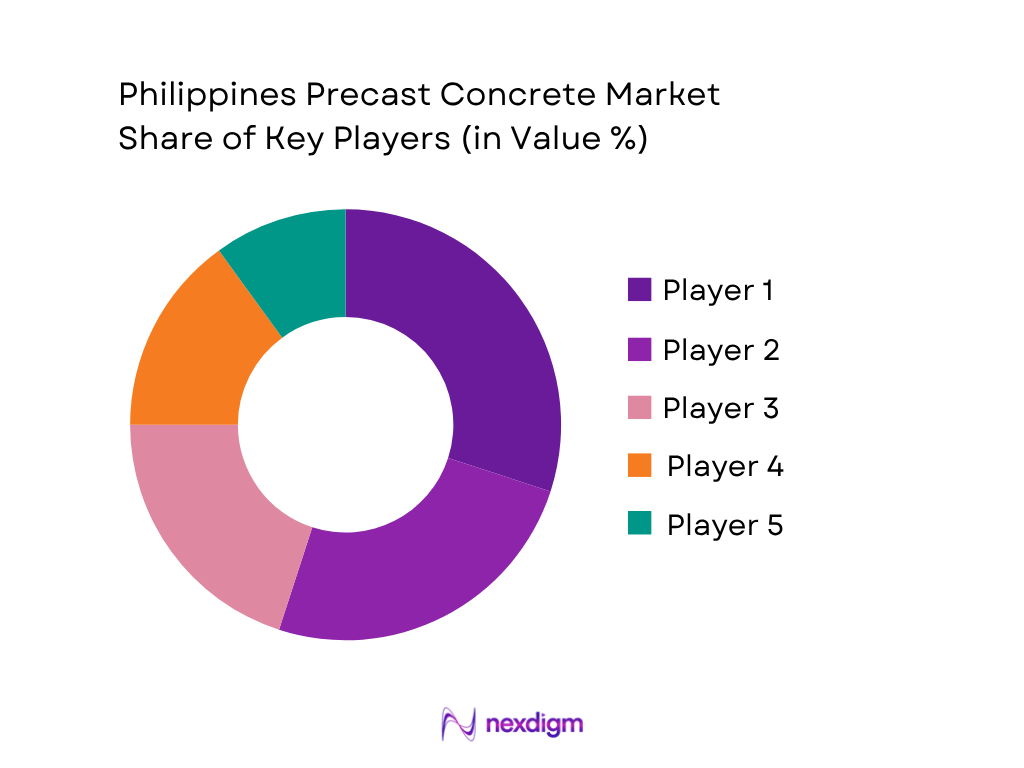
Philippines Precast Concrete Market Analysis
Growth Drivers
Infrastructure Construction and Bridge Programs Supporting Prestressed and Structural Precast Demand
Philippine infrastructure development provides a direct demand base for PC and PHC piles, prestressed bridge girders, precast beams, columns, drainage components and other factory-produced concrete elements. In 2024, the Department of Public Works and Highways completed or maintained 1,446.772 kilometers of roads, rehabilitated or upgraded another 335.876 kilometers, constructed 233.166 kilometers of new roads, and widened 191.783 kilometers. Bridge activity was also material to precast suppliers: newly constructed and replacement bridges represented 3,822.71 lineal meters and 36,468.65 square meters, while 457 bridges were maintained or rehabilitated. These projects create direct applications for prestressed girders, piles, bridge beams, parapets, drainage units and standardized concrete components. Flood infrastructure further broadens the addressable product base: public works implementation delivered 1,978 flood-mitigation structures and drainage systems and 1,101 constructed or rehabilitated facilities within major river basins and principal rivers during 2024. The construction market supporting these infrastructure programs was also substantial. Philippine Statistics Authority records show 180,341 approved constructions covering 42,837,581 square meters in 2024, compared with 171,268 constructions covering 41,472,200 square meters in 2023. Non-residential activity alone accounted for 39,238 projects and 22,380,982 square meters, creating additional opportunities for piles, beams, columns, panels and flooring systems. The demand environment remained active in 2025, with approved construction reaching 181,832 projects covering 45,236,312 square meters.
Industrial, Commercial and Residential Construction Expanding the Precast Application Base
The expansion and diversification of Philippine building construction provides another significant growth driver for the precast concrete industry because PC/PHC piles, structural frames, wall panels, slabs and other standardized elements can be deployed across factories, warehouses, commercial buildings and large residential developments. Philippine Statistics Authority data show that the country recorded 180,341 approved constructions in 2024, compared with 171,268 in 2023, while total permitted floor area increased from 41,472,200 square meters to 42,837,581 square meters. Residential construction accounted for 116,427 projects and 19,748,190 square meters in 2024, compared with 112,399 projects and 18,131,455 square meters in 2023. This provides a large addressable building base for foundation piles, precast stairs, wall elements, structural frames and flooring systems, particularly where developers seek repeatability across multi-building developments. Non-residential construction is even more relevant for large structural precast components: approved projects increased from 35,772 to 39,238, with 22,380,982 square meters of floor area in 2024. Current investment activity reinforces the industrial opportunity. The Philippine Board of Investments approved PHP 1.62 trillion of investment commitments as of December 17, 2024, including PHP 31.67 billion in manufacturing, PHP 37.26 billion in mass housing, PHP 121.20 billion in air and water transport, and PHP 16.28 billion in water supply, sewerage, waste management and remediation activities.
Market Challenges
Uneven Construction Activity and Project Pipeline Volatility Affecting Precast Plant Utilization
The Philippines Precast Concrete Market faces significant exposure to fluctuations in construction activity because precast production requires advance mold preparation, reinforcement fabrication, prestressing operations, casting schedules, storage space and coordinated transport, making factory utilization dependent on predictable project pipelines. Although full-year approved construction increased to 181,832 projects and 45,236,312 square meters in 2025, monthly statistics demonstrate substantial volatility beneath the annual total. In November 2025, approved construction declined to 12,281 projects, compared with 14,066 in November 2024, while total floor area fell from 3,860,747 square meters to 2,753,477 square meters. Residential floor area during the same monthly comparison moved from 1,894,280 square meters to 1,147,448 square meters, while non-residential floor area decreased from 1,888,627 square meters to 1,564,866 square meters. December also remained soft: approved construction reached 11,411 projects and 2,669,759 square meters in December 2025, compared with 12,127 projects and 2,908,940 square meters in December 2024. The volatility extended into 2026. January recorded 13,577 approved projects, but total floor area stood at only 2,797,912 square meters, compared with 3,962,768 square meters in January 2025. Residential floor area declined from 1,532,214 square meters to 1,398,887 square meters over the same comparison.
Heavy-Component Logistics, Site Access and Infrastructure Execution Constraints
Transportation and erection remain structural challenges for the Philippines Precast Concrete Market because PC/PHC piles, prestressed girders, columns, beams, wall panels and box culverts are large, heavy products that must move from fixed manufacturing plants to geographically dispersed construction sites. Unlike bagged cement or reinforcing steel, precast components have dimensions and lifting requirements established before dispatch; this makes road geometry, bridge clearances, trailer access, crane availability, storage areas and installation sequencing important determinants of commercial feasibility. Public infrastructure data illustrate why logistics capability is material. DPWH maintained 1,446.772 kilometers of roads in 2024, but only 335.876 kilometers were rehabilitated, reconstructed or upgraded. The department constructed 233.166 kilometers of new roads and widened 191.783 kilometers, while convergence programs delivered 7.198 kilometers of airport access roads, 7.183 kilometers of seaport access roads, 193.202 kilometers of tourism access roads, 77.321 kilometers of industry access roads and 0.413 kilometers of railway-station access roads. These figures demonstrate continuing network development but also highlight the dispersed infrastructure environment through which oversized precast products must travel. Building demand is similarly geographically broad. The Philippines recorded 180,341 approved construction projects covering 42,837,581 square meters in 2024, requiring manufacturers to serve numerous individual sites rather than a single concentrated project cluster. The following year generated 181,832 projects and 45,236,312 square meters, further emphasizing the scale and geographic dispersion of construction.
Market Opportunities
Industrialized and Off-Site Construction Creating Scope for Structural Precast Systems
Industrialized construction represents a substantial future opportunity for the Philippines Precast Concrete Market because the current building pipeline already contains enough residential, commercial and industrial activity to support greater standardization of piles, beams, columns, wall panels and floor components. Philippine Statistics Authority data provide a concrete current demand base: 180,341 construction projects covering 42,837,581 square meters were approved in 2024, including 116,427 residential projects covering 19,748,190 square meters and 39,238 non-residential projects covering 22,380,982 square meters. The building pipeline remained active in 2025, with 181,832 approved projects covering 45,236,312 square meters. The additional 2,398,731 square meters of approved floor area between these two annual observations creates a larger physical base in which off-site structural systems can be specified. Industrial investment provides another important supporting indicator. The Board of Investments recorded PHP 1.62 trillion of approved investments as of December 17, 2024, including PHP 31.67 billion for manufacturing and PHP 37.26 billion for mass housing. These categories are particularly suitable for precast because factories, warehouses and repetitive housing developments frequently use standardized structural dimensions that allow molds and production lines to be reused. Public infrastructure construction provides parallel opportunities for industrialized manufacturing: DPWH completed 3,822.71 lineal meters and 36,468.65 square meters of new and replacement bridge construction during 2024, while maintaining or rehabilitating 457 bridges.
Flood-Control, Drainage and Water Infrastructure Opening New Demand for Precast Components
Flood-control, drainage and water infrastructure provide one of the clearest diversification opportunities for Philippine precast manufacturers because these projects consume standardized, repetitive concrete components that can be efficiently manufactured off-site. Actual 2024 public works performance demonstrates the scale of the addressable infrastructure base: DPWH completed 1,978 flood-mitigation structures and drainage systems and constructed or rehabilitated 1,101 flood-mitigation facilities within major river basins and principal rivers. These projects can incorporate precast box culverts, concrete pipes, catch basins, manholes, channel components, headwalls and other engineered drainage structures. The government’s infrastructure framework also allocated PHP 11.0 billion to flood-mitigation facilities protecting public infrastructure under the Basic Infrastructure Program and PHP 22.9 billion to flood-mitigation structures under the SIPAG program in the 2024 budget framework. The Special Road Fund additionally earmarked PHP 15.232 billion for construction, upgrading, repair and rehabilitation of roads, bridges and road drainage. Private and promoted investment reinforces this infrastructure requirement: Board of Investments approvals for water supply, sewerage, waste management and remediation activities reached PHP 16.28 billion in 2024. Building construction adds another layer of drainage demand. The country recorded 180,341 approved constructions covering 42,837,581 square meters in 2024, followed by 181,832 constructions covering 45,236,312 square meters in 2025.
Future Outlook
The Philippines Precast Concrete Market is forecast to expand at approximately ~% CAGR during 2026–2035, supported by continued urban construction, industrial development, transport infrastructure and increasing adoption of off-site manufacturing. Demand will progressively shift toward higher-strength, factory-controlled and installation-ready structural components.
PC and PHC piles are expected to remain strategically important as industrial estates, warehouses, transport facilities, bridges and large buildings require reliable foundation systems. Producers with centrifugal spinning, prestressing and high-strength concrete capabilities will be better positioned for technically demanding projects.
Major Players
- Megawide Construction Corporation
- EEI Corporation
- First Balfour, Inc.
- Monocrete Construction Philippines, Inc.
- Concrete Stone Corp.
- Pacific Concrete Products, Inc.
- Frey-Fil Corporation
- MGS Construction, Inc.
- D.M. Consunji, Inc.
- Datem, Inc.
- Holcim Philippines, Inc.
- Republic Cement
- PHINMA Construction Materials Group
- Hanjin Heavy Industries and Construction Philippines
- Concrete Aggregates Corporation
Key Target Audience
- Precast and Prestressed Concrete Manufacturers
- PC and PHC Pile Manufacturers
- General and Infrastructure Contractors
- Residential and Commercial Property Developers
- Industrial Estate, Factory and Logistics Developers
- Cement, Aggregate, Reinforcing Steel and Prestressing Strand Suppliers
- Investments and Venture Capitalist Firms
- Government and Regulatory Bodies (Department of Public Works and Highways, Department of Transportation, Philippine Contractors Accreditation Board, Department of Trade and Industry–Bureau of Philippine Standards)
Research Methodology
Step 1: Identification of Key Variables
The initial phase involves constructing an ecosystem map covering precast manufacturers, PC and PHC pile producers, cement and aggregate suppliers, reinforcement and prestressing-strand suppliers, contractors, developers and infrastructure agencies. Critical variables include production capacity, concrete strength, pile dimensions, prestressing technology, girder capability, casting-yard location, transport radius and end-use demand.
Step 2: Market Analysis and Construction
Historical construction and infrastructure information is analyzed using top-down and bottom-up methodologies. Building permits, floor area, infrastructure activity and manufacturer capacity are assessed alongside demand for piles, structural components, bridge products and drainage systems. Manufacturer production capability is reconciled against residential, commercial, industrial and infrastructure construction requirements.
Step 3: Hypothesis Validation and Expert Consultation
Market hypotheses are validated through computer-assisted telephone interviews with precast manufacturers, contractors, developers, structural engineers and construction-material suppliers. Discussions examine plant utilization, product specifications, procurement practices, project lead times, transportation constraints, erection requirements and competition between precast and cast-in-place construction.
Step 4: Research Synthesis and Final Output
Primary findings are triangulated with construction statistics, company disclosures, project pipelines and government infrastructure information. Bottom-up manufacturer assessments are reconciled against construction-demand indicators. The resulting analysis establishes market structure, segmentation, competitive positioning, product demand, manufacturing requirements and the long-term outlook for the Philippines Precast Concrete Market.

- Executive Summary
- Research Methodology (Market Definitions and Assumptions, Philippines Precast Concrete Market Classification, Precast and Prestressed Concrete Scope, Product Mapping, Structural Component Mapping, Infrastructure Product Mapping, PC and PHC Pile Assessment, Prestressed Girder Assessment, Structural Precast Assessment, Precast Wall Panel Assessment, Hollow-Core Slab Assessment, Box Culvert Assessment, Concrete Pipe Assessment, Drainage Product Assessment, Utility Structure Assessment, Bridge Component Assessment, Production Capacity Assessment, Plant Utilization Assessment, Prestressing Bed Capacity Assessment, Supply-Side Assessment, Demand-Side Assessment, Top-Down Market Sizing, Bottom-Up Market Sizing, Primary Industry Interviews, Infrastructure and Construction Project Pipeline Assessment, Data Triangulation, Forecasting Framework)

- Definition and Scope
- Philippines Precast Concrete Industry Evolution and Development of PC Piles, PHC Piles, Prestressed Concrete Girders, Precast Beams and Columns, Precast Wall Panels, Hollow-Core Slabs, Box Culverts, Concrete Pipes, Drainage Structures, Utility Components, Bridge Components, Industrialized Building Systems, High-Strength Precast Concrete, Automated Precast Manufacturing, Low-Carbon Precast Concrete
- Precast Concrete Value Chain Analysis
- Precast Concrete Supply Chain Analysis
- Cement Producers, Aggregate Suppliers, Reinforcing Steel Suppliers, Prestressing Strand Suppliers, Admixture Suppliers, Mold and Formwork Providers, Precast Manufacturing Plants, Prestressing Facilities, Engineering Companies, Heavy Transport Providers, Crane and Erection Contractors, General Contractors, Property Developers, Industrial Estate Developers, DPWH Contractors, Transport Infrastructure Developers, Water Utilities, Government Infrastructure Agencies

- Growth Drivers (DPWH Infrastructure Construction, Bridge Development, Expressway Expansion, Railway and Transit Projects, Metro Manila Urban Infrastructure, Residential Construction, Industrial Estate Expansion, Warehouse and Logistics Development, Flood-Control Infrastructure, Construction Industrialization)
- Market Challenges (High Precast Plant Capital Intensity, Heavy Component Transportation, Oversized Load Logistics, Crane and Erection Requirements, Cement and Reinforcement Input Exposure, Project-Based Capacity Utilization, Skilled Technical Labor Requirements, Quality-Control Requirements, Site Access Constraints, Cast-in-Place Concrete Competition)
- Market Opportunities (PHC Pile Manufacturing, Prestressed Bridge Girders, Segmental Bridge Components, Precast Box Culverts, Flood-Control Components, Hollow-Core Slabs, Precast Structural Frames, Industrial Building Systems, Data Center Construction, Modular Precast Housing, Low-Carbon Precast Concrete, Automated Precast Manufacturing)
- Market Trends (Cast-in-Place to Off-Site Construction Transition, Higher-Strength Concrete Adoption, Prestressed Product Expansion, PHC Pile Adoption, Automated Batching, BIM-Enabled Precast Design, Digital Production Scheduling, Factory Quality Control, Modular Construction, Low-Carbon Cementitious Mixes)
- Government Regulations and Standards (National Structural Code of the Philippines, DPWH Standard Specifications, DPWH Blue Book Requirements, Philippine National Standards for Concrete Products, ACI-Based Structural Requirements, ASTM-Based Precast Testing, Concrete Compressive Strength Requirements, Prestressing Steel Requirements, Reinforcement Standards, Product Accreditation and Materials Testing)
- SWOT Analysis
- Porter’s Five Forces Analysis
- PESTLE Analysis
- Stakeholder Ecosystem
- Precast Concrete Production and Construction Ecosystem

- By Market Value (2020-2025)
- By Precast Concrete Production Volume (2020-2025)
- By Precast Concrete Consumption Volume (2020-2025)
- By Structural Precast Production Volume (2020-2025)
- By PC and PHC Pile Production Volume (2020-2025)
- By Prestressed Girder and Beam Production Volume (2020-2025)
- By Precast Wall Panel Production Volume (2020-2025)
- By Hollow-Core Slab Production Volume (2020-2025)
- By Box Culvert Production Volume (2020-2025)
- By Concrete Pipe and Drainage Product Volume (2020-2025)
- By Bridge Component Production Volume (2020-2025)
- By Utility and Underground Structure Production Volume (2020-2025)
- By Installed Precast Concrete Capacity (2020-2025)
- By Production Capacity Utilization (2020-2025)

- By Product Type (In Value %)
PC Piles
PHC Piles
Prestressed Concrete Girders
Precast Beams and Columns
Precast Wall Panels
Hollow-Core and Precast Floor Slabs
Box Culverts
Concrete Pipes and Drainage Products
Manholes and Catch Basins
Bridge Components
Utility Poles and Specialty Precast Products - By Structural System (In Value %)
Prestressed Precast Concrete Systems
Reinforced Precast Concrete Systems
Pre-Tensioned Concrete Systems
Post-Tensioned Concrete Systems
Centrifugally Spun Prestressed Systems
Non-Structural Precast Concrete Systems
Architectural Precast Concrete Systems - By Application (In Value %)
Road and Expressway Infrastructure
Bridges and Elevated Structures
Rail and Transit Infrastructure
Residential and Mass Housing
Commercial and Mixed-Use Buildings
Industrial Factories
Warehouses and Logistics Facilities
Ports and Marine Infrastructure
Flood-Control and Drainage Infrastructure
Water and Sewerage Infrastructure
Utility Infrastructure - By Manufacturing Technology (In Value %)
Fixed-Mold Wet-Cast Production
Long-Line Prestressing
Short-Line Segmental Casting
Centrifugal Spinning
Battery Mold Production
Automated Hollow-Core Production
Dry-Cast Concrete Production
Automated Precast Production
Low-Carbon Precast Concrete Production - By Region (In Value %)
National Capital Region
CALABARZON
Central Luzon
Central Visayas
Western Visayas
Davao Region
Northern Mindanao
Other Luzon, Visayas and Mindanao Regions

- Market Share of Major Players (By Philippines Revenue, Precast Production Capacity, Number of Manufacturing Plants, PC and PHC Pile Capacity, Prestressed Girder Capacity, Structural Precast Capability, Drainage Product Portfolio, Infrastructure Project Supply, Residential and Industrial Project Supply, Geographic Coverage, Engineering Capability, Heavy Transport Capability, Erection Capability, Major Project Portfolio)
- Cross Comparison Parameters (Annual Precast Concrete Production Capacity, PC-PHC Pile Diameter and Length Capability, Prestressed Girder and Beam Span Capability, Box Culvert and Drainage Product Manufacturing Capability, Concrete Strength and Prestressing Technology Capability, DPWH Infrastructure Project Supply and Quality Accreditation, Precast Plant-Casting Yard and Heavy Transport Coverage, Residential-Industrial-Transport Infrastructure Project Portfolio)
- SWOT Analysis of Major Players
- Competitive Positioning Matrix
- Major Companies
EEI Corporation
First Balfour, Inc.
Megawide Construction Corporation
Monocrete Construction Philippines, Inc.
Concrete Stone Corp.
Pacific Concrete Products, Inc.
Frey-Fil Corporation
MGS Construction, Inc.
D.M. Consunji, Inc.
Datem, Inc.
Holcim Philippines, Inc.
Republic Cement
PHINMA Construction Materials Group
Hanjin Heavy Industries and Construction Philippines
Concrete Aggregates Corporation

- DPWH Infrastructure Contractor Requirement Assessment
- Bridge and Expressway Contractor Requirement Assessment
- Rail and Transit Contractor Requirement Assessment
- Residential Developer Precast Requirement Assessment
- Industrial Estate Developer Requirement Assessment
- Warehouse and Logistics Developer Requirement Assessment
- Flood-Control and Drainage Contractor Requirement Assessment
- Port and Marine Contractor Requirement Assessment
- Water and Utility Contractor Requirement Assessment
- Precast Performance Requirement Assessment (Compressive Strength, Flexural Strength, Prestressing Capacity, Concrete Cover, Dimensional Tolerance, Durability, Water Absorption, Load-Bearing Capacity, Installation Speed, Service Life)

- By Market Value (2026-2035)
- By Precast Concrete Production Volume (2026-2035)
- By Structural Precast Production Volume (2026-2035)
- By PC and PHC Pile Production Volume (2026-2035)
- By Prestressed Girder and Beam Production Volume (2026-2035)
- By Precast Wall Panel Production Volume (2026-2035)
- By Hollow-Core Slab Production Volume (2026-2035)
- By Box Culvert and Drainage Product Demand (2026-2035)
- By Bridge Component Demand (2026-2035)
- By Road and Expressway Precast Demand (2026-2035)


 Request a Sample
 Ask for Customization
 Get a Quote
 Enquire Now
