

 Download PDF
 Download PDF
Market Overview
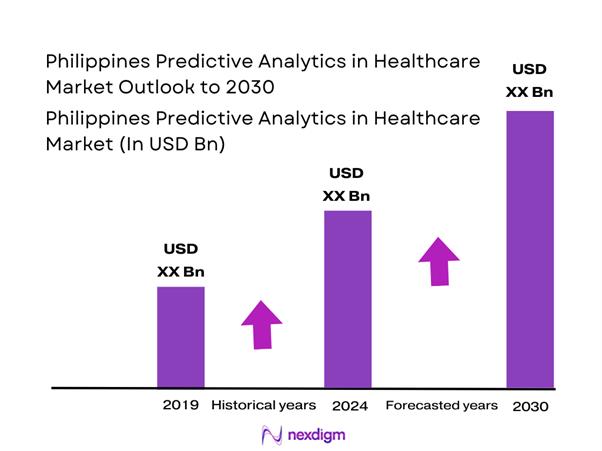
The Philippines Predictive Analytics in Healthcare market is valued at USD ~ million, reflecting enterprise spending on analytics platforms, integration services, and analytics-enabled decision-support solutions embedded across care delivery workflows. Demand is structurally linked to increasing clinical complexity, rising patient volumes, and operational pressure on hospitals and payers to improve outcomes while controlling costs. Predictive analytics has transitioned from experimental dashboards to mission-critical tools supporting early risk identification, care prioritization, and resource optimization, making it a foundational layer in the evolving healthcare digital stack.
Within the Philippines, adoption is concentrated in metropolitan healthcare clusters where large private hospital networks, referral centers, and payer operations are located. These regions dominate due to higher patient density, greater availability of digitized clinical data, and stronger financial capacity to invest in advanced analytics. On the supply side, technology leadership is influenced by global analytics and cloud solution providers that shape platform standards, model governance practices, and integration frameworks, enabling local healthcare organizations to deploy enterprise-grade predictive capabilities aligned with international best practices.
Market Segmentation
By Use Case
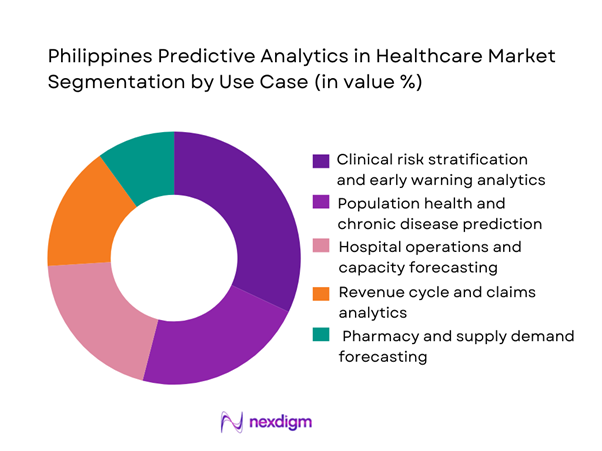
The market is segmented by use case into clinical risk stratification and early warning analytics, population health and chronic disease prediction, hospital operations and capacity forecasting, revenue cycle and claims analytics, and pharmacy and supply demand forecasting. Clinical risk stratification and early warning analytics dominate this segmentation due to their direct impact on patient outcomes and clinician workflows. Hospitals prioritize early identification of patient deterioration, sepsis risk, and readmission probability because these use cases deliver measurable improvements in mortality avoidance, length of stay reduction, and ICU utilization efficiency. Predictive alerts integrated into clinical systems support timely interventions and reduce decision fatigue among clinicians. This dominance is reinforced by regulatory emphasis on patient safety and quality metrics, as well as the ability to pilot these solutions in high-acuity departments before scaling across the organization.
By End User Type
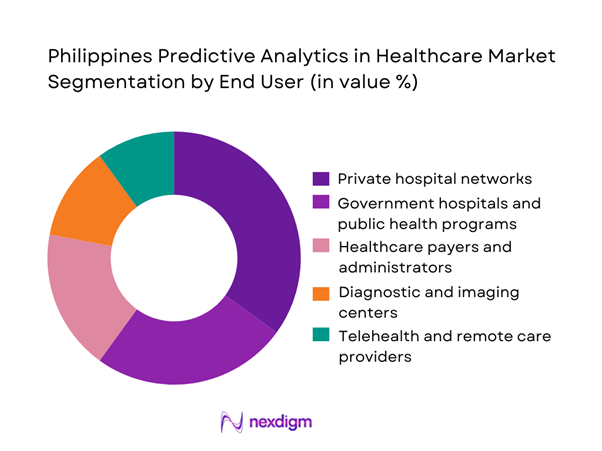
The market includes private hospital networks, government hospitals and public health programs, healthcare payers and administrators, diagnostic and imaging centers, and telehealth providers. Private hospital networks account for the largest share due to their stronger capital expenditure capacity, higher digital maturity, and focus on operational efficiency and patient experience. These organizations manage multi-site operations with complex care pathways, making predictive analytics essential for coordinating capacity, staffing, and clinical priorities. Their ability to align analytics investments with revenue and quality outcomes accelerates adoption compared to public-sector facilities, which often face longer procurement cycles and interoperability challenges.
Competitive Landscape
The Philippines Predictive Analytics in Healthcare market is dominated by a few major players, including Oracle Health and global or regional brands like SAS, IBM, and Microsoft. This consolidation highlights the significant influence of these key companies.
| Player | Established | Headquarters | Core healthcare analytics focus | Deployment model | Interoperability & integration | Model governance / MLOps | Data security / compliance posture | AI explainability & clinical validation | Local delivery & partner ecosystem | Typical buyer fit |
| Oracle Health (Cerner) | 1977 (Cerner) | USA | ~ | ~ | ~ | ~ | ~ | ~ | ~ | ~ |
| SAS | 1976 | USA | ~ | ~ | ~ | ~ | ~ | ~ | ~ | ~ |
| IBM (Watson / analytics stack) | 1911 | USA | ~ | ~ | ~ | ~ | ~ | ~ | ~ | ~ |
| Microsoft (Azure + Fabric ecosystem) | 1975 | USA | ~ | ~ | ~ | ~ | ~ | ~ | ~ | ~ |
| Philips (HealthSuite / informatics) | 1891 | Netherlands | ~ | ~ | ~ | ~ | ~ | ~ | ~ | ~ |

Philippines Predictive Analytics in Healthcare Market Analysis
Growth Drivers
Rising clinical workload complexity
Healthcare providers are facing steadily rising clinical workload complexity driven by higher patient volumes, increasing multimorbidity, and greater acuity levels across inpatient and outpatient settings. Clinicians are required to process large volumes of clinical data, monitor patients more frequently, and make time-sensitive decisions under resource constraints. Predictive analytics helps address this challenge by synthesizing historical and real-time clinical data into actionable risk signals that support prioritization of care. By flagging patients with elevated deterioration risk, potential complications, or likely readmissions, predictive tools enable clinicians to intervene earlier and allocate attention more effectively. This reduces unnecessary escalation, improves care coordination, and mitigates clinician fatigue. Over time, such decision support enhances operational throughput, improves continuity of care, and supports consistent clinical outcomes across high-demand departments.
Expansion of digital health records
The widespread expansion of electronic medical records and hospital information systems has significantly increased the availability of structured and semi- structured healthcare data across clinical, administrative, and operational domains. As documentation practices mature, data quality and completeness improve, creating a stronger foundation for predictive model development and validation. Predictive analytics leverages this growing digital footprint to transform retrospective records into forward-looking insights that guide clinical and operational decision-making. Embedded analytics within digital workflows allows providers to move beyond descriptive reporting toward anticipatory care planning. This shift improves responsiveness, reduces manual analysis burdens, and enables real-time monitoring of patient trajectories. As digital records become more interoperable and standardized, predictive analytics adoption accelerates, reinforcing the value of sustained investment in healthcare digitization.
Challenges
Fragmented healthcare data environments
Despite progress in digitization, healthcare data remains fragmented across multiple platforms, departments, and care settings, creating significant barriers to effective predictive analytics deployment. Clinical, laboratory, imaging, pharmacy, and administrative systems often operate in silos, limiting data continuity and increasing integration complexity. Inconsistent data formats, incomplete records, and variable documentation practices reduce model accuracy and undermine confidence in analytics outputs. These challenges increase implementation timelines and require substantial investment in data engineering and governance frameworks. Without reliable data harmonization, predictive insights may fail to capture the full patient journey, reducing their operational usefulness. Addressing fragmentation requires coordinated interoperability strategies, standardized data governance, and sustained organizational commitment, which can be difficult to achieve across diverse healthcare stakeholders.
Limited analytics talent and clinical adoption
The shortage of skilled analytics professionals and clinical informatics specialists remains a critical constraint on predictive analytics adoption. Healthcare organizations often lack personnel who can bridge clinical knowledge with data science, resulting in slow deployment and limited model customization. In parallel, clinician skepticism toward algorithm-driven recommendations can hinder adoption if predictive outputs are not transparent, explainable, and well-integrated into existing workflows. Resistance is often driven by concerns around accuracy, accountability, and disruption to clinical autonomy. Overcoming this challenge requires structured change management, clinician engagement during model design, and governance frameworks that emphasize explainability and clinical validation. Without these measures, predictive analytics risks remaining underutilized despite technical capability.
Opportunities
Predictive command centers for hospitals
Predictive command centers represent a significant opportunity to centralize data-driven decision-making across hospital operations. These centers integrate predictive insights related to bed availability, patient flow, staffing requirements, and emergency demand into a unified operational view. By aggregating signals from multiple departments, command centers enable faster coordination and proactive resource allocation. Predictive models help anticipate surges, identify bottlenecks, and optimize throughput before disruptions occur. This approach supports more resilient operations, particularly during periods of peak demand or unexpected events. As hospitals seek to improve efficiency without expanding physical infrastructure, predictive command centers offer a scalable way to enhance situational awareness and operational agility across the care continuum.
Chronic disease burden management
The growing burden of chronic diseases creates a strong opportunity for predictive analytics to support proactive and personalized care strategies. Predictive models can identify patients at higher risk of disease progression, non-adherence, or acute events, enabling early intervention and targeted care plans. This improves long-term outcomes while reducing avoidable hospital visits and complications. Predictive analytics also supports care coordination across providers by highlighting patients who require closer monitoring or multidisciplinary intervention. These capabilities align well with emerging value-based care approaches that emphasize prevention, continuity, and outcome optimization. As healthcare systems seek sustainable models for managing chronic conditions, predictive analytics becomes a critical enabler of efficient, patient-centered care delivery.
Future Outlook
The Philippines Predictive Analytics in Healthcare market is expected to evolve toward deeper integration within clinical and operational systems, with analytics becoming an embedded decision layer rather than a standalone function. Adoption will increasingly depend on governance maturity, interoperability progress, and alignment of analytics outputs with measurable outcomes, positioning predictive analytics as a strategic enabler of sustainable healthcare delivery.
Major Players
- Oracle Health
- Epic Systems
- SAS
- IBM
- Microsoft
- Google Cloud
- Amazon Web Services
- Philips
- GE HealthCare
- Siemens Healthineers
- SAP
- IQVIA
- Optum
Key Target Audience
- Hospital groups and integrated delivery networks
- Specialty and tertiary care hospitals
- Healthcare payers and administrators
- Diagnostic and imaging service providers
- Telehealth and remote care operators
- Investments and venture capitalist firms
- Government and regulatory bodies
- Healthcare technology procurement teams
Research Methodology
Step 1: Identification of Key Variables
The research begins with mapping the healthcare analytics ecosystem, identifying stakeholders, data flows, and adoption drivers that influence predictive analytics demand.
Step 2: Market Analysis and Construction
Historical data on healthcare digitization and analytics adoption is analyzed to construct the market framework and align use cases with revenue-generating activities.
Step 3: Hypothesis Validation and Expert Consultation
Findings are validated through expert consultations with healthcare IT leaders, clinicians, and analytics practitioners to refine assumptions and priorities.
Step 4: Research Synthesis and Final Output
Insights are synthesized into a structured market view, integrating quantitative indicators and qualitative validation to deliver a client-ready analysis.


 Request a Sample
 Ask for Customization
 Get a Quote
 Enquire Now