

 Download PDF
Market Overview
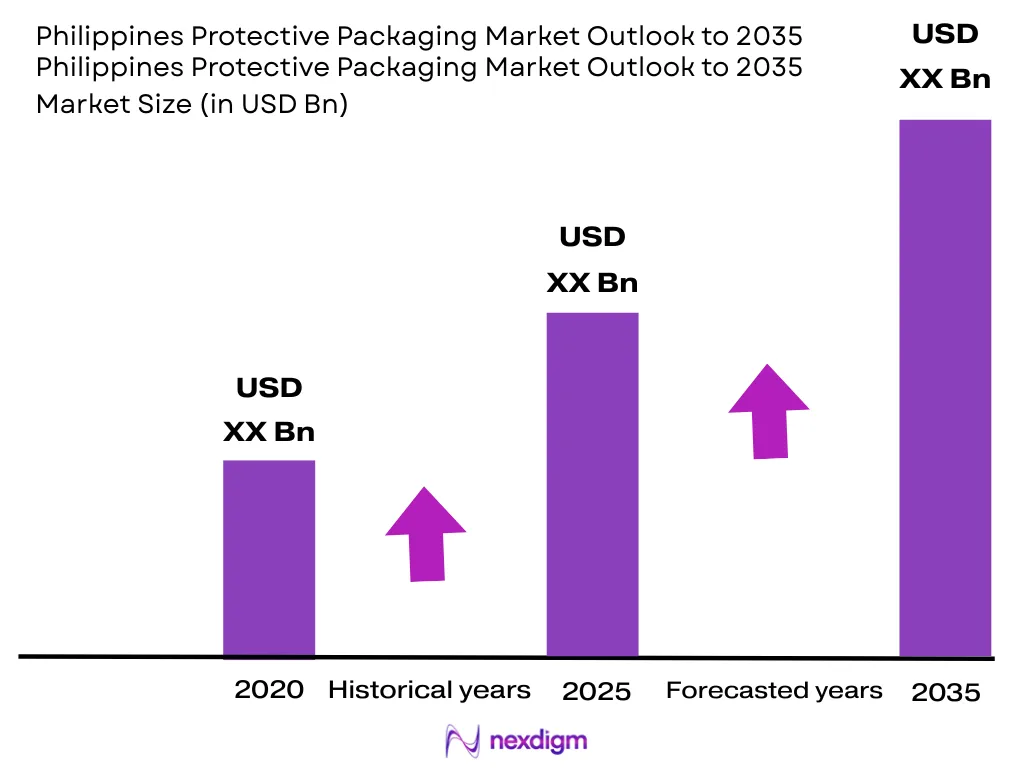
The Philippines Protective Packaging Market was valued at USD ~ Billion in 2024 and is anticipated to expand at a CAGR of ~% during 2026–2035. The market is primarily driven by the Philippines’ well-established position as a global hub for semiconductor Assembly, Testing, and Packaging (ATP), hosting more than 500 semiconductor and electronics companies including global leaders such as Texas Instruments, Analog Devices, ON Semiconductor, STMicroelectronics, NXP, Maxim Integrated, and Microchip Technology. This concentration of electronics manufacturing, supported by fiscal incentives administered through the Philippine Economic Zone Authority (PEZA), including a 5% special corporate income tax and duty-free resin imports, has attracted dedicated protective packaging investment such as Optispac Philippines, which is investing PHP 30 million to manufacture advanced ceramic and metal-glass hermetic packaging for semiconductors, sensors, and optical communications at the Lima Technology Center-Special Economic Zone in Batangas. Extended Producer Responsibility obligations under Republic Act No. 11898 are simultaneously reshaping the market, with mandatory plastic packaging recovery targets rising steeply from 20% in 2025 to 80% by 2028, creating urgent compliance pressure across the country’s protective packaging supply chain.
Market Segmentation
By Type
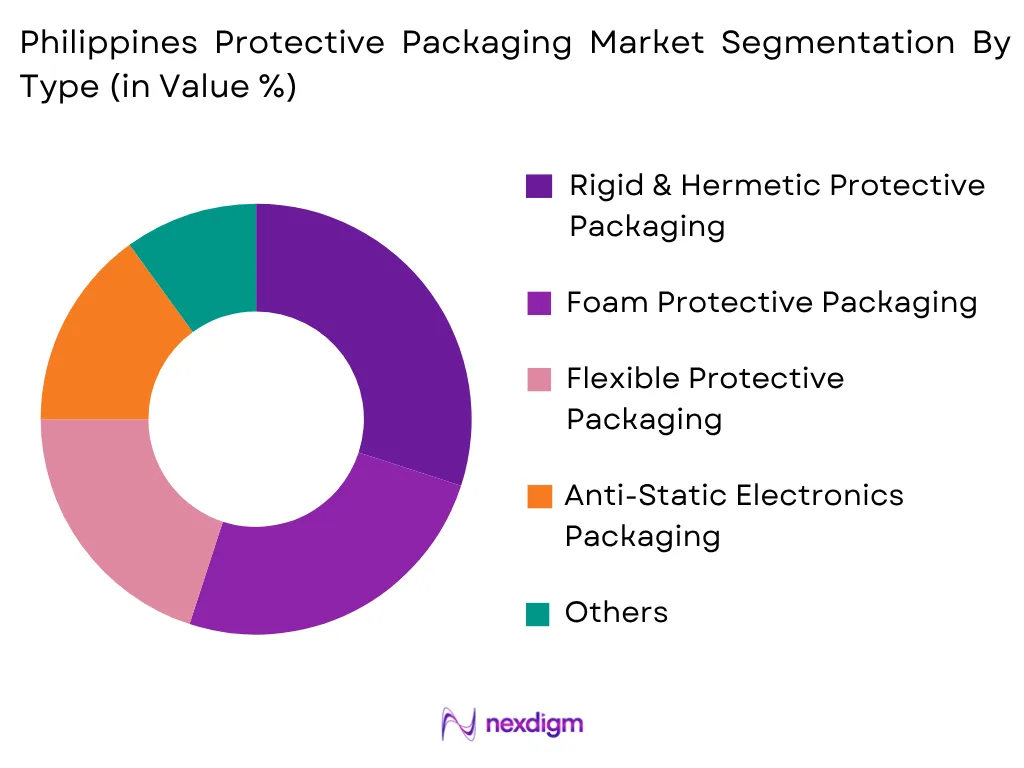
Rigid & Hermetic Protective Packaging represents a distinctive and technically sophisticated category within the Philippines Protective Packaging Market, reflecting the country’s specialization in advanced semiconductor and electronics packaging; Optispac Philippines’ investment in advanced ceramic and metal-glass hermetic packaging for semiconductors, sensors, and optical communications, alongside miniaturized packaging solutions for automotive, medical devices, and artificial intelligence applications, illustrates the technical depth of this segment. Foam Protective Packaging (EPS/EPE) remains widely used given injection molding’s 45.72% share of the Philippines plastics market in 2025, serving as the workhorse technology for electronics casings and connector housings requiring dimensional tolerances below 0.05 millimeters. Anti-Static Electronics Packaging continues to grow in importance as the Philippines’ semiconductor Assembly, Testing, and Packaging sector expands, given the sector’s fundamental requirement for static-safe handling of sensitive components throughout the manufacturing and export process.
By End-Use Industry
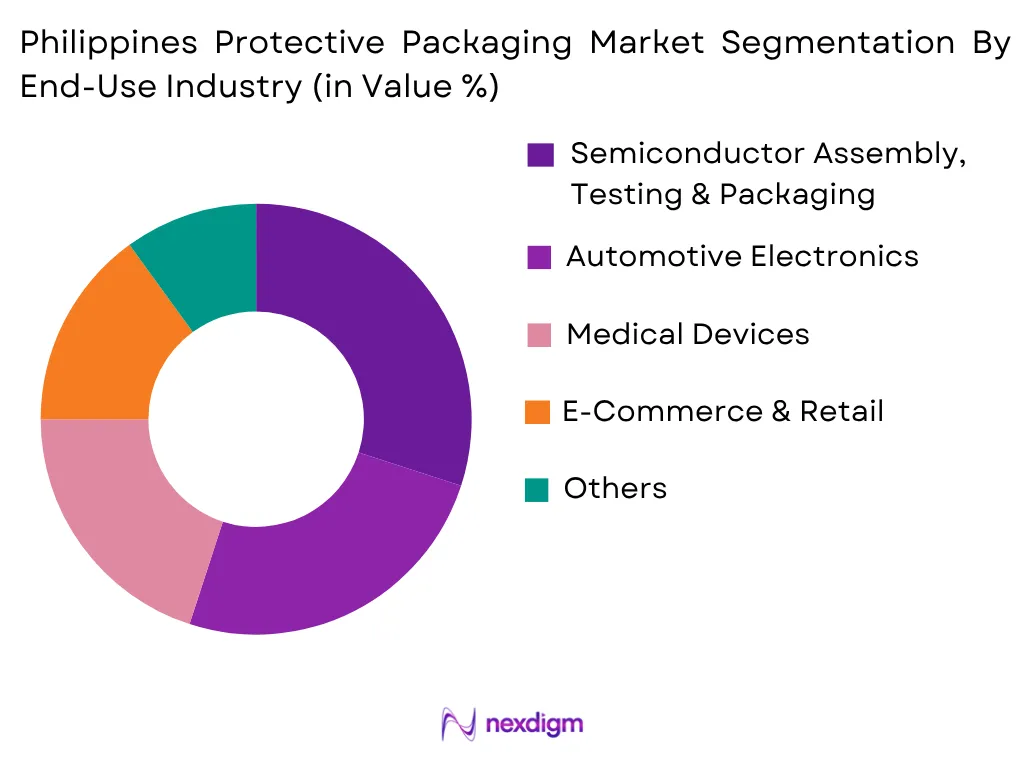
Semiconductor Assembly, Testing & Packaging (ATP) represents the dominant end-use industry in the Philippines Protective Packaging Market, with the Philippine electronics industry classified into 73% Semiconductor Manufacturing Services and 27% Electronics Manufacturing Services, concentrated across four key manufacturing clusters: Metro Manila, CALABARZON, Northern/Central Luzon, and Cebu. Philippine electronics exports reached approximately USD 29.99 billion in the January-August period of 2021 alone, with Hong Kong, the United States, China, Singapore, and Japan representing the top five export destinations, underscoring the scale of protective and hermetic packaging demand required to move sensitive components safely through complex international supply chains. Automotive Electronics and Medical Devices represent increasingly important end-use categories as the Philippines pursues value-added upgrading beyond basic assembly and testing; Optispac’s miniaturized packaging solutions for automotive, medical devices, and artificial intelligence applications exemplify this shift toward higher-value manufacturing functions further up the electronics technology chain.
Competitive Landscape
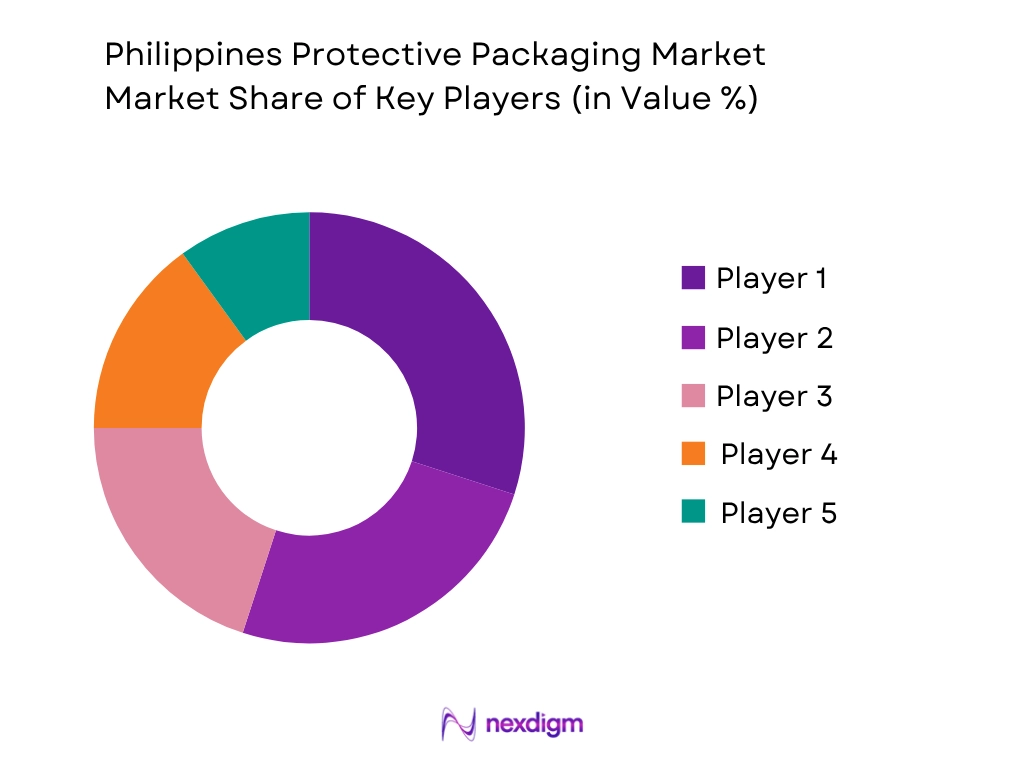
The Philippines Protective Packaging Market is shaped by a concentration of global semiconductor and electronics majors operating advanced assembly, testing, and packaging facilities within PEZA-registered economic zones, alongside a smaller but growing base of specialized domestic and regional protective packaging manufacturers. Optispac Philippines, newly established within the Lima Technology Center-Special Economic Zone in Batangas, is scaling its advanced hermetic packaging operations from an initial 100,000 units in its first year to more than 375,000 units annually by its fourth year, directly serving the semiconductor and electronics value chain with ceramic and metal-glass hermetic packaging technology. Onsemi, registered with PEZA since 2007 and operating facilities across Tarlac, Cavite, and Mactan, represents one of the most established semiconductor manufacturers in the country, having been recognized by PEZA as a strategic partner in driving the expansion of its EliteSiC Growth portfolio. Ionics EMS, a longstanding Philippine electronics manufacturing services company, alongside global semiconductor majors including Texas Instruments and Analog Devices operating extensive Philippine assembly and test operations, further anchor the market’s demand base. Competitive dynamics are increasingly shaped by the ability to deliver hermetic, anti-static, and EPR-compliant recycled-content packaging solutions capable of meeting both international semiconductor industry standards and the Philippines’ rapidly tightening domestic recovery targets.
| Company | Established | Headquarters | Primary Product Portfolio | Sustainable/Recyclable Portfolio | Manufacturing Presence | Major End-Use Industries | Key Strategic Focus | Certifications & Compliance |
| Optispac Philippines | 2020 | ~ | ~ | ~ | ~ | ~ | ~ | ~ |
| Onsemi (ON Semiconductor) | 1999 | ~ | ~ | ~ | ~ | ~ | ~ | ~ |
| Ionics EMS | 1978 | ~ | ~ | ~ | ~ | ~ | ~ | ~ |
| Texas Instruments Philippines | 1930 | ~ | ~ | ~ | ~ | ~ | ~ | ~ |
| Analog Devices Philippines | 1965 | ~ | ~ | ~ | ~ | ~ | ~ | ~ |
Philippines Protective Packaging Market Analysis
Growth Drivers
Philippines’ Rise as a Global Semiconductor ATP Hub
The Philippines has established itself as a leading Assembly, Testing, and Packaging (ATP) hub within the global semiconductor supply chain, hosting more than 500 semiconductor and electronics companies including global leaders such as Texas Instruments, Analog Devices, ON Semiconductor, STMicroelectronics, NXP, Maxim Integrated, and Microchip Technology. The Philippine government is actively strengthening this ecosystem through policy support and investment incentives administered by PEZA and the Board of Investments, providing tax incentives, streamlined regulatory approvals, and infrastructure support to electronics manufacturers. Optispac Philippines’ investment of PHP 30 million to manufacture advanced ceramic and metal-glass hermetic packaging for semiconductors, sensors, and optical communications, with export operations projected to scale from 100,000 units in its first year to more than 375,000 units annually by its fourth year, exemplifies the kind of specialized protective packaging investment being attracted to the country’s expanding electronics manufacturing base.
PEZA Ecozone Incentives Attracting Packaging Investment
The Philippine Economic Zone Authority’s fiscal incentives, including a 5% special corporate income tax and duty-free resin imports, continue to attract compounders and packaging manufacturers seeking to balance imported feedstocks with local production to serve the Philippines’ growing electronics and plastics manufacturing base. Certified mold shops operating inside PEZA zones shorten lead times for OEM changes, supporting the precision manufacturing requirements of injection-molded electronics casings and connector housings, which held 45.72% of the Philippines plastics market in 2025. The recently enacted CREATE MORE Law has further strengthened the country’s incentives regime, a development PEZA officials have actively promoted to global semiconductor and electronics companies at international forums such as CES 2025, where meetings with companies including onsemi and Applied Materials focused on expanding the Philippines’ role in the global semiconductor and electronics supply chain.
Market Challenges
Steep EPR Recovery Target Ramp Creating Compliance Pressure
The Philippine EPR Law (Republic Act No. 11898) imposes mandatory plastic packaging recovery targets that rise steeply from 20% in 2025 to 80% by 2028, an exceptionally demanding four-year compliance ramp that creates urgent pressure across the protective packaging value chain, particularly given that polystyrene, commonly used in foam protective packaging for electronics, falls explicitly within the law’s scope. Companies that fail to take adequate action on their plastic packaging obligations face substantial fines ranging from PHP 5 million to PHP 20 million depending on the severity and repetition of violations, alongside potential suspension of business permits and civil or criminal liability for negligence causing environmental damage, with the Department of Environment and Natural Resources emphasizing strict enforcement through its National Ecology Center.
Archipelagic Geography and Typhoon Exposure Straining Logistics
The Philippines’ geography, spanning more than 7,000 islands and subject to frequent typhoons and monsoon flooding, creates distinctive protective packaging challenges not present in more geographically stable and climate-uniform markets. Electronics and semiconductor components moving through the country’s export supply chains require packaging engineered to withstand humidity, moisture ingress, and logistics disruptions during typhoon season, adding cost and engineering complexity relative to protective packaging designed for less climate-exposed distribution networks. High electricity tariffs further compound these operational challenges, requiring packaging manufacturers to invest in energy-recovery equipment and servo-hydraulic machines to offset elevated production costs while maintaining the precision tolerances required for semiconductor-grade packaging applications.
Market Opportunities
Value-Added Upgrading Beyond Assembly, Testing and Packaging
The Philippines is entering a pivotal phase of value-added upgrading as the global semiconductor market shifts toward technologies powering the digital and green economy, with national policy increasingly emphasizing regulatory simplification, logistics efficiency, and expanded research and development investment to move beyond basic Assembly, Testing, and Packaging functions into higher-value activities further up the technology chain. Optispac Philippines’ focus on miniaturized packaging solutions for automotive, medical devices, and artificial intelligence applications illustrates the kind of advanced, higher-margin protective packaging capability well positioned to capture this shift, as the Philippines seeks to sustain its competitiveness beyond traditional assembly-focused semiconductor manufacturing.
Recycled-Content and Bioplastic Packaging Innovation Under EPR
The Philippines’ steep EPR recovery targets, rising from 20% in 2025 to 80% by 2028, are accelerating capital flows into recycling infrastructure, particularly for food-grade recycled PET and plant-fiber composites, creating substantial opportunity for packaging manufacturers that can develop compliant recycled-content and bio-based alternatives. Continued research by the Industrial Technology Development Institute into nanocellulose and polyhydroxyalkanoate (PHA) bioplastics could narrow the current 40% to 100% cost premium these materials carry relative to conventional polymers, diversifying raw material options for protective packaging manufacturers as scale-up economics improve alongside more favorable electricity pricing and credit access.
Future Outlook
The Philippines Protective Packaging Market is expected to witness sustained expansion over the forecast period, supported by continued growth in semiconductor and electronics manufacturing investment, progressive tightening of EPR recovery targets toward the 80% threshold by 2028, and the country’s ongoing transition toward higher-value electronics packaging functions. Growing investment in hermetic and miniaturized packaging technology for automotive, medical device, and artificial intelligence applications, alongside continued PEZA-driven investment attraction and CREATE MORE Law incentives, will further accelerate market growth. The market is also likely to benefit from the Philippines’ deepening integration into the global semiconductor supply chain, as international electronics majors and domestic packaging specialists alike invest in the advanced, climate-resilient, and EPR-compliant protective packaging capability required to serve the country’s expanding and increasingly sophisticated electronics manufacturing base.
Major Players
- Optispac Philippines
- Onsemi (ON Semiconductor)
- Ionics EMS
- Texas Instruments Philippines
- Analog Devices Philippines
- STMicroelectronics Philippines
- NXP Semiconductors Philippines
- Maxim Integrated Philippines
- Microchip Technology Philippines
- Toshiba Philippines
- Sealed Air Corporation
- Storopack
- Sonoco Products Company
- Amkor Technology Philippines
- Integrated Micro-Electronics, Inc. (IMI)
Key Target Audience
- Protective Packaging Manufacturers and Converters
- Semiconductor and Electronics Manufacturers
- Electronics Manufacturing Services (EMS) Providers
- Automotive and Medical Device Component Manufacturers
- E-Commerce Retailers and Export Trading Companies
- Investment and Venture Capitalist Firms
- Government and Regulatory Bodies (Philippine Economic Zone Authority – PEZA, Department of Environment and Natural Resources – DENR, Board of Investments – BOI)
- Raw Material Suppliers and Packaging Material Distributors
Research Methodology
Step 1: Identification of Key Variables
The research process begins with identifying the complete ecosystem of the Philippines Protective Packaging Market, including raw material suppliers, packaging converters, semiconductor and electronics manufacturers, export trading companies, and regulatory authorities. Extensive secondary research is conducted using company reports, government publications, trade associations, customs statistics, industry journals, and proprietary databases to determine the variables influencing market demand, pricing, production, consumption, and technological developments.
Step 2: Market Analysis and Construction
Historical market information is collected and analyzed to estimate market size, import volumes, application-wise demand, and pricing trends. A combination of top-down and bottom-up approaches is used to estimate market revenues and validate segment-level performance. Consumption patterns across semiconductor ATP, EMS, e-commerce, automotive, and medical device applications are evaluated to establish an accurate representation of the industry.
Step 3: Hypothesis Validation and Expert Consultation
The preliminary findings are validated through Computer-Assisted Telephone Interviews (CATIs) and structured discussions with packaging converters, procurement managers, semiconductor manufacturing engineers, regulatory experts, and senior executives operating within the Philippine electronics and packaging industry. These interviews help verify market assumptions, competitive developments, technology adoption trends, pricing dynamics, and future investment opportunities while refining the overall market estimates.
Step 4: Research Synthesis and Final Output
The final stage integrates insights obtained from primary interviews with quantitative information collected through secondary sources. Data triangulation techniques are applied to reconcile differences between supply-side and demand-side estimates, ensuring robust market forecasting. The report is then reviewed through multiple quality assurance checkpoints to deliver a comprehensive analysis covering market size, segmentation, competitive landscape, future outlook, and strategic recommendations for industry stakeholders.

- Executive Summary
- Research Methodology (Market Definitions and Assumptions, Protective Packaging Taxonomy, Abbreviations, Market Sizing Approach, Top-Down Personal Care Product Consumption Analysis, Bottom-Up Packaging Supplier Aggregation, Packaging Units per Finished Product, Demand-Side Assessment, Supply-Side Capacity Mapping, Import–Export Reconciliation, Retail Channel Analysis, Primary Industry Interviews, Data Triangulation, Forecasting Framework, Scenario Analysis, Limitations and Future Conclusions)

- Definition and Scope
- Market Evolution and Industry Genesis
- Timeline of Major Industry Developments
- Protective Packaging Industry Value Chain Analysis
- Supply Chain Analysis

- Growth Drivers (Philippines’ Rise as a Global Semiconductor ATP Hub, PEZA Ecozone Incentives Attracting Packaging Investment, Growth of Electronics Manufacturing Services (EMS), Expansion of E-Commerce and Last-Mile Delivery, Automotive and Medical Device Packaging Demand Growth, CREATE MORE Law Investment Incentives)
- Market Challenges (Steep EPR Recovery Target Ramp Creating Compliance Pressure, Archipelagic Geography and Typhoon Exposure Straining Logistics, High Electricity Tariffs Raising Production Costs, Bioplastic Cost Premium Limiting Sustainable Material Adoption, Patchwork of Single-Use Plastic Bans, Raw Material Import Dependency)
- Market Opportunities (Value-Added Upgrading Beyond Assembly, Testing and Packaging, Recycled-Content and Bioplastic Packaging Innovation Under EPR, Growth in Hermetic Packaging for Automotive and Medical Devices, Typhoon-Resilient Packaging Innovation, Regional ASEAN Semiconductor Supply Chain Integration, Public-Private Recycling Infrastructure Partnerships)
- Market Trends (Growth of Advanced Hermetic and Miniaturized Packaging, Rise of Certified Traceability Systems for EPR Compliance, Energy-Efficient Equipment Adoption Amid High Tariffs, Consolidation of PEZA-Registered Packaging Converters, Growing Nanocellulose and PHA Bioplastic R&D, Climate-Resilient Packaging Design Innovation)
- Government Regulations (Philippine EPR Law (Republic Act No. 11898), DENR National Ecology Center EPR Program Registration, PEZA Fiscal Incentives and Duty-Free Resin Imports, CREATE MORE Law Investment Incentives, Board of Investments (BOI) Incentive Programs, Single-Use Plastic Ban Ordinances)
- Import and Export Analysis (Trade Volume, Major Import Sources, Electronics Export Destinations, HS Code Analysis, Trade Balance)
- Raw Material Availability Analysis (Imported Plastic Resin Feedstocks, Domestic Corrugated and Molded Pulp Production, Ceramic and Metal-Glass Hermetic Packaging Materials, Anti-Static Material Feedstocks, Nanocellulose and PHA Bioplastic Feedstock Development)
- Technology Landscape (Advanced Hermetic and Miniaturized Packaging Technology, Injection Molding and Precision Tooling, Anti-Static Packaging Technology, Molded Pulp Production Technology, Certified Traceability and Compliance Systems)
- Sustainability Assessment (EPR Recovery Target Compliance, Bioplastic and Nanocellulose Material Development, Energy-Efficient Manufacturing Adoption, Single-Use Plastic Reduction, Circular Economy Alignment)
- PESTLE Analysis
- SWOT Analysis
- Porter’s Five Forces Analysis
- Stakeholder Ecosystem
- Competition Ecosystem

- By Market Value (2020-2025)
- By Volume Consumption (2020-2025)
- By Average Selling Price (2020-2025)

- By Type (In Value %)
Flexible Protective Packaging
Foam Protective Packaging (EPS/EPE)
Rigid & Hermetic Protective Packaging
Anti-Static Electronics Packaging - By Material (In Value %)
Corrugated & Solid Board
Molded Pulp & Fiber
Plastic Foams (EPS/EPE)
Ceramic & Metal-Glass Hermetic Packaging
Anti-Static Materials - By End-Use Industry (In Value %)
Semiconductor Assembly, Testing & Packaging (ATP)
Electronics Manufacturing Services (EMS)
E-Commerce & Retail
Automotive Electronics
Medical Devices - By Function (In Value %)
Hermetic Sealing & Moisture Protection
Anti-Static Protection
Cushioning & Void Fill
Climate & Typhoon-Resilient Packaging
Blocking & Bracing - By Region (In Value %)
National Capital Region (NCR)
Luzon
Visayas
Mindanao

- Market Share of Major Players (By Value, Volume, Material Type, End-Use Industry, Function)
- Cross Comparison Parameters (Hermetic/Advanced Packaging Portfolio Breadth, Anti-Static and Electronics Packaging Capability, PEZA Ecozone Manufacturing Presence, Application Technical Support, Manufacturing Capacity, Regulatory Compliance & Certifications, Customer Base, Innovation & New Product Launch Frequency)
- SWOT Analysis of Major Players
- Pricing Analysis by Product Category and Application
- Production Capacity Analysis
- Manufacturing Footprint Analysis
- Distribution Network Analysis
- Innovation Benchmarking
- Detailed Profiles of Major Companies
Optispac Philippines
Onsemi (ON Semiconductor)
Ionics EMS
Texas Instruments Philippines
Analog Devices Philippines
STMicroelectronics Philippines
NXP Semiconductors Philippines
Maxim Integrated Philippines
Microchip Technology Philippines
Toshiba Philippines
Sealed Air Corporation
Storopack
Sonoco Products Company
Amkor Technology Philippines
Integrated Micro-Electronics, Inc. (IMI)

- Consumption Pattern Analysis (Industrial Usage, Batch Size, End-Use Industry Penetration, Seasonal and Typhoon-Season Demand, Export Shipment Volume Impact)
- Purchasing Criteria (Hermetic and Moisture-Barrier Performance, Regulatory and EPR Compliance, Cost Efficiency, Anti-Static Capability, Climate Resilience, Export Standards Compatibility)
- Procurement and Supplier Selection Analysis
- Recycled Content and EPR Compliance Adoption Assessment
- Premium Semiconductor-Grade vs Standard Packaging Demand
- Product Attribute Preference Analysis (Hermetic Sealing Performance, Anti-Static Properties, Moisture and Typhoon Resilience, Recyclability, Dimensional Precision, Export Certification Compatibility)
- Sustainability & ESG Influence on Procurement Decisions
- Pain Point Analysis
- Decision-Making Process

- By Market Value (2026-2035)
- By Volume Consumption (2026-2035)
- By Average Selling Price (2026-2035)


 Request a Sample
 Ask for Customization
 Get a Quote
 Enquire Now