
 Download PDF
Market Overview
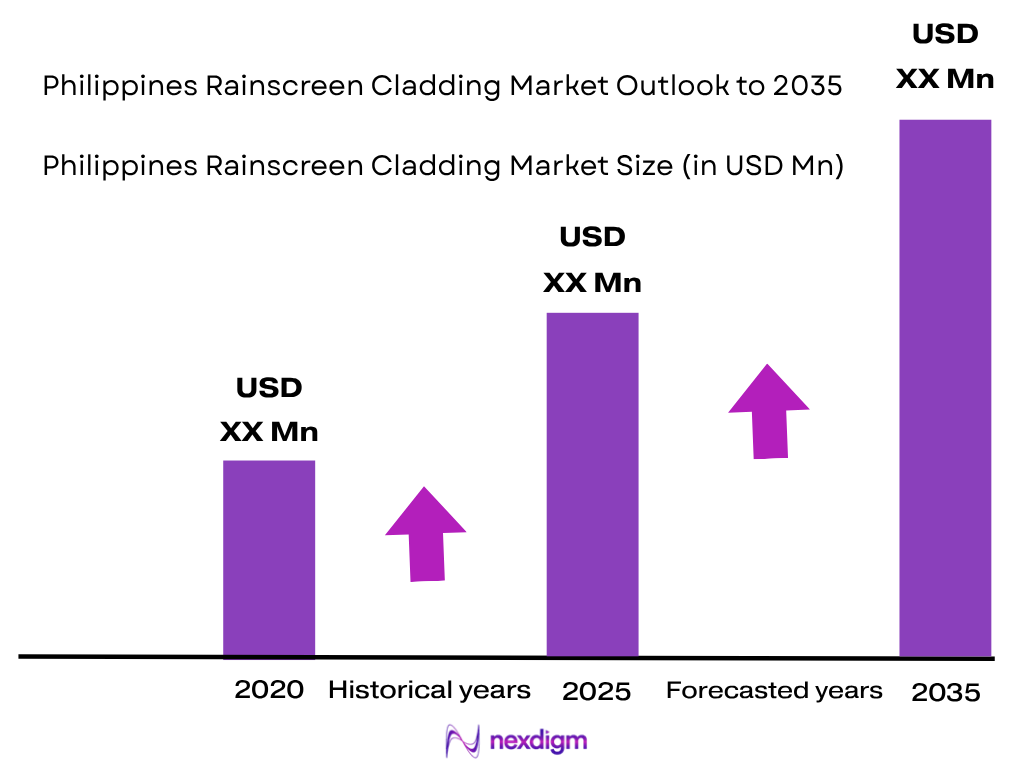
The Philippines Rainscreen Cladding Market is valued at approximately ~USD XX million, supported by an addressable construction base that expanded from 171,268 approved constructions and 41.47 million sq. m. of floor area to 180,341 constructions and 42.84 million sq. m. The corresponding construction value increased from PHP 515.30 billion to PHP 563.89 billion, creating a larger addressable base for ventilated façades, ACP, fiber cement, metal panels and recladding systems. Philippine Statistics Authority
Metro Manila/NCR, CALABARZON and Central Luzon represent the principal demand centers for the Philippines Rainscreen Cladding Market because of concentrated high-rise development, commercial projects, industrial estates and residential construction. NCR’s approved-building floor area increased from 4.85 million sq. m. to 5.74 million sq. m., while CALABARZON recorded PHP 118.37 billion and NCR PHP 112.84 billion in construction value. These regions also concentrate architects, façade contractors, fabricators, developers and specialist building-envelope procurement.
Market Segmentation
By Cladding Material Type
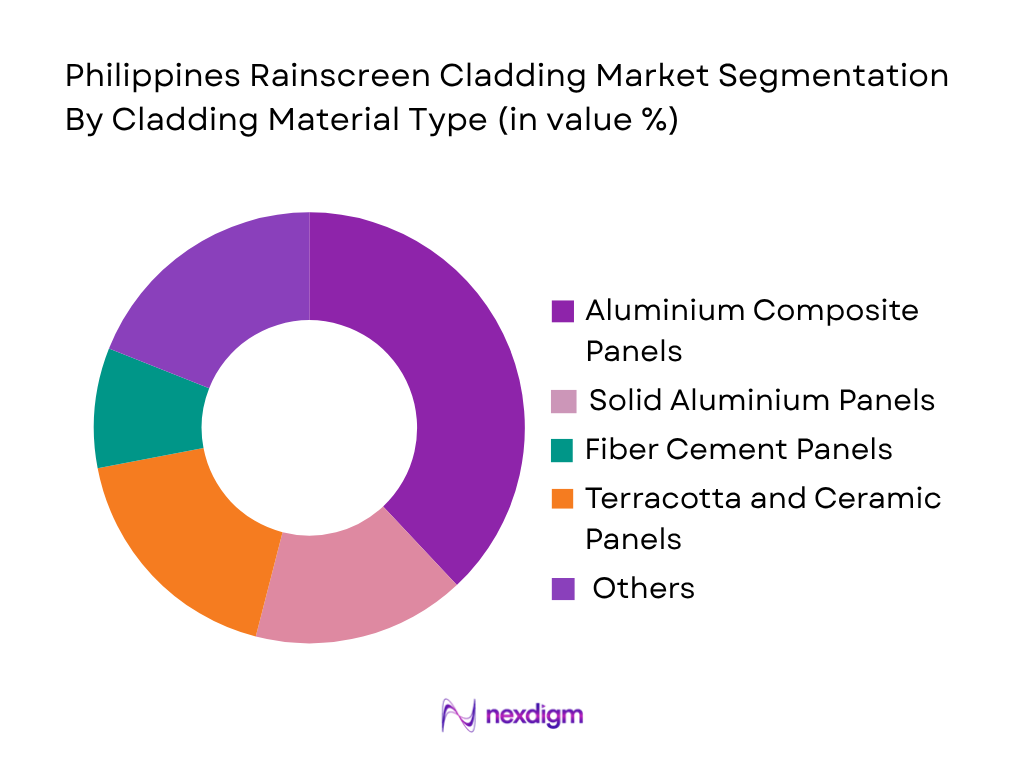
The Philippines Rainscreen Cladding Market is segmented by material type into aluminium composite panels, solid aluminium panels, fiber cement panels, terracotta and ceramic panels, high-pressure laminate panels, natural stone systems, and other architectural rainscreen materials. Aluminium composite panels represent the dominant sub-segment, supported by their comparatively low façade dead load, design flexibility, availability of multiple finishes, ease of fabrication and familiarity among Philippine façade contractors. ACP systems are extensively applicable to commercial façades, residential towers, retail developments and institutional buildings. Demand is increasingly migrating toward mineral-core and fire-retardant products as developers and architects place greater emphasis on façade fire performance. Aluminum’s suitability for cassette fabrication, concealed fixing and large-format architectural elevations also supports its position. In high-density markets such as Metro Manila, lightweight construction and shorter installation schedules further improve ACP’s competitiveness relative to heavier stone or precast façade alternatives.
By Building Type
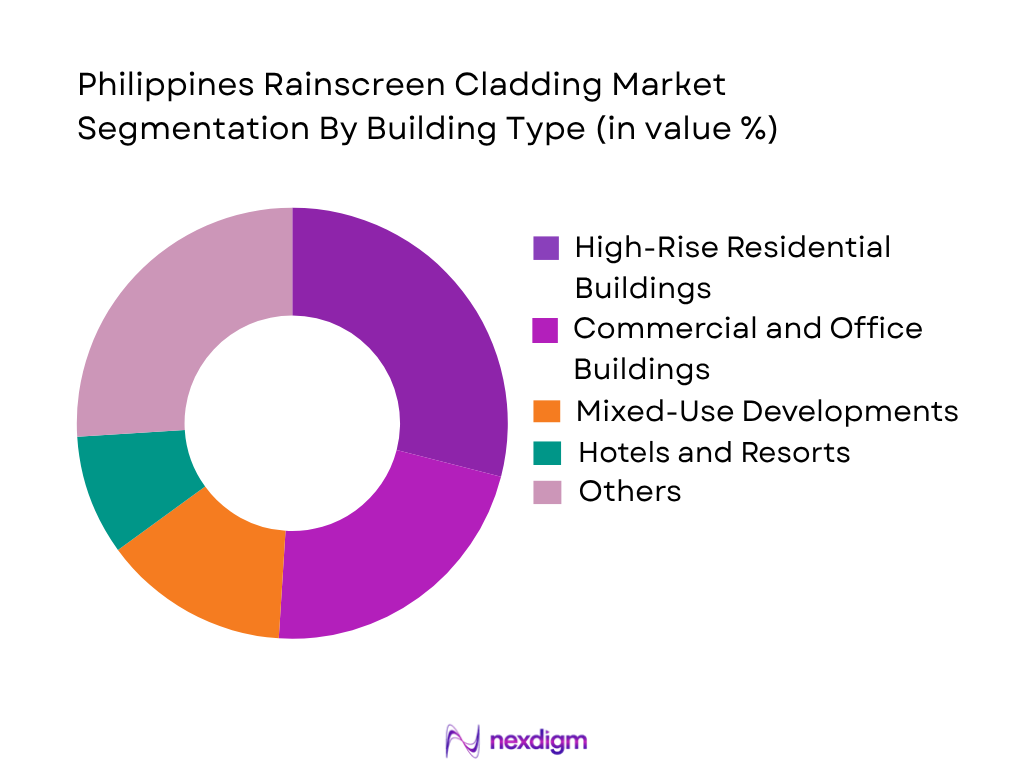
The Philippines Rainscreen Cladding Market is segmented by building type into high-rise residential developments, commercial and office buildings, hospitality buildings, retail facilities, healthcare and institutional buildings, data centres, transportation facilities, industrial buildings and mixed-use developments. High-rise residential buildings constitute the dominant sub-segment, reflecting the concentration of condominium development in Metro Manila and other metropolitan centers where façade appearance, building weight, weather protection and installation efficiency are significant design considerations. Residential construction generated PHP 248.65 billion in approved-construction value in the national building-permit dataset, illustrating the scale of the underlying building market. Philippine Statistics Authority Rainscreen adoption is particularly relevant for premium towers and mixed-use residential schemes requiring durable exterior finishes. Commercial offices and mixed-use developments form another important demand pool because developers increasingly evaluate thermal performance, façade maintenance, fire performance and architectural differentiation during material selection.
Competitive Landscape
The Philippines Rainscreen Cladding Market combines international building-envelope manufacturers with local distributors, façade contractors, fabricators and specialist installation companies. Competition is influenced not only by panel pricing but also by fire-performance documentation, system engineering, anchor and subframe capability, material availability, architect specification, contractor relationships and proven project execution. International groups typically compete through technology and product credentials, while Philippine specialists strengthen their position through fabrication capability, local stock, installation support and project access.
| Major Player | Establishment Year | Headquarters | Primary Market Role | Relevant Rainscreen Offering | Fire/Envelope Capability | Philippines Route-to-Market | Technical Strength | Key Customer Groups |
| James Hardie | 1888 | Dublin, Ireland | ~ | ~ | ~ | ~ | ~ | ~ |
| Etex / Kalsi | 1905 | Zaventem, Belgium | ~ | ~ | ~ | ~ | ~ | ~ |
| Kingspan Group | 1965 | Kingscourt, Ireland | ~ | ~ | ~ | ~ | ~ | ~ |
| ROCKWOOL Group | 1937 | Hedehusene, Denmark | ~ | ~ | ~ | ~ | ~ | ~ |
| Hilti | 1941 | Schaan, Liechtenstein | ~ | ~ | ~ | ~ | ~ | ~ |
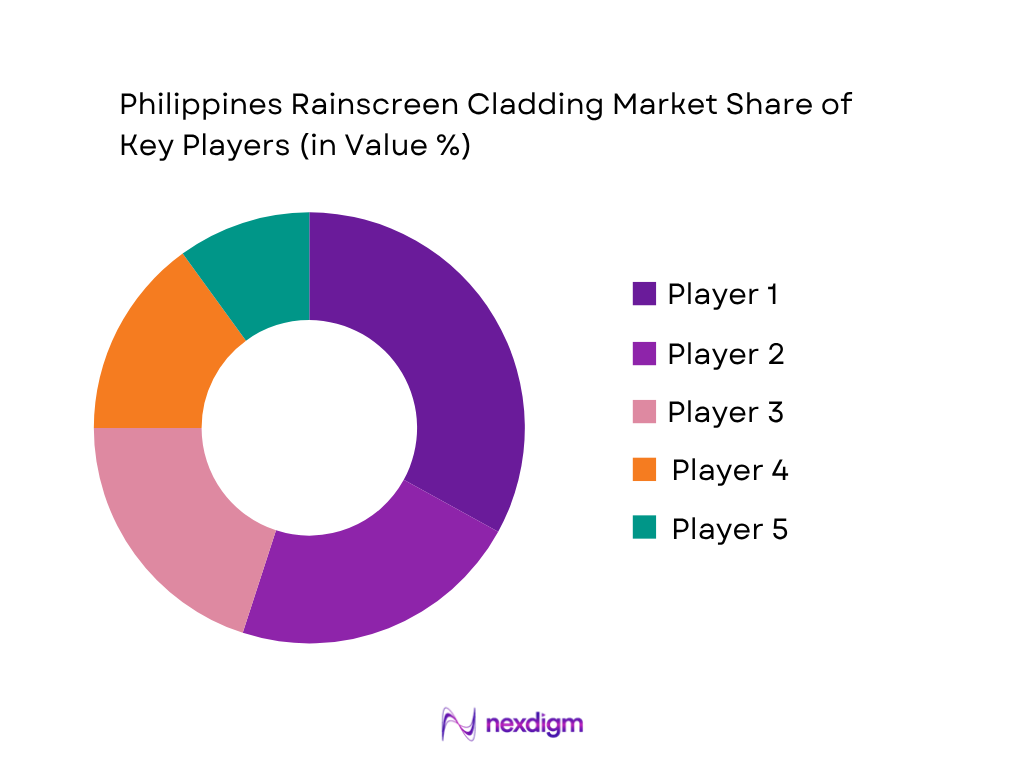
Philippines Rainscreen Cladding Market Analysis
Growth Drivers
Expanding Building Construction Pipeline and High-Rise Development
The Philippines’ expanding building-construction base is creating a larger addressable surface area for rainscreen cladding, ventilated façades, aluminium composite panels, solid aluminium panels and fiber-cement exterior systems. According to the Philippine Statistics Authority, 180,341 approved constructions were recorded in 2024, covering 42,837,581 square meters of floor area and representing PHP 563.89 billion in construction activity. Residential projects accounted for 116,427 constructions and 19,748,190 square meters, while non-residential buildings represented 39,238 projects covering 22,380,982 square meters. Commercial buildings alone generated PHP 112.42 billion in approved construction, demonstrating the depth of office, retail and other commercial structures that can require engineered façade solutions. These fundamentals are supported by the wider Philippine economy: World Bank data place national GDP at USD 461.67 billion in 2024, while Philippine Statistics Authority national accounts record GDP at PHP 26.45 trillion at current prices. The combination of substantial new floor area and a large construction economy directly expands the pipeline from which rainscreen suppliers, façade fabricators, system integrators and installation contractors can secure new-build specifications.
Urban Concentration and Growing Building-Envelope Performance Requirements
Urbanization is strengthening demand for higher-performing exterior wall systems because dense metropolitan construction increasingly requires façades capable of handling rainfall, solar exposure, thermal loads, wind pressure and long-term maintenance requirements. The Philippine Statistics Authority’s 2024 Census recorded a national population of 112,729,484 people, including 62.22 million people living in urban barangays, providing a substantial urban base for residential towers, offices, malls, hospitals and mixed-use developments. Building-envelope performance is also becoming more material as electricity use rises. Department of Energy statistics show residential electricity consumption reached 41,205 GWh in 2024, while commercial consumption reached 28,033 GWh and industrial consumption reached 31,074 GWh. Luzon alone accounted for 23,904,218 MWh of commercial electricity use, aligning with its concentration of Metro Manila and surrounding urban construction. The World Bank recorded Philippine GDP per capita at USD 3,984.8 in 2024 alongside national GDP of USD 461.67 billion. These conditions support greater consideration of ventilated cavities, continuous insulation, solar-resistant finishes and thermally improved rainscreen assemblies in buildings where owners seek durable envelope performance.
Market Challenges
Construction Pipeline Volatility and Irregular Large-Project Demand
Rainscreen cladding suppliers face exposure to fluctuations in building approvals because demand is closely tied to the timing, scale and façade specification of individual construction projects. Philippine Statistics Authority figures demonstrate this variability. In January 2026, approved constructions totaled 13,577 projects, with 2,797,912 square meters of floor area and PHP 37.05 billion in construction value. The corresponding January 2025 figures were 13,504 projects, 3,962,768 square meters and PHP 51.63 billion. Residential floor area moved from 1,532,214 square meters in January 2025 to 1,398,887 square meters in January 2026, while total approved project numbers remained broadly similar, indicating how project size and mix can materially alter façade-addressable area even without a comparable change in building counts. Such volatility complicates production planning, imported-panel inventory, aluminium extrusion procurement, fabrication utilization and installation workforce scheduling. At the macroeconomic level, World Bank data place Philippine GDP at USD 461.67 billion in 2024 and USD 487.09 billion in 2025, underscoring the economy’s substantial scale, but rainscreen suppliers still depend on project-level conversion from investment into actual façade packages and awarded construction contracts.
Fragmented Execution Capacity and Dependence on Specialized Façade Capabilities
Rainscreen cladding is more technically demanding than basic decorative wall covering because performance depends on coordinated panel fabrication, bracket positioning, anchors, subframes, cavity dimensions, membranes, insulation, flashing and installation tolerances. The Philippines has a sizeable construction industry, but specialist capability is distributed across a much broader contractor ecosystem. Philippine Statistics Authority’s 2024 Annual Survey of Philippine Business and Industry recorded 2,512 formal construction establishments, of which 1,091 establishments were classified under construction of buildings. Electrical, plumbing and other construction installation activities accounted for another 389 establishments, illustrating the multiple specialist trades that must be coordinated during building-envelope installation. Formal construction-sector revenue reached PHP 713.19 billion, while construction-of-buildings establishments generated PHP 240.84 billion. NCR construction establishments reported average annual employee compensation of PHP 351.09 thousand, compared with PHP 276.05 thousand in CALABARZON, highlighting regional differences in the construction labor base. This execution environment is particularly relevant for rainscreens, where errors in anchors, drainage paths or cavity detailing can affect system performance. The challenge exists within an economy with 112,729,484 residents and PHP 26.45 trillion in GDP, making scalable technical capability important as façade demand spreads beyond core Metro Manila projects.
Market Opportunities
Recladding, Façade Rehabilitation and Existing-Building Upgrades
The existing building stock provides a significant future route for rainscreen cladding suppliers because demand does not depend solely on new construction. Philippine Statistics Authority building-permit data recorded 13,997 alteration and repair projects in 2024 with an aggregate construction value of PHP 43.05 billion. A further 5,694 additions were approved, covering 708,409 square meters of floor area and representing PHP 8.97 billion in construction activity. These figures establish an active base of buildings receiving physical modifications, creating potential pathways for exterior-wall rehabilitation, recladding, moisture remediation, replacement of aging panels and upgrades to fire or thermal performance. The opportunity is particularly relevant for older commercial, hospitality, institutional and residential buildings where direct-fixed façade materials can eventually require replacement or modernization. The addressable building environment is substantial: the country recorded 180,341 approved constructions and 42,837,581 square meters of approved floor area during 2024. World Bank data place the broader Philippine economy at USD 461.67 billion in 2024, while PSA records PHP 26.45 trillion in domestic output. These fundamentals provide a base for suppliers to develop dedicated retrofit systems, lightweight replacement panels and engineered over-cladding solutions.
Energy-Efficient Rainscreens and High-Performance Building Envelope Upgrades
Energy efficiency represents a substantial future opportunity for ventilated rainscreen systems because exterior-wall design can contribute to thermal control, solar-load management, insulation continuity and durability in tropical buildings. Department of Energy data show total Philippine electricity consumption reached 126,941 GWh in 2024, including 41,205 GWh from residential users, 28,033 GWh from commercial users and 31,074 GWh from industrial users. The scale of commercial consumption makes offices, malls, hotels, hospitals, data-related facilities and institutional buildings particularly relevant for façade-performance strategies. Government activity is also strengthening the building-efficiency ecosystem. By June 2026, 15 NCR local governments were participating in the Department of Energy’s Solar Solutions for Government: Energy Efficiency and Renewable Energy in Public Buildings initiative, covering jurisdictions including Manila, Quezon City, Taguig, Pasig, Caloocan and Parañaque. This creates a stronger environment for energy-oriented building retrofits and specification of improved building envelopes. The Philippine Statistics Authority additionally recorded 62.22 million urban residents from the 2024 Census, while World Bank data place GDP at USD 461.67 billion. Rainscreen suppliers can address this opportunity through insulated subframes, thermal-break components, ventilated cavities, durable solar-resistant finishes and systems compatible with energy-efficient refurbishment programs.
Future Outlook
The Philippines Rainscreen Cladding Market is forecast to expand at approximately ~X.X% CAGR during 2026–2035. Growth is expected to be supported by high-rise construction, refurbishment of aging building façades, mixed-use urban developments, hospitality investments and increasing emphasis on building-envelope performance. Adoption should progressively shift from basic decorative cladding toward engineered rainscreen assemblies with verified subframes, fire-safe materials, drainage cavities and higher-performance insulation.
Typhoon resilience will remain a particularly important purchasing criterion. Façade manufacturers capable of demonstrating structural attachment performance, corrosion resistance and panel behavior under high wind pressure should gain preference in coastal and high-rise developments. Water management will remain equally significant because ventilated rainscreen assemblies can provide a secondary drainage and drying layer when correctly engineered.
Major Players
- Fasclad Inc. / Cladding Components Specialist Unlimited Inc.
- Composite Panel Specialist Inc.
- CladCore Construction Finishing Services
- CT-BOND Decorative Materials Philippines Corporation
- Alutech Aluminum Composite Panels
- Filipinas Multi-Line Corporation / Alucobest
- OneSky Green Aluminum
- James Hardie Philippines, Inc.
- SHERA Philippines
- Kalsi / Etex Building Performance
- Hunter Douglas Architectural / NBK Terracotta
- BFG Philippines
- Kingspan Group
- ROCKWOOL Building Materials Philippines Ltd.
- Hilti Philippines
Key Target Audience
- Rainscreen Cladding and Architectural Façade Manufacturers
- Aluminium Composite Panel and Fiber Cement Manufacturers
- Façade Contractors, Fabricators and System Integrators
- Property Developers and Commercial Real Estate Companies
- General Contractors and EPC Companies
- Architects, Façade Engineering and Building-Envelope Design Firms
- Investments and Venture Capitalist Firms
- Government and Regulatory Bodies (Department of Public Works and Highways, Bureau of Fire Protection, Department of Energy, Housing and Urban Development Coordinating bodies, Local Government Building Officials)
Research Methodology
Step 1: Identification of Key Variables
The initial phase develops a complete ecosystem map for the Philippines Rainscreen Cladding Market, covering panel manufacturers, importers, distributors, façade contractors, developers, architects and system suppliers. Secondary research is used to identify variables including addressable façade area, building pipeline, cladding material penetration, installed price, import dependency, building height, refurbishment activity and regional construction intensity.
Step 2: Market Analysis and Construction
Historical demand is constructed through top-down and bottom-up analysis. Philippine construction value, permitted floor area, residential and non-residential development, major project pipelines and façade-addressable building types are assessed. PSA reported 180,341 constructions covering 42.84 million sq. m. in its finalized national dataset, providing an important macro-level reference base for demand modelling. Philippine Statistics Authority
Step 3: Hypothesis Validation and Expert Consultation
Market hypotheses are validated through computer-assisted telephone interviews and direct discussions with façade contractors, ACP distributors, fiber cement suppliers, architects, developers and construction procurement professionals. Interviews test assumptions regarding material penetration, panel pricing, subframe costs, installation rates, fire-rating requirements, imported-material lead times and customer preferences across high-rise residential, commercial and institutional projects.
Step 4: Research Synthesis and Final Output
The final stage triangulates project-level demand, construction statistics, supplier information and industry interviews. Bottom-up installation-area calculations are reconciled with top-down building-envelope expenditure and supplier-revenue analysis. Material-level shares, regional demand, competitive positioning and forecast assumptions are then stress-tested to create a coherent market model covering new construction, recladding and performance-oriented façade replacement.

- Executive Summary
- Research Methodology (Market Definitions and Assumptions, Philippines Rainscreen Cladding Market Classification, Building-Envelope Scope, Rainscreen Facade System Mapping, Ventilated Facade Assessment, Drained and Back-Ventilated Rainscreen Assessment, Pressure-Equalized Rainscreen Assessment, Open-Joint Rainscreen Assessment, Closed-Joint Rainscreen Assessment, Aluminium Composite Panel Assessment, Solid Aluminium Panel Assessment, Fiber Cement Cladding Assessment, Terracotta Cladding Assessment, Ceramic and Porcelain Cladding Assessment, High-Pressure Laminate Assessment, Natural Stone Rainscreen Assessment, Metal Cladding Assessment, Subframe and Rail System Assessment, Fixing and Anchoring System Assessment, Thermal Insulation Assessment, Air and Water Barrier Assessment, Fire-Stopping and Cavity Barrier Assessment, Wind-Load Assessment, Water-Tightness Assessment, Thermal Performance Assessment)

- Definition and Scope
- Philippines Building-Envelope Industry Evolution and Development of Aluminium Composite Panel Cladding, Solid Aluminium Cladding, Fiber Cement Facades, Terracotta Rainscreen Systems, Ceramic and Porcelain Cladding, High-Pressure Laminate Facades, Natural Stone Rainscreen Systems, Metal Panel Facades, Ventilated Rainscreen Systems, Drained and Back-Ventilated Facades, Pressure-Equalized Rainscreen Systems, Open-Joint Facades, Concealed-Fix Panel Systems, Fire-Rated Facade Systems, Thermally Insulated Rainscreen Systems, Lightweight Building Envelopes, High-Rise Facade Systems, Prefabricated Facade Assemblies, Sustainable Building Envelope Technologies
- Rainscreen Cladding Value Chain Analysis
- Rainscreen Cladding Supply Chain Analysis
- Aluminium Coil and Sheet Suppliers, Aluminium Composite Panel Manufacturers, Solid Aluminium Panel Manufacturers, Fiber Cement Manufacturers, Terracotta and Ceramic Panel Manufacturers

- Growth Drivers (High-Rise Residential Development, Commercial and BPO Construction, Mixed-Use Development, Data Centre Expansion, Hotel and Resort Construction, Urban Redevelopment, Facade Modernization, Typhoon-Resistant Building Envelope Demand, Moisture-Managed Facade Demand, Lightweight Cladding Adoption, Energy-Efficient Building Envelope Development, Existing Facade Replacement Demand, Premium Architectural Facade Adoption)
- Market Challenges (High Initial Installed Cost, Imported Material Dependency, Peso Exchange-Rate Exposure, Specialist Facade Installer Requirements, Limited Rainscreen Design Expertise, Complex High-Rise Installation, Typhoon Wind-Load Requirements, Coastal Corrosion Exposure, Fire-Rated Panel Cost Premium, Imported Panel Lead Times, Provincial Logistics Costs, Low-Cost ACP Competition, Installation Quality Variability, Water-Ingress Risk)
- Market Opportunities (Non-Combustible Rainscreen Systems, Fire-Rated ACP Conversion, Fiber Cement Ventilated Facades, Solid Aluminium Facades, Terracotta and Ceramic Rainscreen Systems, Existing ACP Recladding, Energy-Efficient Building Envelope Retrofits, Data Centre Facades, Hospital and Institutional Facades, Premium Hospitality Facades, Sustainable Cladding Materials, Local Aluminium Fabrication)
- Market Trends (Fire-Retardant and Non-Combustible Cladding Adoption, Mineral-Core ACP Adoption, Fiber Cement Architectural Panels, Solid Aluminium Panel Systems, Large-Format Facade Panels, Concealed-Fix Rainscreen Systems, Wood-Look and Stone-Look Finishes, PVDF and FEVE Coatings, Prefabricated Facade Assemblies, BIM-Based Facade Coordination)
- Government Regulations and Standards (National Building Code of the Philippines, Revised Fire Code of the Philippines, Philippine Green Building Code, Exterior Wall Fire Performance Requirements, Cavity Fire-Stopping Requirements, Structural Wind-Load Requirements, Typhoon Resistance Requirements, Building Envelope Thermal Performance Requirements)
- SWOT Analysis
- Porter’s Five Forces Analysis
- PESTLE Analysis
- Stakeholder Ecosystem
- Construction and Facade Project Ecosystem

- By Market Value (2020-2025)
- By Rainscreen Cladding Installation Area (2020-2025)
- By Aluminium Composite Panel Installation Area (2020-2025)
- By Solid Aluminium Cladding Installation Area (2020-2025)
- By Fiber Cement Rainscreen Installation Area (2020-2025)
- By Terracotta and Ceramic Rainscreen Installation Area (2020-2025)
- By High-Pressure Laminate Cladding Installation Area (2020-2025)
- By Natural Stone Rainscreen Installation Area (2020-2025)
- By Metal Cladding Installation Area (2020-2025)
- By New Construction Rainscreen Installation Area (2020-2025)

- By Cladding Material Type (In Value %)
Aluminium Composite Panels
Fire-Retardant Mineral-Core Aluminium Composite Panels
A2 and Non-Combustible Aluminium Composite Panels
Solid Aluminium Panels
Pre-Painted and Coated Metal Panels
Fiber Cement Panels
Terracotta Panels
Ceramic and Porcelain Panels
High-Pressure Laminate Exterior Panels
Natural Stone Rainscreen Panels
Engineered Stone and Sintered Surface Panels
Glass-Fiber-Reinforced and Composite Panels
Other Architectural Rainscreen Materials - By Rainscreen System Type (In Value %)
Open-Joint Ventilated Rainscreen Systems
Closed-Joint Rainscreen Systems
Drained and Back-Ventilated Rainscreen Systems
Pressure-Equalized Rainscreen Systems
Cassette and Tray Panel Systems
Plank and Board Rainscreen Systems
Large-Format Panel Rainscreen Systems
Concealed-Fix Rainscreen Systems
Exposed-Fix Rainscreen Systems
Clip and Rail Rainscreen Systems - By Application (In Value %)
New Building Construction
Facade Recladding
Facade Rehabilitation
Fire-Safety Facade Remediation
Thermal Performance Upgrades
Moisture Management Upgrades
Architectural Feature Facades
High-Rise Building Facades
Building Energy-Efficiency Upgrades
Facade Repair and Panel Replacement - By Building Type (In Value %)
High-Rise Residential Condominiums
Commercial Office Buildings
BPO Buildings
Retail and Shopping Centres
Hotels and Resorts
Healthcare Facilities
Educational Buildings
Government and Institutional Buildings
Airports and Transportation Buildings
Data Centres
Industrial and Manufacturing Buildings
Logistics and Warehousing Facilities
Mixed-Use Developments
Premium Residential Developments - By Region (In Value %)
Metro Manila
CALABARZON
Central Luzon
Cebu
Davao
Other Luzon Markets
Other Visayas Markets
Other Mindanao Markets

- Market Share of Major Players (By Philippines Revenue, Rainscreen Project Value, Installed Cladding Area, Aluminium Composite Panel Portfolio, Solid Aluminium Panel Capability, Fiber Cement Portfolio, Terracotta and Ceramic Cladding Capability, High-Rise Project Portfolio, Fire-Rated System Capability, Facade Engineering Capability, Panel Fabrication Capacity, Installation Capacity, Luzon-Visayas-Mindanao Coverage, Import and Distribution Network, Technical Support Capability, Warranty and Aftermarket Support)
- Cross Comparison Parameters (Rainscreen Cladding Material Portfolio Breadth, Fire-Rated and Non-Combustible Facade System Capability, Average Installed Facade Cost Competitiveness, Facade Engineering and Substructure Design Capability, Philippines Stock Availability and Import Lead Time, High-Rise and Landmark Project Reference Base, Luzon-Visayas-Mindanao Supply and Installation Reach, Panel and System Warranty and Technical After-Sales Support)
- SWOT Analysis of Major Players
- Competitive Positioning Matrix
- Rainscreen Cladding Technology and Performance Benchmarking
- Aluminium Composite Panel and Solid Aluminium Technology Assessment
- Fiber Cement, Terracotta and Ceramic Cladding Benchmarking
- Rainscreen Substructure, Bracket and Fixing System Benchmarking
- Thermal, Moisture and Weather-Resistance Performance Assessment
- Sustainable and Energy-Efficient Rainscreen Technology Assessment
- BIM and Digital Facade Engineering Assessment
- Philippines Rainscreen Fabrication and Installation Capability Assessment
- Major Companies
Fasclad Inc. / Cladding Components Specialist Unlimited Inc.
Composite Panel Specialist Inc.
CladCore Construction Finishing Services
CT-BOND Decorative Materials Philippines Corporation
Alutech Aluminum Composite Panels
Filipinas Multi-Line Corporation / Alucobest
OneSky Green Aluminum
James Hardie Philippines, Inc.
SHERA Philippines
Kalsi / Etex Building Performance
Hunter Douglas Architectural / NBK Terracotta
BFG Philippines
Kingspan Group
ROCKWOOL Building Materials Philippines Ltd.
Hilti Philippines

- Property Developer Facade Requirement Assessment
- General Contractor Procurement Assessment
- Facade Contractor Project Requirement Analysis
- Architect and Design Specification Assessment
- Facade Consultant Material Specification Assessment
- High-Rise Residential Facade Requirement Assessment
- Commercial and BPO Facade Requirement Assessment
- Hospitality and Resort Facade Requirement Assessment
- Data Centre Facade Requirement Assessment
- Healthcare and Institutional Facade Requirement Assessment
- Airport and Transportation Facade Assessment
- Industrial and Logistics Facade Requirement Assessment
- Fire-Rated Cladding Requirement Assessment
- Typhoon-Resistant Facade Requirement Assessment
- Cladding Material Purchase Decision Assessment

- By Market Value (2026-2035)
- By Rainscreen Cladding Installation Area (2026-2035)
- By Aluminium Composite Panel Installation Area (2026-2035)
- By Solid Aluminium Cladding Installation Area (2026-2035)
- By Fiber Cement Rainscreen Installation Area (2026-2035)
- By Terracotta and Ceramic Rainscreen Installation Area (2026-2035)
- By High-Pressure Laminate Cladding Installation Area (2026-2035)
- By Natural Stone Rainscreen Installation Area (2026-2035)
- By Metal Cladding Installation Area (2026-2035)
- By New Construction Rainscreen Installation Area (2026-2035)


 Request a Sample
 Ask for Customization
 Get a Quote
 Enquire Now