
 Download PDF
Market Overview
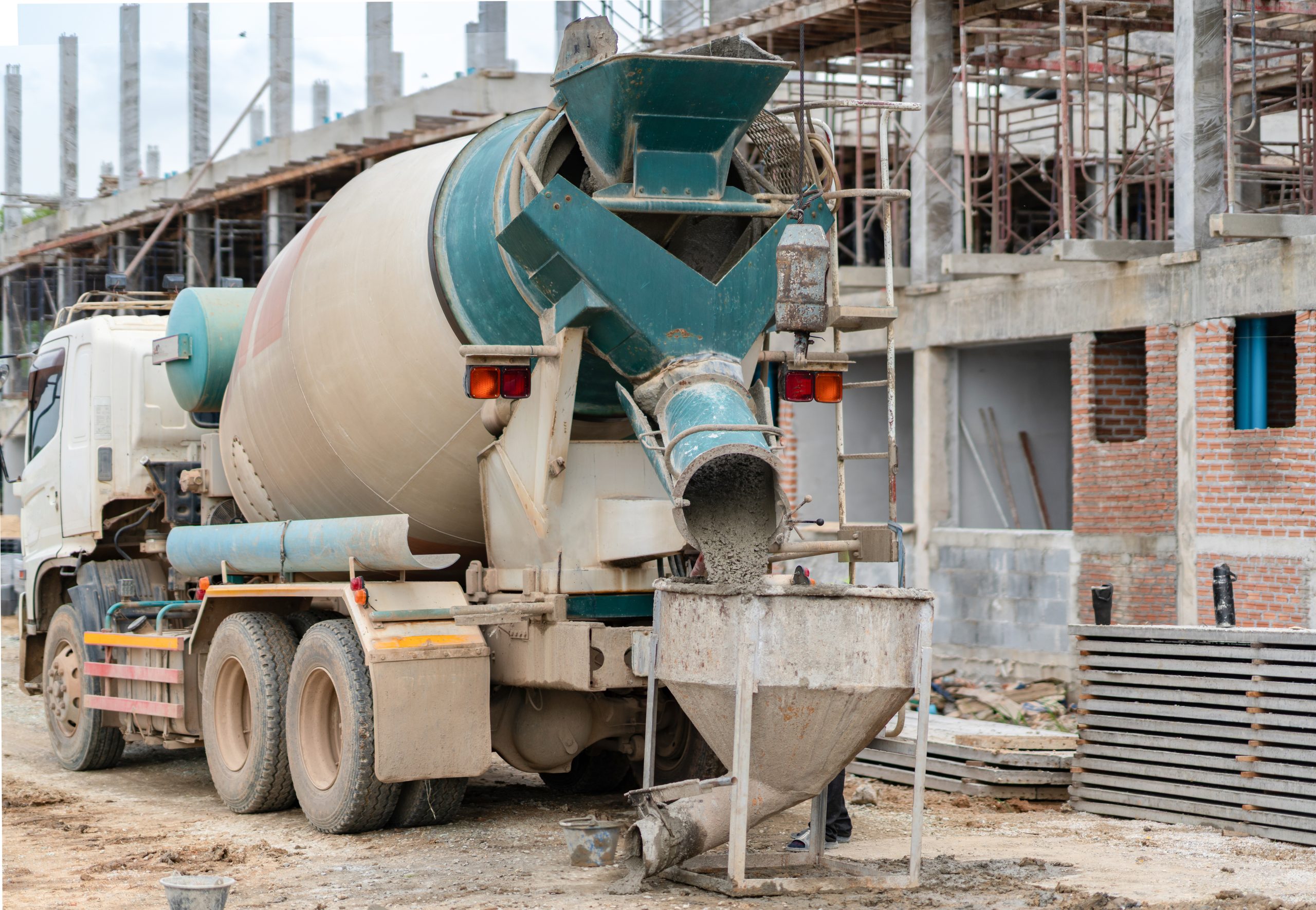
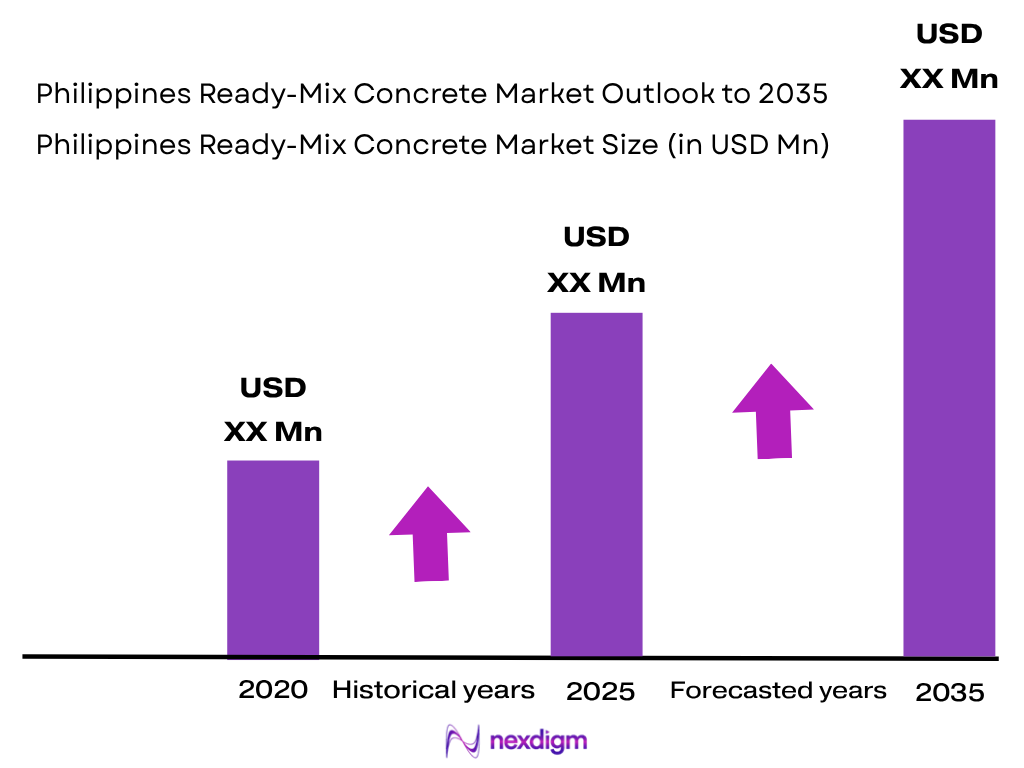
The Philippines ready-mix concrete market is valued at ~USD XX billion in 2024 and is supported by infrastructure development, residential construction, commercial real estate expansion, and industrial facility investments. The market demand is closely linked with national construction activity, where government infrastructure programs and private-sector developments continue increasing requirements for quality-controlled concrete supply. Industry assessments indicate that ready-mix concrete adoption is increasing as contractors shift from site-mixed concrete toward centralized batching operations due to consistency, reduced material wastage, and faster project execution. The Department of Public Works and Highways continues implementing large infrastructure programs requiring substantial concrete consumption across roads, bridges, and public facilities.
Ready-mix concrete demand in the Philippines is concentrated in Metro Manila, Calabarzon, Central Luzon, Cebu, and Davao due to higher construction activity, urbanization, and infrastructure investment. Metro Manila remains a major demand center because of high-rise residential developments, commercial buildings, transport projects, and redevelopment activities. Central Luzon benefits from industrial estate expansion and infrastructure connectivity improvements, while Cebu and Davao are supported by regional commercial development and tourism-related construction. The Philippines’ archipelagic geography creates regional supply opportunities, encouraging ready-mix producers to establish batching facilities near major construction corridors.
Market Segmentation
By Concrete Type
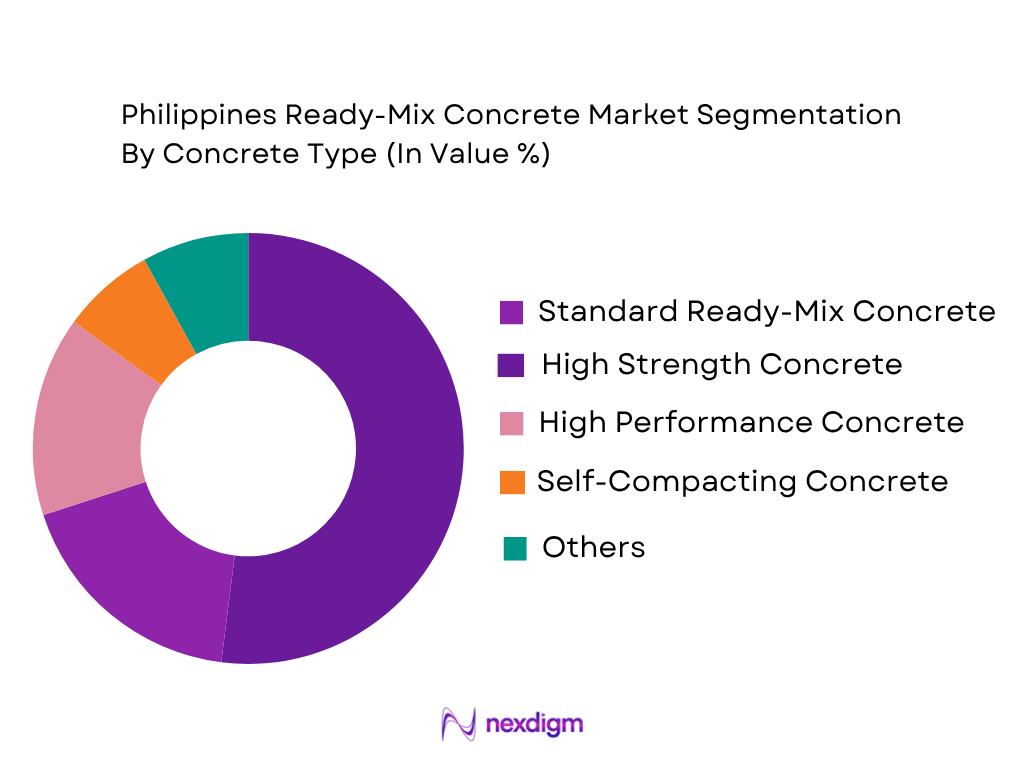
The Philippines ready-mix concrete market is segmented by concrete type into standard ready-mix concrete, high-strength concrete, high-performance concrete, self-compacting concrete, fiber-reinforced concrete, lightweight concrete, and sustainable concrete. Standard ready-mix concrete dominates the segment because it is widely used across residential buildings, commercial structures, roads, and general construction applications. Most low- and mid-rise developments require conventional concrete grades due to established engineering practices and cost efficiency. Infrastructure projects and large commercial developments are increasing demand for specialized concrete types such as high-performance and self-compacting concrete due to durability requirements. Suppliers including integrated cement-concrete companies are expanding product portfolios to address infrastructure specifications and sustainability requirements.
By Application
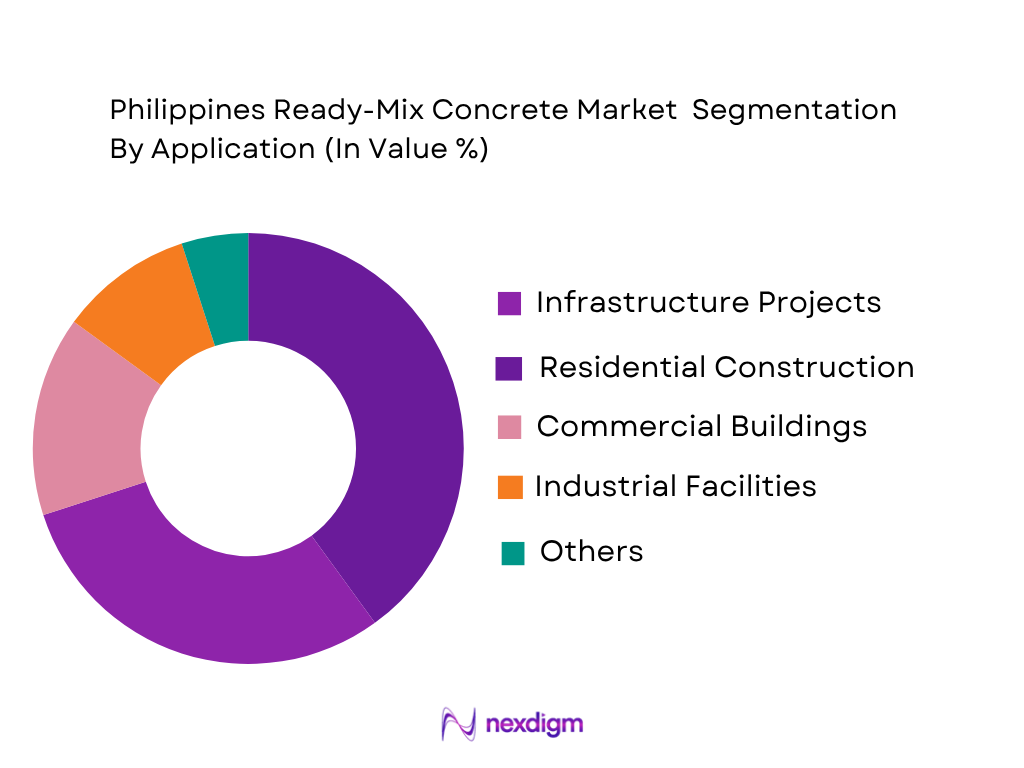
The Philippines ready-mix concrete market is segmented by application into residential construction, commercial construction, industrial construction, transportation infrastructure, public infrastructure, and other civil engineering projects. Infrastructure projects represent the leading application segment due to government investment in highways, bridges, airports, rail systems, and public facilities. The government’s infrastructure agenda continues generating demand for large-volume concrete supply from contractors requiring consistent quality and scheduled delivery. Residential construction is another significant application area due to population growth, urban migration, condominium development, and housing projects. Commercial and industrial construction demand is supported by business expansion, logistics facilities, manufacturing plants, and economic zones. Ready-mix concrete is increasingly preferred because it provides controlled mixing conditions and improves construction productivity compared with traditional site batching methods.
Competitive Landscape
The Philippines ready-mix concrete market consists of integrated cement producers, construction material companies, and regional ready-mix suppliers. Competition is shaped by batching plant coverage, logistics capability, concrete technology, project experience, and relationships with contractors and developers. Major suppliers focus on expanding production networks near high-growth construction areas to improve delivery efficiency. Companies such as Holcim Philippines, Republic Cement, CEMEX Philippines, and regional ready-mix operators participate in supplying concrete for infrastructure, residential, and commercial developments.
| Company | Establishment Year | Headquarters | Batching Plant Network | Product Portfolio | Infrastructure Capability | Sustainability Focus | Delivery Network |
| Holcim Philippines | 1974 | Philippines | ~ | ~ | ~ | ~ | ~ |
| CEMEX Philippines | 1997 | Philippines | ~ | ~ | ~ | ~ | ~ |
| Republic Cement | 1955 | Philippines | ~ | ~ | ~ | ~ | ~ |
| Filcon Ready Mixed | 1997 | Philippines | ~ | ~ | ~ | ~ | ~ |
| Eagle Cement | 2010 | Philippines | ~ | ~ | ~ | ~ | ~ |
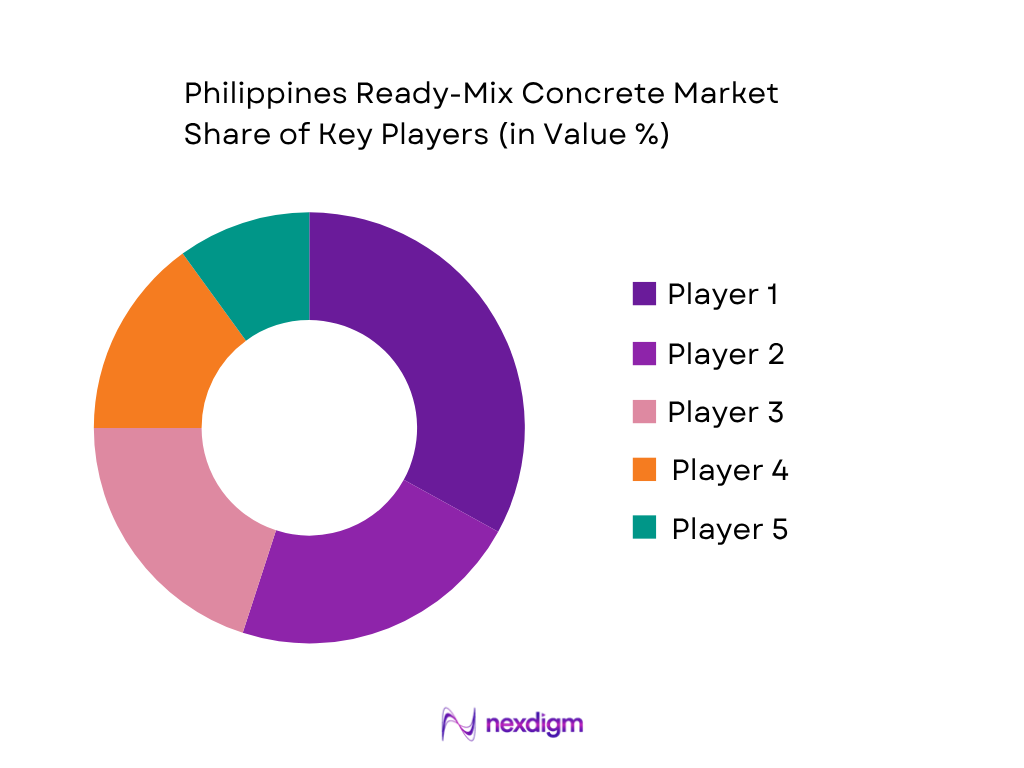
Philippines Ready-Mix Concrete Market Analysis
Growth Drivers
Infrastructure Development Programs and Metro Manila Urban Expansion
The Philippines ready-mix concrete market is supported by large-scale infrastructure development programs and continuous urban expansion, particularly in Metro Manila and surrounding growth corridors. The government’s infrastructure agenda has maintained strong demand for concrete-intensive projects, including roads, bridges, flood-control structures, rail systems, and public facilities. The Philippine Statistics Authority reported that the country’s construction industry contributed approximately PHP 1.2 trillion in gross value added during recent national economic assessments, reflecting sustained construction activity. The Department of Public Works and Highways allocated approximately PHP 900 billion for infrastructure programs, including major transportation and public works projects, creating demand for controlled-quality concrete supply. Metro Manila continues to experience concentrated construction activity due to high-density residential developments, commercial towers, and urban redevelopment projects. The National Economic and Development Authority has identified infrastructure connectivity as a priority area, supporting projects requiring reliable ready-mix concrete delivery. These developments encourage contractors to shift from traditional site-mixed concrete toward ready-mix solutions because of improved consistency, faster placement schedules, and compliance with engineering specifications. The increasing concentration of construction activities around urban centers continues strengthening demand for batching plants and concrete logistics networks.
Industrial Park Expansion and Foreign Direct Investment Manufacturing Projects
Industrial expansion and foreign investment-driven manufacturing development are increasing demand for ready-mix concrete across economic zones and emerging industrial corridors in the Philippines. The Philippine Economic Zone Authority reported continued expansion of registered economic zone activities, with more than 400 operating economic zones supporting manufacturing, logistics, and industrial facilities. Manufacturing investments require concrete-intensive infrastructure, including factories, warehouses, production buildings, utilities, and internal transportation networks. The Board of Investments recorded approved investment commitments exceeding PHP 1 trillion, indicating continued private-sector development requiring construction materials. Industrial locations in Calabarzon, Central Luzon, and Cebu are becoming important demand centers because of proximity to ports, workforce availability, and established industrial infrastructure. Ready-mix concrete suppliers benefit from these projects as industrial developers generally require consistent concrete specifications, scheduled deliveries, and quality documentation. Tourism infrastructure development also contributes additional demand through hotels, resorts, airports, and commercial facilities. The World Bank has highlighted continued economic activity in the Philippines supported by domestic investment and infrastructure development, reinforcing construction sector requirements. These industrial and commercial projects create opportunities for ready-mix producers capable of serving large-volume contracts with reliable logistics capabilities.
Market Challenges
Limited Ready-Mix Penetration Outside Urban Areas and Transportation Distance Constraints
The Philippines ready-mix concrete market faces challenges due to geographic dispersion, limited penetration outside major urban areas, and transportation limitations. The country consists of more than 7,600 islands, creating significant logistical complexity for construction material distribution. The Philippine Statistics Authority reported that a large portion of economic activity remains concentrated in highly urbanized regions such as Metro Manila, Central Luzon, and Calabarzon, resulting in uneven demand distribution across provinces. Ready-mix concrete requires delivery within controlled time periods because concrete quality can decline after batching, making transportation distance a critical operational constraint. Remote construction locations often rely on site-mixed concrete due to limited access to batching facilities. The Department of Transportation has identified logistics connectivity as a continuing national infrastructure priority, reflecting challenges associated with movement of goods across islands and regions. Suppliers must invest in strategically located batching plants, mixer truck fleets, and distribution networks to overcome regional accessibility issues. These limitations increase operational complexity for ready-mix producers attempting nationwide expansion while maintaining concrete quality standards. The challenge is particularly significant in rural infrastructure projects where demand volumes may not justify permanent batching facilities.
Cement Supply Fluctuation and High Initial Plant Investment Requirements
Ready-mix concrete producers in the Philippines face challenges related to cement supply availability, aggregate sourcing, and capital requirements for establishing batching operations. Cement production depends on stable supply chains involving limestone resources, energy availability, and transportation infrastructure. The Philippine Statistics Authority reported continued growth in construction-related material demand, increasing pressure on supply networks for cement and aggregates. Establishing a ready-mix facility requires investment in batching equipment, land acquisition, storage systems, laboratory facilities, and mixer truck fleets, creating entry barriers for smaller suppliers. Aggregate availability is also influenced by environmental regulations and quarrying restrictions, affecting consistent raw material sourcing. The Department of Environment and Natural Resources regulates quarry operations and resource extraction activities, influencing aggregate supply availability for construction projects. In addition, construction demand can fluctuate based on government project cycles, weather conditions, and seasonal activity patterns. Heavy rainfall during the monsoon season affects project schedules and concrete placement activities, creating utilization challenges for ready-mix facilities. These operational factors require suppliers to optimize plant locations, inventory management, and production planning to maintain profitability and service reliability.
Market Opportunities
Green Concrete Adoption and Low-Carbon Cement Integration
The Philippines ready-mix concrete market has growing opportunities from sustainable construction requirements, green building standards, and increasing adoption of low-carbon concrete solutions. The construction sector is facing increasing pressure to reduce emissions associated with cement production and building activities. The Philippine Green Building Code and sustainable building initiatives encourage developers to adopt environmentally responsible materials and energy-efficient construction practices. The Department of Energy reported continued focus on reducing national carbon intensity through cleaner technologies and efficiency programs, supporting demand for lower-emission construction solutions. Ready-mix producers can benefit by developing concrete mixes incorporating supplementary cementitious materials such as fly ash, slag, and other alternative materials that reduce dependence on conventional cement. The Philippines Green Building Council’s LEED and BERDE-certified projects continue promoting sustainable construction approaches in commercial and institutional developments. Infrastructure modernization programs also create opportunities for durable concrete solutions with longer service life and reduced maintenance requirements. Low-carbon concrete adoption allows suppliers to differentiate through environmentally optimized products while meeting evolving requirements from developers, government projects, and multinational companies operating in industrial zones.
Digital Concrete Ordering Platforms and Advanced Concrete Solutions
Digitalization of construction supply chains presents opportunities for ready-mix concrete suppliers through automated dispatch systems, digital ordering platforms, and advanced concrete management technologies. The Philippine Information and Communications Technology sector has expanded rapidly, with digital transformation becoming a priority across industries. The Department of Information and Communications Technology has continued promoting digital infrastructure development, supporting wider adoption of technology-enabled business operations. Ready-mix producers can integrate digital systems for order tracking, delivery scheduling, fleet management, and real-time communication between contractors and batching plants. Large infrastructure and industrial projects increasingly require precise delivery coordination because concrete placement depends on project timelines and workforce availability. High-performance concrete solutions also provide opportunities in specialized applications such as bridges, high-rise buildings, industrial facilities, and transportation infrastructure. The increasing development of smart cities and industrial parks creates demand for durable and technically advanced construction materials. Recycled aggregate concrete and sustainable construction materials offer additional opportunities as developers seek environmentally responsible alternatives. Digital technologies combined with advanced concrete formulations can improve operational efficiency, reduce delivery delays, and strengthen supplier competitiveness in the evolving Philippine construction market.
Future Outlook
The Philippines ready-mix concrete market is expected to expand through continued infrastructure investment, urban development, industrial expansion, and increasing preference for quality-controlled construction materials. Future market development will be influenced by sustainable construction practices, adoption of low-carbon concrete solutions, digital construction technologies, and improved logistics management. Infrastructure modernization programs, residential demand, and industrial investments are expected to create opportunities for ready-mix suppliers with strong regional networks and advanced concrete capabilities.
Major Players
- Holcim Philippines Inc.
- CEMEX Philippines
- Republic Cement
- Eagle Cement Corporation
- Filcon Ready Mixed Inc.
- DMCI Holdings
- Megawide Construction Corporation
- EEI Corporation
- DATEM Incorporated
- Aboitiz Construction
- Atlantic Gulf & Pacific Company
- Makati Development Corporation
- Concrete Aggregates Corporation
- Union Cement Corporation
- Semirara Mining and Power Corporation
Key Target Audience
- Ready-Mix Concrete Manufacturers and Suppliers
- Cement Producers and Construction Material Companies
- Construction Contractors and Engineering Companies
- Real Estate Developers
- Infrastructure Development Companies
- Investments and Venture Capitalist Firms
- Government and Regulatory Bodies (Department of Public Works and Highways, Department of Environment and Natural Resources, Housing and Urban Development Coordinating Council)
- Industrial Park Developers and Manufacturing Facility Owners
Research Methodology
Step 1: Identification of Key Variables
The research begins with mapping the Philippines ready-mix concrete ecosystem, including cement manufacturers, aggregate suppliers, ready-mix producers, contractors, developers, government agencies, and logistics providers. Secondary research is conducted using construction databases, government infrastructure documents, company information, and industry publications to identify market variables.
Step 2: Market Analysis and Construction
Historical construction trends, infrastructure investments, residential development activity, supplier capacity, and concrete consumption patterns are analyzed to estimate market dynamics. The assessment evaluates demand from infrastructure, residential, commercial, and industrial construction segments.
Step 3: Hypothesis Validation and Expert Consultation
Market assumptions are validated through discussions with concrete manufacturers, construction companies, suppliers, and industry stakeholders. These consultations provide insights into procurement behavior, product requirements, supply-chain challenges, and emerging market opportunities.
Step 4: Research Synthesis and Final Output
The final research output integrates supply-side analysis, demand-side evaluation, competitive assessment, and construction activity analysis. Data is validated through triangulation of industry information, government infrastructure plans, company developments, and market observations.

- Executive Summary
- Research Methodology (Market Definitions and Scope, Ready-Mix Concrete Classification Framework, Market Sizing Methodology, Top-Down Market Assessment, Bottom-Up Demand Evaluation, Construction Activity Mapping, Supply-Side Capacity Analysis, Concrete Producer Assessment, Contractor and Developer Interviews, Project Pipeline Analysis, Data Validation and Triangulation, Forecasting Framework, Research Limitations)

- Definition and Scope of Philippines Ready-Mix Concrete Market
- Industry Evolution and Development Timeline
- Philippines Construction Ecosystem Analysis
- Ready-Mix Concrete Value Chain Analysis
- Ready-Mix Concrete Supply Chain Analysis
- Construction Project Pipeline Assessment

- Growth Drivers (Infrastructure Development Programs, Metro Manila Urban Expansion, Public Housing Construction, Highway and Bridge Development, Industrial Park Expansion, Foreign Direct Investment Manufacturing Projects, Tourism Infrastructure Growth, Commercial Real Estate Development, Contractor Preference for Quality-Controlled Concrete)
- Market Challenges (Limited Ready-Mix Penetration Outside Urban Areas, Transportation Distance Constraints, Cement Supply Fluctuation, Aggregate Availability Issues, Mixer Truck Fleet Limitations, Construction Seasonality, Weather Disruptions, High Initial Plant Investment, Regional Demand Concentration, Competition from Site-Mixed Concrete)
- Market Opportunities (Green Concrete Adoption, Low-Carbon Cement Integration, Infrastructure Modernization, Smart City Development, Industrial Park Construction, Digital Concrete Ordering Platforms, Automated Dispatch Systems, High-Performance Concrete Solutions, Recycled Aggregate Concrete, Sustainable Construction Materials)
- Market Trends (Sustainable Concrete Development, Construction Technology Adoption, Precast and Ready-Mix Integration, Digital Construction Management, High-Durability Concrete Demand, Automated Batching Systems, Concrete Quality Monitoring Technologies)
- Government Regulations and Industry Standards (Department of Public Works and Highways Specifications, Philippine National Building Code Requirements, Environmental Compliance Regulations, Construction Quality Standards, Sustainable Building Guidelines)
- SWOT Analysis
- Porter’s Five Forces Analysis
- PESTLE Analysis
- Stakeholder Ecosystem Analysis
- Construction Material Supply Chain Ecosystem

- By Market Value (2020-2025)
- By Ready-Mix Concrete Consumption Volume (2020-2025)
- By Concrete Production Volume (2020-2025)
- By Average Delivery Volume (2020-2025)
- By Construction Application Revenue Contribution (2020-2025)
- By Regional Demand Contribution (2020-2025)

- By Concrete Type (In Value %)
Normal Strength Concrete
High Strength Concrete
High Performance Concrete
Self-Compacting Concrete
Fiber Reinforced Concrete
Lightweight Concrete
Green Concrete
Low-Carbon Concrete - By Application (In Value %)
Residential Construction
Commercial Buildings
Industrial Facilities
Road and Highway Infrastructure
Bridge and Transportation Infrastructure
Ports and Airport Infrastructure
Public Infrastructure Projects - By Construction Sector (In Value %)
Residential Real Estate Development
Commercial Real Estate Development
Government Infrastructure Projects
Industrial Manufacturing Facilities
Tourism and Hospitality Infrastructure
Energy and Utility Infrastructure - By Delivery Model (In Value %)
Ready-Mix Concrete Delivered Through Mixer Trucks
Large Infrastructure Contract Supply
Project-Based Concrete Supply
On-Demand Concrete Delivery
Long-Term Construction Contracts - By Region (In Value %)
National Capital Region
Calabarzon
Central Luzon
Central Visayas
Davao Region
Northern Mindanao
Other Emerging Construction Regions

- Market Positioning of Major Players (Production Capacity, Batching Plant Coverage, Project Portfolio, Customer Segments)
- Cross Comparison Parameters (Production Capacity and Batching Plant Network, Geographical Coverage of Concrete Delivery Operations, Concrete Product Portfolio Breadth, High-Performance Concrete Capability, Large Infrastructure Project Experience, Mixer Truck Fleet Availability, Digital Ordering and Delivery Management Systems, Sustainability and Green Concrete Capability)
- SWOT Analysis of Major Players
- Pricing Analysis by Concrete Grade and Application
- Detailed Profiles of Major Companies
Holcim Philippines
Cemex Philippines
Republic Cement
Eagle Cement Corporation
DMCI Holdings
Megawide Construction Corporation
EEI Corporation
Concrete Aggregates Corporation
Union Cement Corporation
Aboitiz Construction
Vulcan Materials Corporation
Philkonstrak Development Corporation
Atlantic Gulf & Pacific Company
Makati Development Corporation
DATEM Incorporated

- Construction Industry Demand Assessment
- Project-Based Consumption Analysis
- Contractor Procurement Analysis
- Regional Consumption Analysis
- Concrete Specification Preference Analysis
- Construction Technology Adoption Analysis

- By Market Value (2026-2035)
- By Ready-Mix Concrete Consumption Volume (2026-2035)
- By Concrete Production Volume (2026-2035)
- By Average Delivery Volume (2026-2035)
- By Construction Application Revenue Contribution (2026-2035)
- By Regional Demand Contribution (2026-2035)


 Request a Sample
 Ask for Customization
 Get a Quote
 Enquire Now