
 Download PDF
Market Overview
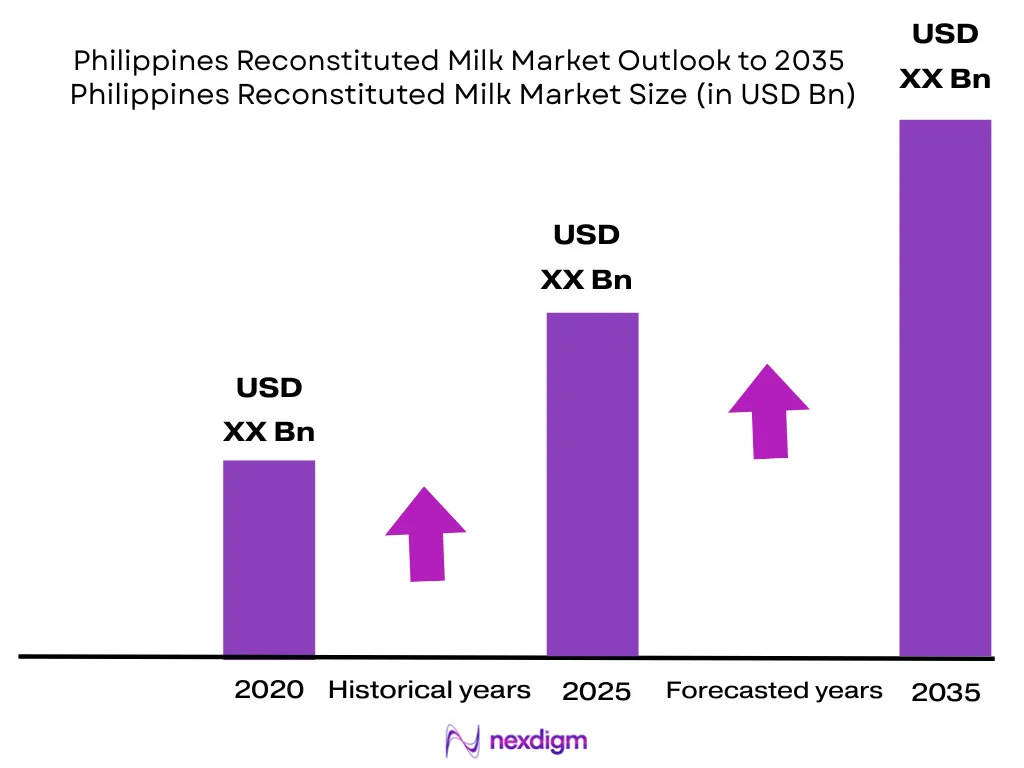
The Philippines Reconstituted Milk Market is valued at approximately USD ~ billion, based on dairy import value used as the closest formal proxy for powder-based reconstitution, recombined milk and UHT dairy demand. The previous import base stood at 2.913 million MT LME, rising to 3.496 million MT LME, while domestic production moved from 29.10 thousand MT to 32.98 thousand MT. Demand is driven by milk powder, UHT milk, coffee and milk tea consumption, bakery use and school milk feeding.
The Philippines Reconstituted Milk Market is dominated by National Capital Region, CALABARZON, Central Luzon, Central Visayas, Davao Region and Northern Mindanao due to population density, modern retail, foodservice, ports, processing and dairy development clusters. USDA FAS identifies Batangas and Laguna as relevant local milk supply areas for milk tea, coffee shops and imported UHT milk handling. The United States and New Zealand remain major dairy suppliers, followed by Indonesia, Australia and Denmark, supporting import-led recombination.
Market Segmentation
By Source Ingredient
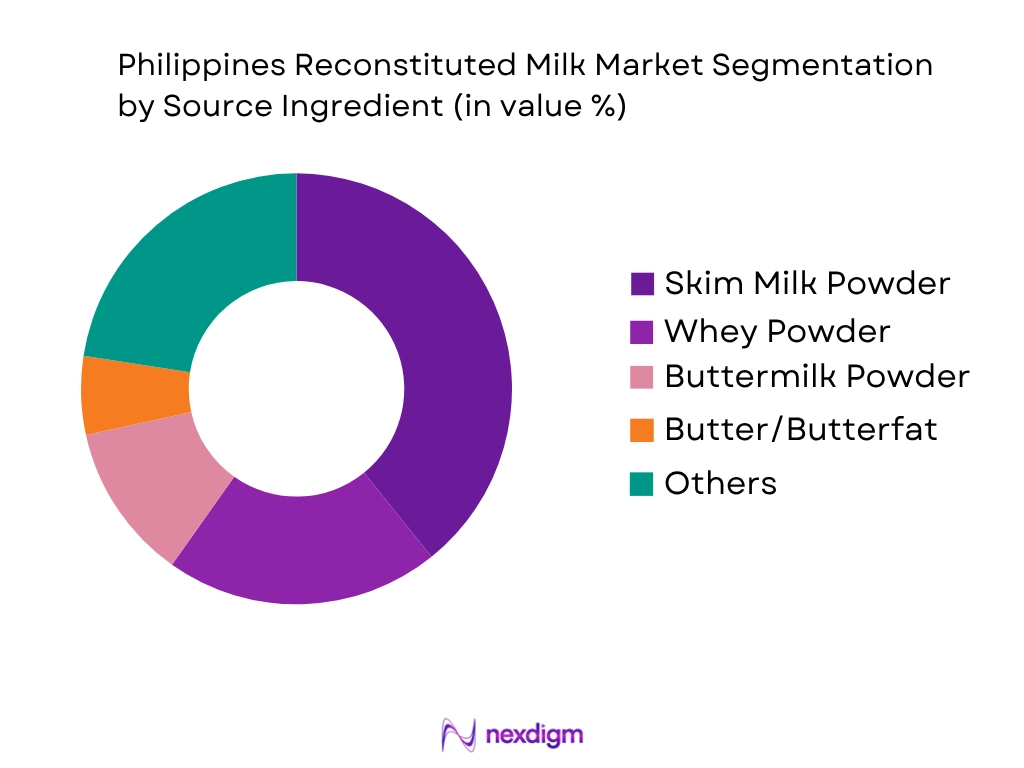
Philippines Reconstituted Milk Market is segmented by source ingredient into skim milk powder, whole milk powder, whey powder, buttermilk powder, liquid RTD milk imports, butter/butterfat and other dairy solids. Recently, skim milk powder has a dominant market share in the Philippines under source ingredient segmentation because it is the most functional and cost-effective base for reconstituted milk, recombined dairy, yogurt, bakery products, confectionery and other packaged dairy applications. USDA FAS states that SMP is used for cooking, bakery products, confectionery, cheese and yogurt, and that some consumers use it as recombined or reconstituted milk by adding water to make liquid milk. SMP supply in the country is mostly imported, and the United States and New Zealand remain major suppliers. This makes SMP the backbone ingredient for both household and industrial reconstitution.
By Application
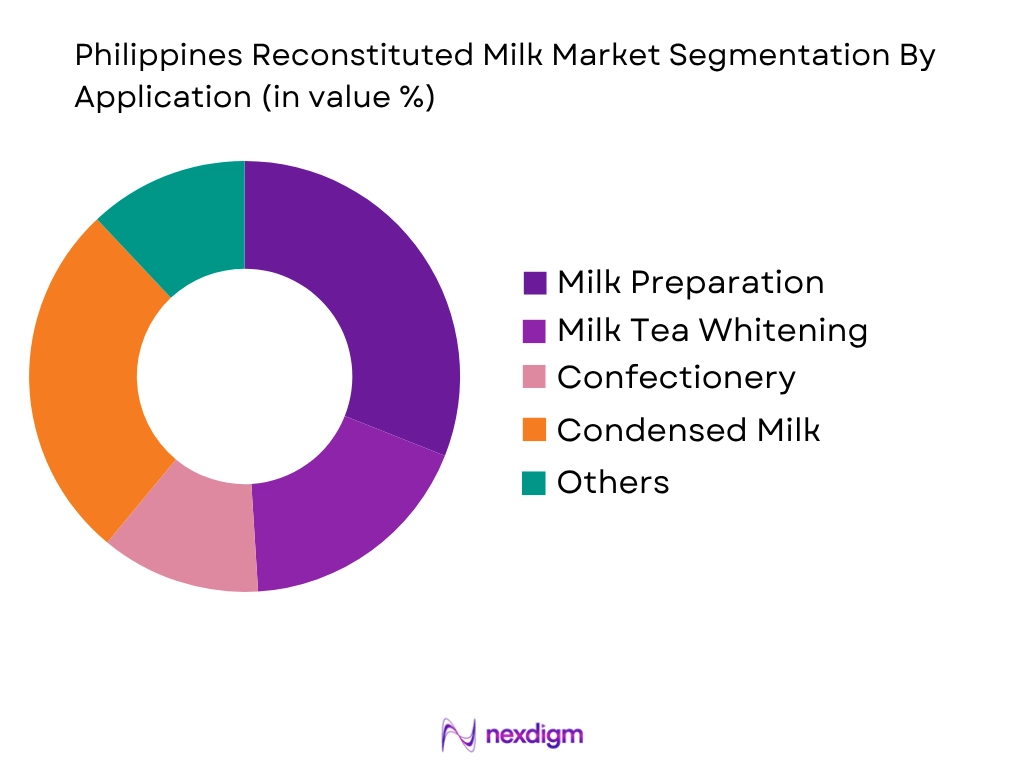
Philippines Reconstituted Milk Market is segmented by application into household milk preparation, coffee and milk tea whitening, bakery and confectionery, recombined evaporated and condensed milk, UHT drinking milk, infant and family nutrition, foodservice dairy base and school feeding. Recently, household milk preparation has a dominant market share under application segmentation because powdered milk is deeply embedded in daily Filipino consumption through breakfast drinks, chocolate beverages, coffee, cereals and family nutrition. Reconstituted milk is practical in the Philippines because households can store powder without refrigeration and prepare milk in smaller quantities. The application is also supported by imported SMP and WMP availability, while recombined evaporated and condensed milk remain important for cooking, desserts and beverage whitening. Foodservice applications are growing through milk tea, cafés, bakeries, restaurants and hotels, but household preparation remains the widest consumption base.
Competitive Landscape
The Philippines Reconstituted Milk Market is led by multinational dairy companies, domestic food manufacturers and import-led dairy brands with strong powder milk, evaporated milk, condensed milk, UHT milk and family nutrition portfolios. Alaska Milk Corporation, Nestlé Philippines, FrieslandCampina, Fonterra and Century Pacific Food/Birch Tree are highly relevant because they operate across milk powder, recombined canned milk, nutrition, foodservice and nationwide retail channels. Competition is shaped by import access, SKU breadth, sari-sari store penetration, supermarket visibility, product fortification, powder solubility, brand trust and regulatory compliance.
| Company | Establishment Year | Headquarters | Reconstituted Milk Presence | Key Brands/Business Lines | Ingredient Sourcing Linkage | Distribution Strength | Regulatory/Quality Position | Market-Specific Position |
| Alaska Milk Corporation | 1972 | Makati, Philippines | ~ | ~ | ~ | ~ | ~ | ~ |
| Nestlé Philippines | 1911 local establishment | Makati, Philippines | ~ | ~ | ~ | ~ | ~ | ~ |
| FrieslandCampina Philippines | 1871 group roots; Alaska link from 2012 | Philippines / Netherlands parent | ~ | ~ | ~ | ~ | ~ | ~ |
| Fonterra Brands Philippines | Global group established 2001 | Philippines / New Zealand parent | ~ | ~ | ~ | ~ | ~ | ~ |
| Century Pacific Food / Birch Tree | 1978 | Pasig/Taguig, Philippines | ~ | ~ | ~ | ~ | ~ | ~ |
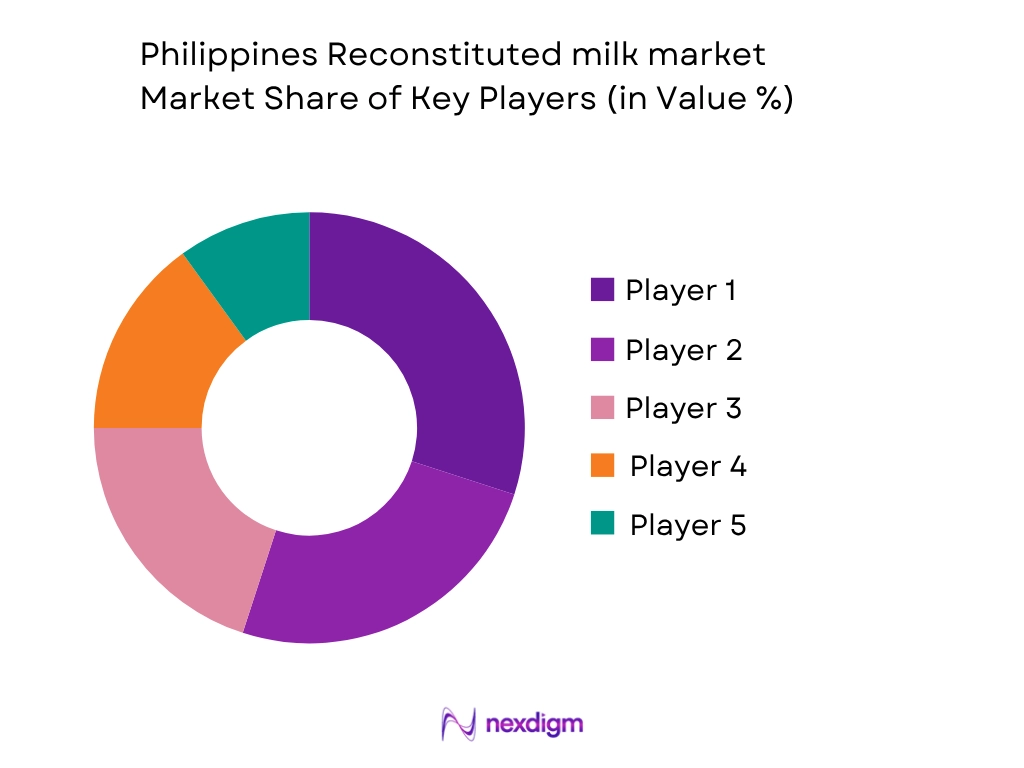
Philippines Reconstituted Milk Market Analysis
Growth Drivers
High Reliance on Imported Dairy Inputs for Reconstituted Milk Production
Philippines Reconstituted Milk Market is driven by imported dairy ingredients because local production remains structurally below national demand. USDA FAS reports total dairy imports at 3.496 million MT LME in 2024, compared with 2.913 million MT LME in 2023, while domestic milk production reached only 32.98 thousand MT in 2024. This creates direct demand for skim milk powder, whole milk powder, whey and UHT milk used in reconstituted and recombined products. World Bank records Philippines GDP at USD 461.62 billion, GDP per capita at USD 3,984.8, and GDP growth at 5.7 in 2024, supporting packaged dairy consumption.
Household and Foodservice Applications Expanding Powder-to-Liquid Usage
Philippines Reconstituted Milk Market benefits from broad use of milk powder in households, cafés, milk tea outlets, bakeries and food manufacturers. USDA FAS states that skim milk powder is used in cooking, bakery, confectionery, cheese and yogurt, and that consumers also add water to use it as recombined or reconstituted milk. The same source links liquid ready-to-drink milk demand to coffee and milk tea consumption and foodservice expansion. World Bank records Philippines population growth at 0.8 in 2024 and consumer inflation at 3.2 in 2024, while GDP per capita reached USD 3,984.8, supporting demand for shelf-stable, flexible dairy formats across urban channels.
Market Challenges
Low Domestic Milk Output Limits Local Substitution
Philippines Reconstituted Milk Market faces a major challenge from limited domestic milk output, which restricts the scope for local substitution in recombined and reconstituted dairy products. USDA FAS reports domestic milk production at 32.98 thousand MT in 2024 against dairy imports of 3.496 million MT LME in the same year. Earlier FAS dairy reporting notes average daily milk output at 10 liters for dairy cows, 4.5 liters for buffalo and 1.5 liters for goats, showing low productivity across the local herd base. World Bank records GDP growth at 5.7 and consumer inflation at 3.2 in 2024, but dairy processors remain dependent on imported milk solids.
Import and Macroeconomic Exposure Affect Ingredient Availability
Philippines Reconstituted Milk Market is exposed to external supply and macroeconomic pressure because skim milk powder, whole milk powder, whey and UHT milk are sourced largely from overseas suppliers. USDA FAS identifies the United States and New Zealand as major dairy suppliers to the Philippines, with Indonesia, Australia and Denmark also contributing. This supplier structure matters because reconstituted milk processors depend on import documents, shipping, customs clearance and foreign exchange access. World Bank records consumer inflation at 3.2 in 2024, GDP at USD 461.62 billion, and GDP per capita at USD 3,984.8; these macro indicators support demand but also highlight sensitivity to imported-input availability.
Market Opportunities
School Feeding and Child Nutrition Demand for Fortified Reconstituted Milk
Philippines Reconstituted Milk Market has an opportunity in fortified milk for children, because reconstituted dairy can be standardized with milk solids, vitamins and protein for school feeding and family nutrition. USDA FAS notes that the National Dairy Authority supports local milk supply and school milk feeding, while total domestic milk production reached 32.98 thousand MT in 2024. The country’s current demographic base supports this opportunity: the Philippine Statistics Authority declared the 2024 population count official, showing the population increased by 3.69 million from the 2020 count of 109.04 million. World Bank also records GDP growth at 5.7 in 2024, supporting institutional and household dairy demand.
Future Outlook
Over the next decade, the Philippines Reconstituted Milk Market is expected to expand steadily as imported dairy ingredients, powder-based milk, recombined evaporated milk, UHT milk, milk tea applications and school feeding continue to shape demand. The market will remain structurally import-led because local dairy production supplies only a small part of domestic requirements. USDA FAS reports that the Philippines imports 99% of its dairy requirement and produces only 1% of demand. This import dependence will keep SMP, WMP, whey powder and UHT milk central to processor strategy. The same source reports that dairy consumption is supported by an expanding middle class, growing population, cold chain investments, supermarkets and display infrastructure. Foodservice will remain a critical growth channel. USDA FAS links liquid RTD milk demand to the expansion of coffee and milk tea consumption and the foodservice sector. Imported UHT milk supports cafés and milk tea shops because it offers easier handling and supply assurance. The strongest opportunities will be in fortified milk, affordable powder packs, school feeding, recombined evaporated milk, café milk bases, bakery applications and local milk blending. However, the market will remain exposed to foreign exchange movement, global dairy price volatility, import logistics, food safety compliance and consumer affordability pressure.
Major Players
- Alaska Milk Corporation
- Nestlé Philippines
- FrieslandCampina Philippines
- Fonterra Brands Philippines
- Arla Foods Philippines
- Magnolia / San Miguel Foods
- RFM Corporation / Selecta
- Century Pacific Food / Birch Tree
- Mondelez Philippines / Eden Dairy Portfolio
- Yakult Philippines
- Universal Robina Corporation
- Rebisco / Suncrest Dairy-Adjacent Portfolio
- Dairy Farm International / Meadows Private Label
- Puregold Private Label Dairy
- SM Markets Private Label Dairy
Key Target Audience
- Dairy processors and recombined milk manufacturers
- Milk powder, whey and dairy ingredient importers
- Supermarket, hypermarket and convenience retail chains
- Sari-sari store distributors and traditional trade wholesalers
- Foodservice, milk tea, bakery and beverage manufacturers
- Investments and venture capitalist firms
- Government and regulatory bodies (Food and Drug Administration Philippines; Bureau of Animal Industry; National Dairy Authority; Department of Agriculture; Department of Education; Bureau of Customs)
- Aseptic packaging, dairy processing and cold-chain logistics companies
Research Methodology
Step 1: Identification of Key Variables
The initial phase involves constructing an ecosystem map covering dairy exporters, milk powder importers, recombined milk processors, UHT milk brands, supermarkets, sari-sari store distributors, foodservice buyers and institutional procurement bodies. Key variables include SMP imports, WMP imports, UHT milk imports, local milk production, reconstitution applications and school feeding demand.
Step 2: Market Analysis and Construction
In this phase, historical data is compiled across dairy imports, domestic production, milk powder usage, UHT milk demand, foodservice applications and company product portfolios. The market is constructed through a top-down import-based approach and a bottom-up assessment of SKUs, channels, powder conversion and end-use demand.
Step 3: Hypothesis Validation and Expert Consultation
Market hypotheses are validated through CATI interviews with dairy processors, milk powder traders, wholesalers, supermarket category managers, foodservice distributors and institutional procurement stakeholders. These consultations test assumptions around reconstituted milk usage, powder-to-liquid conversion, pack format demand, foodservice uptake and local milk blending.
Step 4: Research Synthesis and Final Output
The final phase integrates secondary research, trade data, company benchmarking and primary validation into a structured market model. The output captures market size, segmentation, competitive positioning, forecast trajectory and strategic recommendations for stakeholders in the Philippines reconstituted, recombined and powder-based dairy ecosystem.

- Executive Summary
- Research Methodology (Market Definitions and Assumptions, Reconstituted Milk and Recombined Milk Scope, Powder-to-Liquid Conversion Ratio, Milk Solids-Not-Fat Assumptions, Fat Standardization Approach, Import-Export Triangulation, Retail SKU Mapping, Distributor and Sari-Sari Store Validation, Foodservice and Institutional Interviews, Processor-Level Bottom-Up Assessment, Top-Down Dairy Import Analysis, Limitations and Forecast Sensitivities)

- Definition and Scope
- Market Genesis and Evolution
- Role of Reconstituted Milk in Philippines Dairy Consumption
- Timeline of Major Dairy Players
- Business Cycle and Consumption Seasonality

- Growth Drivers (Imported Milk Powder Availability, Household Powder Reconstitution, School Milk Feeding Programmes, Sari-Sari Store Retailing, Coffee and Chocolate Beverage Usage, Bakery and Foodservice Demand, Urban Population Growth, Fortified Nutrition Demand)
- Market Challenges (Import Exposure, Foreign Exchange Volatility, Low Local Milk Production, Feed and Herd Productivity Constraints, Port and Logistics Costs, Regulatory Compliance, Counterfeit and Adulteration Risk, Consumer Price Sensitivity)
- Opportunities (Fortified Reconstituted Milk, School Feeding Supply, Local Milk Collection Blends, Value Sachets, Foodservice Bulk Dairy Base, Milk Tea and Coffee Shop Demand, Online Grocery Expansion, ASEAN Dairy Ingredient Partnerships)
- Market Trends (Powdered Milk Dominance, Recombined Evaporated Milk Usage, Fortified Family Milk, Sachet-Led Affordability, Milk Tea and Coffee Demand, Local Dairy Development, Online Grocery, Nutrition Claims)
- SWOT Analysis
- Porter’s Five Forces
- PESTLE Analysis

- By Value (2020-2025)
- By Volume (2020-2025)
- By Average Realization per Litre/Kilogram (2020-2025)

- By Product Type (In Value %)
Powdered Reconstituted Milk
Liquid Reconstituted Milk
Recombined Evaporated Milk
Recombined Condensed Milk
UHT Reconstituted Milk - By Application (In Value %)
Household Drinking Milk
Coffee and Chocolate Beverage Whitening
Breakfast Cereal Consumption
Bakery and Confectionery
Foodservice and Café Milk Base - By Distribution Channel (In Value %)
Supermarkets and Hypermarkets
Sari-Sari Stores
Convenience Stores
Wet Markets and Traditional Grocers
Wholesalers and Distributors
Online Grocery Platforms - By Region (In Value %)
National Capital Region
CALABARZON
Central Luzon
Central Visayas
Western Visayas
Davao Region

- Market Share of Major Players (Value Share, Volume Share, Powder Milk Share, Evaporated Milk Share, UHT Milk Share, Retail Shelf Presence, Foodservice Presence)
- Cross Comparison Parameters (Milk Powder Import and Sourcing Network, Reconstituted and Recombined Milk Production Capability, Evaporated and Condensed Milk Portfolio Strength, Sari-Sari and Traditional Trade Distribution Reach, Modern Retail and E-Grocery Presence, Local Milk Collection and NDA Partnership Exposure, Fortified Child Nutrition Portfolio Strength, FDA/BAI Compliance and Traceability Capability)
- Pricing Analysis by SKU
- SWOT Analysis of Major Players
- Detailed Profiles of Major Companies
Alaska Milk Corporation
Nestlé Philippines
FrieslandCampina Philippines
Fonterra Brands Philippines
Arla Foods Philippines
Magnolia / San Miguel Foods
RFM Corporation / Selecta
Century Pacific Food / Birch Tree
Mondelez Philippines / Eden Dairy Portfolio
Yakult Philippines
Universal Robina Corporation
Rebisco / Suncrest Dairy-Adjacent Portfolio
Dairy Farm International / Meadows Private Label
Puregold Private Label Dairy
SM Markets Private Label Dairy

- Household Consumers
- Foodservice Buyers
- Bakery and Confectionery Manufacturers
- Beverage and Dairy Drink Manufacturers
- Institutional and Public Procurement Buyers

- By Value (2026-2035)
- By Volume (2026-2035)
- By Average Realization per Litre/Kilogram (2026-2035)


 Request a Sample
 Ask for Customization
 Get a Quote
 Enquire Now