
 Download PDF
Market Overview
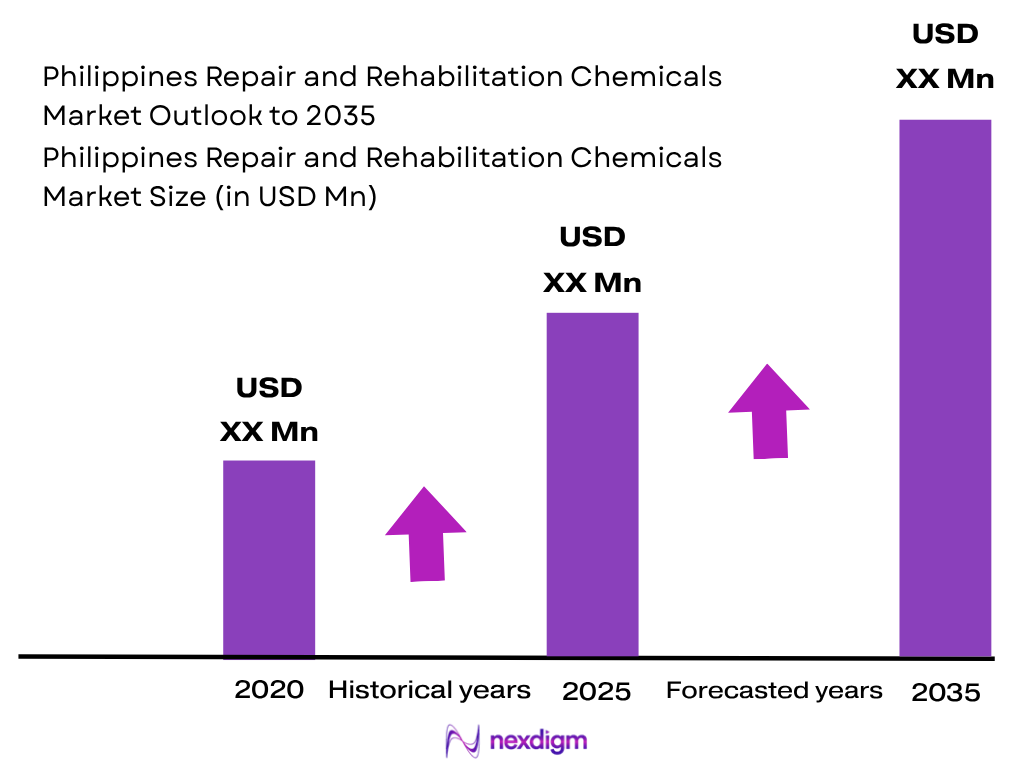
The Philippines Repair and Rehabilitation Chemicals Market is valued at approximately USD ~XX million, supported by alteration and repair activity increasing from 12,875 projects valued at PHP33.98 billion in the preceding annual observation to 13,997 projects valued at PHP43.05 billion in the latest observation. Total approved construction simultaneously increased from 171,268 to 180,341 projects, expanding the future installed base requiring crack repair, waterproofing rehabilitation, structural grouting and corrosion protection.
CALABARZON, Central Luzon, Central Visayas and Metro Manila are major demand centres because they combine dense building stocks, industrial facilities, transport infrastructure and large volumes of ongoing construction. Approved projects increased from 40,332 to 41,471 in CALABARZON, while Central Luzon recorded 22,824 projects and Central Visayas 19,585 projects in the latest observation, providing a sizeable future base for structural repair, crack injection and waterproofing rehabilitation.
Market Segmentation
By Repair Chemical Type
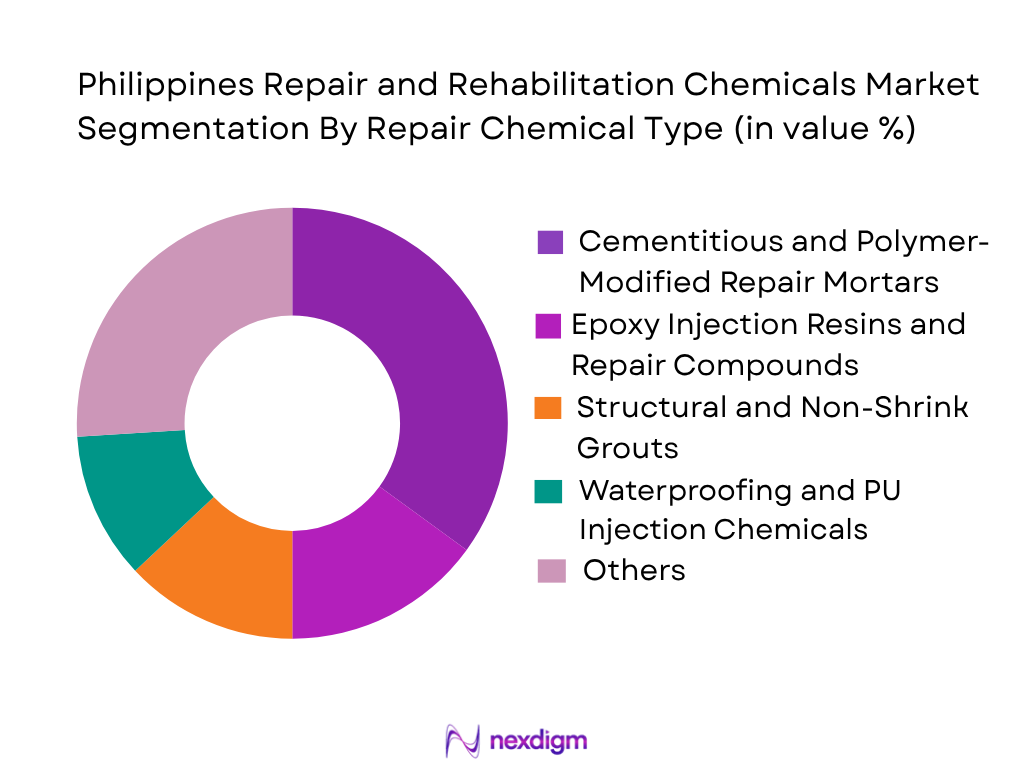
The Philippines Repair and Rehabilitation Chemicals Market is segmented into cementitious repair mortars, polymer-modified repair mortars, fiber-reinforced repair mortars, micro-concrete, epoxy injection resins, polyurethane injection resins, non-shrink grouts, epoxy grouts, bonding agents, corrosion-protection materials, protective coatings and crystalline rehabilitation chemicals. Cementitious and polymer-modified repair mortars hold the dominant market share because concrete remains the primary structural material across Philippine buildings, bridges, flyovers, ports and flood-control assets. These products are suitable for patch repairs, spalled concrete reinstatement, beam and column rehabilitation and damaged cover replacement around corroded reinforcement. The country’s national bridge stock alone includes 7,590 concrete bridges extending 326,120.64 linear metres, creating a substantial installed base exposed to cracking, moisture ingress and reinforcement deterioration. Polymer-modified systems are particularly relevant because they improve adhesion, reduce permeability and provide better dimensional stability than conventional site-mixed mortar, while epoxy and PU systems serve more specialized structural-crack and leakage applications.
By Application
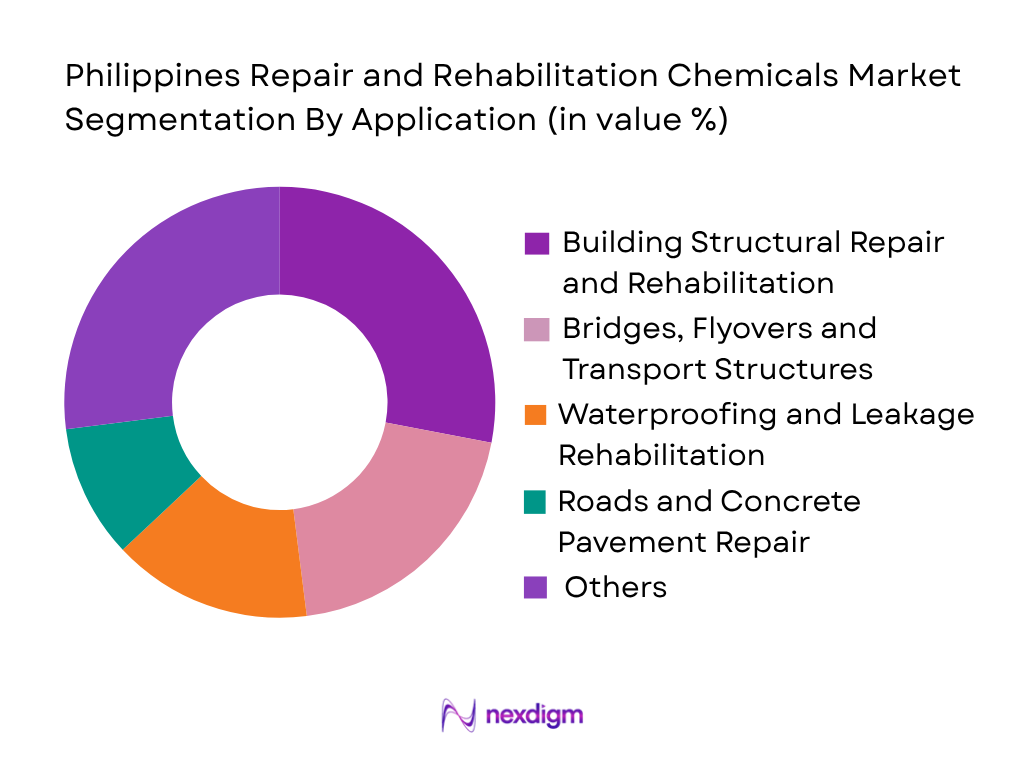
The Philippines Repair and Rehabilitation Chemicals Market is segmented into building structural repair, bridges and flyovers, roads and pavements, waterproofing rehabilitation, industrial structures, marine and coastal structures, water and wastewater facilities and seismic strengthening. Building structural repair represents the dominant application because the country has a large and continually expanding stock of residential, commercial and institutional buildings that eventually require crack sealing, spall repair, waterproofing, column strengthening and slab rehabilitation. PSA recorded 13,997 alteration and repair projects valued at PHP43.05 billion, providing direct evidence of a significant rehabilitation pipeline. Infrastructure applications are also important because DPWH manages 9,007 national bridges with an aggregate length of 414,897.99 linear metres, including thousands of concrete structures that require periodic deck, girder, pier, bearing and corrosion-related interventions. Bridge rehabilitation requires high-performance repair mortars, injection resins and grouts, while tropical rainfall and marine exposure increase the relevance of leak-sealing and corrosion-protection systems.
Competitive Landscape
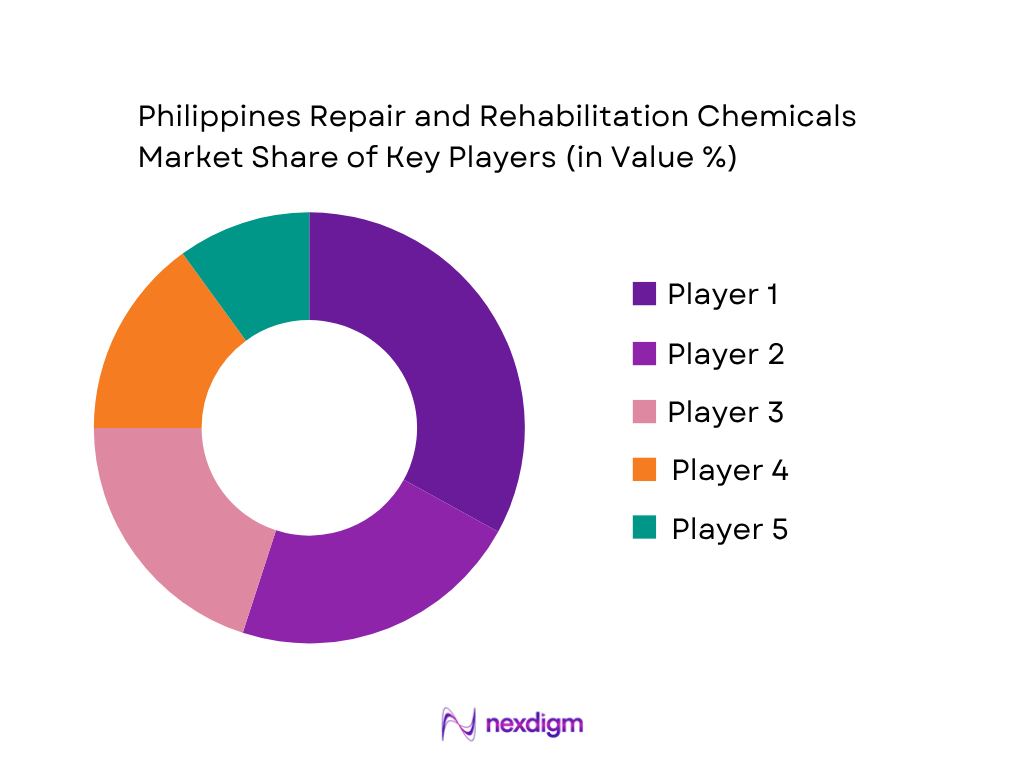
The Philippines Repair and Rehabilitation Chemicals Market combines multinational construction-chemical manufacturers with domestic specialists and locally established applicator networks. Sika, MAPEI and Fosroc participate across repair mortars, grouts, injection systems and protective coatings, while PENETRON and Kryton are especially strong in crystalline concrete protection and durability applications. Local companies such as Canchem and Buildrite add contractor access and application capability. Competition centres on structural repair depth, crack-injection technology, CFRP strengthening capability, bridge rehabilitation experience, technical specifications, applicator training and availability of local project support.
| Major Player | Establishment Year | Headquarters | Repair Mortar Capability | Crack Injection Capability | Structural Grout Capability | CFRP / Strengthening Capability | Waterproofing & Durability Systems | Technical & Project Support |
| Sika | 1910 | Baar, Switzerland | ~ | ~ | ~ | ~ | ~ | ~ |
| MAPEI | 1937 | Milan, Italy | ~ | ~ | ~ | ~ | ~ | ~ |
| Fosroc | 1972 | Dubai, UAE | ~ | ~ | ~ | ~ | ~ | ~ |
| PENETRON | 1978 | East Setauket, New York, US | ~ | ~ | ~ | ~ | ~ | ~ |
| Kryton International | 1973 | Vancouver, Canada | ~ | ~ | ~ | ~ | ~ | ~ |
Philippines Repair and Rehabilitation Chemicals Market Analysis
Growth Drivers
Rising Building Alteration and Repair Activity Expanding Demand for Rehabilitation Chemicals
The Philippines Repair and Rehabilitation Chemicals Market is being supported by sustained modification and repair activity across the country’s residential, commercial and institutional building stock. Philippine Statistics Authority data recorded 13,997 alteration and repair projects in 2024, compared with 12,875 projects in 2023, demonstrating a larger installed-building rehabilitation workload requiring repair mortars, epoxy bonding systems, crack-injection resins, non-shrink grouts and waterproofing chemicals. The repair pipeline remained active through 2025, with 1,333 alteration and repair projects in July, 1,187 in September, 991 in November and 858 in December. These repeated monthly project volumes indicate that rehabilitation demand is not dependent on isolated large developments but arises continuously from deterioration, leakage, structural modifications and building modernization. Repair chemicals are particularly relevant where conventional replacement would require substantial demolition or prolonged facility closure. The broader macroeconomic environment supports continued asset maintenance: World Bank data place Philippine GDP at US$461.67 billion in 2024 and GDP per capita at US$3,984.8. A growing stock of occupied structures, combined with thousands of annual alteration and repair approvals, therefore provides a recurring demand base for engineered rehabilitation systems.
Large National Bridge Inventory Driving Structural Repair and Corrosion-Mitigation Requirements
The scale of the Philippines’ national bridge network is a major driver for repair and rehabilitation chemicals because bridge decks, girders, piers, abutments and bearings require recurring maintenance as concrete cracks, reinforcement corrodes and water penetrates structural elements. The Department of Public Works and Highways recorded 9,007 national bridges in 2024, extending 414,897.99 linear metres nationwide. Of these, 7,590 were concrete bridges covering 326,120.64 linear metres, while 1,406 steel bridges covered 88,400.37 linear metres. Region VIII alone contained 928 bridges, while Region III contained 758, demonstrating the geographic breadth of the maintenance requirement. Concrete-dominated infrastructure creates applications for polymer-modified mortars, epoxy crack injection, micro-concrete, non-shrink bearing grouts, corrosion inhibitors and protective coatings. Even bridges that remain structurally serviceable need preventive intervention before localized deterioration develops into more extensive rehabilitation work. This physical asset base operates within an economy where World Bank data show US$461.67 billion of GDP in 2024 and US$3,984.8 GDP per capita. The combination of extensive bridge length and a large concrete structure inventory provides a sustained technical demand base for specialized repair materials and rehabilitation contractors.
Market Challenges
Wide Variation in Bridge Condition Increasing Repair-System Selection and Execution Complexity
A key challenge for the Philippines Repair and Rehabilitation Chemicals Market is that infrastructure deterioration varies substantially from one asset to another, requiring different repair chemistries, preparation methods and engineering interventions. DPWH’s 2024 bridge condition survey classified 3,993 bridges as good, 4,378 as fair, 563 as poor and 73 as bad. DPWH states that fair-condition bridges may require major repair, strengthening or protective works, poor-condition bridges may require major maintenance or upgrading, and bad-condition bridges can require replacement rather than conventional repair. This variation directly affects chemical-system selection: minor durability defects may need protective coatings or corrosion treatment, structural cracks may require epoxy injection, spalled sections need high-build repair mortars, and severely deteriorated members may require micro-concrete jacketing or CFRP strengthening. Contractors therefore cannot apply a single standardized repair material across the national portfolio. Correct diagnosis, substrate removal, reinforcement treatment, moisture assessment and curing remain critical to performance. The challenge is magnified by the country’s economic scale, with World Bank data showing 2024 GDP of US$461.67 billion and GDP per capita of US$3,984.8, supporting a large but technically diverse infrastructure-maintenance environment.
Uneven Repair Project Flow Complicating Contractor Capacity and Inventory Planning
The Philippines Repair and Rehabilitation Chemicals Market also faces operational challenges because repair work can fluctuate materially between months and locations, complicating material inventory, applicator deployment and project scheduling. Philippine Statistics Authority data show 1,333 alteration and repair projects in July 2025, falling to 1,187 in September, 991 in November and 858 in December. Comparable monthly figures included 1,177 projects in January 2024 and 893 in December 2024, highlighting uneven project timing rather than a uniform procurement cycle. Repair projects also vary widely in technical scope: one structure may require leakage injection, another concrete reinstatement, while bridges may require structural grouting, reinforcement protection or strengthening. Manufacturers and distributors consequently need stocks of multiple resin viscosities, mortar grades, grout types and protective systems while supporting contractors across geographically dispersed regions. Site conditions further influence cure time and substrate preparation, making technical support essential. The broader economy remains substantial, with World Bank data recording US$461.67 billion in Philippine GDP in 2024 and US$3,984.8 GDP per capita. This macroeconomic scale supports rehabilitation spending, but uneven project sequencing can still create short-term demand volatility for specialized chemical suppliers.
Market Opportunities
Bridge Condition Profile Creating Future Demand for Engineered Rehabilitation Systems
The current condition of the Philippines’ bridge network creates a clear future opportunity for engineered repair chemicals because thousands of structures require maintenance before deterioration progresses to replacement-level severity. DPWH’s 2024 inventory identifies 4,378 bridges in fair condition, 563 in poor condition and 73 in bad condition, alongside 3,993 bridges classified as good. DPWH specifically associates fair-condition structures with major repair, strengthening and protective works, while poor bridges are candidates for major maintenance or upgrading. This installed requirement creates opportunities for low-viscosity epoxy injection, high-build polymer-modified mortars, micro-concrete, CFRP strengthening systems, corrosion-inhibiting primers, anti-carbonation coatings and non-shrink grouts. The opportunity extends beyond isolated bridges because the national system covers 9,007 structures and 414,897.99 linear metres, creating a geographically broad maintenance base that can support repeat procurement and specialized applicator networks. Current macroeconomic capacity also supports infrastructure intervention: World Bank data place Philippine GDP at US$461.67 billion in 2024 and GDP per capita at US$3,984.8. Suppliers with complete structural rehabilitation systems, engineering support and field training are therefore positioned to capture demand as asset owners prioritize life extension over premature replacement.
Expanding National Road Asset Base Supporting Pavement and Civil-Structure Rehabilitation
The expanding national road network provides another future growth opportunity for repair and rehabilitation chemicals because a larger paved asset base ultimately requires crack repair, concrete patching, joint rehabilitation, protective treatments and reconstruction of damaged roadside structures. DPWH recorded 35,526.36 kilometres of national roads in 2024, up from 35,164.13 kilometres in 2023, adding 362.23 kilometres to the maintained network. Of the 2024 total, 35,211.00 kilometres were paved, while 315.36 kilometres remained unpaved. The network comprised 7,462.775 kilometres of primary roads, 15,519.33 kilometres of secondary roads and 12,544.26 kilometres of tertiary roads. DPWH’s road-condition framework explicitly identifies poor roads for rehabilitation and bad roads for reconstruction, creating direct relevance for rapid-setting repair mortars, pavement-joint materials, grouts, bonding systems and protective chemicals used in associated bridges, culverts and drainage structures. This infrastructure base is supported by a national economy with US$461.67 billion of GDP in 2024 and US$3,984.8 GDP per capita, according to the World Bank. The continuously expanding road inventory therefore enlarges the future maintenance universe available to rehabilitation-material suppliers.
Future Outlook
The Philippines Repair and Rehabilitation Chemicals Market is expected to expand at approximately ~XX% CAGR during 2026-2035, driven by the increasing need to extend the service life of bridges, commercial buildings, flood-control assets, roads and marine structures. Demand should gradually shift from reactive patching toward engineered rehabilitation systems combining repair mortars, corrosion protection, injection and protective coatings. Bridge rehabilitation will remain particularly important because the national bridge inventory includes 9,007 structures extending almost 415,000 linear metres. Concrete bridges dominate the asset base, making section repair, crack injection and reinforcement-corrosion mitigation strategically important applications.
Building repair will also provide recurring demand as the country’s installed construction stock expands. The annual number of alteration and repair projects reached 13,997, indicating substantial activity beyond greenfield construction. CFRP strengthening, moisture-tolerant epoxy systems, rapid-setting repair mortars and PU injection systems are expected to become increasingly important where asset owners require faster project completion, minimal structural downtime and longer service life.
Major Players
- Sika Philippines, Inc.
- Buildrite Construction Chemicals / Magna Prime Chemical
- Technologies, Inc.
- Canchem, Inc.
- Allgemeine Bau-Chemie Phil., Inc.
- MAPEI Philippines Inc.
- Fosroc
- Master Builders Solutions
- PENETRON Philippines
- Kryton International Inc.
- Saint-Gobain Weber Philippines
- M.M. U-Chem Industries, Inc.
- Goldenmile Chemicals and Construction
- Rimab’s Specialty Building Products, Inc.
- Pioneer Adhesives, Inc.
- TMASSIF Inc.
Key Target Audience
- Repair and Rehabilitation Chemical Manufacturers
- Structural Repair and Strengthening Contractors
- Waterproofing and Concrete Rehabilitation Contractors
- Infrastructure and Bridge Contractors
- Property Developers and Building Owners
- Construction Chemical Distributors and Specialty Material Suppliers
- Investments and Venture Capitalist Firms
- Government and Regulatory Bodies (Department of Public Works and Highways, Department of Transportation, Bases Conversion and Development Authority, Philippine Contractors Accreditation Board)
Research Methodology
Step 1: Identification of Key Variables
The initial phase involves developing an ecosystem map encompassing repair-chemical manufacturers, epoxy and polymer suppliers, structural engineers, concrete-repair contractors, waterproofing applicators, infrastructure contractors, asset owners and government agencies. Key variables include repair area, defect severity, crack length, bridge stock, deterioration mechanism, material yield, rehabilitation technique and project specification.
Step 2: Market Analysis and Construction
Historical information for the Philippines Repair and Rehabilitation Chemicals Market is compiled using alteration and repair activity, bridge inventories, infrastructure projects and construction statistics. Bottom-up analysis estimates product consumption by repair area, crack volume and application rate, while top-down calculations assess overall rehabilitation expenditure and construction-chemical intensity. Both approaches are reconciled to establish market estimates.
Step 3: Hypothesis Validation and Expert Consultation
Market hypotheses are validated through computer-assisted telephone interviews with repair-material manufacturers, distributors, structural contractors, applicators, engineers and infrastructure specialists. These discussions assess cementitious repair usage, epoxy injection intensity, CFRP penetration, corrosion-protection requirements, contractor preferences, product approval processes and technical-support requirements.
Step 4: Research Synthesis and Final Output
Primary findings are triangulated with Philippine Statistics Authority construction data, DPWH bridge inventories, repair standards and manufacturer technical information. Top-down and bottom-up results are reconciled to establish the final market framework, while the forecast incorporates structural ageing, bridge maintenance, waterproofing rehabilitation, seismic strengthening and adoption of higher-performance engineered repair systems.

- Executive Summary
- Research Methodology (Market Definitions and Assumptions, Philippines Repair and Rehabilitation Chemicals Market Classification, Cementitious Repair Mortar Assessment, Polymer-Modified Repair Mortar Assessment, Micro-Concrete Assessment, Epoxy Injection Resin Assessment, Polyurethane Injection Resin Assessment, Epoxy Bonding Agent Assessment, Non-Shrink Grout Assessment, Epoxy Grout Assessment, CFRP Strengthening System Assessment, Corrosion Inhibitor Assessment, Reinforcement Passivation Assessment, Anti-Carbonation Coating Assessment, Protective Coating Assessment, Crystalline Waterproofing Repair Assessment, Rapid-Setting Repair Material Assessment, Underwater Repair Material Assessment, DPWH Bridge Repair Specification Assessment, ASTM C881 Epoxy System Assessment, ASTM C1107 Grout Assessment, ACI Concrete Repair Practice Assessment, ACI 440 Structural Strengthening Assessment, Concrete Defect Mapping, Corrosion Damage Assessment, Structural Crack Assessment, Water Ingress Assessment)

- Definition and Scope
- Philippines Repair and Rehabilitation Chemicals Industry Evolution and Development of Conventional Cement-Sand Patching Mortars, Polymer-Modified Repair Mortars, Shrinkage-Compensated Repair Mortars, Non-Shrink Grouts, Epoxy Bonding Agents, Low-Viscosity Epoxy Injection Resins, Polyurethane Injection Systems, Structural Epoxy Mortars, Micro-Concrete Systems, Rapid-Setting Pavement Repair Mortars, Reinforcement Corrosion Protection Systems, Anti-Carbonation Coatings, Crystalline Waterproofing Repair Systems, Carbon Fiber Reinforced Polymer Strengthening Systems, Glass Fiber Strengthening Systems, Underwater Repair Materials, Bridge Bearing Grouts and High-Performance Structural Rehabilitation Systems
- Repair and Rehabilitation Chemicals Value Chain Analysis
- Repair and Rehabilitation Chemicals Supply Chain Analysis
- Cementitious Binder Suppliers, Polymer Modifier Suppliers, Epoxy Resin Suppliers, Polyurethane Resin Suppliers, Specialty Filler Suppliers, Fiber Suppliers, Corrosion Inhibitor Suppliers, Carbon Fiber Fabric Suppliers, Glass Fiber Fabric Suppliers, Admixture Suppliers, Repair Chemical Manufacturers, Local Formulators, Importers, Distributors, Waterproofing Applicators, Concrete Repair Contractors, Structural Strengthening Contractors, General Contractors, Bridge Contractors, Industrial Maintenance Contractors

- Growth Drivers (Large National Bridge Stock, Bridge Preventive and Major Maintenance, Building Ageing, Structural Crack Repair, Urban Building Rehabilitation, Road and Pavement Repair, Flood Control Rehabilitation, Seismic Retrofitting Requirements, Reinforcement Corrosion Repair, Water Leakage Remediation, Industrial Plant Maintenance, Port and Marine Structure Rehabilitation, Service-Life Extension of Existing Assets)
- Market Challenges (Variable Concrete Condition, Inadequate Substrate Preparation, Improper Crack Diagnosis, Moisture During Epoxy Injection, Inconsistent Repair Mortar Thickness, Rebar Corrosion Progression, Skilled Applicator Availability, Structural Assessment Complexity, Material Compatibility, Cure-Control Requirements, Tropical Rainfall Exposure, Marine Chloride Exposure, Project Downtime Constraints, Specification Enforcement)
- Market Opportunities (CFRP Structural Strengthening, Seismic Retrofitting Chemicals, Bridge Crack Injection Systems, High-Build Structural Repair Mortars, Underwater Repair Materials, Chloride-Resistant Repair Systems, Corrosion Inhibitors, Anti-Carbonation Coatings, Rapid-Setting Pavement Repair, Crystalline Rehabilitation Systems, PU Leak Injection, Wastewater Structure Rehabilitation, Marine Concrete Protection, Preventive Maintenance Systems)
- Market Trends (System-Based Concrete Rehabilitation, Low-Viscosity Epoxy Injection, CFRP Wrapping, Shrinkage-Compensated Repair Mortars, Fiber-Reinforced Repair Materials, High-Flow Micro-Concrete, Rapid-Cure Repair Systems, Spray-Applied Repair Mortars, Underwater Epoxy Injection, Crystalline Crack Treatment, Protective Coating Integration, Corrosion-Mitigation Systems, Digital Structural Condition Assessment, Preventive Asset Maintenance)
- Government Regulations and Standards (DPWH Bridge Repair Manual Requirements, DPWH Standard Specifications, National Building Code of the Philippines, National Structural Code of the Philippines, ASTM C881 Epoxy Resin Bonding Systems, ASTM C1107 Non-Shrink Grouts, ASTM C882 Slant Shear Bond Testing, ASTM D695 Epoxy Compressive Strength Testing, ASTM D790 Flexural Strength Testing, ACI Concrete Repair Requirements, ACI 440 Fiber-Reinforced Polymer Strengthening Guidelines, Philippine Contractors Accreditation Board Requirements, Structural Retrofitting and Rehabilitation Requirements)
- SWOT Analysis
- Porter’s Five Forces Analysis
- PESTLE Analysis
- Stakeholder Ecosystem
- Repair and Rehabilitation Chemicals Project Ecosystem

- By Market Value (2020-2025)
- By Repair Chemical Consumption Volume (2020-2025)
- By Cementitious Repair Mortar Consumption (2020-2025)
- By Polymer-Modified Repair Mortar Consumption (2020-2025)
- By Epoxy Injection Resin Consumption (2020-2025)
- By Polyurethane Injection Resin Consumption (2020-2025)
- By Structural Grout Consumption (2020-2025)
- By Epoxy Grout Consumption (2020-2025)
- By Micro-Concrete Consumption (2020-2025)
- By CFRP Strengthening System Consumption (2020-2025)
- By Corrosion Protection Chemical Consumption (2020-2025)
- By Protective Coating Consumption (2020-2025)
- By Waterproofing Rehabilitation Chemical Consumption (2020-2025)
- By Bridge and Infrastructure Repair Chemical Consumption (2020-2025)

- By Repair Chemical Type (In Value %)
Cementitious Repair Mortars
Polymer-Modified Repair Mortars
Fiber-Reinforced Repair Mortars
Micro-Concrete
Rapid-Setting Repair Mortars
Epoxy Repair Mortars
Epoxy Injection Resins
Polyurethane Injection Resins
Non-Shrink Cementitious Grouts
Epoxy Grouts
Bonding Agents
Corrosion Protection Materials
Protective Coatings
Crystalline Repair and Waterproofing Chemicals
Other Specialty Rehabilitation Chemicals - By Repair and Rehabilitation Technique (In Value %)
Hand-Applied Patch Repair
Trowel-Applied Structural Repair
Form-and-Pour Repair
Micro-Concrete Encasement
Wet-Spray Repair
Dry-Spray Repair
Epoxy Crack Injection
Polyurethane Leak Injection
Pressure Grouting
Structural Bonding
Concrete Jacketing
CFRP Wrapping
CFRP Plate Strengthening
Glass Fiber Strengthening
Rebar Passivation - By Application (In Value %)
Beam Repair
Column Repair
Slab Repair
Shear Wall Repair
Foundation Repair
Pile and Pile Head Repair
Bridge Deck Repair
Bridge Girder Repair
Bridge Pier and Abutment Repair
Road and Pavement Repair
Parking Structure Repair
Retaining Wall Repair
Water Tank and Reservoir Repair
Wastewater Structure Repair
Marine and Coastal Structure Repair - By Rehabilitation Objective (In Value %)
Structural Capacity Restoration
Structural Strengthening
Seismic Retrofitting
Crack Sealing and Structural Continuity Restoration
Concrete Section Reinstatement
Corrosion Mitigation
Waterproofing Rehabilitation
Leak Sealing
Surface Protection
Chemical Resistance Improvement
Abrasion Resistance Improvement
Service-Life Extension
Preventive Maintenance
Emergency Repair - By Region (In Value %)
National Capital Region
CALABARZON
Central Luzon
Central Visayas
Western Visayas
Davao Region
Northern Mindanao
Ilocos Region
Cagayan Valley
Bicol Region
Eastern Visayas
SOCCSKSARGEN
Caraga
Cordillera Administrative Region
Other Philippine Regions

- Market Share of Major Players (By Philippines Revenue, Repair Chemical Consumption, Cementitious Repair Mortar Portfolio, Epoxy Injection Portfolio, Structural Grout Portfolio, CFRP Strengthening Portfolio, Waterproofing Rehabilitation Exposure, Bridge Project Exposure, Building Retrofit Exposure, Corrosion Protection Portfolio, Local Manufacturing Capacity, Distributor Network, Applicator Network, Technical Laboratory Capability, Specification Support)
- Cross Comparison Parameters (Structural and Polymer-Modified Repair Mortar Portfolio Breadth, Low-Viscosity Epoxy and PU Crack Injection Capability, CFRP Structural Strengthening System Capability, Reinforcement Corrosion Protection and Anti-Carbonation Portfolio, Bridge Marine and Infrastructure Rehabilitation Exposure, Philippines Manufacturing Blending and Product Availability, Authorized Applicator and Nationwide Distribution Network Reach, Structural Engineering Technical Training and Project-Site Support Capability)
- SWOT Analysis of Major Players
- Competitive Positioning Matrix
- Major Companies
Sika Philippines, Inc.
Buildrite Construction Chemicals / Magna Prime Chemical Technologies, Inc.
Canchem, Inc.
Allgemeine Bau-Chemie Phil., Inc.
MAPEI Philippines Inc.
Fosroc
Master Builders Solutions
PENETRON Philippines
Kryton International Inc.
Saint-Gobain Weber Philippines
M.M. U-Chem Industries, Inc.
Goldenmile Chemicals and Construction
Rimab’s Specialty Building Products, Inc.
Pioneer Adhesives, Inc.
TMASSIF Inc.

- Structural Repair Contractor Requirement Assessment
- Waterproofing Contractor Requirement Assessment
- Infrastructure Contractor Requirement Assessment
- Bridge Contractor Requirement Assessment
- Industrial Maintenance Contractor Requirement Assessment
- General Contractor Procurement Assessment
- Structural Engineer Specification Assessment
- Government Project Procurement Assessment
- Property Developer Requirement Assessment
- Building Owner and Facility Manager Requirement Assessment
- Port and Marine Contractor Requirement Assessment
- Technical Training and Site-Support Requirement Assessment

- By Market Value (2026-2035)
- By Repair Chemical Consumption Volume (2026-2035)
- By Cementitious Repair Mortar Consumption (2026-2035)
- By Polymer-Modified Repair Mortar Consumption (2026-2035)
- By Epoxy Injection Resin Consumption (2026-2035)
- By Polyurethane Injection Resin Consumption (2026-2035)
- By Structural Grout Consumption (2026-2035)
- By Epoxy Grout Consumption (2026-2035)
- By Micro-Concrete Consumption (2026-2035)
- By CFRP Strengthening System Consumption (2026-2035)
- By Corrosion Protection Chemical Consumption (2026-2035)
- By Protective Coating Consumption (2026-2035)
- By Waterproofing Rehabilitation Chemical Consumption (2026-2035)
- By Bridge and Infrastructure Repair Chemical Consumption (2026-2035)


 Request a Sample
 Ask for Customization
 Get a Quote
 Enquire Now