

 Download PDF
Market Overview
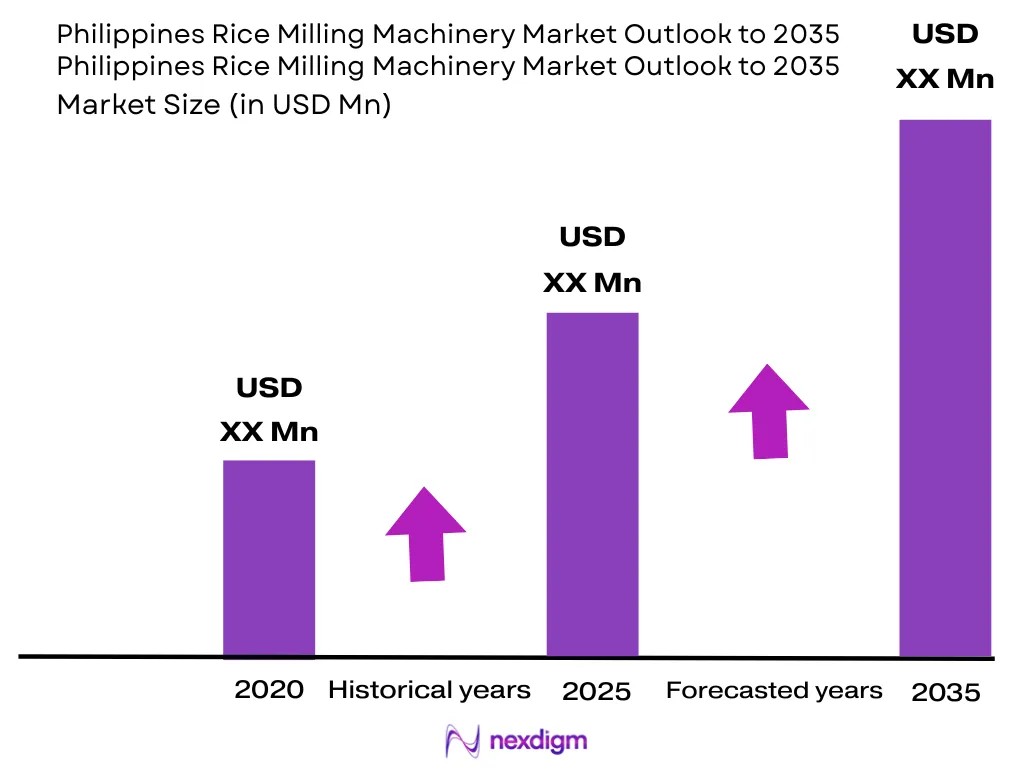
The Philippines Rice Milling Machinery Market was valued at USD ~ Million in 2024, supported by the country’s position as one of the largest rice producers and consumers in Southeast Asia. According to data published by the Philippine Statistics Authority (PSA), the Philippines produced more than 19 million metric tons of palay (rough rice) annually, while domestic per capita rice consumption remains among the highest in the region, driven by a population exceeding 115 million people. Continuous modernization of milling infrastructure under government-led programs such as the Department of Agriculture’s (DA) Modern Rice Facilities Program and the Agricultural Competitiveness Enhancement Fund (ACEF), growing demand for high-quality milled rice, increasing adoption of semi-automatic and automated processing systems, and investments in reducing post-harvest losses are key factors driving equipment demand. The Philippines’ long-standing challenge of high post-harvest losses, estimated at 10 to 16 percent of total production, further reinforces the critical importance of modern milling infrastructure across the country’s archipelagic rice-producing landscape.
Market Segmentation
By Machinery Type
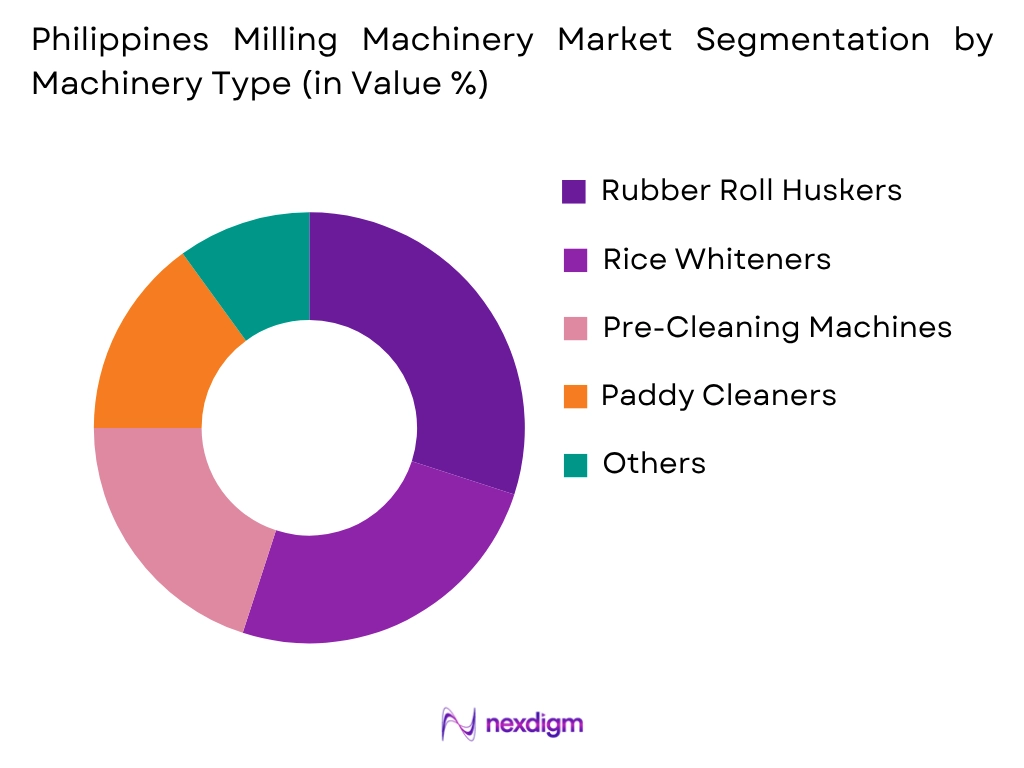
Philippines Rice Milling Machinery Market is segmented by machinery type into Pre-Cleaning Machines, Paddy Cleaners, Destoners, Rubber Roll Huskers, Paddy Separators, Rice Whiteners, Rice Polishers, Color Sorters, Rice Graders, Length Graders, Packaging Systems, and Complete Rice Milling Plants. Recently, Rubber Roll Huskers and Rice Whiteners hold the dominant market share within this segmentation due to their foundational role in the Philippine milling process and the country’s vast installed base of small to medium-scale mills dependent on husking and whitening as their primary value-adding stages. Philippine rice processors are increasingly focused on maximizing head rice recovery, reducing broken rice percentages, and improving grain whiteness to meet the quality expectations of domestic consumers and the requirements of institutional buyers including the National Food Authority (NFA). The continued expansion of commercial and cooperative milling operations and growing replacement demand from aging small-scale mill equipment have reinforced the dominance of husking and whitening machinery categories. Their direct influence on milling recovery rates, final product quality, and farm-gate to market value conversion makes them indispensable investments across the full spectrum of the Philippines’ diverse rice milling sector.
By Automation Level
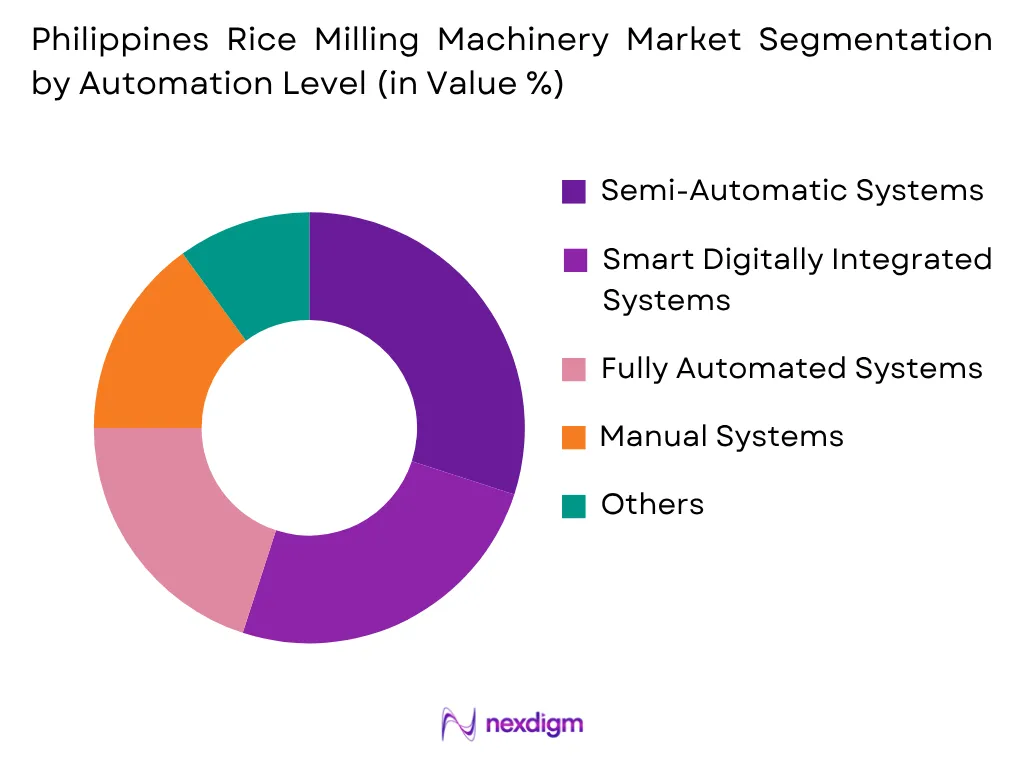
Philippines Rice Milling Machinery Market is segmented by automation level into Manual Systems, Semi-Automatic Systems, Fully Automatic Systems, and Smart Digitally Integrated Systems. Currently, Semi-Automatic Systems dominate the market due to their widespread adoption across the country’s large population of small and medium-scale rice mills, which represent the backbone of Philippine rice milling capacity. The Philippines has one of the most fragmented rice milling landscapes in Southeast Asia, with thousands of kiskisan (single-pass) and multi-pass mills distributed across rice-producing provinces in Luzon, Visayas, and Mindanao. Semi-automatic configurations offer an accessible entry point for mill operators seeking to improve processing efficiency and rice recovery without the full capital commitment required by completely automated lines. Larger commercial mills in Central Luzon, Cagayan Valley, and SOCCSKSARGEN are increasingly investing in fully automated systems to improve throughput and reduce labor dependency. Government financing programs through ACEF and the Land Bank of the Philippines have supported equipment upgrades for cooperative and smallholder-affiliated mills. As the Department of Agriculture continues to prioritize post-harvest loss reduction and milling modernization as national agricultural priorities, the gradual shift toward higher automation levels is expected to accelerate throughout the Philippine rice milling machinery market.
Competitive Landscape
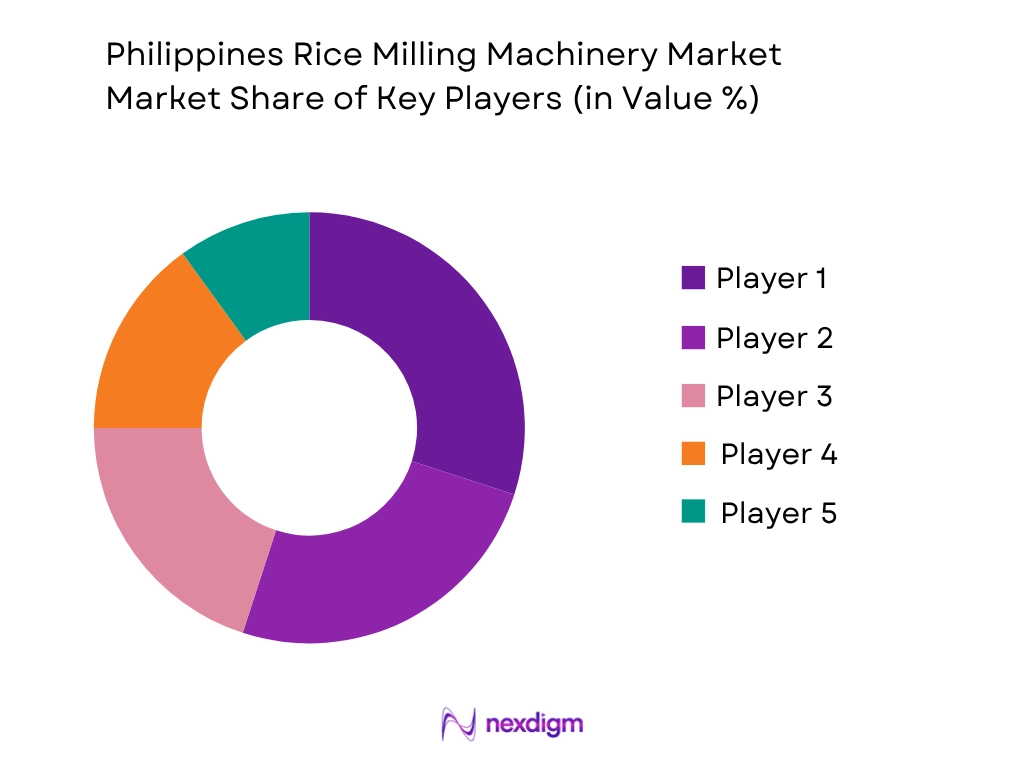
The Philippines Rice Milling Machinery Market is characterized by the presence of Japanese equipment leaders, Chinese machinery suppliers, and domestic distributors serving the country’s extensive and structurally diverse rice milling industry. Japanese companies such as Satake Corporation, Yanmar Holdings, and Kubota Corporation maintain strong positions in the medium to large commercial mill segment through established dealer networks and brand recognition built over decades of presence in Philippine agriculture. Chinese manufacturers have made significant inroads in price-sensitive small and medium-scale mill segments. Domestic distributors and agricultural equipment dealers play an important role in after-sales support and spare parts supply across the archipelago. Competition is primarily driven by equipment affordability, milling recovery performance, durability in tropical operating conditions, dealer network accessibility across provinces, and compatibility with DA and NFA milling quality standards.
| Company | Establishment Year | Headquarters | Rice Milling Portfolio | Automation Capability
|
Color Sorting Technology | Service Network | Turnkey Plant Solutions | Processing Capacity Range |
| Bühler Group | 1860 | ~ | ~ | ~ | ~ | ~ | ~ | ~ |
| Satake Corporation | 1896 | ~ | ~ | ~ | ~ | ~ | ~ | ~ |
| Kubota Corporation | 1890 | ~ | ~ | ~ | ~ | ~ | ~ | ~ |
| Yanmar Holdings | 1912 | ~ | ~ | ~ | ~ | ~ | ~ | ~ |
| Milltec Machinery | 1998 | ~ | ~ | ~ | ~ | ~ | ~ | ~ |
Philippines Rice Milling Machinery Market Analysis
Growth Drivers
Rising Palay Production and Government-Led Modernization of Rice Milling Infrastructure
The Philippines rice milling machinery market is fundamentally supported by the scale of domestic palay production and sustained government investment in modernizing post-harvest infrastructure across the country’s major rice-producing regions. According to the Philippine Statistics Authority (PSA), the Philippines produced approximately 19 to 20 million metric tons of palay annually, with Central Luzon, Cagayan Valley, and Ilocos Region accounting for the largest shares of national output. The Department of Agriculture (DA) has made post-harvest loss reduction a central component of its rice competitiveness program, allocating substantial resources through the Agricultural Competitiveness Enhancement Fund (ACEF) and the Modern Rice Facilities Program to support milling equipment upgrades, solar-powered dryers, and storage facility investments at the cooperative and municipal level. The Philippine Rice Research Institute (PhilRice) has documented that post-harvest losses in rice reach 10 to 16 percent of total production, creating compelling economic justification for investment in modern milling equipment that improves palay-to-rice conversion efficiency and reduces grain breakage. The increasing flow of palay through commercial and cooperative milling facilities creates sustained demand for huskers, polishers, graders, color sorters, and packaging systems. As domestic rice production continues to expand under improved varieties and irrigation development programs, the volume of paddy requiring efficient processing reinforces replacement and new machinery investment across the Philippines’ geographically dispersed rice milling ecosystem.
Rice Tariffication Law and Increased Competition Driving Quality Improvement Investments
The implementation of the Republic Act 11203, known as the Rice Tariffication Law, has had a significant structural impact on the Philippine rice milling machinery market by intensifying competitive pressure on domestic rice processors and incentivizing investments in processing efficiency and quality improvement. By replacing quantitative import restrictions with tariffs and creating the Rice Competitiveness Enhancement Fund (RCEF), the law provided a dedicated financing mechanism for the modernization of rice farming and milling infrastructure. According to the Department of Agriculture, the RCEF has disbursed billions of pesos in support of farm machinery, seed development, extension services, and credit access for rice farmers and processors. The tariffication of rice imports exposed domestic millers to competition from imported rice from Vietnam and Thailand, compelling them to improve milling recovery rates, reduce broken rice percentages, and enhance product quality to maintain market position. The World Bank has noted that the Rice Tariffication Law represents a significant market-opening reform that has simultaneously challenged and incentivized the domestic rice value chain. Commercial and cooperative mills in major producing provinces responded by investing in upgraded husking lines, color sorting equipment, and automated packaging systems to differentiate their products in an increasingly competitive retail environment. The combination of reform-driven competitive pressure and dedicated government financing through RCEF has created a structurally supportive environment for rice milling machinery investment across the Philippines.
Market Challenges
High Post-Harvest Losses and Fragmented Small-Scale Milling Sector Limiting Modernization
One of the most deeply embedded challenges facing the Philippines rice milling machinery market is the structural fragmentation of the milling sector, characterized by a large number of small-scale kiskisan and single-pass mills that lack the financial capacity, technical infrastructure, and operational scale to invest in modern processing equipment. The Philippine Statistics Authority and PhilRice have estimated that the country has tens of thousands of rice mills of varying capacities distributed across rice-producing provinces, with a significant proportion operating single-pass or two-pass milling configurations that yield suboptimal head rice recovery and high broken rice ratios. These small mills typically service the immediate surrounding farming communities and lack access to the formal credit markets, machinery financing programs, or technical training resources required to upgrade to more efficient semi-automatic or fully automatic systems. The archipelagic geography of the Philippines further complicates the delivery, installation, and maintenance of modern milling equipment in remote island provinces, increasing logistics costs and limiting the reach of authorized equipment dealers and service technicians. High post-harvest losses driven by inadequate drying, storage, and milling facilities reduce the economic efficiency of the rice value chain and diminish the financial returns available to mill operators for reinvestment in equipment upgrades. Addressing this structural challenge requires sustained government intervention, cooperative consolidation, and innovative financing solutions that can reach the fragmented base of small-scale milling operators across the Philippine archipelago.
Typhoon and Climate-Related Disruptions Affecting Palay Supply and Milling Operations
The Philippines’ high exposure to typhoons, flooding, and El Ñiño-induced drought represents a persistent and material challenge for the rice milling machinery market, as climate disruptions directly affect palay supply availability, processing facility utilization rates, and investment confidence among mill operators. The Philippines experiences an average of 20 typhoons annually, with major weather events frequently damaging crops, flooding milling facilities, disrupting road and transport networks, and destroying drying and storage infrastructure in vulnerable rice-producing provinces. The Philippine Atmospheric, Geophysical and Astronomical Services Administration (PAGASA) has documented increasing variability in weather patterns that complicate agricultural planning and post-harvest logistics. Severe typhoons affecting Central Luzon, Cagayan Valley, and Eastern Visayas can simultaneously damage standing crops and disrupt the transport of harvested palay to milling facilities, reducing throughput across regional milling networks and delaying investment payback periods. El Ñiño events cause drought conditions that reduce paddy production in rain-fed areas, further constraining the paddy volumes available for processing. Since rice milling facilities depend on a consistent and predictable supply of palay to maintain high utilization rates and justify capital investment in new equipment, the uncertainty introduced by climate variability can significantly affect mill operators’ willingness to commit to machinery modernization programs. Investments in climate-resilient infrastructure, covered drying facilities, and on-site storage capacity are increasingly necessary complements to milling equipment upgrades across the Philippine rice processing landscape.
Market Opportunities
Government-Financed Modernization Programs and RCEF-Driven Equipment Demand
The Philippines rice processing industry presents significant and structurally supported opportunities for machinery suppliers, driven by dedicated government financing programs targeting post-harvest loss reduction and milling modernization at scale. The Rice Competitiveness Enhancement Fund (RCEF), established under the Rice Tariffication Law with an annual allocation of PHP 10 billion, provides direct funding for farm machinery, milling equipment, and post-harvest facility upgrades accessible to rice farmers and their cooperatives. The Department of Agriculture’s Modern Rice Facilities Program has facilitated the procurement and deployment of modern rice processing facilities, color sorters, multi-pass milling systems, and solar dryers across rice-producing provinces through competitive bidding and cooperative financing arrangements. PhilRice and the DA’s regional offices have also conducted technology demonstration programs that expose cooperative mill operators to the efficiency and quality benefits of modern milling equipment, accelerating adoption decisions. The Land Bank of the Philippines and the Agricultural Credit Policy Council provide credit facilities specifically targeted at agri-based enterprises including rice mills, lowering the financing barrier for equipment investment. As the government continues to prioritize rice self-sufficiency and post-harvest efficiency through successive Philippine Development Plans, the pipeline of publicly financed milling equipment procurement represents a substantial and predictable market opportunity for both international technology suppliers and local equipment distributors operating across the Philippine archipelago.
Expansion of Premium and Specialty Rice Processing and Value-Added Product Development
The growing consumer preference for premium, specialty, and health-oriented rice products in the Philippines creates meaningful opportunities for rice milling machinery suppliers serving processors that seek to move up the value chain. Philippine consumers are demonstrating increasing interest in brown rice, red rice, black rice, organically grown rice, and premium branded white rice varieties that command higher retail prices and require differentiated milling and packaging processes. Export-oriented and premium domestic rice processing facilities require sophisticated equipment including high-resolution color sorters capable of precisely grading specialty varieties, precision polishing systems that preserve nutritional layers in brown and red rice, and automated packaging lines that support modern retail presentation formats. The Department of Trade and Industry (DTI) and the Bureau of Agriculture and Fisheries Standards (BAFS) have developed quality grading standards that incentivize processors to invest in grading and sorting equipment to certify premium product categories. Rice-based value-added products including rice flour, rice crackers, and instant rice formats are also driving investment in specialized processing equipment that extends beyond conventional milling machinery. As Philippine processors and food companies seek to capture higher margins through product differentiation, branding, and specialty market positioning, demand for technologically advanced and precision-capable milling and processing machinery is expected to grow progressively across the Philippine rice industry throughout the forecast period.
Future Outlook
The Philippines Rice Milling Machinery Market is expected to witness sustained growth over the forecast period, supported by increasing government investments in post-harvest modernization, the continued disbursement of RCEF funding, rising demand for premium and consistent-quality domestic rice, and greater adoption of semi-automatic and fully automated milling technologies. Growing focus on reducing post-harvest losses, maximizing palay-to-rice conversion efficiency, and improving head rice recovery rates will continue to encourage machinery upgrades across commercial and cooperative mills. Furthermore, digitalization trends, energy-efficient milling systems, and integrated processing solutions are anticipated to gradually reshape industry operations even among smaller operators. Government support for rice self-sufficiency, cooperative milling cluster development, and agricultural productivity enhancement under successive Philippine Development Plans is also expected to contribute to long-term market expansion.
Major Players
- Satake Corporation
- Bühler Group
- Milltec Machinery
- Alvan Blanch Group
- Yanmar Holdings
- Kubota Corporation
- Zhengzhou VOS Machinery
- Hunan Chenzhou Grain & Oil Machinery
- Wuhan Anon Tech
- Alapala Machine Industry
- RCM (Rice Corporation of the Philippines – affiliated processors)
- San Miguel Corporation Food Division
- Agrinurture Inc.
- Universal Robina Corporation (URC) Agro-Industrial Division
- SL Agritech Corporation
Key Target Audience
- Rice Milling Plant Owners and Operators
- Agricultural Equipment Manufacturers and Distributors
- Grain Processing Equipment Dealers and Provincial Distributors
- Rice Farming Cooperatives and Multi-Purpose Cooperatives
- Food Processing and Packaging Companies
- Investments and Venture Capitalist Firms
- Government and Regulatory Bodies (DA – Department of Agriculture, PhilRice – Philippine Rice Research Institute, NFA – National Food Authority, BAFS – Bureau of Agriculture and Fisheries Standards, Land Bank of the Philippines)
- Agricultural Infrastructure and Rural Development Organizations
Research Methodology
Step 1: Identification of Key Variables
The initial phase involves constructing a comprehensive ecosystem map covering palay producers, rice mill operators, equipment manufacturers, distributors, technology providers, and regulatory authorities within the Philippines Rice Milling Machinery Market. Extensive secondary research is conducted using industry databases, trade publications, company reports, and government statistics to identify the critical variables influencing market performance.
Step 2: Market Analysis and Construction
Historical industry data is compiled and analyzed to evaluate machinery installations, equipment replacement cycles, milling capacity additions, and revenue generation across major rice-producing regions and island groups. Market sizing is developed through both demand-side and supply-side assessments, enabling a robust understanding of industry dynamics and competitive positioning.
Step 3: Hypothesis Validation and Expert Consultation
Market assumptions and preliminary findings are validated through computer-assisted telephone interviews (CATIs) and consultations with rice mill operators, machinery manufacturers, distributors, and industry experts. These interactions provide operational insights, purchasing behavior trends, technology adoption patterns, and future investment perspectives specific to the Philippine milling environment.
Step 4: Research Synthesis and Final Output
The final phase involves triangulating data obtained from primary interviews, secondary sources, and proprietary databases. Information regarding product segments, machinery demand, regional consumption patterns across Luzon, Visayas, and Mindanao, and competitive developments is consolidated to produce a comprehensive and validated assessment of the Philippines Rice Milling Machinery Market.

- Executive Summary
- Research Methodology (Market Definitions and Assumptions, Abbreviations, Market Sizing Approach, Top-Down Analysis, Bottom-Up Analysis, Demand-Side Assessment, Supply-Side Assessment, Primary Industry Interviews with Rice Millers and Equipment Manufacturers, Trade Data Analysis, Data Triangulation, Forecasting Framework, Limitations and Future Conclusions)

- Definition and Scope
- Market Evolution and Industry Genesis
- Timeline of Major Industry Developments in Rice Processing Industry
- Philippines Rice Production and Processing Ecosystem
- Rice Milling Industry Value Chain Analysis

- Growth Drivers (Rising Domestic Rice Production, Expansion of Commercial Rice Mills, Growing Demand for Premium Milled Rice Quality, Increasing Processing Efficiency Requirements, Adoption of Automated Milling Technologies)
- Market Challenges (High Post-Harvest Losses, Fragmented Small-Scale Milling Sector, Dependence on Imported Machinery Components, Typhoon and Climate-Related Disruptions, Limited Access to Rural Financing for Mill Upgrades)
- Market Opportunities (Color Sorting Expansion, Modern Rice Facility Program Investments, Energy-Efficient Milling Solutions, Rice Bran Value Recovery Systems, Integrated Turnkey Milling Plants under DA-ACEF Financing)
- Market Trends (IoT-Enabled Milling Equipment, Optical Sorting Adoption, High Yield Milling Systems, Low Broken Rice Technologies, Digital Monitoring Platforms)
- Government Regulations (DA-PhilRice Quality Standards, NFA Licensing and Compliance, Industrial Safety Requirements, Environmental Licensing Standards, Energy Efficiency Regulations)
- SWOT Analysis
- Porter’s Five Forces Analysis
- PESTLE Analysis
- Stakeholder Ecosystem
- Competition Ecosystem
- Rice Milling Cluster Analysis
- Rice Processing Infrastructure Assessment
- Machinery Localization and Manufacturing Assessment

- By Market Value (2020-2025)
- By Units Installed (2020-2025)
- By Average Selling Price (2020-2025)

- By Machinery Type (In Value %)
Pre-Cleaning Machines
Paddy Cleaners
Destoners
Rubber Roll Huskers
Paddy Separators
Rice Whitener Machines
Rice Polishers
Rice Graders
Color Sorters
Length Graders
Packaging and Bagging Systems
Complete Rice Milling Plants - By Milling Capacity (In Value %)
Less than 2 Tons/Hour
2–5 Tons/Hour
5–10 Tons/Hour
10–20 Tons/Hour
Above 20 Tons/Hour - By Automation Level (In Value %)
Manual Systems
Semi-Automatic Systems
Fully Automatic Systems
Smart and Digitally Integrated Systems - By Rice Processing Stage (In Value %)
Pre-Processing Equipment
Husking Equipment
Whitening Equipment
Polishing Equipment
Sorting and Grading Equipment
Packaging Equipment
- By End User (In Value %)
Small-Scale Rice Mills (Kiskisan and Single-Pass Mills)
Medium-Scale Rice Mills
Large Commercial Rice Mills
Rice Processing Cooperatives
Integrated Rice Processing Companies - By Region (In Value %)
Central Luzon (Region III)
Cagayan Valley (Region II)
Ilocos Region (Region I)
Western Visayas (Region VI)
SOCCSKSARGEN (Region XII)
Other Rice Producing Regions

- Market Share of Major Players (By Value, Units Sold, Installed Base, Product Category, Milling Capacity Segment)
- Cross Comparison Parameters (Rice Milling Capacity Range, Head Rice Recovery Performance, Energy Consumption per Ton Processed, Automation and Digital Integration Capability, Color Sorting Accuracy, After-Sales Service Network Strength, Spare Parts Availability and Lead Time, Turnkey Plant Installation Expertise)
- SWOT Analysis of Major Players
- Pricing Analysis by Equipment Category and Capacity
- Distributor and Dealer Network Assessment
- Detailed Profiles of Major Companies
Satake Corporation
Bühler Group
Milltec Machinery
Alvan Blanch Group
Yanmar Holdings
Kubota Corporation
Zhengzhou VOS Machinery
Hunan Chenzhou Grain & Oil Machinery
Wuhan Anon Tech
Alapala Machine Industry
RCM (Rice Corporation of the Philippines – affiliated processors)
San Miguel Corporation Food Division
Agrinurture Inc.
Universal Robina Corporation (URC) Agro-Industrial Division
SL Agritech Corporation

- Milling Capacity Utilization Assessment (Plant Throughput, Downtime, Processing Efficiency, Recovery Rates, Operational Hours)
- Investment and Procurement Analysis (Capex Allocation, Equipment Replacement Cycles, Financing Patterns, Vendor Selection Criteria)
- Rice Recovery and Yield Optimization Assessment (Head Rice Yield, Broken Rice Ratio, Bran Recovery, Milling Losses, Product Quality Consistency)
- Operational Pain Point Analysis (Maintenance Costs, Labor Dependency, Energy Consumption, Spare Parts Availability, Machine Downtime)
- Technology Adoption Assessment (Automation Penetration, Smart Controls Usage, Sensor Integration, Data Monitoring, Predictive Maintenance Adoption)

- By Market Value (2026-2035)
- By Units Installed (2026-2035)
- By Average Selling Price (2026-2035)


 Request a Sample
 Ask for Customization
 Get a Quote
 Enquire Now