

 Download PDF
Market Overview
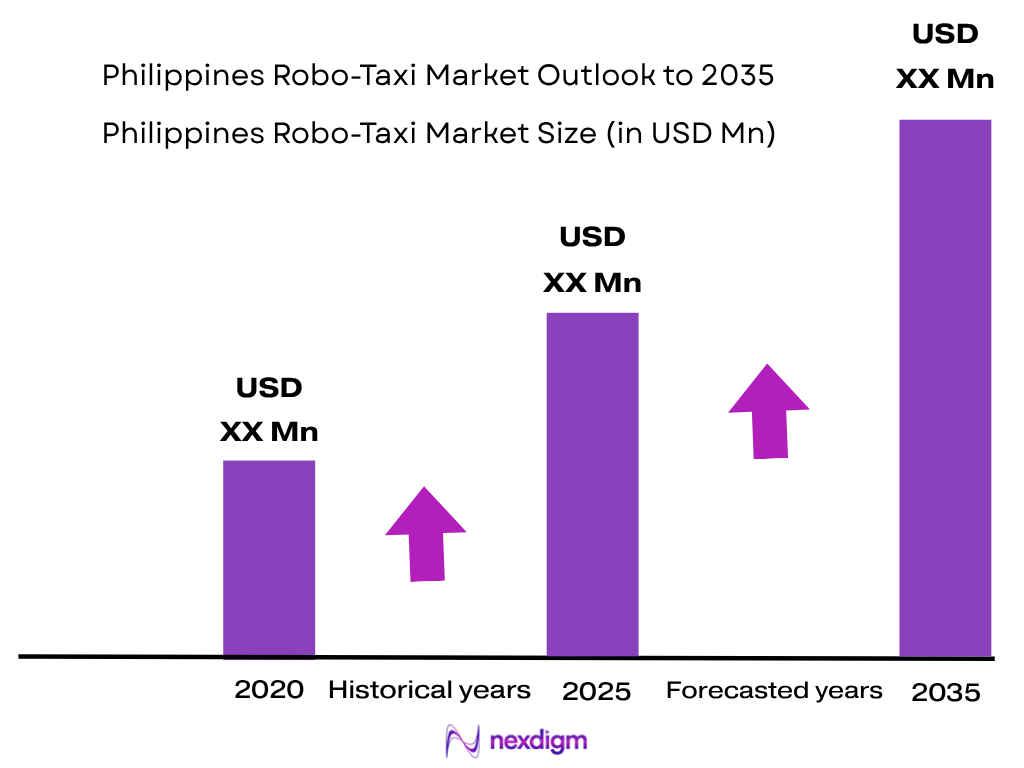
The Philippines robo-taxi market is an emerging autonomous mobility segment driven by increasing urban congestion, rapid digitalization, electric mobility adoption, and the need for efficient first-mile and last-mile transportation solutions. The market size is estimated at ~USD XX million in 2024 and is projected to expand at a CAGR of ~XX% during 2026-2035. Growth is supported by the country’s expanding mobility ecosystem, where the World Bank recorded the Philippines’ GDP at approximately USD 461 billion in 2024, reflecting continued economic activity supporting transportation modernization. The country’s urban population expansion, increasing ride-hailing adoption, and government focus on intelligent transport systems are creating favourable conditions for autonomous mobility deployment.
Metro Manila represents the primary opportunity centre for robo-taxi deployment due to its high population concentration, severe congestion challenges, and strong technology adoption environment. The National Capital Region accommodates more than 13 million residents, generating substantial daily mobility demand across business districts, residential zones, airports, and transport terminals. Cities such as Makati, Taguig, Quezon City, and Pasig are expected to become early adoption locations because of their business activity, technology infrastructure, and demand for premium mobility solutions.
Market Segmentation
By Vehicle Type
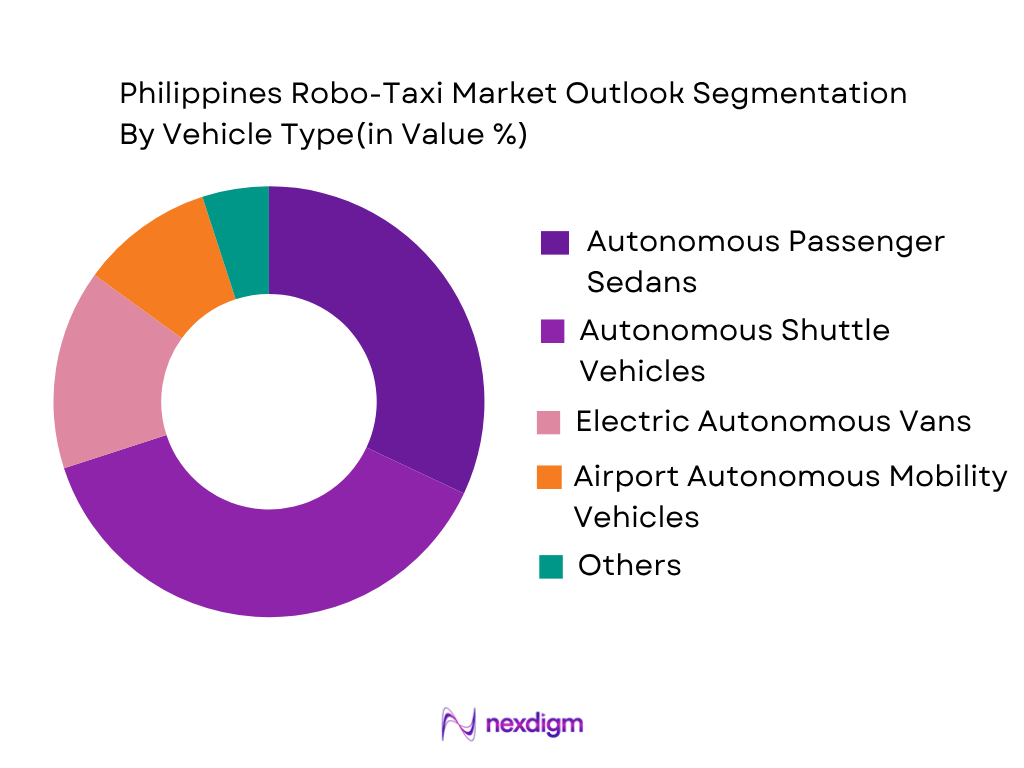
The Philippines robo-taxi market is segmented into autonomous passenger sedans, autonomous shuttle vehicles, electric autonomous vans, airport mobility vehicles, and autonomous ride-hailing vehicles. Autonomous shuttle vehicles represent the dominant segment due to their suitability for controlled operating environments such as airports, business districts, tourism zones, and private developments. These vehicles require less complex route management compared with open-road passenger robo-taxis, making them more feasible during the early deployment stage. Philippine mobility challenges, including congestion and limited road capacity, increase demand for efficient shared transportation solutions. Autonomous shuttles can support first-mile and last-mile connectivity around transport hubs while reducing dependency on conventional vehicles. Additionally, electric shuttle deployment aligns with national clean transportation initiatives and the increasing adoption of electric vehicle infrastructure.
By Automation Level
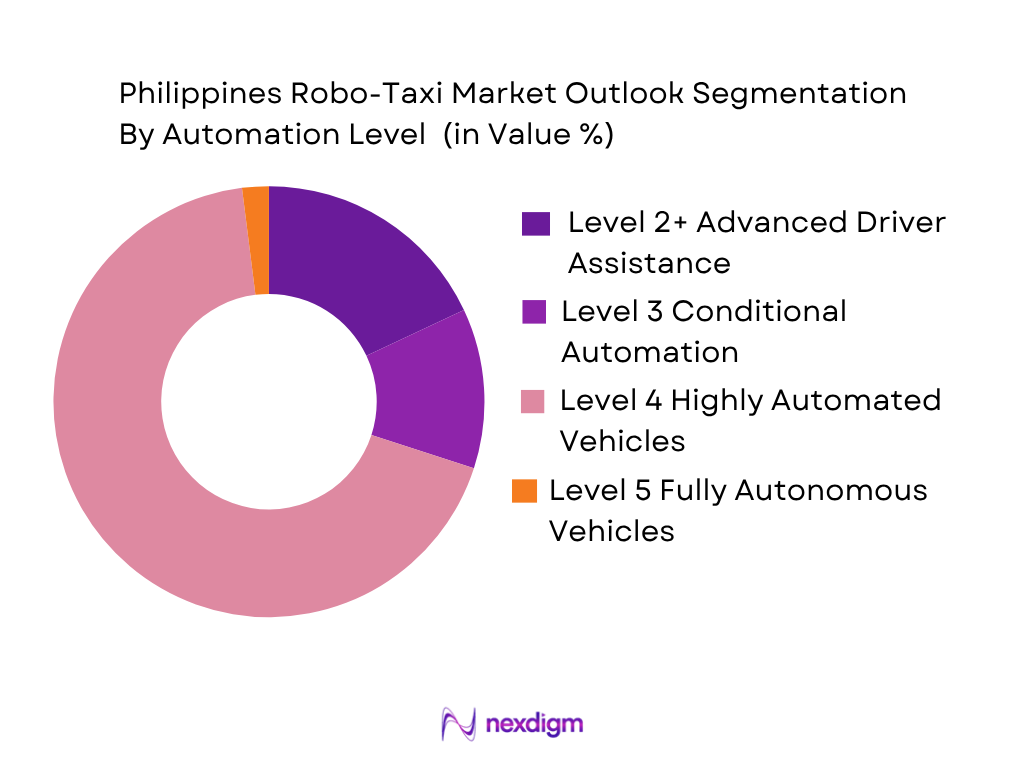
The Philippines robo-taxi market is segmented into Level 2+, Level 3, Level 4, and Level 5 autonomous vehicles. Level 4 highly automated vehicles are expected to represent the leading segment in early commercial applications because they can operate autonomously within defined geographic areas while maintaining safety through remote monitoring systems. Controlled environments such as airports, economic zones, and private townships provide suitable deployment conditions for Level 4 technology. Regulatory development and safety validation requirements make fully autonomous Level 5 deployment more challenging in the near term. International autonomous mobility developments and local pilot programmes are encouraging technology adoption, while Philippine transport authorities continue assessing frameworks for connected and automated vehicles.
Competitive Landscape
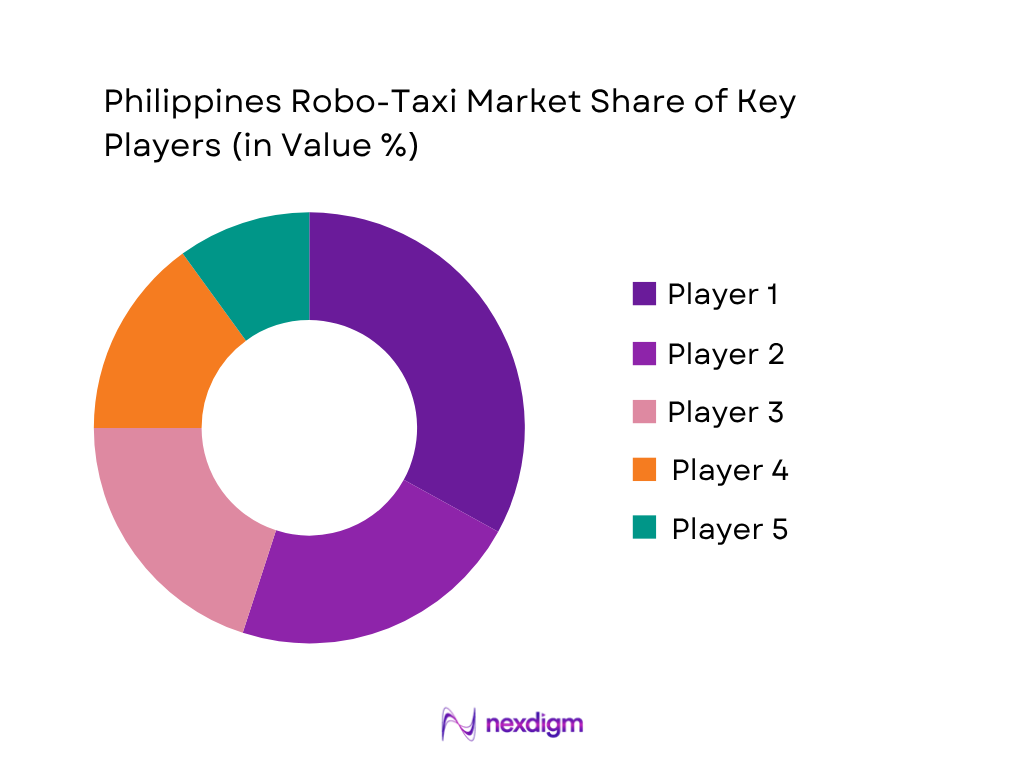
The Philippines robo-taxi market remains at an early development stage, with competition expected to emerge through partnerships between autonomous technology providers, automotive manufacturers, mobility platforms, and government agencies. International autonomous driving companies are likely to influence the market through technology licensing, pilot programmes, and fleet partnerships. Local mobility companies may play an important role by integrating autonomous vehicles into existing ride-hailing and transportation networks.
| Company | Establishment Year | Headquarters | Autonomous Driving Technology | Primary Strength | Key Market Activity | Vehicle Technology Focus | Partnership Strategy |
| Waymo | 2009 | USA | ~ | ~ | ~ | ~ | ~ |
| Baidu Apollo | 2017 | China | ~ | ~ | ~ | ~ | ~ |
| Pony.ai | 2016 | China | ~ | ~ | ~ | ~ | ~ |
| WeRide | 2017 | China | ~ | ~ | ~ | ~ | ~ |
| Motional | 2020 | USA/South Korea | ~ | ~ | ~ | ~ | ~ |
Philippines Robo-Taxi Market Analysis
Growth Drivers
Traffic Congestion and Urban Mobility Inefficiencies
Traffic congestion is a major factor supporting the development of robo-taxi services in the Philippines, particularly in Metro Manila where transportation demand continues to exceed road infrastructure capacity. The World Bank highlighted urban congestion as a major productivity challenge, while the Philippine Statistics Authority recorded a national population exceeding 112 million people in 2024, increasing pressure on existing mobility systems. Metro Manila remains one of the most densely populated urban regions, with more than 13 million residents, generating significant daily commuting requirements. The Philippine economy recorded GDP growth supported by services, industry, and infrastructure activity, creating demand for technology-enabled transportation solutions. Autonomous taxis can address mobility inefficiencies by improving fleet utilization, reducing dependence on human drivers, and enabling continuous operation in high-demand corridors. The expansion of digital transportation platforms also supports future robo-taxi integration, as the country already has a mature ride-hailing ecosystem. Increasing investment in transport modernization, including road improvement projects and intelligent transport systems, provides a foundation for autonomous mobility deployment. These factors collectively position congestion reduction and efficient urban transportation as important drivers for robo-taxi adoption in the Philippines.
Smart City Development Initiatives and Digital Mobility Transformation
Smart city development initiatives are creating opportunities for autonomous mobility solutions in the Philippines by improving digital infrastructure, connectivity, and urban planning capabilities. The country’s digital economy continues expanding, supported by increased internet access and technology adoption across businesses and consumers. The Department of Information and Communications Technology has continued nationwide digital infrastructure programmes, including connectivity expansion and public digital services development. Metro Manila, Clark, Cebu, and Davao are increasingly adopting smart mobility concepts involving intelligent transport systems, digital payment platforms, and data-driven traffic management. The Philippine government has also prioritized transport modernization through projects focused on improving public mobility efficiency. The country recorded GDP of approximately USD 461 billion in 2024, reflecting economic capacity supporting infrastructure and technology investments. Smart city ecosystems enable robo-taxi deployment through connected roads, real-time traffic monitoring, and vehicle-to-infrastructure communication. Autonomous mobility can complement existing transportation networks by providing efficient first-mile and last-mile connectivity. As urban areas become more digitally connected, robo-taxis can integrate with mobility platforms, electric vehicle infrastructure, and public transportation systems, supporting the gradual transition toward intelligent urban mobility.
Market Challenges
Regulatory Approval Complexity and Autonomous Vehicle Safety Validation
Regulatory development remains a significant challenge for robo-taxi deployment in the Philippines because autonomous vehicles require comprehensive safety frameworks before operating on public roads. Existing transportation regulations are primarily designed around human-operated vehicles, creating the need for updated policies covering autonomous operation, liability, cybersecurity, and vehicle certification. The Land Transportation Office and Department of Transportation must evaluate autonomous vehicle standards, testing requirements, and operational guidelines before commercial deployment. Safety validation is particularly important because robo-taxis depend on artificial intelligence, sensors, cameras, radar systems, and automated decision-making technologies. The Philippines recorded more than 112 million residents in 2024, creating a large potential passenger base but also increasing the importance of ensuring safe mobility solutions in densely populated areas. International autonomous mobility experience indicates that controlled testing environments are often required before large-scale deployment. Limited autonomous testing zones in the Philippines restrict opportunities for technology providers to validate performance under local conditions, including traffic density, motorcycle interaction, unpredictable driving behaviour, and mixed road environments. Regulatory clarity and structured pilot frameworks will therefore be essential for commercial robo-taxi expansion.
Infrastructure Readiness Constraints and High Technology Investment Requirements
Infrastructure limitations represent a major challenge for robo-taxi adoption in the Philippines due to the need for advanced connectivity, digital mapping, charging networks, and intelligent transportation infrastructure. Autonomous vehicles require reliable communication systems, high-definition mapping, and road environments capable of supporting automated driving technologies. Although the Philippines continues improving digital infrastructure, connectivity quality varies significantly between metropolitan and provincial regions. The World Bank has identified infrastructure development as an important factor influencing economic competitiveness in emerging markets. The Philippines allocated significant public investment toward infrastructure development, but transportation infrastructure gaps remain visible in major urban areas. High technology requirements also create financial challenges because autonomous vehicles require expensive sensor suites, artificial intelligence platforms, computing systems, and continuous software development. Electric robo-taxis additionally require charging infrastructure expansion, particularly as the country promotes electric vehicle adoption through the Electric Vehicle Industry Development Act. Tropical climate conditions, heavy rainfall, flooding risks, and complex traffic environments create additional engineering requirements for autonomous systems. Addressing infrastructure limitations will require coordination between government agencies, technology companies, automotive manufacturers, and mobility operators.
Market Opportunities
Autonomous Mobility-as-a-Service Integration and Public Transport Connectivity Enhancement
Autonomous Mobility-as-a-Service (MaaS) integration presents a significant opportunity for the Philippines robo-taxi market by connecting autonomous vehicles with existing transportation networks. The country’s transportation system relies heavily on interconnected modes including buses, railways, jeepneys, ride-hailing services, and private vehicles. The Department of Transportation continues implementing transport modernization initiatives aimed at improving accessibility and efficiency. The Philippines’ population exceeded 112 million people in 2024, creating sustained demand for scalable mobility solutions. Robo-taxis integrated into MaaS platforms can provide first-mile and last-mile connectivity around railway stations, airports, business districts, and residential communities. Digital payment adoption and widespread smartphone usage provide supporting conditions for app-based autonomous mobility services. Autonomous fleets can complement public transportation by serving areas where traditional transit coverage is limited. Integration with existing mobility platforms can also improve vehicle utilization through demand-based routing and intelligent fleet management. As urban areas continue expanding, autonomous MaaS solutions can help address transportation gaps while improving commuter convenience and reducing pressure on existing infrastructure.
Airport and Tourism Mobility Deployment with Electric Autonomous Fleet Expansion
Airport and tourism mobility applications represent an early commercial opportunity for robo-taxi deployment in the Philippines because these environments offer controlled routes and predictable passenger demand. The country’s tourism sector continues recovering, with the Department of Tourism recording more than 5 million international visitor arrivals in 2024, increasing demand for efficient transportation services. Airports such as Clark International Airport, Ninoy Aquino International Airport, and Mactan-Cebu International Airport provide suitable environments for autonomous shuttle and robo-taxi pilot programmes. Electric autonomous fleets also align with national efforts to accelerate clean transportation adoption. The Electric Vehicle Industry Development Act provides a policy framework supporting electric vehicle ecosystem development, including charging infrastructure and fleet electrification. Controlled airport routes allow autonomous systems to operate with lower complexity compared with open urban roads, making them practical early deployment locations. Tourism destinations, resorts, and economic zones can also adopt autonomous mobility solutions to improve visitor transportation. These applications can create commercial pathways for autonomous fleet operators while supporting broader smart mobility objectives across the Philippines.
Future Outlook
The Philippines robo-taxi market is expected to witness gradual expansion as autonomous vehicle technology advances, regulatory frameworks mature, and urban mobility requirements increase. Growth will be supported by smart city initiatives, electric vehicle adoption, and demand for efficient transportation alternatives in highly congested metropolitan areas. Initial deployments are expected in controlled environments such as airports, business districts, and economic zones before wider urban adoption.
Major Players
- Waymo
- Baidu Apollo
- Pony.ai
- WeRide
- Motional
- Cruise
- Tesla
- Zoox
- May Mobility
- Mobileye
- Toyota Motor Corporation
- Hyundai Motor Company
- Nissan Motor Corporation
- Grab
- Uber Technologies
Key Target Audience
- Automotive manufacturers and autonomous vehicle developers
- Ride-hailing platforms and mobility service providers
- Electric vehicle infrastructure companies
- Fleet operators and transportation service providers
- Investments and venture capitalist firms
- Government and regulatory bodies (Department of Transportation, Land Transportation Office, Metropolitan Manila Development Authority)
- Smart city developers and urban infrastructure companies
- Telecommunications and connectivity providers
Research Methodology
Step 1: Identification of Key Variables
The initial stage involves mapping the Philippines robo-taxi ecosystem, including autonomous vehicle developers, mobility operators, government agencies, infrastructure providers, and technology suppliers. Secondary research is conducted using transportation databases, government publications, economic indicators, and mobility industry information to identify major market variables influencing autonomous transportation adoption.
Step 2: Market Analysis and Construction
Historical and current market indicators are analyzed to evaluate autonomous vehicle readiness, urban mobility requirements, technology adoption, and transportation infrastructure development. Demand assessment includes analysis of passenger mobility patterns, urban congestion factors, and potential deployment environments such as airports and business districts.
Step 3: Hypothesis Validation and Expert Consultation
Market assumptions are validated through discussions with automotive professionals, mobility operators, technology providers, and transportation stakeholders. These consultations provide insights into regulatory challenges, deployment models, technology readiness, and commercial feasibility of robo-taxi operations in the Philippines.
Step 4: Research Synthesis and Final Output
The final analysis combines primary and secondary research findings to create a comprehensive market assessment. Data validation is conducted through cross-verification of autonomous vehicle developments, government initiatives, infrastructure readiness, and competitive strategies.

- Executive Summary
- Research Methodology (Market Definitions and Assumptions, Autonomous Mobility Ecosystem Mapping, Market Sizing Approach, Top-Down Analysis, Bottom-Up Analysis, Demand-Side Assessment, Supply-Side Assessment, Primary Interviews with Autonomous Vehicle Developers and Mobility Operators, Data Triangulation, Regulatory Framework Assessment, Forecasting Methodology, Limitations and Future Scope)

- Definition and Scope
- Market Evolution and Development Timeline of Autonomous Mobility in the Philippines
- Major Industry Developments in Autonomous Driving, Connected Mobility, and Smart Transportation
- Robo-Taxi Technology Ecosystem Analysis
- Philippines Robo-Taxi Value Chain Analysis
- Autonomous Mobility Supply Chain Analysis

- Growth Drivers (Expansion of Autonomous Vehicle Testing Programs,Metro Manila Traffic Congestion, Smart City Development Initiatives, Electric Vehicle Adoption, First-Mile and Last-Mile Mobility Demand, Digital Ride-Hailing Expansion)
- Market Challenges (Regulatory Approval Complexity, Autonomous Vehicle Safety Validation, Infrastructure Readiness Constraints, High Technology Investment Requirements, Cybersecurity Risks, Limited Dedicated Autonomous Testing Zones)
- Market Opportunities (Autonomous Mobility-as-a-Service Integration, Airport and Tourism Mobility Deployment, Electric Autonomous Fleet Expansion, Public Transport Connectivity Enhancement, AI-Based Traffic Management Solutions, Government Smart Mobility Programs)
- Market Trends (AI-Based Autonomous Driving Systems, Electric Robo-Taxi Fleets, Connected Vehicle Infrastructure, Shared Autonomous Mobility Models, Digital Payment Integration, Autonomous Shuttle Deployment)
- Government Regulations (Land Transportation Office Autonomous Vehicle Guidelines, Department of Transportation Smart Mobility Initiatives, Electric Vehicle Industry Development Act Implementation, Data Privacy Compliance, Road Safety Regulations)
- SWOT Analysis
- Porter’s Five Forces Analysis
- PESTLE Analysis

- By Market Value (2020-2025)
- By Autonomous Fleet Deployment Volume (2020-2025)
- By Number of Robo-Taxi Units Operational (2020-2025)
- By Revenue Generation Model (2020-2025)
- By Average Revenue Per Autonomous Vehicle (2020-2025)
- By Autonomous Vehicle Testing Activity (2020-2025)

- By Vehicle Type (In Value %)
Passenger Robo-Taxis
Autonomous Shuttle Vehicles
Electric Autonomous Vans
Autonomous Ride-Hailing Sedans
Autonomous Airport Mobility Vehicles - By Automation Level (In Value %)
Level 2+ Assisted Autonomous Vehicles
Level 3 Conditional Automation Vehicles
Level 4 Highly Autonomous Vehicles
Level 5 Fully Autonomous Vehicles - By Propulsion Type (In Value %)
Battery Electric Robo-Taxis
Hybrid Autonomous Vehicles
Fuel Cell Autonomous Vehicles
Internal Combustion Engine-Based Autonomous Vehicles - By Operating Environment (In Value %)
Urban Road Networks
Business District Mobility Zones
Airport Transportation Corridors
Tourism and Resort Locations
Industrial and Economic Zones - By Application Type (In Value %)
Passenger Transportation
First-Mile Connectivity
Last-Mile Connectivity
Airport Transfer Services
Corporate and Campus Mobility
Public Transport Integration - By Deployment Model (In Value %)
Private Autonomous Fleet Operators
Ride-Hailing Platform Integration
Government-Led Autonomous Mobility Programs
Mobility-as-a-Service Platforms
Public Transportation Partnerships

- Market Share Analysis of Major Players (By Autonomous Technology Deployment, Vehicle Partnerships, Testing Activities, Mobility Platform Integration, Geographic Presence)
- Cross Comparison Parameters (Autonomous Driving Technology Capability, Level 4 Autonomous Vehicle Development Experience, AI Perception System Capability, Sensor Technology Integration, Fleet Management Platform Strength, Autonomous Testing Infrastructure, Electric Vehicle Integration Capability, Strategic Mobility Partnerships)
Pricing and Business Model Analysis (Ride Per Kilometer Model, Subscription Mobility Services, Fleet Leasing Models, Mobility-as-a-Service Revenue Models) - SWOT Analysis of Major Players
- Detailed Profiles of Major Companies
Waymo
Baidu Apollo
Pony.ai
WeRide
Motional
Cruise
Tesla
Toyota Motor Corporation
Hyundai Motor Company
Nissan Motor Corporation
Zoox
May Mobility
Mobileye
Grab
Autonomous Intelligent Driving

- Passenger Adoption Assessment
- Consumer Acceptance Analysis
- Demographic Mobility Analysis
- Commuter Pain Point Analysis
- Ride Preference Assessment
- Technology Adoption Behaviour
- Autonomous Vehicle Perception Analysis

- By Market Value (2026-2035)
- By Autonomous Fleet Deployment Volume (2026-2035)
- By Number of Robo-Taxi Units Operational (2026-2035)
- By Revenue Generation Model (2026-2035)
- By Average Revenue Per Autonomous Vehicle (2026-2035)
- By Autonomous Vehicle Testing Activity (2026-2035)


 Request a Sample
 Ask for Customization
 Get a Quote
 Enquire Now