
 Download PDF
Market Overview
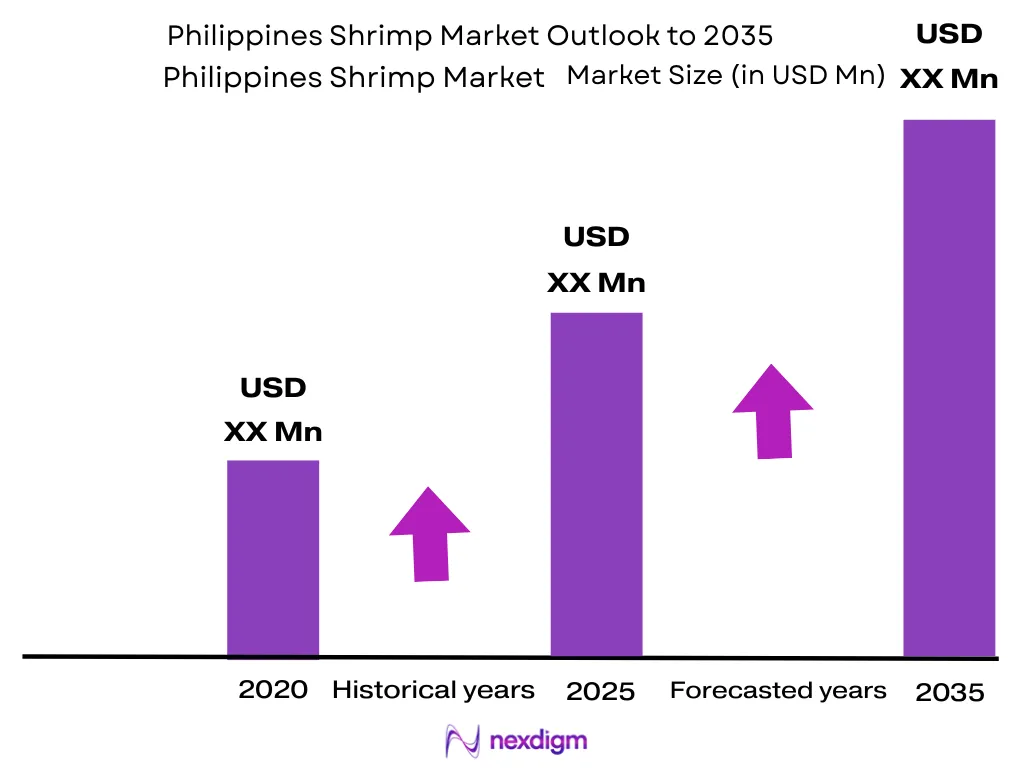
The Philippines Shrimp Market is valued at USD ~ million, based on a five-year historical assessment. The market is driven by farmed shrimp, wild-caught shrimp, frozen shrimp, fresh chilled shrimp, foodservice consumption and export-oriented processing. Sector momentum is supported by total fisheries production of ~ million metric tons and ~ million metric tons, while aquaculture production stood at ~ million metric tons and 2.22 million metric tons across the latest two reported annual periods.
Central Luzon, CALABARZON, Western Visayas, Zamboanga Peninsula, Davao Region and SOCCSKSARGEN dominate the Philippines Shrimp Market because they combine brackishwater pond clusters, grow-out farms, hatchery linkages, processor-exporter access, fish ports and domestic demand centers. Central Luzon benefits from Manila market proximity and vannamei farms, while Western Visayas has a long prawn-farming base. Mindanao regions dominate export-oriented seafood processing through General Santos, Sarangani and Zamboanga cold-chain networks.
Market Segmentation
By Environment
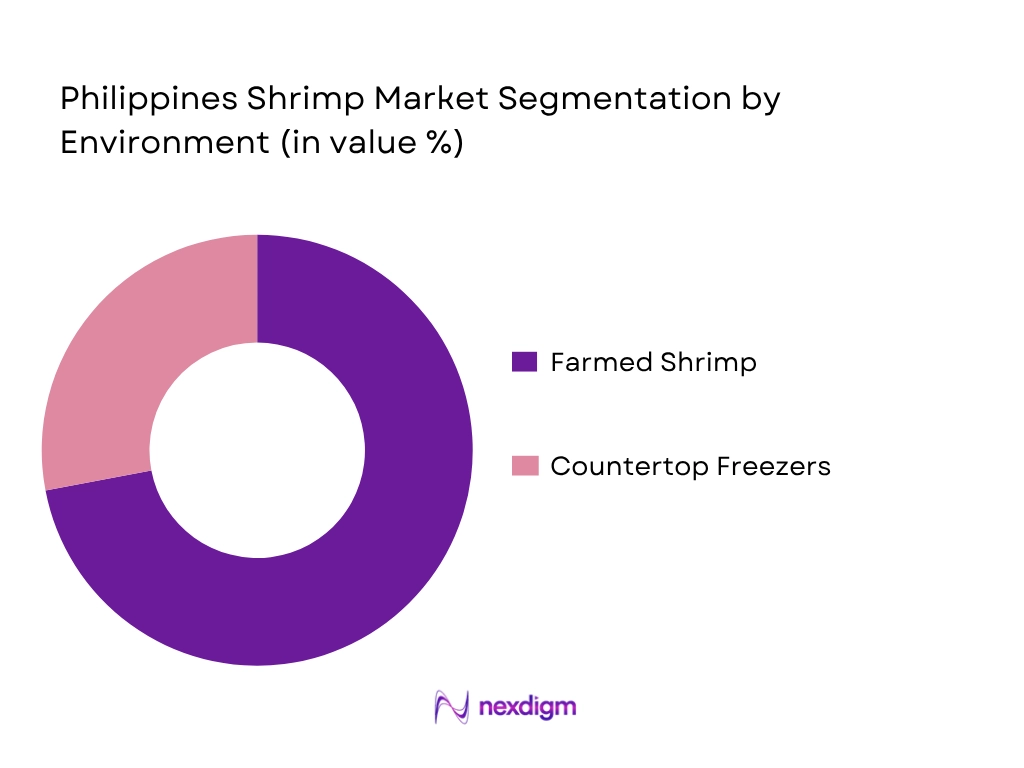
Philippines Shrimp Market is segmented by environment into farmed shrimp and wild shrimp. Recently, farmed shrimp has a dominant market share in the Philippines under the segmentation environment, due to the country’s reliance on brackishwater aquaculture, pond-based vannamei culture and commercial prawn farms. Farmed shrimp provides better control over size grade, harvest timing, biosecurity, feed management, processor supply and export buyer requirements compared with wild-caught shrimp. Vannamei farming has become more important because it supports intensive and semi-intensive grow-out systems, shorter crop cycles and more predictable volume planning for processors and foodservice buyers. Wild shrimp remains relevant for wet markets, small shrimp, dried shrimp, bagoong inputs and local seafood consumption; however, wild supply is seasonal, fragmented and exposed to capture-fisheries volatility. The growing role of accredited vannamei farms, hatchery systems and cold-chain processors strengthens farmed shrimp’s leadership.
By Species
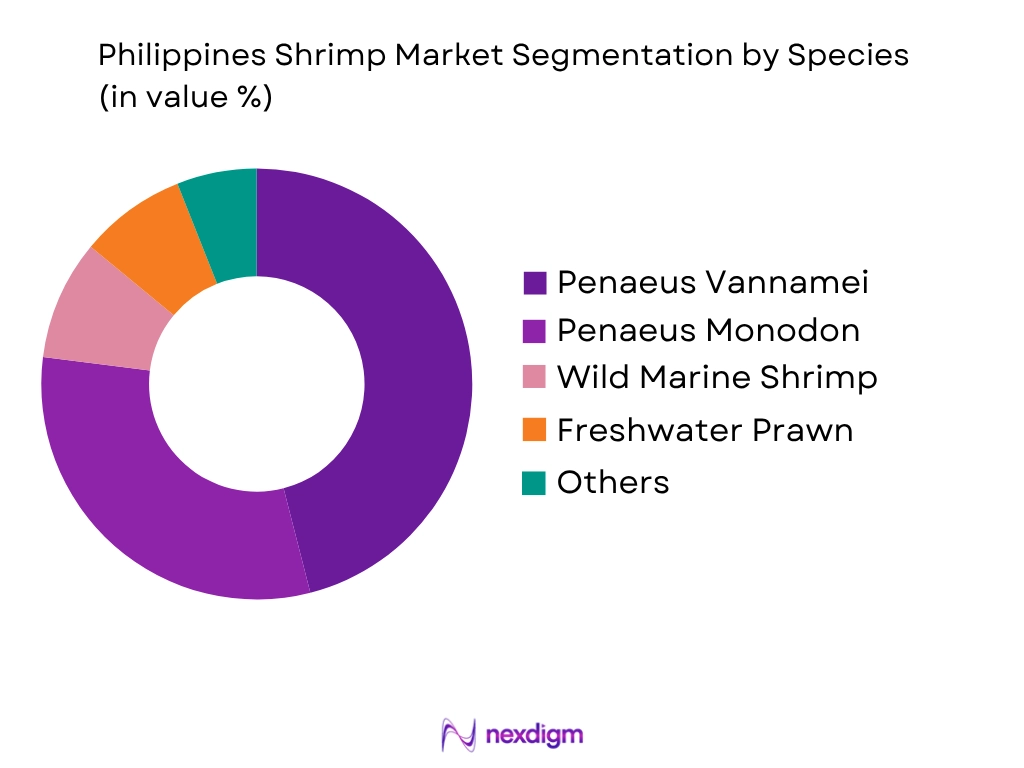
Philippines Shrimp Market is segmented by species into Penaeus vannamei, Penaeus monodon, Macrobrachium rosenbergii, wild marine shrimp, and small shrimp or acetes. Recently, Penaeus vannamei has a dominant market share in the Philippines under the segmentation species, due to its suitability for intensive grow-out farming, higher stocking density, shorter culture cycle and stronger processor acceptance. Vannamei is preferred by farmers shifting toward controlled pond systems because it responds well to commercial feed, aeration, nurseries and biosecurity protocols. It also provides processors with more consistent sizes for frozen head-on shell-on, headless shell-on, peeled and deveined, and foodservice-ready formats. Black tiger prawn remains important in premium grades and traditional pond systems, especially where buyers value large size and taste differentiation. However, its lower stocking density and disease sensitivity limit scalability compared with vannamei. Freshwater prawn and wild shrimp remain niche domestic categories.
Competitive Landscape
The Philippines Shrimp Market is moderately fragmented across integrated aquaculture firms, grow-out farms, hatcheries, feed companies, traders, processors, exporters and cold-chain operators. Alsons Aquaculture Corporation has strong integrated farm-to-processing capability through the Sarangani Bay platform, while CP Foods Philippines supports the sector through aquafeed and aquaculture capability. Phil-Union Frozen Foods and RDEX Food International are important processor-exporters, while regional grow-out players support vannamei and prawn supply in Luzon, Visayas and Mindanao.
| Company | Establishment Year | Headquarters | Value Chain Role | Species Focus | Product Formats | Regional Presence | Export Orientation | Market-Specific Strength |
| Alsons Aquaculture Corporation | 1988 aquaculture start / 1995 business listing | Sarangani, Philippines | ~ | ~ | ~ | ~ | ~ | ~ |
| Charoen Pokphand Foods Philippines Corporation | 1978 parent company | Bangkok, Thailand / Philippines operations | ~ | ~ | ~ | ~ | ~ | ~ |
| Phil-Union Frozen Foods Inc. | 2007 | Lapu-Lapu City, Cebu | ~ | ~ | ~ | ~ | ~ | ~ |
| RDEX Food International Phils. Inc. | 1990 | General Santos City, Philippines | ~ | ~ | ~ | ~ | ~ | ~ |
| San Carlos Agro-Aqua Corporation | N/A | Negros Occidental, Philippines | ~ | ~ | ~ | ~ | ~ | ~ |
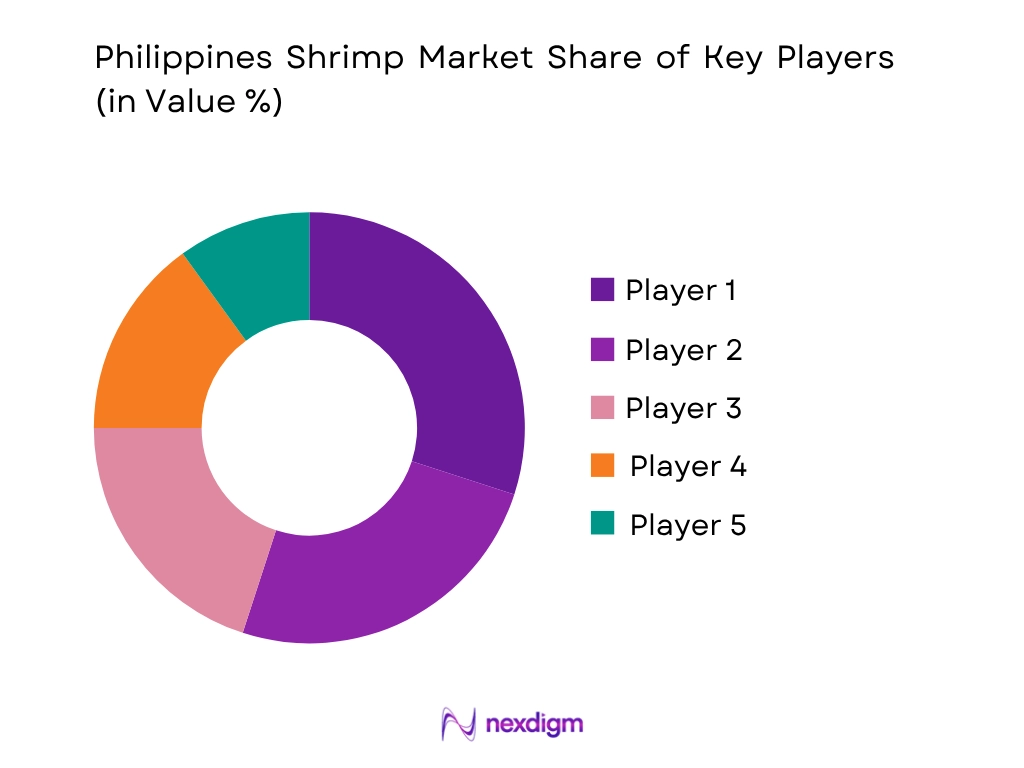
Philippines Shrimp Market Analysis
Growth Drivers
Aquaculture base and P. vannamei production momentum supporting farmed shrimp supply
The Philippines Shrimp Market is supported by a large aquaculture base and visible improvement in P. vannamei output. PSA reported total fisheries production of 4.05 million metric tons and aquaculture production of 2.22 million metric tons in 2024, giving shrimp farmers a broad production ecosystem for brackishwater pond operations, hatchery linkages, feed use, trader aggregation and processor procurement. PSA also stated that P. vannamei was one of the species that posted annual output improvement in 2024, while fourth-quarter fisheries production reached 1.07 million metric tons and aquaculture production reached 683.93 thousand metric tons. BFAR’s certified grow-out list recorded accredited P. vannamei farms across Region III, Region IV-B, Region XI and other areas, including Region III with 21 farms and 246.53 hectares, Region IV-B with 15 farms and 152.25 hectares, and Davao grow-out farms such as King Shrimp Aqua Culture Corporation with 4.8 hectares and Aqua Biological Industries Corporation with 8.8 hectares. The macroeconomic environment also supports seafood demand, with World Bank reporting Philippine GDP of USD 461.62 billion and GDP per capita of USD 3,984.8 in 2024.
Large consumer base and household expenditure supporting domestic shrimp consumption channels
Domestic shrimp demand is supported by the Philippines’ large consumer base, household spending scale, wet-market culture, foodservice demand and regional urban clusters. PSA’s official population count recorded 112,729,484 people in 2024, with CALABARZON at 16.93 million, NCR at 14.00 million, and Central Luzon at 12.99 million; these regions are important for shrimp distribution because they combine urban households, restaurants, wet markets, fish ports, supermarkets and cold-chain access. World Bank data reported Philippine GDP of USD 461.62 billion and GDP per capita of USD 3,984.8 in 2024, while World Bank-linked data reported household and NPISH final consumption expenditure of 20,137,692,097,500 LCU in 2024. For shrimp specifically, these macro indicators support fresh, chilled, frozen and foodservice shrimp because consumer demand is not limited to export channels; household purchases, restaurants, catering, seafood grills and modern retail also absorb shrimp supply. The large coastal and urban market base allows farmers and traders to sell different product formats, from live and fresh shrimp to frozen packs and small shrimp used in processed foods.
Market Challenges
Aquaculture output contraction and biological risk affecting shrimp farm reliability
The Philippines Shrimp Market faces operational pressure from broader aquaculture volatility, even as P. vannamei showed improvement. PSA reported total fisheries production of 4.05 million metric tons in 2024, down from 4.26 million metric tons in 2023, while aquaculture production declined to 2.22 million metric tons from 2.38 million metric tons. In the fourth quarter, total fisheries production was 1.07 million metric tons, compared with 1.17 million metric tons in the same quarter of 2023, and aquaculture production was 683.93 thousand metric tons, compared with 737.93 thousand metric tons. This matters for shrimp because ponds, hatcheries, water quality, disease surveillance and feed conversion performance are linked to overall aquaculture conditions. Disease events, poor post-larvae quality, salinity shifts, pond contamination and weak biosecurity can reduce survival and crop consistency. The challenge is amplified by the national production base: smaller growers often rely on traders and may have limited access to diagnostics, tested seed and controlled water systems. World Bank’s 2024 GDP figure of USD 461.62 billion shows a sizeable economy, but farm-level resilience still depends on biosecurity investment and technical capacity.
Import-export imbalance and cold-chain complexity affecting shrimp availability and processor planning
Trade and logistics present a market-specific challenge for Philippine shrimp processors, traders and retailers. WITS/World Bank data shows the Philippines imported 4,090,050 kg of frozen shrimps and prawns under HS 030613 in 2024, while exports were 1,627,880 kg under the same category. China supplied 716,075 kg of frozen shrimps and prawns to the Philippines, while Japan imported 600,675 kg from the Philippines, followed by France with 226,440 kg, Korea with 135,466 kg, the United States with 123,844 kg, and Guam with 85,588 kg. This shows that the country is simultaneously importing shrimp for domestic use and exporting processed/frozen shrimp into buyer markets, creating pressure on consistent grading, cold storage, traceability and shipment planning. The island geography increases handling risks across ponds, fish ports, processors and cold-chain gateways. For perishable shrimp, ice supply, refrigerated transport, processing yield and export documentation determine whether farmers can capture higher-value buyer channels. The macroeconomic backdrop is supportive, but logistics remain demanding: the World Bank lists Philippine GDP at USD 461.62 billion in 2024, while household consumption expenditure reached 20,137,692,097,500 LCU, increasing domestic pull alongside export obligations.
Market Opportunities
Certified hatchery and grow-out farm expansion to improve traceability and seed reliability
A strong opportunity exists in certified hatchery, nursery and grow-out expansion because shrimp competitiveness depends on post-larvae quality, survival, traceability and disease control. BFAR’s accredited P. vannamei hatchery list recorded 34 accredited hatcheries as of May 31, 2024, including facilities in Pangasinan, Zambales, Sarangani and General Santos City. The same BFAR documentation shows Region XI with 2 accredited hatcheries and Region XII with 3 accredited hatcheries, while the grow-out farm list recorded Region III with 21 farms and 246.53 hectares, Region IV-B with 15 farms and 152.25 hectares, and Region II with 4 farms and 126.16 hectares. This supports future growth because certified post-larvae supply can reduce crop failure risk, help processors meet buyer documentation requirements and support farm clustering around Zambales, Batangas, Palawan, Davao and Sarangani. PSA’s 2024 fisheries data shows P. vannamei as one of the species with annual output improvement, giving a current production signal for expansion. Macroeconomic capacity also supports investment: World Bank reported Philippine GDP of USD 461.62 billion and GNI per capita of USD 4,470 in 2024.
Value-added frozen shrimp and export-market diversification using current trade corridors
Value-added shrimp processing is a future-facing opportunity because the Philippines already has active trade corridors for frozen shrimps and prawns. WITS/World Bank data shows Philippine exports of HS 030613 frozen shrimps and prawns at 1,627,880 kg in 2024, with Japan receiving 600,675 kg, France 226,440 kg, Korea 135,466 kg, the United States 123,844 kg, and Guam 85,588 kg. These current flows show processor access to North Asian, European and US-linked markets, supporting future growth in head-on shell-on, headless shell-on, peeled, deveined, cooked and retail-ready shrimp formats. The opportunity is strengthened by the domestic aquaculture base: PSA reported aquaculture production of 2.22 million metric tons and total fisheries production of 4.05 million metric tons in 2024, while P. vannamei output was one of the annual improving species. Current macroeconomic indicators also support seafood processing investment, with World Bank reporting GDP of USD 461.62 billion and GDP per capita of USD 3,984.8 in 2024. Processors that combine certified farm sourcing, residue testing, cold storage, export cartons and buyer documentation can shift from commodity frozen trade to higher-value, specification-led channels.
Future Outlook
Over the forecast period, the Philippines Shrimp Market is expected to grow steadily, supported by rising domestic seafood consumption, foodservice recovery, export processing, hatchery improvement, farm biosecurity and value-added shrimp formats. IMARC’s forecast anchor places the market at USD ~ million and projects 3.79% CAGR during 2026-2034. For the 2026-2035 planning horizon, the same growth trajectory is used as a conservative working benchmark, subject to revision once an official 2035 country forecast is published.
Major Players
- Alsons Aquaculture Corporation
- Charoen Pokphand Foods Philippines Corporation
- San Carlos Agro-Aqua Corporation
- HP Aquafarm Inc.
- Golden Shrimp Aquaculture Activities
- Shrimp and Co Aqua Farm Inc.
- Pudgy Shrimp Inc.
- JLV Prawn Culture
- Villamar Aquaculture Corporation
- AXP Agriventures Inc.
- Phil-Union Frozen Foods Inc.
- RDEX Food International Phils. Inc.
- Frabelle Fishing Corporation
- Fishta Seafood Inc.
- SeaTrace International Inc.
Key Target Audience
- Shrimp farmers and aquaculture operators
- Hatcheries and broodstock suppliers
- Aquafeed and farm-input companies
- Seafood processors and frozen shrimp exporters
- Seafood wholesalers, traders and fish-port operators
- Hotels, restaurants, catering companies and foodservice buyers
- Investments and venture capitalist firms
- Government and regulatory bodies
Research Methodology
Step 1: Identification of Key Variables
The initial phase involves constructing an ecosystem map encompassing all major stakeholders within the Philippines Shrimp Market. This includes shrimp farms, hatcheries, feed suppliers, farm-gate traders, seafood wholesalers, processors, exporters, cold-chain operators, foodservice buyers and regulatory bodies. The objective is to identify variables such as species mix, production system, pond productivity, disease risk, channel structure and export readiness.
Step 2: Market Analysis and Construction
In this phase, historical data is compiled and analyzed for the Philippines Shrimp Market. This includes fisheries production, aquaculture output, farmed and wild shrimp contribution, processing capacity, export channels, domestic buyer demand and product formats. Market construction is conducted through top-down market sizing and bottom-up validation using farms, processors, traders, channel margins and species-level production patterns.
Step 3: Hypothesis Validation and Expert Consultation
Market hypotheses are developed and validated through computer-assisted telephone interviews with shrimp farmers, hatchery operators, feed suppliers, seafood processors, fish-port traders, cold-chain providers and foodservice buyers. These consultations provide operational insights into stocking density, survival rate, FCR, harvest size, disease exposure, farm-gate trading, processing yield and export documentation requirements.
Step 4: Research Synthesis and Final Output
The final phase involves direct engagement with aquaculture companies, processor-exporters and distributors to validate species segmentation, production-system adoption, regional supply clusters, buyer preferences and value-added processing trends. The synthesis combines secondary data, industry interviews, regional farm mapping and channel analysis to produce a validated market assessment with competitive, strategic and future-facing recommendations.

- Executive Summary
- Research Methodology (Market definitions and assumptions, abbreviations, shrimp species classification, aquaculture and capture scope, farm-gate and wholesale price tracking, export-import triangulation, pond-area productivity mapping, hatchery and post-larvae supply assessment, feed and input cost mapping, processor and exporter interviews, farmer and trader interviews, regional production validation, limitations and future conclusions)

- Definition and Scope
- Overview Genesis
- Timeline of Major Players
- Business Cycle
- Supply Chain and Value Chain Analysis

- Growth Drivers (Domestic seafood demand, export-grade shrimp production, vannamei adoption, foodservice recovery, cold-chain expansion, regional aquaculture clusters)
- Market Challenges (Disease risk, feed cost pressure, seed quality variability, climate exposure, pond salinity fluctuation, export residue compliance)
- Opportunities (Certified shrimp farming, export diversification, value-added processing, hatchery modernization, feed innovation, traceability systems)
- Market Trends (Intensification, biofloc adoption, traceability, black tiger prawn premiumization, frozen retail packs, sustainability claims)
- Government Regulation (BFAR accreditation, aquaculture farm registration, fish health certification, export sanitary requirements, food safety standards, local permits)
- SWOT Analysis
- Stakeholder Ecosystem
- Porter’s Five Forces

- By Value (2020-2025)
- By Volume (2020-2025)
- By Average Farm-Gate Price (2020-2025)

- By Species Type (In Value %)
Whiteleg Shrimp / Vannamei
Black Tiger Prawn
Freshwater Prawn
Wild-Caught Marine Shrimp
Mixed Small Shrimp and Acetes - By Product Form (In Value %)
Live Shrimp
Fresh Chilled Shrimp
Frozen Head-On Shell-On Shrimp
Frozen Headless Shell-On Shrimp
Peeled and Deveined Shrimp - By Distribution Channel (In Value %)
Farm-Gate Traders and Consolidators
Public Wet Markets
Seafood Wholesalers and Fish Port
Modern Retail and Supermarkets
Hotels, Restaurants and Catering - By Region (In Value %)
Central Luzon
CALABARZON
MIMAROPA
Western Visayas
Zamboanga Peninsula

- Market Share of Major Players (Production volume, processing volume, export volume, farm acreage, species specialization, buyer-channel contribution)
- Cross Comparison Parameters (Species portfolio, pond hectarage and farm capacity, hatchery and post-larvae access, feed conversion and survival management, disease biosecurity protocols, processing and export certifications, cold-chain and logistics coverage, domestic and export buyer network)
- SWOT Analysis of Major Players
- Detailed Profiles of Major Companies
Alsons Aquaculture Corporation
Charoen Pokphand Foods Philippines Corporation
San Carlos Agro-Aqua Corporation
HP Aquafarm Inc.
Golden Shrimp Aquaculture Activities
Shrimp and Co Aq
JLV Prawn Culture
Villamar Aquaculture Corporation
AXP Agriventures Inc.
Phil-Union Frozen Foods Inc.
RDEX Food International
Frabelle Fishing Corporation
Fishta Seafood Inc.
SeaTrace International Inc.

- Household Consumer Analysis
- Foodservice Buyer Analysis
- Processor and Exporter Analysis
- Modern Retail Buyer Analysis
- Institutional Buyer Analysis

- By Value (2026-2035)
- By Volume (2026-2035)
- By Average Farm-Gate Price (2026-2035)


 Request a Sample
 Ask for Customization
 Get a Quote
 Enquire Now