
 Download PDF
Market Overview
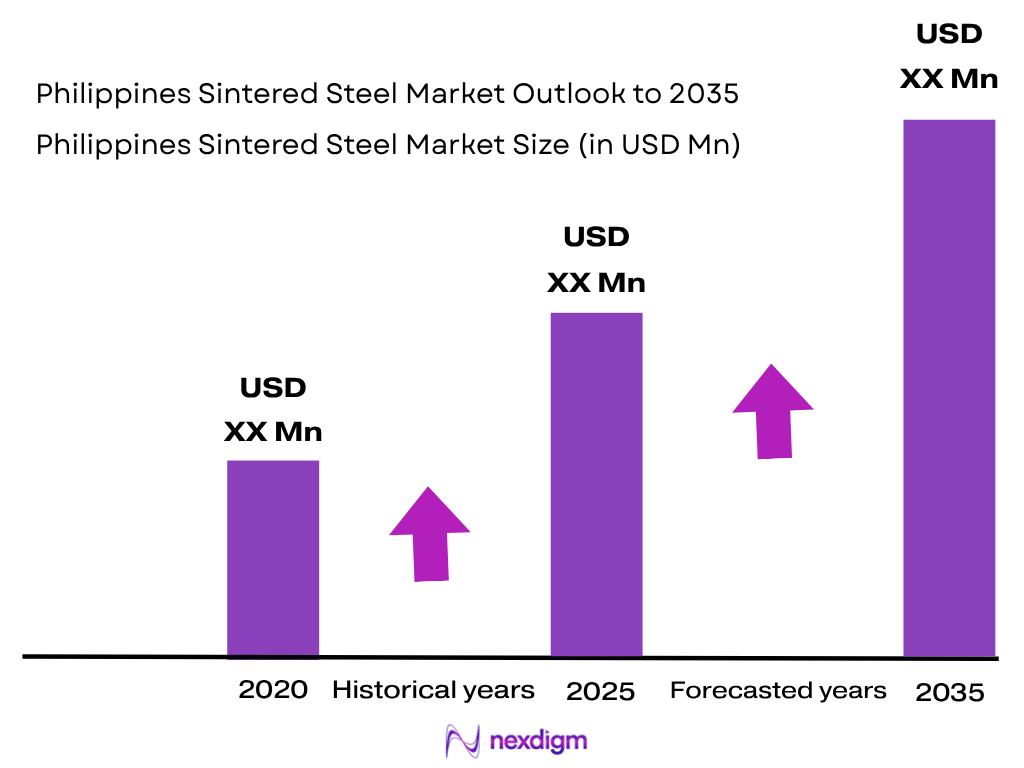
The Philippines Sintered Steel Market is estimated at ~USD XX million based on the report’s defined scope, with demand linked primarily to automotive, motorcycle, industrial machinery, electrical and electronics manufacturing. The country’s total external trade in goods reached USD 200.87 billion, while imports reached USD 127.60 billion, creating a substantial industrial supply-chain base for metal components and manufacturing inputs. Automotive demand also strengthened, with vehicle sales reaching 467,252 units, compared with 429,807 units in the preceding year. Electronics remain another major industrial demand center, with electronic products accounting for USD 27.38 billion of imports. These indicators support requirements for precision gears, bearings, bushings, structural components and other powder-metallurgy parts.
Metro Manila, CALABARZON and Central Luzon represent important demand centers for the Philippines Sintered Steel Market because they concentrate automotive assembly, electronics manufacturing, industrial production, logistics infrastructure and supplier networks. The Philippines recorded USD 73.27 billion in merchandise exports and USD 127.60 billion in imports, demonstrating the country’s extensive integration into international manufacturing supply chains. Electronic products generated USD 27.38 billion in imports, while automotive manufacturers sold 467,252 vehicles domestically. CALABARZON is particularly relevant because of its established automotive and industrial manufacturing ecosystem, while Metro Manila provides corporate procurement, distribution and aftermarket functions. Cebu and other major industrial centers add regional demand.
Market Segmentation
By Product Type
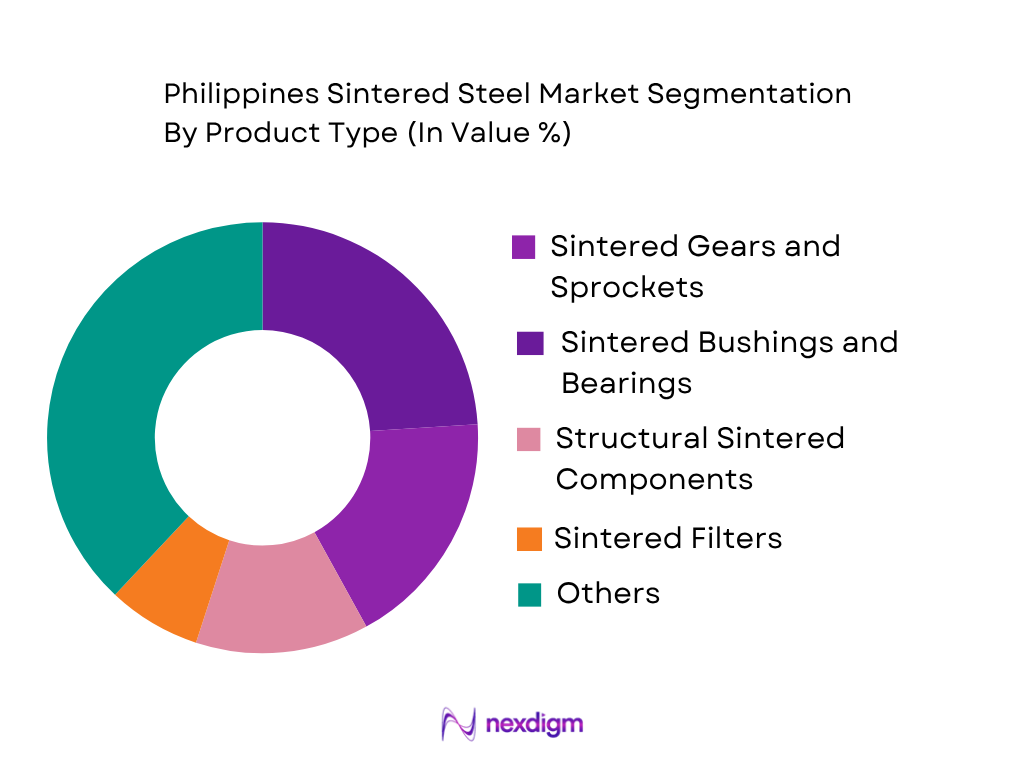
The Philippines Sintered Steel Market is segmented by product type into sintered gears and sprockets, bearings and bushings, structural components, filters, camshaft components, pulleys and rotors, shafts and hubs, synchronizer components, electrical and magnetic components, and wear-resistant components. Sintered gears and sprockets represent the leading modeled product category, supported by their suitability for high-volume automotive and industrial applications where repeatable dimensions, material utilization and near-net-shape manufacturing are important. The automotive ecosystem provides a significant downstream application base, with 467,252 vehicle sales recorded in the Philippines. Motorcycle and industrial-equipment applications further expand requirements for compact gears, bushings and rotating components. Sintered bearings and bushings also benefit from their self-lubricating characteristics and suitability for repetitive mechanical movement. Structural components remain relevant where manufacturers seek reduced machining requirements, while filters and specialized components serve industrial applications. The country’s electronic-product trade base, including USD 27.38 billion of electronic-product imports, additionally supports precision component requirements within electrical equipment and manufacturing machinery. The segmentation therefore captures both high-volume automotive components and specialized industrial applications.
By End-Use Industry
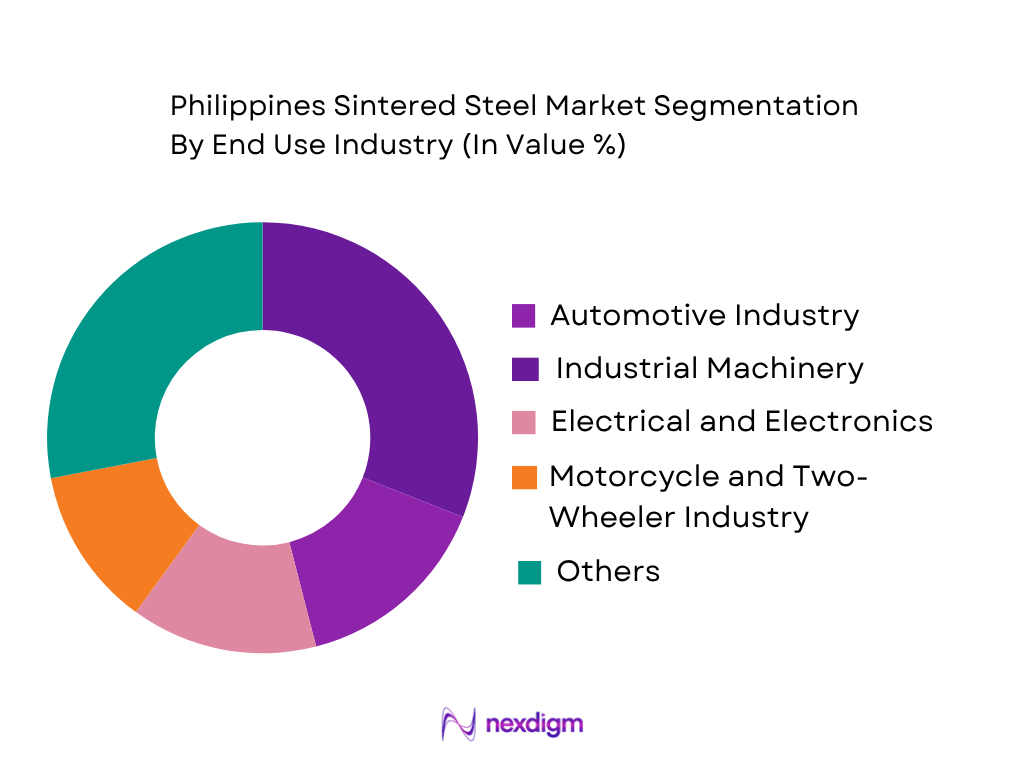
The Philippines Sintered Steel Market is segmented by end-use industry into automotive, motorcycle and two-wheeler, industrial machinery, electrical and electronics, home appliances, agricultural machinery, construction equipment, power tools, medical equipment, and general engineering and fabrication. The automotive industry represents the leading modeled end-use segment because sintered components are widely suited to drivetrain, transmission, braking, engine, pump, bearing and structural applications. Philippine vehicle sales reached 467,252 units, compared with 429,807 units in the preceding year, creating a substantial downstream component requirement. Electrical and electronics manufacturing provides another important application base, with electronic products representing USD 27.38 billion of imports and remaining a major component of Philippine industrial trade. Industrial machinery demand is supported by the country’s manufacturing and infrastructure activities, while motorcycle applications create additional opportunities for gears, bushings and other compact components. Home appliances, power tools and agricultural machinery broaden the addressable customer base. The combination of automotive production, electronics manufacturing and industrial equipment requirements makes sintered steel relevant where manufacturers seek repeatable geometry, efficient material utilization and reduced machining intensity.
Competitive Landscape
The Philippines Sintered Steel Market includes global powder-metallurgy specialists, automotive-component manufacturers and diversified engineering companies serving the country through manufacturing operations, regional supply networks, distributors or customer relationships. Competitive differentiation is centered on powder composition, component density, dimensional tolerance, production scale, automotive qualification, secondary machining, heat treatment and application engineering. The presence of a large electronics supply chain and a substantial automotive market increases the relevance of suppliers capable of delivering precision components at consistent volumes. Major international participants include GKN Powder Metallurgy, Sumitomo Electric Sintered Alloy, Fine Sinter, Miba, Höganäs, Porite, Hitachi Powdered Metals and other specialized powder-metallurgy producers.
| Company | Establishment | Headquarters | Core Sintered Products | Automotive Capability | Powder Metallurgy Technology | Secondary Processing | Regional Supply Capability | Key Application |
| GKN Powder Metallurgy | 1993 | Germany | ~ | ~ | ~ | ~ | ~ | ~ |
| Sumitomo Electric Sintered Alloy | 1959 | Japan | ~ | ~ | ~ | ~ | ~ | ~ |
| Fine Sinter | 1950 | Japan | ~ | ~ | ~ | ~ | ~ | ~ |
| Miba Group | 1927 | Austria | ~ | ~ | ~ | ~ | ~ | ~ |
| Höganäs AB | 1797 | Sweden | ~ | ~ | ~ | ~ | ~ | ~ |
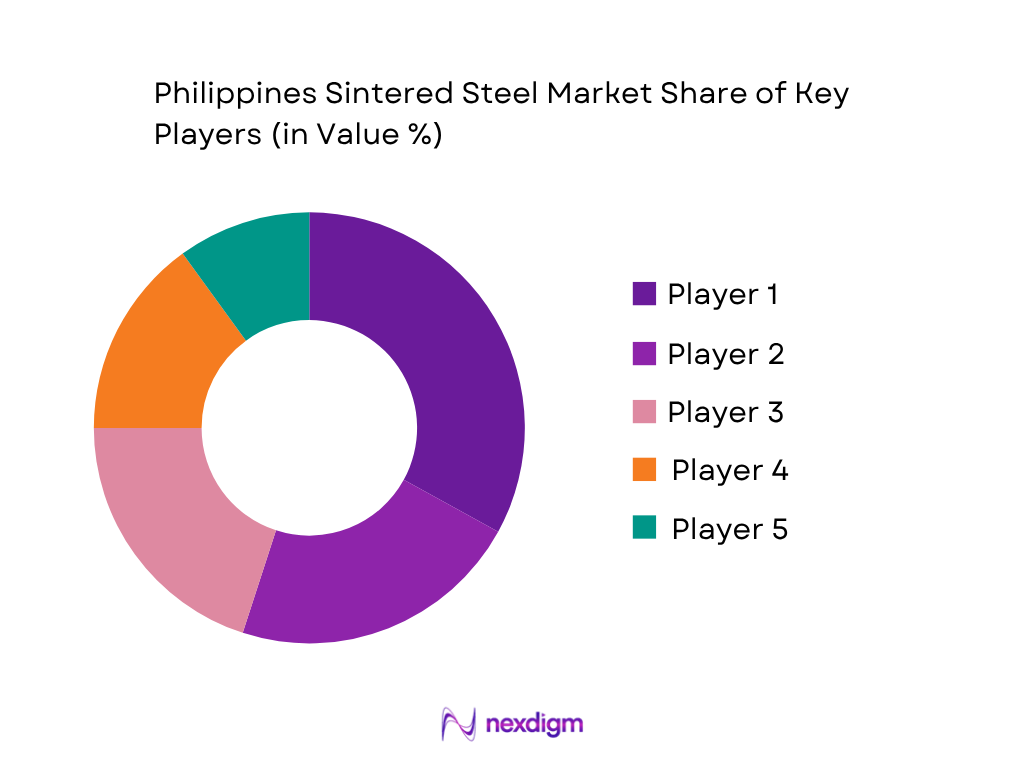
Philippines Sintered Steel Market Analysis
Growth Drivers
Expansion of Automotive Component Manufacturing
The expansion of automotive component manufacturing is creating a stronger industrial base for sintered steel applications such as gears, bushings, structural components, synchronizer parts, hubs and other near-net-shape components. The Philippine Board of Investments identifies motor-vehicle parts and components as a priority manufacturing activity, covering engines, transmissions, transaxles, electric-power-steering systems, instrument clusters, chassis components and other assemblies. The policy framework also specifically recognizes controllers, motors and batteries for electric vehicles as eligible manufacturing activities. The manufacturing environment provides a direct downstream opportunity for powder-metallurgy suppliers because sintered components can reduce machining requirements and support repeatable production of complex geometries. The Philippine Statistics Authority reported that manufacturing remained a major component of industrial activity, while the World Bank recorded Philippine GDP at approximately US$461.7 billion and GDP growth at 5.7 in the latest 2024 observations. The Board of Investments also maintains programs intended to strengthen automotive manufacturing, technology transfer and local parts production. As automotive assemblers and component manufacturers deepen local sourcing, demand can expand for precision sintered steel components capable of meeting dimensional, strength and wear requirements. This creates opportunities across drivetrain, transmission, actuator, steering and electric-mobility component applications.
Growth of Motorcycle Production and Parts Demand
Motorcycle manufacturing and component demand provide another important downstream driver for the Philippines Sintered Steel Market because motorcycles use numerous compact metal components requiring dimensional consistency, wear resistance and high-volume repeatability. The Philippine Board of Investments states that 28 companies have participated in motorcycle-related investment programs and identifies motorcycle manufacturing as an industry with expansion potential because motorcycles are widely used for personal, leisure and business transportation across urban and rural areas. The country also has established participation from Japanese, Taiwanese, Chinese and other international manufacturers, creating an ecosystem for localized component production. This environment is relevant to powder metallurgy because sintered gears, bushings, sprockets, oil-impregnated bearings and other small drivetrain components can be manufactured efficiently in high volumes. The World Bank reports Philippine GDP of approximately US$461.7 billion and GDP growth of 5.7 for the latest 2024 observation, indicating continued overall economic activity supporting transportation demand. The Board of Investments further identifies local technical licensing arrangements and input localization as mechanisms supporting motorcycle-industry development. Increasing localization of components can therefore broaden the addressable market for sintered steel manufacturers, particularly where producers require repeatable tolerances, reduced material waste and integrated component geometries.
Market Challenges
Limited Domestic Metal-Powder Production
Limited domestic production of specialized metal powders remains a structural challenge for the Philippines Sintered Steel Market because powder metallurgy depends on consistent availability of iron powders, alloy powders, stainless-steel powders, lubricants and other controlled feedstocks. The country’s industrial ecosystem has substantial manufacturing activity, but specialized powder-metallurgy feedstock production remains less developed than downstream component manufacturing. This increases dependence on international suppliers for particular grades and formulations and exposes component producers to import logistics, foreign-exchange movements and lead-time requirements. The Philippine Statistics Authority reported that the manufacture of basic iron and steel, electronic components, motor-vehicle parts and batteries are established manufacturing activities, demonstrating the presence of downstream industrial capabilities. However, the available industrial classification does not indicate an equivalent domestic specialization in advanced metal-powder production. The World Bank records Philippine imports of goods and services at roughly 40.1 of GDP in the latest 2024 observation, illustrating the country’s significant integration with international supply chains. For sintered-steel manufacturers, this means feedstock availability can remain sensitive to international sourcing conditions. Developing local powder-processing, atomization, blending and characterization capabilities could reduce supply-chain exposure while enabling manufacturers to formulate materials specifically for automotive, motorcycle, electronics and industrial applications.
Competition from Machining and Casting Processes
Competition from conventional machining, casting and other metal-forming technologies presents a significant challenge because manufacturers can select alternative processes according to component geometry, production volume, mechanical requirements and existing factory capabilities. Sintered steel provides advantages for selected high-volume near-net-shape components, but adoption requires appropriate powder selection, tooling, compaction and sintering infrastructure. Philippine manufacturing already contains established capabilities in metal products, machinery, transport equipment and automotive parts, giving buyers multiple production routes. The Philippine Statistics Authority reported that manufacturing net sales increased 1.0 on average during the latest 2024 period, while machinery and equipment manufacturing recorded a 44.6 year-on-year increase in December 2024 and transport-equipment manufacturing increased 8.6 in the same month. These figures demonstrate active downstream manufacturing demand but also indicate a competitive environment in which component producers can use different manufacturing technologies. Sintered steel suppliers therefore need to demonstrate measurable advantages through dimensional consistency, material utilization, component integration, reduced secondary machining and repeatable high-volume production. The challenge is particularly relevant for lower-volume components where tooling economics may favor machining or casting.
Market Opportunities
Automotive Drivetrain Components
Automotive drivetrain components represent a significant opportunity for expansion of sintered steel applications because the Philippine industrial policy explicitly supports manufacturing of engines, transmissions, transaxles and related automotive components. The Board of Investments lists transmission parts, engine parts, constant-velocity joints, electric-power-steering systems, chassis components and other vehicle components among eligible manufacturing activities. Sintered steel can be applied where high-volume production, dimensional repeatability and integrated geometries provide manufacturing advantages, particularly for gears, hubs, sprockets, synchronizer components and other drivetrain parts. The opportunity is strengthened by the country’s established automotive manufacturing ecosystem and policy emphasis on deeper local participation in automotive supply chains. The Philippine Statistics Authority’s manufacturing data show that transport-equipment production increased 8.6 year-on-year in December 2024, while the World Bank recorded Philippine GDP of approximately US$461.7 billion in the latest 2024 observation. Automotive manufacturers are also being encouraged to develop electric-vehicle-related capabilities, including motors, controllers and batteries. This creates a pathway for sintered-steel producers to diversify beyond conventional drivetrain components toward components used in electrified powertrains and auxiliary systems.
Electric-Motor and EV Components
Electric-motor and EV component manufacturing offers a forward-looking opportunity for the Philippines Sintered Steel Market as domestic electronics and automotive manufacturing capabilities increasingly intersect with electric mobility. The Board of Investments specifically identifies electric vehicles, electric motors, controllers and batteries as priority areas within the country’s automotive investment framework. In parallel, the government convened an electronics manufacturing forum in December 2024 to identify products that could be prioritized for local production following legislation supporting domestic manufacturing. The Philippine Statistics Authority reported an 8.6 year-on-year increase in transport-equipment manufacturing in December 2024, while computer, electronic and optical-product manufacturing recorded an 8.6 increase in its production index and an 18.4 increase in net sales during the same month. These industrial indicators support the development of an ecosystem in which precision metal components can be supplied alongside electronic and electrical assemblies. Sintered steel manufacturers can target motor shafts, magnetic-system components, structural parts, gears, bushings and other precision components where material efficiency and repeatability are important. The combination of automotive-electrification initiatives and electronics manufacturing creates an opportunity for suppliers to establish localized powder-metallurgy capabilities and participate in emerging EV supply chains.
Future Outlook
The Philippines Sintered Steel Market is expected to develop through increasing use of near-net-shape manufacturing, automotive component localization, motorcycle-component production, electronics manufacturing and industrial automation. The country’s 467,252 vehicle sales provide a substantial downstream environment for precision components, while USD 27.38 billion of electronic-product imports demonstrate the scale of the broader electronics ecosystem. Future demand is also likely to be influenced by electric-mobility components, compact motor systems, high-efficiency gears, bearings and precision structural parts. Manufacturers that combine powder development, high-density compaction, automated sintering, dimensional control and secondary machining can address increasingly demanding component specifications.
Major Players
- GKN Powder Metallurgy
- Sumitomo Electric Sintered Alloy
- Fine Sinter Co., Ltd.
- Miba Group
- Höganäs AB
- Porite Corporation
- Hitachi Powdered Metals
- Nippon Piston Ring Co., Ltd.
- Tsubaki Nakashima Co., Ltd.
- Burgess-Norton Mfg. Co.
- MPP Group
- Metal Powder Products Company
- AAM Powder Metal Components
- Fukui Byora Co., Ltd.
- Ferro Corporation
Key Target Audience
- Automotive OEMs and Tier-1 Component Manufacturers
- Motorcycle and Two-Wheeler Component Manufacturers
- Industrial Machinery and Precision Engineering Manufacturers
- Electrical and Electronics Component Manufacturers
- Home Appliance and Power-Tool Manufacturers
- Investments and Venture Capitalist Firms
- Government and Regulatory Bodies (Department of Trade and Industry, Board of Investments, Philippine Economic Zone Authority)
- Metal Powder, Tooling and Powder-Metallurgy Equipment Suppliers
Research Methodology
Step 1: Identification of Key Variables
The initial phase involves mapping the Philippine sintered-steel ecosystem across powder suppliers, component manufacturers, tooling providers, automotive OEMs, Tier-1 suppliers and industrial end users. Secondary research is used to identify variables including automotive production, electronics activity, manufacturing output, import dependence, component applications and powder-metallurgy technology adoption.
Step 2: Market Analysis and Construction
Historical market information is compiled through a bottom-up assessment of component applications, production requirements, manufacturing processes and end-use industries. Component-level demand is evaluated across gears, bearings, bushings, structural components and other sintered products, with cross-checks against automotive, electronics and industrial manufacturing activity.
Step 3: Hypothesis Validation and Expert Consultation
Market hypotheses are evaluated through discussions with manufacturers, component purchasers, engineering personnel, distributors and powder-metallurgy specialists. The consultations focus on material selection, component specifications, procurement patterns, production requirements, technology adoption, localization and the relative use of sintered components against machining, casting and forging alternatives.
Step 4: Research Synthesis and Final Output
The final analysis integrates secondary statistics, industry-level operating indicators and bottom-up component assessments to construct the Philippines Sintered Steel Market model. Data are triangulated across product categories, manufacturing processes and end-use industries before market estimates, segmentation structures and future-demand assumptions are finalized.

- Executive Summary
- Research Methodology (Market Definition and Scope, Philippines Sintered Steel Market Classification, Sintered Steel Manufacturing Process Mapping, Powder Metallurgy Technology Assessment, Metal Powder Feedstock Analysis, Iron Powder and Alloy Powder Evaluation, Compaction Technology Assessment, Sintering Furnace Technology Analysis, Heat Treatment and Secondary Processing Assessment, Density and Porosity Evaluation, Dimensional Accuracy Assessment, Mechanical Strength Analysis, Wear and Fatigue Performance Assessment, Oil-Impregnation and Self-Lubricating Component Assessment, Automotive Component Demand Mapping, Industrial Machinery Component Assessment, Appliance Component Evaluation, Electrical and Electronics Component Assessment, Motorcycle Component Assessment, Agricultural Equipment Application Assessment, Supply-Side Assessment, Demand-Side Assessment, Primary Industry Interviews, Data Triangulation, Forecasting Framework)

- Definition and Scope
- Philippines Sintered Steel Industry Evolution
- Sintered Steel Value Chain Analysis
- Sintered Steel Supply Chain Analysis

- Growth Drivers (Expansion of Automotive Component Manufacturing, Growth of Motorcycle Production and Parts Demand, Electronics Manufacturing Expansion, Industrial Machinery Development, Increasing Precision Component Requirements, Adoption of Lightweight Components, Expansion of Local Manufacturing, Growth of Electric Mobility Components, Demand for Wear-Resistant Parts, Increasing Near-Net-Shape Manufacturing)
- Market Challenges (Limited Domestic Metal-Powder Production, Dependence on Imported Specialty Powders, High Sintering Equipment Requirements, Limited Advanced Powder Metallurgy Infrastructure, Tooling and Die Complexity, Specialized Workforce Requirements, Quality-Control Requirements, Feedstock Supply-Chain Exposure, Limited High-Density Component Capability, Competition from Machining and Casting Processes)
- Market Opportunities (Automotive Drivetrain Components, Electric-Motor Components, Motorcycle Components, Precision Industrial Gears, Self-Lubricating Bearings and Bushings, EV Powertrain Components, Appliance Components, Advanced Stainless Sintered Components, Metal Injection Molding Applications, Local Powder Metallurgy Capacity Development)
- Market Trends (Near-Net-Shape Component Manufacturing, Lightweight Automotive Components, High-Density Sintered Steel Parts, Advanced Alloy Powder Adoption, Powder Metallurgy for EV Components, Increased Automation, Digital Furnace Monitoring, Precision Compaction, Improved Dimensional Control, Integration of Secondary Machining)
- Government Regulations and Standards (Board of Investments Manufacturing Incentives, Philippine Investment Priorities Plan, Philippine Economic Zone Authority Requirements, Department of Trade and Industry Manufacturing Policies, Bureau of Philippine Standards Product Standards, Environmental Management Bureau Requirements, Occupational Safety and Health Standards, Chemical Management Requirements, Import and Customs Regulations, Extended Producer Responsibility Requirements)
- SWOT Analysis
- Porter’s Five Forces Analysis
- PESTLE Analysis
- Stakeholder Ecosystem
- Competition Ecosystem

- By Market Value (2020-2025)
- By Production Volume (2020-2025)
- By Average Selling Price (2020-2025)
- By Sintered Steel Component Production Volume (2020-2025)
- By Automotive Sintered Component Production Volume (2020-2025)
- By Motorcycle Sintered Component Production Volume (2020-2025)

- By Product Type (In Value %)
Sintered Gears and Sprockets
Sintered Bearings and Bushings
Sintered Structural Components
Sintered Filters
Sintered Camshaft Components
Sintered Pulleys and Rotors
Sintered Shafts and Hubs
Sintered Automotive Synchronizer Components
Sintered Magnetic and Electrical Components
Sintered Wear-Resistant Components - By Manufacturing Process (In Value %)
Conventional Press-and-Sinter
Metal Injection Molding (MIM)
Powder Forging
Hot Isostatic Pressing (HIP)
Cold Isostatic Pressing (CIP)
Additive Powder Metallurgy
Warm Compaction
High-Velocity Compaction - By Material Composition (In Value %)
Iron-Based Sintered Steel
Iron-Carbon Steel
Iron-Copper-Carbon Alloys
Nickel-Alloyed Sintered Steel
Chromium-Alloyed Sintered Steel
Stainless Sintered Steel
Low-Alloy Sintered Steel
High-Strength Sintered Steel - By Component Application (In Value %)
Engine Components
Transmission and Drivetrain Components
Steering and Suspension Components
Brake System Components
Motor and Pump Components
Compressor Components
Bearing and Bushing Components
Gearbox Components
Electrical and Electromagnetic Components
Industrial Wear Components - By End-Use Industry (In Value %)
Automotive Industry
Motorcycle and Two-Wheeler Industry
Industrial Machinery
Electrical and Electronics
Home Appliances
Agricultural Machinery
Construction Equipment
Medical Equipment
General Engineering and Fabrication - By Customer Type (In Value %)
Automotive OEMs
Automotive Tier-1 Suppliers
Motorcycle Component Manufacturers
Industrial Equipment Manufacturers
Electrical Component Manufacturers
Appliance Manufacturers
Power-Tool Manufacturers
Aftermarket Component Distributors
Contract Manufacturing Customers

- Market Share of Major Players (By Philippines Revenue, Sintered Component Portfolio, Powder Metallurgy Technology Coverage, Automotive Component Capability, Industrial Component Coverage, Production Capacity, Material Portfolio, Component Precision Capability, Customer Base, Distribution Network, Manufacturing Footprint, Secondary Processing Capability, R&D Capability, Aftermarket Coverage)
- Cross Comparison Parameters (Sintered Component Portfolio Breadth, Powder Metallurgy Process Capability, Automotive Component Manufacturing Capability, Material and Alloy Portfolio, Compaction Technology Capability, Sintering Capacity, Dimensional Precision Capability, Philippines Customer and Distribution Reach)
- SWOT Analysis of Major Players
- Detailed Profiles of Major Companies
GKN Powder Metallurgy
Sumitomo Electric Sintered Alloy
Fine Sinter Co., Ltd.
Miba Group
Höganäs AB
Porite Corporation
Hitachi Powdered Metals
Nippon Piston Ring Co., Ltd.
Tsubaki Nakashima Co., Ltd.
Burgess-Norton Mfg. Co.
MPP Group
Metal Powder Products Company
AAM Powder Metal Components
Fukui Byora Co., Ltd.
Ferro Corporation

- Automotive OEM Sintered Component Requirement Assessment
- Automotive Tier-1 Supplier Procurement Analysis
- Industrial Machinery Component Requirement Analysis
- Electrical and Electronics Component Demand Assessment
- Home Appliance Component Procurement Assessment
- Power-Tool Component Requirement Analysis
- Agricultural Machinery Component Demand Assessment

- By Market Value (2026-2035)
- By Production Volume (2026-2035)
- By Average Selling Price (2026-2035)
- By Sintered Steel Component Production Volume (2026-2035)
- By Automotive Sintered Component Production Volume (2026-2035)
- By Motorcycle Sintered Component Production Volume (2026-2035)


 Request a Sample
 Ask for Customization
 Get a Quote
 Enquire Now