
 Download PDF
Market Overview
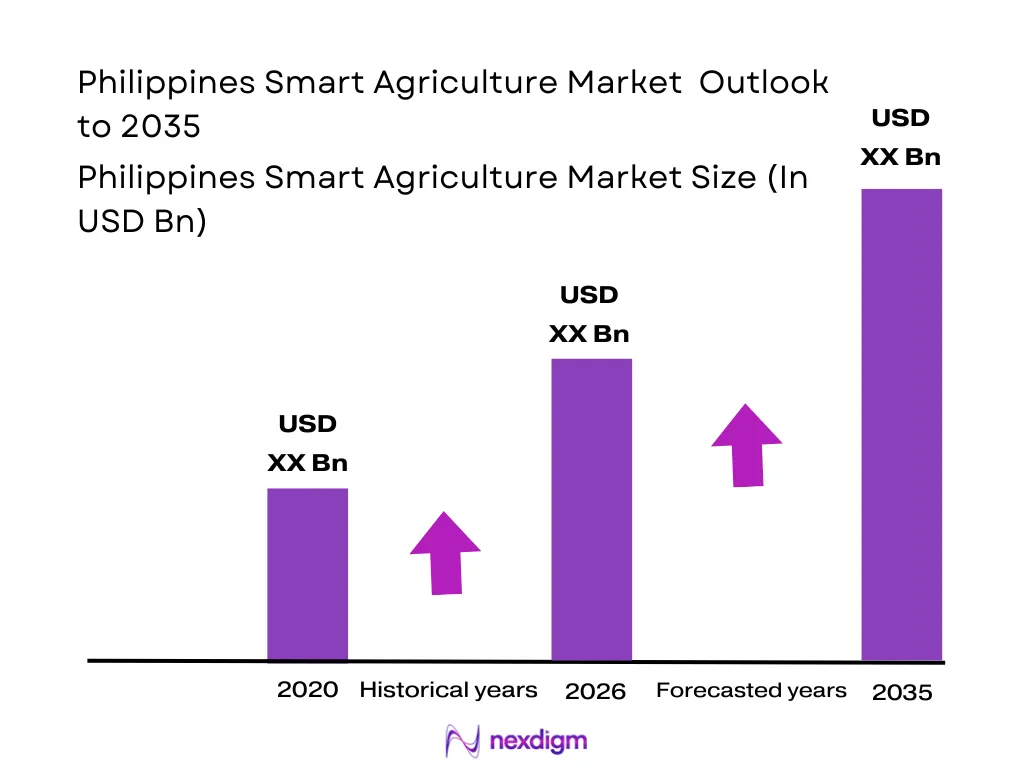
The Philippines Smart Agriculture Market is valued at approximately USD ~ billion, supported by increasing adoption of precision farming technologies, agricultural drones, AI-powered farm analytics, and IoT-enabled irrigation systems across commercial farming operations. Government-backed agricultural modernization initiatives and climate adaptation programs are accelerating digital transformation within the agriculture sector. Agriculture continues to contribute significantly to the Philippine economy, generating over USD 35 billion annually through crop production, fisheries, and livestock activities. Growing pressure on food security and farm productivity optimization is increasing investment in connected farming systems, satellite-based crop monitoring, and automated farm management platforms.
Metro Manila, Davao, Cebu, and Central Luzon dominate the Philippines Smart Agriculture Market due to stronger digital infrastructure, higher mechanization penetration, and concentration of agribusiness investments. Davao has emerged as a major smart farming hub because of extensive banana and pineapple plantations adopting precision agriculture technologies and drone-based crop management systems. Central Luzon leads in smart irrigation and rice farm mechanization because of its large-scale agricultural production ecosystem. Metro Manila functions as the country’s innovation and investment center for agri-tech startups, telecom operators, and cloud-based agriculture platforms, while Cebu is witnessing rising deployment of aquaculture monitoring systems and smart greenhouse technologies.
Market Segmentation
By Technology Type
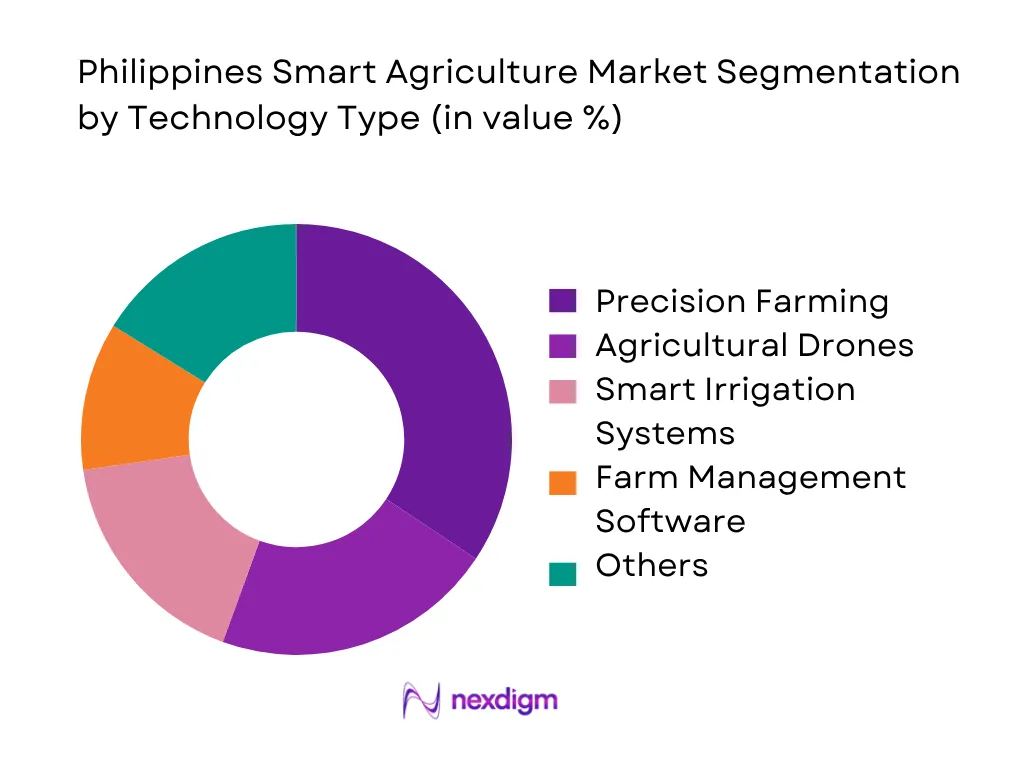
The Philippines Smart Agriculture Market is segmented by technology type into precision farming, agricultural drones, smart irrigation systems, farm management software, livestock monitoring systems, AI and predictive analytics platforms, and IoT-enabled monitoring systems. Precision farming dominates the Philippines Smart Agriculture Market under this segmentation due to rising demand for crop yield optimization, automated irrigation management, and efficient fertilizer utilization. Large commercial farms and plantation operators increasingly rely on GPS-guided systems, satellite imaging, and sensor-enabled analytics to improve productivity and reduce operational losses caused by climate disruptions. The dominance of precision farming is also supported by increasing government mechanization initiatives and deployment of telecom-enabled digital agriculture platforms across rice, banana, sugarcane, and pineapple farming operations. Additionally, farm operators are investing in predictive analytics and variable-rate application systems to optimize labor efficiency and reduce input wastage, strengthening the adoption of precision agriculture technologies throughout the country.
By Application
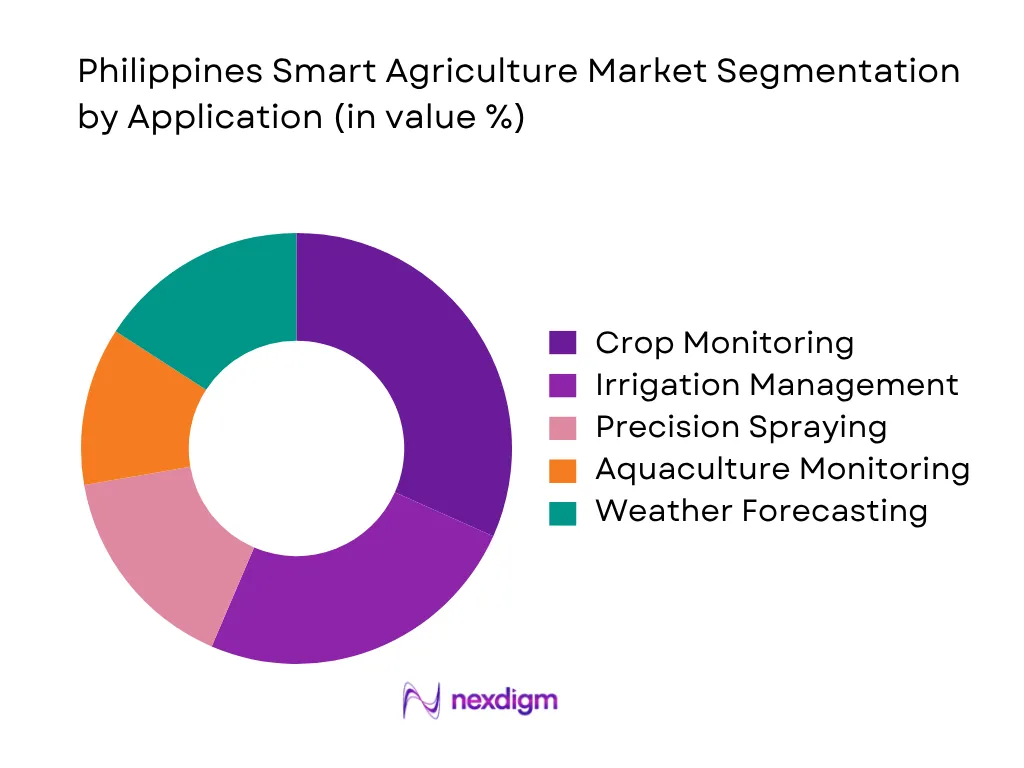
The Philippines Smart Agriculture Market is segmented by application into crop monitoring, irrigation management, precision spraying, weather forecasting, livestock monitoring, aquaculture monitoring, and harvest management. Crop monitoring dominates the market because of increasing deployment of drone imaging systems, multispectral analytics, and IoT-enabled field sensors across plantation agriculture and commercial crop farming operations. Farmers and agribusiness firms are increasingly utilizing crop monitoring technologies to identify pest infestations, nutrient deficiencies, crop stress, and disease outbreaks in real time. This dominance is particularly evident in banana, pineapple, rice, and sugarcane plantations located across Mindanao and Central Luzon, where predictive crop analytics significantly improve operational efficiency and yield optimization. Rising climate variability and weather-related agricultural risks are further accelerating adoption of remote sensing technologies and AI-driven crop intelligence platforms. Government-backed smart farming initiatives and rising awareness regarding digital agriculture benefits among agricultural cooperatives are also contributing to strong demand for crop monitoring solutions.
Competitive Landscape
The Philippines Smart Agriculture Market is moderately consolidated, with competition driven by international agri-tech companies, telecom operators, agricultural drone manufacturers, and domestic digital farming solution providers. Market participants are focusing on AI-enabled farm analytics, smart irrigation technologies, IoT integration, and drone-based crop monitoring solutions to strengthen market presence. Strategic collaborations between technology firms, agricultural cooperatives, and government agencies are accelerating smart agriculture adoption across the country.
| Company | Establishment Year | Headquarters | Core Smart Agriculture Focus | Precision Farming Capability | IoT and Connectivity Strength | Regional Presence | Government Project Participation | Innovation Focus |
| Cropital | 2015 | Pasig, Philippines | Agri-financing and digital farm solutions | ~ | ~ | ~ | ~ | ~ |
| DJI | 2006 | Shenzhen, China | Agricultural drones and aerial analytics | ~ | ~ | ~ | ~ | ~ |
| Trimble | 1978 | Colorado, USA | GPS-enabled precision farming systems | ~ | ~ | ~ | ~ | ~ |
| Smart Communications | 1991 | Makati, Philippines | IoT-enabled farm connectivity platforms | ~ | ~ | ~ | ~ | ~ |
| John Deere | 1837 | Illinois, USA | Smart farm machinery and automation | ~ | ~ | ~ | ~ | ~ |
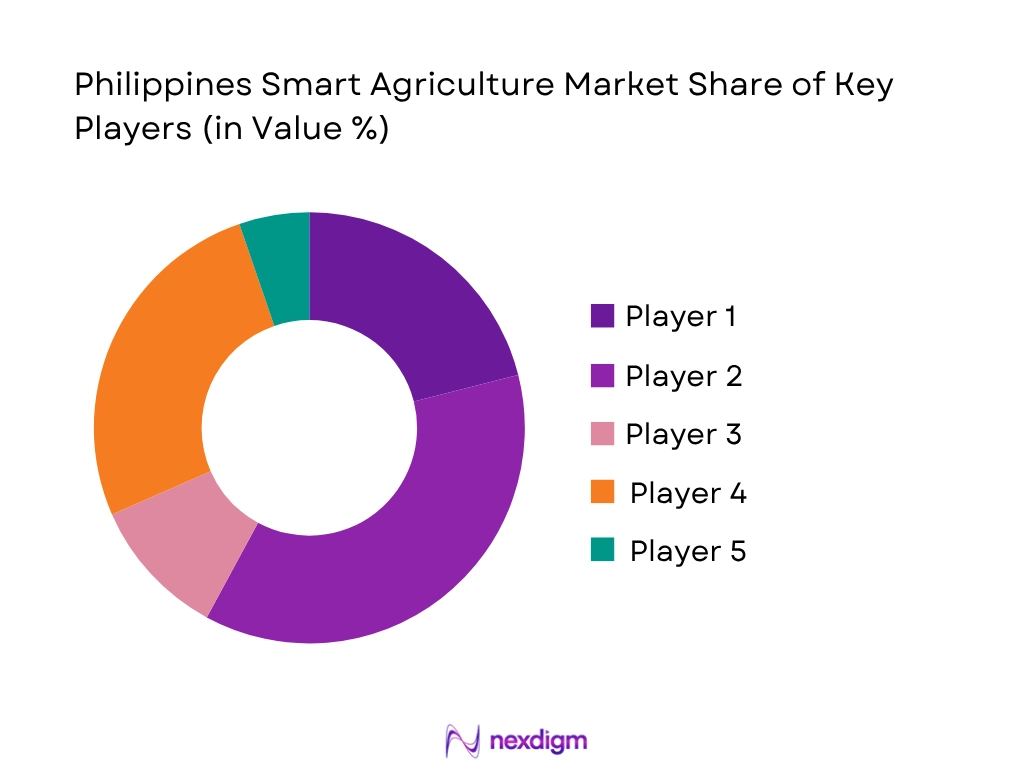
Philippines Smart Agriculture Market Analysis
Growth Drivers
Increasing Government Support for Agricultural Digitalization
The Philippines smart agriculture market is strongly supported by increasing government investment in agricultural modernization and climate-resilient farming infrastructure. The Department of Agriculture launched multiple digital agriculture and mechanization initiatives under national agricultural modernization frameworks. Agriculture, forestry, and fishing continue to contribute significantly to the national economy while supporting millions of rural livelihoods. International development institutions have also expanded funding for climate-smart agriculture programs targeting hundreds of thousands of smallholder farmers across Mindanao and Luzon. These initiatives are accelerating adoption of IoT-based monitoring systems, smart irrigation technologies, AI-enabled farm analytics, and drone-assisted crop management platforms throughout the Philippine agricultural ecosystem.
Rising Climate Risks and Need for Precision Farming
Climate-related agricultural disruptions are significantly driving the adoption of smart agriculture technologies in the Philippines. The country remains among the world’s most climate-vulnerable agricultural economies, resulting in rising deployment of automated irrigation systems, predictive weather analytics, and precision crop monitoring technologies. Agricultural losses caused by typhoons, flooding, and irregular rainfall patterns continue to impact rice, corn, and plantation crop production across major farming regions. Large-scale commercial farms and agribusiness operators are increasingly implementing satellite imaging, sensor-enabled field analytics, and drone-based monitoring systems to reduce operational risk and improve crop productivity.
Market Challenges
Fragmented Land Ownership and Smallholder Farm Structure
One of the major challenges affecting the Philippines smart agriculture market is the fragmented structure of agricultural land ownership. A substantial share of farming activity is conducted by smallholder farmers with limited financial capability to invest in high-cost digital farming systems and advanced automation technologies. The relatively low productivity of the agriculture sector compared to industrial sectors reduces the pace of mechanization and connected farming adoption. Many small farms continue to rely on traditional cultivation practices with limited access to precision farming equipment, AI-powered analytics platforms, and cloud-based farm management systems.
Rural Connectivity Gaps and Digital Infrastructure Limitations
Limited digital infrastructure in remote agricultural regions remains a significant operational challenge for the Philippines smart agriculture market. Smart farming systems including IoT-enabled monitoring devices, AI-powered analytics platforms, and cloud-based irrigation management solutions require stable internet connectivity and telecom infrastructure, which remain inconsistent across several rural provinces. The country’s archipelagic geography creates infrastructure deployment challenges, particularly in geographically dispersed farming regions such as Mindanao and Visayas. Limited mobile coverage and broadband accessibility continue to constrain real-time farm monitoring and connected agriculture adoption among medium and small-scale farms.
Market Opportunities
Expansion of Climate-Smart Agriculture Programs
The rapid expansion of climate-smart agriculture initiatives presents a significant growth opportunity for the Philippines smart agriculture market. Government agencies and international organizations are increasingly prioritizing digital agriculture technologies to improve climate resilience and food security. Large-scale agricultural transformation programs are promoting smart irrigation systems, low-emission farming technologies, AI-enabled crop monitoring, and digital agriculture platforms across commercial and smallholder farming communities. Increasing institutional funding and public-private partnerships are expected to create long-term opportunities for precision farming providers, drone analytics companies, and IoT-enabled agriculture solution vendors operating in the country.
Increasing Digitalization and Rural Connectivity Investments
Ongoing expansion of digital infrastructure and rural connectivity programs is creating strong opportunities for the Philippines smart agriculture ecosystem. Telecom operators, government agencies, and agricultural modernization initiatives are investing heavily in digital transformation projects to improve internet accessibility across rural farming regions. Increasing deployment of mobile agriculture applications, cloud-enabled farm management systems, and IoT-based monitoring solutions is enabling farmers to access weather intelligence, crop diagnostics, and remote irrigation controls more efficiently. Integration of telecom infrastructure with agricultural operations is expected to accelerate demand for smart sensors, farm connectivity platforms, drone services, and AI-driven farm analytics solutions.
Future Outlook
The Philippines Smart Agriculture Market is expected to witness substantial growth over the coming years due to increasing demand for food security, climate-resilient farming systems, and agricultural productivity optimization. Expansion of rural broadband infrastructure and IoT connectivity is expected to accelerate deployment of precision farming technologies, smart irrigation systems, and AI-powered crop analytics across commercial plantations and cooperative farming operations. Rising adoption of drone-based crop monitoring and automated farm management systems is expected to improve operational efficiency and resource utilization across the agriculture sector. Government-backed agricultural modernization initiatives and climate-smart farming programs are likely to strengthen long-term investment in digital agriculture infrastructure. Additionally, increasing integration of predictive analytics, satellite imaging, and telecom-enabled farm monitoring solutions is expected to transform the country’s agricultural productivity landscape over the forecast period.
Major Players
- Cropital
- Mayani
- Xurpas Agri
- Smart Communications
- Globe Telecom
- Nokia
- Huawei
- John Deere
- Trimble
- AGCO Corporation
- DJI
- Topcon Positioning Systems
- DeLaval
- IBM
- Microsoft
Key Target Audience
- Agribusiness Plantation Operators
- Agricultural Cooperatives and Farming Associations
- Agricultural Drone Manufacturers and Service Providers
- Smart Irrigation and Farm Automation Providers
- Telecom and Rural IoT Infrastructure Companies
- Investments and Venture Capitalist Firms
- Government and Regulatory Bodies
- Precision Farming and Agri-Analytics Platform Providers
Research Methodology
Step 1: Identification of Key Variables
The initial phase involved identifying major variables influencing the Philippines Smart Agriculture Market including agricultural mechanization, IoT deployment, farm automation trends, rural connectivity, climate adaptation initiatives, and digital agriculture investments. Extensive secondary research was conducted using government publications, industry databases, agricultural policy reports, and company disclosures to understand the overall market ecosystem and value chain structure.
Step 2: Market Analysis and Construction
Historical market analysis was conducted using farm technology adoption trends, smart irrigation deployment data, agricultural infrastructure investments, and connected farming penetration across the Philippines. Revenue estimations were derived using bottom-up calculations based on agricultural technology spending, farm automation deployment, and digital agriculture infrastructure expansion across major farming regions.
Step 3: Hypothesis Validation and Expert Consultation
The preliminary market findings were validated through interviews with agricultural technology providers, telecom operators, agribusiness executives, drone service providers, and farm automation companies. These interactions provided operational insights regarding adoption barriers, procurement cycles, technology pricing, infrastructure challenges, and future investment priorities across the smart agriculture ecosystem.
Step 4: Research Synthesis and Final Output
The final phase involved consolidating qualitative and quantitative findings to produce a comprehensive market assessment. Cross-validation was conducted using agricultural production statistics, government modernization initiatives, infrastructure investment trends, and technology deployment analysis to ensure consistency and reliability of market estimates, segmentation analysis, and future outlook for the Philippines Smart Agriculture Market.

- Executive Summary
- Research Methodology (Market Definitions and Assumptions, Abbreviations, Research Framework, Bottom-Up Market Estimation, Top-Down Validation, Agricultural Technology Mapping, Farm Digitization Assessment, Trade Flow Assessment, Primary Interviews with AgriTech Providers and Farm Operators, Forecasting Model, Limitations and Assumptions)

- Definition and Scope
- Evolution of Smart Farming Ecosystem in the Philippines
- Agricultural Digitalization Landscape
- Industry Ecosystem and Stakeholder Mapping
- Agricultural Technology Supply Chain Analysis
- Farm Automation Value Chain Analysis

- Growth Drivers
Increasing Government Support for Agricultural Digitalization
Rising Climate Risks and Need for Precision Farming
Expansion of Rural IoT and Telecom Infrastructure
Growing Food Security Concerns and Yield Optimization Requirements
Rising Adoption of Drone-Based Crop Monitoring - Market Challenges
Fragmented Land Ownership and Smallholder Farm Structure
Rural Connectivity Gaps and Digital Infrastructure Limitations
High Initial Investment Costs for Smart Farming Systems
Limited Technical Literacy Among Farmers
Maintenance and Integration Challenges for Smart Devices - Market Opportunities
Expansion of Climate-Smart Agriculture Programs
Increasing Digitalization and Rural Connectivity Investments
Growth of Drone-as-a-Service Business Models
AI-Based Predictive Crop Analytics Adoption
Expansion of Smart Aquaculture Technologies - Market Trends
Adoption of AI-Driven Farm Management Platforms
Growth in Satellite and Drone-Based Mapping Solutions
Expansion of Automated Irrigation Systems
Increasing Use of Mobile Agriculture Applications
Development of Carbon-Smart and Sustainable Farming Technologies - Government Regulations
Department of Agriculture Smart Farming Initiatives
Drone and UAV Regulatory Compliance
Agricultural Mechanization Policies
Food Security and Climate Adaptation Programs
Digital Infrastructure and Rural Connectivity Regulations - Porter’s Five Forces Analysis
- PESTLE Analysis
- Pricing Analysis
- Competition Ecosystem

- By Value, 2020-2025
- By Installed Base of Smart Agriculture Devices, 2020-2025
- By Connected Agricultural Land Area, 2020-2025
- By Number of Smart Farms, 2020-2025
- By Average Technology Spending per Farm, 2020-2025

- By Technology Type (in Value %)
Precision Farming
Agricultural Drones
Smart Irrigation Systems
Farm Management Software
Livestock Monitoring Systems
AI and Predictive Analytics Platforms
IoT and Sensor-Based Monitoring Systems - By Application (in Value %)
Crop Monitoring
Irrigation Management
Precision Spraying
Weather Forecasting
Livestock Monitoring
Aquaculture Monitoring
Harvest Management - By Farm Type (in Value %)
Smallholder Farms
Medium Commercial Farms
Large Agribusiness Plantations
Cooperative Farming Systems
Contract Farming Operations - By Connectivity Technology (in Value %)
Cellular IoT
LoRaWAN
Wi-Fi
Bluetooth Low Energy
Satellite Connectivity - By Deployment Model (in Value %)
Cloud-Based Platforms
On-Premise Platforms
Hybrid Systems - By Crop Type (in Value %)
Rice
Corn
Banana
Pineapple
Sugarcane
Coconut
High-Value Vegetables
Aquaculture and Fisheries - By End User (in Value %)
Individual Farmers
Agribusiness Corporations
Agricultural Cooperatives
Government Agricultural Agencies
Research and Agricultural Innovation Centers - By Region (in Value %)
Luzon
Visayas
Mindanao
NCR and Peri-Urban Farming Clusters

- Market Share Analysis of Major Players on the Basis of Revenue and Installed Devices
- Cross Comparison Parameters (Company Overview, Smart Agriculture Portfolio, Precision Farming Capability, Drone and UAV Integration, IoT Connectivity Strength, Geographic Presence, Farm Coverage, Technology Partnerships, Cloud Platform Capability, AI Analytics Strength, Distribution Network, Customer Support Infrastructure, Government Project Participation, Innovation Pipeline, Strategic Collaborations, Sustainability Focus)
- Competitive Benchmarking Matrix
- SWOT Analysis of Major Players
- Pricing Analysis by Solution Type and Device Category
- Detailed Profiles of Major Companies
Cropital
Mayani
Xurpas Agri
Smart Communications
Globe Telecom
Nokia
Huawei
John Deere
Trimble
AGCO Corporation
DJI
Topcon Positioning Systems
DeLaval
IBM
Microsoft

- Farm Technology Adoption Analysis
- Agribusiness Spending and Investment Patterns
- Purchase Decision Parameters
- Digital Literacy and Technology Readiness
- Pain Point and Operational Efficiency Mapping

- By Value, 2026-2035
- By Installed Base of Smart Agriculture Devices, 2026-2035
- By Connected Agricultural Land Area, 2026-2035
- By Number of Smart Farms, 2026-2035
- By Average Technology Spending per Farm, 2026-2035


 Request a Sample
 Ask for Customization
 Get a Quote
 Enquire Now