

 Download PDF
Market Overview
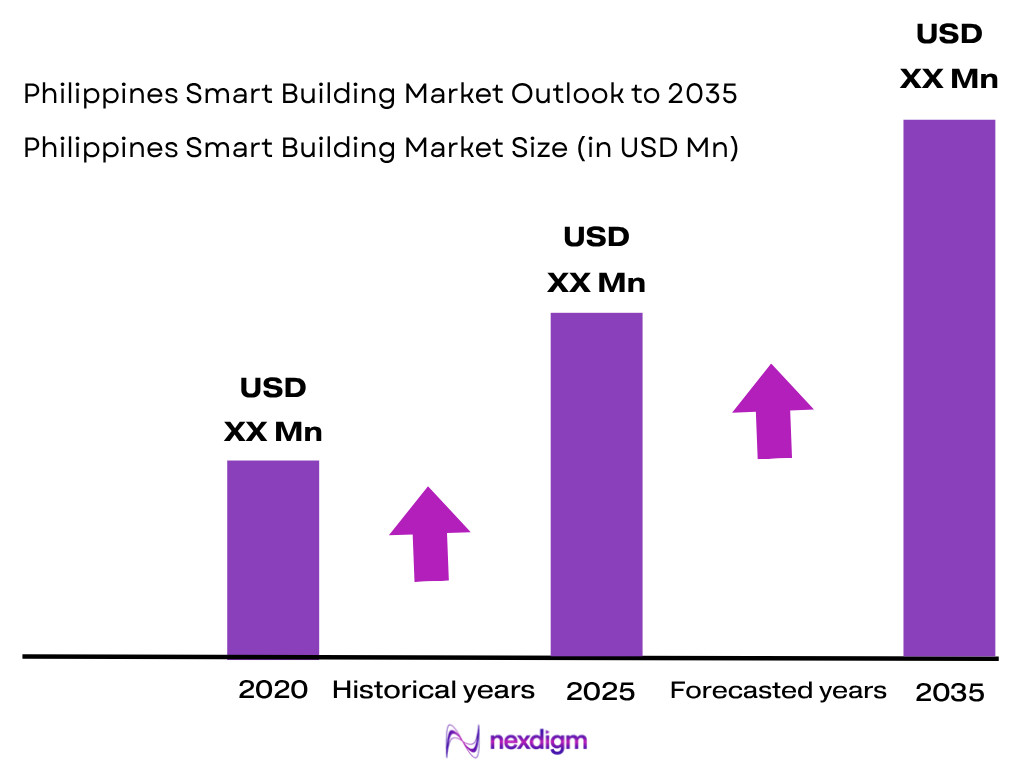
The Philippines Smart Building Market is valued at approximately USD ~XX billion based on the historical assessment, with growth supported by increasing commercial construction, modernization of existing buildings, energy-efficiency requirements, digital facility management and expanding IoT adoption. The market is particularly influenced by the development of office towers, shopping malls, hotels, hospitals, condominiums and data centers, where building automation can improve HVAC control, energy monitoring, security and facility operations. Increasing integration of cloud platforms, connected sensors, building management systems and automated controls is also expanding the addressable market.
Metro Manila represents the principal concentration of smart-building activity because it contains the country’s largest cluster of commercial offices, mixed-use developments, shopping centers, hotels, financial institutions, government facilities and high-rise residential buildings. Quezon City, Makati, Taguig and Pasay provide significant demand through business districts, hospitality developments, large commercial properties and infrastructure projects. Cebu City is another important market because of its expanding business-process outsourcing, hospitality and mixed-use real-estate ecosystem, while Clark and Davao are developing additional opportunities through industrial, logistics, airport-linked and commercial infrastructure.
Market Segmentation
By Component
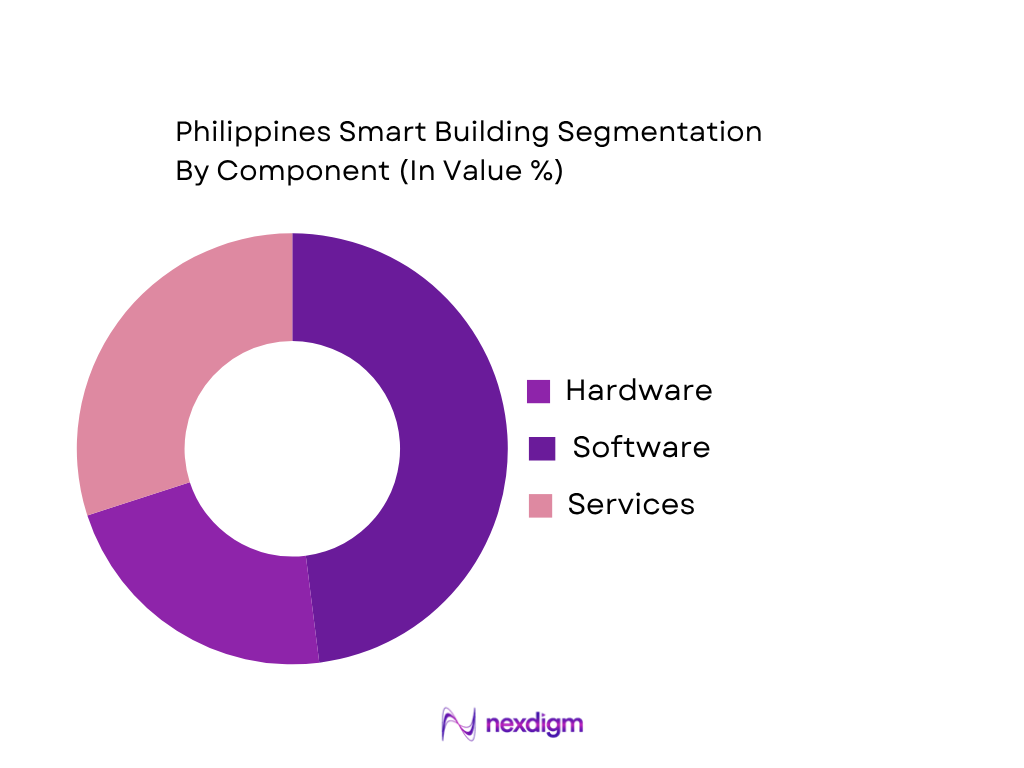
The Philippines Smart Building Market is segmented by component into hardware, software and services. Hardware represents the leading component category because smart-building deployments require physical infrastructure such as sensors, controllers, gateways, meters, access-control devices, surveillance equipment, lighting controls and HVAC automation equipment. Building owners generally require hardware deployment before software platforms can collect operational data and automate building functions. Demand is further supported by new commercial developments and retrofit projects in Metro Manila, Cebu and other urban centers. Software is increasingly important as property owners move toward centralized building management, energy analytics, cloud-based monitoring and predictive maintenance. Services also remain essential because Philippine buildings require system integration, commissioning, maintenance, cybersecurity and lifecycle support. The increasing complexity of multi-vendor installations is creating demand for specialized integration services. The component structure therefore reflects the progression from physical connectivity toward software-enabled building intelligence and recurring operational services. Hardware remains closely linked to construction activity, while software and services provide opportunities for continuous optimization after installation.
By Building Technology
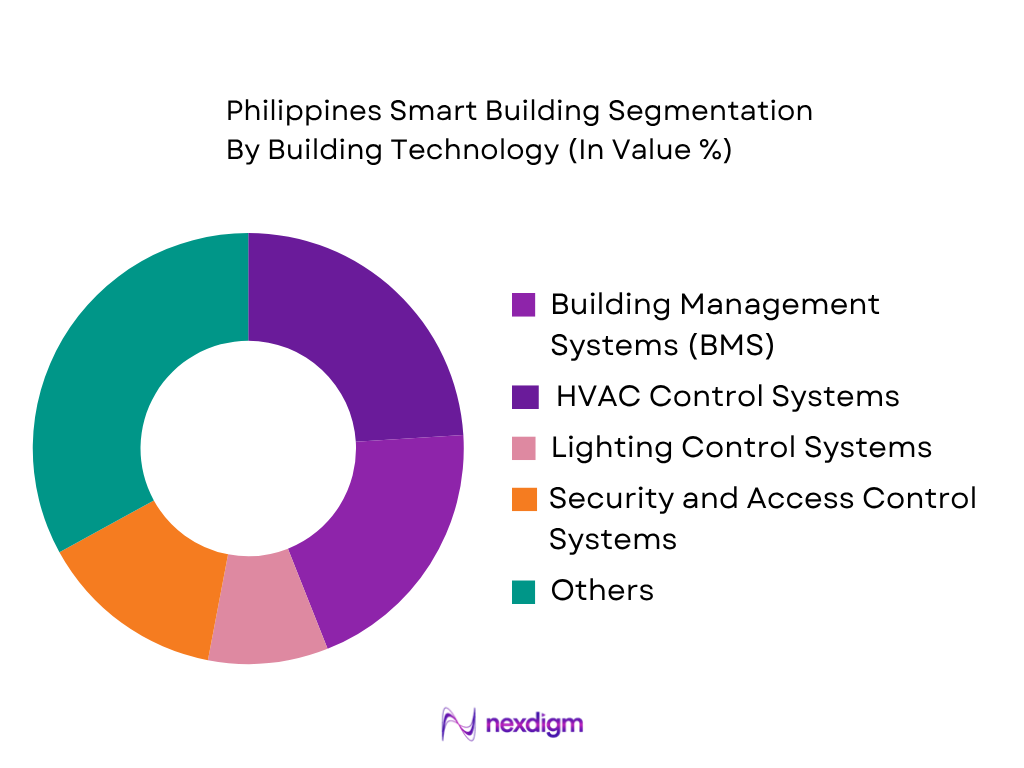
The Philippines Smart Building Market is segmented by building technology into building management systems and building automation, HVAC and smart climate control, energy management and BEMS, security and access control, smart lighting, fire and life safety, IoT sensors and environmental monitoring, and digital twin and building analytics platforms. Building management systems and building automation represent the leading technology category because they provide the central infrastructure for coordinating multiple building functions through a unified platform. Their application across commercial offices, malls, hotels, hospitals, airports and high-rise residential properties increases their addressable demand. HVAC automation is another major technology area because cooling systems represent an important operational requirement in the Philippines’ tropical climate. Energy management technologies are gaining importance as property owners seek greater visibility over electricity consumption and operating performance. Security and access control remain essential in high-density commercial and residential properties. IoT sensors, analytics and digital twins are developing as building owners transition from conventional automation toward data-driven facility management, predictive maintenance and occupancy-based optimization.
Competitive Landscape
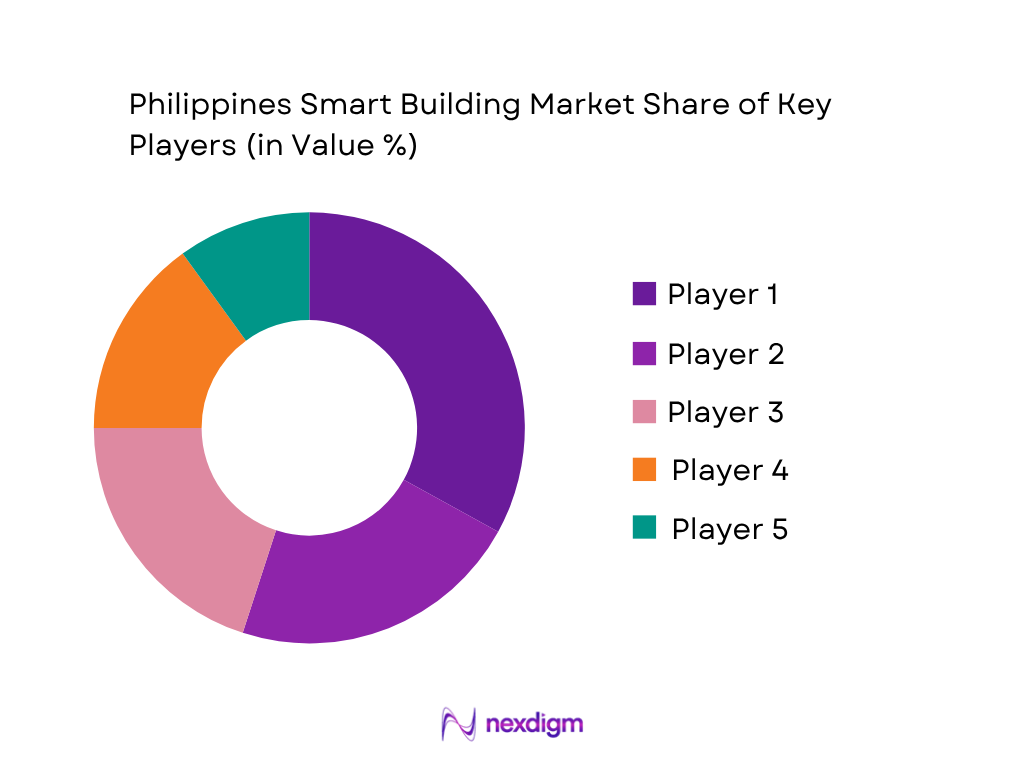
The Philippines Smart Building Market includes international automation, electrical, HVAC, security, networking and building-technology companies alongside local system integrators and engineering providers. Competition is shaped by BMS capabilities, HVAC automation, energy-management platforms, IoT connectivity, security integration, project execution capabilities and after-sales technical support. International technology providers generally compete through broad technology portfolios, while local integrators provide market-specific installation, commissioning, maintenance and multi-vendor integration capabilities.
| Company | Establishment Year | Headquarters | BMS Capability | HVAC Automation | Energy Management | Security & Access Control | IoT & Analytics | Philippines Presence |
| Schneider Electric | 1836 | Rueil-Malmaison, France | ||||||
| Siemens | 1847 | Munich, Germany | ||||||
| Honeywell | 1906 | Charlotte, USA | ||||||
| Johnson Controls | 1885 | Cork, Ireland | ||||||
| ABB | 1988 | Zurich |
Philippines Smart Building Market Analysis
Growth Drivers
Expansion of Commercial Real Estate and Mixed-Use Developments
The expansion of commercial and mixed-use construction is strengthening the addressable base for smart building systems across the Philippines. The Philippine Statistics Authority recorded 180,341 approved construction projects and 42.84 million sq. m. of construction floor area in 2024, compared with 171,268 projects and 41.47 million sq. m. in 2023. Non-residential construction represented 22.38 million sq. m. of floor area, while commercial-type buildings generated PHP 112.42 billion in construction value. NCR recorded 935 construction establishments, the highest regional count, followed by CALABARZON with 372 and Central Luzon with 229. These construction concentrations create demand for integrated building management systems, automated HVAC, access control, smart lighting, fire safety, occupancy monitoring, and energy-management platforms. The broader economic environment also supports construction investment: the Philippine economy expanded by 5.7% in 2024, according to the PSA, while the construction industry was among the major contributors to annual economic expansion. The combination of new commercial floor area, metropolitan development, and sustained construction activity provides a structural pipeline for deploying connected building technologies in offices, retail facilities, hotels, mixed-use complexes, and institutional properties.
Energy Efficiency and Conservation Requirements
Energy efficiency is an important driver because Philippine buildings increasingly require measurable control of electricity-consuming systems, particularly HVAC, cooling, lighting, and other mechanical equipment. The Department of Energy’s Government Energy Management Program has specifically included energy-efficient air-conditioning initiatives for government buildings, with a PHP 5 million approved budget for a 2024 demonstration project. The program’s focus on air-conditioning is relevant because cooling systems are among the principal controllable loads within commercial and institutional buildings. The national construction pipeline further increases the importance of energy-management capabilities: approved construction reached 180,341 projects with 42.84 million sq. m. of floor area in 2024, while non-residential construction accounted for 22.38 million sq. m. The Philippines also recorded PHP 563.89 billion in total construction value, compared with PHP 515.30 billion in 2023, according to the PSA. At the macroeconomic level, the country’s GDP expanded 5.7% in 2024, while the IMF identified domestic demand as an important support for economic activity. These conditions support continued investment in technologies that monitor consumption, automate equipment schedules, optimize HVAC operation, and provide building operators with real-time energy data.
Market Challenges
High System Integration Complexity
High system-integration complexity remains a challenge because Philippine smart-building projects often require multiple technologies to operate across a common building-management environment. The construction ecosystem itself is sizeable: the PSA recorded 296,144 workers across establishments in the construction section in 2024, including 103,894 workers in construction of buildings. NCR contained 935 construction establishments, while CALABARZON and Central Luzon recorded 372 and 229, respectively. This geographically concentrated but technically diverse ecosystem can involve separate HVAC, lighting, fire-safety, access-control, elevators, electrical, and facility-management systems. Integration becomes particularly difficult when equipment uses different communication protocols or when existing buildings contain legacy controllers that were not designed for centralized monitoring. The economic environment also places importance on efficient capital allocation. The Bangko Sentral ng Pilipinas reduced its target reverse repurchase rate to 5.75% in December 2024 from the earlier 6.50% level, while the PSA reported 5.7% full-year GDP growth. Although these indicators do not measure smart-building integration directly, they illustrate the financing and investment environment in which building owners evaluate technology upgrades. As a result, vendors must demonstrate interoperability, lifecycle value, commissioning capability, and reliable technical support alongside the technology itself.
Legacy Building-System Interoperability
Interoperability constraints are particularly relevant to the Philippines because smart-building adoption is not limited to newly constructed facilities; existing commercial, hospitality, institutional, and mixed-use properties also represent potential deployment sites. PSA data show that 13,997 alteration and repair projects were recorded in 2024, compared with 12,875 in 2023, while the value of alteration and repair activity increased from PHP 33.98 billion to PHP 43.05 billion. Addition projects also generated 708,409 sq. m. of floor area, compared with 536,372 sq. m. in 2023. These figures indicate a substantial active base of existing structures undergoing physical changes, creating opportunities for technology upgrades but also increasing the technical requirement to connect new systems with existing infrastructure. Legacy HVAC controllers, lighting circuits, meters, access systems, fire panels, and building-management platforms may use different interfaces and communication standards. The challenge is therefore not only installing sensors or software but creating a dependable data layer across heterogeneous equipment. With total Philippine construction reaching 180,341 approved projects in 2024, system integrators must simultaneously support new-build deployments and modernization projects.
Market Opportunities
AI-Based Energy Optimization and Predictive Maintenance
AI-enabled energy optimization and predictive maintenance present an opportunity because the Philippine economy is becoming increasingly digital while its building base continues to expand. The PSA valued the country’s digital economy at PHP 2.25 trillion in 2024, up from PHP 2.09 trillion in 2023, while digital-economy employment reached 11.30 million workers, compared with 10.78 million in 2023. Digital-enabling infrastructure alone generated PHP 1.88 trillion, demonstrating the expanding economic foundation for connected technologies and data-intensive services. In parallel, the construction pipeline included 180,341 approved projects and 42.84 million sq. m. of floor area in 2024. These conditions create an expanding installed base from which smart-building platforms can collect operational data. AI-based systems can use information from HVAC equipment, electricity meters, occupancy sensors, indoor environmental sensors, and equipment controllers to identify abnormal operating conditions and optimize equipment schedules. Predictive-maintenance platforms can similarly prioritize maintenance based on operating conditions rather than fixed schedules. The opportunity is particularly relevant to commercial facilities, data centers, hotels, hospitals, and large institutional buildings where equipment downtime and inefficient cooling can have operational consequences. The combination of digital infrastructure growth and expanding physical building stock provides a foundation for greater adoption of data-driven building operations.
Smart Building Retrofit Programs and Integrated Energy Management Platforms
Retrofit-oriented smart-building solutions represent an opportunity because the Philippines has a large ongoing alteration, repair, and modernization pipeline alongside new construction. PSA records show 13,997 alteration and repair projects in 2024, up from 12,875 in 2023, while the value of this activity reached PHP 43.05 billion, compared with PHP 33.98 billion in 2023. Addition projects contributed another 708,409 sq. m. of floor area. At the same time, non-residential construction represented 22.38 million sq. m. of floor area, creating a significant installed environment for energy-management, HVAC optimization, smart lighting, occupancy analytics, and centralized facility-management solutions. Government energy initiatives provide an additional institutional pathway: the Department of Energy allocated PHP 5 million for a 2024 demonstration project involving energy-efficient air-conditioning systems under the Government Energy Management Program. The digital foundation is also strengthening, with the PSA reporting PHP 2.25 trillion in digital-economy activity and 11.30 million digital-economy workers in 2024. Together, these indicators support opportunities for vendors offering modular retrofit packages, connected meters, IoT gateways, building-management software, HVAC optimization, and integrated energy dashboards that can be deployed without completely replacing existing building infrastructure.
Future Outlook
Over the forecast period, the Philippines Smart Building Market is expected to develop through the convergence of building automation, IoT connectivity, energy management and digital facility operations. New commercial developments will continue to create opportunities for integrated BMS, smart HVAC, security and energy-management systems, while the existing building stock will create demand for retrofit solutions. Data centers, hospitality properties, shopping malls, offices and high-rise residential developments are expected to remain important deployment environments. AI-enabled analytics, predictive maintenance, digital twins and cloud-based building-management platforms are expected to progressively complement conventional automation systems.
Major Players
- Schneider Electric
- Siemens
- Honeywell International
- Johnson Controls
- ABB
- Cisco Systems
- Delta Electronics
- Bosch Building Technologies
- Legrand
- Carrier Global
- Trane Technologies
- Mitsubishi Electric
- Azbil Corporation
- Distech Controls
- Eaton
Key Target Audience
- Commercial Real Estate Developers and Property Owners
- Shopping Mall and Mixed-Use Development Operators
- Data Center Developers and Operators
- Hospitality and Hotel Property Groups
- Facility Management and Building Operations Companies
- Investments and Venture Capitalist Firms
- Government and Regulatory Bodies (Department of Energy, Department of Public Works and Highways, Department of Information and Communications Technology, Energy Regulatory Commission)
- Building Automation, HVAC and Electrical Technology Providers
Research Methodology
Step 1: Identification of Key Variables
The initial phase involves constructing an ecosystem map encompassing developers, building owners, facility managers, technology providers, system integrators, HVAC suppliers, electrical contractors and regulatory stakeholders within the Philippines Smart Building Market. Desk research is used to identify building automation technologies, deployment models, building types, geographic concentrations and technology adoption variables. The objective is to establish the measurable variables influencing market demand and supply.
Step 2: Market Analysis and Construction
In this phase, historical information relating to smart-building deployments is compiled across commercial, residential, hospitality, industrial, healthcare, institutional and data-center buildings. The analysis considers BMS installations, HVAC automation, energy-management systems, security technologies, IoT devices, software platforms and associated integration services. A bottom-up assessment links deployment volumes, technology configurations and project activity with revenue generation to construct the market database.
Step 3: Hypothesis Validation and Expert Consultation
Market hypotheses are developed around technology adoption, retrofit activity, building-type penetration, system integration and purchasing behavior. These hypotheses are validated through consultations with building owners, developers, facility-management companies, system integrators, HVAC specialists, electrical contractors and technology providers operating in the Philippines. Expert discussions are used to validate technology specifications, project requirements, procurement structures and implementation practices.
Step 4: Research Synthesis and Final Output
The final stage synthesizes demand-side and supply-side findings into a consolidated Philippines Smart Building Market model. Company portfolios, technology capabilities, project references, building applications, regional demand and competitive positioning are cross-checked to identify inconsistencies. The resulting analysis is structured to provide market sizing, segmentation, competitive assessment, technology trends and future market development indicators for business and investment decision-making.

- Executive Summary
- Research Methodology (Market Definition and Scope, Philippines Smart Building Market Classification, Smart Building Technology Mapping, Building Automation System Assessment, IoT Connectivity Assessment, Artificial Intelligence and Building Analytics Evaluation, Energy Management Assessment, HVAC Automation Assessment, Smart Lighting Assessment, Security and Access Control Assessment, Fire and Life Safety Assessment, Digital Twin Assessment, Building Management Platform Evaluation, New-Build and Retrofit Assessment, Commercial Building Assessment, Residential Smart Building Assessment, Industrial Facility Assessment, Data Center Assessment, Hospitality Building Assessment, Supply-Side Assessment, Demand-Side Assessment, Top-Down Analysis, Bottom-Up Analysis, Primary Interviews, Data Triangulation, Forecasting Framework, Market Limitations)

- Definition and Scope
- Philippines Smart Building Industry Evolution and Development of Building Automation Systems, Building Energy Management Systems, IoT-Enabled Buildings, Connected HVAC Systems, Smart Lighting Infrastructure, Integrated Security Systems, Digital Facility Management, Cloud-Based Building Management Platforms, AI-Based Building Analytics, Predictive Maintenance Systems, Digital Twin Applications, Occupancy Intelligence, Smart Water Management, Connected Workplace Technologies and Building-as-a-Service Models
- Smart Building Value Chain Analysis
- Smart Building Supply Chain Analysis
- Building Automation Hardware Suppliers, HVAC Equipment Manufacturers, Smart Sensor Suppliers, Lighting Control Manufacturers, Security and Access Control Providers, Fire and Life Safety Technology Providers, Energy Management Software Providers, IoT Connectivity Providers, Building Management Platform Developers, Cloud Service Providers, System Integrators, MEP Contractors, Facility Management Companies, Property Developers, Commercial Building Owners, Mall Operators, Hotel Operators, Data Center Operators and Government Building Operators

- Growth Drivers (Expansion of Commercial Real Estate and Mixed-Use Developments, Energy Efficiency and Conservation Requirements, Rapid Data Center Development, Smart City and Digital Infrastructure Programs, Growing HVAC Automation Demand, Increasing IoT Connectivity, Expansion of Premium Hospitality Infrastructure, Modernization of Existing Buildings, Growth of Integrated Facility Management, Increasing Adoption of Building Energy Management Systems)
- Market Challenges (High Initial System Integration Complexity, Legacy Building-System Interoperability, Fragmented Technology Protocols, Cybersecurity Requirements, Limited Specialized Engineering Skills, Retrofit Constraints in Existing Buildings, Multi-Vendor Integration Requirements, Long Building Equipment Replacement Cycles, Data Governance Requirements, Dependence on HVAC and Cooling Optimization)
- Market Opportunities (Smart Building Retrofit Programs, AI-Based Energy Optimization, Digital Twin Deployment, Predictive Maintenance, Smart HVAC Optimization, Integrated Energy Management Platforms, Connected Hospitality Infrastructure, Data Center Automation, Smart Building Cybersecurity, IoT-Based Occupancy Analytics, Intelligent Water Management, Smart Building-as-a-Service, Net-Zero Building Management)
- Market Trends (Cloud-Based Building Management, AI-Enabled Energy Optimization, IoT Sensor Deployment, Integrated BMS Platforms, Occupancy-Based HVAC Control, Smart Lighting Automation, Predictive Facility Maintenance, Digital Twin Adoption, Remote Building Monitoring, Building Cybersecurity Integration, Data-Driven Facility Management, Connected Workplace Solutions)
- Government Regulations and Standards (Energy Efficiency and Conservation Act, Department of Energy Energy Efficiency and Conservation Guidelines, Philippine Green Building Code, National Building Code of the Philippines, Philippine Electrical Code, Fire Code of the Philippines, Data Privacy Act Requirements, Cybersecurity and Critical Infrastructure Requirements, Energy Audit Requirements, Green Building Certification Requirements)
- SWOT Analysis
- Porter’s Five Forces Analysis
- PESTLE Analysis
- Competition Ecosystem

- By Market Value (2020-2025)
- By Installed Smart Building Systems (2020-2025)
- By Smart Building Floor Area (2020-2025)
- By Building Automation System Deployments (2020-2025)
- By Smart Building Technology Adoption Volume (2020-2025)
- By New-Build Smart Building Installations (2020-2025)

- By Component (In Value %)
Hardware
Software
Services - By Building Technology (In Value %)
Building Management Systems and Building Automation
HVAC and Smart Climate Control
Energy Management and Building Energy Management Systems
Smart Lighting and Lighting Controls
Security and Access Control Systems
Fire and Life Safety Systems
IoT Sensors and Environmental Monitoring
Occupancy and Space Management Systems
Digital Twin and Building Analytics Platforms - By Application (In Value %)
Energy Management and Optimization
HVAC Automation
Lighting Automation
Security and Surveillance
Access Control
Fire and Life Safety
Facility Management
Water Management - By Building Type (In Value %)
Commercial Offices
Retail Malls and Shopping Centers
Hotels and Hospitality Buildings
Residential Buildings and Condominiums
Industrial Facilities
Healthcare Facilities
Government Buildings
Data Centers
Transportation and Infrastructure Facilities - By Deployment Model (In Value %)
New Construction
Full Building Automation Integration
Hybrid Deployment - By Region (In Value %)
CALABARZON
Central Luzon
Central Visayas
Western Visayas
Davao Region
Northern Mindanao
Rest of Philippines

- Market Share of Major Players (By Philippines Revenue, Building Automation Portfolio, BMS Capability, HVAC Automation Capability, Energy Management Portfolio, Smart Lighting Capability, Security and Access Control Portfolio, Fire and Life Safety Capability, IoT Integration Capability, AI and Analytics Capability, Digital Twin Capability, System Integration Network, Local Distribution Presence, Project Portfolio, Technical Support Capability)
- Cross Comparison Parameters (BMS Platform Integration Capability, HVAC Automation and Chiller Optimization Capability, Energy Monitoring and BEMS Functionality, IoT Sensor and Connectivity Integration, Cybersecurity and Data Protection Capability, AI-Based Building Analytics Capability, Local System Integrator and MEP Contractor Network, Philippines Smart Building Project References)
- SWOT Analysis of Major Players
- Detailed Profiles of Major Companies
Schneider Electric SE
Siemens AG
Honeywell International Inc.
Johnson Controls International plc
ABB Ltd.
Cisco Systems, Inc.
Delta Electronics, Inc.
Azbil Corporation
Bosch Building Technologies
Legrand SA
Carrier Global Corporation
Trane Technologies plc
Mitsubishi Electric Corporation
Distech Controls Inc.
Eaton Corporation plc

- Building Owner Smart Technology Requirement Assessment
- Commercial Property Developer Technology Adoption Analysis
- Facility Management and Building Operations Assessment
- Energy Consumption Optimization Requirement Analysis
- HVAC Automation and Cooling Management Assessment
- Occupancy and Space Utilization Requirement Analysis
- Security and Access Control Requirement Assessment
- Digital Facility Management and Predictive Maintenance Assessment

- By Market Value (2026-2035)
- By Installed Smart Building Systems (2026-2035)
- By Smart Building Floor Area (2026-2035)
- By Building Automation System Deployments (2026-2035)
- By Smart Building Technology Adoption Volume (2026-2035)
- By New-Build Smart Building Installations (2026-2035)


 Request a Sample
 Ask for Customization
 Get a Quote
 Enquire Now
