

 Download PDF
Market Overview
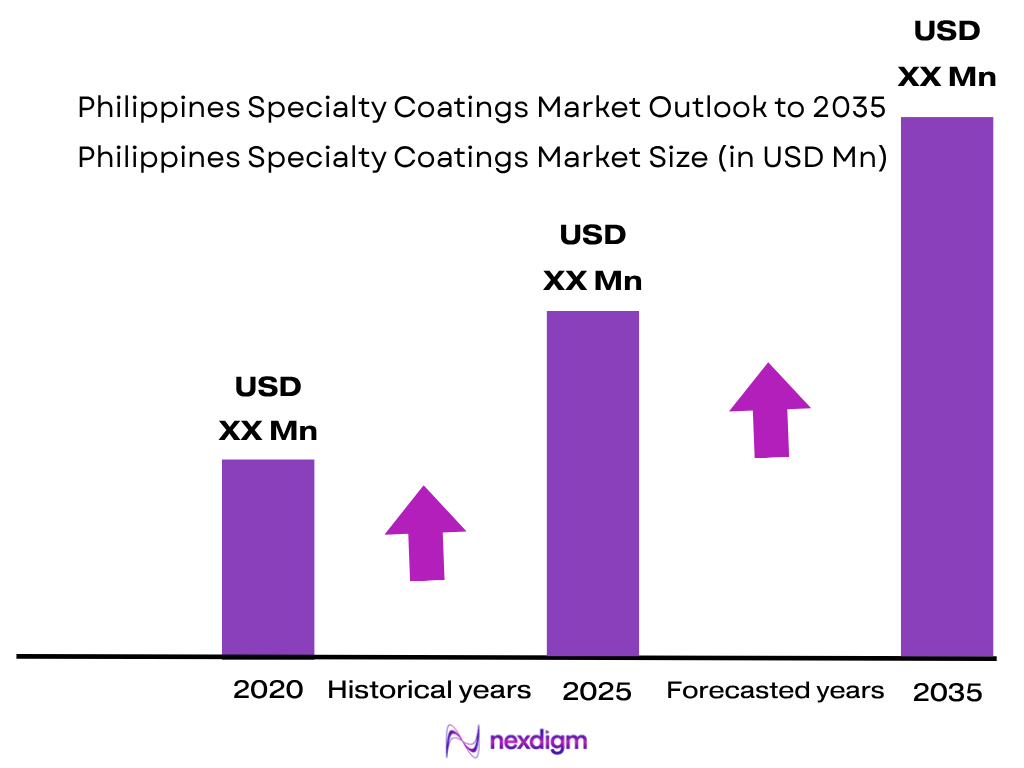
The Philippines Specialty Coatings Market is valued at approximately ~USD XXX million, compared with ~USD XXX million in the preceding period, supported by industrial production, infrastructure construction, automotive activity, electronics manufacturing, and corrosion-control requirements. Philippine industry GVA increased from PHP 6.13 trillion to PHP 6.47 trillion, while non-aqueous paints and varnishes imports reached USD 71.27 million, demonstrating a substantial demand and import-supported coatings ecosystem.
Demand is concentrated across Metro Manila, Laguna, Cavite, Batangas, Central Luzon and Cebu, where industrial production, construction, ports, automotive manufacturing, electronics and logistics assets create recurring coating requirements. Laguna, Cavite and Batangas collectively generated approximately PHP 1.40 trillion of the country’s PHP 6.47 trillion industry GVA, while NCR contained 935 formal construction establishments in the latest survey, reinforcing the geographic concentration of protective, floor, automotive and industrial coatings consumption.
Market Segmentation
By Coating Type
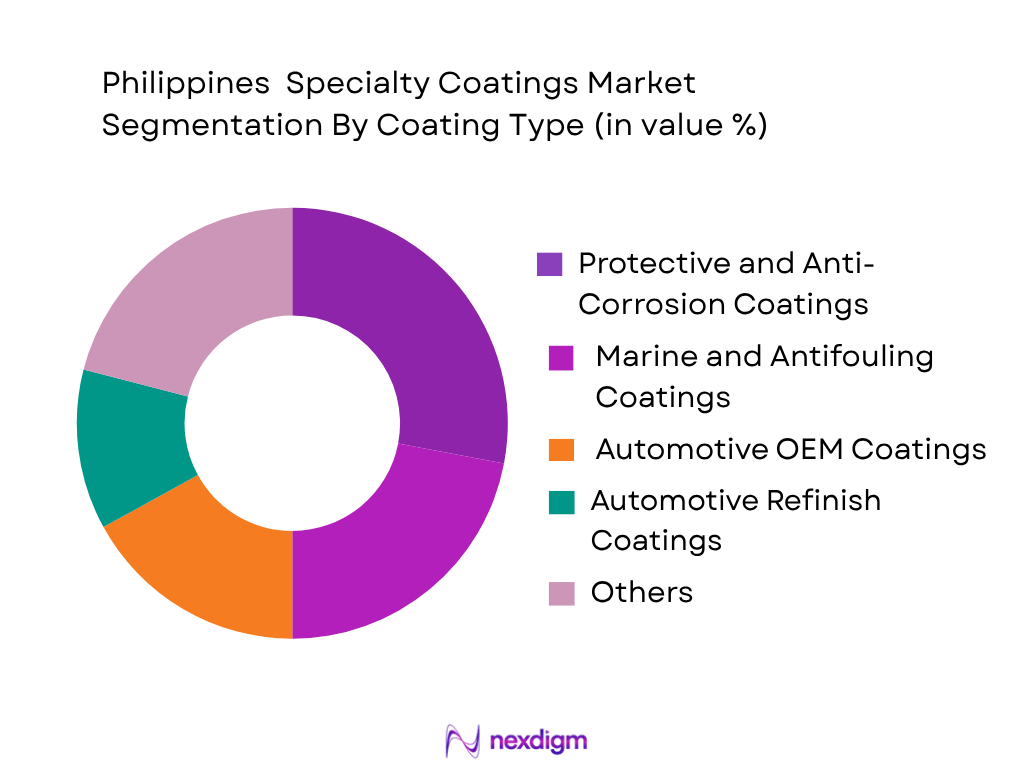
The Philippines Specialty Coatings Market is segmented by coating type into protective and anti-corrosion coatings, marine and antifouling coatings, automotive OEM coatings, automotive refinish coatings, powder coatings, electronics and electrical coatings, coil coatings, industrial wood coatings, industrial floor coatings, and fire-protective and intumescent coatings. Protective and anti-corrosion coatings represent the dominant sub-segment because Philippine industrial assets experience high humidity, salt exposure, chemical contact and recurring maintenance requirements. Infrastructure, ports, storage tanks, factories, power assets and structural steel require epoxy, polyurethane and zinc-rich systems capable of extending asset life. The Philippines corrosion-protection coatings market alone has been valued at about USD 33 million in its historical base period, while non-aqueous coating imports reached USD 71.27 million, demonstrating a substantial supply base for performance coatings. Marine and antifouling coatings also remain strategically important because of the country’s extensive maritime economy, ship-repair activity and coastal asset base.
By Resin Type
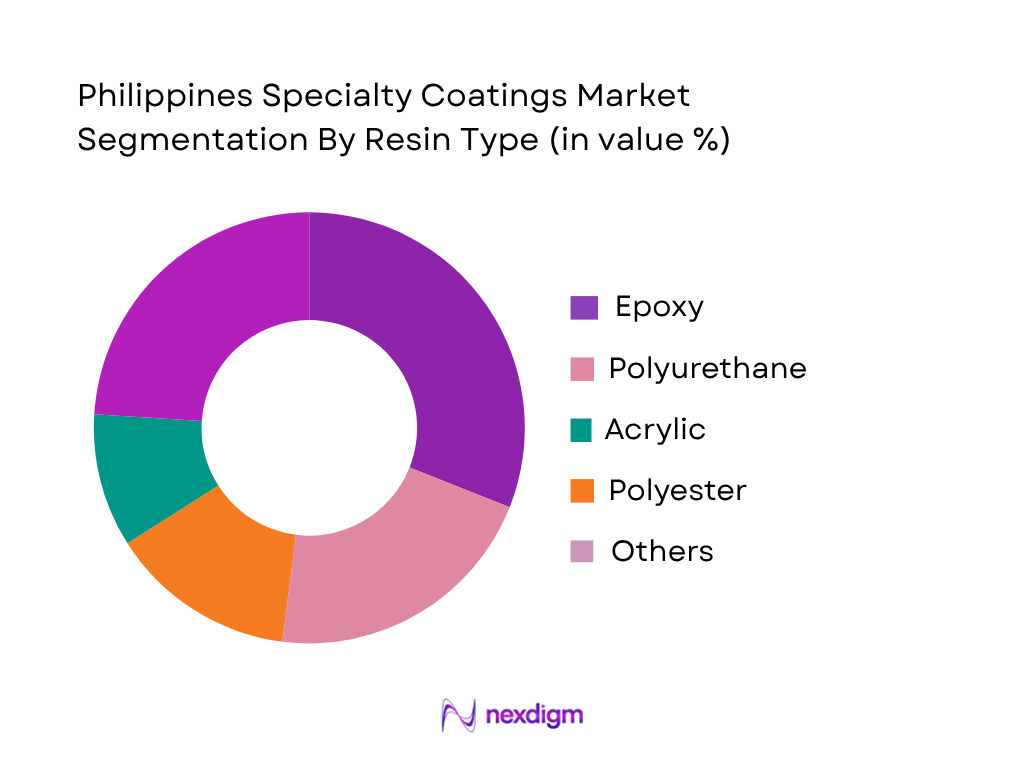
The Philippines Specialty Coatings Market is segmented by resin type into epoxy, polyurethane, acrylic, polyester, alkyd, fluoropolymer and PVDF, silicone, vinyl, epoxy-polyester hybrid, and other high-performance resin systems. Epoxy coatings hold the dominant position because their adhesion, chemical resistance, corrosion protection and high-build characteristics make them suitable for industrial floors, steel structures, storage tanks, pipelines, marine environments and manufacturing facilities. Protective-coatings research for the Philippines identifies epoxy as the leading chemistry within corrosion-control applications, reflecting its extensive use in infrastructure and industrial maintenance. Polyurethane follows as an important technology for durable finishing systems requiring color retention, UV resistance and abrasion performance. Demand for polyester and hybrid resins is supported by powder-coated appliances, metal furniture and industrial components, while fluoropolymer and silicone systems remain concentrated in demanding architectural, industrial and high-temperature applications.
Competitive Landscape
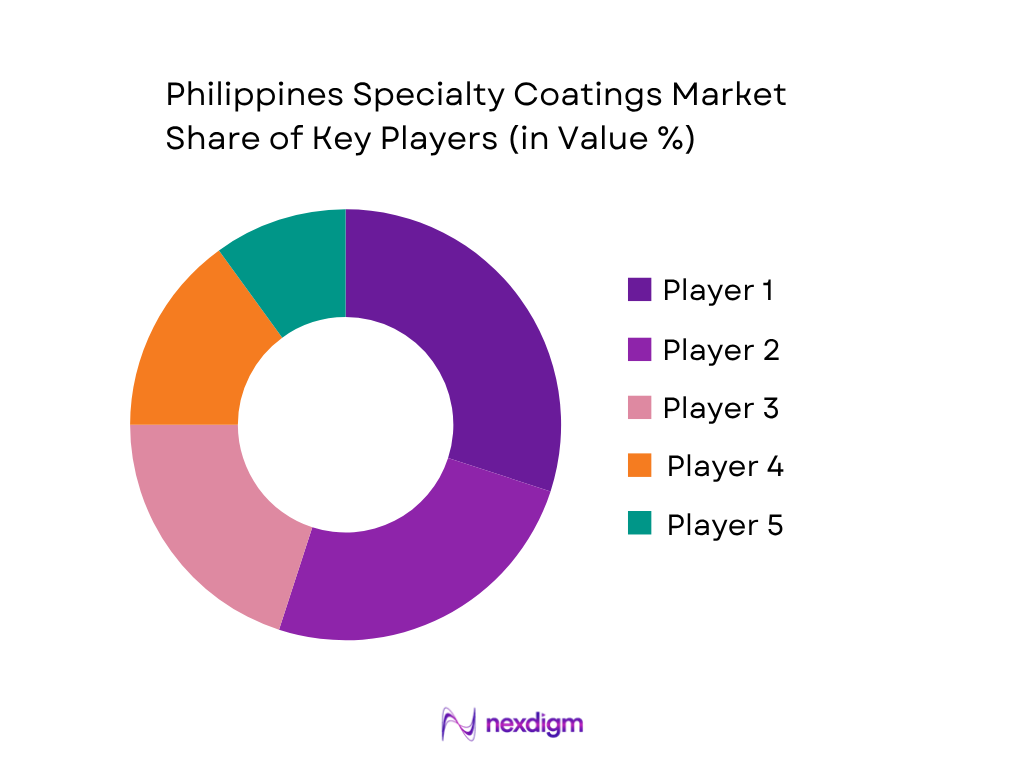
The Philippines Specialty Coatings Market combines established domestic paint manufacturers with multinational suppliers specializing in marine, automotive, protective and industrial coating technologies. Companies compete through specification approvals, formulation performance, local technical support, application expertise and distribution coverage rather than price alone. Pacific Paint (Boysen) has a substantial domestic manufacturing position, Nippon Paint has a long-standing Philippine manufacturing presence and OEM strength, while Jotun has a particularly broad marine and protective portfolio.
| Major Player | Establishment Year | Headquarters | Philippines Presence | Key Specialty Coating Portfolio | Major Resin / Technology Strength | Primary End-Use Exposure | Marine / Protective Capability | Local Market Positioning |
| Pacific Paint (Boysen) Philippines | 1953 | Quezon City, Philippines | ~ | ~ | ~ | ~ | ~ | ~ |
| Nippon Paint | 1881 | Tokyo, Japan | ~ | ~ | ~ | ~ | ~ | ~ |
| Jotun | 1926 | Sandefjord, Norway | ~ | ~ | ~ | ~ | ~ | ~ |
| PPG Industries | 1883 | Pittsburgh, United States | ~ | ~ | ~ | ~ | ~ | ~ |
| AkzoNobel | 1792 | Amsterdam, Netherlands | ~ | ~ | ~ | ~ |
Philippines Specialty Coatings Market Analysis
Growth Drivers
Expansion of Electronics, Transport Equipment and Export-Oriented Manufacturing
The Philippines Specialty Coatings Market is supported by the scale of the country’s electronics and advanced manufacturing ecosystem, which requires conformal coatings, dielectric coatings, powder coatings, automotive coatings and corrosion-resistant finishes for components and production equipment. Philippine Statistics Authority data show that electronic-product exports reached USD 39.09 billion in 2024, while machinery and transport equipment contributed another USD 2.18 billion to exports. The same agency recorded USD 27.38 billion of electronic-product imports and USD 11.36 billion of transport-equipment imports, illustrating the size of the domestic manufacturing supply chain requiring coated metals, housings, assemblies and components. Manufactured-goods exports totaled USD 58.39 billion, creating a substantial industrial base for performance coatings with controlled adhesion, electrical insulation, chemical resistance and surface durability. Supporting these sector-specific indicators, the International Monetary Fund placed Philippine nominal GDP at USD 469.5 billion in 2024, compared with USD 437.1 billion in 2023, reflecting a larger industrial and investment environment. These manufacturing fundamentals support recurring specialty-coating consumption across electronics factories, automotive facilities, fabricated-metal producers, electrical equipment plants and export-oriented industrial estates.
Infrastructure Construction and Expansion of the Industrial Asset Base
Infrastructure, industrial buildings and non-residential construction create recurring demand for epoxy systems, polyurethane topcoats, zinc-rich primers, waterproof coatings, industrial flooring and fire-protective coatings in the Philippines. Philippine Statistics Authority building-permit statistics recorded 10,809 approved construction projects in December 2024 alone, covering 2.63 million square meters of floor area and approximately PHP 32.94 billion in construction value. The agency defines non-residential construction as including commercial, industrial, institutional and agricultural structures, with industrial buildings covering factories, plants, mills, repair shops, warehouses and electric-generating plants—all direct application environments for specialty coatings. The country’s construction pipeline is complemented by public infrastructure spending, which the IMF identified as an important contributor to Philippine economic activity during 2024. At the macroeconomic level, IMF data placed Philippine nominal output at PHP 26.43 trillion in 2024, up from PHP 24.32 trillion in 2023, while gross international reserves reached USD 113.3 billion. As additional bridges, factories, warehouses, transport facilities, utilities and industrial structures enter service, the installed base requiring corrosion protection, concrete protection and scheduled recoating expands, supporting both first-application and maintenance demand for specialty coating systems.
Market Challenges
Heavy Dependence on Imported Raw Materials and Exposure to External Supply Chains
The Philippines Specialty Coatings Market remains exposed to imported resins, pigments, curing agents, functional additives, solvents and specialized finished coating systems, making procurement reliability a significant operating issue for manufacturers and distributors. Philippine Statistics Authority data show that the country imported USD 127.60 billion of goods in 2024, including USD 46.47 billion of raw materials and intermediate goods and USD 35.73 billion of capital goods. China alone supplied USD 32.83 billion of Philippine imports, followed by Indonesia at USD 10.64 billion, Japan at USD 10.11 billion, South Korea at USD 9.63 billion, and the United States at USD 8.17 billion. This regional sourcing structure is particularly relevant to specialty coatings because high-performance epoxy inputs, polyurethane intermediates, specialty pigments, additives and functional chemicals are not comprehensively available from domestic supply. The IMF placed Philippine gross international reserves at USD 113.3 billion in 2024 and nominal GDP at USD 469.5 billion, highlighting the economy’s extensive interaction with external trade. For coating suppliers, international freight disruptions, feedstock availability and extended import lead times can therefore affect production planning, inventory requirements, customer fulfillment and formulation continuity.
Technical Qualification, Application Quality and Compliance Complexity
Specialty coatings require substantially tighter application and performance control than conventional decorative products, creating barriers in OEM qualification, substrate preparation, film-thickness management, curing and environmental compliance. The Philippine industrial base involved is considerable: Philippine Statistics Authority data recorded USD 58.39 billion of manufactured-goods exports in 2024, including USD 39.09 billion of electronics, while imported transport equipment reached USD 11.36 billion. Supplying coatings into these industries requires consistent formulations and application performance because automotive components, electronics housings, industrial machinery and marine assets operate under technical specifications rather than purely aesthetic requirements. Construction activity further broadens this challenge: 10,809 building projects approved in December 2024 represented 2.63 million square meters of floor area, creating numerous sites where surface preparation and contractor capability directly influence coating performance. The wider economy generated PHP 26.43 trillion in nominal GDP according to IMF data, indicating the scale over which industrial standards and environmental controls must operate. Suppliers consequently need technical-service personnel, applicator training, documented safety procedures and reliable quality control, increasing operational complexity for companies attempting to compete in specification-driven protective, marine, automotive and functional coating categories.
Market Opportunities
Localization of High-Performance Coatings for Electronics and Industrial Manufacturing
The Philippines has a strong opportunity to deepen domestic formulation, technical service and localized supply of conformal coatings, ESD-compatible systems, powder coatings, protective finishes and other functional coatings serving electronics and industrial manufacturers. Philippine Statistics Authority data show electronic-product exports of USD 39.09 billion in 2024, making electronics the country’s largest merchandise export category, while electronic-product imports reached USD 27.38 billion. The country also exported USD 2.43 billion of ignition wiring sets used in vehicles, aircraft and ships and USD 2.18 billion of machinery and transport equipment. These values demonstrate an established production ecosystem in which specialized surface protection, dielectric performance, corrosion control and precision finishing are commercially relevant. Broader manufactured-goods exports reached USD 58.39 billion, providing an extensive addressable industrial customer base. IMF data placed Philippine nominal GDP at USD 469.5 billion and gross reserves at USD 113.3 billion, supporting continued integration with regional manufacturing networks. Greater localization could allow specialty-coating suppliers to reduce import lead times, provide faster formulation adjustment, strengthen OEM technical support and develop products tailored to tropical humidity, electronics cleanliness requirements and local industrial operating conditions.
Protective, Marine and Infrastructure Coatings for an Expanding Installed Asset Base
The Philippines offers a substantial future opportunity for high-performance corrosion protection, marine coatings, industrial flooring and concrete-protection systems because current infrastructure and construction activity continually adds assets requiring long-term maintenance. Philippine Statistics Authority data recorded 10,809 approved construction projects in December 2024, representing 2.63 million square meters of floor area and approximately PHP 32.94 billion in construction value. Industrial buildings within the government’s construction classification include factories, plants, mills, repair facilities, warehouses, storage plants and electric-generating facilities, all of which require specialized coatings for steel, concrete, machinery and flooring surfaces. The maritime geography of the Philippines further increases the relevance of anti-corrosion and antifouling technologies for ports, coastal infrastructure, vessels and ship-repair operations because exposure to salt water and humid environments accelerates substrate degradation. At the macroeconomic level, IMF data placed nominal Philippine GDP at PHP 26.43 trillion in 2024, compared with PHP 24.32 trillion in the preceding year, while international reserves stood at USD 113.3 billion. The expanding stock of infrastructure and productive assets provides a widening installed base for inspection, maintenance, refurbishment and recurring recoating demand.
Future Outlook
The Philippines Specialty Coatings Market is expected to expand at a forecast CAGR of approximately ~X.X% during 2026-2035. Growth is likely to be supported by continuing industrial asset formation, infrastructure construction, automotive and electronics manufacturing, marine maintenance and greater adoption of higher-performance coating systems. Increasing emphasis on longer maintenance intervals, corrosion resistance and lower-emission technologies should gradually shift demand from conventional solvent-heavy coatings toward high-solids, waterborne, powder and advanced functional formulations.
Protective coatings should remain central to future demand because additional infrastructure creates an expanding installed asset base that subsequently requires inspection, repair and recoating. Construction activity is already broad-based: the formal Philippine construction sector counted 2,512 establishments, including 1,091 building-construction establishments and 363 road-and-rail construction establishments in the latest business survey. This generates downstream opportunities across steel protection, concrete coatings, flooring, waterproof specialty systems and fire-protection coatings. Electronics and automotive coatings also offer attractive structural growth. Computer, electronic and optical products recorded strong manufacturing growth in the latest production statistics, while transport-equipment output also expanded. Nippon Paint identifies itself as a leading Philippine automotive OEM coating supplier, illustrating how specialized paint systems are embedded directly into vehicle manufacturing processes rather than relying solely on aftermarket consumption.
Major Players
- Pacific Paint (Boysen) Philippines, Inc.
- Davies Paints Philippines, Inc.
- Nippon Paint (Coatings) Philippines, Inc.
- Jotun Philippines, Inc.
- Twin Aces Industries, Inc.
- Sycwin Coating & Wires, Inc.
- Chugoku Marine Paints
- AkzoNobel / International Paint
- PPG Industries
- Sherwin-Williams
- Axalta Coating Systems
- Kansai Paint
- Hempel
- Sika Philippines, Inc.
- Universal Paint and Coatings Philippines, Inc.
Key Target Audience
- Specialty Coatings Manufacturers and Formulators
- Paint, Resin, Pigment and Performance Additive Manufacturers
- Marine, Automotive, Electronics and Industrial OEM Companies
- Specialty Coating Distributors, Importers and Industrial Applicators
- Infrastructure Developers, EPC Contractors and Industrial Asset Owners
- Shipyards, Ship Repair Companies and Maritime Operators
- Investments and Venture Capitalist Firms
- Government and Regulatory Bodies (Department of Trade and Industry, Board of Investments, Department of Environment and Natural Resources–Environmental Management Bureau, Bureau of Philippine Standards)
Research Methodology
Step 1: Identification of Key Variables
The initial phase involves constructing the complete ecosystem of the Philippines Specialty Coatings Market, including manufacturers, importers, distributors, resin suppliers, applicators, OEMs, shipyards and industrial end users. Extensive desk research is used to identify variables such as coating consumption, resin chemistry, import dependency, pricing, production capacity, end-use intensity and application requirements that determine market size and competitive behavior.
Step 2: Market Analysis and Construction
Historical information is compiled across protective, marine, automotive, powder, industrial and functional coatings. A top-down assessment evaluates broader paints and coatings activity, manufacturing output and trade flows, while bottom-up analysis examines company revenues, coating consumption by end-use industry, application area, dry-film requirements and average selling prices. Import and domestic production data are reconciled to reduce double counting and establish the addressable specialty coatings market.
Step 3: Hypothesis Validation and Expert Consultation
Market hypotheses are validated through computer-assisted telephone interviews and direct discussions with coating manufacturers, distributors, industrial applicators, raw-material suppliers, engineering companies and purchasing professionals. Interviews are designed to verify resin preferences, purchasing behavior, project specifications, import dependence, distribution margins, pricing ranges and competitive positioning. Conflicting observations are cross-checked across multiple respondent categories before being incorporated into the market model.
Step 4: Research Synthesis and Final Output
The final phase integrates supply-side findings with demand-side consumption models covering industrial manufacturing, automotive, marine, infrastructure, electronics and other specialty applications. Company information, trade statistics and primary interview findings are triangulated against published government and industry data. The resulting analysis is used to establish historical market structure, competitive positioning, segmentation, growth drivers and the long-term forecast for the Philippines Specialty Coatings Market.

- Executive Summary
- Research Methodology (Market Definition and Scope, Philippines Specialty Coatings Taxonomy, Coating Chemistry Classification, Functional Performance Mapping, Market Sizing Framework, Top-Down Analysis, Bottom-Up Analysis, Domestic Production Assessment, Import Dependency Assessment, Demand-Side Assessment, Supply-Side Assessment, End-Use Application Mapping, Industrial Consumption Assessment, Primary Industry Interviews, Trade-Flow Validation, Data Triangulation, Forecasting Framework, Scenario Analysis, Assumptions and Limitations)

- Definition and Scope
- Philippines Specialty Coatings Industry Evolution and Technology Development
- Specialty Coatings Manufacturing and Formulation Process
- Specialty Coatings Value Chain Analysis
- Philippines Specialty Coatings Supply Chain Analysis

- Growth Drivers (Infrastructure Construction Expansion, Electronics and Semiconductor Manufacturing Growth, Automotive Production Growth, Marine and Ship Repair Activity, Industrial and Logistics Facility Development, Steel and Metal Fabrication Growth, Coastal Corrosion Protection Requirements, Low-VOC Coating Adoption)
- Market Challenges (Imported Raw-Material Dependency, Epoxy and Polyurethane Feedstock Volatility, Solvent Price Fluctuation, OEM Qualification Requirements, Skilled Applicator Constraints, Inter-Island Logistics Costs, VOC and Chemical Compliance Costs, Specialty Formulation Complexity)
- Market Opportunities (Marine Protective Coatings, Electronics Functional Coatings, Waterborne Industrial Coatings, High-Performance Powder Coatings, ESD Flooring Systems, High-Solids Epoxy Systems, Infrastructure Protective Coatings, Premium Automotive Refinish, Renewable-Energy Protective Coatings)
- Market Trends (Waterborne Conversion, High-Solids Technology Adoption, Powder Coating Penetration, Low-VOC Formulation, Localized Technical Support, Functional Surface Coatings, Fast-Cure Systems, Longer-Life Corrosion Protection)
- Regulatory and Standards Landscape (Lead Content Regulations, Chemical Control Orders, PICCS Requirements, GHS and SDS Compliance, Hazardous Chemical Management, Product Labeling Requirements, Environmental Permitting, Hazardous Waste Management, Worker Safety Standards)
- SWOT Analysis
- Porter’s Five Forces Analysis
- PESTLE Analysis

- By Market Value (2020-2025)
- By Coating Consumption Volume (2020-2025)
- By Domestic Production Volume (2020-2025)
- By Import Volume (2020-2025)
- By Export Volume (2020-2025)
- By Industrial Coatings Consumption Volume (2020-2025)
- By Specialty Coatings Production Capacity (2020-2025)
- By Average Realized Selling Price (2020-2025)
- By Application Revenue (2020-2025)

- By Coating Type (In Value %)
Protective and Anti-Corrosion Coatings
Marine and Antifouling Coatings
Automotive OEM Coatings
Automotive Refinish Coatings
Powder Coatings
Electronics and Electrical Coatings
Coil Coatings
Industrial Wood Coatings
Industrial Floor Coatings
Fire-Protective and Intumescent Coatings - By Resin Type (In Value %)
Epoxy
Polyurethane
Acrylic
Polyester
Alkyd
Fluoropolymer and PVDF
Silicone
Vinyl
Epoxy-Polyester Hybrid
Other High-Performance Resin Systems - By Technology (In Value %)
Waterborne Coatings
Solvent-Borne Coatings
Powder Coatings
High-Solids Coatings
UV-Cured Coatings
Two-Component Coatings
Moisture-Cured Coatings
Advanced Functional Coatings - By End-Use Industry (In Value %)
Electronics and Semiconductor Manufacturing
Automotive Manufacturing
Marine, Shipbuilding and Ship Repair
Infrastructure and Construction
Steel and Metal Fabrication
Oil, Gas and Petrochemicals
Power and Renewable Energy
Industrial and Logistics Infrastructure
Food and Beverage Processing
Machinery and General Industrial - By Substrate (In Value %)
Carbon Steel
Galvanized Steel
Aluminium
Stainless Steel
Concrete
Wood and Engineered Wood
Plastics and Engineering Polymers
Composite Materials
Electronic Components and Housings - By Sales Channel (In Value %)
Direct-to-OEM Sales
Direct Industrial Project Sales
Specialty Coating Distributors
Marine and Protective Coating Distributors
Automotive Refinish Distributors
Industrial Applicators and Contractors
EPC and Specification Sales
Dealer and Specialist Retail Networks

- Market Share of Major Players (By Revenue, Volume, Coating Type, Resin Type, Technology, Application, End-Use Industry, Distribution Channel)
- Cross Comparison Parameters (Specialty Coating Portfolio Breadth, Philippines Manufacturing and Localization Capability, Resin and Technology Coverage, Industrial and Marine Specification Approval Depth, Protective and Marine Project Presence, Electronics and Automotive OEM Penetration, Local Technical Service and Applicator Support Capability, Distribution and Inter-Island Reach)
- SWOT Analysis of Major Players
- Detailed Profiles of Major Companies
Pacific Paint (Boysen) Philippines
Davies Paints Philippines
Nippon Paint Philippines
Jotun Philippines
Twin Aces Industries
Sycwin Coating and Wires
Chugoku Marine Paints
AkzoNobel / International Paint
PPG Industries
Sherwin-Williams
Axalta Coating Systems
Kansai Paint
Hempel
Sika Philippines
Universal Paint and Coatings Philippines

- Buyer Segmentation
- Procurement Behaviour
- Supplier Selection Criteria
- Buyer Pain Points
- Technology Adoption Assessment
- Replacement and Repurchase Behaviour

- By Market Value (2026-2035)
- By Coating Consumption Volume (2026-2035)
- By Domestic Production Volume (2026-2035)
- By Import Volume (2026-2035)
- By Export Volume (2026-2035)
- By Industrial Coatings Consumption Volume (2026-2035)
- By Specialty Coatings Production Capacity (2026-2035)
- By Average Realized Selling Price (2026-2035)
- By Application Revenue (2026-2035)


 Request a Sample
 Ask for Customization
 Get a Quote
 Enquire Now