
 Download PDF
Market Overview
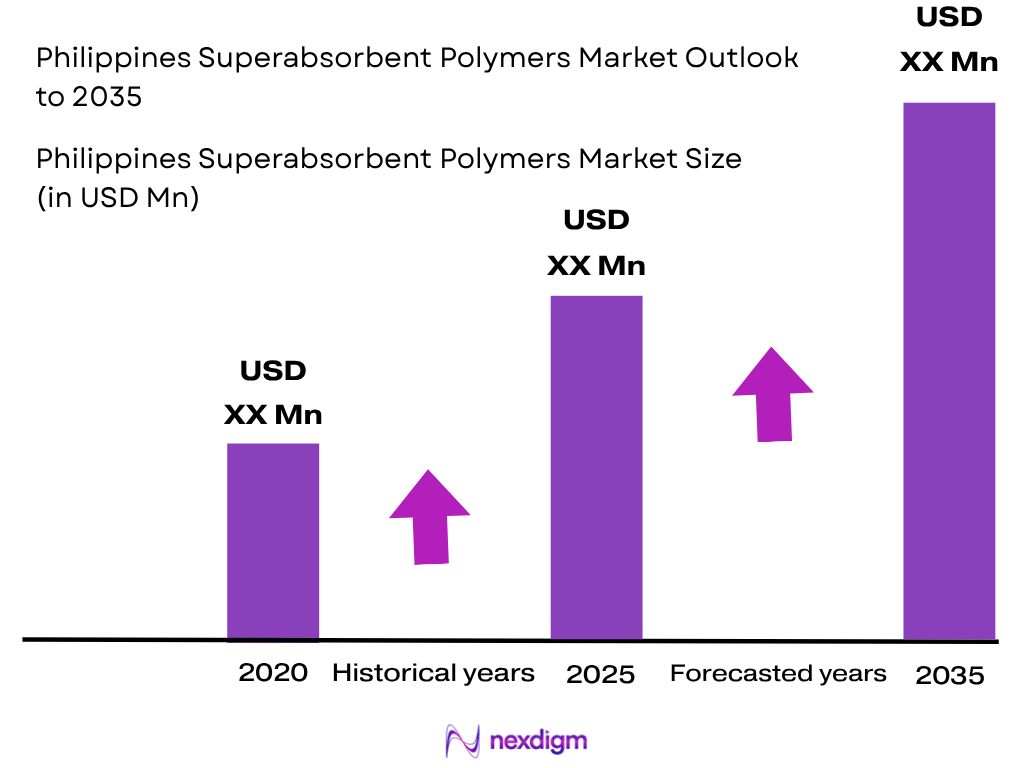
The Philippines Superabsorbent Polymers Market is valued at ~USD XX.X million, with demand supported by recurring consumption of diapers, feminine hygiene products, adult incontinence products, medical absorbents, and emerging agricultural applications. The country recorded 1,358,989 registered live births, while total population reached 112,729,484, establishing a substantial recurring hygiene-products base. Manufacturing also generated PHP 4,146,037,835 thousand at current prices, demonstrating the scale of the industrial ecosystem that can support downstream polymer conversion and hygiene-product manufacturing.
The Philippines Superabsorbent Polymers Market is concentrated around major population and manufacturing corridors, particularly CALABARZON, the National Capital Region, and Central Luzon. CALABARZON recorded 16.93 million residents, NCR 14.00 million, and Central Luzon 12.99 million, creating dense consumer and manufacturing bases for hygiene products and chemical distribution. These three regions also accounted for approximately 44 million people collectively, while NCR alone generated PHP 894,213,206 thousand in manufacturing gross value added at current prices, reinforcing its role as a major industrial and distribution center.
Market Segmentation
By Product Type
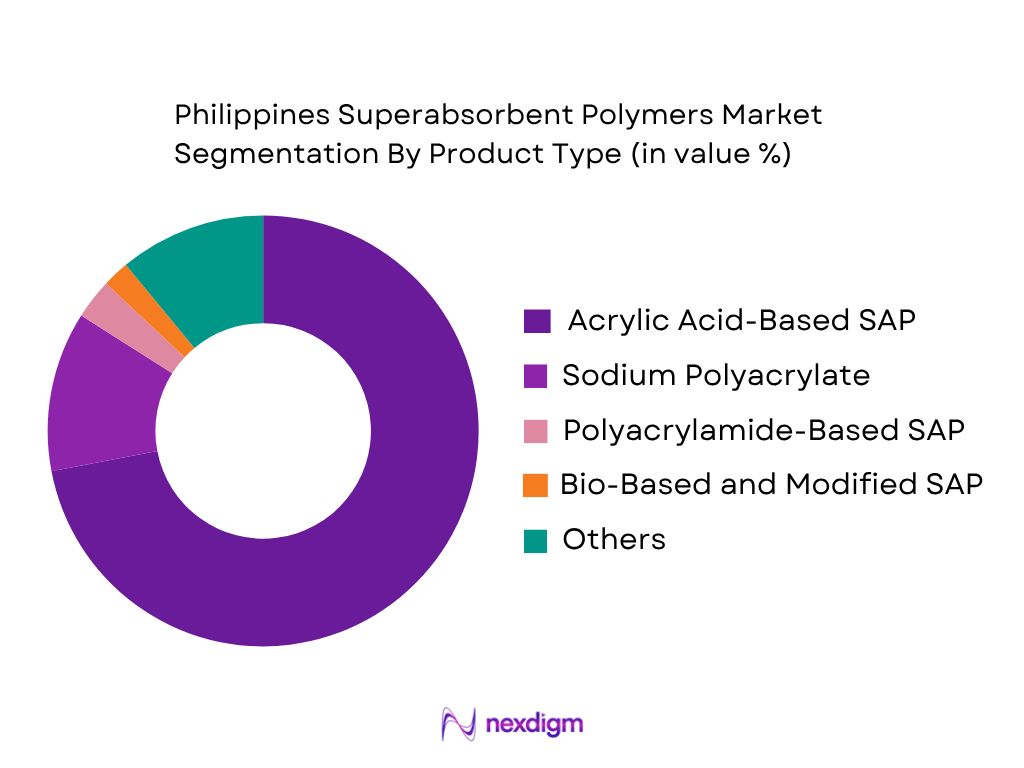
The Philippines Superabsorbent Polymers Market is segmented by product type into acrylic acid-based SAP, sodium polyacrylate, polyacrylate/polyacrylamide copolymers, polyacrylamide-based SAP, bio-based and modified SAP, and other specialty SAP grades. Acrylic acid-based SAP is expected to represent the dominant product category because it aligns closely with the technical requirements of disposable hygiene products, particularly diapers and feminine hygiene products. Its ability to absorb and retain substantial quantities of aqueous liquid makes it suitable for absorbent-core applications where liquid retention, gel strength, absorption speed, and absorption under load are critical. The Philippines has 1.36 million registered live births, providing a substantial recurring end-use base for diaper-related absorbent materials. In addition, the country recorded PHP 4.15 trillion in manufacturing gross value added at current prices, indicating a substantial manufacturing environment for converting imported polymer inputs into finished hygiene products.
By Application
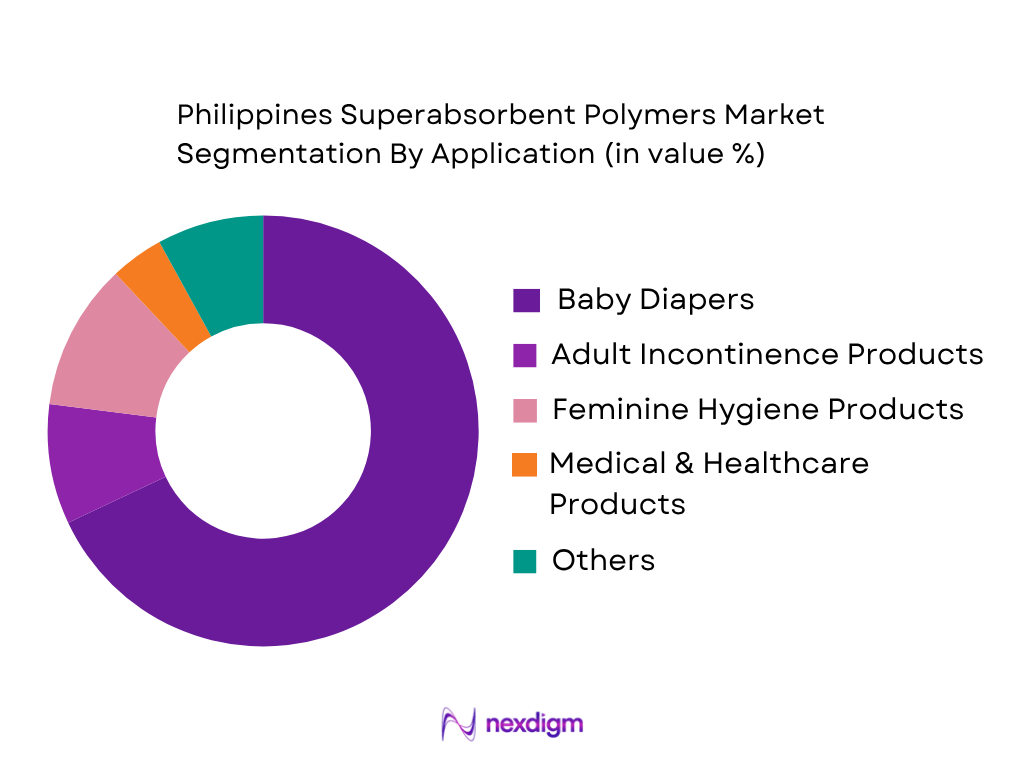
The Philippines Superabsorbent Polymers Market is segmented by application into baby diapers, adult incontinence products, feminine hygiene products, medical absorbent products, agriculture and horticulture, industrial absorbent applications, and other specialty applications. Baby diapers represent the principal application because SAP is a critical component of modern absorbent cores and because infant-care products have a recurring replacement cycle. The Philippines registered 1,358,989 live births, equivalent to approximately 3,713 births per day, providing a continuing base of potential diaper consumers. The demographic base is complemented by substantial manufacturing activity, with Philippine manufacturing gross value added reaching PHP 3,920,747,812 thousand at constant 2018 prices. Meanwhile, CALABARZON, NCR, and Central Luzon recorded 16.93 million, 14.00 million, and 12.99 million residents respectively, concentrating consumer demand and manufacturing infrastructure within key industrial corridors.
Competitive Landscape
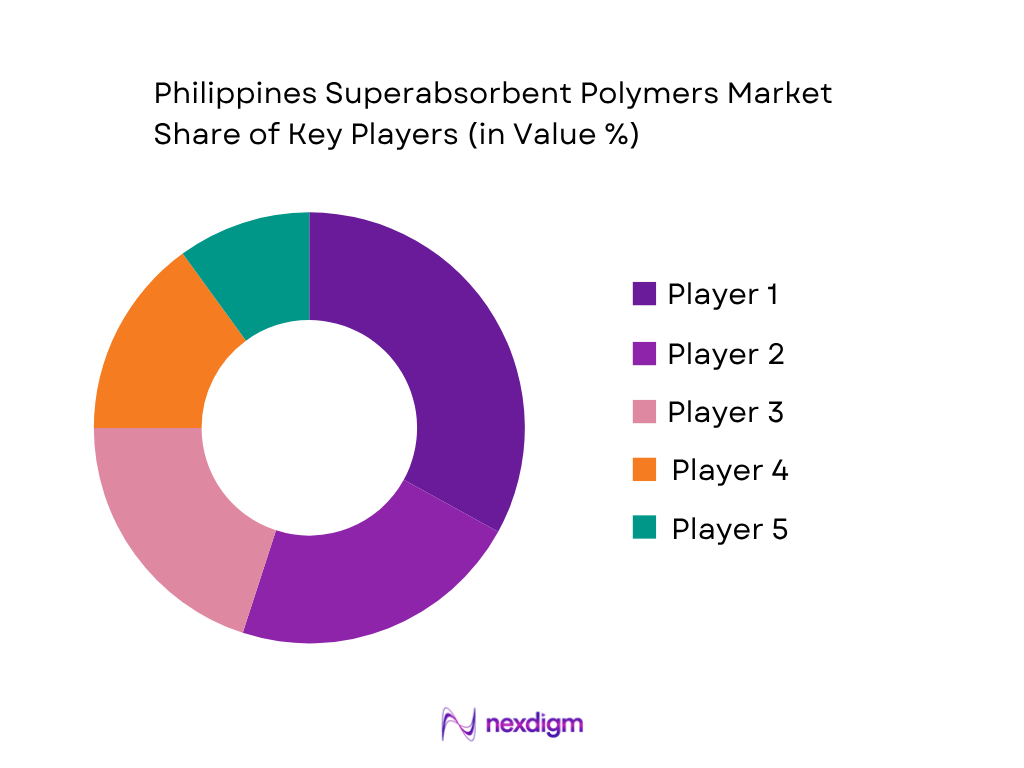
The Philippines Superabsorbent Polymers Market is characterized by international polymer manufacturers and specialty-chemical companies supplying SAP grades into a downstream ecosystem of hygiene-product manufacturers, importers, distributors, and industrial users. Competition is influenced by polymer performance, hygiene-grade qualification, absorption capacity, retention characteristics, supply reliability, technical support, and regional logistics. The country’s total imports reached USD 127.60 billion, while exports reached USD 73.27 billion, highlighting the significance of international supply networks for chemical and manufactured inputs.
| Company | Establishment Year | Headquarters | SAP Product Portfolio | Key Application Exposure | Regional Supply Capability | Technology Focus | Distribution Model |
| Sumitomo Seika Chemicals Co., Ltd. | 1944 | Japan | ~ | ~ | ~ | ~ | ~ |
| Nippon Shokubai Co., Ltd. | 1941 | Japan | ~ | ~ | ~ | ~ | ~ |
| BASF SE | 1865 | Germany | ~ | ~ | ~ | ~ | ~ |
| LG Chem Ltd. | 1947 | South Korea | ~ | ~ | ~ | ~ | ~ |
| Evonik Industries AG | 2007 | Germany | ~ | ~ | ~ | ~ | ~ |
Philippines Superabsorbent Polymers Market Analysis
Growth Drivers
Expansion of Disposable Diaper Manufacturing
The Philippines Superabsorbent Polymers Market is supported by the continuing requirement for disposable diapers and other absorbent hygiene products across a population of 112.73 million people. The Philippine Statistics Authority recorded 1,358,989 registered live births, compared with 1,448,522 in the preceding year, creating a recurring consumer base for infant hygiene products that use SAP in absorbent cores. CALABARZON recorded the highest number of live-birth occurrences, followed by the National Capital Region and Central Luzon, reinforcing demand concentration around major population and manufacturing corridors. The broader industrial ecosystem also supports downstream conversion, with manufacturing generating PHP 4.15 trillion in gross value added at current prices. The country’s merchandise imports reached USD 127.60 billion, while raw materials and intermediate goods accounted for USD 46.47 billion, demonstrating the importance of imported industrial inputs in Philippine manufacturing. These conditions support demand for acrylic-acid-based SAP supplied to diaper producers and hygiene-product converters. Increasing requirements for thinner, lighter and higher-retention absorbent cores can further encourage manufacturers to use higher-performance SAP grades, particularly where product manufacturers compete on liquid retention, leakage protection, core thickness and overall product performance.
Rising Hygiene and Healthcare Product Adoption
The Philippines Superabsorbent Polymers Market is supported by demand across baby diapers, feminine hygiene products, adult incontinence products and medical absorbent materials, with demographic and industrial indicators providing a substantial underlying demand base. The Philippine Statistics Authority recorded 1,358,989 live births, equivalent to approximately 3,713 births each day, maintaining a large recurring requirement for infant-care products containing SAP. NCR recorded 169,300 registered live births, while CALABARZON and Central Luzon also ranked among the leading regions for births, concentrating downstream hygiene consumption. Healthcare and manufacturing infrastructure provide additional channels because SAP can be incorporated into absorbent pads, wound-care materials and other fluid-management products. Philippine manufacturing generated PHP 4.15 trillion in gross value added at current prices, indicating substantial industrial capacity for converting imported chemical materials into finished products. Imports of raw materials and intermediate goods reached USD 46.47 billion, while total merchandise imports reached USD 127.60 billion, demonstrating the country’s established dependence on internationally supplied production inputs. This combination of demographic demand, manufacturing capability and international sourcing supports continued adoption of high-absorbency SAP grades across hygiene and healthcare applications.
Market Challenges
Dependence on Imported SAP Grades
The Philippines Superabsorbent Polymers Market faces supply-side constraints because advanced SAP grades and upstream chemical inputs are closely connected to international manufacturing and logistics networks. The country recorded USD 127.60 billion in merchandise imports, including USD 46.47 billion of raw materials and intermediate goods, demonstrating the scale of imported production inputs used across Philippine industry. China alone supplied USD 32.83 billion of imported goods, while East Asia supplied USD 58.63 billion, illustrating the importance of Asian trade corridors to domestic manufacturing. SAP producers and downstream hygiene manufacturers can therefore remain exposed to shipping disruptions, customs processing, foreign production interruptions and availability of specialized polymer grades. Acrylic acid-based SAP also depends on upstream petrochemical chemistry, making consistent access to suitable feedstocks important for production continuity. The challenge becomes more significant for manufacturers requiring tightly controlled absorption capacity, retention performance, particle-size distribution and gel-strength specifications because supplier qualification can limit rapid substitution. Philippine total external trade reached USD 200.87 billion, confirming the country’s extensive international trade integration but also highlighting its exposure to external supply conditions. Developing additional regional sourcing relationships, local compounding capabilities and inventory-management systems can reduce operational exposure without requiring complete domestic production of every upstream chemical.
Environmental and End-of-Life Concerns
The Philippines Superabsorbent Polymers Market faces environmental-management challenges because SAP is primarily incorporated into disposable hygiene products that combine polymers, cellulose, films, adhesives and other materials, making recovery and recycling technically difficult. The country generated substantial merchandise flows, with USD 73.27 billion of exports and USD 127.60 billion of imports, indicating extensive movement of manufactured and consumer products through domestic supply chains. At the same time, the country’s population reached 112.73 million, creating a large potential volume of post-consumer hygiene waste. The Philippine manufacturing sector generated PHP 4.15 trillion in gross value added at current prices, increasing the importance of industrial approaches that address material efficiency and waste management alongside production growth. Conventional SAP is designed for high liquid absorption and retention rather than straightforward separation from used hygiene products, which complicates recovery after consumption. Manufacturers therefore face technical requirements involving polymer selection, absorbent-core design, material reduction and end-of-life compatibility. Environmental compliance can also influence future product specifications as hygiene manufacturers seek lower material intensity and improved waste-management outcomes. These factors create a challenge for conventional SAP while increasing the importance of recyclable-compatible, bio-based and lower-footprint absorbent technologies.
Market Opportunities
High-Performance Hygiene-Grade SAP
The Philippines Superabsorbent Polymers Market presents an opportunity for high-performance hygiene-grade SAP as manufacturers seek improved absorption, retention and thinner absorbent-core designs. The country registered 1,358,989 live births, providing a recurring base for baby-diaper demand, while NCR alone recorded 169,300 registered live births. CALABARZON and Central Luzon also recorded high birth volumes, concentrating opportunities around major population and manufacturing corridors. The country’s manufacturing sector generated PHP 4.15 trillion in gross value added at current prices, creating an established downstream environment for converting SAP into diapers, feminine hygiene products and medical absorbents. International supply connectivity also provides access to advanced polymer technologies: Philippine merchandise imports reached USD 127.60 billion, with raw materials and intermediate goods accounting for USD 46.47 billion. This infrastructure can support the introduction of surface-crosslinked, high-retention and application-specific SAP grades through established chemical distribution channels. The opportunity extends beyond basic absorption because premium hygiene products increasingly require balanced absorption speed, absorption under load, gel strength, retention and controlled swelling. Suppliers capable of providing technically consistent grades and application support can therefore address manufacturers seeking improved product performance while reducing absorbent-core thickness and material requirements.
Regional SAP Distribution and Advanced Hygiene Manufacturing
The Philippines Superabsorbent Polymers Market has an opportunity to strengthen its role within Southeast Asian hygiene-product supply chains through improved SAP distribution, downstream converting and regional manufacturing integration. Philippine merchandise trade reached USD 200.87 billion, including USD 127.60 billion of imports and USD 73.27 billion of exports, demonstrating extensive connectivity with international production networks. East Asia supplied USD 58.63 billion of imports, while China alone supplied USD 32.83 billion, providing established regional channels for chemical and polymer procurement. The domestic manufacturing ecosystem generated PHP 4.15 trillion in gross value added at current prices, creating an industrial foundation for hygiene-product conversion and specialty-material applications. Population concentration also supports domestic demand, with 112.73 million residents nationally and major population centers across NCR, CALABARZON and Central Luzon. These conditions create an opportunity for suppliers to establish regional warehousing, technical-support operations and application-development capabilities close to diaper and hygiene-product manufacturers. Advanced hygiene manufacturing can increasingly incorporate high-retention SAP, thinner absorbent cores and specialized polymer grades. Regional re-export and distribution can further connect Philippine manufacturing facilities with neighboring Southeast Asian markets while leveraging existing maritime trade infrastructure and established chemical-import channels.
Future Outlook
The Philippines Superabsorbent Polymers Market is expected to develop through the continued expansion of disposable hygiene consumption, healthcare applications, adult incontinence products, and specialized absorbent materials. The demographic base remains substantial, with 112.73 million people recorded nationally and 1.36 million registered live births. At the same time, manufacturing gross value added reached PHP 4.15 trillion at current prices, supporting opportunities for downstream converting, hygiene-product production, and specialty chemical distribution.
Major Players
- Nippon Shokubai Co., Ltd.
- Sumitomo Seika Chemicals Co., Ltd.
- BASF SE
- Evonik Industries AG
- LG Chem Ltd.
- Sanyo Chemical Industries, Ltd.
- Formosa Plastics Corporation
- Kao Corporation
- Mitsubishi Chemical Group Corporation
- SNF Group
- Wanhua Chemical Group Co., Ltd.
- Satellite Chemical Co., Ltd.
- Shandong Nuoer Biological Technology Co., Ltd.
- Yixing Danson Technology Co., Ltd.
- Songwon Industrial Group
Key Target Audience
- Baby Diaper and Infant Hygiene Product Manufacturers
- Feminine Hygiene Product Manufacturers
- Adult Incontinence and Elderly Care Product Manufacturers
- Medical Absorbent Product Manufacturers
- Specialty Chemical Importers and Distributors
- Agricultural Input and Water-Retention Product Manufacturers
- Investments and Venture Capitalist Firms (Industrial Chemicals, Advanced Materials, Hygiene Manufacturing)
- Government and Regulatory Bodies (Department of Trade and Industry, Philippine FDA, Department of Environment and Natural Resources, Bureau of Customs)
Research Methodology
Step 1: Identification of Key Variables
The initial phase establishes the Philippines Superabsorbent Polymers Market ecosystem by mapping SAP producers, importers, distributors, hygiene-product manufacturers, medical users, agricultural users, and specialty industrial consumers. Secondary research is used to identify demand variables including registered births, population distribution, manufacturing activity, trade flows, and downstream hygiene-product requirements.
Step 2: Market Analysis and Construction
Historical market information is compiled across product chemistry, polymer grade, application, end-use industry, distribution channel, and geographic demand. Import and export information is examined alongside manufacturing indicators to distinguish domestic consumption from externally supplied SAP and to establish the market’s supply structure.
Step 3: Hypothesis Validation and Expert Consultation
Market hypotheses are validated through discussions with SAP suppliers, chemical distributors, diaper manufacturers, hygiene-product converters, medical-material users, and agricultural product manufacturers. Interviews focus on grade qualification, procurement practices, application requirements, supply reliability, import dependency, and technical performance requirements.
Step 4: Research Synthesis and Final Output
The final stage integrates top-down macroeconomic analysis with bottom-up assessment of SAP applications and end-use consumption. Market estimates are cross-checked against demographic, manufacturing, trade, and downstream-industry indicators before segmentation, competitive analysis, forecasts, and strategic conclusions are finalized.

- Executive Summary
- Research Methodology (Market Definition and Scope, Philippines Superabsorbent Polymers Market Classification, SAP Chemistry Mapping, Polymer Grade Assessment, Hygiene-Grade and Industrial-Grade SAP Assessment, Absorption and Retention Performance Assessment, Application-Level Demand Mapping, End-Use Industry Assessment, Domestic Manufacturing Assessment, Import and Export Trade Analysis, Feedstock and Raw Material Assessment, Supply-Side Capacity Mapping, Demand-Side Assessment, Top-Down Market Sizing, Bottom-Up Market Sizing, Primary Industry Interviews, Data Triangulation, Forecasting Framework, Market Share Validation, Limitations and Future Conclusions)

- Definition and Scope
- Philippines Superabsorbent Polymers Industry Evolution
- Philippines Superabsorbent Polymers Value Chain Analysis
- Philippines Superabsorbent Polymers Supply Chain Analysis

- Growth Drivers (Expansion of Disposable Diaper Manufacturing, Rising Hygiene Product Adoption, Growth of Feminine Hygiene Consumption, Increasing Adult Incontinence Product Demand, Expansion of Healthcare Product Manufacturing, Agricultural Water-Retention Requirements, Urbanization and Modern Retail Expansion, Increasing Demand for High-Absorbency Hygiene Materials)
- Market Challenges (Dependence on Imported SAP Grades, Acrylic Acid Feedstock Exposure, Petrochemical Raw Material Volatility, Limited Domestic SAP Manufacturing Infrastructure, Import Logistics Dependency, Environmental and End-of-Life Concerns, Recycling Limitations for Used Hygiene Products, Product Qualification Requirements, Competition from Alternative Absorbent Materials)
- Market Opportunities (High-Performance Hygiene-Grade SAP, Adult Incontinence Applications, Sustainable and Bio-Based SAP, Surface-Crosslinked High-Retention SAP, Agricultural Water-Retention Applications, Medical Absorbent Materials, Specialty Industrial Absorbents, Domestic SAP Manufacturing and Compounding, Regional SAP Distribution and Re-Export Opportunities, Advanced Hygiene Product Manufacturing)
- Market Trends (Thinner Diaper Absorbent Cores, High-Retention SAP Adoption, Surface-Crosslinked SAP Development, Premium Hygiene Product Formulation, Increased Adult Incontinence Product Development, Sustainable SAP Research, SAP Material Optimization, Higher Absorption-Under-Load Requirements, Specialty SAP Grade Development, Regional Hygiene Manufacturing Integration)
- Government Regulations and Standards (Philippine Food and Drug Administration Requirements, Department of Trade and Industry Product Standards, Department of Environment and Natural Resources Environmental Requirements, Chemical Control Order Requirements, Toxic Substances and Hazardous and Nuclear Wastes Control Act, Consumer Product Safety Requirements, Medical Device and Healthcare Product Requirements, Import and Customs Compliance, Chemical Handling and Workplace Safety Requirements, Packaging and Environmental Compliance)
- SWOT Analysis
- Porter’s Five Forces Analysis
- PESTLE Analysis
- Stakeholder Ecosystem
- Competition Ecosystem

- By Market Value (2020-2025)
- By SAP Consumption Volume (2020-2025)
- By Hygiene-Grade SAP Consumption Volume (2020-2025)
- By Industrial-Grade SAP Consumption Volume (2020-2025)
- By Domestic Production Volume (2020-2025)

- By Product Type (In Value %)
Acrylic Acid-Based SAP
Sodium Polyacrylate
Polyacrylate / Polyacrylamide Copolymers
Polyacrylamide-Based SAP
Bio-Based and Modified SAP
Other Specialty SAP Grades - By Polymer Form (In Value %)
SAP Powder
SAP Granules
Fine-Particle SAP
Surface-Crosslinked SAP
Specialty Modified SAP - By Performance Grade (In Value %)
Standard Absorbency SAP
High Absorbency SAP
High Retention SAP
Absorption-Under-Load SAP
Fast-Absorption SAP
Premium Hygiene-Grade SAP - By Application (In Value %)
Baby Diapers
Adult Incontinence Products
Feminine Hygiene Products
Medical Absorbent Products
Agriculture and Horticulture
Industrial Absorbent Applications
Other Specialty Applications - By End-Use Industry (In Value %)
Baby Care and Hygiene Industry
Feminine Hygiene Industry
Adult Incontinence and Elderly Care Industry
Healthcare and Medical Products Industry
Agriculture and Horticulture Industry
Industrial Manufacturing Industry
Specialty Chemical and Absorbent Products Industry

- Market Share of Major Players (By Philippines Revenue, SAP Sales Volume, Hygiene-Grade SAP Volume, Industrial-Grade SAP Volume, Product Chemistry, Performance Grade, Application Exposure, Production Capacity, Import Supply Capability, Distribution Network Coverage, Regional Presence, Hygiene Manufacturer Coverage)
- Cross Comparison Parameters (SAP Production Capacity, Hygiene-Grade SAP Portfolio Breadth, High-Retention Grade Capability, Product Chemistry Portfolio, Absorption-Under-Load Performance, Southeast Asian Supply Coverage, Technical Application Support Capability, Distribution Network Reach)
- SWOT Analysis of Major Players
- Detailed Profiles of Major Companies
Sumitomo Seika Chemicals Co., Ltd.
Nippon Shokubai Co., Ltd.
BASF SE
LG Chem Ltd.
Evonik Industries AG
Sanyo Chemical Industries, Ltd.
Formosa Plastics Corporation
Kao Corporation
SNF Group
Mitsubishi Chemical Group Corporation
Satellite Chemical Co., Ltd.
Wanhua Chemical Group Co., Ltd.
Yixing Danson Technology Co., Ltd.
Shandong Nuoer Biological Technology Co., Ltd.
Songwon Industrial Group

- Baby Diaper Manufacturer SAP Procurement Assessment
- Disposable Diaper Converter Absorbent-Core Requirement Analysis
- Feminine Hygiene Manufacturer SAP Requirement Assessment
- Adult Incontinence Product Manufacturer Absorbency Requirement Analysis
- Medical Absorbent Product Manufacturer Material Assessment
- Agricultural Water-Retention Product Manufacturer SAP Requirement Analysis
- Industrial Absorbent Manufacturer Specialty SAP Assessment

- By Market Value (2026-2035)
- By SAP Consumption Volume (2026-2035)
- By Hygiene-Grade SAP Consumption Volume (2026-2035)
- By Industrial-Grade SAP Consumption Volume (2026-2035)
- By Domestic Production Volume (2026-2035)


 Request a Sample
 Ask for Customization
 Get a Quote
 Enquire Now