
 Download PDF
Market Overview
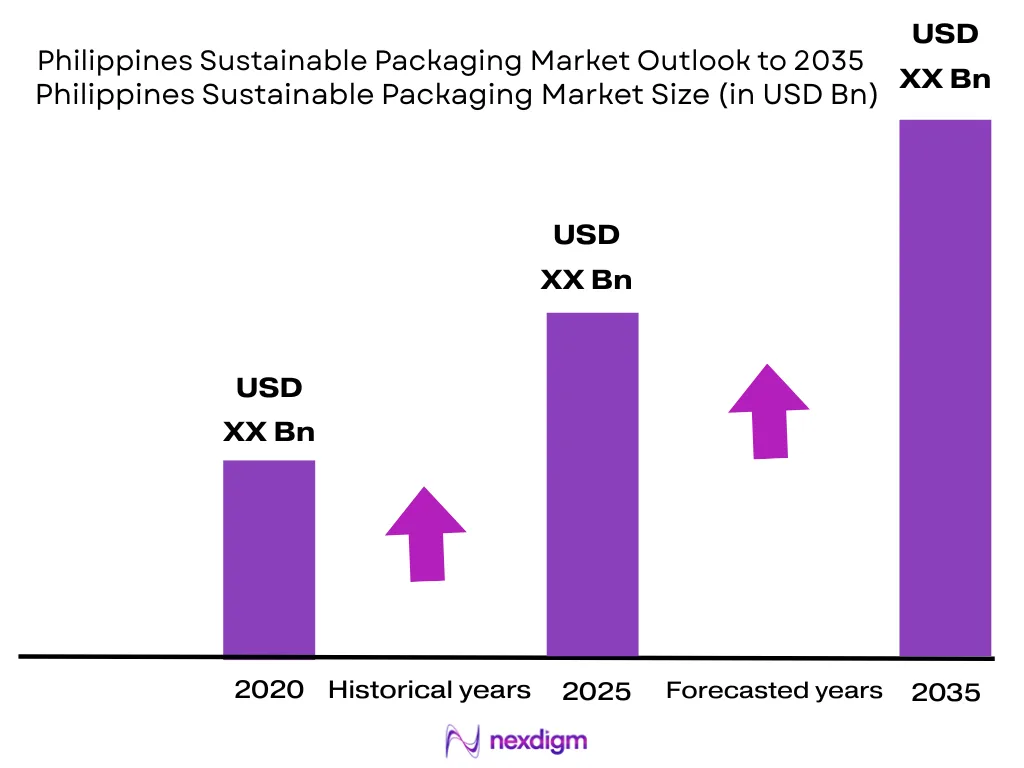
The Philippines sustainable packaging market is valued at approximately USD ~ billion, compared with USD ~ billion in the preceding annual period. Demand is supported by a national population of 112,729,484, increasing packaged-goods consumption and regulatory pressure on plastic-producing enterprises. The economy expanded by 5.7 percentage points, while gross national income per capita reached USD 4,470, supporting retail, foodservice, e-commerce and packaged consumer-product activity. Metro Manila, CALABARZON and Central Luzon dominate the Philippines sustainable packaging market because they combine large consumer populations, packaging-conversion plants, consumer-goods manufacturers, ports, distribution centres and material-recovery networks. The National Capital Region contains 14,001,751 residents, while Central Luzon has 12,989,074. These regions provide proximity to major food, beverage, personal-care and household-product companies, enabling converters to reduce lead times and coordinate packaging redesign, EPR reporting, collection and recycling partnerships.
Market Segmentation
By Packaging Material
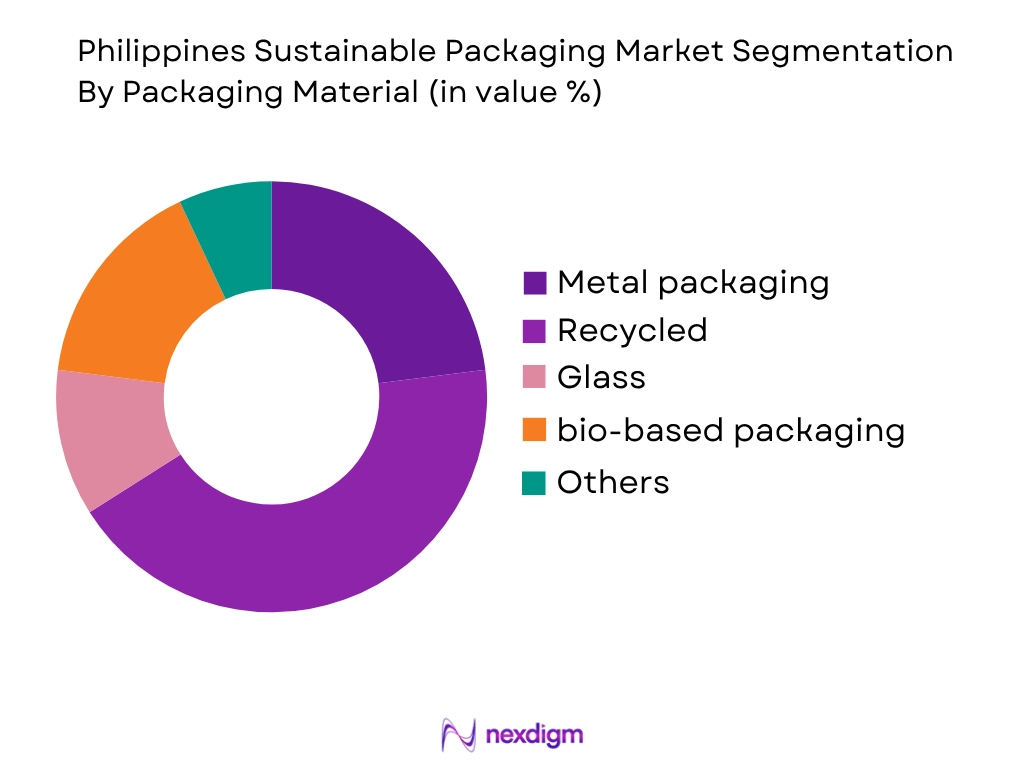
The Philippines sustainable packaging market is segmented by material into paper and paperboard, recycled plastics, glass, metal, bioplastics, agricultural-fibre packaging and other renewable materials. Paper and paperboard packaging holds the dominant market position because corrugated cases, folding cartons, paper bags, moulded fibre and foodservice packaging can enter established fibre-recovery channels and are increasingly used to replace selected plastic formats. Paper-based structures are particularly relevant to e-commerce, processed food, takeaway meals, consumer electronics and retail distribution. Corrugated packaging also combines stacking strength, printability and relatively low empty-packaging weight. Recycled plastic remains important where moisture resistance, transparency, sealability or product durability cannot be achieved through fibre alone. Glass and metal are widely recoverable but require greater transport energy because of weight or rigid geometry. Agricultural fibres such as bagasse, bamboo, abaca and crop residues offer local-material opportunities, although performance consistency and converting capacity remain developing areas. The shares below are placeholders pending primary-industry validation.
By End-Use Industry
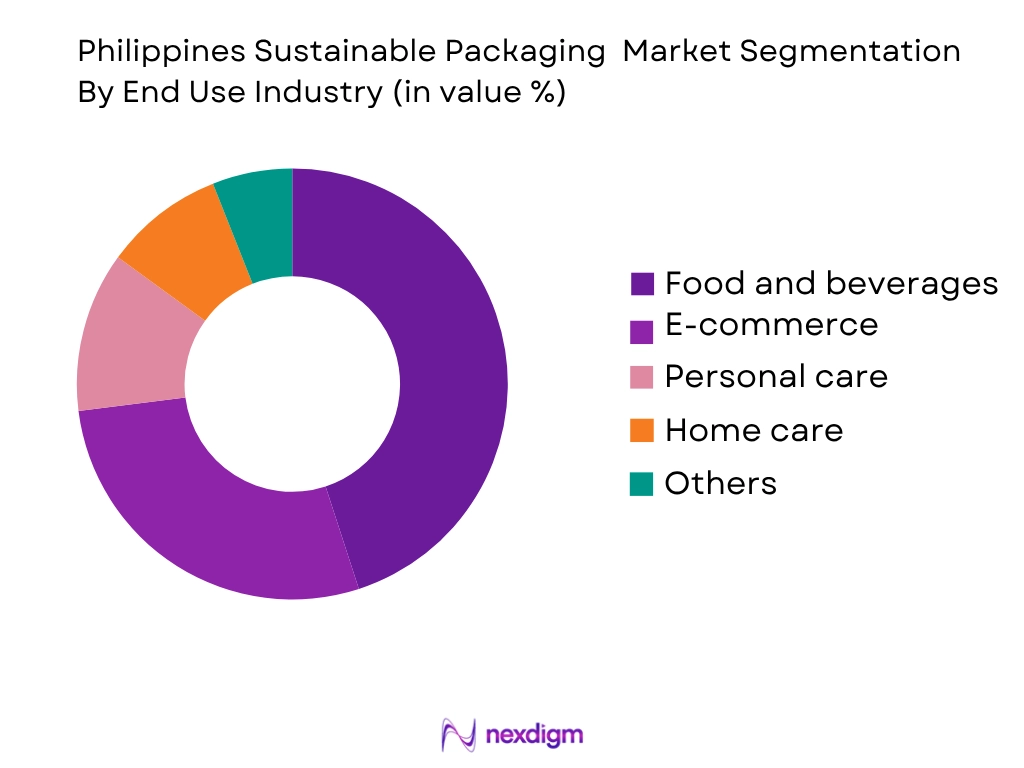
The market is segmented by end-use industry into food and beverages, personal care and cosmetics, home care, pharmaceuticals, retail and e-commerce, foodservice, electronics and industrial products. Food and beverages represent the dominant application because packaged foods, bottled drinks, dairy products, snacks, sauces, fresh produce and takeaway meals generate recurring demand for primary, secondary and transport packaging. The category uses corrugated cases, recyclable bottles, metal cans, returnable glass, paperboard cartons, mono-material pouches and moulded-fibre trays. Food safety, barrier performance, shelf-life preservation and resistance to moisture or grease influence the pace at which conventional structures can be replaced. Beverage producers also face significant exposure to Extended Producer Responsibility requirements because bottles, caps, labels, shrink films and multipack materials form part of their plastic footprint. Retail and e-commerce create strong demand for right-sized corrugated boxes, paper mailers and fibre cushioning, while personal-care and home-care brands increasingly adopt refill pouches, recycled-content bottles and concentrated product formats. The figures below are report placeholders.
Competitive Landscape
The Philippines sustainable packaging market includes a combination of integrated domestic packaging manufacturers, multinational flexible-packaging companies, paper and corrugated suppliers, beverage-carton specialists and emerging bio-based packaging providers. San Miguel Yamamura Packaging has a broad local portfolio spanning glass, plastics, metal, PET, flexible packaging and paper. Amcor and Huhtamaki contribute flexible-material and fibre-based capabilities, while Oji and SCG Packaging are important in paper, corrugated and recovered-fibre systems. Competition increasingly depends on recycled-content capability, design-for-recycling expertise, EPR documentation, food-contact performance and access to post-consumer recovery partners.
| Company | Establishment year | Headquarters | Sustainable materials | Core packaging formats | Recycling or circularity capability | End-use coverage | Philippines manufacturing relevance | EPR support capability |
| San Miguel Yamamura Packaging Corporation | 1938 | Mandaluyong City, Philippines | ~ | ~ | ~ | ~ | ~ | ~ |
| Amcor | 1860 | Zurich, Switzerland | ~ | ~ | ~ | ~ | ~ | ~ |
| Huhtamaki | 1920 | Espoo, Finland | ~ | ~ | ~ | ~ | ~ | ~ |
| Oji Holdings | 1873 | Tokyo, Japan | ~ | ~ | ~ | ~ | ~ | ~ |
| SCG Packaging | 1965 | Bangkok, Thailand | ~ | ~ | ~ | ~ | ~ | ~ |
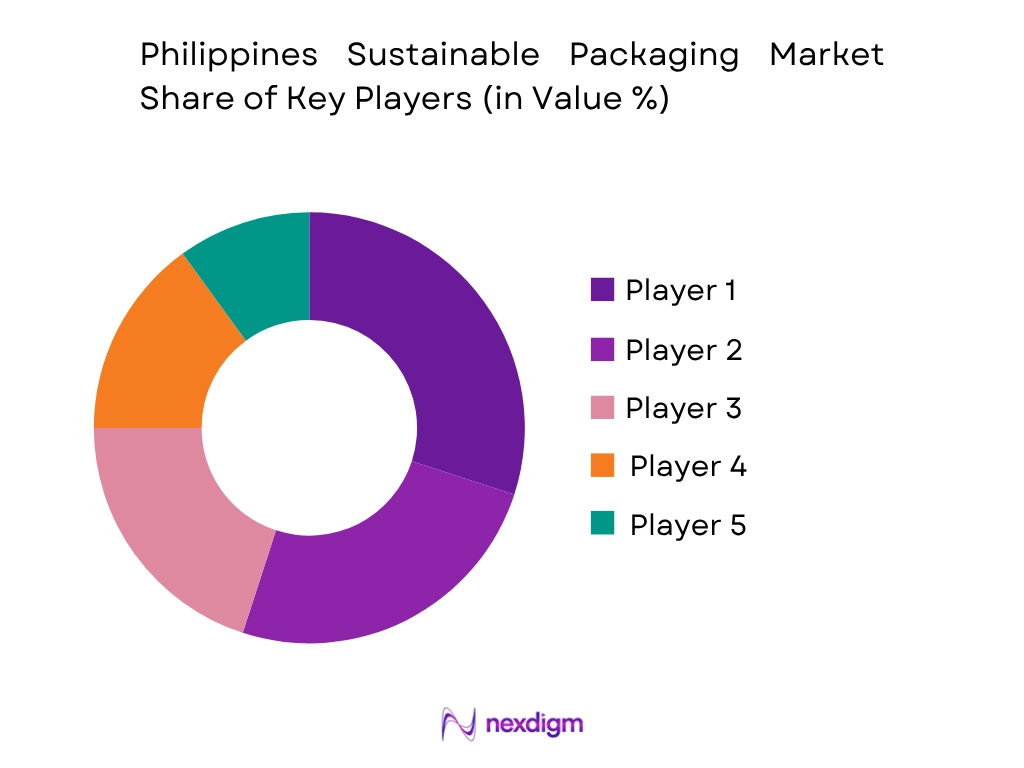
Philippines Sustainable Packaging Market Analysis
Growth Drivers
Extended Producer Responsibility and Mandatory Packaging Redesign
The Extended Producer Responsibility framework is accelerating the transition from difficult-to-recover packaging toward recyclable, reusable, refillable and recycled-content alternatives. Republic Act No. 11898 requires covered enterprises to recover 40 units for every 100 units of plastic packaging introduced during the 2024 compliance period, increasing to 50 units in 2025 and 60 units in 2026. The regulation applies to large enterprises whose products use flexible plastics, rigid containers, sachets, labels, laminates, caps and other plastic packaging components. These obligations make packaging weight, resin selection, component compatibility and end-of-life management measurable procurement factors.
Urban Consumption, E-Commerce and Concentrated Recovery Potential
Urbanization is supporting sustainable packaging demand by concentrating packaged-goods consumption, retail distribution, foodservice activity and recoverable material within major cities. The Philippine Statistics Authority recorded 62.22 million urban residents in 2024, an increase of 3.29 million people from the previous census benchmark. The total population reached 112.73 million, meaning more than half of the country’s consumers lived in urban barangays where supermarkets, convenience stores, restaurants, delivery platforms and online retail generate high volumes of bottles, pouches, cartons, cups, mailers and corrugated cases. Metro Manila, CALABARZON and Central Luzon provide especially favourable conditions for sustainable packaging because their combined population exceeds 43.9 million people. These regions also contain consumer-goods plants, packaging converters, ports, warehouses, materials-recovery facilities, junk shops and recycling operations. High geographic density improves the economics of recovering paper, PET bottles, aluminium cans and reusable transport packaging because collection vehicles can aggregate larger quantities over shorter routes. By contrast, low-density material recovery often produces insufficient volume to justify sorting, washing or recycling.
Market Challenges
Limited Recovery Infrastructure and Archipelagic Material Logistics
The Philippines’ geographic structure creates a major challenge for sustainable packaging because collecting a package is often more difficult than manufacturing or distributing it. The country had 112,729,484 residents in 2024 spread across Luzon, Visayas, Mindanao and numerous smaller islands. Although 62.22 million people lived in urban barangays, approximately 50.51 million lived outside the urban classification. This dispersed population generates packaging waste in locations where aggregation volumes, transport links, baling capacity and recycling facilities may be limited. Paper, PET, polyethylene film, glass and aluminium have different logistics requirements. Loose PET bottles occupy substantial freight space unless compacted. Flexible films and sachets are lightweight but difficult to consolidate into commercially meaningful loads. Glass has established reuse and recycling potential but is heavy, breakable and expensive to move between islands. Paper packaging can lose fibre quality when contaminated by food, oil or moisture. Compostable packaging requires a segregated organic-waste stream and suitable processing infrastructure; otherwise, it may enter landfill or mixed waste together with conventional materials.
Material Performance, Feedstock Quality and Conversion Complexity
Sustainable packaging must reduce environmental impact without compromising food safety, shelf life, transport strength or consumer convenience. This creates a technical challenge because simplified and renewable structures do not automatically match the performance of conventional multilayer packaging. Foods and beverages may require resistance to oxygen, moisture, grease, light, heat or carbonation. Personal-care and household products need chemical compatibility and leak-resistant closures. E-commerce packaging must withstand compression, vibration and handling across inter-island distribution routes. The domestic demand base magnifies this challenge. The Philippines supported 112.73 million consumers in 2024 and an economy valued by the World Bank at US$461.62 billion. GDP per capita was US$3,984.8, while gross national income per capita reached US$4,470. Packaging manufacturers must therefore serve both high-volume mass-market products and premium brands while maintaining affordability, line efficiency and regulatory compliance.
Market Opportunities
Food-Grade Recycling, Design-for-Recycling and Digital Traceability
The shift toward verified circularity creates an opportunity for investment in food-grade recycling, mono-material packaging and digital material tracking. The Philippines had 112,729,484 residents in 2024, including 62.22 million urban residents, generating a large recurring stream of PET bottles, rigid polyolefin containers, paperboard, aluminium and other packaging materials. These current material flows provide the feedstock base for future packaging growth when collection, sorting and processing quality can be improved. The EPR schedule creates immediate commercial demand. Obliged enterprises must recover 40 units per 100 units of covered plastic packaging for 2024, increasing to 50 units in 2025 and 60 units in 2026. Companies therefore need packaging structures that can be recognized by recycling systems and reliable records proving the quantity recovered. Suppliers can respond with clear PET bottles, compatible caps, reduced label coverage, washable adhesives, unpigmented containers and mono-material polyethylene or polypropylene pouches.
Agricultural-Fibre Packaging and Regional Circular Manufacturing
The Philippines has an opportunity to develop packaging based on locally available agricultural fibres while expanding conversion and recovery capacity outside Metro Manila. Paper substitutes and moulded-fibre structures can potentially use bagasse, bamboo, abaca, banana fibre, coconut residues, pineapple leaves and rice straw for trays, foodservice containers, protective inserts and selected secondary packaging. These materials can reduce dependence on imported substrates when technical performance, food-contact safety and fibre consistency are adequately controlled. Current population distribution supports regional manufacturing. CALABARZON contained 16,933,234 residents, the National Capital Region approximately 14.00 million, and Central Luzon 12.99 million in 2024. More than 68.8 million people lived outside these three largest regions, creating substantial packaged-goods demand across Visayas, Mindanao and other parts of Luzon. Regional fibre-processing, moulded-pulp, corrugated and recycling facilities could shorten transport routes between agricultural feedstock, packaging plants and end users.
Future Outlook
The Philippines sustainable packaging market is forecast to expand at approximately ~% CAGR during the forecast period. Growth will be driven by EPR compliance, increasing recycled-content adoption, plastic-reduction initiatives and demand for fibre-based e-commerce and foodservice packaging. Large consumer-product companies will increasingly evaluate packaging on material weight, recoverability, recycled content and end-of-life infrastructure rather than procurement cost alone. Republic Act No. 11898 institutionalized Extended Producer Responsibility for plastic packaging and requires covered large enterprises to establish programmes for recovering their plastic footprint. Department of Environment and Natural Resources reporting systems are intended to standardize EPR submissions and waste-recovery documentation. The framework will support demand for packaging suppliers capable of supplying material declarations, packaging weights, resin identification, recycled-content data and design-for-recycling guidance.
Major Players
- San Miguel Yamamura Packaging Corporation
- Amcor Flexibles Philippines Corporation
- Huhtamaki Philippines, Inc.
- Oji Containers Philippines, Inc.
- SCG Packaging and United Pulp and Paper Co., Inc.
- Tetra Pak Philippines, Inc.
- SIG Combibloc Philippines, Inc.
- Can Asia, Inc.
- Filpet, Incorporated
- Bestpak Packaging Solutions, Inc.
- Flexible Packaging Products Corporation
- Flexo Manufacturing Corporation
- Papercon Philippines, Inc.
- McBride Corporation
- Shrinkpack Philippines Corporation
Key Target Audience
- Sustainable packaging manufacturers and converters
- Food, beverage and consumer-goods brand owners
- Packaging resin, paperboard and agricultural-fibre suppliers
- Recycling, materials-recovery and waste-management companies
- Producer responsibility organizations
- Retail, e-commerce and foodservice operators
- Investments and venture capitalist firms
- Government and regulatory bodies
Research Methodology
Step 1: Identification of Key Variables
The initial phase constructs an ecosystem map covering material suppliers, packaging converters, brand owners, producer responsibility organizations, collectors, aggregators and recyclers. Critical variables include packaging units, substrate consumption, recycled content, conversion capacity, plastic footprint, recovery volumes and end-use demand. Definitions distinguish recyclable, reusable, refillable, compostable, bio-based and recycled-content packaging.
Step 2: Market Analysis and Construction
Historical market demand is analysed through packaged-goods production, converter revenues, material consumption, import–export flows and domestic manufacturing capacity. The top-down model converts end-use packaging demand into sustainable material consumption. The bottom-up model aggregates revenue from paper, plastic, glass, metal, fibre and flexible-packaging suppliers before reconciling results through unit-weight and material-yield analysis.
Step 3: Hypothesis Validation and Expert Consultation
Market hypotheses are validated through computer-assisted telephone interviews with packaging manufacturers, brand owners, recyclers, material suppliers and EPR programme operators. Interviews assess material substitution, recycled-content availability, recovery economics, minimum order quantities, production utilization and regulatory compliance. Responses are normalized according to company scale, packaging format and end-use industry.
Step 4: Research Synthesis and Final Output
The final phase integrates government regulations, company disclosures, material-flow data and primary-industry findings. Market size is triangulated across packaging revenue, unit shipments and material tonnage. Forecast assumptions consider EPR obligations, packaged-goods demand, recycling capacity, material lightweighting and adoption of reuse or refill systems. Competitive positioning is validated against manufacturing capability and recovery partnerships.

- Executive Summary
- Research Methodology (Market Definitions and Assumptions, Sustainable Packaging Taxonomy, Abbreviations, Market Sizing Approach, Top-Down Analysis, Bottom-Up Converter Revenue Aggregation, Packaging Material Flow Assessment, Demand-Side Evaluation, Supply-Side Capacity Mapping, Import–Export Reconciliation, Primary Industry Interviews, EPR Compliance Validation, Data Triangulation, Forecasting Framework, Scenario Analysis, Limitations and Future Conclusions)

- Definition and Scope
- Market Evolution and Industry Genesis
- Timeline of Major Industry Developments
- Transition from Conventional to Sustainable Packaging
- Packaging Consumption and Waste Generation Linkages
- Circular Packaging Business Cycle
- Sustainable Packaging Value Chain Analysis

- Growth Drivers (Extended Producer Responsibility Compliance, Consumer Brand Sustainability Commitments, Expansion of E-Commerce, Growth of Food Delivery, Increasing Plastic Waste Recovery Requirements, Retailer Packaging Reduction Programmes, Export-Market Packaging Standards and Corporate Net-Zero Strategies)
- Market Challenges (Limited Food-Grade Recycled Resin Supply, Fragmented Waste Collection, Inadequate Composting Infrastructure, Multilayer Packaging Recovery Constraints, Imported Sustainable Material Dependence, Packaging Performance Trade-Offs, Greenwashing Risk and Archipelagic Reverse-Logistics Costs)
- Market Opportunities (Food-Grade Recycled PET Production, Agricultural-Fibre Packaging, Refill and Reuse Systems, Mono-Material Flexible Packaging, Moulded Fibre Foodservice Packaging, Regional Material Recovery Hubs, E-Commerce Paper Packaging and Digital Packaging Traceability)
- Market Trends (Paperization, Plastic Lightweighting, Recycled-Content Integration, Refill Pouch Adoption, Returnable Packaging, Fibre-Based Foodservice Packs, Water-Based Inks, Solvent-Free Laminates, Packaging SKU Rationalization and Design-for-Recycling)
- SWOT Analysis
- Porter’s Five Forces Analysis
- PESTLE Analysis

- By Market Value (2020-2025)
- By Packaging Units (2020-2025)
- By Sustainable Packaging Material Consumption (2020-2025)

- By Packaging Material (In Value %)
Recycled Paper and Paperboard
Virgin Certified Paper and Paperboard
Corrugated Fibreboard
Moulded Fibre and Pulp Packaging
Recycled Polyethylene Terephthalate
Recycled High-Density Polyethylene - By End-Use Industry (In Value %)
Food and Processed Food
Beverages
Personal Care and Cosmetics
Home Care and Household Products
Pharmaceuticals and Healthcare
Consumer Electronics and Appliances
Apparel, Footwear and Lifestyle Products - By Sales Channel (In Value %)
Direct Business-to-Business Sales
Authorized Packaging Distributors
Packaging Trading Companies
Digital Business-to-Business Platforms
Direct-to-Small-Business Packaging Sales
Contract Manufacturing and Co-Packing Channels - By Geographic Market (In Value %)
National Capital Region
CALABARZON
Central Luzon
Northern and Southern Luzon
Western Visayas
Central Visayas
Eastern Visayas

- Market Share of Major Players
- Cross Comparison Parameters (Sustainable Material Portfolio, Recycled-Content Packaging Capability, EPR Compliance and Reporting Support, Domestic Manufacturing Footprint, Design-for-Recycling Expertise, Reuse and Refill Packaging Solutions, Post-Consumer Recovery Partnerships, End-Use Industry Coverage)
- SWOT Analysis of Major Players
- Detailed Profiles of Major Companies
San Miguel Yamamura Packaging Corporation
Amcor Flexibles Philippines Corporation
Huhtamaki Philippines, Inc.
Oji Containers Philippines, Inc.
SCG Packaging and United Pulp and Paper Co., Inc.
Tetra Pak Philippines, Inc.
SIG Combibloc Philippines, Inc.
Can Asia, Inc.
Filpet, Incorporated
Bestpak Packaging Solutions, Inc.
Flexible Packaging Products Corporation
Flexo Manufacturing Corporation
Papercon Philippines, Inc. McBride Corporation
Shrinkpack Philippines Corporation

- Sustainable Packaging Demand Assessment
- Brand Owner Procurement Criteria
- Packaging Supplier Qualification
- Large Obliged Enterprise Analysis
- Micro, Small and Medium Enterprise Analysis
- Food and Beverage Manufacturer Requirements

- By Market Value (2026-2035)
- By Packaging Units (2026-2035)
- By Sustainable Packaging Material Consumption (2026-2035)


 Request a Sample
 Ask for Customization
 Get a Quote
 Enquire Now