

 Download PDF
Market Overview
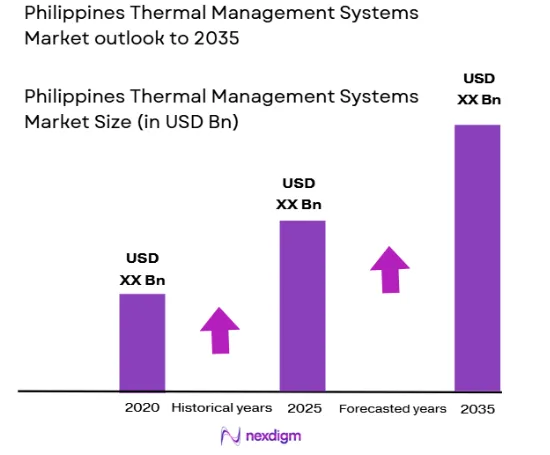
The Philippines Thermal Management Systems market is valued at approximately USD ~ billion based on a recent historical assessment, supported by increasing demand across automotive, electronics, and industrial sectors. Growth is driven by rising electric vehicle adoption, expansion of data centers, and increasing electronics manufacturing. The need for efficient temperature control in tropical climates further accelerates system deployment, particularly in battery cooling and high-performance computing environments.
Metro Manila, Cebu, and Calabarzon region dominate the Philippines Thermal Management Systems market due to strong industrial clusters, automotive assembly operations, and electronics manufacturing hubs. These regions benefit from better infrastructure, skilled labor availability, and proximity to ports and logistics networks. Additionally, increasing investments in energy, telecommunications, and commercial infrastructure strengthen demand for advanced cooling solutions across urban and industrialized zones.
Market Segmentation
By Product Type
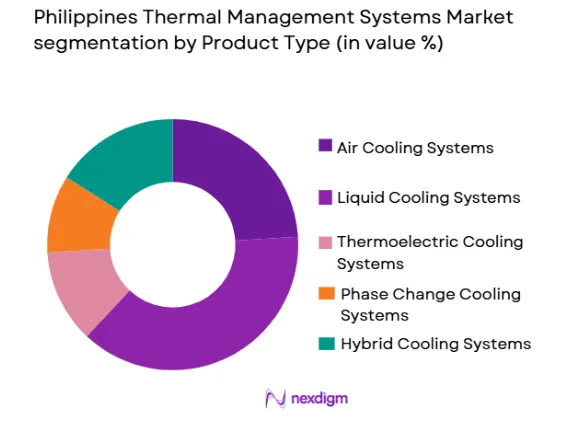
Philippines Thermal Management Systems market is segmented by product type into air cooling systems, liquid cooling systems, thermoelectric cooling systems, phase change cooling systems, and hybrid cooling systems. Recently, liquid cooling systems have a dominant market share due to their superior efficiency in high-performance applications such as electric vehicles and data centers. These systems provide better heat dissipation compared to traditional air-based methods, making them ideal for compact and high-density systems. Increasing adoption in EV battery cooling and industrial automation has further strengthened their dominance, supported by technological advancements and growing awareness regarding energy efficiency.
By End-Use
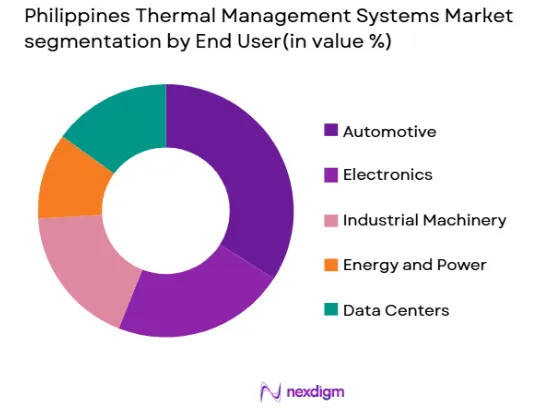
Philippines Thermal Management Systems market is segmented by end-use industry into automotive, electronics, industrial machinery, energy and power, and data centers. Recently, automotive has a dominant market share due to increasing vehicle production and growing adoption of electric vehicles requiring advanced battery cooling systems. Automotive manufacturers are integrating thermal systems to improve vehicle efficiency and safety, especially in high-temperature environments. The rise of local assembly operations and government support for EV adoption further enhances demand, making automotive the leading contributor within this segment.
Competitive Landscape
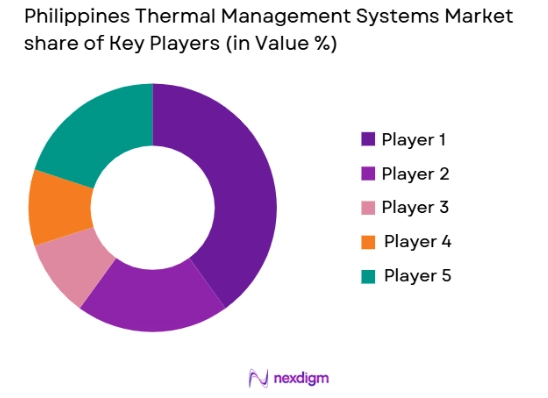
The Philippines Thermal Management Systems market is moderately consolidated, with global players maintaining strong technological advantages while regional firms focus on distribution and integration. Major companies influence pricing, innovation, and supply chains through established OEM relationships and continuous R&D investments. Strategic collaborations and localized manufacturing are shaping competitive positioning.
| Company Name | Establishment Year | Headquarters | Technology Focus | Market Reach | Key Products | Revenue | Application Focus |
| Denso Corporation | 1949 | Japan | ~ | ~ | ~ | ~ | ~ |
| Valeo | 1923 | France | ~ | ~ | ~ | ~ | ~ |
| Mahle GmbH | 1920 | Germany | ~ | ~ | ~ | ~ | ~ |
| Hanon Systems | 1986 | South Korea | ~ | ~ | ~ | ~ | ~ |
| Modine Manufacturing | 1916 | USA | ~ | ~ | ~ | ~ | ~ |
Philippines Thermal Management Systems Market Analysis
Growth Drivers
Rising Electric Vehicle Adoption and Battery Cooling Requirements
The increasing adoption of electric vehicles in the Philippines is significantly driving demand for advanced thermal management systems, particularly for battery cooling applications. As EV penetration expands, efficient temperature regulation becomes essential to ensure battery performance, longevity, and safety under tropical climate conditions. Automotive manufacturers are integrating liquid cooling technologies to address overheating challenges and improve energy efficiency. Government initiatives promoting cleaner transportation and incentives for EV adoption further support market growth. Additionally, the expansion of charging infrastructure increases the need for effective thermal systems within charging stations. The shift toward electrification is also encouraging innovation in compact and lightweight cooling solutions. Rising consumer awareness about sustainable mobility contributes to higher EV demand, indirectly boosting thermal system requirements. Furthermore, global automotive suppliers are strengthening their presence in the Philippines, enhancing technology transfer and product availability. Continuous advancements in battery technologies necessitate improved thermal management solutions, reinforcing market expansion.
Expansion of Data Centers and Electronics Manufacturing Infrastructure
The rapid growth of data centers and electronics manufacturing facilities in the Philippines is another major driver for the thermal management systems market. Increasing digitalization and cloud computing demand require advanced cooling solutions to maintain optimal operating conditions in high-density server environments. Data centers generate substantial heat, making efficient thermal management critical for system reliability and energy efficiency. The Philippines is emerging as a regional hub for electronics production, particularly semiconductors and consumer devices, which require precise temperature control during manufacturing processes. Investments from multinational companies are boosting infrastructure development and increasing demand for industrial cooling technologies. Government support for digital transformation and ICT infrastructure expansion further strengthens market growth. Additionally, rising internet penetration and digital services consumption contribute to the proliferation of data centers. Technological advancements in liquid cooling and immersion cooling solutions are enhancing efficiency and reducing energy consumption. The need for cost-effective and sustainable cooling systems continues to drive innovation and adoption across industries.
Market Challenges
High Cost of Advanced Thermal Management Technologies
The high cost associated with advanced thermal management systems remains a significant challenge for market growth in the Philippines. Technologies such as liquid cooling and thermoelectric systems require substantial initial investment, limiting adoption among small and medium enterprises. Many local industries rely on conventional cooling solutions due to budget constraints, slowing the transition toward more efficient technologies. Import dependency for high-end components further increases system costs, affecting overall affordability. Maintenance and operational expenses associated with advanced systems also pose financial challenges for end users. Limited availability of financing options for technology upgrades restricts widespread adoption across sectors. Additionally, fluctuations in raw material prices impact production costs and pricing strategies. The lack of economies of scale in the domestic market contributes to higher per-unit costs. Industries often prioritize cost-saving measures over efficiency improvements, delaying investments in modern thermal solutions. This financial barrier continues to hinder market penetration despite growing demand.
Technical Complexity and Integration Challenges Across Applications
The complexity involved in integrating thermal management systems across diverse applications presents another key challenge for the market. Different industries require customized solutions based on specific temperature control needs, making standardization difficult. Integration with existing systems often requires significant modifications, increasing implementation time and cost. Skilled labor shortages in advanced thermal system installation and maintenance further complicate adoption. Compatibility issues between components and system inefficiencies can arise if not properly designed and implemented. Rapid technological advancements necessitate continuous upgrades, posing challenges for companies with limited technical expertise. Additionally, the tropical climate introduces variability in environmental conditions, requiring robust and adaptable solutions. Lack of local technical expertise in specialized cooling technologies affects system performance and reliability. Training and capacity building are essential but require time and investment. These factors collectively slow down adoption rates and create barriers for new market entrants.
Opportunities
Growth in Renewable Energy Systems Requiring Thermal Regulation Solutions
The expansion of renewable energy systems in the Philippines presents significant opportunities for thermal management system providers. Solar and wind energy installations require efficient cooling systems to maintain performance and prevent overheating of critical components. Energy storage systems, particularly batteries used in renewable applications, depend heavily on thermal regulation for optimal efficiency and longevity. Government initiatives promoting renewable energy adoption are increasing investments in power infrastructure. This creates demand for advanced thermal solutions across generation, storage, and distribution stages. Integration of smart grid technologies further enhances the need for temperature monitoring and control systems. Technological innovations in cooling systems tailored for renewable applications are gaining traction. Additionally, increasing focus on sustainability drives the adoption of eco-friendly cooling technologies. Partnerships between energy companies and thermal system providers are expanding market opportunities. The shift toward decentralized energy systems also supports demand for compact and efficient thermal solutions.
Adoption of Smart and IoT Enabled Thermal Management Systems
The integration of smart technologies and IoT into thermal management systems is creating new growth opportunities in the Philippines market. Smart systems enable real-time monitoring and predictive maintenance, improving system efficiency and reducing downtime. Industries are increasingly adopting digital solutions to optimize operations and enhance energy efficiency. IoT-enabled thermal systems provide data-driven insights, allowing better temperature control and system performance. The growing trend of Industry 4.0 adoption supports the integration of advanced cooling technologies with automation systems. Smart cooling solutions are particularly beneficial in data centers, manufacturing plants, and commercial buildings. Increased awareness about energy conservation and operational efficiency drives demand for intelligent systems. Technological advancements are making these solutions more accessible and cost-effective. Collaboration between technology providers and industrial players is accelerating innovation. The demand for connected and automated systems continues to expand, offering long-term growth potential.
Future Outlook
The Philippines Thermal Management Systems market is expected to experience steady growth driven by increasing electrification, digitalization, and industrial expansion. Technological advancements in liquid cooling and smart thermal systems will enhance efficiency and adoption. Government initiatives supporting EVs and renewable energy will further strengthen demand. Expanding data center infrastructure and electronics manufacturing will continue to create opportunities. Overall, innovation and sustainability trends will shape market evolution over the coming years.
Major Players
Step 1: Identification of Key Variables
Critical market variables including product types, end-use industries, technology adoption rates, and regional demand patterns were identified through secondary research and industry databases.
Step 2: Market Analysis and Construction
Comprehensive analysis was conducted using historical data, supply-demand mapping, and sectoral insights to construct the market framework and segmentation structure.
Step 3: Hypothesis Validation and Expert Consultation
Industry experts, manufacturers, and stakeholders were consulted to validate assumptions, refine data points, and ensure accuracy in market representation.
Step 4: Research Synthesis and Final Output
All data points were consolidated, analyzed, and structured into a coherent report, ensuring consistency, reliability, and actionable insights for stakeholders.

- Executive Summary
- Research Methodology (Definitions, Scope, Industry Assumptions, Market Sizing Approach, Primary & Secondary Research Framework, Data Collection & Verification Protocol, Analytic Models & Forecast Methodology, Limitations & Research Validity Checks)

- Market Definition and Scope
- Value Chain & Stakeholder Ecosystem
- Regulatory / Certification Landscape
- Sector Dynamics Affecting Demand
- Strategic Initiatives & Infrastructure Growth

- Growth Drivers
Rising adoption of electric vehicles increasing demand for efficient cooling systems
Expansion of data centers requiring advanced thermal management solutions
Growth in electronics manufacturing driving need for heat dissipation technologies
Industrial automation increasing reliance on temperature control systems
Government initiatives promoting energy efficiency across sectors - Market Challenges
High cost of advanced thermal management technologies limiting adoption
Complex integration requirements across diverse applications
Limited local manufacturing capabilities for specialized components
Supply chain disruptions affecting availability of raw materials
Technical challenges in maintaining system efficiency under varying climates - Market Opportunities
Increasing investments in EV infrastructure creating demand for battery cooling systems
Adoption of smart thermal systems with IoT integration across industries
Growth in renewable energy systems requiring temperature regulation solutions - Trends
Shift toward liquid cooling systems in high performance applications
Integration of AI driven thermal monitoring technologies
Rising use of lightweight materials to improve system efficiency
Development of compact and modular cooling solutions
Increasing focus on sustainable and eco friendly refrigerants - Government Regulations & Defense Policy
Energy efficiency standards for industrial and automotive cooling systems
Environmental regulations on refrigerants and emissions
Incentives for local manufacturing and technology adoption - SWOT Analysis
- Stakeholder and Ecosystem Analysis
- Porter’s Five Forces Analysis
- Competition Intensity and Ecosystem Mapping

- By Market Value, 2020-2025
- By Installed Units, 2020-2025
- By Average System Price, 2020-2025
- By System Complexity Tier, 2020-2025

- By System Type (In Value%)
Air Cooling Systems
Liquid Cooling Systems
Phase Change Cooling Systems
Thermoelectric Cooling Systems
Hybrid Thermal Management Systems - By Platform Type (In Value%)
Passenger Vehicles
Commercial Vehicles
Electric Vehicles
Industrial Equipment
Consumer Electronics - By Fitment Type (In Value%)
OEM Installed Systems
Aftermarket Retrofits
Integrated Modular Systems
Standalone Units
Customized Thermal Solutions - By EndUser Segment (In Value%)
Automotive Manufacturers
Electronics Manufacturers
Industrial Machinery Producers
Energy and Power Sector
Data Center Operators - By Procurement Channel (In Value%)
Direct OEM Contracts
Authorized Distributors
Online Procurement Platforms
Government Tenders
Third Party Integrators - By Material / Technology (in Value %)
Aluminum Based Heat Exchangers
Copper Based Cooling Systems
Advanced Polymer Composites
Nanofluid Cooling Technology
Smart Sensor Integrated Systems

- Market structure and competitive positioning
- Market share snapshot of major players
- Cross Comparison Parameters (Product Portfolio, Technology Integration, Pricing Strategy, Regional Presence, Manufacturing Capability, R&D Investment, Customer Base, Energy Efficiency, System Reliability, After Sales Support)
- SWOT Analysis of Key Players
- Pricing & Procurement Analysis
- Key Players
Denso Philippines Corporation
Valeo Thermal Systems Philippines
Mahle Philippines Automotive Parts
Hanon Systems Philippines
Bosch Automotive Systems Philippines
Modine Manufacturing Philippines
Delphi Technologies Philippines
Sanden International Philippines
Calsonic Kansei Philippines
Eberspächer Climate Control Systems Philippines
Aptiv Thermal Solutions Philippines
Johnson Electric Cooling Systems Philippines
Keihin Thermal Systems Philippines
Marelli Automotive Lighting and Thermal Philippines
Gentherm Asia Pacific Philippines

- Automotive sector increasingly adopting advanced cooling for EV batteries and engines
- Electronics industry requiring compact and efficient heat management solutions
- Industrial sector focusing on process optimization through temperature control
- Data centers prioritizing energy efficient cooling to reduce operational costs

- Forecast Market Value, 2026-2035
- Forecast Installed Units, 2026-2035
- Price Forecast by System Tier, 2026-2035
- Future Demand by Platform, 2026-2035


 Request a Sample
 Ask for Customization
 Get a Quote
 Enquire Now