
 Download PDF
Market Overview
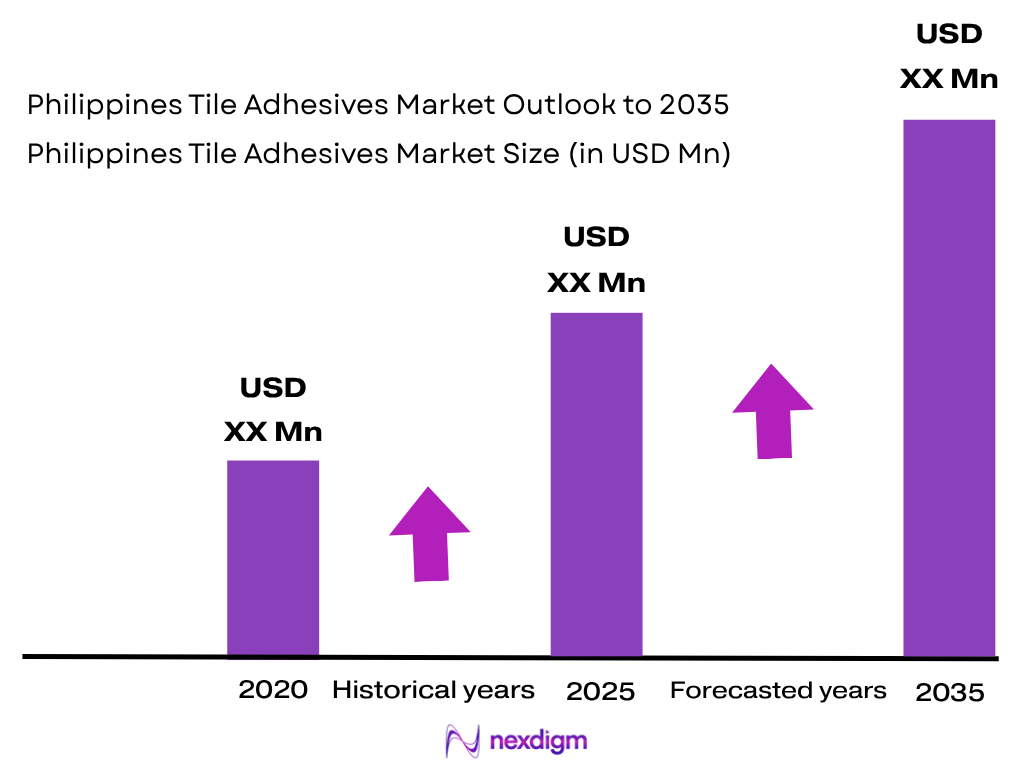
The Philippines Tile Adhesives Market is valued at approximately ~USD XX million, supported by residential construction, commercial development, renovation and growing factory-mixed mortar adoption. Across the latest two annual observations, approved residential constructions increased from 112,399 to 116,427, while residential floor area expanded from 18.13 million m² to 19.75 million m². Alteration and repair permits also increased from 12,875 to 13,997, strengthening replacement and tile-on-tile adhesive demand.
Metro Manila, CALABARZON, Central Luzon, Metro Cebu and Metro Davao dominate the Philippines Tile Adhesives Market because they combine dense housing, condominiums, commercial construction and renovation activity. CALABARZON recorded 40,332 constructions in the earlier observation and 41,471 subsequently, while Central Luzon increased from 18,583 to 22,824 and Central Visayas moved from 18,631 to 19,585, reinforcing demand around the country’s major urban and industrial corridors.
Market Segmentation
By Adhesive Technology
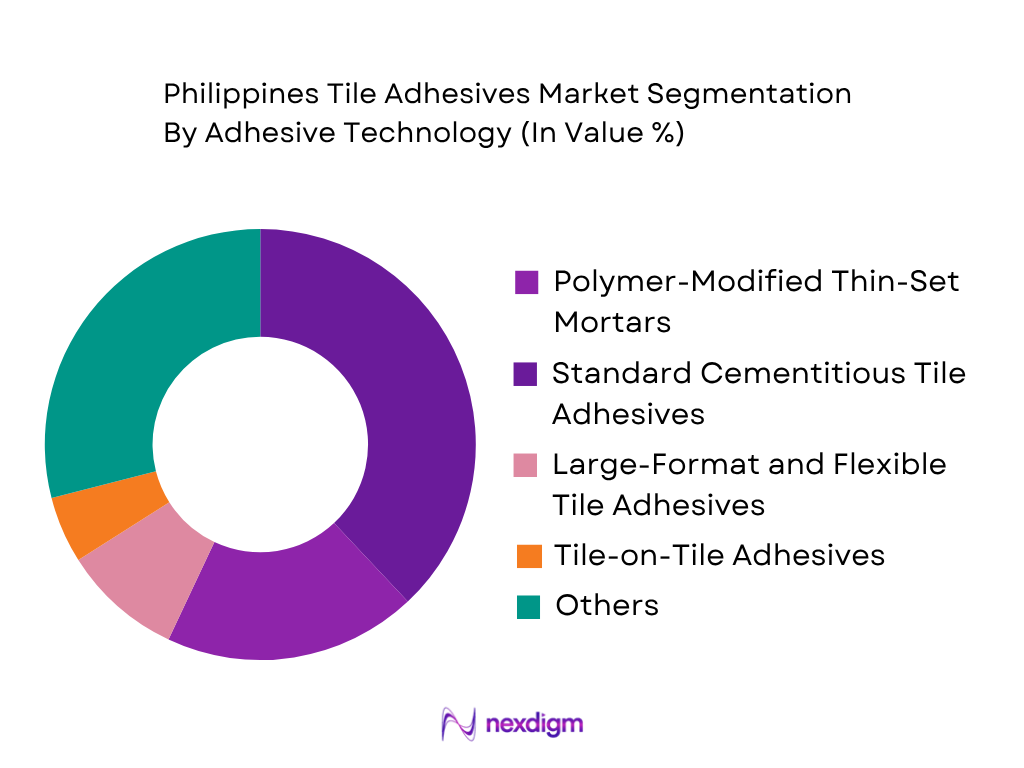
The Philippines Tile Adhesives Market is segmented into standard cementitious adhesives, polymer-modified cementitious adhesives, heavy-duty adhesives, flexible products, low-dust systems, large-format tile adhesives, tile-on-tile products, rapid-setting adhesives and reaction-resin systems. Polymer-modified cementitious adhesives hold the dominant modeled market share because they address the broadest range of ceramic, porcelain, residential and commercial installations while providing stronger bond performance and better workability than basic cement-sand mortar. Local product portfolios demonstrate this transition. ABC’s Heavy-Duty Tile Adhesive is designed for all tile sizes, low-porosity tiles, pools, outdoor applications and heavy-foot-traffic areas, with a stated tensile adhesive strength of 300 PSI. Sika Philippines now offers distinct C1, C2T and C2TS1 tile-setting products, showing that the market has developed a clear performance hierarchy from standard interior mortars to premium flexible systems.
By Tile and Stone Type
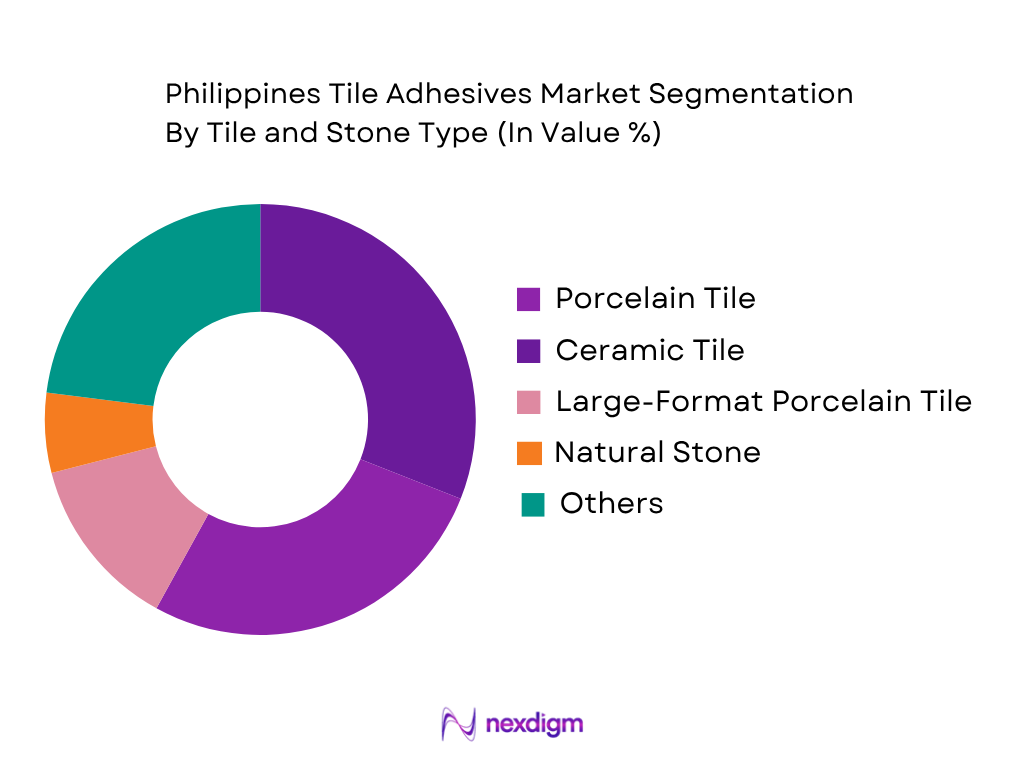
The Philippines Tile Adhesives Market is segmented into ceramic tiles, porcelain tiles, homogeneous tiles, large-format porcelain, natural stone, marble, granite, mosaics and existing tile surfaces. Ceramic and porcelain tiles represent the dominant modeled demand base, supported by extensive residential floor and wall applications together with increasing specification of low-porosity and larger-format products. Porcelain and larger tiles require more consistent adhesive coverage, higher tensile strength and better accommodation of substrate movement than traditional small-format ceramic installations. ABC’s Heavy-Duty system is specifically positioned for low-porosity and large-format tiles, while Boysen’s Konstrukt Tileworks recommends additional adhesion promoter for tiles measuring 60 cm × 60 cm and above and for tile-on-tile applications. These current technical offerings indicate that Philippine installation practices are becoming increasingly differentiated by tile dimension and surface absorption rather than using one universal cementitious mortar for every application.
Competitive Landscape
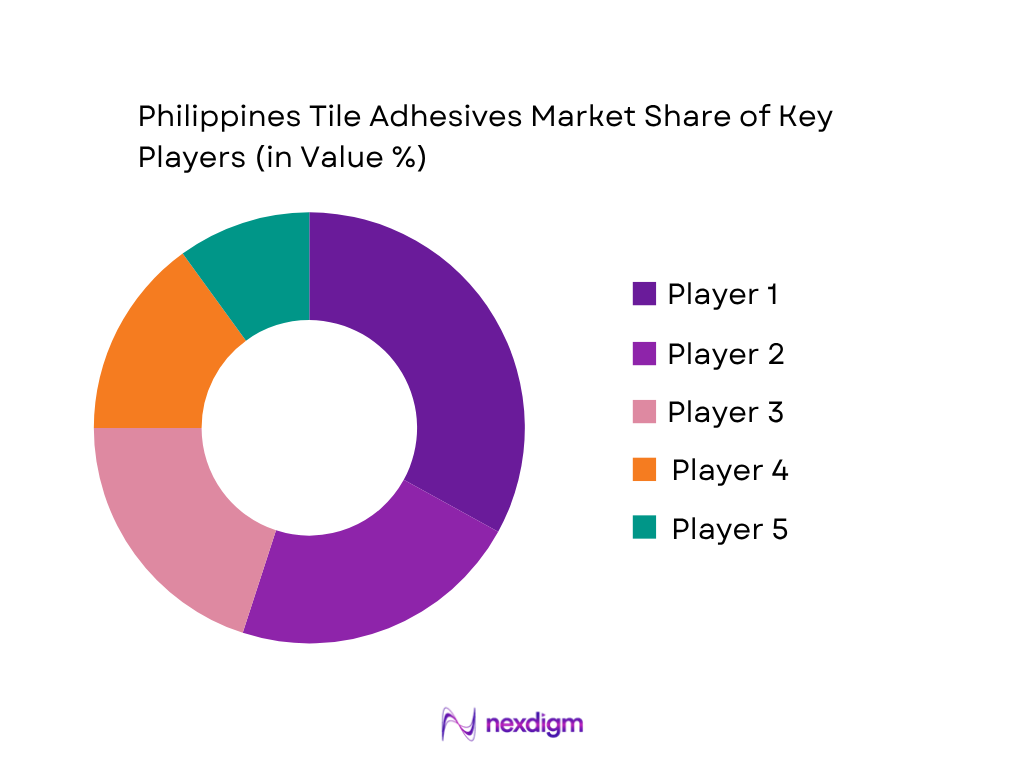
The Philippines Tile Adhesives Market combines a strong domestic construction-chemical manufacturing base with multinational tile-installation specialists. ABC, Sika, MAPEI, Saint-Gobain Weber and LATICRETE compete through cementitious technology, heavy-duty and large-format capability, wet-area systems, contractor support and regional distribution. Competition is increasingly shifting from basic bagged mortar toward complete systems covering substrate preparation, waterproofing, tile fixing, grouting and technical installation guidance.
| Major Player | Establishment Year | Headquarters | Standard / Polymer-Modified Portfolio | Large-Format / Heavy-Duty Capability | Wet-Area & Pool Systems | Philippines Manufacturing / Supply | Renovation / Tile-on-Tile Capability | Technical & Contractor Support |
| Allgemeine Bau-Chemie Philippines / ABC | 1981 | Quezon City, Philippines | ~ | ~ | ~ | ~ | ~ | ~ |
| Sika | 1910 | Baar, Switzerland | ~ | ~ | ~ | ~ | ~ | ~ |
| MAPEI | 1937 | Milan, Italy | ~ | ~ | ~ | ~ | ~ | ~ |
| Saint-Gobain Weber | 1900 | France | ~ | ~ | ~ | ~ | ~ | ~ |
| LATICRETE | 1956 | Bethany, Connecticut, USA | ~ | ~ | ~ | ~ | ~ | ~ |
Philippines Tile Adhesives Market Analysis
Growth Drivers
Residential Construction Expansion and Condominium Development
Residential construction remains a primary growth driver for the Philippines Tile Adhesives Market because every new house, apartment and condominium adds tiled floors, bathrooms, kitchens and utility areas. Philippine Statistics Authority data show 116,427 residential constructions covering 19,748,190 m² of floor area in 2024, with approved construction value of PHP248.65 billion. Activity remained substantial in 2025, when 117,832 residential constructions covering 19,715,877 m² were approved. June 2026 alone recorded 11,392 residential constructions, including 9,272 single houses, demonstrating the continuing volume of potential tile-installation sites. This scale supports factory-mixed polymer-modified adhesives because standardized bagged formulations improve consistency across repetitive residential installations compared with variable site-batched cement-sand mortar. Porcelain and bathroom applications additionally increase requirements for controlled adhesion and water resistance. The macroeconomic setting reinforces this demand: the IMF records Philippine 2024 nominal GDP at USD461.6 billion, GDP per capita at USD4,089, population at 112.9 million, and gross international reserves at USD106.3 billion. The combination of sustained building approvals, a large population and expanding residential floor area provides a measurable base for organized tile adhesive consumption.
Commercial Construction, Porcelain Tiles and Large-Format Installation
Commercial and institutional construction is increasing demand for high-bond, large-format and heavy-duty tile adhesives because malls, hotels, offices, hospitals and mixed-use buildings typically require extensive tiled areas exposed to higher foot traffic than ordinary residential surfaces. PSA’s finalized 2025 data recorded 181,832 approved constructions covering 45,236,312 m², with total approved construction value reaching PHP601.42 billion, compared with 180,341 constructions and 42,837,581 m² in 2024. Even in June 2026, nationwide approved construction reached 17,081 projects, demonstrating continuing installation activity. Large-format tiles impose more demanding requirements on adhesive coverage, substrate flatness and bond strength. Philippine technical products already reflect this shift: locally marketed heavy-duty adhesives are specifically designed for low-porosity and large-format tiles, while installation guidance increasingly distinguishes tiles of 60 cm × 60 cm and above from standard applications. The IMF records 2024 gross fixed capital formation at PHP-linked national investment growth equivalent to a 6.3 annual change, nominal GDP of USD461.6 billion, GDP per capita of USD4,089, and population of 112.9 million. This construction and macroeconomic base supports continued migration toward application-specific tile-setting systems.
Market Challenges
Traditional Cement-Sand Mortar and Installation Variability
Traditional cement-sand mortar remains a significant competitive and technical challenge because many Philippine installations can still be executed through site-mixed methods, particularly in smaller residential projects where contractor familiarity may outweigh specification-led product selection. The scale of installation magnifies this issue: PSA recorded 116,427 residential projects and 19,748,190 m² of residential floor area in 2024, followed by 117,832 residential projects and 19,715,877 m² in 2025. In January 2026 alone, another 8,156 residential constructions covering 1,398,887 m² were approved. Across this large volume, incorrect water addition, inconsistent mortar ratios, inadequate substrate cleaning and insufficient tile coverage can produce hollow spots, poor adhesion and premature debonding. Large-format and low-porosity tiles are less tolerant of these errors, increasing the value of controlled factory-mixed formulations but also raising the training burden for applicators. Macroeconomic scale further underscores the challenge: IMF data place Philippine 2024 nominal GDP at USD461.6 billion, GDP per capita at USD4,089, population at 112.9 million, and gross reserves at USD106.3 billion. Organized adhesive suppliers therefore must compete not only against other brands but against entrenched installation habits across a very large residential construction base.
Large-Format Installation, Moisture Exposure and Renovation Constraints
Large-format installation and moisture-intensive applications create another market-specific challenge because the Philippines combines humid conditions, wet-area construction and growing use of larger porcelain surfaces. PSA recorded 13,997 alteration and repair projects in 2024, demonstrating a meaningful renovation channel where contractors often work within occupied homes, condominiums and commercial properties. In December 2025 alone, 858 alteration and repair permits were recorded, while overall construction during that month still reached 11,411 projects. These environments require careful substrate inspection and often restrict drying time, work space and demolition activity. Large-format tile installation further raises execution risk because incomplete adhesive transfer or uneven substrates can cause lippage and hollow areas. Current Philippine product guidance distinguishes heavy-duty installation for tiles of 60 cm × 60 cm and above, reinforcing the fact that larger tile dimensions require different fixing practices from traditional small-format ceramics. The macroeconomic backdrop remains large enough for these quality issues to matter at scale: the IMF records 2024 nominal GDP of USD461.6 billion, GDP per capita of USD4,089, population of 112.9 million, and USD106.3 billion of gross reserves. The challenge for suppliers is therefore to pair products with installer education, surface-preparation guidance and wet-area system compatibility.
Market Opportunities
High-Bond Polymer-Modified and Large-Format Tile Adhesives
High-bond polymer-modified and large-format tile adhesives represent a strong future opportunity because current construction activity already provides a substantial addressable installation base. PSA finalized 180,341 approved constructions covering 42,837,581 m² in 2024 and 181,832 constructions covering 45,236,312 m² in 2025. Residential projects alone numbered 117,832 in 2025, while June 2026 added 11,392 residential constructions within a single month. As developers and homeowners use more porcelain and larger tiles, these projects increasingly require products with higher tensile adhesion, better transfer and stronger resistance to movement than basic mortar. Philippine product portfolios already differentiate heavy-duty systems for low-porosity and large-format tile, showing that the technical category is established and can expand further as specification awareness improves. The country’s macroeconomic fundamentals provide additional support: IMF data record Philippine 2024 nominal GDP at USD461.6 billion, GDP per capita at USD4,089, population at 112.9 million, and gross reserves at USD106.3 billion. These current construction volumes and economic indicators create a strong platform for future growth of C2-type, flexible and large-format adhesive systems without requiring speculative future construction statistics.
Tile-on-Tile, Low-Dust and Provincial Distribution Expansion
Tile-on-tile renovation and low-dust adhesives offer a future growth route as the Philippines’ existing building stock generates increasing refurbishment demand while construction expands beyond Metro Manila. PSA recorded 13,997 alteration and repair projects in 2024, with approved value of approximately PHP43.05 billion, establishing a current renovation base for high-bond systems that can reduce demolition and installation downtime. The distribution opportunity is also broad: nationwide construction increased to 181,832 projects in 2025, and June 2026 alone added 17,081 approved constructions. Provincial markets are especially relevant because residential building dominates national permit volumes, meaning hardware dealers and construction-material distributors can extend organized adhesive penetration into fast-growing secondary cities rather than relying only on metropolitan projects. Low-dust products also address practical constraints in occupied homes, hospitals, condominiums and commercial interiors by reducing airborne material during mixing. The macroeconomic platform remains supportive: the IMF records 2024 nominal GDP of USD461.6 billion, GDP per capita of USD4,089, population of 112.9 million, and gross international reserves of USD106.3 billion. These current renovation, construction and macroeconomic indicators support future expansion of tile-on-tile, low-dust and dealer-led provincial adhesive categories.
Future Outlook
The Philippines Tile Adhesives Market is forecast to expand at approximately ~X.X% CAGR during 2026–2035. Growth is expected to be driven by residential construction, regional urbanization, renovation, higher use of porcelain and large-format tiles, and progressive substitution of traditional site-mixed cement mortar with factory-formulated products. Residential building remains the strongest volume platform. PSA recorded 116,427 residential constructions covering 19.75 million m² in 2024, compared with 112,399 projects covering 18.13 million m² in 2023. Residential construction value increased from approximately PHP214.76 billion to PHP248.65 billion, indicating a substantial pipeline of floor and wall finishing activity.
Major Players
- Allgemeine Bau-Chemie Philippines / ABC
- Sika Philippines
- Davco Philippines / Sika
- MAPEI Philippines
- Saint-Gobain Weber Philippines
- LATICRETE Philippines
- Bostik Philippines / Arkema
- Fosroc Philippines / Saint-Gobain
- Pacific Paint (Boysen) / Konstrukt Tileworks
- Eurotiles Industrial Corporation
- Mariwasa Siam Ceramics
- Pioneer Adhesives
- Cementaid Philippines
- Terraco Philippines
- ParexGroup Philippines / Sika
Key Target Audience
- Tile Adhesive and Dry-Mix Mortar Manufacturers
- Ceramic, Porcelain and Natural Stone Manufacturers
- Real Estate Developers and General Contractors
- Tile, Sanitaryware and Hardware Distributors
- Tile and Interior Installation Contractors
- Home Improvement and Building Material Retailers
- Investments and Venture Capitalist Firms
- Government and Regulatory Bodies (Department of Trade and Industry–Bureau of Philippine Standards, Department of Public Works and Highways, Department of Human Settlements and Urban Development, Philippine Statistics Authority)
Research Methodology
Step 1: Identification of Key Variables
The initial phase involves constructing an ecosystem map covering cement and polymer suppliers, tile adhesive manufacturers, ceramic producers, hardware dealers, distributors, contractors and applicators. Secondary and proprietary research identifies critical variables including adhesive technology, tile format, construction permits, regional building activity, renovation intensity, local production and distribution structure.
Step 2: Market Analysis and Construction
Historical information for the Philippines Tile Adhesives Market is compiled using top-down and bottom-up approaches. Top-down analysis assesses approved residential and non-residential construction, renovation activity and regional construction concentration, while bottom-up modelling estimates adhesive consumption using tile area, coverage, application thickness, project type and packaged-adhesive penetration.
Step 3: Hypothesis Validation and Expert Consultation
Market hypotheses are validated through computer-assisted telephone interviews with tile adhesive producers, ceramic-tile companies, hardware dealers, construction-chemical distributors, contractors and tilers. These consultations test assumptions concerning polymer-modified product adoption, large-format requirements, low-dust demand, traditional mortar substitution and provincial distribution patterns.
Step 4: Research Synthesis and Final Output
The final phase triangulates PSA construction statistics, manufacturer technical documents, company manufacturing information and primary industry interviews. Bottom-up consumption estimates are reconciled with national and regional building activity to establish the final segmentation, competitive positioning, customer requirements and strategic outlook for the Philippines Tile Adhesives Market.

- Executive Summary
- Research Methodology (Market Definitions and Assumptions, Philippines Tile Adhesives Market Boundary, Cementitious Adhesive Classification, Polymer-Modified Adhesive Assessment, ISO 13007 Classification Mapping, C1 and C2 Adhesive Assessment, Slip-Resistance Assessment, Extended Open-Time Assessment, Large-Format Tile Adhesive Assessment, Porcelain and Low-Porosity Tile Assessment, Natural Stone Adhesive Assessment, Wet-Area Adhesive Assessment, Swimming Pool Adhesive Assessment, Tile-on-Tile Renovation Assessment, Local Dry-Mix Manufacturing Mapping, Tile Contractor Mapping, Dealer and Distributor Mapping, Construction Permit Analysis, Supply-Side Assessment, Demand-Side Assessment, Top-Down Market Sizing, Bottom-Up Market Sizing, Primary Industry Interviews, Data Triangulation, Forecasting Framework)

- Definition and Scope
- Evolution of Tile Fixing Practices in the Philippines
- Transition from Conventional Cement-Sand Mortar to Factory-Mixed Tile Adhesives
- Development of Polymer-Modified Cementitious Tile Adhesives
- Evolution of Ceramic and Porcelain Tile Installation
- Growth of Low-Porosity and Large-Format Tile Installation
- Development of Tile-on-Tile Renovation Systems
- Expansion of Flexible Exterior Tile Adhesives

- Growth Drivers (Residential Construction Expansion, Condominium Development, Porcelain Tile Adoption, Large-Format Tile Installation, Bathroom Renovation, Commercial Building Construction, Hospitality Development, Swimming Pool Construction, Factory-Mixed Mortar Adoption, Low-Dust Adhesive Adoption, Applicator Productivity Requirements, Organized Hardware and Home Improvement Retail)
- Market Challenges (Traditional Cement-Sand Mortar Competition, Low-Cost Regional Products, Incorrect Adhesive Selection, Poor Substrate Preparation, Incorrect Water Addition, Inadequate Adhesive Coverage, Applicator Skill Variation, Large-Format Tile Lippage, High-Humidity Installation Conditions, Imported Polymer Dependence, Product Quality Variation, Limited Technical Standard Awareness)
- Market Opportunities (High-Bond Polymer-Modified Adhesives, Large-Format Tile Adhesives, Low-Dust Tile Adhesives, Tile-on-Tile Renovation Systems, Swimming Pool Adhesives, Wet-Area Adhesives, Epoxy Tile Systems, Natural Stone Adhesives, Flexible Exterior Adhesives, Rapid-Setting Adhesives, Contractor Training, Provincial Distribution Expansion)
- Market Trends (Factory-Mixed Tile Adhesive Conversion, Large-Format Tile Growth, Low-Porosity Tile Installation, Low-Dust Formulations, Flexible Adhesives, Tile-on-Tile Renovation, Integrated Adhesive-Grout Systems, Waterproofing-Compatible Adhesives, Pool Adhesives, Technical Contractor Training, Application-Specific Product Selection)
- Government Regulations and Standards (DTI-BPS Construction Product Requirements, Philippine National Standards, ISO 13007 Alignment, Adhesive Performance Testing, Tensile Adhesion Strength, Open Time, Slip Resistance, Department of Public Works and Highways Specifications, National Building Code Requirements, Occupational Safety Requirements, Product Labelling)
- SWOT Analysis
- Porter’s Five Forces Analysis
- PESTLE Analysis
- Stakeholder Ecosystem

- By Market Value (2020-2025)
- By Tile Adhesive Consumption Volume (2020-2025)
- By Standard Cementitious Tile Adhesive Consumption (2020-2025)
- By Polymer-Modified Tile Adhesive Consumption (2020-2025)
- By Flexible Tile Adhesive Consumption (2020-2025)
- By Large-Format Tile Adhesive Consumption (2020-2025)

- By Adhesive Technology (In Value %)
Standard Cementitious Tile Adhesives
Polymer-Modified Cementitious Tile Adhesives
High-Bond Cementitious Tile Adhesives
Flexible Tile Adhesives
Large-Format Tile Adhesives
Low-Dust Tile Adhesives
Rapid-Setting Tile Adhesives
Tile-on-Tile Adhesives
Epoxy and Reaction-Resin Adhesives
Ready-to-Use Tile Adhesives
White Tile and Stone Adhesives
Mosaic Adhesive and Grout Systems - By Tile and Stone Type (In Value %)
Ceramic Tiles
Porcelain Tiles
Homogeneous Tiles
Large-Format Porcelain Tiles
Glazed Porcelain Tiles
Natural Stone
Marble
Granite
Mosaic Tiles
Glass Tiles
Decorative Stone
Existing Tile Surfaces - By Application (In Value %)
Internal Floor Tile Installation
Internal Wall Tile Installation
Bathroom and Wet-Area Installation
Kitchen Tile Installation
Large-Format Tile Installation
Tile-on-Tile Installation
Exterior Wall Tile Installation
Swimming Pool Tile Installation
Natural Stone Installation
Commercial Flooring Installation
Condominium Tile Installation
Hospitality Tile Installation
Institutional Tile Installation - By Performance Class (In Value %)
Standard Cementitious Adhesives
Improved Cementitious Adhesives
High-Tensile Adhesion Systems
Slip-Resistant Adhesives
Extended Open-Time Adhesives
Flexible Adhesives
Fast-Setting Adhesives
Water-Resistant Adhesives
Heavy-Duty Adhesives
Large-Format Tile Adhesives
Pool and Submerged-Service Adhesives
Low-Dust Adhesives - By Construction Activity (In Value %)
New Residential Construction
Condominium Construction
Commercial Construction
Hospitality Construction
Institutional Construction
Industrial Construction
Residential Renovation
Commercial Refurbishment
Bathroom Renovation
Tile Replacement
Tile-on-Tile Renovation
Repair and Alteration Works - By Building Type (In Value %)
Single-Family Houses
Condominiums
Townhouses
Commercial Offices
Shopping Malls and Retail Buildings
Hotels and Resorts
Hospitals and Healthcare Facilities
Educational Buildings
Industrial Facilities
Airports and Transportation Buildings
Government Buildings
Mixed-Use Developments

- Market Share of Major Players (By Philippines Revenue, Tile Adhesive Volume, Standard Cementitious Portfolio, Polymer-Modified Portfolio, Large-Format Tile Adhesive Portfolio, Low-Dust Portfolio, Wet-Area Exposure, Residential Exposure, Commercial Exposure, Manufacturing Footprint, Hardware and Dealer Network, Contractor Network, Project Specification Presence, Product Innovation, Technical Support)
- Cross Comparison Parameters (Tile and Stone Adhesive Portfolio Breadth, High-Bond Polymer-Modified and International-Standard Performance Capability, Large-Format Porcelain and Low-Porosity Tile Capability, Wet-Area Pool Tile-on-Tile and Natural Stone Application Capability, Philippines Dry-Mix Manufacturing and Local Supply Footprint, Hardware Tile Dealer Distributor and Applicator Network Reach, Low-Dust Rapid-Setting Flexible and Specialty Adhesive Technology Capability, Technical Specification Contractor Training and Jobsite Support Capability)
- SWOT Analysis of Major Players (Portfolio Breadth, Local Manufacturing, Distribution, Contractor Reach, Technical Positioning)
- Major Companies
Allgemeine Bau-Chemie Philippines / ABC
Sika Philippines
Davco Philippines / Sika
MAPEI Philippines
Saint-Gobain Weber Philippines
LATICRETE Philippines
Bostik Philippines / Arkema
Fosroc Philippines / Saint-Gobain
Pacific Paint (Boysen) / Konstrukt Tileworks
Eurotiles Industrial Corporation
Mariwasa Siam Ceramics
Pioneer Adhesives
Cementaid Philippines
Terraco Philippines
ParexGroup Philippines / Sika

- Property Developer Requirement Assessment
- General Contractor Requirement Assessment
- Tile Contractor Requirement Assessment
- Renovation Contractor Requirement Assessment
- Interior Fit-Out Contractor Requirement Assessment
- Hospitality Contractor Requirement Assessment
- Tile Manufacturer Partnership Assessment
- Hardware Dealer Requirement Assessment
- Tile and Sanitaryware Dealer Requirement Assessment

- By Market Value (2026-2035)
- By Tile Adhesive Consumption Volume (2026-2035)
- By Standard Cementitious Tile Adhesive Consumption (2026-2035)
- By Polymer-Modified Tile Adhesive Consumption (2026-2035)
- By Flexible Tile Adhesive Consumption (2026-2035)
- By Large-Format Tile Adhesive Consumption (2026-2035)


 Request a Sample
 Ask for Customization
 Get a Quote
 Enquire Now
