
 Download PDF
Market Overview
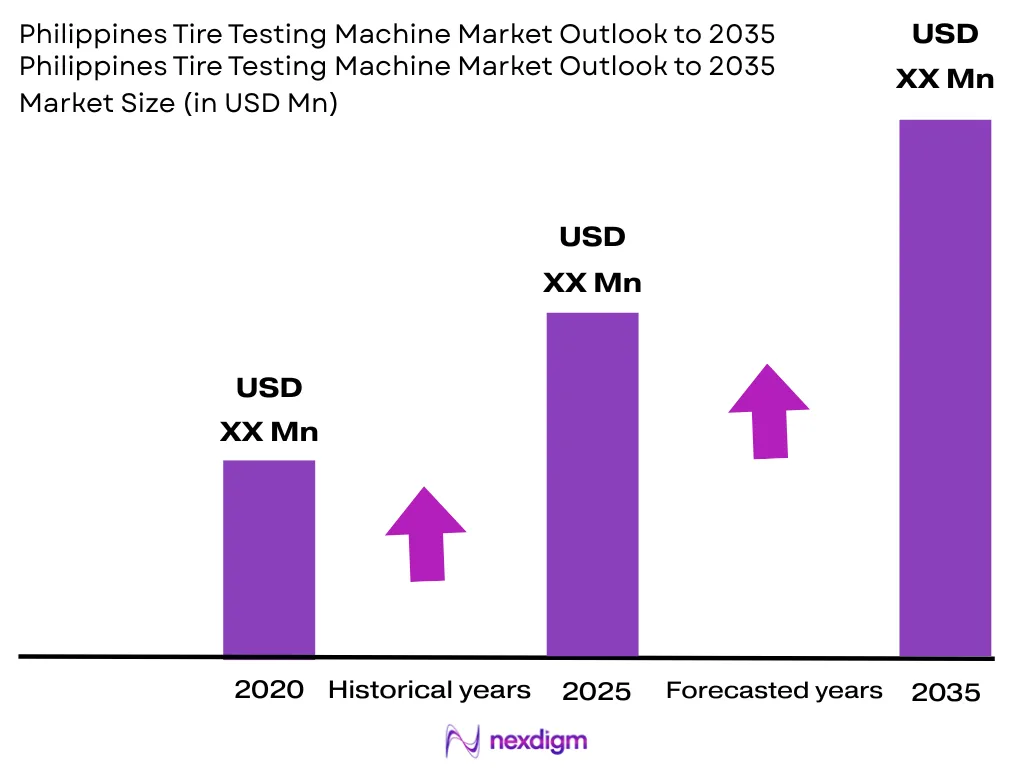
The Philippines Tire Testing Machine Market is valued at USD ~ Million in 2024 based on a five-year historical assessment, supported by the country’s mandatory Philippine National Standards (PNS) certification regime for pneumatic tires, expanding automotive vehicle registrations, and the growing role of the Bureau of Philippine Standards (DTI-BPS) Product Testing Laboratory in verifying imported and locally distributed tires. The Philippine tire market itself reached approximately USD ~ Billion in 2024, with automotive sales hitting a record 467,252 units through CAMPI-TMA member companies, an 8.7% year-on-year increase that continues to expand the vehicle parc requiring certified, quality-assured tires. Under DTI Department Administrative Order No. 11-03, Series of 2011, pneumatic tires are subject to mandatory PNS certification, requiring manufacturers and importers to secure either a Philippine Standard (PS) Quality Certification Mark or an Import Commodity Clearance (ICC) certificate, both of which depend on product test reports issued by DTI-BPS-recognized testing laboratories. This regulatory framework, combined with rising import volumes of passenger, commercial, and specialty tires, continues to sustain demand for tire testing machinery among testing laboratories, tire distributors, and quality-assurance-focused importers across the archipelago.
Market Segmentation
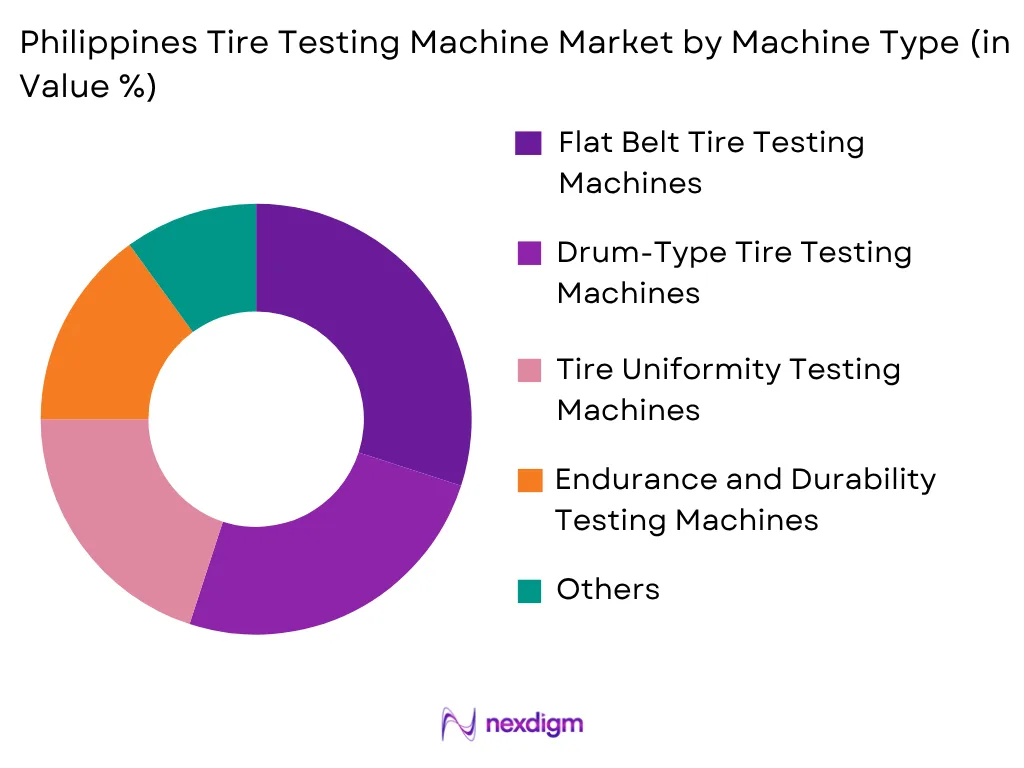
By Machine Type
Flat Belt Tire Testing Machines hold a leading share of the Philippines Tire Testing Machine Market, mirroring the global trend in which flat belt systems are projected to account for approximately 39% of tire testing machine market revenue in 2025 due to their versatility in dynamic tire testing simulations. These systems allow testing laboratories and quality-focused distributors in the Philippines to simulate real-world road conditions for uniformity, endurance, and rolling resistance evaluation without requiring the larger footprint associated with drum-type systems. Given the Philippines’ predominantly import-driven tire supply chain, flat belt machines are particularly valued by BPS-recognized testing laboratories and larger import-focused distributors seeking to verify compliance with PNS 34:2000 and related mandatory certification requirements across a wide range of tire categories, from passenger car tires to two-wheeler and three-wheeler tires common in domestic transport.
By End-Use
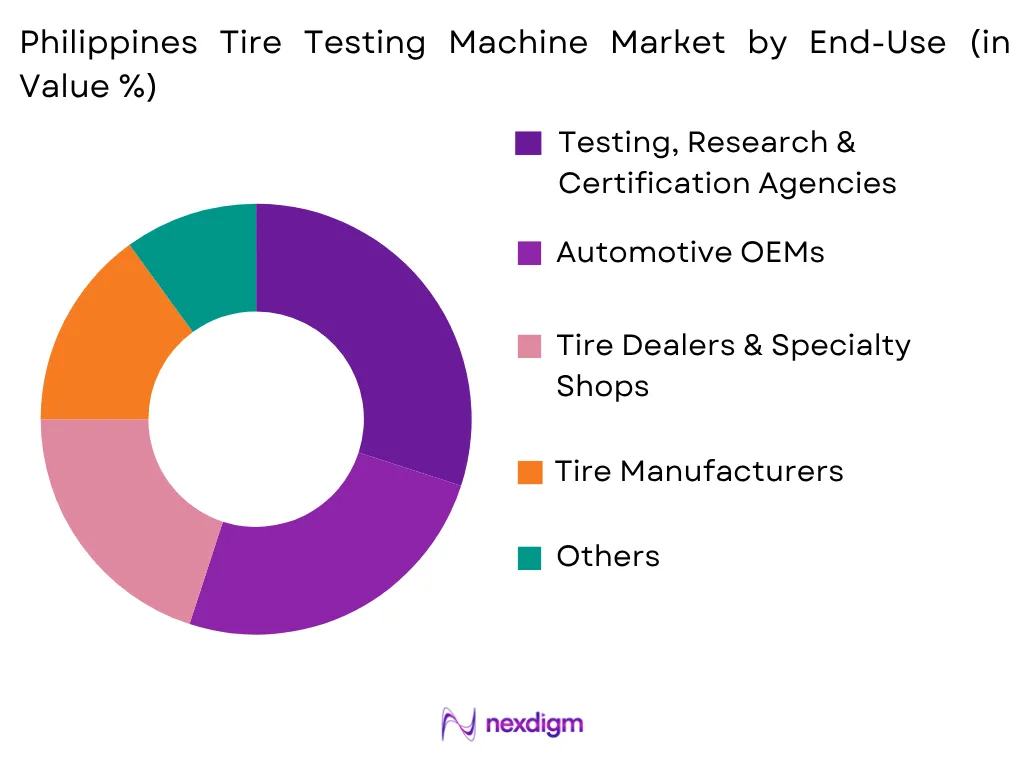
Testing, Research & Certification Agencies, led by the DTI-BPS Product Testing Laboratory (BPSTL), represent a critical end-use segment given the country’s mandatory certification framework, under which the Bureau conducts third-party testing of tires to verify PNS compliance ahead of Philippine Standard (PS) or Import Commodity Clearance (ICC) issuance. Automotive OEMs and Tire Dealers & Specialty Shops constitute the second-largest demand pool, driven by record vehicle sales of 467,252 units in 2024 and continued expansion of authorized tire dealer and specialty retail networks across Luzon, Visayas, and Mindanao. As e-commerce and online tire retail expand nationally, distributors are increasingly investing in in-house quality verification equipment to reduce dependence on third-party laboratory queues and strengthen consumer confidence in imported tire quality, particularly for higher-value passenger and light commercial vehicle tire categories.
Competitive Landscape
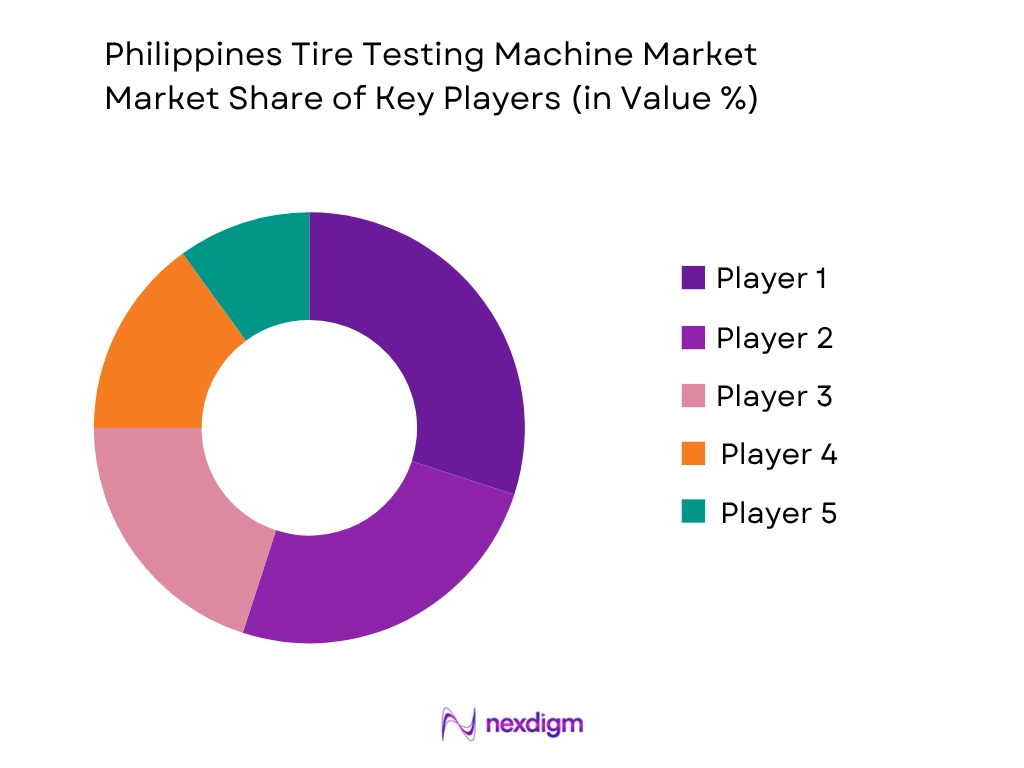
The Philippines Tire Testing Machine Market is niche and import-dependent, dominated by established global equipment manufacturers supplying through regional distributors and local test-equipment specialists, given the country’s limited domestic tire testing machine manufacturing base. Global players such as MTS Systems Corporation, A&D Company, Burke E. Porter Machinery Company, AMETEK, and Kistler Instrumente AG supply advanced automatic testing systems to the DTI-BPS Product Testing Laboratory and to larger tire importers and OEM-linked facilities, while Chinese manufacturers including Qingdao GaoCe Technology, Qingdao Guangyue Rubber Machinery, and Hebei Better United Test Equipment are increasingly competitive on cost for flat belt and drum-type testing machines supplied into Southeast Asian markets. Locally, Siccion Marketing Inc., established in 1965 and one of the Philippines’ longest-standing testing equipment providers, supplies materials and mechanical testing equipment, including tire and rubber testing instrumentation, to domestic laboratories and industrial clients, while international testing instrumentation brands such as Testronix maintain distribution relationships to serve Philippine quality-assurance buyers. Competition in the market is shaped by PNS and ICC certification compatibility, after-sales calibration and technical support availability, equipment automation levels, and total cost of ownership given the Philippines’ import-dependent equipment supply chain.
| Company | Establishment Year | Headquarters | Primary Product/Service Portfolio | Testing Technology Focus
|
Network Presence | Major End-Use Industries | Key Strategic Focus | Certifications & Compliance |
| MTS Systems Corporation | 1966 | ~ | ~ | ~ | ~ | ~ | ~ | ~ |
| A&D Company, Limited | 1977 | ~ | ~ | ~ | ~ | ~ | ~ | ~ |
| Burke E. Porter Machinery Company | 1937 | ~ | ~ | ~ | ~ | ~ | ~ | ~ |
| Qingdao GaoCe Technology Co., Ltd. | 2001 | ~ | ~ | ~ | ~ | ~ | ~ | ~ |
| Siccion Marketing Inc. | 1965 | ~ | ~ | ~ | ~ | ~ | ~ | ~ |
Philippines Tire Testing Machine Market Analysis
Growth Drivers
Mandatory PNS Certification and Expanding DTI-BPS Testing Infrastructure
The mandatory certification regime established under DTI Department Administrative Order No. 11-03, Series of 2011, requiring PNS compliance for pneumatic tires, remains the foundational driver of the Philippines Tire Testing Machine Market. All manufacturers, importers, distributors, and retailers of tires must secure either a Philippine Standard (PS) Quality Certification Mark or an Import Commodity Clearance (ICC) certificate, both of which require product test reports issued by DTI-BPS-recognized testing laboratories, directly sustaining institutional demand for accredited tire testing machinery. As the volume of tire imports continues rising alongside record vehicle sales of 467,252 units in 2024, the DTI-BPS Product Testing Laboratory and accredited private laboratories face growing testing throughput requirements, creating steady replacement and capacity-expansion demand for automatic, higher-throughput testing systems.
Rising Vehicle Registrations and Growing Tire Import Volumes
The Philippines automotive market’s strong performance, with CAMPI-TMA sales reaching a record 467,252 units in 2024, an 8.7% year-on-year increase, continues to expand the country’s vehicle parc and drive both OEM and replacement tire demand. The broader Philippines tire market, valued at approximately USD 0.98 Billion in 2024 and projected to reach USD 1.39 Billion by 2030, is overwhelmingly supplied through imports from China, Thailand, Indonesia, and other regional manufacturing hubs, requiring sustained testing and certification activity at ports of entry and BPS-recognized laboratories. This growing import volume, combined with rising consumer and OEM expectations around tire safety and fuel efficiency, continues to reinforce the need for accurate, high-throughput tire testing machinery across the Philippines’ certification ecosystem.
Market Challenges
High Capital Cost and Import Dependence for Testing Equipment
The Philippines Tire Testing Machine Market faces a significant structural constraint in its near-total dependence on imported testing machinery, as no meaningful domestic manufacturing base for tire testing equipment currently exists in the country. Advanced automatic testing systems from global suppliers such as MTS Systems and Burke E. Porter Machinery carry high capital costs that can be prohibitive for smaller testing laboratories and independent tire distributors, limiting broader market penetration beyond the DTI-BPS Product Testing Laboratory, larger OEM-linked facilities, and select accredited private laboratories. Currency fluctuations and international freight costs further compound total cost of ownership for equipment buyers reliant on imports from the United States, Europe, Japan, and China.
Limited Domestic Manufacturing Base and Skilled Personnel Shortage
The absence of a large-scale domestic tire manufacturing industry in the Philippines constrains the addressable base of OEM-linked testing demand relative to major regional tire-producing markets such as China, India, and Japan. Additionally, the specialized nature of tire testing machinery, spanning uniformity testing, dynamic balancing, endurance testing, and rolling resistance measurement, requires trained technical personnel capable of equipment calibration, data interpretation, and compliance reporting, a skill set that remains in limited supply domestically and often requires vendor-provided training and ongoing technical support arrangements.
Market Opportunities
Expansion of BPS Testing Laboratory Capacity and Accredited Private Laboratories
Continued growth in tire import volumes and mandatory PNS certification requirements present a sustained opportunity for capacity expansion at the DTI-BPS Product Testing Laboratory and for the accreditation of additional private third-party testing laboratories under the Philippine Accreditation Bureau (PAB). As the Bureau works to reduce certification processing timelines and testing backlogs, increased investment in automated, higher-throughput testing machinery offers equipment suppliers a clear opportunity to support the country’s compliance infrastructure while improving service turnaround for importers and distributors.
Growth of E-Commerce Tire Retail and Rising EV Tire Testing Requirements
The rapid growth of e-commerce and digital retail platforms in the Philippines is encouraging tire distributors and online retailers to invest in in-house quality verification capabilities to build consumer trust in imported and domestically distributed tire products. Simultaneously, the Philippines’ developing electric vehicle market is beginning to generate demand for specialized testing protocols addressing the unique rolling resistance, load-bearing, and noise characteristics of EV-specific tires, creating a longer-term opportunity for testing equipment suppliers to introduce EV-focused testing solutions as the country’s electric mobility policies mature.
Future Outlook
The Philippines Tire Testing Machine Market is expected to witness steady growth over the coming years, supported by continued expansion of vehicle registrations, sustained enforcement of mandatory PNS tire certification requirements, and gradual capacity expansion within the DTI-BPS testing infrastructure and accredited private laboratory network. As import volumes of passenger, commercial, and specialty tires continue rising and consumer and regulatory expectations around tire safety and fuel efficiency increase, demand for automated, higher-throughput, and increasingly digitalized tire testing machinery is expected to grow steadily across both institutional and private testing facilities in the country.
Major Players
- MTS Systems Corporation
- A&D Company, Limited
- Burke E. Porter Machinery Company
- AMETEK, Inc.
- Kistler Instrumente AG
- ZF Friedrichshafen AG
- Calspan Corporation
- Qingdao GaoCe Technology Co., Ltd.
- Qingdao Guangyue Rubber Machinery Manufacturing Co., Ltd.
- Hebei Better United Test Equipment Co., Ltd.
- Leonardo Automation Pvt. Ltd.
- Siccion Marketing Inc.
- Testronix Instruments Pvt. Ltd. (Philippines Distribution)
Key Target Audience
- Tire Manufacturers and Rubber Product Companies
- Automotive OEMs and Vehicle Assemblers
- Testing, Research and Certification Agencies
- Tire Importers and Distributors
- Tire Dealers and Specialty Retail Shops
- Investments and Venture Capitalist Firms
- Government and Regulatory Bodies (Department of Trade and Industry (DTI), Bureau of Philippine Standards (DTI-BPS), Philippine Accreditation Bureau (PAB), Land Transportation Office (LTO), Bureau of Customs)
- Electric Vehicle Manufacturers and Mobility Solution Providers
Research Methodology
Step 1: Identification of Key Variables
The initial phase involves constructing a comprehensive ecosystem map covering all major stakeholders operating within the Philippines Tire Testing Machine Market. Extensive desk research is undertaken using government publications, DTI-BPS regulatory filings, automotive industry databases, testing equipment manufacturer disclosures, trade associations, and proprietary industry sources. The primary objective is to identify and define the critical variables influencing market dynamics, including tire import volumes, PNS certification demand, testing laboratory capacity, equipment automation adoption, vehicle registration trends, and regulatory compliance timelines.
Step 2: Market Analysis and Construction
In this phase, historical market data relating to the Philippines Tire Testing Machine Market are compiled and analyzed to estimate market size and identify growth patterns. Both top-down and bottom-up approaches are employed to evaluate testing equipment demand across machine type, operation mode, end-use segment, and tire category. Market segmentation is validated by analyzing DTI-BPS testing laboratory throughput, equipment import data, distributor sales volumes, and regional demand across Luzon, Visayas, and Mindanao. Revenue estimates are cross-verified through import volumes, distributor disclosures, and end-user consumption patterns to ensure accuracy.
Step 3: Hypothesis Validation and Expert Consultation
Market hypotheses are developed using secondary research findings and subsequently validated through Computer-Assisted Telephone Interviews (CATI) and structured consultations with industry experts. Respondents include testing equipment manufacturers, DTI-BPS laboratory personnel, accredited private testing laboratories, tire importers and distributors, automotive OEM representatives, and quality assurance professionals. These discussions provide valuable commercial, operational, and technical insights that help validate market assumptions, assess technology adoption, understand procurement trends, and refine future market projections across institutional and private testing channels.
Step 4: Research Synthesis and Final Output
The final phase integrates findings from secondary research, primary interviews, and quantitative analysis to develop a comprehensive assessment of the Philippines Tire Testing Machine Market. Data obtained through the bottom-up methodology are cross-validated using top-down analysis and multiple independent information sources to ensure consistency and reliability. The report is further verified through consultations with leading testing equipment manufacturers, distributors, and DTI-BPS-recognized laboratory representatives regarding equipment innovation, certification trends, competitive developments, and regulatory outlook before publication, ensuring a robust and accurate market assessment.

- Executive Summary
- Research Methodology (Market Definitions and Assumptions, Abbreviations, Market Sizing Approach, Top-Down Analysis, Bottom-Up Analysis, Demand-Side Assessment, Supply-Side Assessment, Primary Industry Interviews, Secondary Research Validation, Data Triangulation, Forecasting Framework, Limitations and Future Conclusions)

- Definition and Scope
- Market Evolution and Industry Genesis
- Timeline of Major Industry Developments
- Tire Testing Machine Industry Value Chain Analysis
- Supply Chain Analysis

- Growth Drivers (Mandatory PNS Certification for Pneumatic Tires, Expansion of DTI-BPS Testing Infrastructure, Growth of Domestic and Import Tire Trade, Rising Vehicle Registrations and CAMPI-TMA Sales, Infrastructure Development under Build-Better-More Program, Increasing Focus on Rolling Resistance and Fuel Efficiency, Growth of Third-Party Testing and Certification Laboratories, Rising Investment in Quality Control by Tire Distributors)
- Market Challenges (High Capital Cost of Advanced Testing Equipment, Limited Domestic Tire Manufacturing Base, Dependence on Imported Testing Machinery, Shortage of Skilled Testing Personnel, Lengthy ICC and PS Certification Timelines, Infrastructure and Power Reliability Constraints, Competition from Regional Testing Hubs, Foreign Currency and Import Cost Exposure)
- Market Opportunities (Expansion of BPS Product Testing Laboratory Capacity, Growth of Electric Vehicle Tire Testing Requirements, Rising Demand for Rolling Resistance and Wet Grip Testing, Accreditation of Additional Third-Party Testing Laboratories, Regional Testing Hub Potential for ASEAN Trade, Digitalization and IoT-Enabled Testing Systems, Growing Aftermarket and Retreading Industry, Public-Private Partnerships in Standards Infrastructure)
- Market Trends (Automation and PLC-Controlled Testing Systems, IoT-Enabled Real-Time Data Acquisition, Integration of AI in Predictive Maintenance and Analysis, Growing Adoption of Flat Belt Testing Machines, Rising Demand for Multi-Axis and Uniformity Testing, EV-Specific Tire Testing Protocols, Increasing Preference for Automatic over Manual Systems, Expansion of Mobile and Portable Testing Solutions)
- Government Regulations (Republic Act No. 7394 – Consumer Act of the Philippines, DTI Department Administrative Order No. 11-03 s.2011 – Mandatory PNS for Pneumatic Tyres, PNS 34:2000 – Rubber Inner Tubes for Pneumatic Tires Specification, Bureau of Philippine Standards (DTI-BPS) Product Certification Scheme, Import Commodity Clearance (ICC) Certification Requirements, Philippine Standard (PS) Quality and Safety Certification Mark, Philippine Accreditation Bureau (PAB) Laboratory Accreditation, ASEAN Mutual Recognition Arrangement Alignment)
- SWOT Analysis
- PESTLE Analysis
- Porter’s Five Forces Analysis
- Stakeholder Ecosystem
- Competition Ecosystem

- By Market Value (2020-2025)
- By Installed Base of Testing Machines (2020-2025)
- By Average Machine Price (2020-2025)

- By Machine Type (In Value %)
Flat Belt Tire Testing Machines
Drum-Type Tire Testing Machines
Tire Uniformity Testing Machines
Tire Balancing Testing Machines
Rolling Resistance Testing Machines
Endurance and Durability Testing Machines - By Operation (In Value %)
Automatic Tire Testing Machines
Manual/Semi-Automatic Tire Testing Machines - By End-Use (In Value %)
Tire Manufacturers
Automotive OEMs
Repair & Maintenance Service Stations
Tire Dealers & Specialty Shops
Testing, Research & Certification Agencies - By Tire Category (In Value %)
Passenger Car Tires
Light Commercial Vehicle Tires
Medium & Heavy Commercial Vehicle Tires
Two-Wheeler & Three-Wheeler Tires
Off-The-Road (OTR) Tires - By Region (In Value %)
Luzon
Visayas
Mindanao

- Market Share of Major Players (By Revenue, Unit Shipments, Machine Type, End-Use Segment, Distribution Reach)
- Cross Comparison Parameters (Product Portfolio Breadth, Local Distributor Network, Calibration & After-Sales Service, Automation Capability, R&D Investment, Certification Compatibility, Regional Presence)
- SWOT Analysis of Major Players
- Pricing Analysis (Flat Belt Testing Machines, Drum-Type Testing Machines, Uniformity Testing Machines, Balancing Testing Machines, Portable/Mobile Testing Units)
- Detailed Profiles of Major Companies
MTS Systems Corporation
A&D Company, Limited
Burke E. Porter Machinery Company
AMETEK, Inc.
Kistler Instrumente AG
ZF Friedrichshafen AG
Calspan Corporation
Qingdao GaoCe Technology Co., Ltd.
Qingdao Guangyue Rubber Machinery Manufacturing Co., Ltd.
Hebei Better United Test Equipment Co., Ltd.
Leonardo Automation Pvt. Ltd.
Siccion Marketing Inc.
Testronix Instruments Pvt. Ltd. (Philippines Distribution)

- Facility Utilization Assessment (Testing Volume, Machine Uptime, Calibration Frequency, Laboratory Throughput)
- Procurement Behavior (Equipment Brand Preference, Import Sourcing Patterns, Replacement Frequency, Price Sensitivity)
- Technology Adoption Analysis (Automation Adoption, Digital Data Logging, IoT Integration, Predictive Maintenance)
- Investment and Budget Allocation Analysis (Capital Equipment Budget, Testing Laboratory Expansion Plans, Lifecycle Cost Analysis, ROI Expectations)
- Needs, Desires and Pain Point Analysis (Testing Accuracy, Equipment Reliability, Calibration Support, Compliance Turnaround Time, After-Sales Service)
- Vendor Selection Criteria (Brand Reputation, Technical Support Availability, Local Service Network, Certification Compatibility, Equipment Cost)
- Decision-Making Process (Technical Evaluation, Compliance Requirement Mapping, Budget Approval, Vendor Negotiation)

- By Market Value (2026-2035)
- By Installed Base of Testing Machines (2026-2035)
- By Average Machine Price (2026-2035)


 Request a Sample
 Ask for Customization
 Get a Quote
 Enquire Now