
 Download PDF
Market Overview
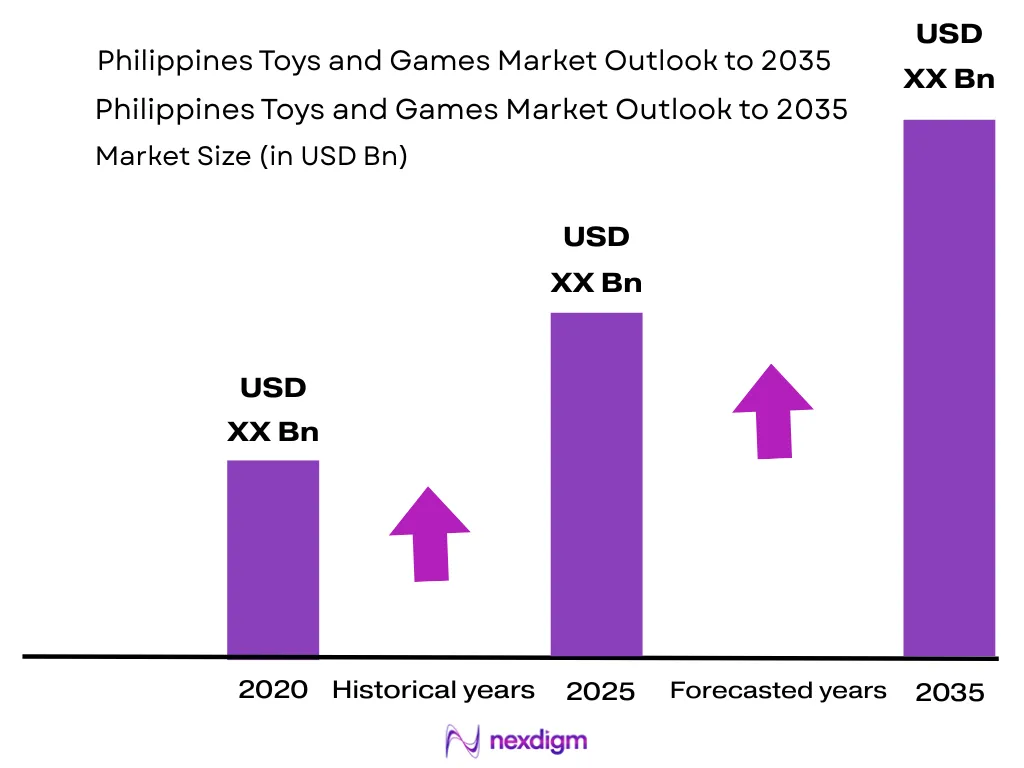
The Philippines Toys and Games Market is valued at USD ~ billion, based on a five-year historical market assessment. The comparable toys-only market is valued at USD ~ million, indicating strong demand across traditional toys, digital games, collectibles, educational toys and licensed merchandise. Growth is driven by rising family consumption, kidult buyers, e-commerce-led discovery, cloud gaming and collectible-focused toy demand across urban households and mall-based retail channels. Metro Manila, CALABARZON, Central Luzon, Cebu and Davao dominate the Philippines Toys and Games Market because these locations combine dense households, high mall concentration, stronger logistics coverage, organized retail chains and higher exposure to online marketplaces. The country’s population reached 112.73 million, with CALABARZON at 16.93 million, NCR at around 14.00 million, and Central Luzon at 12.99 million, creating large consumer clusters for toys, games, gifts and collectibles.
Market Segmentation
By Product Type
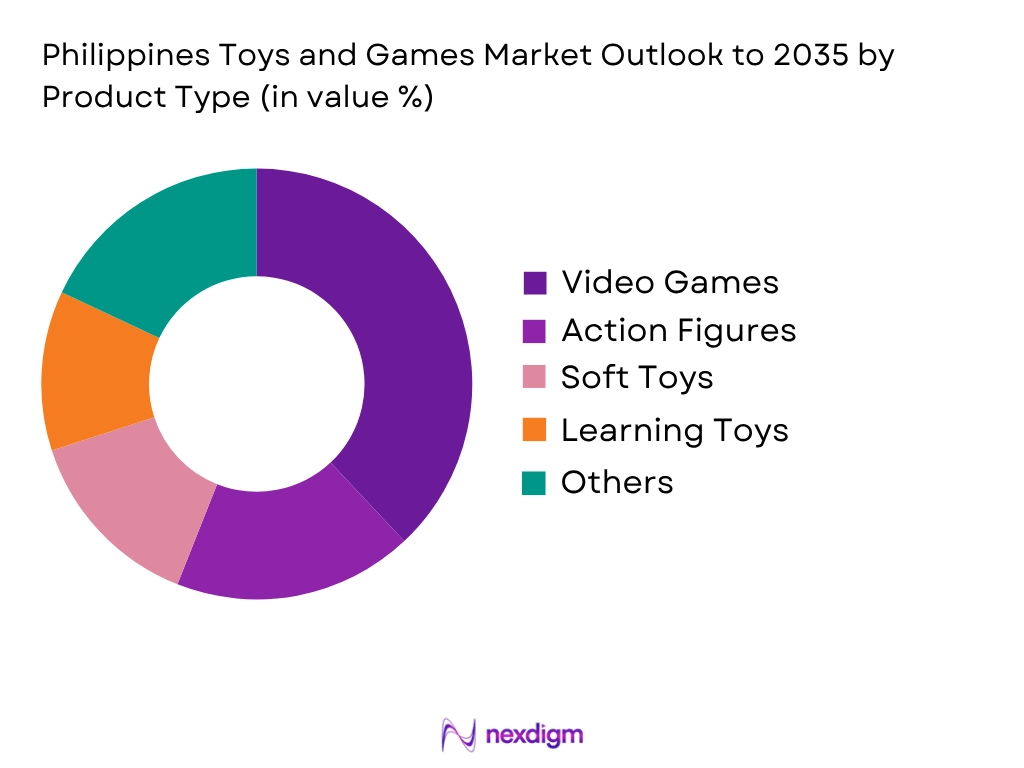
The Philippines Toys and Games Market is segmented by product type into video games and digital games, action figures and character toys, dolls and plush, educational and STEM toys, construction toys, and games, puzzles and board games. Recently, video games and digital games have held the dominant market share in the Philippines under product type because mobile-first entertainment, cloud gaming, subscription gaming and digital purchases have become deeply embedded in youth and adult leisure behavior. Euromonitor notes that both traditional toys and video games registered strong value growth, with cloud gaming and subscription services supporting expansion. Action figures and character toys remain strategically important because anime, superhero franchises, movie IP and gaming-linked merchandise drive repeat purchases among children, teenagers and kidult collectors. Educational toys are also rising as urban parents increasingly connect toys with early learning, school readiness and skill development.
By Distribution Channel
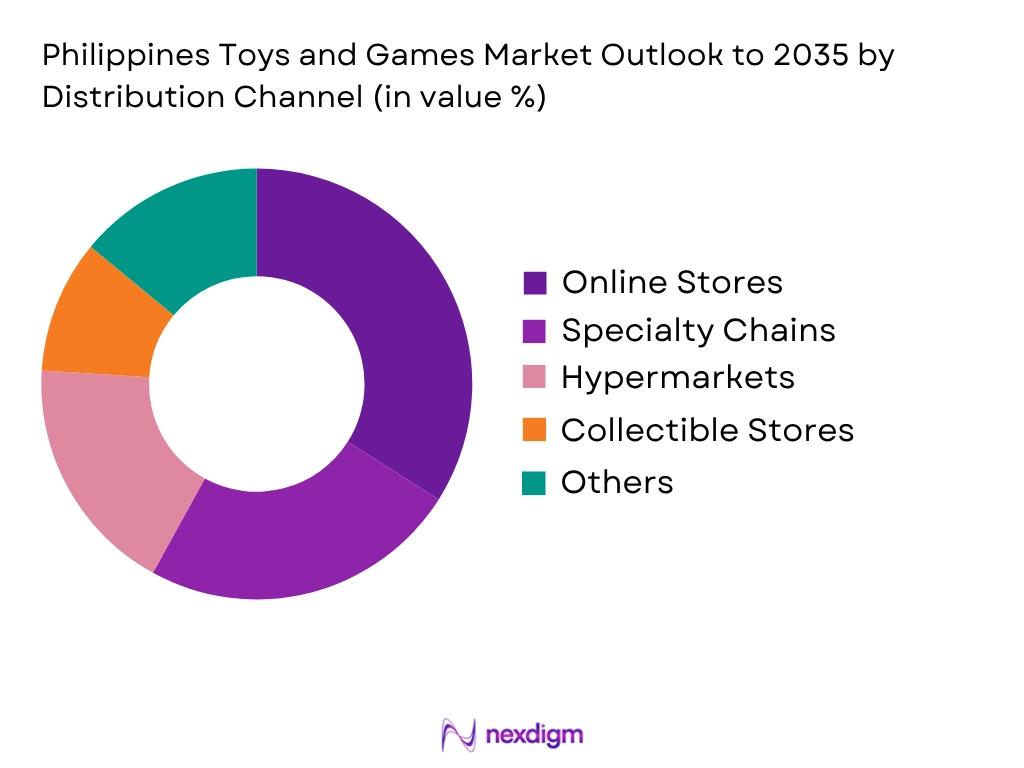
The Philippines Toys and Games Market is segmented by distribution channel into e-commerce marketplaces and online stores, toy specialty chains, department stores and hypermarkets, hobby and collectible stores, baby and learning retailers, and informal neighborhood retail. Recently, e-commerce marketplaces and online stores have held the dominant market share in the Philippines under distribution channel because consumers use online platforms for price comparison, voucher-led purchases, cross-border assortment, official brand stores and fast access to long-tail SKUs. Shopee, Lazada, TikTok Shop and brand-owned online stores have become important for collectibles, educational kits, licensed toys, games and value toys. Euromonitor also identifies retail e-commerce as the leading distribution channel for toys and games in the Philippines. Offline toy specialty chains remain relevant because mall-based shopping, birthday gifting, Christmas purchases and product trial still shape family toy buying.
Competitive Landscape
The Philippines Toys and Games Market is fragmented, with competition between global manufacturers, licensed IP owners, local retailers, distributors, e-commerce sellers and hobby stores. Toy Kingdom and Toys“R”Us Philippines dominate organized mall-based toy retail, while LEGO, Mattel and Hasbro lead through global IP portfolios, construction toys, dolls, vehicles, action toys and family games. The market is shaped by a dual structure: branded premium toys in malls and official stores, and value/cross-border toys through marketplaces and informal retail.
| Company | Establishment Year | Headquarters | Core Categories | Philippines Channel Presence | IP/Brand Strength | Target Consumer | Market-Specific Strength | Competitive Position |
| Toy Kingdom | 1990 | Pasay City, Philippines | ~ | ~ | ~ | ~ | ~ | ~ |
| Toys“R”Us Philippines | 1948 global brand; Philippines operated under Robinsons Retail | United States / Philippines retail operations | ~ | ~ | ~ | ~ | ~ | ~ |
| LEGO Group | 1932 | Billund, Denmark | ~ | ~ | ~ | ~ | ~ | ~ |
| Mattel | 1945 | El Segundo, United States | ~ | ~ | ~ | ~ | ~ | ~ |
| Hasbro | 1923 | Pawtucket, United States | ~ | ~ | ~ | ~ | ~ | ~ |
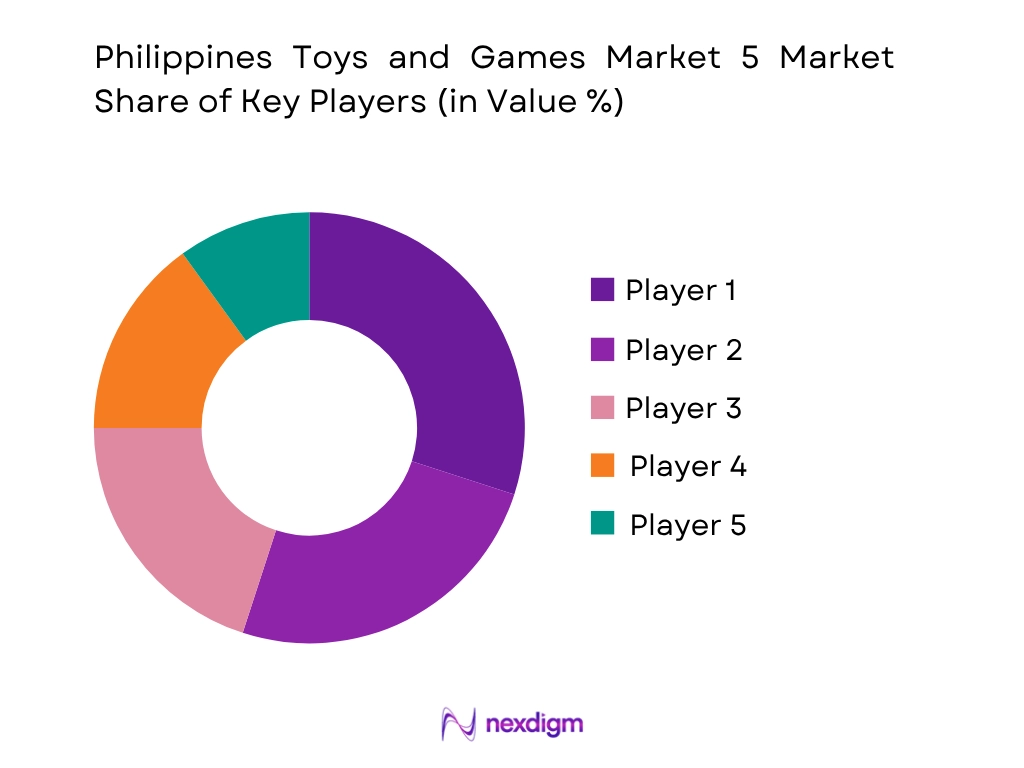
Philippines Toys and Games Market
Growth Drivers
Large child, student and family-consumption base supporting traditional toys, learning toys and gifting demand
The Philippines Toys and Games Market is supported by a large child-facing consumer base, making demand structurally stronger for preschool toys, action figures, dolls, plush toys, educational kits, board games and school-age gifting products. The Philippine Statistics Authority reported the national population at 112,729,484 people in the official population count, while the largest demand clusters are CALABARZON with 16.93 million people, NCR with 14.00 million people, and Central Luzon with 12.99 million people. These regions are also the strongest mall, logistics and e-commerce fulfilment hubs, supporting toy retail through Toy Kingdom, Toys“R”Us, department stores and marketplace sellers. DepEd’s Learner Information System recorded 25,885,587 learners for SY 2024-2025, including 1,706,702 kindergarten learners, 12,292,987 Grades 1-6 learners, 7,407,802 junior high school learners, and 3,865,520 senior high school learners. This creates a broad addressable base for developmental toys, STEM kits, puzzles, craft sets, character toys, sports toys and digital gaming accessories. Household purchasing capacity also supports recurring toy demand: BSP national accounts recorded household final consumption expenditure of PHP 20,140,904 million in 2024 and PHP 21,402,164 million in 2025.
Online access, mobile-first consumption and omnichannel retail supporting games, collectibles and long-tail toy SKUs
Digital access is a direct growth driver for the Philippines Toys and Games Market because consumers increasingly discover action figures, collectibles, trading cards, educational toys, plush toys, electronic toys and video games through marketplaces, social commerce and official online stores. PSA’s 2024 NICTHS reported 13.56 million households with internet access at home and 61.46 million individuals aged 10 years and over who used the internet. The same official release recorded an average daily internet-use duration of 4.6 hours, with NCR users spending 6.1 hours and CALABARZON users spending 5.3 hours daily online. This is directly relevant to toy demand because online product discovery is driven by unboxing videos, livestream selling, flash campaigns, character searches, marketplace reviews and pre-orders for anime, gaming and licensed merchandise. The device base also supports mobile-first shopping and gaming: PSA reported 16.40 million computer users aged 10 years and over, with laptops as the most used computer type among users. Combined with BSP data showing household final consumption expenditure of PHP 5,452,905 million in Q1 2026, the market has strong current support for online toys, mobile games, digital game top-ups, collectible drops and official-store toy purchases.
Market Challenges
Heavy import dependence creating supply-chain, certification and seasonal inventory risk
The Philippines Toys and Games Market is highly import-dependent, particularly for plastic toys, licensed character products, action figures, electronic toys, dolls, plush toys, construction sets and collectibles. WITS/World Bank trade data shows that China exported USD 488,695.80 thousand of HS 950390 “Toys nes” to the Philippines in 2024, with a shipment quantity of 56,141,700 kg. Hong Kong exported another USD 28,155.95 thousand and 1,985,470 kg to the Philippines under the same product code, while Japan shipped USD 3,211.99 thousand and 187,651 kg. This supplier concentration makes the market vulnerable to late shipments, customs delays, production allocation shifts, freight disruption and foreign-currency exposure. The challenge is market-specific because Philippine toy demand is strongly seasonal, especially around Christmas, birthdays, school rewards, mall sales and online campaign days. A delay in imported licensed merchandise can immediately affect toy-specialty retailers, marketplace sellers, distributors and hobby shops. Meanwhile, the Philippines exported only USD 55,247.19 thousand and 4,183,660 kg of HS 950390 toys in 2024, indicating that local outbound toy production is much smaller than inbound supply flows. This creates risk for retailers managing product launches, franchise tie-ins, collectible drops and peak-season stock planning.
Safety-labeling and certification pressure on importers, retailers and online sellers
Product compliance is a major challenge in the Philippines Toys and Games Market because toys are purchased for infants, preschool children and school-age consumers, where safety labeling, choking-risk warnings and certification documentation are critical. Republic Act No. 10620, the Toy and Game Safety Labeling Act, requires the protection of children through special labeling of toys and games and recognizes that children need safeguards because of physical and mental immaturity. The DTI-BPS certification framework also requires products covered by mandatory certification schemes to carry the Philippine Standard Mark or Import Commodity Clearance sticker before being distributed in the Philippine market. This creates operational pressure for toy importers and retailers handling high-SKU-volume categories such as plush toys, small plastic toys, electronic toys, activity kits and cross-border marketplace products. The compliance burden is amplified by DepEd’s large school-age base of 25,885,587 learners in SY 2024-2025 and PSA’s national population count of 112,729,484 people, because unsafe or mislabeled products can affect a large consumer base. Online sellers face additional pressure because toy listings can move quickly through marketplaces, while documentation, labeling and traceability remain uneven across unofficial imports and grey-market SKUs.
Market Opportunities
Educational, STEM and school-linked toy expansion through the basic education ecosystem
Educational toys, STEM kits, puzzles, learning games, coding toys, construction sets and activity-based play products have strong opportunity in the Philippines because the current education ecosystem provides a large and structured user base. DepEd recorded 25,885,587 learners for SY 2024-2025, including 1,706,702 kindergarten learners, 12,292,987 Grades 1-6 learners, 7,407,802 junior high school learners, and 3,865,520 senior high school learners. DepEd also reported 57,176 supervised schools, including 39,826 elementary schools, 1,531 junior high schools, 1,288 senior high schools, 7,558 JHS-with-SHS schools, and 3,690 Kinder-to-G12 integrated schools. This institutional and household base supports future growth for products positioned around school readiness, numeracy, science experiments, robotics, coding, problem-solving, fine-motor development and family learning. The opportunity is not limited to formal procurement; it also extends to parent-led purchases through malls, bookstores, toy-specialty stores, Shopee, Lazada and TikTok Shop. DepEd’s 2025 target for 5,298 new classrooms and 18,061 furniture sets also indicates continuing investment in school infrastructure, which supports broader learning-related consumption around children and families. Brands that localize STEM kits to Filipino curricula, bilingual learning needs and affordable bundles can capture growth without relying only on character toys or seasonal gifting.
Regional retail, e-commerce and collectible-toy expansion outside Metro Manila
The Philippines Toys and Games Market has a strong opportunity to expand beyond Metro Manila through regional mall retail, official marketplace stores and collectible-focused online channels. PSA reported CALABARZON as the country’s largest region with 16.93 million people, followed by NCR with 14.00 million people and Central Luzon with 12.99 million people. Central Visayas recorded 6,640,875 people, creating a strong Cebu-led regional hub for mall retail, tourist gifting and online fulfilment. These population clusters justify future expansion of toy-specialty stores, hobby shops, learning-toy retailers, licensed-character pop-ups and online fulfilment nodes. Digital infrastructure strengthens the same opportunity: PSA reported 13.56 million households with internet access at home and 61.46 million internet users aged 10 years and over. NCR users spent 6.1 hours online daily, while CALABARZON users spent 5.3 hours, supporting online discovery of anime figures, blind boxes, trading cards, video games and official merchandise. The opportunity is particularly relevant for authenticated collectibles because WITS data shows substantial inbound toy shipments from China at 56,141,700 kg and Hong Kong at 1,985,470 kg, creating a need for verified official stores, brand-backed sellers and anti-counterfeit positioning.
Future Outlook
The Philippines Toys and Games Market is expected to expand steadily over the forecast period, supported by urban family consumption, rising digital engagement, licensed IP demand, e-commerce penetration and kidult collectibles. The toys market is expected to grow at a 4.80% CAGR during the 2026-2035 period, while the broader toys and games market benefits from video games, cloud gaming and digital leisure adoption. The market will increasingly move toward omnichannel retail, where malls support brand experience and online channels support price discovery, convenience, campaign-day sales and cross-border assortment. Educational toys, STEM kits, construction toys, collectibles, anime merchandise, trading cards and premium licensed products are expected to gain relevance. Market participants that combine authenticity, product safety, official distribution, fast fulfilment and localized product assortment will be better positioned.
Major Players
- Toy Kingdom
- Toys“R”Us Philippines
- Richprime Global
- LEGO Group
- Mattel
- Hasbro
- Bandai Namco
- Spin Master
- MGA Entertainment
- TOMY
- Moose Toys
- Funko
- Playmobil
- POP MART
- VTech
Key Target Audience
- Toy manufacturers and global toy brand owners
- Toy importers, distributors and wholesalers
- Specialty toy retailers and mall-based retail chains
- E-commerce marketplaces and official online toy stores
- Licensed IP owners and entertainment companies
- Baby, childcare and learning-product retailers
- Investments and venture capitalist firms
- Government and regulatory bodies
Research Methodology
Step 1: Identification of Key Variables
The initial phase involves constructing an ecosystem map encompassing all major stakeholders within the Philippines Toys and Games Market. This includes toy manufacturers, licensed IP owners, importers, distributors, mall retailers, online marketplaces, hobby stores, parents, children and kidult buyers. The objective is to identify variables such as product category mix, distribution channels, regulatory compliance, regional demand and pricing tiers.
Step 2: Market Analysis and Construction
In this phase, historical data is compiled and analyzed for the Philippines Toys and Games Market. This includes product-level demand, online and offline retail penetration, organized retail footprint, importer-distributor relationships and e-commerce channel performance. Revenue validation is conducted through top-down published market sizing and bottom-up mapping of categories, retailers and consumer cohorts.
Step 3: Hypothesis Validation and Expert Consultation
Market hypotheses are developed and validated through computer-assisted telephone interviews with category managers, toy distributors, specialty retailers, marketplace sellers and licensing professionals. These consultations provide operating insights into SKU velocity, product certification, consumer preferences, seasonal sales, channel margins and competition from counterfeit or grey-market toys.
Step 4: Research Synthesis and Final Output
The final phase involves synthesizing secondary research, trade context, company mapping, retailer benchmarking and expert inputs. Direct engagement with manufacturers, distributors and retailers is used to verify category trends, product positioning, consumer demand and channel economics. The final output provides validated market size, segmentation, competitive analysis, future outlook and strategic recommendations.

- Executive Summary
- Research Methodology (Market definitions and assumptions, abbreviations, product taxonomy, toys and games classification, primary interview framework, secondary research framework, market sizing approach, top-down validation, bottom-up validation, channel audit, SKU benchmarking, importer-distributor mapping, consumer cohort analysis, limitations and future conclusions)

- Definition and Scope
- Market Genesis and Evolution
- Timeline of Major Players
- Business Cycle
- Supply Chain and Value Chain Analysis

- Growth Drivers (Child population base, family gifting, mall retail, e-commerce, licensed IP, educational toy demand, kidult collectibles)
- Market Challenges (Counterfeit toys, import certification, price sensitivity, logistics fragmentation, unsafe products, inventory markdowns)
- Opportunities (Premiumization, official-store expansion, provincial retail growth, STEM kits, verified collectibles, regional distribution)
- Market Trends (Blind boxes, livestream selling, anime fandom, STEM play, sustainable toys, official merchandise, creator-led discovery)
- Government Regulation (Toy and Game Safety Labeling Act, DTI-BPS product
- SWOT Analysis
- Stakeholder Ecosystem
- Porter’s Five Forces

- By Retail Sales Value (2020-2025)
- By Units Sold (2020-2025)
- By Average Selling Price (2020-2025)

- By Product Category (In Value %)
Action Figures and Character Toys
Dolls, Plush and Soft Toys
Construction Toys and Building Sets
Games, Puzzles and Board Games
- By Age Group (In Value %)
Infant and Toddler
Preschool Children
Primary School Children
Tweens and Teenagers
Adults and Kidults - By Distribution Channel (In Value %)
Toy Specialty Chains
Department Stores and Hypermarkets
Baby and Childcare Retailers
Bookstores and Learning Retailers - By Region (In Value %)
Metro Manila
CALABARZON
Central Luzon
Central Visayas
Davao Region

- Market Share of Major Players (Retail value share, product category share, online channel share, store footprint, licensed portfolio strength)
- Cross Comparison Parameters (Product category coverage, licensed IP portfolio, mall retail footprint, e-commerce official-store strength, distributor network depth, safety certification compliance, price-band coverage, collectible/drop capability)
- SWOT Analysis of Major Players
- Pricing Analysis Basis SKUs (Entry-level toys, branded mid-tier toys, premium licensed toys, collectible figures, learning kits, board games)
- Detailed Profiles of Major Companies
Toy Kingdom
Toys“R”Us Philippines
Richprime Global
LEGO Group
Mattel
Hasbro
Bandai Namco
Spin Master
MGA Entertainment
TOMY
Moose Toys
Funko
Playmobil
POP MART
VTech

- Parent and Family Buyer Analysis
- Child and Teen Consumer Influence
- Kidult and Collector Consumer Analysis
- Institutional Buyer Analysis
- Tourist and Event Buyer Analysis

- By Value, 2026-2035
- By Volume, 2026-2035
- By Average Price, 2026-2035


 Request a Sample
 Ask for Customization
 Get a Quote
 Enquire Now