
 Download PDF
Market Overview
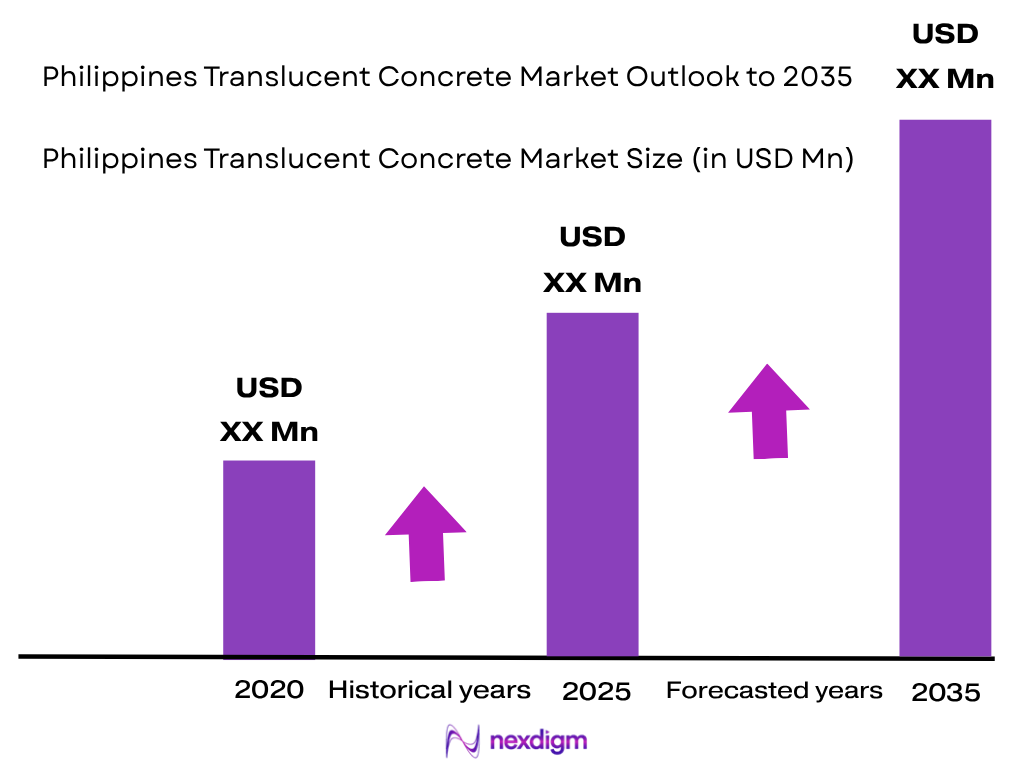
The Philippines Translucent Concrete Market is valued at approximately USD ~ million, compared with USD ~ million in the preceding period, with demand supported by premium commercial buildings, hospitality projects, façade modernization and daylight-oriented architecture. The country’s construction base expanded from 171,268 approved constructions covering 41.47 million square meters to 180,341 constructions covering 42.84 million square meters. Non-residential construction increased from 35,772 to 39,238 projects, strengthening the addressable environment for specialty architectural concrete.
Metro Manila, CALABARZON and Central Luzon represent the principal demand centers for the Philippines Translucent Concrete Market because of their concentration of commercial, institutional, hospitality, residential and mixed-use construction. NCR recorded PHP 112.84 billion in permitted construction value, while CALABARZON reached PHP 118.37 billion and Central Luzon PHP 76.50 billion. CALABARZON recorded 41,471 constructions, compared with 22,824 in Central Luzon, creating substantial project ecosystems for precast panels, façades and customized architectural materials.
Market Segmentation
By Light-Transmitting Technology
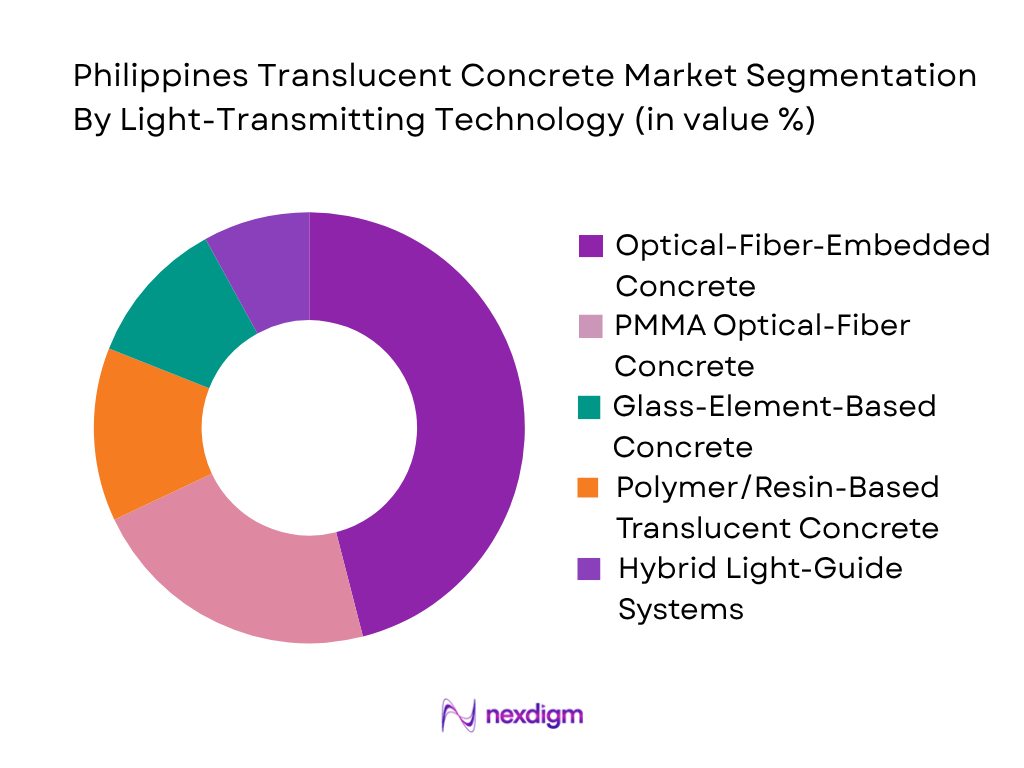
The Philippines Translucent Concrete Market is segmented into optical-fiber-embedded concrete, PMMA optical-fiber concrete, glass-element-based concrete, polymer/resin-based translucent concrete and hybrid light-guide systems. Optical-fiber-embedded concrete holds the dominant modeled share because it is the most established commercial approach to transmitting light through a cementitious matrix while retaining the appearance and material character of concrete. Optical fibers can be integrated into precast blocks, panels, partitions and feature walls, making the technology applicable to commercial, hospitality and institutional architecture. Litracon’s commercial system, for example, combines glass optical fibers with fine concrete and supports prefabricated blocks with thicknesses ranging from 25 mm to 200 mm and dimensions reaching 1,200 × 400 mm. LUCEM likewise develops light-transmitting concrete for façades and architectural elements and reports more than 600 completed projects worldwide. Such established product formats give optical-fiber systems a stronger specification base than newer hybrid approaches.
By Application
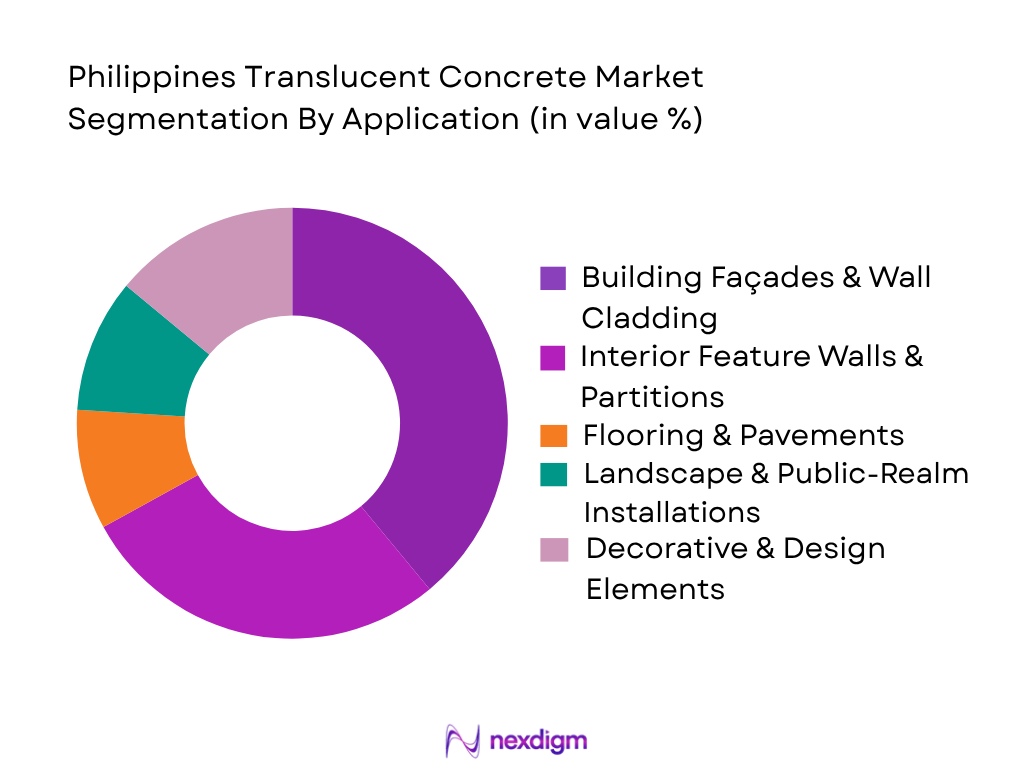
The Philippines Translucent Concrete Market is segmented into building façades and wall cladding, interior feature walls and partitions, flooring and pavements, landscape/public-realm installations and decorative architectural elements. Building façades and wall cladding represent the dominant modeled application because translucent concrete offers architectural differentiation while retaining the mass, texture and appearance associated with cementitious materials. The country’s non-residential construction ecosystem provides a relevant addressable base: 39,238 non-residential constructions covering 22.38 million square meters were recorded, with construction value reaching PHP 250.86 billion. Commercial buildings alone accounted for PHP 112.42 billion in permitted construction value. CALABARZON recorded 3.67 million square meters of non-residential floor area, while Central Luzon recorded 3.62 million square meters. These commercial and institutional environments are particularly suitable for specialty façades, entrance installations and illuminated architectural walls where translucent concrete’s differentiation is most valuable.
Competitive Landscape
The Philippines Translucent Concrete Market has a specialized and internationally oriented competitive structure. Dedicated technology developers such as LUCEM and Litracon coexist with broader building-material and concrete companies, while Philippine projects can also be served through importers, façade specialists and local precast fabricators. Competition is consequently influenced less by mass concrete capacity and more by light-transmission technology, architectural customization, panel engineering, exterior durability, installation systems, technical support and the ability to work with architects during the specification stage. LUCEM reports more than 600 completed projects globally, while Litracon has commercialized both optical-fiber-based Litracon Classic and polymer-light-guide-based Litracon pXL.
| Major Player | Establishment Year | Headquarters | Core Technology | Primary Product Form | Façade Capability | Interior Capability | Customization Capability | Philippines/APAC Relevance |
| LUCEM GmbH / Paradigm DH | 2007 | Germany | ~ | ~ | ~ | ~ | ~ | ~ |
| LiTraCon / Litracon | 2004 | Hungary | ~ | ~ | ~ | ~ | ~ | ~ |
| Heidelberg Materials | 1873 | Germany | ~ | ~ | ~ | ~ | ~ | ~ |
| Pan-United Corporation | 1999* | Singapore | ~ | ~ | ~ | ~ | ~ | ~ |
| Fapinex LLC | 2016 | UAE | ~ | ~ | ~ | ~ | ~ | ~ |
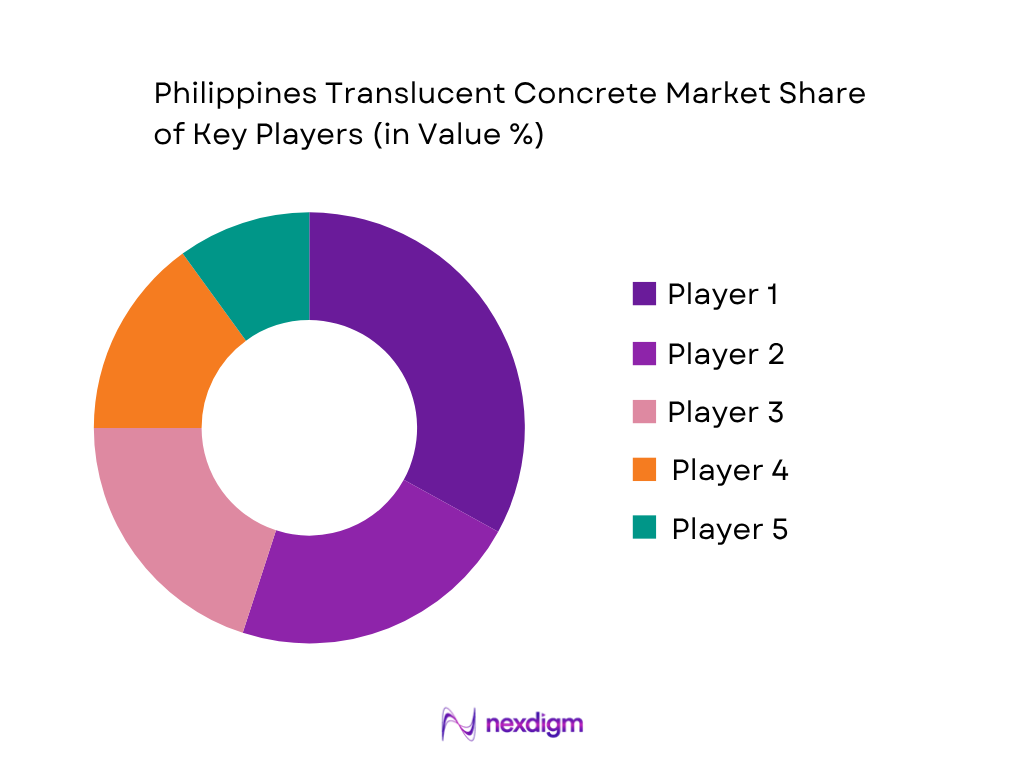
Philippines Translucent Concrete Market Analysis
Growth Drivers
Expansion of Construction Activity and Non-Residential Building Pipeline
The Philippines’ expanding construction base is strengthening the addressable environment for translucent concrete across façades, feature walls, entrance installations, commercial interiors and customized architectural panels. In 2024, the country recorded 180,341 approved constructions, compared with 171,268 in 2023, while permitted floor area increased from 41.47 million square meters to 42.84 million square meters. Particularly relevant to translucent concrete, non-residential developments increased from 35,772 to 39,238 projects and represented 22.38 million square meters of permitted floor area. The broader construction industry generated PHP 2.047 trillion in gross value added at current prices, compared with PHP 1.833 trillion in 2023. General-government gross fixed capital formation in construction reached PHP 1.626 trillion, while financial and non-financial corporations contributed another PHP 1.346 trillion. The country’s wider economic base reached USD 461.67 billion in GDP, supported by a population of approximately 115.84 million. This construction environment gives translucent-concrete suppliers a sizeable project ecosystem in which specialty optical-fiber panels can be specified selectively. Expansion of hotels, corporate buildings, transport facilities, retail destinations and mixed-use developments can generate additional specification opportunities. Increasing architectural emphasis on landmark entrances and illuminated surfaces further broadens potential applications. Precast manufacturing capabilities can also facilitate project-specific panel production. Consequently, construction expansion provides both the physical project pipeline and industrial ecosystem required for wider adoption of light-transmitting cementitious materials.
Rising Capital Formation and Public Infrastructure Development
Capital deployment into Philippine buildings and infrastructure supports the specification environment for advanced cementitious materials, including optical-fiber-embedded concrete, precast translucent panels and illuminated architectural surfaces. At constant 2018 prices, gross fixed capital formation in construction reached PHP 1.339 trillion for general government, PHP 1.110 trillion for financial and non-financial corporations and PHP 916.49 billion for households and non-profit institutions in 2024. At current prices, the corresponding amounts were PHP 1.626 trillion, PHP 1.346 trillion and PHP 1.102 trillion. The Department of Budget and Management programmed approximately PHP 1.365 trillion for overall infrastructure expenditure, providing an extensive activity base around transportation infrastructure, public facilities and associated urban development. Meanwhile, permitted building construction reached PHP 563.89 billion, including PHP 250.86 billion of non-residential construction. The country’s macroeconomic base remained substantial, with GDP reaching USD 461.67 billion and GDP per capita standing at approximately USD 3,984.8. These conditions are relevant to translucent concrete because public infrastructure can stimulate surrounding commercial, hospitality and mixed-use developments where premium architectural materials have stronger specification potential. Airports, stations, civic facilities and public-realm developments can accommodate illuminated walls, signage and façade elements. Corporate capital formation simultaneously expands the addressable pipeline for offices and commercial properties. Higher construction investment also supports larger networks of precast manufacturers and façade contractors. This ecosystem can make technologically specialized concrete systems more accessible to architects and developers.
Market Challenges
Dependence on Specialized Imported Optical Components and Technology
The Philippines Translucent Concrete Market faces a structural supply challenge because light-transmitting concrete requires specialized glass optical fibers, PMMA fibers, light guides and proprietary fabrication expertise that are not normally incorporated into conventional ready-mix concrete supply chains. The country’s economy generated approximately USD 461.67 billion in GDP in 2024 and supported a population of approximately 115.84 million, creating substantial construction requirements but also demanding scalable supply systems for specialty building products. For translucent concrete, dependence on imported optical components can lengthen procurement chains and complicate project coordination compared with locally available ordinary architectural concrete. This constraint becomes increasingly relevant across the 180,341 permitted construction projects recorded nationally and particularly within the 39,238 non-residential developments that form the most applicable potential customer base. Philippine construction itself generated PHP 2.047 trillion in gross value added at current prices, indicating that any specialty material seeking broader adoption must integrate efficiently into a very large domestic construction ecosystem. Optical fibers must be procured consistently according to diameter, density and light-transmission requirements. Fabricators additionally need accurate fiber placement and concrete casting processes. Cutting and polishing must preserve exposed fiber ends and surface quality. Imported proprietary systems can also require technical coordination between overseas technology providers and Philippine project teams. Therefore, the central challenge is establishing a dependable localized chain connecting component procurement, fabrication, quality assurance, façade engineering, transportation, installation and after-sales technical support.
Complex Performance Requirements Across a Large and Diverse Construction Base
Translucent concrete suppliers must adapt specialized panels to Philippine building conditions while meeting structural, installation and durability requirements expected of architectural materials. This challenge exists within a construction ecosystem comprising 180,341 permitted projects and 42.84 million square meters of approved floor area in 2024. Residential projects numbered 116,427, while non-residential developments numbered 39,238, demonstrating considerable diversity in project scale, building configuration and construction practices. Non-residential buildings alone represented 22.38 million square meters of permitted floor area, meaning façade and architectural-material suppliers must accommodate projects ranging from standardized commercial buildings to complex institutional and landmark developments. The Philippine economy supported approximately 115.84 million people and GDP per capita of about USD 3,984.8, creating a broad construction environment but reinforcing the need to position translucent concrete selectively rather than as a universal replacement for ordinary concrete. Exterior translucent-concrete systems require careful engineering of panel anchorage, moisture protection, joints and interfaces with surrounding building-envelope components. Optical fibers or polymer light guides must maintain functionality following fabrication and installation. Panel weight requires consideration during transportation and lifting. Electrical systems for backlit installations introduce additional coordination with lighting contractors. Tropical moisture exposure increases the importance of joint detailing and drainage. Façade applications must also integrate with structural movement and building-maintenance requirements. Consequently, commercialization requires coordinated involvement from technology owners, precast manufacturers, structural engineers, architects, façade specialists, lighting designers, contractors and installers.
Market Opportunities
Localization of Translucent Concrete Panel Manufacturing
Localization represents a significant future opportunity because the Philippines already possesses the underlying concrete, construction and precast ecosystem required to manufacture the cementitious portion of translucent panels domestically. The country’s construction sector generated PHP 2.047 trillion in gross value added at current prices in 2024, while permitted construction covered 42.84 million square meters across 180,341 projects. Non-residential developments contributed 39,238 projects and 22.38 million square meters, providing a substantial potential specification base for locally fabricated architectural panels. General-government gross fixed capital formation in construction reached PHP 1.626 trillion at current prices, while financial and non-financial corporations contributed PHP 1.346 trillion. These figures demonstrate substantial existing construction activity without relying on speculative future projections. A localized translucent-concrete model could import specialized optical fibers or proprietary light guides while conducting cement-matrix preparation, moulding, fiber integration, curing, cutting, polishing and panel finishing domestically. Local production could support smaller project quantities that may be inefficient to procure as complete imported systems. Domestic fabrication could also allow panel dimensions to be adjusted according to individual façade modules and interior layouts. Philippine precast partners could develop standardized quality-control processes for fiber alignment and surface finishing. Architectural mock-ups could be manufactured closer to project sites, supporting faster design revisions. Local fabricators could collaborate directly with lighting specialists to optimize backlighting configurations. Technology licensing and joint manufacturing arrangements could consequently establish a scalable bridge between international translucent-concrete intellectual property and Philippine construction capabilities.
Commercial, Institutional and Architectural Façade Applications
The concentration of Philippine construction in commercial and non-residential projects creates an opportunity to expand translucent concrete beyond decorative installations into façade panels, entrance features, lobby walls, partitions and illuminated architectural surfaces. In 2024, the Philippines recorded 39,238 non-residential constructions encompassing 22.38 million square meters of floor area, compared with 35,772 projects in the preceding period. Total permitted construction value reached PHP 563.89 billion, of which non-residential projects accounted for PHP 250.86 billion. The wider construction sector generated PHP 2.047 trillion in gross value added at current prices, while NCR alone generated approximately PHP 352.44 billion in construction gross value added. These numbers indicate a substantial existing ecosystem of architects, developers, façade contractors, precast producers and building owners that can support specialized architectural-material adoption. The country’s broader macroeconomic platform includes approximately USD 461.67 billion in GDP and a population of 115.84 million. Translucent concrete can be positioned particularly for reception zones and landmark entrance walls where lighting forms part of architectural identity. Hotels can use illuminated concrete in lobbies, restaurants and exterior feature elements. Corporate developments can integrate logos and patterned light transmission into concrete surfaces. Transportation buildings offer applications in circulation areas and passenger-facing architectural elements. Cultural and civic developments provide further potential for customized installations. The opportunity therefore centers on specification-intensive projects where concrete aesthetics, light transmission, durability and visual differentiation can be combined within a single architectural material.
Future Outlook
The Philippines Translucent Concrete Market is expected to record a forecast CAGR of approximately ~% during 2026-2035. Growth potential is associated with commercial construction, mixed-use development, hospitality infrastructure, green-building design and increased architectural differentiation. Expansion will nevertheless depend on architects’ familiarity with the material, local fabrication capabilities, optical-fiber availability and successful integration with Philippine structural, façade and climatic requirements.
Localization is expected to be an important strategic pathway. Rather than importing every finished panel, suppliers could combine imported optical fibers or proprietary light-guide components with locally manufactured cementitious matrices, moulding, casting, cutting and finishing. The Philippines already possesses a substantial construction ecosystem, with 180,341 permitted constructions covering 42.84 million square meters and PHP 563.89 billion in permitted construction value.
Major Players
- LUCEM GmbH / Paradigm DH GmbH
- LiTraCon / Litracon
- Heidelberg Materials / Italcementi
- Pan-United Corporation Ltd.
- Fapinex LLC
- FİBROBETON
- Dupont Lightstone
- CRE Panel GmbH
- LCT GesmbH
- Beton Brož
- Glass Block Technology Ltd.
- Florack Bauunternehmung GmbH
- Concrete LCDA
- Gravelli / LiCrete
- DITON s.r.o.
Key Target Audience
- Translucent Concrete Manufacturers and Technology Developers
- Precast Concrete and Architectural Panel Manufacturers
- Optical Fiber, PMMA Fiber and Light-Guide Component Suppliers
- Real Estate and Integrated Township Developers
- Façade Contractors and Architectural Building-System Suppliers
- Hospitality, Commercial and Infrastructure Developers
- Investments and Venture Capitalist Firms
- Government and Regulatory Bodies (Department of Public Works and Highways, Department of Energy, Department of Trade and Industry, Board of Investments, Bases Conversion and Development Authority)
Research Methodology
Step 1: Identification of Key Variables
The initial phase constructs the Philippines Translucent Concrete Market ecosystem covering optical-fiber suppliers, technology owners, cement producers, precast manufacturers, façade contractors, architects, developers and specialty-material distributors. Desk research identifies variables including installed area, technology type, panel form, light-transmission characteristics, application mix, import dependency, domestic fabrication potential and geographic concentration of addressable construction.
Step 2: Market Analysis and Construction
Historical market construction combines top-down and bottom-up approaches. The top-down framework examines Philippine construction permits, non-residential floor area, commercial construction, green-building activity and geographic development patterns. The bottom-up framework evaluates supplier portfolios, potential panel installations, product specifications, technology availability, project references and estimated installed surface area to develop a structured market-sizing model.
Step 3: Hypothesis Validation and Expert Consultation
Market hypotheses are validated through computer-assisted telephone interviews with translucent-concrete technology suppliers, precast manufacturers, architects, façade specialists, distributors, developers and contractors. Discussions assess product awareness, specification requirements, procurement routes, technology preferences, installation constraints, tropical-weather requirements, project lead times and willingness to consider locally fabricated versus imported light-transmitting concrete systems.
Step 4: Research Synthesis and Final Output
Primary findings are triangulated against official construction statistics, company technical information, building regulations and project-level evidence. Bottom-up supplier and installation findings are reconciled with the top-down addressable construction base. The final model evaluates the Philippines Translucent Concrete Market by technology, application, product form, geography and competitive positioning while separating documented statistics from analyst-modelled market assumptions.

- Executive Summary
- Research Methodology (Market Definition and Scope, Philippines Translucent Concrete Market Classification, Light-Transmitting Concrete Technology Mapping, Optical-Fiber-Embedded Concrete Assessment, PMMA Optical Fiber Concrete Evaluation, Glass-Fiber Light-Transmitting Concrete Analysis, Resin and Polymer-Based Translucent Concrete Assessment, Precast Translucent Concrete Panel Evaluation, Translucent Concrete Block Assessment, Architectural Panel Performance Mapping, Light Transmission Efficiency Analysis, Compressive Strength Assessment, Flexural Strength Evaluation, Optical Fiber Density Analysis, Panel Thickness and Dimension Assessment, Surface Finish Evaluation, Façade Application Mapping, Interior Application Assessment, Building Type Demand Mapping, Commercial and Infrastructure Project Demand Mapping, Precast Manufacturing Assessment, Architectural Specification Analysis, Import Dependency Assessment, Domestic Manufacturing Capability Assessment, Supply-Side Assessment, Demand-Side Assessment)

- Definition and Scope
- Philippines Translucent Concrete Industry Evolution and Development of Optical-Fiber-Embedded Concrete, Light-Transmitting Cementitious Materials, Precast Translucent Concrete Panels, Architectural Façade Systems, Interior Feature-Wall Applications, Daylighting Solutions, High-Performance Concrete Matrices, PMMA Optical Fiber Integration, Glass Light-Guide Technologies, Custom Architectural Elements, Smart Concrete Surfaces, LED-Integrated Concrete, Low-Carbon Concrete Matrices, Automated Fiber Placement, Digital Fabrication and Advanced Precast Manufacturing
- Translucent Concrete Value Chain Analysis
- Translucent Concrete Supply Chain Analysis
- Cement and Binder Suppliers, Fine Aggregate Suppliers, Optical Fiber Manufacturers, PMMA Fiber Suppliers, Glass Light-Guide Suppliers, Admixture Manufacturers, Translucent Concrete Technology Developers, Precast Concrete Manufacturers, Architectural Panel Fabricators, Façade System Suppliers, Specialty Building Material Importers, Construction Material Distributors, Architects, Façade Consultants, Lighting Designers, Infrastructure Developers, General Contractors, Specialty Installers, Property Developers and Building Owners

- Growth Drivers (Expansion of Commercial and Mixed-Use Construction, Increasing Demand for Premium Architectural Materials, Hospitality and Tourism Infrastructure Development, Growth of Landmark Architecture, Increasing Demand for Daylighting Solutions, Adoption of Signature Building Façades, Expansion of High-End Interior Fit-Out Projects)
- Market Challenges (High Translucent Concrete Production Cost, High Optical Fiber Cost, Dependence on Imported Optical Fibers and Specialized Components, Limited Domestic Commercial-Scale Manufacturing, Labor-Intensive Fiber Placement, Complex Precast Manufacturing Requirements, Tropical Climate Performance Requirements)
- Market Opportunities (Domestic Translucent Concrete Manufacturing, Localization of Precast Panel Production, Technology Licensing and Joint Ventures, Commercial and Infrastructure Project Specifications, Automated Optical Fiber Placement, Lightweight Translucent Concrete Panels, Low-Carbon Cementitious Matrices, Integrated LED Concrete Systems)
- Market Trends (Increasing Adoption of Optical-Fiber-Embedded Concrete, Growth of Custom Precast Panels, Integration of LED Backlighting, Development of Lightweight Panels, Increasing Use in Feature Walls and Signature Façades, Growing Interest in Locally Fabricated Architectural Concrete, Adoption of Digital Fabrication)
- Government Regulations and Standards (National Building Code of the Philippines Requirements, Philippine Green Building Code Requirements, National Structural Code Requirements, Energy Efficiency and Conservation Requirements, Concrete and Reinforced Concrete Standards, Construction Product Compliance Requirements)
- SWOT Analysis
- Porter’s Five Forces Analysis
- PESTLE Analysis
- Stakeholder Ecosystem
- Competition Ecosystem

- By Market Value (2020-2025)
- By Installed Volume (2020-2025)
- By Installed Surface Area (2020-2025)
- By Average Selling Price per Square Meter (2020-2025)
- By Precast Translucent Concrete Panel Consumption Volume (2020-2025)
- By Optical-Fiber-Embedded Concrete Consumption Volume (2020-2025)
- By Translucent Concrete Block and Tile Consumption Volume (2020-2025)
- By Exterior Façade Application Volume (2020-2025)
- By Interior Architectural Application Volume (2020-2025)

- By Light-Transmitting Technology (In Value %)
Optical-Fiber-Embedded Cementitious Concrete
PMMA Optical-Fiber Concrete
Glass-Fiber and Glass-Element-Based Concrete
Polymer and Resin-Based Translucent Concrete
Hybrid Light-Guide Concrete Systems
Integrated LED Translucent Concrete
Alternative Light-Transmitting Cementitious Systems - By Product Form (In Value %)
Precast Translucent Concrete Panels
Translucent Concrete Slabs
Translucent Concrete Blocks and Bricks
Translucent Concrete Tiles
Custom Architectural Elements
Decorative Concrete Components
Furniture and Interior Elements
Bespoke Formed and 3D Elements - By Application (In Value %)
Building Façades
Exterior Wall Cladding
Interior Feature Walls
Partitions and Space Dividers
Flooring and Pavements
Staircases and Vertical Circulation Elements
Reception Desks and Countertops
Signage and Branded Architectural Surfaces
Landscape and Public-Realm Installations
Furniture and Decorative Applications - By End-Use Building Type (In Value %)
Luxury Hotels and Resorts
Grade-A Offices and Corporate Buildings
Premium Residential Developments
Retail Malls and Luxury Stores
Airports and Transportation Facilities
Museums, Galleries and Cultural Buildings
Entertainment and Leisure Destinations
Healthcare Facilities
Government and Civic Buildings
Mixed-Use Developments
Educational and Institutional Buildings
Integrated Township Developments - By Project Type (In Value %)
New Construction
Large-Scale Infrastructure and Urban Development Projects
Major Renovation
Façade Retrofit
Interior Fit-Out
Public-Realm Redevelopment
Landmark and Signature Architecture
Luxury Hospitality Development - By Region (In Value %)
Metro Manila
CALABARZON
Central Luzon
Central Visayas
Western Visayas
Davao Region
Northern Mindanao
Ilocos Region
Rest of Philippines

- Market Share of Major Players (By Philippines Revenue, Translucent Concrete Product Portfolio, Optical-Fiber Technology Capability, Precast Panel Portfolio, Light Transmission Performance, Panel Size and Thickness Range, Exterior Façade Capability, Interior Application Coverage, Customization Capability, Integrated Lighting Capability, Manufacturing Capacity, Philippines and Asia-Pacific Distribution Network, Architectural Specification Reach, Large-Scale Project Qualification Capability, Project Portfolio, Technical Support Capability)
- Cross Comparison Parameters (Light Transmission Efficiency, Compressive and Flexural Strength Performance, Panel Size and Thickness Range, Optical Fiber and Light-Guide Technology Capability, Philippines and Asia-Pacific Project and Distribution Presence, Tropical-Climate Façade Application Capability, Customization and Integrated Lighting Capability, Manufacturing Scalability and Project Lead-Time Capability)
- SWOT Analysis of Major Players
- Competitive Positioning Matrix
- Translucent Concrete Technology and Architectural Application Benchmarking
- Panel Performance, Anchorage and Building System Integration Assessment
- Philippines Distribution, Architectural Specification and Technical Support Assessment
- Detailed Profiles of Major Companies
LUCEM GmbH
LiTraCon / Litracon
Heidelberg Materials / Italcementi
Pan-United Corporation Ltd.
Fapinex LLC
FİBROBETON
Dupont Lightstone
CRE Panel GmbH
LCT GesmbH
Beton Brož
Glass Block Technology Ltd.
Florack Bauunternehmung GmbH
Concrete LCDA
Gravelli / LiCrete
DITON s.r.o.

- Architectural Façade Requirement Assessment
- Exterior Wall Cladding Demand Analysis
- Interior Feature-Wall Requirement Assessment
- Large-Scale Commercial and Infrastructure Project Demand Analysis
- Grade-A Office and Corporate Building Demand Analysis
- Luxury Hotel and Resort Application Assessment
- Luxury Retail Application Requirement Analysis
- Airport and Transportation Facility Demand Assessment
- Entertainment and Leisure Destination Application Analysis
- Museum and Cultural Building Application Analysis
- Government and Civic Building Requirement Assessment
- Educational and Institutional Infrastructure Application Analysis

- By Market Value (2026-2035)
- By Installed Volume (2026-2035)
- By Installed Surface Area (2026-2035)
- By Average Selling Price per Square Meter (2026-2035)
- By Precast Translucent Concrete Panel Consumption Volume (2026-2035)
- By Optical-Fiber-Embedded Concrete Consumption Volume (2026-2035)
- By Translucent Concrete Block and Tile Consumption Volume (2026-2035)
- By Exterior Façade Application Volume (2026-2035)
- By Interior Architectural Application Volume (2026-2035)


 Request a Sample
 Ask for Customization
 Get a Quote
 Enquire Now