
 Download PDF
 Download PDF
Market Overview
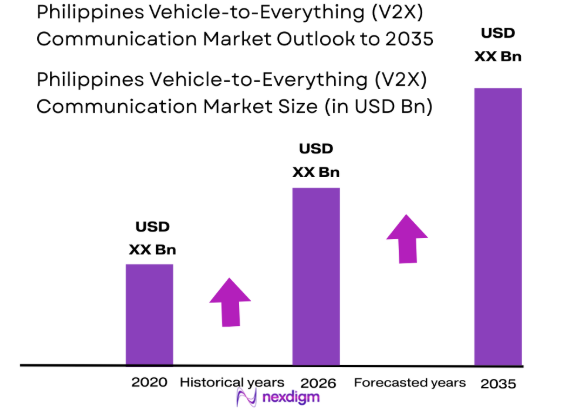
The Philippines Vehicle-to-Everything (V2X) Communication market is valued at approximately USD ~ billion, driven by rapid advancements in automotive technologies, smart city initiatives, and growing demand for connected vehicle solutions. As the country focuses on developing digital infrastructure and enhancing road safety, V2X technology is becoming essential for enabling seamless communication between vehicles, infrastructure, and other connected devices. Investments in autonomous vehicle systems, road management, and telecommunication infrastructure contribute significantly to this market’s growth.
Dominant cities in the Philippines for V2X adoption include Metro Manila, Cebu, and Davao, driven by their high urbanization rates and advanced transportation infrastructures. Metro Manila, as the country’s capital, leads the adoption with government-backed initiatives for intelligent transport systems and increased public-private partnerships. The market in these regions is further propelled by government policies promoting digital connectivity and innovation in transportation solutions, creating fertile ground for V2X technology implementation and development.
Market Segmentation
By System Type
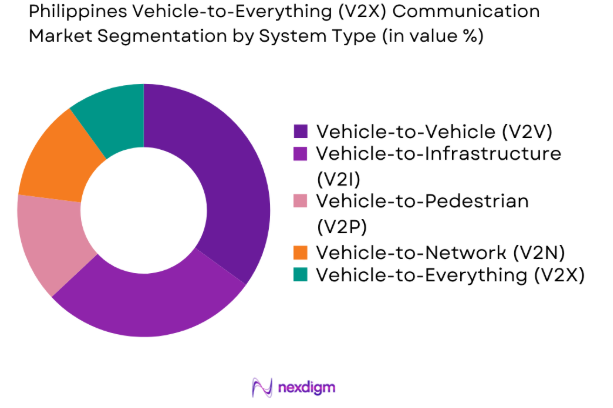
The Philippines V2X communication market is segmented by system type into vehicle-to-vehicle (V2V), vehicle-to-infrastructure (V2I), vehicle-to-pedestrian (V2P), vehicle-to-network (V2N), and vehicle-to-everything (V2X) platforms. Recently, vehicle-to-vehicle (V2V) systems have dominated the market share due to their significant role in enhancing road safety and enabling real-time communication between vehicles to prevent accidents and improve traffic management. These systems are favored by automakers, given their potential to support autonomous driving and intelligent transport systems.
By Platform Type
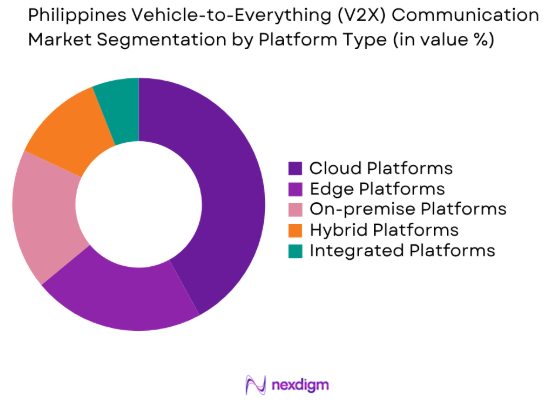
The Philippines Vehicle-to-Everything (V2X) Communication market is segmented by platform type into cloud platforms, edge platforms, on-premise platforms, hybrid platforms, and integrated platforms. Recently, cloud platforms have garnered the dominant market share due to their scalability, cost-effectiveness, and ability to support real-time data processing and communication across vast networks. Cloud solutions provide flexibility for automakers and transport authorities, enabling the smooth implementation of V2X services, regardless of the infrastructure’s complexity or size.
Competitive Landscape
The competitive landscape in the Philippines V2X communication market is rapidly evolving, with key players focusing on strategic partnerships, acquisitions, and technological advancements. The influence of global automotive and tech companies is significant, with players leading the way in V2X infrastructure and communication technology. These major players are driving innovation and setting the foundation for smart transportation systems in the Philippines.
| Company Name | Establishment Year | Headquarters | Technology Focus | Market Reach | Key Products | Revenue | Additional Market-Specific Parameter |
| Qualcomm | 1985 | USA | ~ | ~ | ~ | ~ | ~ |
| Ericsson | 1876 | Sweden | ~ | ~ | ~ | ~ | ~ |
| NXP Semiconductors | 1953 | Netherlands | ~ | ~ | ~ | ~ | ~ |
| Autotalks | 2008 | Israel | ~ | ~ | ~ | ~ | ~ |
| Cohda Wireless | 2004 | Australia | ~ | ~ | ~ | ~ | ~ |
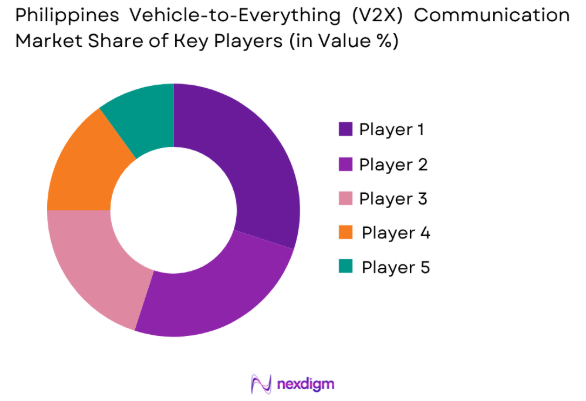
Philippines Vehicle-to-Everything (V2X) Communication Market Analysis
Growth Drivers
Government Support for Smart Cities
Government initiatives focused on developing smart cities are fueling the growth of the Philippines V2X communication market. Through the “Build, Build, Build” program, substantial investments are being made in infrastructure projects, including intelligent transport systems and smart traffic management. These efforts create the essential infrastructure for V2X technology, enabling real-time communication and data exchange between vehicles and traffic systems. The government’s focus on sustainable urban mobility and reducing traffic congestion further drives the demand for V2X adoption in major cities. As urban areas expand, these initiatives support the integration of V2X systems, promoting safer roads, efficient transportation networks, and the overall advancement of smart city development.
Increasing Demand for Autonomous Vehicles
The Philippines is experiencing a growing interest in autonomous vehicle technologies, driving the demand for V2X communication systems. As automakers advance driverless technology, V2X becomes essential for enabling vehicles to communicate with each other, infrastructure, and pedestrians, ensuring safer operations. This real-time data exchange is crucial for improving vehicle decision-making, particularly in dynamic traffic environments. V2X systems help enhance vehicle awareness, facilitating more efficient and reliable autonomous driving. The increasing focus on autonomous vehicles, coupled with the need for seamless communication between vehicles and surrounding systems, is accelerating the development and integration of V2X communication into modern vehicles, supporting the country’s push toward safer and smarter transportation.
Market Challenges
Infrastructure Limitations
A major challenge to the widespread adoption of V2X communication in the Philippines is the lack of infrastructure needed to support its implementation. Many urban areas still lack the essential digital infrastructure, such as smart traffic lights, roadside sensors, and communication towers, required to fully enable V2X technology. This gap between the rapid development of V2X technologies and the availability of the necessary infrastructure presents a significant barrier to its adoption. The challenge is particularly pronounced in less developed regions, where the digital infrastructure needed to support V2X systems is often inadequate, slowing the nationwide rollout and limiting the technology’s potential benefits.
High Initial Investment Costs
Implementing V2X communication technologies requires substantial upfront investment in both hardware and software, which presents a major challenge for governments and private stakeholders. The cost of upgrading infrastructure and vehicles to support V2X systems is a significant concern, especially in a developing economy like the Philippines. Limited budgets for transportation and communication projects further complicate the adoption of V2X technology. The high costs associated with deploying these systems make it difficult for smaller municipalities to invest in the necessary infrastructure, potentially slowing the widespread adoption of V2X communication. This financial barrier hampers the pace of integration, particularly in less affluent regions.
Opportunities
Integration with Electric Vehicles (EVs)
A key opportunity in the Philippines V2X communication market is the integration of V2X technologies with electric vehicles (EVs). As the government encourages a transition to sustainable transportation, the demand for EVs is growing rapidly. V2X communication can significantly enhance EV capabilities, offering features like better battery management and optimized routes that improve energy efficiency. This integration can enable EVs to communicate with infrastructure and other vehicles, ensuring smoother operations and maximizing the benefits of electric mobility. The synergy between V2X and EV technologies aligns with the Philippines’ sustainability goals, presenting a substantial growth opportunity in the V2X communication market. This collaboration will drive the adoption of both technologies and support the country’s move toward greener transportation solutions.
Public-Private Partnerships for Infrastructure Development
Another significant opportunity in the Philippines V2X communication market is the potential for public-private partnerships (PPPs) to develop the necessary infrastructure. With the government prioritizing the construction of smart cities, there is increasing demand for private-sector involvement in deploying V2X technologies. Collaborations between automotive companies, telecommunications providers, and local authorities can fast-track the development of the infrastructure required for V2X systems, such as smart traffic management and communication networks. These partnerships can help accelerate the rollout of V2X technologies across urban areas, enabling the integration of connected transportation systems. By leveraging the strengths of both the public and private sectors, PPPs can create a solid foundation for the widespread adoption of V2X communication in the country.
Future Outlook
The future outlook for the Philippines V2X communication market is promising, with expected growth driven by ongoing urbanization and government initiatives in the transportation sector. Technological developments in autonomous vehicles and the rollout of 5G connectivity will further fuel the demand for V2X systems. Additionally, regulatory support aimed at enhancing road safety and reducing congestion will create a favorable environment for V2X adoption. As cities continue to develop and embrace smart technologies, the V2X market is expected to expand significantly over the next five years.
Major Players
- Qualcomm
- Ericsson
- NXP Semiconductors
- Autotalks
- CohdaWireless
- Intel
- Harman International
- Bosch
- Continental AG
- Denso Corporation
- Autoliv
- LG Electronics
- ZF Friedrichshafen
- Delphi Technologies
- Valeo
Key Target Audience
- Investments and venture capitalist firms
- Government and regulatory bodies
- Automobile manufacturers
- Telecommunications providers
- Transport authorities
- Technology solution providers
- Urban infrastructure developers
- Public sector agencies
Research Methodology
Step 1: Identification of Key Variables
We identify critical market variables such as system types, platform types, and procurement channels that influence the V2X communication market in the Philippines.
Step 2: Market Analysis and Construction
Comprehensive analysis of market trends, growth drivers, and barriers is conducted to estimate the market size and forecast.
Step 3: Hypothesis Validation and Expert Consultation
Consultations with industry experts, stakeholders, and government officials validate the findings and assumptions used in market modeling.
Step 4: Research Synthesis and Final Output
The research is synthesized into a structured report, presenting key insights, segmentation data, and strategic recommendations.

- Executive Summary
- Research Methodology (Definitions, Scope, Industry Assumptions, Market Sizing Approach, Primary & Secondary Research Framework, Data Collection & Verification Protocol, Analytic Models & Forecast Methodology, Limitations & Research Validity Checks)

- Market Definition and Scope
- Value Chain & Stakeholder Ecosystem
- Regulatory / Certification Landscape
- Sector Dynamics Affecting Demand
- Strategic Initiatives & Infrastructure Growth

- Growth Drivers
Increased Investment in Smart City Infrastructure
Adoption of Autonomous Vehicles
Government Policies Promoting V2X Technology - Market Challenges
Lack of Standardized Protocols for V2X Communication
High Initial Investment for V2X Infrastructure
Security and Privacy Concerns in V2X Systems - Market Opportunities
Expansion of Electric Vehicle Integration with V2X
Technological Advancements in 5G for V2X Communication
Growth of Private-Industry Partnerships for V2X Development - Trends
Shift Toward Autonomous Transportation Systems
Integration of Artificial Intelligence in V2X Communication
Growing Adoption of Vehicle Safety Features - Government Regulations
- SWOT Analysis of Key Competitors
- Porter’s Five Forces

- By Market Value 2020-2025
- By Installed Units 2020-2025
- By Average System Price 2020-2025
- By System Complexity Tier 2020-2025

- By System Type (In Value%)
Connected Vehicles
Traffic Management Systems
Vehicle-to-Infrastructure Communication
Vehicle-to-Vehicle Communication
Cloud-based V2X Systems - By Platform Type (In Value%)
Cloud Platforms
On-premise Platforms
Edge Platforms
Hybrid Platforms
Integrated Platforms - By Fitment Type (In Value%)
On-board Units
Aftermarket Devices
Embedded Systems
Cloud-based Solutions
Modular Systems - By End User Segment (In Value%)
Automobile Manufacturers
Transportation Authorities
Telecommunications Providers
Government Bodies
Private Enterprises - By Procurement Channel (In Value%)
Direct Procurement
Government Tenders
Private Sector Procurement
Online Bidding Platforms
Third-party Distributors

- Market Share Analysis
- Cross Comparison Parameters (System Type, Platform Type, Procurement Channel, End User Segment, Fitment Type, Technology Integration, Market Reach, Pricing Strategy, Service Coverage, Fleet Size)
- SWOT Analysis of Key Competitors
- Pricing & Procurement Analysis
- Key Players
Qualcomm
Intel
Ericsson
NXP Semiconductors
Cohda Wireless
Delphi Technologies
Autotalks
Commsignia
Econolite
Harman International
Uptake Technologies
Ansys
Verizon
AT&T
Huawei

- Increasing Adoption by Automakers for Safety Features
- Telecommunications Providers’ Role in Infrastructure Development
- Government Initiatives in Transportation Modernization
- Private Sector Interest in V2X for Logistics and Fleet Management

- Forecast Market Value, 2026-2035
- Forecast Installed Units, 2026-2035
- Price Forecast by System Tier, 2026-2035
- Future Demand by Platform, 2026-2035


 Request a Sample
 Ask for Customization
 Get a Quote
 Enquire Now