
 Download PDF
Market Overview
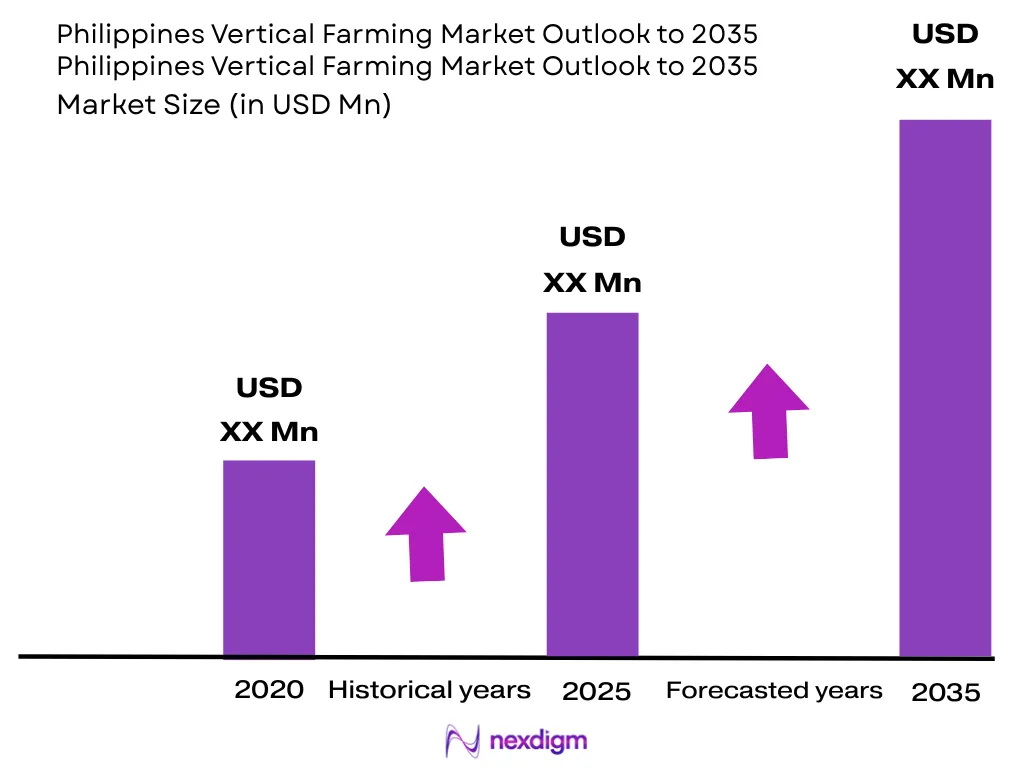
The Philippines vertical farming market is currently valued at approximately USD ~ million. The Philippines Vertical Farming Market is emerging as one of Southeast Asia’s fastest-growing controlled environment agriculture markets, driven by a uniquely powerful convergence of structural demand factors: the country’s status as one of the world’s most disaster-prone nations, with an agricultural sector that suffered approximately USD 3.8 billion in losses and damages from 75 disasters between 2006 and 2013 alone; a chronically dysfunctional fresh produce supply chain in which conventional produce from highland growing regions such as Benguet in the Cordillera Administrative Region passes through up to ten intermediaries before reaching consumers in Metro Manila; and a rapidly urbanising population of over 113 million people concentrated in land-scarce, densely populated metropolitan areas where access to consistently fresh, pesticide-free produce remains limited.
Market Segmentation
By Crop Type
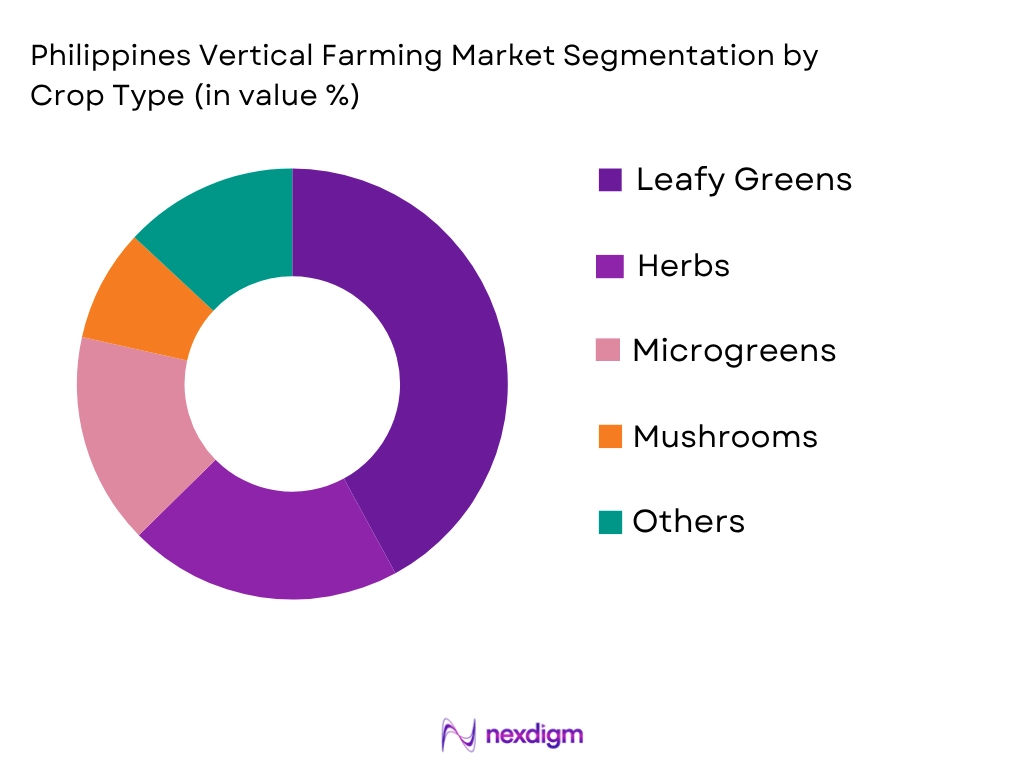
The Philippines Vertical Farming Market is segmented by crop type into leafy greens, herbs, microgreens, mushrooms, tomatoes, strawberries, and other vegetables including pechay, kangkong, bell peppers, and eggplants. Leafy greens, led by lettuce and a range of culturally significant Filipino vegetables including pechay and spinach, dominate the market due to their short cultivation cycles — NXTLVL Farms’ Future Fresh brand reduces lettuce cultivation time from 60 days in conventional farming to approximately 30 days in controlled indoor environments — high yield density, and strong demand from supermarkets and restaurants in Metro Manila and Cebu. Leafy greens also benefit most directly from vertical farming’s core advantages in the Philippine context: protection from typhoon-related supply disruption, elimination of the deterioration associated with long-haul cold-chain logistics from Benguet to Metro Manila, and consistently pesticide-free quality that conventional supply chains cannot guarantee. NXTLVL Farms alone supplies up to 50 different product lines, including lettuce, leafy greens, herbs, microgreens, salad mixes, fresh mushrooms, and mushroom powder, demonstrating the breadth of vertically farmed produce commercially viable in the Philippine market. Microgreens represent the fastest-growing premium segment, driven by rising demand from fine-dining restaurants and diet delivery platforms.
By Growing Mechanism
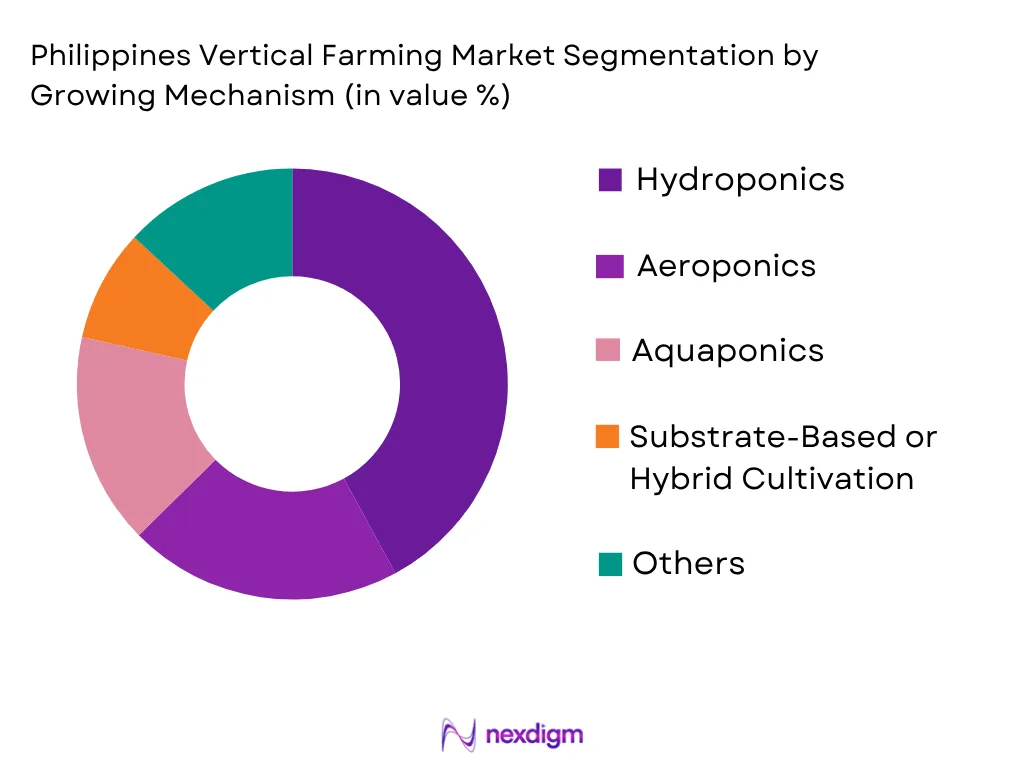
The Philippines Vertical Farming Market is segmented by growing mechanism into hydroponics, aeroponics, aquaponics, and substrate-based cultivation. Hydroponics holds dominant market share, with ebb-and-flow and nutrient film technique (NFT) systems accounting for the overwhelming majority of commercial production capacity. NXTLVL Farms’ containerised hydroponic farmboxes, now in their fourth system generation and twelfth custom grow light iteration, represent the most technologically mature commercial hydroponic system in the Philippines market. Hydroponic systems deliver water savings of up to 95% relative to conventional agriculture, require no soil, eliminate soil-borne pathogens, allow plants to grow faster and closer together, and enable fully enclosed climate control that is critical for year-round production in the Philippines’ hot, humid tropical climate subject to seasonal monsoons and destructive typhoons. The sector’s growing production volumes are also driving efficiency improvements: one NXTLVL container uses less than 120 kilowatt-hours of electricity per day, with each improvement cycle targeting further energy reduction. Aeroponics represents a smaller but distinctive segment, deployed in tower farm configurations by King Tower Farm and Good Greens and Co.’s Navotas City installation, reflecting the technology’s suitability for compact, community-scale food security applications across the country’s densely populated urban areas.
Competitive Landscape
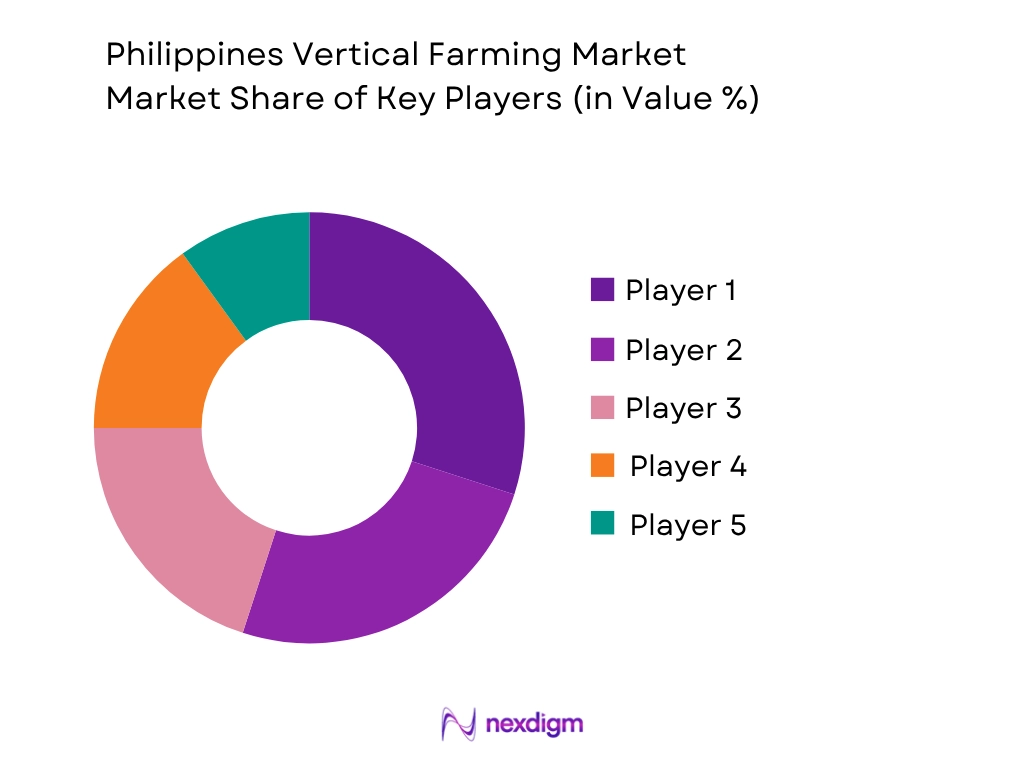
The Philippines Vertical Farming Market is characterised by a pioneering but nascent competitive environment, led by NXTLVL Farms’ Future Fresh brand as the undisputed market innovator and scale leader, alongside a growing ecosystem of complementary operators pursuing differentiated strategies across Metro Manila, Cebu, and government-backed community deployments. NXTLVL Farms distinguishes itself through proprietary containerised farm technology, an omni-channel distribution model spanning supermarket chains, e-commerce partnerships, and direct farm-to-door delivery within hours of harvest, and a clear national expansion strategy targeting 15 or more sites across the Philippines. Urban Greens has built a case for converting vacant Metro Manila commercial buildings into productive indoor farms, citing the abundance of idle commercial real estate as a scalable opportunity. Good Greens and Co., backed by the Delgado Brothers Group’s logistics heritage, has combined vertical farming with an explicit food security mission aimed at making fresh, affordable produce accessible to urban Filipinos including lower-income communities. The market has attracted early international attention, with Singapore-based Singrow identifying the Philippines among its priority expansion markets in the region. The Department of Agriculture’s container farm programme and Urban Agriculture policy framework have further expanded the addressable market for commercial operators by raising public awareness, supporting procurement from local producers, and establishing a replicable deployment model across disaster-affected provinces.
| Company | Establishment Year | Headquarters | Primary Crop Focus | Growing Technology | Automation Level | Geographic Presence | Retail Partnerships | Sustainability Focus |
| NXTLVL Farms (Future Fresh) | 2018 | ~ | ~ | ~ | ~ | ~ | ~ | ~ |
| Urban Greens | 2019 | ~ | ~ | ~ | ~ | ~ | ~ | ~ |
| Good Greens and Co. (Delbros) | 2018 | ~ | ~ | ~ | ~ | ~ | ~ | ~ |
| Urban Roots Philippines | 2018 | ~ | ~ | ~ | ~ | ~ | ~ | ~ |
| King Tower Farm | 2018 | ~ | ~ | ~ | ~ | ~ | ~ | ~ |
Philippines Vertical Farming Market Analysis
Growth Drivers
Typhoon and Climate Disaster Vulnerability Driving Demand for Resilient Food Production
The Philippines’ status as one of the world’s most disaster-prone nations is the most powerful structural driver of the Vertical Farming Market. The country is struck by an average of 20 typhoons annually, and between 2006 and 2013 alone, 75 disasters caused approximately USD 3.8 billion in agricultural losses and damages. According to the Food and Agriculture Organisation, the Philippines has one of the most vulnerable agricultural systems in the world, with droughts reducing rainfall that leads to increased pest infestations, rising sea levels increasing soil salinity, and land and irrigation water being progressively lost to climate change. Conventional open-field agriculture in the Philippines operates under constant typhoon risk, and the supply chain connecting highland growing regions to Metro Manila consumers is routinely disrupted by weather events, damaging road infrastructure and cold-chain logistics. In contrast, vertical farms enclosed in reinforced containers or buildings are protected from typhoons, monsoons, floods, and extreme heat, enabling year-round production independent of weather conditions. The Department of Agriculture’s deployment of over 200 container farms in typhoon-affected provinces in 2023 to ensure continuous vegetable supply during natural disasters represents an explicit government acknowledgement of vertical farming’s disaster-resilience role within the national food security framework.
Dysfunctional Supply Chain with Excessive Intermediary Layers
The structural inefficiency of the Philippines’ fresh produce supply chain represents a uniquely compelling driver of vertical farming adoption. Conventional fresh produce in Metro Manila typically passes through up to ten intermediaries between the highland farm and the end consumer, resulting in significant post-harvest deterioration, food waste, price amplification, and inconsistent quality by the time products reach urban supermarkets and households. The geography of the Philippines — a nation of 7,641 islands — compounds these logistics challenges, with infrastructure limitations including road quality and cold-chain capacity further degrading produce quality and increasing transportation costs. NXTLVL Farms’ Future Fresh brand has directly addressed this structural problem by siting container farms within Metro Manila itself — in Quezon City and Taguig City — and delivering produce within hours of harvest with only two intermediaries between the farm and the consumer, compared to the conventional ten. This freshness and traceability advantage, combined with the guarantee of zero bad leaves or waste on delivery, has proven a compelling commercial proposition for restaurants, diet delivery services, and health-conscious consumers who have directly experienced the limitations of the conventional supply chain.
Market Challenges
High Electricity Costs and Tropical Climate Energy Demands
High electricity costs represent one of the most significant structural challenges facing the Philippines Vertical Farming Market. Indoor cultivation in the Philippines’ hot, humid tropical climate requires continuous LED lighting, climate control, humidity management, and ventilation — energy demands that are further intensified by the need to cool growing environments against the country’s year-round high ambient temperatures. The Philippines has among the highest industrial electricity tariffs in Southeast Asia, driven by a high proportion of oil-based and imported fuel generation, which directly increases the operating costs of energy-intensive vertical farming facilities. One NXTLVL Farms container uses less than 120 kilowatt-hours of electricity per day — a figure that the company has actively sought to reduce through successive technology innovations — but operating at commercial scale still requires significant continuous power consumption. Unlike South Africa, where a mature solar and battery storage industry offers vertical farm operators a relatively accessible off-grid pathway, the Philippines’ renewable energy integration for agricultural operations remains less developed, though growing interest in solar-powered farming is beginning to address this challenge.
Capital Intensity and Affordability Constraints in an Archipelagic Nation
Establishing commercial-scale vertical farming facilities in the Philippines requires substantial upfront capital investment that is difficult to access in a market where venture capital for agri-tech remains limited relative to more mature Asian markets. The Philippines’ archipelagic geography further compounds capital and logistics challenges: shipping equipment across 7,641 islands increases procurement costs and delivery times for imported components, while finding suitable commercial sites close to urban consumer markets can be more complex than in more geographically compact economies. Income inequality remains significant in the Philippines, with a large proportion of the population concentrated in lower-income segments for whom premium-priced vertically farmed produce is unaffordable at current price points. This creates a two-tier market dynamic in which commercial growth is predominantly confined to Metro Manila’s affluent and upper-middle-income consumer segments, premium restaurants, and sophisticated retail channels, while the broader mass market continues to rely on conventionally grown produce. Closing this affordability gap will require sustained production scale improvements, technology cost reductions, and the development of lower-capital-expenditure farming models suited to a wider range of operators, including community groups and local government units.
Market Opportunities
Vacant Building Conversion and Expansion to Secondary Cities
The Philippines’ large and growing stock of vacant commercial buildings — a legacy of over-construction in Metro Manila and secondary cities before and during the pandemic — presents a significant opportunity for vertical farming expansion using retrofitted warehouse and office space. Iloilo Metropolitan Times has highlighted the potential for idle buildings to be converted into productive food production facilities on at least a temporary basis, with the modular and reversible nature of hydroponic and aeroponic systems making retrofitting commercially viable. This approach could substantially reduce the capital cost barrier for new operators while deploying production capacity within existing urban infrastructure close to consumers. Beyond Metro Manila, the expansion to Cebu led by NXTLVL Farms demonstrates the commercial potential of entering secondary cities with established restaurant and hospitality sectors that currently lack locally grown premium produce supply. Davao, Iloilo, and other regional centres represent additional untapped markets with growing urban middle-class populations and a strong hospitality and restaurant sector, while Cebu’s development as a plant factory model beyond container farming illustrates the sector’s technological progression.
Department of Agriculture Partnership and Disaster Resilience Programmes
The Department of Agriculture’s demonstrated willingness to invest in container farm deployments across typhoon-affected provinces and its formal integration of vertical farming into national food security policy creates significant opportunities for commercial operators to partner with government bodies on disaster-resilience programmes at scale. Commercial operators with proven container farm technology — particularly NXTLVL Farms, whose NXTLVL Farmbox system has undergone four successive technology iterations — are well positioned to supply DA procurement programmes, train local government unit personnel in farm operations, and potentially participate in public-private partnership frameworks for community food security installations. The Department of Science and Technology’s agri-tech support initiatives and the National RDE Network for Urban Agriculture’s research and extension programmes further expand the range of collaborative opportunities between the commercial sector and government agencies. Legislative developments including SB 257 and HB 1297 have the potential to unlock government land and building resources for commercial vertical farming operations, representing a significant real estate subsidy that could materially reduce operators’ capital expenditure on suitable sites.
Future Outlook
The Philippines Vertical Farming Market is expected to witness strong expansion over the forecast period, supported by the structural permanence of typhoon and climate-disaster risk that makes controlled environment agriculture a strategic national imperative rather than a niche innovation, the continued maturation of the commercial operator ecosystem led by NXTLVL Farms’ multi-city expansion, and growing government investment and policy support under the Agriculture 2.0 agenda and urban agriculture legislation. The expansion of leading operators to secondary cities including Cebu and potentially Davao, Iloilo, and other regional centres will materially expand the addressable market beyond Metro Manila. Commercial operators are expected to pursue further energy efficiency improvements in their indoor farming systems to manage electricity costs, while growing interest in renewable energy integration, particularly solar, is expected to improve long-term operating economics. The mainstreaming of vertical farming in secondary and tertiary education curricula, mandated under pending urban agriculture legislation, is expected to build a larger domestic talent pool, reducing dependency on international expertise and lowering the human capital cost of scaling operations. Direct-to-consumer and omni-channel distribution models, enabled by the Philippines’ rapidly growing e-commerce and quick-delivery ecosystem, will further support market growth by improving accessibility and reducing distribution costs. Sustained government and donor investment in community and disaster-resilience container farm programmes across typhoon-affected provinces will expand the reach of vertical farming beyond premium urban commercial markets, building both production capacity and public familiarity with locally grown indoor produce. The Philippines is expected to consolidate its position as the leading vertical farming market in the archipelagic Southeast Asian sub-region through 2035.
Major Players
- NXTLVL Farms (Future Fresh)
- Urban Greens
- Good Greens and Co. (Delgado Brothers Group)
- Urban Roots Philippines
- King Tower Farm
- Harbest Agribusiness Corporation
- Singrow Philippines
- AgriNurture Inc.
- GROW Philippines AgriTech Accelerator
- Green Acres Hydroponics Philippines
- BenguetCorp Hydroponics Ventures
- FarmBox Philippines
- Navotas Aeroponic Community Farm
- PhilRice Hydroponic Research and Extension
- UrbanEats Philippines
Key Target Audience
- Vertical Farming Operators and Indoor Agriculture Companies
- Fresh Produce Retail Chains and Supermarkets
- Restaurants and Fine-Dining Establishments
- Diet Delivery and Health Food Platform Companies
- Agricultural Technology Equipment Manufacturers
- Hydroponic Systems Suppliers and Integrators
- Investment and Venture Capital Firms
- Government and Regulatory Bodies (Department of Agriculture, Department of Science and Technology, Local Government Units)
- Controlled Environment Agriculture Infrastructure Developers
- Academic Institutions and Agricultural Research Programmes
- NGOs and Community Food Security Organisations
- Sustainable Food Supply Chain and Distribution Companies
Research Methodology
Step 1: Identification of Key Variables
The initial phase involves constructing an ecosystem map encompassing all major stakeholders within the Philippines Vertical Farming Market. Extensive secondary research is conducted through industry publications, government databases including Department of Agriculture programme reports, company reports, and agricultural technology resources. The objective is to identify key variables influencing production capacity, crop yields, technology adoption, disaster resilience, and market growth across the Philippines’ major urban centres and typhoon-affected provinces.
Step 2: Market Analysis and Construction
This phase focuses on collecting and analysing historical industry data related to production volume, facility expansion, crop output, technology deployment, and revenue generation. Market segmentation is developed based on crop types, cultivation technologies, and end-user demand patterns across Metro Manila, Cebu, Davao, and government-supported provincial deployments. Supply-side and demand-side assessments are integrated, with particular attention to the role of typhoon-related supply chain disruptions in driving periodic surges in vertical farm demand.
Step 3: Hypothesis Validation and Expert Consultation
Market assumptions and forecasts are validated through structured interviews with vertical farm operators, hydroponic systems providers, equipment suppliers, retail and restaurant buyers, and government programme representatives. These consultations provide operational insights regarding yield performance, distribution strategies, disaster-resilience performance, and future technology and expansion priorities specific to the Philippine vertical farming sector.
Step 4: Research Synthesis and Final Output
The final stage combines insights from primary and secondary research sources. Data triangulation techniques are applied to validate market estimates and segment-level findings. The resulting analysis provides a comprehensive view of competitive dynamics, growth opportunities, future trends, and strategic recommendations within the Philippines Vertical Farming Market through 2035.

- Executive Summary
- Research Methodology (Market Definitions and Assumptions, Abbreviations, Market Sizing Approach, Top-Down Analysis, Bottom-Up Analysis, Controlled Environment Agriculture Assessment, Demand-Side Assessment, Supply-Side Assessment, Primary Industry Interviews, Data Triangulation, Forecasting Framework, Limitations and Future Conclusions)

- Definition and Scope
- Market Evolution and Industry Genesis
- Timeline of Major Industry Developments
- Vertical Farming Ecosystem Structure
- Controlled Environment Agriculture Value Chain Analysis

- Growth Drivers (Typhoon and Climate Disaster Resilience, Dysfunctional Supply Chain with Up to Ten Intermediaries, National Food Security and Agriculture 2.0 Agenda, Rapid Urbanisation and Urban Food Access Challenges, Rising Consumer Demand for Pesticide-Free and Traceable Produce, Department of Agriculture Container Farm Deployments)
- Market Challenges (High Electricity Costs and Grid Reliability, Capital Intensive Infrastructure in a Price-Sensitive Economy, Archipelagic Logistics and Equipment Import Complexity, Affordability Constraints, Limited Domestic AgriTech Expertise, Consumer Price Sensitivity Beyond Premium Urban Segments)
- Market Opportunities (Vacant Building Conversion for Urban Farming, Expansion to Secondary Cities Including Cebu and Davao, E-Commerce and Farm-to-Door Direct Delivery Growth, Department of Agriculture Partnership and Disaster Resilience Programmes, Diet Delivery and Health Food Platform Integration, Renewable Energy Integration)
- Market Trends (Container Farm Deployment as Modular Disaster-Resilient Model, Plant Factory Format Transition, Omni-Channel Retail and Direct-to-Consumer Delivery, AI and IoT-Enabled Crop Monitoring, Local Government Unit Community Food Security Collaboration, Urban Farming Integration into Education Curricula)
- Government Regulations (Department of Agriculture Urban Agriculture Programme and Agriculture 2.0 Agenda, Senate Bill 257 Urban Agriculture and Vertical Farming Act, House Bill 1297 Instructional Gardens and Urban Agriculture Act of 2022, National RDE Network for Urban Agriculture Programme, Department of Science and Technology AgriTech Initiatives, Local Government Unit Urban Farming Mandates)
- SWOT Analysis
- PESTLE Analysis
- Porter’s Five Forces Analysis
- Stakeholder Ecosystem
- Competition Ecosystem

- By Market Value (2020-2025)
- By Production Volume (2020-2025)
- By Average Selling Price (2020-2025)

- By Crop Type (In Value %)
Lettuce
Leafy Greens (Pechay, Kangkong, Spinach, Arugula)
Microgreens
Herbs (Basil, Coriander, Chili, Mint)
Strawberries
Tomatoes
Mushrooms
Bell Peppers, Eggplants, and Other Vegetables - By Farming Structure (In Value %)
Shipping Container Farms
Building-Based Vertical Farms
Greenhouse-Integrated Vertical Farms
Aeroponic Tower Farms - By Growing Mechanism (In Value %)
Hydroponics
Aeroponics
Aquaponics
Substrate-Based Cultivation - By Region (In Value %)
National Capital Region (Metro Manila)
Central Visayas (Cebu)
Davao Region
Typhoon-Affected Provinces (Luzon, Visayas, Mindanao) - By End User (In Value %)
Retail Chains and Supermarkets
Restaurants and Fine-Dining Establishments
Diet Delivery Services and Health Food Platforms
Culinary Schools and Institutions
Direct-to-Consumer
Institutional and Community Buyers

- Market Share Analysis of Major Players (By Revenue, Production Volume, Cultivation Capacity, Crop Portfolio, Regional Presence)
- Market Concentration Analysis
- Cross Comparison Parameters (Cultivation Capacity, Annual Yield Output, Number of Facilities, Crop Portfolio Diversity, Growing System Innovation, Distribution Channel Reach, Energy Efficiency per Kg of Produce, Disaster Resilience Performance)
- SWOT Analysis of Major Players
- Pricing Analysis (Per Kilogram Pricing, Premium vs Conventional Produce Pricing, Retail Channel Pricing, Crop-Wise Pricing Benchmarking)
- Detailed Profiles of Major Companies
NXTLVL Farms (Future Fresh)
Urban Greens
Good Greens and Co. (Delgado Brothers Group)
Urban Roots Philippines
King Tower Farm
Harbest Agribusiness Corporation
Singrow Philippines
AgriNurture Inc.
GROW Philippines AgriTech Accelerator
Green Acres Hydroponics Philippines
BenguetCorp Hydroponics Ventures
FarmBox Philippines
Navotas Aeroponic Community Farm
PhilRice Hydroponic Research and Extension
UrbanEats Philippines

- Fresh Produce Consumption and Utilisation Assessment (Consumption Frequency, Freshness Preference, Local Produce Demand, Premium Produce Adoption)
- Procurement Behaviour Analysis (Contract Farming Preference, Supplier Switching Rate, Procurement Volume, Supply Consistency Requirements)
- Purchasing Power and Spending Analysis
- Sustainability-Driven Purchase Behaviour (Carbon Footprint Awareness, Water Conservation Preference, Food Miles Reduction Importance)
- Premium Pricing Acceptance Analysis

- By Market Value (2026-2035)
- By Production Volume (2026-2035)
- By Average Selling Price (2026-2035)


 Request a Sample
 Ask for Customization
 Get a Quote
 Enquire Now