
 Download PDF
Market Overview
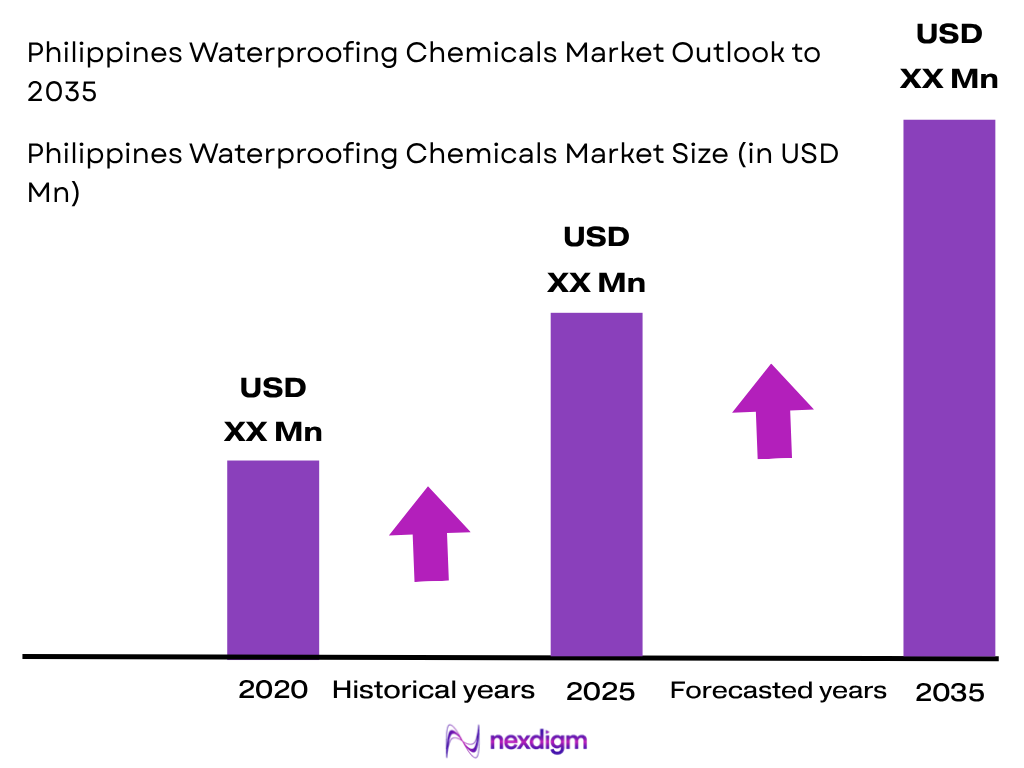
The Philippines Waterproofing Chemicals Market is valued at approximately US$ ~ billion in 2024, with the market supported by sustained construction activity, infrastructure development, building rehabilitation and rising requirements for moisture protection in tropical structures. Official Philippine Statistics Authority data show that the value of construction from approved building permits reached PHP 563.89 billion in 2024, compared with PHP 515.30 billion in 2023, while reported construction floor area increased from 41.47 million sq. m. to 42.84 million sq. m. The construction sector itself recorded 10.2% growth in 2024, strengthening the underlying demand pool for waterproofing chemicals.
Demand is concentrated around major construction and economic centers, particularly Metro Manila, CALABARZON, Central Luzon and Central Visayas, where commercial, residential, industrial and infrastructure activity creates recurring waterproofing requirements. In 2024, NCR generated PHP 384.08 billion in construction-section revenue, followed by CALABARZON at PHP 49.39 billion and Central Visayas at PHP 40.04 billion. PSA data also identify NCR as a major contributor to construction activity, while Central Visayas recorded 7.3% regional economic growth, supporting construction and infrastructure demand across these locations.
Market Segmentation
By Product Type
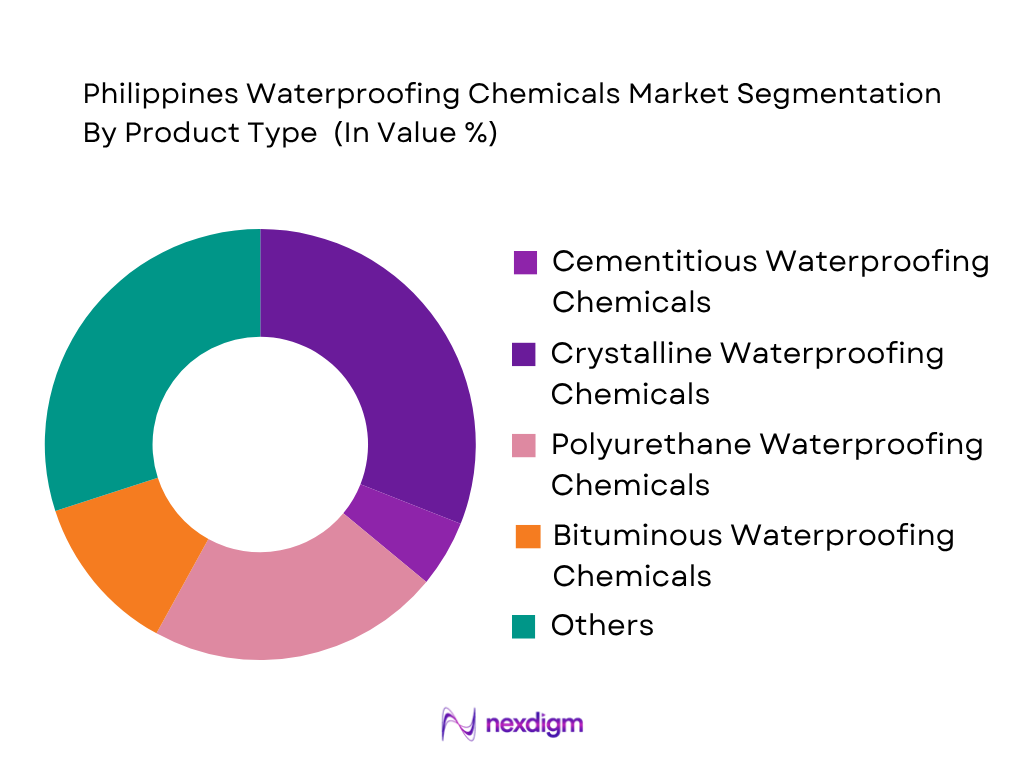
The Philippines Waterproofing Chemicals Market is segmented by product type into cementitious waterproofing chemicals, polyurethane waterproofing chemicals, acrylic waterproofing chemicals, bituminous waterproofing chemicals, epoxy waterproofing chemicals, polyurea waterproofing chemicals and crystalline waterproofing chemicals. Cementitious waterproofing chemicals are positioned as the dominant segment in the market segmentation framework because of their suitability for concrete and masonry substrates, broad applicability across residential and commercial construction, and compatibility with common construction practices. Cementitious systems can be applied to basements, bathrooms, water tanks, foundations, concrete structures and other moisture-exposed surfaces. Their integration with concrete construction also makes them relevant to infrastructure projects where concrete durability and water resistance are key specification requirements. The breadth of applications gives cementitious systems a wider addressable project base than highly specialized technologies. Polyurethane and polyurea systems remain important in projects requiring higher-performance liquid-applied protection, while crystalline systems are increasingly relevant to integral concrete waterproofing. Sika’s Philippine product portfolio, for example, includes cementitious waterproofing admixture applications for concrete, tunnels, water tanks, manholes and culverts, illustrating the breadth of cementitious waterproofing use cases.
By Application
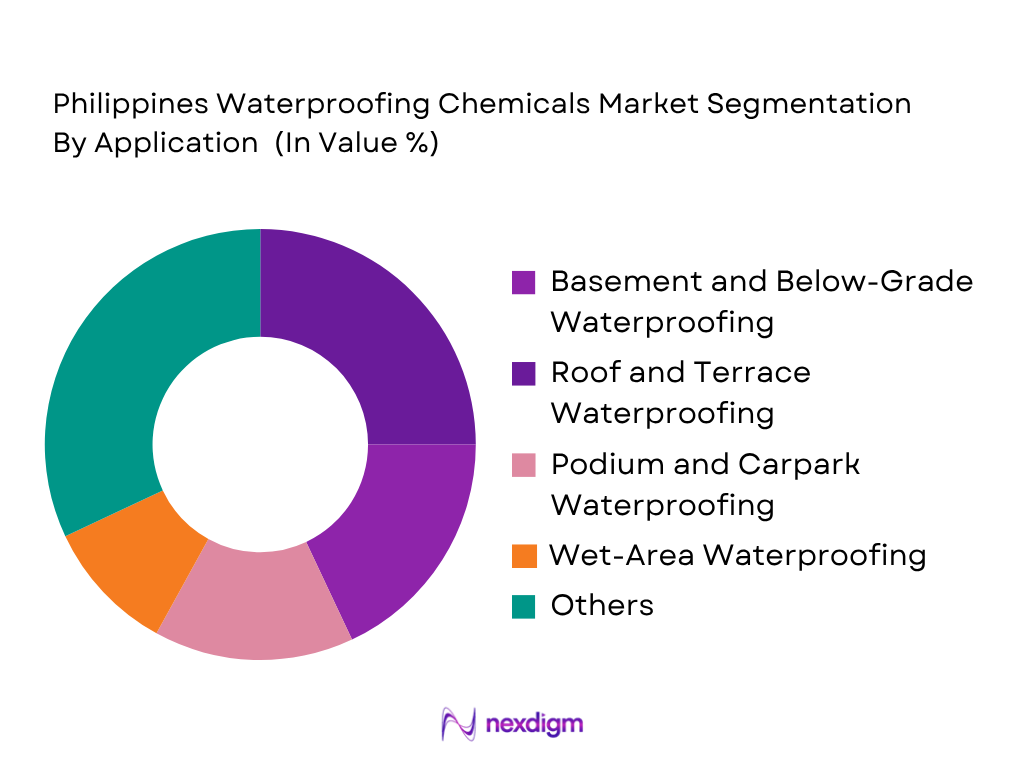
The Philippines Waterproofing Chemicals Market is segmented by application into roofing and roof decks, basements and foundations, wet areas, water tanks and reservoirs, walls and façades, bridges and tunnels, roads and transportation structures, and water and wastewater infrastructure. Roofing and roof-deck applications are positioned as the dominant segment because Philippine buildings operate under substantial rainfall, humidity and moisture exposure, making roof and exposed concrete protection recurring requirements across both new construction and refurbishment projects. The application base spans residential buildings, commercial properties, industrial facilities, hospitality developments and institutional structures. Waterproofing demand is also generated by remedial work where leakage develops in existing roofs, balconies, terraces and podium structures. Below-grade applications represent another strategically important demand pool because foundations, basements and retaining structures require protection against groundwater and soil moisture. Water tanks, reservoirs, sewer infrastructure and other hydraulic structures create more specialized demand for chemically resistant waterproofing systems. The broad application range means waterproofing chemicals are consumed not only during initial construction but also during maintenance, repair and rehabilitation cycles. Mapei’s waterproofing portfolio, for example, covers terraces, balconies, bathrooms, basins, storage tanks, bridge decks and underground structures, illustrating the breadth of application categories served by modern waterproofing systems.
Competitive Landscape
The Philippines Waterproofing Chemicals Market includes global construction-chemical manufacturers, specialized waterproofing suppliers, coatings companies and construction-material businesses competing through product breadth, technical specifications, contractor support and distribution reach. Competition is particularly influenced by the ability to supply multiple waterproofing chemistries and support different application environments, including roofs, wet areas, below-grade structures, concrete infrastructure, water-retaining structures and transportation assets. Companies with established construction-chemical portfolios can leverage relationships with contractors, developers, engineers and distributors to strengthen specification-driven demand.
| Company | Establishment Year | Headquarters | Cementitious Systems | PU / Polyurea Systems | Concrete Repair | Infrastructure Applications | Technical Support |
| Sika | 1910 | Baar, Switzerland | |||||
| Mapei | 1937 | Milan, Italy | |||||
| Fosroc | 1934 | Birmingham, UK | |||||
| Saint-Gobain Weber | 1900 | Paris, France | |||||
| Henkel | 1876 | Düsseldorf, Germany |
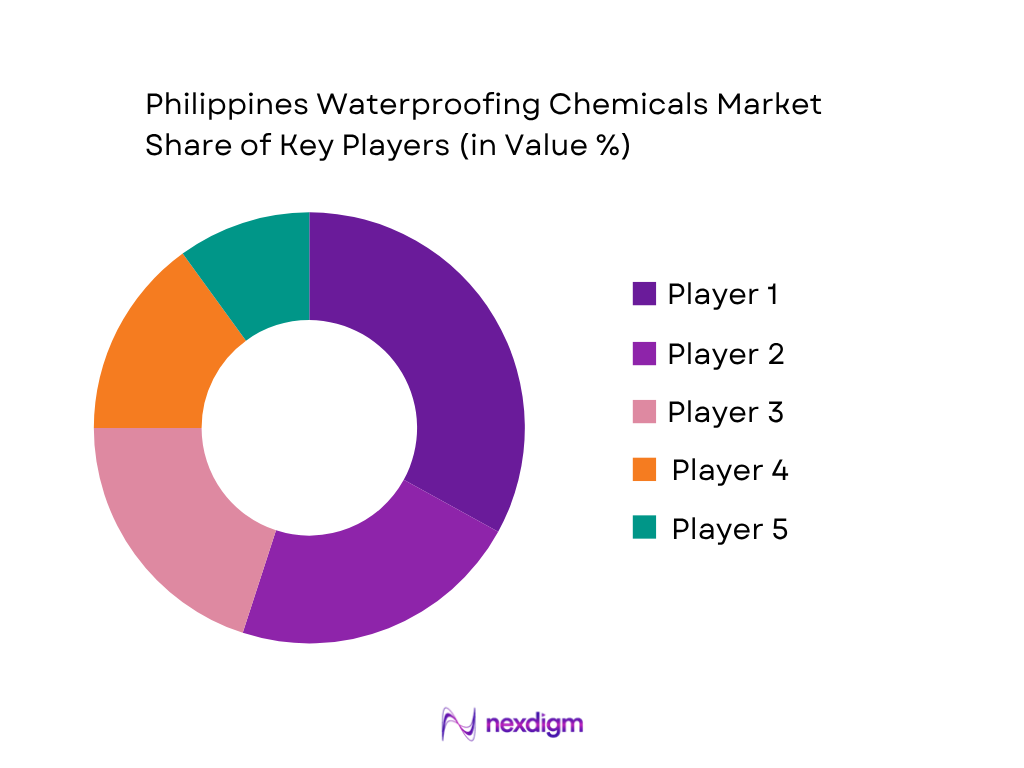
Philippines Waterproofing Chemicals Market Analysis
Growth Drivers
Expansion of Residential Construction
The Philippines Waterproofing Chemicals Market is supported by a large and expanding residential construction base, with the Philippine Statistics Authority recording 116,427 residential construction projects in 2024, compared with 112,399 in 2023. Residential construction floor area also increased from 18.13 million sq. m. to 19.75 million sq. m., while residential construction value rose from PHP 214.76 billion to PHP 248.65 billion. Philippine Statistics Authority This provides a direct application base for waterproofing chemicals across foundations, bathrooms, kitchens, balconies, roofs, terraces, water tanks and external walls. The wider construction environment is also supported by resilient economic activity: the IMF reported Philippine real GDP growth of 5.7% in 2024, following 5.5% in 2023, with gross fixed capital formation expanding 6.3% in 2024. International Monetary Fund The increase in residential floor area is particularly relevant because waterproofing demand is associated with the physical surface area requiring protection rather than simply the number of housing units. In addition, the 2024 construction data show that additions to existing buildings reached 708,409 sq. m., while alteration and repair construction value reached PHP 43.05 billion, indicating a parallel remediation and refurbishment opportunity. Philippine Statistics Authority These conditions support recurring demand for cementitious coatings, polyurethane systems, acrylic coatings, crystalline waterproofing and injection chemicals alongside new-build applications.
Infrastructure Investment
Infrastructure development is a major structural driver for the Philippines Waterproofing Chemicals Market because public projects create extensive requirements for protecting concrete, foundations, bridges, tunnels, roads, drainage structures and water infrastructure from moisture ingress. The government’s 2024 budget allocated PHP 997.9 billion to the Department of Public Works and Highways, including PHP 139.0 billion for asset preservation, PHP 132.3 billion for network development and PHP 24.8 billion for the Bridge Program. Department of Budget and Management The same program targeted maintenance of 1,196.398 km of roads, rehabilitation or upgrading of 798.711 km of damaged paved national roads and construction of 721.66 km of new roads. The bridge program included 15,208.83 lineal meters and 156,156.76 sq. m. of new bridge structures, alongside maintenance and rehabilitation of 525 existing bridges. Department of Budget and Management These physical assets create waterproofing requirements across bridge decks, joints, abutments, retaining structures, drainage components and concrete surfaces. Transportation spending also included PHP 73.9 billion for the Department of Transportation, with allocations for rail, air, land and maritime transport. Department of Budget and Management The infrastructure pipeline is reinforced by macroeconomic investment conditions, with IMF data showing gross fixed capital formation growth of 6.3% in 2024, following 8.2% in 2023, while economic growth remained at 5.7%. International Monetary Fund Consequently, waterproofing chemicals can benefit not only from new infrastructure construction but also from rehabilitation programs requiring crack sealing, concrete protection, below-grade waterproofing, bridge protection and restoration of deteriorated structures.
Market Challenges
Raw Material Price Volatility and Dependence on Imported Specialty Chemicals
The Philippines Waterproofing Chemicals Market faces supply-side pressure because advanced waterproofing formulations frequently depend on chemical intermediates, polymers, resins, additives and specialty ingredients whose availability can be influenced by international supply conditions. The challenge is particularly relevant for polyurethane, polyurea, epoxy, acrylic and specialized crystalline systems that require more technically specific formulation inputs than basic cementitious products. Macroeconomic conditions reinforce the importance of supply-chain management: the IMF recorded a 4.0% of GDP current-account deficit in 2024, compared with 2.7% in 2023, while identifying commodity-price volatility among the downside risks affecting the Philippine economy. International Monetary Fund At the same time, the Philippine construction sector generated PHP 713.19 billion in revenue in 2024, demonstrating the scale of construction activity exposed to material availability and procurement conditions. Philippine Statistics Authority Waterproofing manufacturers and distributors therefore need reliable inventories of resins, polymers, modifiers, solvents, mineral components and other specialty inputs to avoid interruptions on project sites. The issue becomes more significant for infrastructure and industrial projects where specifications may require a particular chemistry or certified system rather than a generic substitute. Product qualification and compatibility requirements can also limit immediate substitution between formulations. This can lengthen procurement cycles and increase operational complexity for distributors and contractors serving geographically dispersed construction projects. Consequently, manufacturers with diversified sourcing, local inventory, formulation flexibility and broad product portfolios can be better positioned to manage supply disruptions while maintaining project continuity.
Skilled Applicator Shortages and Application Quality Variability
Waterproofing performance in the Philippines is strongly influenced by installation quality, making skilled applicator availability a significant challenge for the Waterproofing Chemicals Market. Liquid-applied polyurethane, polyurea, crystalline coatings, injection systems and other specialized technologies require correct substrate preparation, mixing, application thickness, curing and joint treatment. The scale of the construction industry increases the importance of maintaining application capability: the 2024 Annual Survey of Philippine Business and Industry recorded 2,512 formal-sector construction establishments, including 1,091 establishments engaged in construction of buildings, 363 in construction of roads and railways, and 389 in electrical, plumbing and other construction installation activities. Philippine Statistics Authority Construction-sector revenue reached PHP 713.19 billion in 2024, indicating a broad contractor ecosystem in which waterproofing specifications must be translated into consistent site execution. Philippine Statistics Authority The challenge is particularly important in tropical conditions, where rainfall and moisture can affect substrate readiness and curing windows. Inadequate surface preparation, excessive substrate moisture, incorrect film thickness or poor detailing around joints and penetrations can cause premature waterproofing failure even when the chemical formulation itself meets technical requirements. The problem can increase rework and remediation requirements, particularly in basements, roofs, bathrooms, reservoirs, balconies and infrastructure structures. The market therefore requires not only product availability but also trained applicators, technical supervision, method statements and quality-control procedures. Manufacturers that provide application training and technical support can reduce installation variability and improve confidence among developers, contractors and project specifiers.
Market Opportunities
Infrastructure Rehabilitation and Below-Grade Waterproofing Expansion
Infrastructure rehabilitation presents a significant opportunity for the Philippines Waterproofing Chemicals Market because the country is allocating substantial resources toward maintaining and upgrading existing physical assets. The 2024 national budget assigned PHP 997.9 billion to DPWH, including PHP 139.0 billion for asset preservation and PHP 24.8 billion for the Bridge Program. The program covered rehabilitation, reconstruction and upgrading of 798.711 km of damaged paved national roads and maintenance of 1,196.398 km of roads. Department of Budget and Management The bridge program additionally included maintenance and rehabilitation of 525 existing bridges. Department of Budget and Management These activities create application opportunities for waterproofing chemicals in concrete decks, expansion joints, bridge substructures, retaining walls, culverts, drainage systems and other exposed or below-grade components. Existing-building rehabilitation also provides a measurable demand base. PSA data show alteration and repair construction value reached PHP 43.05 billion in 2024, up from PHP 33.98 billion in 2023, while additions to existing structures reached 708,409 sq. m. compared with 536,372 sq. m. Philippine Statistics Authority Below-grade waterproofing can benefit further because underground structures require continuous protection against groundwater and moisture migration. Cementitious crystalline systems, polyurethane coatings, injection grouts and integrated concrete-repair systems can address different remediation requirements. The opportunity is therefore not limited to new construction; it extends to leakage repair, concrete rehabilitation, crack injection, joint treatment and restoration of aging infrastructure, creating recurring demand for specialized waterproofing solutions.
Water and Wastewater Infrastructure Protection
Water and wastewater infrastructure modernization provides a market-specific opportunity because concrete tanks, reservoirs, treatment structures, drainage facilities and related infrastructure require protection from continuous water exposure and, in some applications, chemically aggressive environments. The 2024 Philippine infrastructure program allocated PHP 4.68 billion to water supply systems within the DPWH infrastructure budget, while flood-control systems received PHP 349.33 billion and road networks received PHP 492.82 billion. Department of Budget and Management These allocations demonstrate the scale of public infrastructure requiring durable concrete protection and moisture-management solutions. Waterproofing chemicals can be deployed in water-retaining structures, concrete joints, foundations, pumping facilities, drainage structures and rehabilitation projects where leakage prevention is critical. The broader construction base reinforces this opportunity: PSA recorded 180,341 approved construction projects in 2024, with total construction floor area reaching 42.84 million sq. m. and construction value reaching PHP 563.89 billion. Philippine Statistics Authority Within that activity, non-residential construction value reached PHP 250.86 billion, while residential construction value reached PHP 248.65 billion, creating multiple building and infrastructure interfaces where water protection is required. Philippine Statistics Authority Current infrastructure spending therefore provides a platform for higher-performance waterproofing technologies, particularly crystalline concrete waterproofing, polyurethane systems, polyurea spray applications, injection grouts and integrated concrete repair-and-waterproofing systems. Such solutions can address both preventive protection in new infrastructure and leakage remediation in existing assets, allowing suppliers to participate across construction, rehabilitation and maintenance cycles.
Future Outlook
The Philippines Waterproofing Chemicals Market is expected to benefit from continued construction activity, infrastructure development, urban redevelopment and increasing requirements for long-life structural protection. The demand environment is supported by both new-build construction and repair requirements, creating opportunities across roofing, below-grade structures, wet areas, concrete infrastructure and water-retaining assets. PSA data indicate that the country’s total construction value from approved building permits reached PHP 601.42 billion in 2025, following PHP 563.89 billion in 2024, while total construction floor area reached 45.24 million sq. m. from 42.84 million sq. m. This continued activity provides a substantial addressable base for waterproofing chemical applications.
Major Players
- Sika Philippines, Inc.
- Mapei Philippines, Inc.
- Fosroc Philippines
- Saint-Gobain
- BASF / Master Builders Solutions
- Dow Philippines
- Henkel Philippines
- Tremco
- Pidilite Industries / Dr. Fixit
- Nippon Paint Philippines
- Davies Philippines
- CEMEX Philippines
- RPM International
- Arkema
- Pacific Paint (BOYSEN) Philippines, Inc.
Key Target Audience
- Waterproofing Chemical Manufacturers
- Construction Chemical Importers and Distributors
- Waterproofing Contractors and Applicators
- Property Developers and Real Estate Companies
- General Contractors and Infrastructure Contractors
- Building Materials Procurement and Specification Teams
- Investments and Venture Capitalist Firms
- Government and Regulatory Bodies (Department of Public Works and Highways, Department of Human Settlements and Urban Development, Department of Environment and Natural Resources, Department of Trade and Industry)
Research Methodology
Step 1: Identification of Key Variables
The research begins by mapping the Philippines Waterproofing Chemicals Market ecosystem across manufacturers, raw-material suppliers, importers, distributors, contractors, applicators, developers and infrastructure stakeholders. Key variables include product chemistry, application technology, project type, construction end use, distribution route, specification requirements and regional demand.
Step 2: Market Analysis and Construction
The market is constructed through a combination of top-down and bottom-up analysis. Construction activity, building-permit data, infrastructure development, renovation requirements and application-level demand are evaluated to establish the addressable waterproofing chemical consumption base across residential, commercial, industrial and infrastructure projects.
Step 3: Hypothesis Validation and Expert Consultation
Market hypotheses are validated through discussions with manufacturers, distributors, waterproofing contractors, applicators, engineers and construction-material specialists. Expert inputs are used to assess product adoption, application practices, procurement criteria, technical specifications, competitive positioning and the relative importance of different waterproofing chemistries.
Step 4: Research Synthesis and Final Output
The final assessment integrates construction statistics, infrastructure activity, product-level information, competitive intelligence and application-specific demand indicators. Data are triangulated between supply-side and demand-side approaches to establish the market structure, segmentation, competitive landscape and long-term opportunity areas.

- Executive Summary
- Research Methodology (Market Definitions and Assumptions, Waterproofing Chemicals Classification, Chemical Formulation Mapping, Waterproofing Performance Assessment, Substrate Compatibility Assessment, Application Environment Assessment, Construction Activity Mapping, Infrastructure Demand Assessment, Building Renovation Assessment, Contractor and Applicator Assessment, Supply-Side Assessment, Demand-Side Assessment, Top-Down Market Construction, Bottom-Up Market Construction, Primary Industry Interviews, Data Triangulation, Forecasting Framework, Market Limitations)

- Definition and Scope
- Philippines Waterproofing Chemicals Industry Evolution and Major Waterproofing Technology Developments, Cementitious Waterproofing Adoption, Polyurethane System Development, Polyurea Spray Technology, Bituminous Waterproofing Evolution, Crystalline Waterproofing Development, Integral Waterproofing Admixtures, Injection Grouting Technologies, Concrete Protection Systems, Roof Waterproofing Applications, Below-Grade Waterproofing Development, Infrastructure Waterproofing Applications
- Waterproofing Chemicals Value Chain Analysis
- Waterproofing Chemicals Supply Chain Analysis
- Cement and Binder Suppliers, Polymer and Resin Suppliers, Bitumen Suppliers, Chemical Admixture Suppliers, Mineral and Silicate Suppliers, Polyurethane Raw Material Suppliers, Waterproofing Chemical Manufacturers, Formulators, Importers, Distributors, Construction Chemical Dealers, Waterproofing Contractors, Applicators, General Contractors, Civil Engineering Contractors, Property Developers, Infrastructure Developers, Building Owners and Facility Managers

- Growth Drivers (Expansion of Residential Construction, Commercial Building Development, Infrastructure Investment, Urban Redevelopment, Industrial Park Expansion, Manufacturing Facility Construction, Transportation Infrastructure Development, Water and Wastewater Infrastructure Expansion, Hospitality Construction, Tropical Rainfall and Moisture Exposure)
- Market Challenges (Raw Material Price Volatility, Dependence on Imported Specialty Chemicals, Skilled Applicator Shortages, Inconsistent Surface Preparation, Informal Construction Practices, Regional Distribution Constraints, Product Compatibility Requirements, Climate-Specific Performance Requirements, Application Quality Variability, Competition from Waterproofing Membranes and Preformed Systems)
- Market Opportunities (Infrastructure Rehabilitation, Below-Grade Waterproofing Expansion, Metro and Transport Infrastructure Waterproofing, Water and Wastewater Infrastructure Protection, Industrial Park Waterproofing, Roof Restoration, Low-VOC Waterproofing Systems, Polyurea Spray Applications, High-Performance Polyurethane Systems, Crystalline Concrete Waterproofing, Integrated Concrete Repair and Waterproofing Systems, Long-Life Bridge and Tunnel Protection)
- Market Trends (Shift Toward High-Performance Liquid-Applied Systems, Increased Polyurethane Adoption, Polyurea Spray Technology, Crystalline Concrete Protection, Integrated Waterproofing and Concrete Repair, Low-VOC Formulations, Faster-Curing Systems, Below-Grade Waterproofing, Roof Restoration, Long-Life Infrastructure Protection)
- Government Regulations and Standards (National Building Code of the Philippines, DPWH Infrastructure Specifications, Philippine National Standards, Environmental Compliance Requirements, VOC and Chemical Handling Requirements, Building Permit Requirements, Fire Safety Requirements, Structural Concrete Requirements, Occupational Safety Requirements, Water Infrastructure Standards)
- SWOT Analysis
- Porter’s Five Forces Analysis
- PESTLE Analysis
- Stakeholder Ecosystem
- Construction Chemical Ecosystem

- By Market Value (2020-2025)
- By Volume Consumption (2020-2025)
- By Waterproofed Surface Area (2020-2025)
- By Product Consumption Volume (2020-2025)
- By Construction Application Volume (2020-2025)

- By Product Type (In Value %)
Cementitious Waterproofing Coatings
Polyurethane Waterproofing Coatings
Polyurea Waterproofing Systems
Bituminous Waterproofing Coatings
Acrylic Waterproofing Coatings
Crystalline Waterproofing Systems
Epoxy Waterproofing Systems
Integral Waterproofing Admixtures
Injection Grouting Chemicals
Silane and Siloxane Waterproofing Treatments - By Chemistry (In Value %)
Cement-Based Waterproofing Chemistry
Polyurethane-Based Chemistry
Polyurea-Based Chemistry
Bitumen-Based Chemistry
Acrylic-Based Chemistry
Epoxy-Based Chemistry
Silicate-Based Chemistry
Polymer-Modified Cementitious Chemistry - By Application (In Value %)
Roof and Terrace Waterproofing
Basement and Below-Grade Waterproofing
Wet-Area Waterproofing
Podium and Carpark Waterproofing
Water Tank and Reservoir Waterproofing
Swimming Pool Waterproofing
Bridge and Infrastructure Waterproofing
Tunnel and Underground Infrastructure Waterproofing
Concrete Joint and Crack Waterproofing
Façade and Building-Envelope Waterproofing - By End-Use Sector (In Value %)
Residential Buildings
Commercial Buildings
Industrial Facilities
Institutional BuildingsHotels and Hospitality
Retail and Shopping Centers
Industrial Parks and Warehouses
Healthcare Facilities
Educational Buildings
Transportation Infrastructure
Water and Wastewater Infrastructure - By Distribution Channel (In Value %)
Direct Manufacturer Sales
Authorized Distributors
Construction Chemical Dealers
Building Material Retailers
Contractor and Applicator Procurement
Project-Based Institutional Procurement
Online and Digital Construction Material Channels - By Region (In Value %)
National Capital Region
Central Luzon
CALABARZON
Central Visayas
Western Visayas
Northern Mindanao
Davao Region
Ilocos Region
Bicol Region
Rest of Philippines

- Market Share of Major Players (By Revenue, Product Category, Chemistry, Application, Distribution Channel, End-Use Sector)
- Cross Comparison Parameters (Waterproofing Product Portfolio Breadth, Cementitious System Capability, Polyurethane and Polyurea Technology Capability, Crystalline Waterproofing Capability, Below-Grade Waterproofing Coverage, Concrete Repair and Waterproofing Integration, Distribution Network Reach, Technical Training and Applicator Support)
- SWOT Analysis of Major Players
- Detailed Profiles of Major Companies
Sika Philippines Inc.
Fosroc Philippines Inc.
MAPEI Philippines Inc.
Henkel Philippines Inc.
Saint-Gobain Weber Philippines
Pidilite Industries Philippines
Kryton International Inc.
Penetron International Ltd.
Tremco CPG Philippines
Master Builders Solutions
Jotun Philippines Inc.
Davies Philippines, Inc.
Boysen Philippines
Polymer Products Philippines, Inc.
Chryso Philippines, Inc.

- Waterproofing Specification Requirements
- Residential Construction Demand Assessment
- Commercial Building Waterproofing Assessment
- Industrial and Logistics Waterproofing Assessment
- Infrastructure Waterproofing Requirement Assessment
- Water and Wastewater Waterproofing Requirement Assessment

- By Market Value (2026-2035)
- By Volume Consumption (2026-2035)
- By Waterproofed Surface Area (2026-2035)
- By Product Consumption Volume (2026-2035)
- By Construction Application Volume (2026-2035)


 Request a Sample
 Ask for Customization
 Get a Quote
 Enquire Now