
 Download PDF
Market Overview
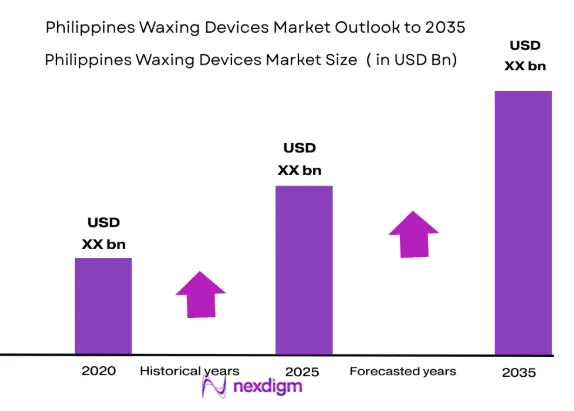
The Philippines waxing devices market is experiencing significant growth, driven by increasing demand for personal care and grooming products. With consumers becoming more health-conscious and beauty-oriented, the market has seen a surge in demand for effective, convenient, and affordable waxing solutions. Based on a recent historical assessment, the market size in the Philippines for waxing devices is valued at approximately USD ~ billion. The growth is largely attributed to rising disposable incomes, growing awareness of beauty standards, and a shift towards home-based solutions that are cost-effective and easy to use.
Dominating regions in the Philippines include urban centers such as Metro Manila, Cebu, and Davao. These cities have a large, diverse population with high disposable income and a strong interest in beauty and personal care products. Metro Manila, being the economic and cultural hub, shows the highest market concentration due to its established retail and e-commerce infrastructure. Cebu and Davao, with their growing urbanization and rising middle class, are also becoming key players in driving market growth, as consumers in these areas increasingly opt for waxing devices in both professional salons and at-home applications.
Market Segmentation
By Product Type
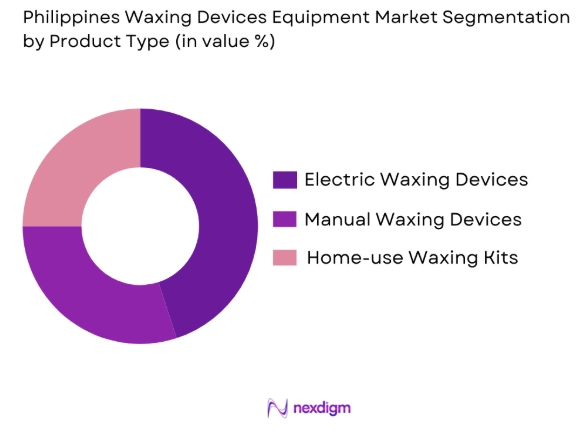
The Philippines waxing devices market is segmented by product type into electric waxing devices, manual waxing devices, and home-use waxing kits. Among these, electric waxing devices dominate the market share due to their efficiency and ease of use. These devices are favored for their ability to offer consistent and smooth results, making them ideal for both professional and at-home use. Electric waxing devices also benefit from technological advancements that enhance user comfort, such as adjustable temperature settings and improved wax cartridge systems. These features have contributed to a higher demand for electric devices, which have become a staple in the beauty industry and household usage.
By Consumer Type
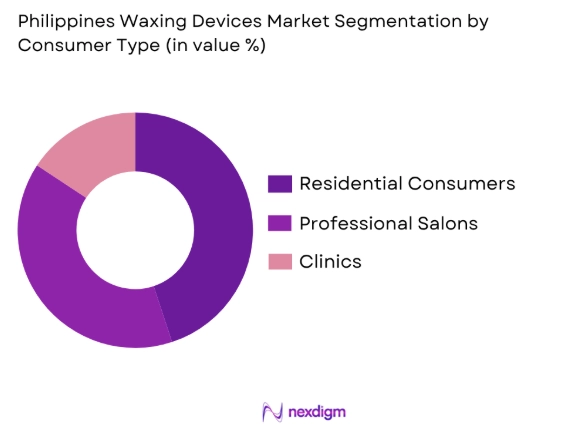
The market is segmented by consumer type into residential consumers, professional salons, and clinics. Residential consumers currently hold the largest share of the market due to the growing trend of at-home beauty treatments. Factors such as convenience, cost-effectiveness, and the availability of user-friendly products have made residential usage increasingly popular. Consumers are investing in home waxing kits and electric devices that enable them to achieve professional results in the comfort of their own homes. This segment’s dominance is driven by the expanding middle class, which seeks affordable beauty solutions.
Competitive Landscape
The competitive landscape of the Philippines waxing devices market is highly fragmented, with several global and local players striving for market share. The market is influenced by product innovation, brand loyalty, and pricing strategies. Major international brands continue to dominate, but local players are increasingly penetrating the market with affordable and tailored solutions for Filipino consumers. Consolidation is expected as leading companies seek to expand their market reach through acquisitions and strategic partnerships.
| Company Name | Establishment Year | Headquarters | Technology Focus | Market Reach | Key Products | Revenue (USD) | Additional Parameter |
| Philips | 1891 | Netherlands | ~ | ~ | ~ | ~ | ~ |
| Braun | 1921 | Germany | ~ | ~ | ~ | ~ | ~ |
| Panasonic | 1918 | Japan | ~ | ~ | ~ | ~ | ~ |
| Remington | 1937 | USA | ~ | ~ | ~ | ~ | ~ |
| Conair | 1959 | USA | ~ | ~ | ~ | ~ | ~ |
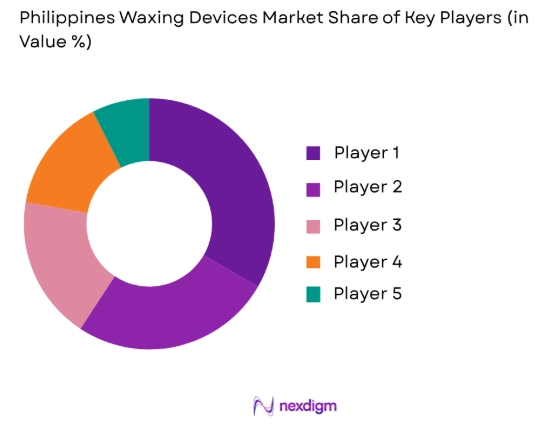
Philippines Waxing Devices Market Analysis
Growth Drivers
Rising Disposable Income and Beauty Spending
The Philippines’ economy recorded a GDP of USD 461.62 billion in 2024 with a GDP per capita of USD 3,984.8, reflecting increasing household income and purchasing power available for non‑essentials such as personal grooming and beauty products. Urban areas like Metro Manila have high income levels; for example, Metro Manila’s provincial GDP reached PHP 6.27 trillion in 2022, the highest among provinces, translating into greater discretionary spending on devices including waxing tools. With unemployment dropping to 2.2 percent in 2025, more Filipinos hold steady incomes that support beauty and personal care expenditures. This macroeconomic context of rising earnings and steady employment expands consumer capacity to invest in at‑home waxing devices rather than traditional salon services.
Increasing Urbanization & Appearance Consciousness
Urbanization in the Philippines continues to rise; 54.4 percent of the population lived in urban areas in 2023, with cities like Quezon City housing over 3 million residents and Manila close behind. Urban consumers typically have greater exposure to beauty trends, social media influences, and retail offerings that favor at‑home personal care purchases. The concentration of beauty salons, lifestyle stores, and advertising in high‑density urban centers fosters heightened awareness of appearance and grooming practices, including waxing. Population figures from the Philippine population count of 112.7 million in 2024 further underline that substantial urban consumer bases exist for beauty device adoption. Urban growth, coupled with infrastructure and retail access, supports increased uptake of personal grooming tools like waxing devices.
Challenges
Import Dependency and Supply Chain Disruptions
The Philippines maintains a large volume of imported goods; in 2025 total imported goods amounted to USD 134.20 billion, with electronic products as the largest category valued at USD 32.03 billion, reflecting heavy reliance on foreign‑manufactured devices and components. Waxing devices, especially electric and professional models, largely depend on imported machinery and parts, exposing supply chains to foreign exchange fluctuations, logistics delays, and tariff impacts. Trade imbalances further emerged in 2024 total external trade valued at USD 200.87 billion with a trade deficit of USD 54.33 billion, indicating persistent dependency on imports over exports. Interruptions in global supply chains, port congestion, or shifts in trade flows can delay product availability or increase costs for sellers and consumers in the Philippines.
Limited After‑Sales Service Infrastructure
Despite growing ownership of consumer electronics and beauty devices, after‑sales service networks remain underdeveloped outside major metropolitan areas. With urban population concentrations like 29.56 million in the Greater Manila Area, service centers tend to cluster in these hubs, leaving provincial and rural customer bases with limited access to repairs, replacements, or warranty support. Sparse distribution of service facilities can deter purchases of higher‑end waxing devices that require technical support, discouraging adoption among segments outside key urban centers. The infrastructure gap complicates warranty fulfilment and diminishes brand trust among users who lack convenient local support, slowing broader market penetration.
Opportunities
Rise of E‑Commerce and Direct‑to‑Consumer Models
The Philippines’ e‑commerce sector has expanded substantially, with the online retail and digital commerce market reaching approximately USD 28 billion in 2024, of which retail e‑commerce accounted for USD 15.5 billion. This digital marketplace enables direct‑to‑consumer sales of beauty and personal care devices, including waxing tools, without dependence on physical retail presence. Filipino online shoppers spend an average USD 273 per capita on e‑commerce purchases, showing robust engagement with digital retail channels. With mobile devices generating 57 percent of online transaction volume, companies can leverage mobile commerce and digital payments for broader reach and lower distribution costs than traditional retail networks.
Professional Salon Partnerships & Service Expansion
Although formal statistics on salon growth are limited, the rapid urbanization and rising service sector employment reflect expanding demand for professional grooming services. Partnerships between waxing device manufacturers and salons or aesthetic centers can facilitate product trials and professional endorsements, enhancing consumer confidence in at‑home device quality. Linkages with service providers also support extended service networks and training programs for maintenance support. As urban centers house millions—including population of 112.7 million nationally—collaboration with professional salons creates opportunities to integrate products into service bundles and expand after‑sales support infrastructure, boosting device adoption.
Future Outlook
The future outlook for the Philippines waxing devices market is promising, with strong growth anticipated over the next few years. Increasing consumer awareness about beauty and self-care, coupled with the rise of e-commerce and the growing middle class, will continue to drive market expansion. Technological advancements in product design and functionality will further enhance user experiences, making waxing devices more attractive to a broad range of consumers. Regulatory support for the beauty industry and a shift towards DIY grooming will contribute to sustained demand. As the market matures, innovation, affordability, and accessibility will be key drivers of success in the coming years.
Major Players
- Philips
- Braun
- Panasonic
- Remington
- Conair
- Wahl
- Kenza Waxing
- Emjoi
- Silk’n
- Veet
- Nair
- GiGi
- Lumenis
- Tria Beauty
- Cynosure
Key Target Audience
- Investments and venture capitalist firms
- Government and regulatory bodies
- Manufacturers of beauty devices
- E-commerce platforms
- Beauty retailers
- Professional salons
- Healthcare professionals
- Spa owners
Research Methodology
Step 1: Identification of Key Variables
This step involves identifying the essential factors that influence the waxing devices market, including consumer behavior, technological advancements, and market trends.
Step 2: Market Analysis and Construction
Market segmentation is conducted to understand the different types of consumers, products, and geographical regions, allowing for accurate data-driven conclusions.
Step 3: Hypothesis Validation and Expert Consultation
Expert consultations and validation of hypotheses ensure that the research findings are credible, reflecting the real-world dynamics of the market.
Step 4: Research Synthesis and Final Output
All gathered data is synthesized to generate a final report, which offers actionable insights on market trends, growth drivers, and challenges.

- Executive Summary
- Research Methodology (Market Definitions and Standardizations, Assumptions and Normalizations, Data Sources and Triangulation Logic, Bottom‑Up Market Sizing and Validation Approach, Top‑Down Opportunity Estimation Protocol, Primary Research Intercept Framework, Limitations and Future Method Refinements)

- Definition and Scope
- Market Genesis and Evolution
- Beauty & Personal Care Trends in the Philippines
- Industry Value Chain and Distribution Architecture

- Growth Drivers
Rising Disposable Income and Beauty Spending
Increasing Urbanization & Appearance Consciousness - Challenges
Import Dependency and Supply Chain Disruptions
Limited After‑Sales Service Infrastructure - Opportunities
Rise of E‑Commerce and Direct‑to‑Consumer Models
Professional Salon Partnerships & Service Expansion - Trends
Smart and Temperature‑Controlled Wax Systems
Influence of Beauty Influencers & Social Media - Regulatory & Compliance Landscape
- Market SWOT Analysis
- Ecosystem Mapping
- Porter’s Five Forces Analysis

- By Current Market Size – Value (PHP) & Volume, 2020‑2025
- By Market Density, 2020‑2025
- By Price Band Analysis, 2020‑2025

- By Product Type (In Value%)
Electric Waxing Devices
Manual Waxing Devices
Home – use Waxing Kits - By Consumer (In value %)
Residential consumers
Professional Salons
Clinics - By Distribution Channel (In value %)
Online E‑Commerce Platforms
Specialty Beauty Retailers
Department Stores & Supermarkets
Direct OEM Channel
Professional Salon Distributors - By Price Tier (In value %)
Economy / Entry‑Level
Mid‑Tier
Premium / Smart Devices - By Feature Set (In value %)
Multifunction Waxing Systems
Single‑Function Units
Temperature‑Controlled Smart Devices - By Geography (In value %)
Metro Manila & Luzon
Visayas Region
Mindanao Region

- Market Share by Value & Volume
- Brand Positioning / Value Proposition Mapping
- Cross‑Comparison Parameters (Company Overview, Product Portfolio Breadth, Distribution and Sales Channels, After‑Sales Support and Warranty Coverage, Pricing and Promotional Strategies, Brand Loyalty and Customer Satisfaction Index, Retail Presence & E‑Commerce Penetration, Innovative Features and Technology Adoption, Service Network Reach, Marketing and Influencer Engagement, Supply Chain & Logistics Efficiency)
- Competitor Analysis and Profiles
Philippines Waxing Devices Local & Global Players
Braun GmbH
Philips Domestic Appliances
Veet / Reckitt
Nair Professional
Remington Products
Parlux
Salon‑Brand Pro Waxing Equipment
Panasonic Personal Care
Conair Corporation
Beurer GmbH
Local OEM & Private Label Manufacturers

- Consumer Purchase Patterns
- Usage Frequency and Grooming Preferences
- Brand Loyalty & Repurchase Intent
- Online vs Offline Purchase Preferences
- Price Sensitivity and Value Awareness

- By Current Market Size – Value (PHP) & Volume, 2026‑2035
- By Market Density, 2026‑2035
- By Price Band Analysis, 2026‑2035


 Request a Sample
 Ask for Customization
 Get a Quote
 Enquire Now