

 Download PDF
 Download PDF
Market Overview
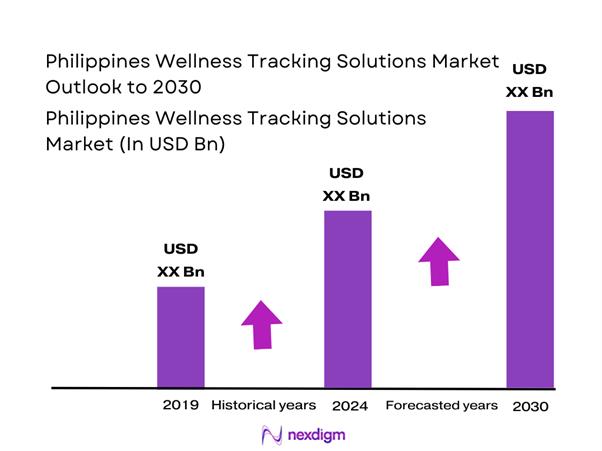
The Philippines Wellness Tracking Solutions Market is valued at over USD ~ million, based on aggregated revenues from fitness tracking wearables, mobile wellness applications, and digital preventive health platforms operating across consumer and enterprise channels. Smartphone users in the country crossed ~ million users, while wearable device shipments exceeded ~ million units, creating a strong installed base for wellness tracking services. Increased out-of-pocket healthcare spending exceeding USD ~ billion and rising prevalence of lifestyle-related health risks are pushing consumers toward self-monitoring solutions, supporting sustained market expansion.
The market is concentrated in Metro Manila, followed by Cebu City and Davao City, due to higher disposable incomes, stronger broadband penetration, and dense corporate employment bases. These cities host a majority of enterprise wellness programs, private insurance initiatives, and premium fitness infrastructure. Urban professionals show higher adoption of subscription-based wellness platforms due to flexible payment systems, digital wallets, and employer reimbursement models. The dominance is further reinforced by proximity to healthcare providers, insurers, and multinational employers integrating wellness tracking into employee benefits.
Market Segmentation
By Solution Type
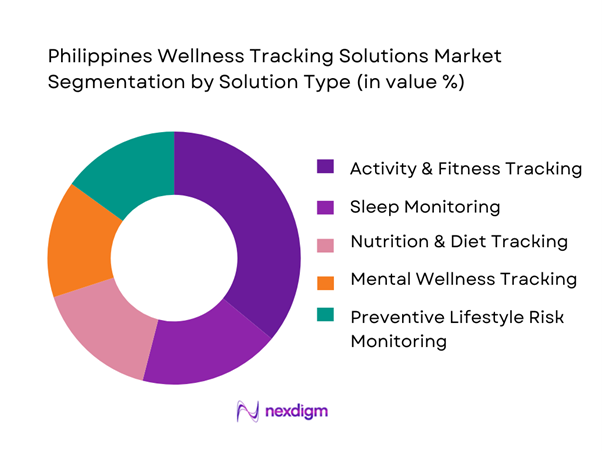
The Philippines Wellness Tracking Solutions Market is segmented by solution type into activity & fitness tracking, sleep monitoring, nutrition & diet tracking, mental wellness tracking, and preventive lifestyle risk monitoring. Among these, activity & fitness tracking solutions dominate the market, supported by their broad consumer appeal and strong integration with wearable devices. Fitness tracking platforms benefit from daily usage frequency, real-time feedback, and gamification features that encourage sustained engagement. Popular solutions integrate step counting, calorie tracking, and heart-rate analytics, making them highly accessible even to first-time users. Their dominance is also reinforced by compatibility with low-cost fitness bands and smartphones, enabling penetration beyond premium urban segments into mass-market users.
By End User
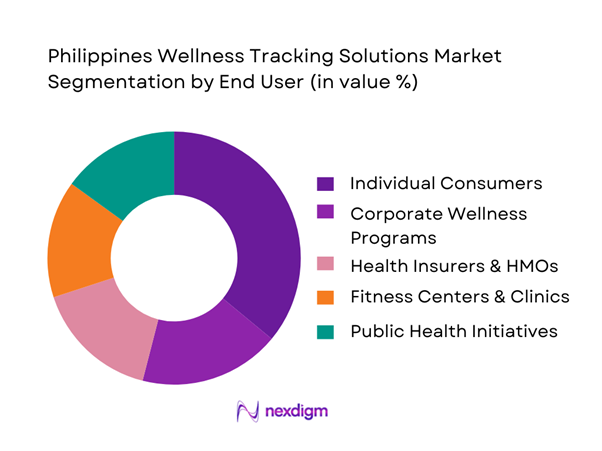
The market is segmented into individual consumers, corporate wellness programs, health insurers & HMOs, fitness centers & clinics, and public health initiatives. Individual consumers represent the dominant segment, driven by rising personal health awareness and direct-to-consumer digital distribution. Consumers increasingly adopt wellness tracking solutions for weight management, stress control, and daily activity monitoring without requiring medical prescriptions. The affordability of freemium apps, combined with flexible monthly subscriptions, supports adoption across income levels. High smartphone dependency and strong social media influence further amplify consumer uptake, making this segment the primary revenue generator for solution providers.
Competitive Landscape
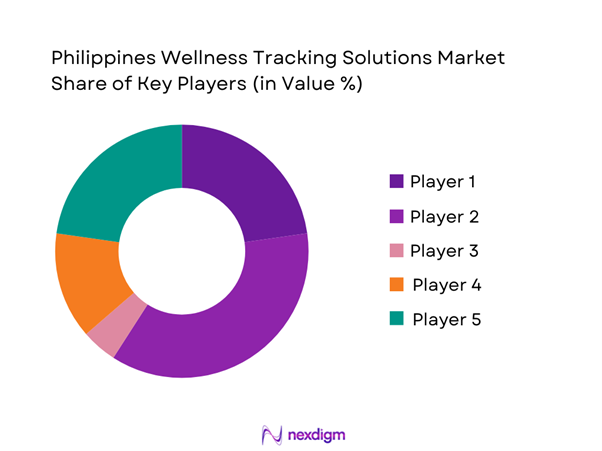
The Philippines Wellness Tracking Solutions Market is moderately consolidated, led by global wearable and app ecosystem providers with strong device-platform integration. International brands dominate due to superior technology stacks, data analytics capabilities, and brand trust, while regional platforms compete through localization and corporate partnerships.
| Company | Established | Headquarters | Core Focus | Device Integration | Monetization Model | Data Analytics Depth | Enterprise Presence | Platform Reach |
| Fitbit | 2007 | USA | ~ | ~ | ~ | ~ | ~ | ~ |
| Apple (Health Ecosystem) | 1976 | USA | ~ | ~ | ~ | ~ | ~ | ~ |
| Samsung Health | 2012 | South Korea | ~ | ~ | ~ | ~ | ~ | ~ |
| Garmin | 1989 | USA | ~ | ~ | ~ | ~ | ~ | ~ |
| Xiaomi Health | 2010 | China | ~ | ~ | ~ | ~ | ~ | ~ |
Philippines Wellness Tracking Solutions Market Analysis
Growth Drivers
Rising Smartphone Penetration
Wellness tracking adoption in the Philippines is structurally enabled by expanding mobile connectivity and device access. The country’s total economic output is USD ~ billion and income per person is USD ~, which supports continuous spending on entry-to-mid smartphones that act as the “core sensor hub” for wellness apps (accelerometer, GPS, camera, Bluetooth). In payments and app ecosystems, the country’s fast-payment rails show strong mobile-led behavior: PESONet processed ~ million transactions totaling ₱~ trillion, and InstaPay reached ~ billion transactions within the same period—evidence of daily mobile utility that increases the feasibility of app-based health tracking subscriptions and add-ons. On infrastructure, tower densification (installed telecommunications towers increasing from ~ to ~) improves the practicality of always-on syncing for wearable-integrated wellness solutions, especially in dense urban corridors where usage intensity is highest. Together, these indicators explain why smartphone penetration translates directly into wellness-tracking scale: the phone is both the access device and the behavioral loop engine (push notifications, streaks, biometric dashboards, and wallet-based renewals).
Preventive Healthcare Awareness
Preventive wellness tracking grows when the healthcare system’s “need pressure” is visible in national health outcomes and coverage systems. The Philippines is dealing with high mortality loads from chronic conditions: national compiled death data shows heart disease ~ and cancer ~ among leading causes, reinforcing demand for lifestyle monitoring such as activity, sleep, and nutrition tracking. At the same time, broad health coverage infrastructure expands the addressable base for prevention-linked programs: PhilHealth records ~ direct contributors, with ~ total beneficiaries tied to these contributors, creating a very large base for prevention programs that can be integrated into member engagement (risk scoring, coaching nudges, preventive reminders). On the macroeconomic side, the country’s scale (USD ~ billion GDP) matters because it supports larger public and employer financing capacity for preventive initiatives, even when households remain cost-sensitive. In practice, this combination pushes wellness tracking from “fitness novelty” toward “preventive routine,” particularly in urban centers where chronic disease risk factors and sedentary work patterns are more common.
Challenges
Data Privacy and User Trust Concerns
Wellness tracking solutions rely on continuous collection of sensitive personal data (location, sleep routines, stress markers, weight logs), so privacy incidents and compliance capacity directly influence adoption and retention. The National Privacy Commission documented intensive enforcement and investigation activity, including ~ fact-finding reports produced from January to March, reflecting the operational load of complaints and incident evaluation. In breach monitoring, official communications reference breach notifications in the system, illustrating that breach reporting and incident handling are active and visible to consumers. When trust is fragile, users are less willing to connect wearables, authorize location or sensor access, or store longitudinal health histories, reducing the effectiveness of wellness personalization models. Macro context matters: with GDP per capita at USD ~, consumers are value-conscious and less tolerant of services perceived as risky or non-essential, which makes privacy assurance a decisive factor for whether users pay for premium tracking or stay in free or basic modes.
User Engagement Drop-Off Rates
Wellness tracking apps face a structural engagement challenge: sustained behavior change requires long-term motivation, while users often churn after the “novelty phase.” In the Philippines, this drop-off risk is amplified by the country’s time and attention economy being heavily mobile-first, and by the scale of digital transactions that indicates high app switching and frequent digital interactions. National payment system data shows the intensity of day-to-day mobile activity: InstaPay recorded ~ billion transactions, and monthly volumes reached ~ in December, reflecting a digital environment with constant micro-engagement and rapid switching between services. For wellness tracking, this means the platform must continuously earn engagement through coaching, rewards, and personalization. On the macro side, GDP per capita of USD ~ reinforces that engagement is tied to perceived utility. This is why retention, rather than just downloads, remains a key execution barrier in the Philippines wellness tracking solutions market.
Opportunities
Insurance-Linked Wellness Incentives
A major growth opportunity is aligning wellness tracking with insurance economics by rewarding preventive behaviors, improving risk segmentation, and increasing retention in health plans. The Philippines has a large health coverage base to anchor incentives: PhilHealth reports ~ direct contributors and ~ total beneficiaries associated with these contributors, creating a substantial pool for benefit-linked wellness programs such as step targets, preventive check reminders, and sleep improvement plans. The private insurance ecosystem is also large enough to operationalize partnerships, with individual firms recording multi-billion-peso premium totals, indicating significant financial flows and institutional capacity for rewards programs. Combined with strong national digital payments throughput, insurers can deliver incentives digitally at scale. The opportunity is current-stats-backed, enabling immediate deployment of wellness incentives without requiring future infrastructure leaps.
AI-Driven Personalized Coaching Models
AI-enabled coaching is a high-upside opportunity because it improves retention through habit formation, increases perceived value through actionable guidance, and enables personalization across diverse user segments without linear cost increases. The Philippines has a workforce and digital services base that supports this shift: the IT-BPM industry records ~ million jobs and USD ~ billion in revenue, indicating a large pool of tech-enabled operations capacity and a corporate ecosystem that already invests in productivity tools. Payment rails further support AI coaching monetization, with PESONet processing ~ million transactions totaling ₱~ trillion and InstaPay reaching ~ billion transactions, showing that subscription renewals and micro-upsells are operationally feasible. On the macro side, the country’s GDP of USD ~ billion provides the platform economy scale for AI-enabled consumer services to thrive. Practically, this enables wellness solutions to move from generic dashboards to locally relevant coaching that raises engagement and makes paid tiers more defensible.
Future Outlook
The Philippines Wellness Tracking Solutions Market is expected to experience accelerated growth, supported by preventive healthcare awareness, digital insurance models, and expanding employer wellness mandates. Increased integration of artificial intelligence, personalized coaching, and predictive health analytics will enhance user engagement. Corporate demand is expected to rise as employers seek productivity gains and healthcare cost containment. Continued urbanization, rising digital payments adoption, and government emphasis on preventive healthcare will further strengthen long-term market fundamentals.
Major Players
- Fitbit
- Apple
- Samsung Health
- Garmin
- Xiaomi Health
- Huawei Health
- WHOOP
- Oura
- MyFitnessPal
- Noom
- Calm
- Headspace
- Strava
- Virgin Pulse
Key Target Audience
- Investments and Venture Capitalist Firms
- Health Insurance Providers and HMOs
- Corporate Employers and HR Wellness Buyers
- Wearable Device Manufacturers
- Digital Health Platform Developers
- Fitness and Lifestyle Service Operators
- Government and Regulatory Bodies
- Pharmaceutical and Preventive Healthcare Companies
Research Methodology
Step 1: Identification of Key Variables
This phase involved constructing a comprehensive ecosystem map covering wellness app providers, wearable OEMs, insurers, employers, and consumers. Secondary databases, public financial filings, and digital health adoption datasets were used to identify core demand and revenue drivers influencing market dynamics.
Step 2: Market Analysis and Construction
Historical adoption trends, wearable shipment volumes, app subscription revenues, and enterprise wellness program penetration were analyzed. Bottom-up revenue aggregation was validated using device-linked and subscription-based monetization models.
Step 3: Hypothesis Validation and Expert Consultation
Market assumptions were validated through structured interviews with wellness platform executives, fitness service providers, insurance wellness managers, and digital health experts to refine adoption drivers and pricing structures.
Step 4: Research Synthesis and Final Output
Primary insights were cross-verified with secondary data sources to ensure consistency. Segment-level trends were triangulated to finalize market size, growth outlook, and competitive positioning.

- Executive Summary
- Research Methodology (Market Definitions and Scope Boundaries, Ecosystem Mapping Assumptions, Abbreviation Framework, Market Sizing Logic, Bottom-Up & Top-Down Validation Model, Data Triangulation Framework, Primary Interview Framework with Device OEMs, App Developers, Healthcare Providers, Channel Partners, Data Reliability Filters, Limitations and Research Caveats)

- Definition and Scope
- Market Genesis and Evolution Pathway
- Technology Adoption Lifecycle
- Consumer Health Digitization Cycle
- Philippines Digital Health Value Chain Analysis

- Growth Drivers
Rising Smartphone Penetration
Preventive Healthcare Awareness
Corporate Wellness Spending
Youth Fitness and Lifestyle Adoption
Digital Payments and In-App Monetization Enablement - Challenges
Data Privacy and User Trust Concerns
User Engagement Drop-Off Rates
Device and OS Fragmentation
Price Sensitivity Across Income Segments
Limited Clinical Validation Perception - Opportunities
Insurance-Linked Wellness Incentives
AI-Driven Personalized Coaching Models
Localized Filipino Health and Lifestyle Content
SME-Focused Corporate Wellness Platforms
Alignment with Government Preventive Health Programs - Trends
AI-Based Health Scoring Systems
Behavioral Analytics and Habit Formation Tools
Gamification and Social Fitness Models
Predictive Wellness Algorithms
API-Driven Health Data Interoperability - Regulatory & Policy Landscape
- SWOT Analysis
- Stakeholder & Ecosystem Analysis
- Porter’s Five Forces Analysis
- Competitive Intensity & Ecosystem Mapping

- By Value, 2019–2024
- Installed Base by Active Users, 2019–2024
- Service Revenue Mix (Subscription vs Device-Linked), 2019–2024

- By Technology Architecture (in Value %)
Activity & Fitness Tracking Solutions
Sleep Monitoring Solutions
Nutrition & Diet Tracking Platforms
Stress & Mental Wellness Tracking Solutions
Preventive Health & Lifestyle Risk Monitoring Solutions - By Connectivity Type (in Value %)
Mobile App-Based Solutions
Wearable-Integrated Platforms
Hybrid Device-App Ecosystems
Employer-Integrated Wellness Platforms
Insurer-Linked Preventive Health Platforms - By Fleet Type (in Value %)
Smartwatches
Fitness Bands
Smart Rings & Accessories
Smartphone-Only Tracking
Multi-Device Health Ecosystems - By End-Use Industry (in Value %)
Individual Consumers
Corporate & Enterprise Wellness Programs
Health Insurance & HMO-Led Programs
Fitness Centers & Lifestyle Clinics
Public Health & Preventive Care Initiatives - By Application (in Value %)
Direct-to-Consumer Digital Channels
App Stores & OEM Marketplaces
Corporate Sales & B2B Contracts
Healthcare & Insurance Partnerships
Fitness & Lifestyle Brand Collaborations - By Region (in Value %)
Metro Manila
Luzon (Excluding NCR)
Visayas
Mindanao
Emerging Tier-2 Urban Clusters

- Market Share Analysis by User Base and Revenue Contribution
- Cross Comparison Parameters (Active Monthly Users, Daily Engagement Time, Sensor Dependency Level, AI Personalization Depth, Data Privacy Architecture, Device Compatibility Breadth, Corporate Wellness Penetration, Monetization Model)
- SWOT Analysis of Major Players
- Pricing and Subscription Architecture Analysis
- Detailed Profiles of Major Companies
Fitbit
Apple Health and Fitness Ecosystem
Samsung Health
Garmin
Xiaomi Health
Huawei Health
Oura
WHOOP
MyFitnessPal
Noom
Calm
Headspace
Strava
Virgin Pulse

- Usage Behavior and Engagement Patterns
- Willingness to Pay and Subscription Sensitivity
- Feature Preference and Value Perception Matrix
- Pain Point and User Drop-Off Analysis
- Decision-Making and Purchase Triggers

- By Value, 2025–2030
- Installed Base by Active Users, 2025–2030
- Service Revenue Mix (Subscription vs Device-Linked), 2025–2030


 Request a Sample
 Ask for Customization
 Get a Quote
 Enquire Now