
 Download PDF
Market Overview
The Philippines Wood Based Panel Market is valued at USD ~ billion based on the latest market assessment, with demand primarily linked to construction, furniture manufacturing, interior fit-outs and industrial applications. Official construction data provide a strong demand indicator: approved construction value increased from PHP 515.30 billion in the preceding annual period to PHP 563.89 billion in the latest annual period, while total approved construction projects increased from 171,268 to 180,341. Residential construction value reached PHP 248.65 billion, supporting demand for plywood, MDF and decorative panels.
The Philippines Wood Based Panel Market is concentrated around major construction, manufacturing and distribution centers, particularly Metro Manila, CALABARZON, Central Luzon and Central Visayas. CALABARZON recorded 41,471 approved constructions, followed by Central Luzon with 22,824 and Central Visayas with 19,585, making these regions important demand centers. CALABARZON also recorded the highest construction value among regions at approximately PHP 118.37 billion, while NCR and Central Luzon remained major construction and commercial activity centers. Their dominance reflects industrial concentration, housing development, commercial construction and proximity to logistics infrastructure.
Market Segmentation
By Panel Type
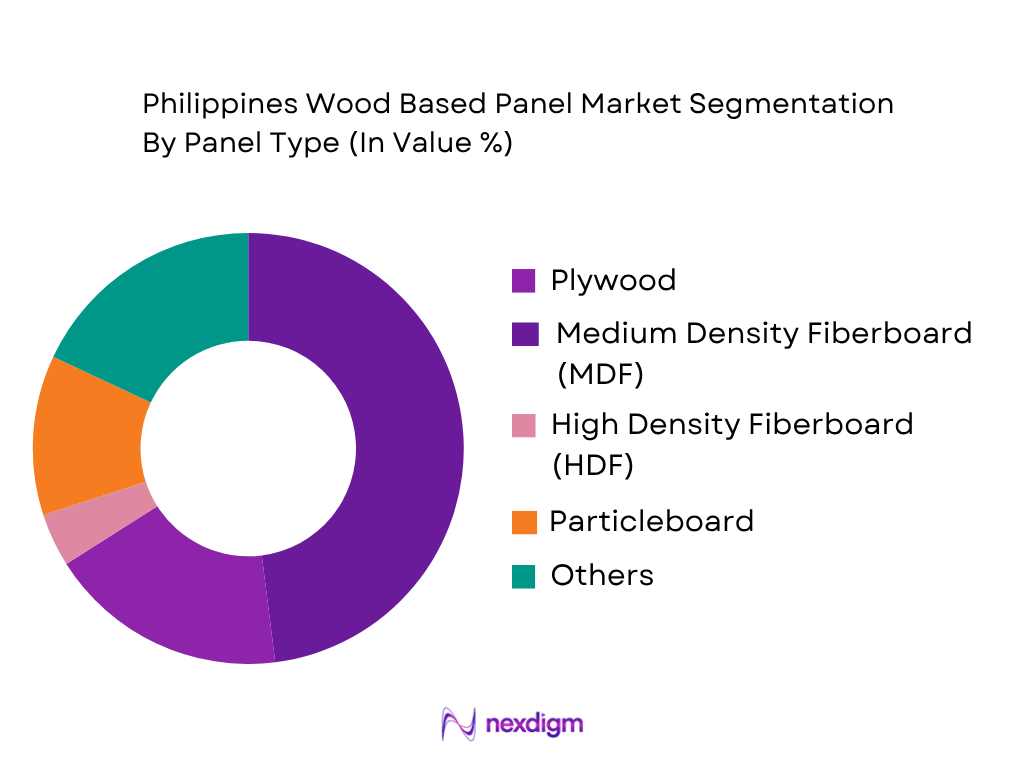
The Philippines Wood Based Panel Market is segmented by panel type into plywood, medium-density fiberboard, particle board, oriented strand board, blockboard, high-density fiberboard and other engineered wood panels. Plywood is estimated to hold the largest share at ~48% because of its established use across residential construction, commercial projects, furniture manufacturing, concrete formwork and marine applications. Its broad availability, established contractor familiarity and ability to meet structural and moisture-resistance requirements support its widespread use. The construction ecosystem provides an important demand base, with residential construction alone accounting for 116,427 approved projects in the latest annual period, while non-residential construction reached 39,238 projects. Plywood also benefits from its suitability for applications where dimensional strength and layered construction are important. Marine-grade and film-faced plywood provide additional application depth beyond standard construction panels. MDF and particle board remain important for furniture, cabinetry and interior applications, while OSB has a comparatively smaller role because local construction practices and product availability continue to favor plywood in many applications.
By Application Type
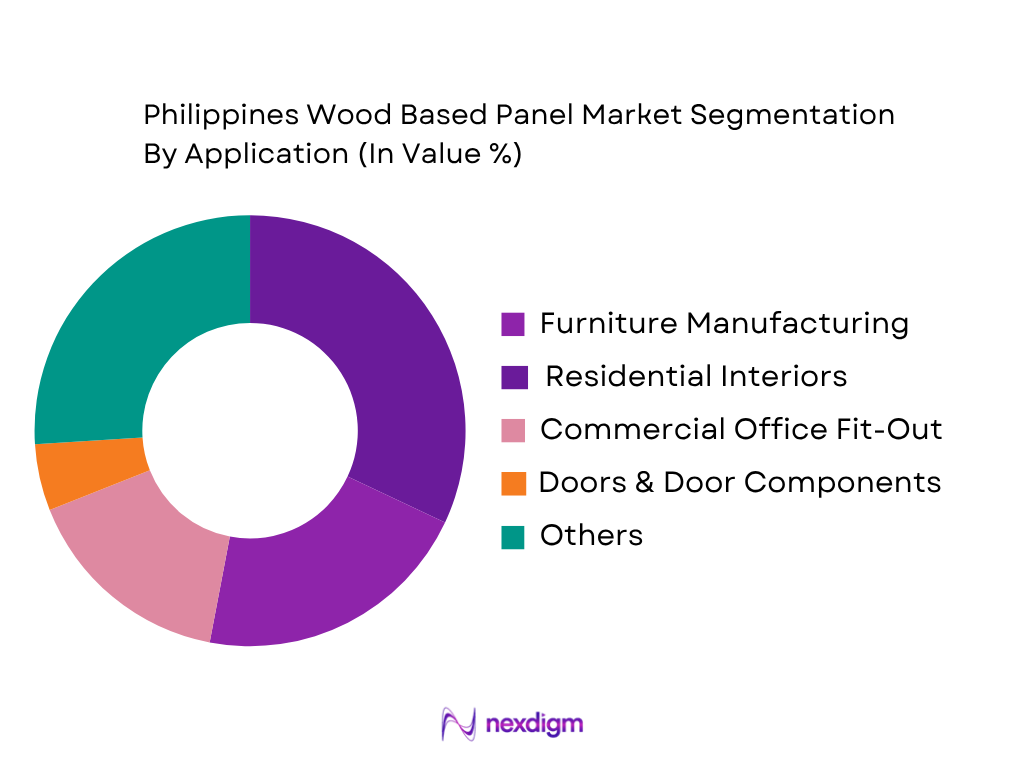
The Philippines Wood Based Panel Market is segmented by application into residential construction, commercial construction, furniture manufacturing, interior fit-out, concrete formwork, doors and windows, marine applications and industrial uses. Residential construction is estimated to account for ~32%, supported by the country’s large housing requirement and continued construction activity. Approved residential projects reached 116,427, while residential construction value reached PHP 248.65 billion in the latest annual period. Plywood is extensively used for structural applications, temporary formwork, partitions, doors and general construction, while MDF and particle board are important for cabinetry, furniture and interior applications. Commercial construction represents another substantial demand pool, with 27,053 commercial building projects included within the country’s non-residential construction activity. Furniture manufacturing also provides recurring demand for MDF, particle board, laminated panels and decorative surfaces. The application structure is therefore diversified, although residential construction provides the broadest consumption base because wood-based panels can be incorporated into multiple stages of residential development, from structural and semi-structural applications to interior finishing and furniture.
Competitive Landscape
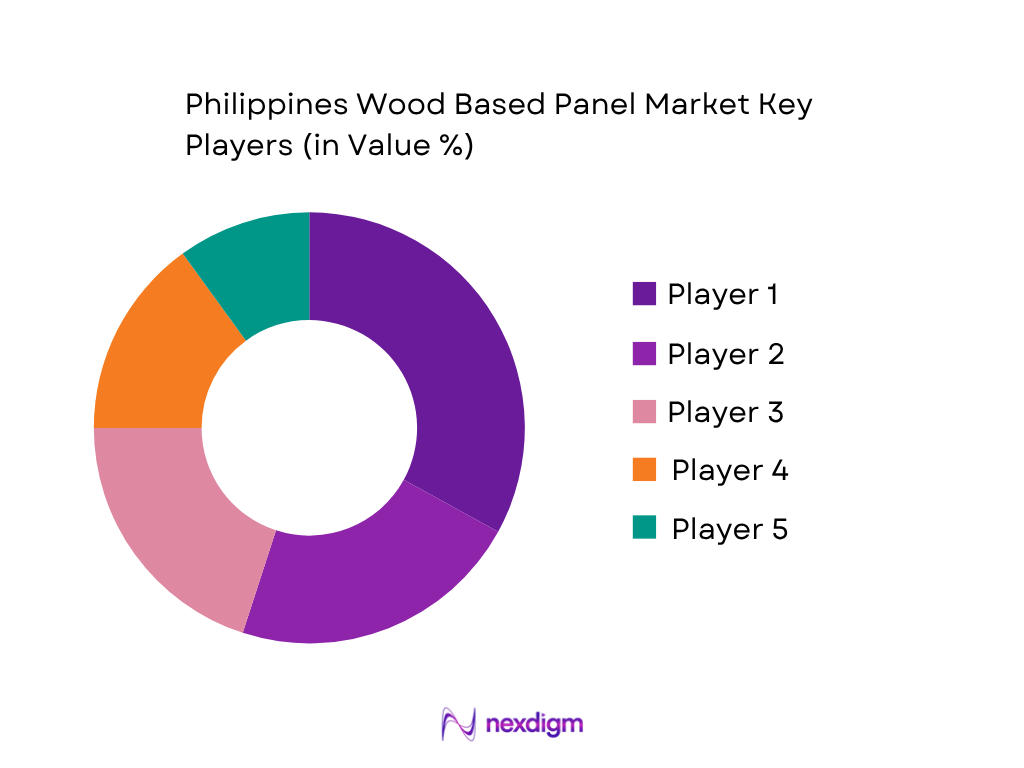
The Philippines Wood Based Panel Market comprises established domestic plywood manufacturers, wood-product processors, panel distributors and suppliers of engineered wood products. Competition is differentiated by plywood manufacturing capability, access to timber and veneer resources, panel grades, marine and structural product offerings, distribution reach and ability to supply construction and furniture customers. SMWPI Wood Products, Matimco, Mindanao Omega Industries, Timbermate-HMT Industries and Philippine Softwood Products represent notable participants within the Philippine wood-products ecosystem. Industry association records also identify a broader group of plywood and wood-product manufacturers operating across Luzon and Mindanao.
| Company | Establishment | Headquarters / Main Base | Core Panel Focus | Key Application Coverage | Manufacturing / Supply Capability | Distribution Focus | Market Positioning |
| SMWPI Wood Products, Inc. | 1923 | Manila / Davao production operations | ~ | ~ | ~ | ~ | ~ |
| Matimco, Inc. | Established wood-products business | Philippines | ~ | ~ | ~ | ~ | ~ |
| Mindanao Omega Industries Corp. | 2002* | Davao City | ~ | ~ | ~ | ~ | ~ |
| Timbermate-HMT Industries Corp. | 1990* | Taguig, Metro Manila | ~ | ~ | ~ | ~ | ~ |
| Philippine Softwood Products, Inc. | 2000* | San Juan / Metro Manila | ~ | ~ | ~ | ~ | ~ |
Philippines Wood Based Panel Market Analysis
Growth Drivers
Residential and Commercial Construction Activity
The Philippines Wood Based Panel Market is supported by sustained construction activity across residential, commercial and institutional projects, creating demand for plywood, MDF, particle board, laminated panels and formwork products. Philippine Statistics Authority data show that the total value of approved construction reached PHP 563.89 billion in 2024, compared with PHP 515.30 billion in 2023, while the number of approved construction projects increased from 171,268 to 180,341. Residential construction accounted for PHP 248.65 billion in approved value and 116,427 projects, compared with PHP 214.76 billion and 112,399 projects in 2023. Non-residential construction generated PHP 250.86 billion from 39,238 projects, creating an additional demand base for commercial interiors, partitions, doors, furniture components and construction formwork. The approved construction floor area also reached 42.84 million square meters, including 19.75 million square meters of residential floor area. This construction pipeline directly supports wood-based panel consumption because plywood remains widely used in structural and temporary construction applications, while MDF and particle board are relevant to cabinetry, furniture and interior finishing. The continuation of project approvals provides a broad downstream market for panel manufacturers, distributors and building-material suppliers.
Furniture and Interior Manufacturing Expansion
Furniture manufacturing, cabinetry and interior fit-out activity provide an important demand channel for the Philippines Wood Based Panel Market, particularly for MDF, particle board, laminated boards, decorative panels and furniture-grade plywood. The country’s construction ecosystem recorded 180,341 approved construction projects in 2024, with 42.84 million square meters of approved floor area, providing a substantial installed-building base requiring doors, cabinets, wall systems, fixtures and interior components. Residential construction alone reached 116,427 approved projects, while commercial construction formed the largest category within non-residential buildings, with commercial structures accounting for PHP 112.42 billion of approved construction value. These applications require panels with consistent thickness, machinability, dimensional stability and surface-finish compatibility for CNC cutting, edge banding, laminating and furniture assembly. The market is also supported by alteration and repair activity: the value of approved additions reached PHP 8.97 billion in 2024, while alteration and repair reached PHP 43.05 billion. Such activities generate recurring requirements for replacement cabinetry, partitions, doors and interior components rather than only new-build demand. Consequently, panel suppliers able to provide decorative, moisture-resistant and furniture-grade products can address both new construction and renovation-related consumption.
Market Challenges
Dependence on Imported Plywood and Panel Products
Import dependence presents a structural challenge for the Philippines Wood Based Panel Market because manufacturers and distributors may need to supplement domestic supply with imported plywood, MDF, particle board, decorative panels and specialized engineered wood products. The challenge becomes more significant for products requiring specific thicknesses, surface finishes, moisture resistance or technical certifications that may have limited domestic availability. At the same time, the domestic construction market is large: approved construction value reached PHP 563.89 billion in 2024, with residential construction contributing PHP 248.65 billion and non-residential construction contributing PHP 250.86 billion. This creates substantial recurring panel demand that must be supplied through a combination of domestic manufacturing and international sourcing. Supply-chain disruptions can affect project schedules because construction contractors and furniture manufacturers often purchase panels according to specific dimensions, grades and delivery requirements. The geographic structure of the Philippines adds another layer of complexity because products must be transported among major islands and regional markets. The market therefore faces a balancing requirement between maintaining domestic production capacity and ensuring access to specialized imported products. Manufacturers with diversified raw-material procurement, inventory management and regional distribution capabilities can reduce exposure to disruptions in imported panel availability.
Forest Resource Constraints and Quality Standardization Requirements
Sustainable wood availability, timber legality, product consistency and technical specifications represent continuing challenges for the Philippines Wood Based Panel Market. Wood-based panel manufacturers require reliable supplies of suitable timber, veneer and wood residues while complying with applicable forestry and timber-transport requirements. At the downstream level, buyers increasingly require predictable thickness, density, bonding performance, dimensional stability and moisture resistance because panels are incorporated into structural, furniture and interior applications. The scale of construction activity increases the importance of consistent supply: the Philippines recorded 42.84 million square meters of approved construction floor area in 2024, including 19.75 million square meters of residential floor area. Residential construction value reached PHP 248.65 billion, while non-residential construction reached PHP 250.86 billion, creating demand across different panel grades and performance requirements. Manufacturers therefore have to maintain consistent raw-material inputs and production parameters while serving customers with different technical specifications. In addition, the archipelagic geography of the country can make timber procurement and finished-panel distribution more complex, particularly when production facilities and end-use markets are located in different regions. These factors can increase the operational importance of certified sourcing, quality control, inventory planning and regional distribution networks.
Market Opportunities
Residential Construction Pipeline
The Philippines Wood Based Panel Market has an opportunity to expand through continued residential development, renovation and housing-related construction. The country recorded 116,427 approved residential construction projects in 2024, compared with 112,399 in 2023, while residential construction value increased from PHP 214.76 billion to PHP 248.65 billion. Residential approved floor area also reached 19.75 million square meters, creating a broad application base for plywood, MDF, particle board, laminated panels, doors, cabinetry and interior components. The opportunity extends beyond structural construction because each completed residential unit can generate recurring demand for furniture, kitchen cabinets, wardrobes, partitions, wall panels and other interior products. Alteration and repair activity provides an additional replacement market, with the value of approved alteration and repair work reaching PHP 43.05 billion in 2024. This supports demand for panels in renovation and refurbishment projects even where new residential construction slows. Manufacturers can therefore differentiate through moisture-resistant plywood, furniture-grade MDF, decorative laminated boards, lightweight panels and ready-to-process formats. Regional expansion is also possible because residential projects are distributed across Luzon, Visayas and Mindanao, allowing manufacturers and distributors with regional warehouses and dealer networks to address localized construction demand and reduce delivery constraints.
MDF and Particle Board Production Localization
Localization of MDF, particle board and other engineered-panel production represents an opportunity to broaden the Philippines Wood Based Panel Market beyond its established plywood base. Domestic production of advanced engineered panels can help address furniture, cabinetry, interior fit-out and modular construction requirements while utilizing suitable wood residues and other fiber resources. The scale of downstream demand is substantial: total approved construction value reached PHP 563.89 billion in 2024, while furniture- and interior-related demand is supported by 116,427 residential construction projects and 39,238 non-residential projects. Engineered panels are particularly suited to applications requiring uniform thickness, smooth surfaces and efficient machining, including cabinet components, shelving, doors, partitions and decorative interiors. The opportunity is also supported by the growth of alteration and repair activity, which reached PHP 43.05 billion in approved value in 2024 and can generate demand for replacement furniture and interior components. Local production could reduce lead times for standardized MDF and particle-board grades and provide manufacturers with greater control over panel specifications and surface treatments. Investments in pressing, resin application, drying, sanding, laminating and precision-cutting capabilities could consequently create a more diversified domestic panel supply base while supporting furniture and interior manufacturers that require predictable panel availability.
Future Outlook
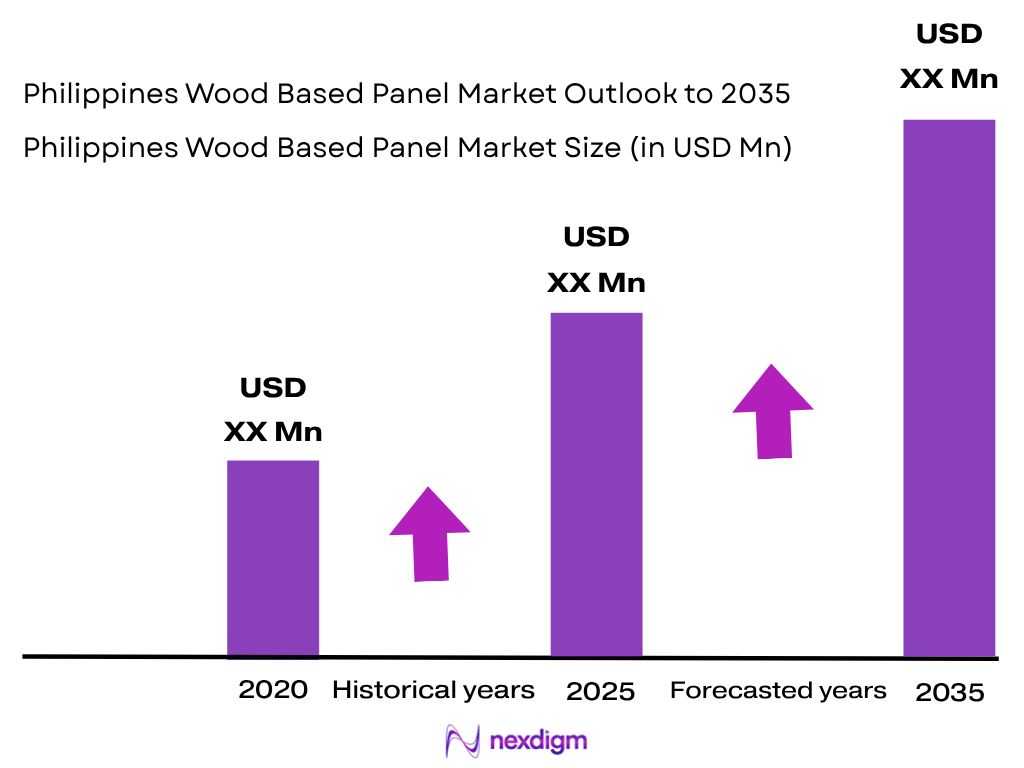
The Philippines Wood Based Panel Market is expected to expand at a ~% CAGR during 2026-2035, reaching approximately USD ~ billion by 2035. Growth is expected to be supported by residential construction, commercial development, furniture manufacturing, interior renovation and increasing substitution of solid wood with engineered panels. The country’s construction pipeline provides a substantial addressable demand base. Approved construction value reached PHP 563.89 billion, while construction floor area reached 42.84 million square meters in the latest annual period. Residential construction alone represented 19.75 million square meters of approved floor area. Future demand is also expected to become more diversified as furniture manufacturers, developers and interior contractors increasingly require laminated, moisture-resistant, lightweight and dimensionally stable panels. Growth opportunities are particularly relevant to MDF, particle board, decorative panels, marine plywood, film-faced plywood and specialized engineered wood products.
Major Players
- SMWPI Wood Products, Inc.
- Matimco, Inc.
- Mindanao Omega Industries Corporation
- Timbermate-HMT Industries Corp.
- Philippine Softwood Products, Inc.
- Richmond Plywood Corporation
- United Wood Industries Corporation
- New South Star Manufacturing Corporation
- Consolidated Plywood Industries, Inc.
- C. Alcantara & Sons, Inc.
- Baganga Plywood Corporation
- Vicmar Development Corporation
- Davao Panels Enterprises, Inc.
- Forever Richsons Trading Corporation
- San Manuel Wood Products, Inc.
Key Target Audience
- Wood-based panel manufacturers and engineered wood producers
- Furniture and cabinet manufacturers
- Construction companies and property developers
- Building material distributors and wholesalers
- Architectural, interior-fit-out and joinery companies
- Investments and venture capitalist firms
- Government and regulatory bodies (Department of Environment and Natural Resources, Department of Trade and Industry, Department of Public Works and Highways)
- Industrial machinery, panel-processing and woodworking equipment suppliers
Research Methodology
Step 1: Identification of Key Variables
The initial phase involves mapping the Philippine wood-based panel ecosystem, covering timber suppliers, veneer producers, plywood manufacturers, MDF and particle-board producers, distributors, furniture manufacturers, construction companies and end users. Secondary research is used to establish panel classifications, production structures, import dependencies, application requirements and regional demand variables.
Step 2: Market Analysis and Construction
Historical market information is compiled across panel value, production volume, consumption, imports, exports, construction activity and end-use demand. Construction statistics, manufacturing indicators and industry-level trade information are evaluated to establish relationships between wood-panel consumption and downstream construction, furniture and interior applications.
Step 3: Hypothesis Validation and Expert Consultation
Market hypotheses are validated through discussions with manufacturers, distributors, furniture producers, contractors, architects, project developers and wood-product specialists. Interviews focus on product preferences, procurement criteria, panel grades, material substitution, import dependence, capacity utilization and customer requirements.
Step 4: Research Synthesis and Final Output
The final stage integrates supply-side and demand-side findings into a consolidated market model. Bottom-up company and application assessments are cross-checked against top-down construction and manufacturing indicators, with data triangulation used to validate market sizing, segmentation and competitive positioning.

- Executive Summary
- Research Methodology (Market Definition and Scope, Wood-Based Panel Classification, Product Boundary and Inclusion Criteria, Top-Down Market Sizing, Bottom-Up Market Sizing, Production and Consumption Assessment, Import-Export Analysis, Demand-Side Assessment, Supply-Side Assessment, Primary Industry Interviews, Manufacturer and Distributor Validation, End-Use Mapping, Data Triangulation, Forecasting Framework)

- Definition and Scope
- Wood-Based Panel Industry Evolution and Development of Plywood, MDF, Particle Board, OSB, Blockboard and Laminated Panels
- Philippines Wood-Based Panel Industry Structure and Manufacturing Ecosystem
- Wood-Based Panel Value Chain Analysis
- Wood Raw Material to Panel Conversion Analysis
- Wood-Based Panel Supply Chain Analysis
- Domestic Production and Import Dependency Assessment
- Construction, Furniture and Interior Manufacturing Linkage

- Growth Drivers (Residential and Commercial Construction Activity, Furniture and Interior Manufacturing Expansion, Infrastructure Development, Urbanization and Housing Requirements, Replacement of Solid Wood with Engineered Panels, Expansion of Construction Formwork Applications, Growth of Export-Oriented Furniture Manufacturing, Increasing Demand for Moisture-Resistant and Laminated Panels)
- Market Challenges (Dependence on Imported Plywood and Panel Products, Limited Domestic MDF and Particle Board Manufacturing Capacity, Sustainable Wood Raw Material Availability, Volatility in Imported Panel Supply, Forest Resource Constraints, Quality and Thickness Standardization Requirements, Logistics Across Island Markets, Competition from Imported Low-Cost Panels)
- Market Opportunities (Residential Construction Pipeline, Commercial and Institutional Construction, Furniture Manufacturing Expansion, Modular and Prefabricated Construction, Engineered Wood Adoption, Sustainable and Certified Wood Panels, MDF and Particle Board Production Localization, High-Performance Marine Plywood, Film-Faced Formwork Panels, Laminated and Decorative Panel Applications)
- Market Trends (Engineered Wood Substitution, Laminated Surface Adoption, Marine-Grade Plywood Demand, Lightweight Furniture Panels, Sustainable Forestry and Certification, Formaldehyde-Emission Compliance, Moisture-Resistant Panel Development, Prefabricated Construction, Digital Panel Cutting and Processing, Custom-Size Panel Manufacturing)
- Government Regulations and Standards (Department of Environment and Natural Resources Forest Product Regulations, Philippine Forestry Code Requirements, Timber Legality and Transport Documentation, Philippine National Standards for Plywood, Building Code Requirements, Fire Safety Requirements, Product Quality Standards, Formaldehyde and Adhesive Compliance, Sustainable Forest Management Requirements)
- SWOT Analysis
- Porter’s Five Forces Analysis
- PESTLE Analysis

- By Market Value (2020-2025)
- By Production Volume (2020-2025)
- By Consumption Volume (2020-2025)
- By Import Volume (2020-2025)
- By Export Volume (2020-2025)
- By Average Selling Price per Cubic Meter (2020-2025)
- By Domestic Production Capacity (2020-2025)

- By Panel Type (In Value %)
Plywood
Medium Density Fiberboard (MDF)
Particle Board
Oriented Strand Board (OSB)
Blockboard
High-Density Fiberboard (HDF)
Laminated Wood Panels
Other Engineered Wood Panels - By Wood Raw Material Type (In Value %)
Hardwood
Softwood
Tropical Wood
Plantation Wood
Falcata and Fast-Growing Species
Wood Residues and Recycled Wood Fibers
Mixed Wood Feedstock - By Application (In Value %)
Residential Construction
Commercial Construction
Furniture Manufacturing
Interior Fit-Out and Joinery
Doors and Windows
Flooring and Wall Systems
Concrete Formwork
Packaging and Industrial Applications
Marine and Transportation Applications - By Surface Treatment and Panel Finish (In Value %)
Plain Panels
Melamine-Faced Panels
Film-Faced Panels
Veneer-Faced Panels
High-Pressure Laminate Panels
UV-Finished Panels
Paint-Ready Panels - By End-Use Industry (In Value %)
Construction Industry
Furniture and Cabinet Manufacturing
Interior Design and Fit-Out
Real Estate Development
Retail and Commercial Infrastructure
Shipbuilding and Marine Applications
Industrial Manufacturing
Packaging and Logistics - By Distribution Channel (In Value %)
Direct Manufacturer Sales
Building Material Distributors
Specialty Wood and Panel Dealers
Hardware and Home Improvement Stores
Construction Material Wholesalers
Furniture Component Suppliers
Online and Digital Building Material Channels

- Market Share of Major Players (By Value, Panel Type, Production Capacity, Application, Distribution Channel)
- Cross Comparison Parameters (Panel Portfolio Breadth, Annual Production Capacity, Plywood Grade Coverage, MDF and Particle Board Capability, Surface Lamination Capability, Wood Raw Material Integration, Geographic Distribution Reach, Certification and Product Compliance)
- SWOT Analysis of Major Players
- Detailed Profiles of Major Companies
SMWPI Wood Products Inc.
Matimco, Inc.
Mindanao Omega Industries Corporation
Tagum Global Ply Corporation
Timbermate-HMT Industries Corporation
World Class Laminate, Inc.
Scanwolf Philippines Manufacturing Inc.
James Hardie Philippines, Inc.
Spring Wood Industry
Zamboply
Santa Clara Marine Plywood
Woodtek
FRTC
House Technology Industries
Wu Kong Singapore Pte. Ltd. – Philippines Operations

- Housing Construction Panel Requirement Analysis
- Interior and Architectural Application Analysis
- Marine and Shipbuilding Panel Requirement Analysis
- Packaging and Industrial Panel Application Assessment
- Panel Specification Requirement Assessment
- Purchasing Criteria Analysis
- Philippines Wood Based Panel Supply-Side Analysis
- Domestic Wood-Based Panel Manufacturing Capacity
- Plywood Manufacturing Facility Assessment

- By Market Value (2026-2035)
- By Production Volume (2026-2035)
- By Consumption Volume (2026-2035)
- By Import Volume (2026-2035)
- By Export Volume (2026-2035)
- By Average Selling Price per Cubic Meter (2026-2035)
- By Domestic Production Capacity (2026-2035)


 Request a Sample
 Ask for Customization
 Get a Quote
 Enquire Now