
 Download PDF
Market Overview
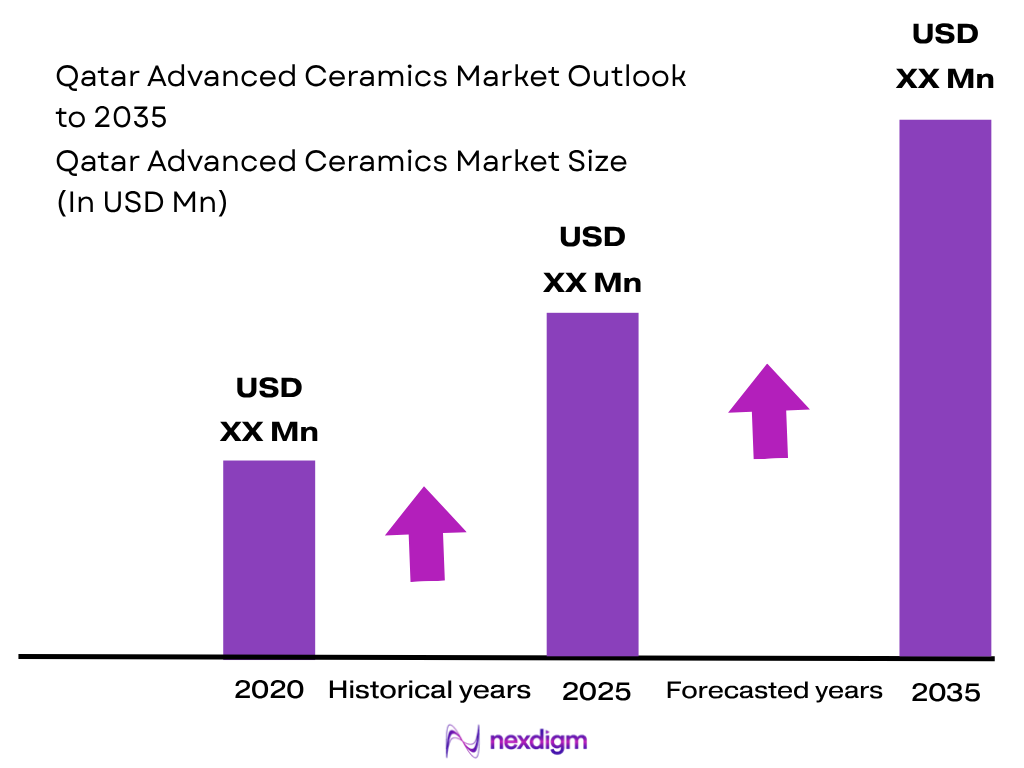
The Qatar Advanced Ceramics Market is valued at approximately USD ~XX million, based on historical demand from LNG, petrochemicals, desalination, power generation, aviation, healthcare and industrial maintenance. Demand is particularly concentrated in silicon-carbide mechanical seals, alumina wear components, electrical insulators and corrosion-resistant parts. Qatar produced 181.8 million tonnes of hydrocarbons in 2023 and 179.6 million tonnes in 2024, providing a substantial installed equipment base requiring high-performance ceramic components.
Ras Laffan, Mesaieed and Doha dominate Qatar’s advanced-ceramic demand because they concentrate LNG processing, petrochemicals, utilities, aviation, healthcare and industrial procurement. Qatar’s LNG production capacity stood at 77 million tonnes annually in 2023 and 2024, with Ras Laffan functioning as the country’s principal gas-processing and export complex. Mesaieed supports petrochemical and process-industry applications, while Doha concentrates hospitals, aviation infrastructure, engineering procurement and specialist industrial distribution, creating diversified demand for technical ceramics.
Market Segmentation
By Material Type
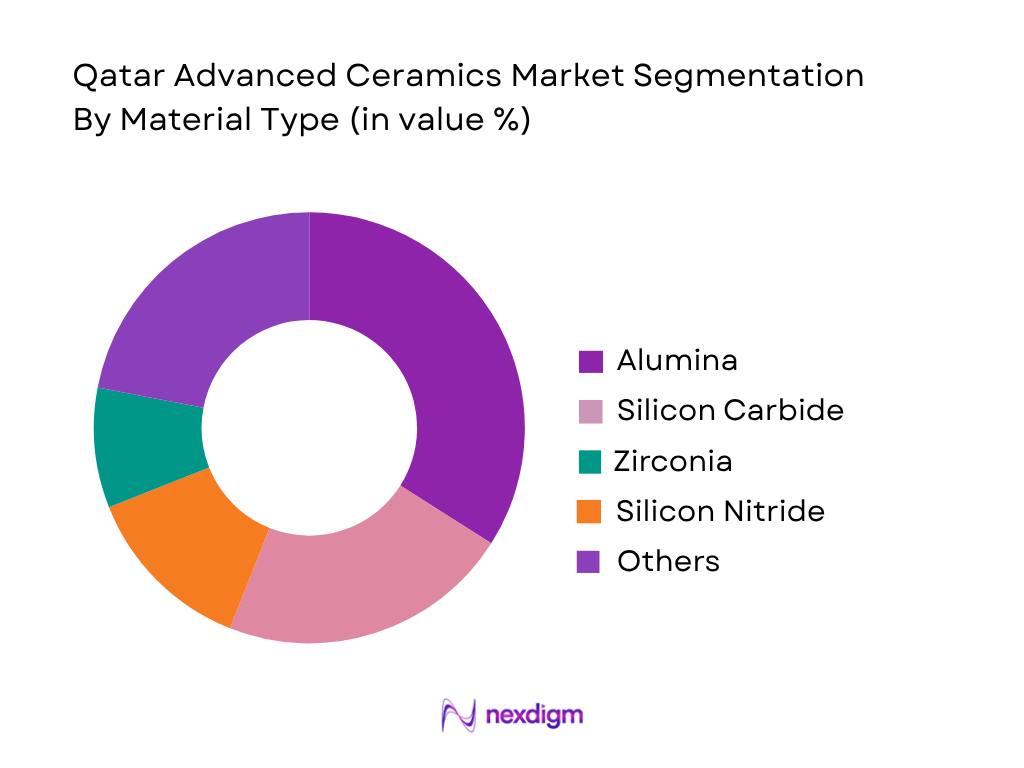
The Qatar Advanced Ceramics Market is segmented by material type into alumina, zirconia, silicon carbide, silicon nitride, aluminium nitride, boron nitride and other specialty advanced ceramics. Alumina holds the dominant report-model share because Qatar’s demand profile is heavily oriented toward oil and gas processing, LNG, petrochemicals, electrical equipment and industrial maintenance. Alumina combines electrical insulation, hardness, chemical stability and abrasion resistance with broader component availability than more specialised ceramic systems. It is consequently suitable for electrical insulators, wear components, sleeves, tubes, instrumentation components and industrial assemblies. Silicon carbide represents another strategically important category because mechanical seals, pump components and rotating equipment operating with aggressive fluids benefit from its hardness, thermal conductivity and corrosion resistance. Zirconia is comparatively important in precision and healthcare applications, particularly dental components. Silicon nitride and aluminium nitride remain smaller, higher-performance segments associated with specialised mechanical, electrical and thermal-management applications. Qatar’s industrial configuration therefore supports a market led by established oxide ceramics while creating targeted demand for non-oxide materials.
By End-Use Industry
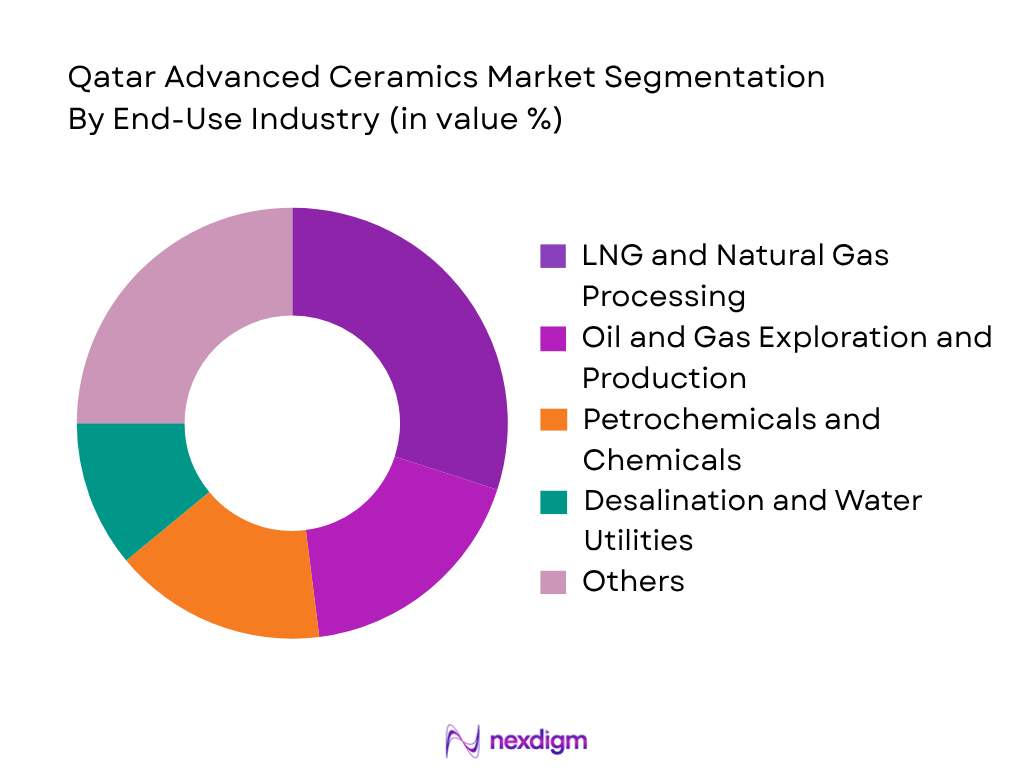
The Qatar Advanced Ceramics Market is segmented into LNG and natural gas processing, oil and gas, petrochemicals and chemicals, desalination and water utilities, power generation, aerospace and aviation, healthcare and industrial machinery. LNG and natural gas processing hold the dominant report-model share, reflecting Qatar’s extensive liquefaction, gas-treatment, compression, pumping and associated processing infrastructure. Advanced ceramics are valuable in these facilities because equipment is exposed to abrasive media, corrosive process environments, pressure, thermal cycling and continuous-operation requirements. Silicon-carbide seal faces, alumina wear components, ceramic valve parts, sleeves, bearings and electrically insulating components can therefore address performance requirements that conventional materials cannot always meet economically over long operating cycles. Petrochemicals and oil and gas create closely related demand for pumps, valves, seals and wear-resistant components. Desalination is another important application because seawater handling places stringent corrosion and reliability requirements on rotating equipment. Aviation and healthcare create smaller but technically higher-value opportunities for precision ceramics, zirconia and specialised high-temperature materials.
Competitive Landscape
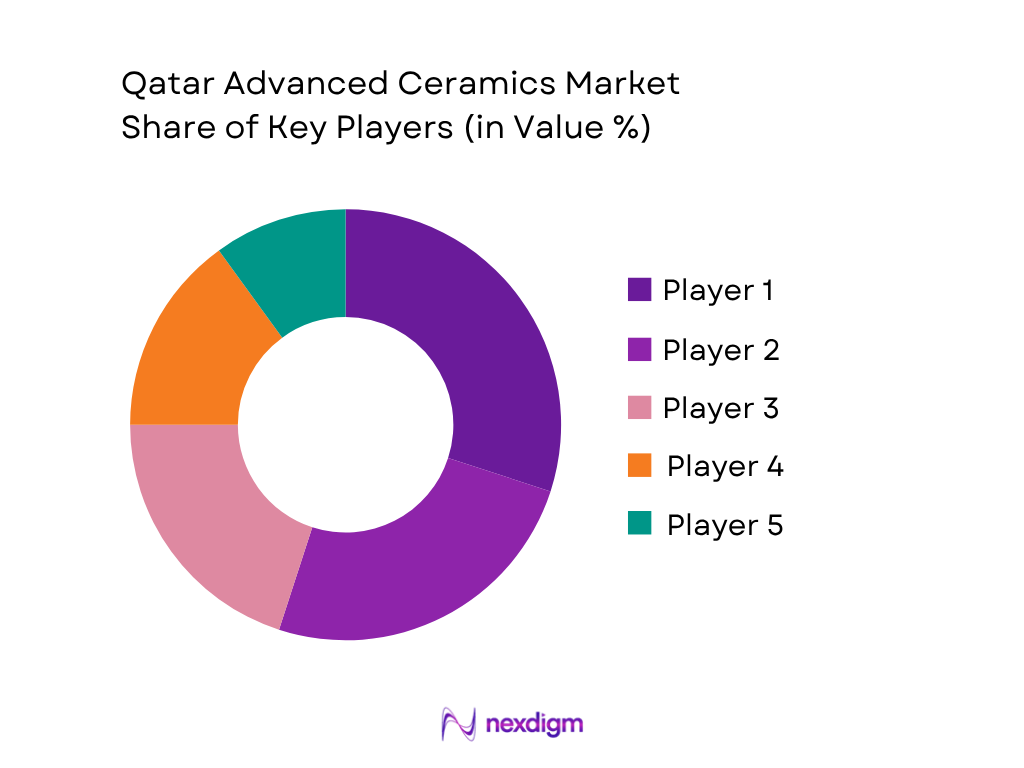
The Qatar Advanced Ceramics Market is primarily served by international technical-ceramic manufacturers and specialised industrial-material suppliers because domestic high-purity powder synthesis and advanced ceramic manufacturing remain limited. Competition is based less on mass-market production and more on material performance, OEM qualification, silicon-carbide expertise, precision machining, seal and pump applications, corrosion resistance and technical support. CoorsTek, CeramTec, Morgan Advanced Materials, Saint-Gobain and Kyocera constitute important global suppliers relevant to Qatar’s energy, water, industrial and high-performance engineering requirements.
| Company | Established | Headquarters | Key Materials | LNG/Petrochemical Applications | Seal & Pump Capability | Wear Ceramics | Electrical Ceramics | Precision Engineering |
| CoorsTek | 1910 | Golden, USA | ~ | ~ | ~ | ~ | ~ | ~ |
| CeramTec | 1903 | Plochingen, Germany | ~ | ~ | ~ | ~ | ~ | ~ |
| Morgan Advanced Materials | 1856 | Windsor, UK | ~ | ~ | ~ | ~ | ~ | ~ |
| Saint-Gobain | 1665 | Courbevoie, France | ~ | ~ | ~ | ~ | ~ | ~ |
| Kyocera Corporation | 1959 | Kyoto, Japan | ~ | ~ | ~ | ~ | ~ | ~ |
Qatar Advanced Ceramics Market Analysis
Growth Drivers
North Field LNG Expansion and Petrochemical Processing Infrastructure
Qatar’s LNG and petrochemical expansion is creating a large installed base of pumps, compressors, mechanical seals, valves, bearings, electrical systems and process equipment where silicon carbide, alumina and other advanced ceramics provide abrasion resistance, corrosion stability and high-temperature performance. QatarEnergy reported that domestic LNG production capacity stood at 77 million tonnes per annum in 2024, while its North Field development programme progressed through projects in Ras Laffan. During 2024, QatarEnergy also completed ownership and long-term charter arrangements covering 128 new LNG carriers, substantially expanding the infrastructure supporting the gas value chain. The Ras Laffan Petrochemical Complex adds another application platform, incorporating an ethane cracker designed for approximately 2.1 million tonnes of ethylene annually and two high-density polyethylene units with combined production capability of 1.7 million tonnes annually. This operating environment strengthens demand for ceramic seal faces, pump components, valve parts, electrical insulators and wear-resistant linings capable of continuous-duty service. Qatar’s macroeconomic capacity supports these capital-intensive applications: the World Bank records 2024 GDP at USD 219.16 billion, GDP per capita at USD 76,688.7, and a national population of 2,857,822, demonstrating a high-value industrial economy with substantial energy-sector infrastructure.
Expansion of Desalination, Water Transmission and Utility Infrastructure
Qatar’s expanding desalination and water-distribution infrastructure is another important growth driver for the Qatar Advanced Ceramics Market because seawater, high-pressure pumping and continuous water circulation create demanding conditions for mechanical seals, bearings, bushings, valve seats and corrosion-resistant pump components. Kahramaa reported potable desalinated-water production capacity of 538 million imperial gallons per day in 2024 following expansion of the Umm Al Houl facility. Qatar’s water transmission and distribution network also extends beyond 11,000 kilometres, requiring extensive pumping, pressure control, flow-management and maintenance infrastructure. These operating conditions support the use of silicon carbide in seal faces and bearings, alumina in wear-resistant components and specialised ceramics in electrical and instrumentation applications because technical ceramics maintain dimensional and chemical stability in environments where metallic components can experience corrosion or accelerated wear. The opportunity extends across desalination plants, pumping stations, transmission systems and industrial-water facilities serving Qatar’s energy and urban infrastructure. The country’s ability to finance and operate such utility assets is supported by substantial macroeconomic scale: World Bank data place Qatar’s 2024 GDP at USD 219.16 billion, GDP per capita at USD 76,688.7, and population at 2,857,822, providing a strong industrial and infrastructure base for advanced engineering-material consumption.
Market Challenges
Heavy Dependence on Imported Technical Ceramic Components
Qatar’s advanced ceramics supply chain remains strongly dependent on imported technical ceramic products, creating exposure to international production schedules, specialised supplier availability, logistics lead times and OEM qualification requirements. World Bank WITS trade data show that Qatar imported 412,751 kilograms of HS 6909 ceramic ware for laboratory, chemical and other technical uses in 2024, with recorded trade value of USD 2.419 million. Imports from China alone reached USD 416,280 and 294,154 kilograms, while Germany supplied USD 417,540 and 36,497 kilograms and France supplied another USD 119,880 and 12,040 kilograms. In contrast, Qatar’s exports under the same broad technical-ceramic classification were only USD 25,740, highlighting the limited outward production footprint for this category and reinforcing the market’s reliance on overseas manufacturing centres. For critical LNG, desalination, petrochemical and industrial applications, this dependence can complicate replacement-part availability when components require exact material grades, tolerances or OEM approvals. The macroeconomic context shows that demand originates from a high-value economy rather than a weak industrial base: World Bank data record 2024 GDP of USD 219.16 billion, GDP per capita of USD 76,688.7, and population of 2,857,822.
Limited Domestic High-Precision Ceramic Processing and Qualification Capability
A second challenge is the limited domestic ecosystem for high-purity powder processing, controlled ceramic forming, advanced sintering, precision grinding, lapping, polishing and ceramic-to-metal integration required for demanding Qatar applications. The trade structure illustrates this capability gap: World Bank WITS records USD 2.419 million and 412,751 kilograms of Qatar imports under the broad HS 6909 technical-ceramics category in 2024, against only USD 25,740 of recorded exports. For one narrower technical-ceramic classification, Qatar imported 247,040 kilograms, including 226,868 kilograms from China, 14,832 kilograms from Germany and 3,477 kilograms from the United Kingdom. Developing local production is more complex than establishing conventional ceramic fabrication because LNG mechanical seals, petrochemical pump components, electrical insulators, aerospace parts and medical ceramics require tightly controlled purity, microstructure, tolerances and surface finish. Qualification barriers become particularly significant in industries where equipment operates continuously and component failure can affect plant availability. Qatar’s economy provides sufficient industrial scale to justify localisation initiatives, with World Bank figures showing 2024 GDP of USD 219.16 billion, GDP per capita of USD 76,688.7, and population of 2,857,822; however, converting this economic strength into technical-ceramic capability requires specialised equipment, engineering expertise and customer qualification systems.
Market Opportunities
Localisation of Silicon Carbide and Alumina Components for Energy and Water Applications
Qatar presents a strong future localisation opportunity for silicon-carbide seal faces, alumina wear components, ceramic bearings, valve parts, bushings and precision-machined components serving LNG, petrochemical and desalination assets. Current infrastructure already provides the demand foundation: QatarEnergy operated around 77 million tonnes per annum of domestic LNG capacity in 2024, progressed North Field projects in Ras Laffan and completed arrangements covering 128 LNG carriers. In parallel, Kahramaa reported desalinated-water production capacity of 538 million imperial gallons per day and a water network extending more than 11,000 kilometres. These assets require large numbers of pumps, valves, rotating assemblies, electrical systems and fluid-handling components that experience abrasion, seawater exposure, chemicals, pressure and continuous operation. Local ceramic machining, finishing, inspection and inventory capability could therefore shorten replacement cycles and allow components to be engineered around Qatar-specific equipment configurations rather than supplied entirely through overseas channels. The existing import pattern reinforces the opportunity, with 412,751 kilograms of broad technical ceramic ware entering Qatar in 2024. This future industrial-development proposition is supported by World Bank macroeconomic indicators showing USD 219.16 billion of GDP, USD 76,688.7 of GDP per capita, and a population of 2,857,822 in 2024.
High-Performance Ceramics for Aviation, Healthcare and Precision Engineering
Qatar has an emerging opportunity to broaden advanced-ceramic consumption beyond hydrocarbon processing into aviation, healthcare and precision engineering, where zirconia, alumina, silicon nitride and specialised electrically insulating ceramics address high-value performance requirements. Qatar Civil Aviation Authority data show Hamad International Airport handled 13,171,540 passengers, 69,959 aircraft movements, more than 626,338 tonnes of cargo and 10,457,444 pieces of baggage during the first quarter of 2024 alone, supporting a substantial aviation maintenance, ground-equipment and technical-services ecosystem. Healthcare provides another application platform: Qatar’s official open-data system records 15 governmental hospitals, 12 private hospitals, 31 primary healthcare centres, 99 specialised dental centres, 17 dental laboratories, 22 diagnostic and treatment centres, and 15 laboratory and diagnostic-imaging centres within the 2024 healthcare-facility classification. These facilities create prospective applications for dental zirconia, laboratory ceramics, medical equipment insulators, precision pump components and wear-resistant parts. Future growth can therefore come from developing specialised distribution, finishing and qualification capability serving these non-energy applications. Qatar’s macroeconomic base supports high-value technology adoption, with World Bank data recording 2024 GDP of USD 219.16 billion, GDP per capita of USD 76,688.7, and population of 2,857,822.
Future Outlook
The Qatar Advanced Ceramics Market is forecast to expand at approximately ~XX% CAGR during 2026–2035, supported by LNG capacity expansion, petrochemical development, desalination infrastructure, industrial localisation and increasing requirements for high-reliability equipment. Advanced ceramics should increasingly penetrate applications where longer component life, corrosion resistance, electrical insulation, low friction and high-temperature stability can reduce maintenance requirements.
The North Field development will be particularly relevant because additional LNG infrastructure expands the installed base of pumps, compressors, valves, processing trains and auxiliary equipment. This creates potential for silicon-carbide seal faces, ceramic bearings, alumina wear components and precision-engineered ceramic parts. Desalination and water infrastructure will provide another application platform. Seawater exposure and high-pressure pumping create technically demanding conditions for seals, bearings, valve components and corrosion-resistant parts. Silicon carbide and alumina can therefore gain relevance where reliability and extended service intervals are critical.
Major Player
- CoorsTek
- CeramTec
- Morgan Advanced Materials
- Saint-Gobain Performance Ceramics & Refractories
- Kyocera Corporation
- NGK Insulators
- Schunk Technical Ceramics
- Mersen
- 3M Advanced Materials
- SINTX Technologies
- McDanel Advanced Ceramic Technologies
- Precision Ceramics
- International Syalons
- Rauschert
- IPS Ceramics
Key Target Audience
- Advanced Ceramic Material and Component Manufacturers
- LNG, Oil and Gas and Petrochemical Operators
- Pump, Valve, Mechanical Seal and Rotating Equipment Manufacturers
- Desalination, Water Treatment and Power Utility Companies
- Aerospace, Aviation and MRO Companies
- Industrial Distributors, EPC Contractors and Maintenance Service Providers
- Investments and Venture Capitalist Firms
- Government and Regulatory Bodies (Ministry of Commerce and Industry, Qatar General Organization for Standardization, QatarEnergy, Qatar Free Zones Authority, Qatar Investment Authority, Qatar Civil Aviation Authority)
Research Methodology
Step 1: Identification of Key Variables
The initial phase involves constructing an ecosystem map covering all major stakeholders within the Qatar Advanced Ceramics Market, including international ceramic manufacturers, distributors, OEMs, EPC contractors, energy operators, utilities and industrial maintenance companies. Critical variables include material type, component application, operating environment, equipment criticality, replacement cycles, import dependence, OEM qualification and end-user procurement structures.
Step 2: Market Analysis and Construction
Historical market information is analysed using both top-down and bottom-up methodologies. The top-down approach evaluates Qatar’s LNG, oil and gas, petrochemical, desalination, power, aviation and healthcare ecosystems, while bottom-up modelling assesses advanced-ceramic consumption across mechanical seals, pumps, valves, wear liners, electrical insulators, bearings, sleeves and precision-engineered components.
Step 3: Hypothesis Validation and Expert Consultation
Market hypotheses are validated through computer-assisted telephone interviews with advanced-ceramic suppliers, technical distributors, mechanical-seal companies, pump and valve suppliers, EPC contractors, industrial maintenance providers and relevant end users. These consultations evaluate material preferences, component replacement cycles, supplier qualification, procurement practices, inventory requirements and performance specifications to refine demand-side and supply-side assumptions.
Step 4: Research Synthesis and Final Output
The final phase triangulates supplier information, end-user requirements, import structures and component-level demand estimates. Material-level findings for alumina, silicon carbide, zirconia, silicon nitride and other advanced ceramics are reconciled against LNG, petrochemical, desalination, power, aviation and healthcare applications. This combined top-down and bottom-up framework produces the final market segmentation, competitive structure and long-term outlook.

- Executive Summary
- Research Methodology (Market Definition and Scope, Qatar Advanced Ceramics Market Classification, Advanced Ceramic Material Demand Assessment, Oxide and Non-Oxide Ceramic Mapping, LNG and Petrochemical Application Assessment, Desalination and Water Infrastructure Analysis, Aerospace and Aviation Ceramic Demand Mapping, Healthcare and Medical Ceramic Evaluation, Import and Distribution Analysis, End-Use Industry Demand Mapping, Advanced Ceramic Processing Technology Assessment)

- Definition and Scope
- Qatar Advanced Ceramics Industry Evolution and Development of LNG, Petrochemical, Desalination, Aerospace and Precision Industrial Ecosystem
- Advanced Ceramic Material Distribution, Industrial Component Supply and Technical Ceramic Application Structure
- Qatar Advanced Ceramics Value Chain Analysis
- Qatar Advanced Ceramics Supply Chain Analysis
- Advanced Ceramic Manufacturer, International Supplier, Technical Distributor, Industrial Service Provider, OEM, EPC Contractor and End-User Ecosystem Analysis
- Advanced Ceramic Integration Assessment Across LNG, Oil and Gas, Petrochemicals, Power, Desalination, Aerospace, Healthcare and Industrial Applications

- Growth Drivers (North Field LNG Expansion, Ras Laffan Petrochemical Development, Expansion of Desalination Capacity, Increasing Mechanical Seal and Pump Maintenance Demand, Aviation MRO Development, Industrial Localisation under Qatar National Manufacturing Strategy)
- Market Challenges (High Dependence on Imported Advanced Ceramic Components, Limited Domestic Ceramic Powder and Sintering Capacity, Small Local Manufacturing Base, Stringent Oil and Gas Qualification Requirements, Long OEM Approval Cycles, High Precision Machining Requirements, Specialist Technical Skill Constraints)
- Market Opportunities (Silicon Carbide Mechanical Seal Components, Alumina Wear Components for LNG Facilities, Ceramic Valve and Pump Components, Desalination Ceramic Applications, Aerospace High-Temperature Ceramics, Medical and Dental Zirconia, Local Precision Ceramic Machining, Ceramic-to-Metal Component Integration)
- Market Trends (Silicon Carbide Seal Adoption, High-Purity Alumina Components, Longer-Life Wear Components, Ceramic Bearings, Advanced Pump and Valve Ceramics, Predictive Maintenance Integration, Local Industrial Service Capability, High-Performance Material Substitution)
- Regulatory and Standards Landscape (Qatar General Organization for Standardization Requirements, QatarEnergy Technical Specifications, API Pump and Mechanical Seal Standards, ASME Pressure Equipment Requirements, ISO Quality Management Standards, Medical Device Requirements, Kahramaa Water Specifications, Aerospace Maintenance and Certification Requirements)
- SWOT Analysis
- Porter’s Five Forces Analysis
- PESTLE Analysis
- Stakeholder Ecosystem
- Competition Ecosystem

- By Market Value (2020-2025)
- By Advanced Ceramic Consumption Volume (2020-2025)
- By Oxide Ceramic Consumption Volume (2020-2025)
- By Non-Oxide Ceramic Consumption Volume (2020-2025)
- By Structural Ceramic Consumption Volume (2020-2025)
- By Functional Ceramic Consumption Volume (2020-2025)
- By Imported Advanced Ceramic Component Volume (2020-2025)

- By Material Type (In Value %)
Alumina
Zirconia
Silicon Carbide
Silicon Nitride
Aluminium Nitride
Boron Nitride
Boron Carbide
Zirconia Toughened Alumina
Piezoelectric and Titanate Ceramics
Machinable Glass Ceramics
Other Specialty Advanced Ceramics - By Product Type (In Value %)
Mechanical Seal Faces and Seal Rings
Ceramic Bearings and Bushings
Ceramic Sleeves and Shafts
Ceramic Valve Components
Ceramic Pump Components
Wear-Resistant Ceramic Liners
Ceramic Nozzles
Ceramic Tubes and Rods
Electrical Insulators
Electronic Ceramic Substrates
Precision-Machined Ceramic Components
Ceramic-to-Metal Assemblies - By Application Type (In Value %)
Pump and Mechanical Seal Applications
Valve and Flow-Control Applications
Compressor and Rotating Equipment Applications
LNG Processing Equipment
Petrochemical Processing Equipment
Desalination and Water Treatment Systems
Power Generation Equipment
Electrical and Electronic Insulation
Aerospace Engine and Auxiliary Power Applications
Medical and Dental Applications
Laboratory and Analytical Equipment
High-Temperature Industrial Applications - By Ceramic Function (In Value %)
Structural Ceramics
Wear-Resistant Ceramics
Corrosion-Resistant Ceramics
Electrical Insulating Ceramics
Thermal Management Ceramics
High-Temperature Ceramics
Piezoelectric Ceramics
Bioceramics
Precision Engineering Ceramics - By End-Use Industry (In Value %)
LNG and Natural Gas Processing
Oil and Gas Exploration and Production
Petrochemicals and Chemicals
Power Generation
Desalination and Water Utilities
Aerospace and Aviation
Healthcare and Medical Devices
Electrical and Electronics
Industrial Machinery and Maintenance
Marine and Port Operations
Construction Materials and Processing - By Sales Channel (In Value %)
Direct Manufacturer-to-OEM Supply
Authorized Industrial Distributors
Oil and Gas Equipment Suppliers
EPC Contractor Procurement
Mechanical Seal and Pump Service Companies
Water and Desalination Equipment Suppliers
Healthcare and Medical Distributors
Aerospace MRO Procurement
Direct End-User Industrial Procurement

- Market Share of Major Players (By Revenue, Material Type, Product Category, End-Use Industry, Application Type, Distribution Model, OEM Supply, Customer Segment)
- Cross Comparison Parameters (Silicon Carbide Mechanical Seal Capability, Advanced Ceramic Material Portfolio Breadth, LNG and Petrochemical Application Expertise, Pump Valve and Rotating Equipment Ceramic Portfolio, Desalination and Water Treatment Ceramic Capability, Precision Machining and Surface-Finishing Capability, Qatar Distribution and Industrial Customer Reach, Application Engineering and Technical Support Capability)
- SWOT Analysis of Major Players
- Competitive Positioning Matrix
- Advanced Ceramic Material Portfolio Benchmarking
- Product and Application Portfolio Benchmarking
- Manufacturing and Processing Technology Assessment
- Qatar Distribution and Aftermarket Service Assessment
- Detailed Profiles of Major Companies
CoorsTek
CeramTec
Morgan Advanced Materials
Saint-Gobain Performance Ceramics & Refractories
Kyocera Corporation
NGK Insulators
Schunk Technical Ceramics
Mersen
3M Advanced Materials
SINTX Technologies
McDanel Advanced Ceramic Technologies
Precision Ceramics
International Syalons
Rauschert
IPS Ceramics

- QatarEnergy and LNG Operator Advanced Ceramic Requirement Assessment
- Petrochemical Manufacturer Wear and Corrosion Ceramic Assessment
- Pump and Mechanical Seal Operator Ceramic Component Requirement Analysis
- Desalination Plant Ceramic Component Procurement Assessment
- Power Utility Electrical and Wear Ceramic Requirement Analysis
- Aviation and MRO High-Temperature Ceramic Assessment
- Healthcare Provider Medical and Dental Ceramic Requirement Analysis
- Industrial Maintenance Company Ceramic Replacement Component Assessment
- EPC Contractor Advanced Ceramic Procurement Analysis

- By Market Value (2026-2035)
- By Advanced Ceramic Consumption Volume (2026-2035)
- By Oxide Ceramic Consumption Volume (2026-2035)
- By Non-Oxide Ceramic Consumption Volume (2026-2035)
- By Structural Ceramic Consumption Volume (2026-2035)
- By Functional Ceramic Consumption Volume (2026-2035)
- By Imported Advanced Ceramic Component Volume (2026-2035)


 Request a Sample
 Ask for Customization
 Get a Quote
 Enquire Now