

 Download PDF
 Download PDF
Market Overview
The Qatar AI infrastructure market reached approximately USD ~ billion based on a recent historical assessment derived from national digital transformation expenditure, sovereign technology investment disclosures, and hyperscale data center development budgets reported by the Qatar Ministry of Communications and Information Technology and Qatar Investment Authority. Market expansion is driven by national artificial intelligence strategy implementation, cloud and data center capacity expansion, and accelerated deployment of GPU-accelerated computing infrastructure supporting government, energy, and smart city digitalization initiatives.
Dominance is concentrated in Doha and surrounding economic zones where hyperscale data centers, research institutes, and digital government platforms are co-located with sovereign technology programs and national telecom infrastructure. Strong state-backed investment pipelines, proximity to energy sector headquarters, and integration with smart city infrastructure projects enable rapid deployment of AI computing clusters and cloud platforms. National digitalization mandates and centralized procurement structures reinforce Qatar’s leadership within the domestic AI infrastructure ecosystem.
Market Segmentation
By Infrastructure Type
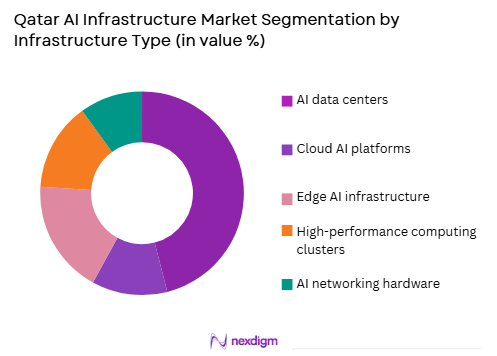
Qatar AI Infrastructure market is segmented by infrastructure type into AI data centers, cloud AI platforms, edge AI infrastructure, high-performance computing clusters, and AI networking hardware. Recently, AI data centers has a dominant market share due to factors such as demand patterns, brand presence, infrastructure availability, or consumer preference. National AI deployment programs prioritize centralized computing facilities capable of supporting large-scale model training, energy analytics, and smart city data processing workloads. Sovereign investment in hyperscale facilities and GPU clusters has expanded domestic compute capacity, while telecom operators and government entities anchor long-term hosting demand. Centralized facilities offer higher efficiency, security, and scalability compared with distributed alternatives, reinforcing procurement preference. AI data centers also integrate with national cloud and government digital platforms, enabling multi-sector adoption across energy, transportation, healthcare, and public services. Consequently, capital allocation and deployment scale remain concentrated in hyperscale and national AI data center infrastructure within Qatar’s digital economy.
By End-use Sector
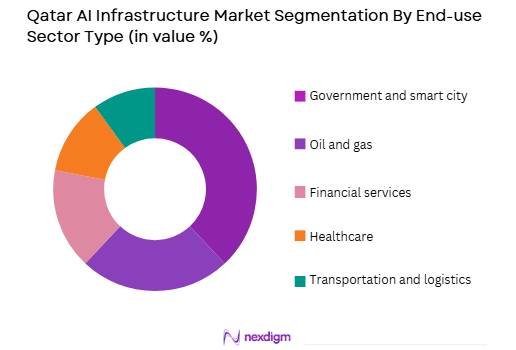
Qatar AI Infrastructure market is segmented by end-use sector into government and smart city, oil and gas, financial services, healthcare, and transportation and logistics. Recently, government and smart city has a dominant market share due to factors such as demand patterns, brand presence, infrastructure availability, or consumer preference. National digital government platforms, urban analytics systems, and surveillance and mobility management applications require large-scale AI compute and storage resources hosted in sovereign infrastructure. State-led procurement and funding for smart city platforms and digital public services generate sustained demand for AI processing capacity. Centralized data governance and cybersecurity requirements favor domestic AI hosting infrastructure for public sector applications. Integration of AI into urban operations, utilities optimization, and citizen services further expands compute requirements. As the primary orchestrator of national digital transformation, the government sector accounts for the largest share of AI infrastructure deployment within Qatar’s technology ecosystem.
Competitive Landscape
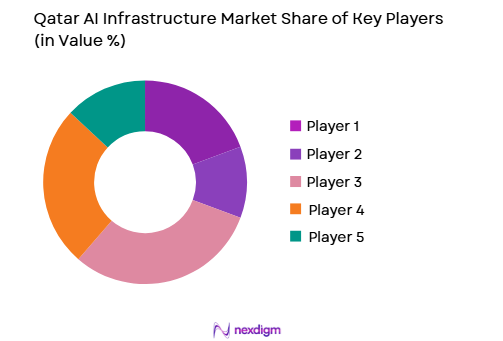
The Qatar AI infrastructure market is moderately concentrated, with sovereign-backed telecom operators, global cloud providers, and specialized AI hardware vendors forming the core ecosystem. State investment and national digital programs shape procurement dynamics, while partnerships between international technology firms and domestic operators enable hyperscale and cloud deployment across government and enterprise sectors.
| Company Name | Establishment Year | Headquarters | Technology Focus | Market Reach | Key Products | Revenue | Qatar AI Infrastructure Role |
| Ooredoo | 1987 | Doha, Qatar | ~ | ~ | ~ | ~ | ~ |
| Microsoft | 1975 | Redmond, USA | ~ | ~ | ~ | ~ | ~ |
| Google Cloud | 2008 | Mountain View, USA | ~ | ~ | ~ | ~ | ~ |
| NVIDIA | 1993 | Santa Clara, USA | ~ | ~ | ~ | ~ | ~ |
| Qatar Data Centre | 2012 | Doha, Qatar | ~ | ~ | ~ | ~ | ~ |
Qatar AI Infrastructure Market Analysis
Growth Drivers
National artificial intelligence strategy and sovereign digital transformation investment
Qatar’s national artificial intelligence strategy and digital government roadmap have established large-scale investment programs dedicated to AI computing infrastructure, cloud platforms, and data ecosystems across public sector and strategic industries. Sovereign funding allocated through national technology initiatives and state-owned enterprises supports deployment of hyperscale data centers and GPU-accelerated computing clusters required for advanced analytics, automation, and machine learning workloads. Centralized procurement frameworks enable coordinated infrastructure deployment across ministries, municipalities, and public service agencies, accelerating adoption of shared AI platforms. Integration of AI into energy optimization, urban planning, and public administration systems increases demand for domestic compute capacity and secure hosting environments. National data governance policies prioritize local infrastructure to ensure sovereignty, cybersecurity, and regulatory compliance for sensitive datasets. Partnerships with global technology vendors facilitate transfer of advanced hardware and cloud capabilities into domestic facilities. Continuous expansion of digital public services and smart city platforms sustains long-term infrastructure utilization. Consequently, sovereign digital transformation programs constitute the primary growth engine shaping the scale and structure of Qatar’s AI infrastructure market.
Expansion of hyperscale cloud and GPU computing capacity for energy and enterprise analytics
The rapid adoption of AI across Qatar’s energy sector, financial services, and logistics industries is driving substantial demand for high-performance computing infrastructure capable of processing large datasets and complex predictive models. Energy companies deploy AI for reservoir modeling, predictive maintenance, and emissions optimization, requiring scalable GPU clusters and cloud analytics platforms hosted domestically. Enterprise digitalization initiatives across banking, aviation, and supply chain management also require machine learning infrastructure and secure data environments. Global cloud providers are expanding regional presence through partnerships with national telecom operators and data center developers, increasing hyperscale capacity. GPU-accelerated computing platforms enable advanced simulation, image recognition, and automation workloads critical to industrial optimization. Integration of enterprise systems with national cloud frameworks enhances interoperability and data exchange. Growing adoption of AI applications across multiple industries increases utilization of domestic computing infrastructure. As enterprise AI adoption expands, hyperscale and GPU infrastructure investment continues to accelerate within Qatar’s AI ecosystem.
Market Challenges
Limited domestic AI hardware manufacturing and dependence on imported high-performance components
Qatar’s AI infrastructure development relies heavily on imported GPUs, semiconductor components, and specialized cooling and networking equipment sourced from global technology suppliers, creating supply chain dependence and procurement risks. Absence of local semiconductor fabrication or advanced electronics manufacturing capacity limits domestic value creation within the AI infrastructure stack. Global demand fluctuations for AI hardware can affect availability and pricing of GPUs and accelerator chips required for hyperscale computing deployments. Logistics lead times and geopolitical trade dynamics may delay infrastructure expansion schedules. Maintenance and upgrade cycles depend on foreign technical support and vendor ecosystems, increasing operational reliance on external partners. Limited domestic engineering base in advanced chip design and fabrication constrains technology autonomy. National initiatives to localize technology capabilities require long-term investment and skill development. Consequently, import dependence represents a structural constraint affecting scalability and resilience of Qatar’s AI infrastructure market.
High energy consumption and cooling requirements of hyperscale AI data centers in arid climate
AI computing infrastructure, particularly GPU-dense data centers, consumes substantial electrical power and requires advanced cooling systems to maintain performance and reliability, posing operational challenges in Qatar’s high-temperature desert environment. Elevated ambient temperatures increase cooling loads and energy consumption for data center operations. Water-intensive cooling technologies face sustainability constraints in arid regions with limited freshwater resources. Electricity demand from hyperscale facilities places pressure on national power infrastructure and operating costs. Designing energy-efficient data centers requires specialized engineering and advanced thermal management technologies. Integration of renewable energy and waste-heat recovery systems adds complexity and capital requirements. Environmental sustainability and carbon reduction objectives influence infrastructure design standards. These operational and environmental factors increase cost and complexity of large-scale AI infrastructure deployment in Qatar.
Opportunities
Integration of AI infrastructure with smart city and urban digital twin initiatives
Qatar’s smart city programs and urban digital twin initiatives create significant opportunities for expanded AI computing infrastructure to support real-time analytics, simulation, and urban optimization applications. City-scale sensor networks, mobility systems, and infrastructure monitoring platforms generate large data volumes requiring centralized AI processing and storage. Digital twin models for urban planning, utilities, and transportation rely on high-performance computing clusters and cloud platforms. Integration of AI with municipal services, public safety, and environmental monitoring increases compute demand. National smart city investments prioritize domestic hosting and sovereign cloud environments. Collaboration between telecom operators, municipalities, and technology firms enables deployment of edge and central AI infrastructure. Continuous urban digitalization initiatives sustain long-term infrastructure utilization. Consequently, smart city ecosystems represent a major growth opportunity for Qatar’s AI infrastructure market.
Development of regional AI cloud hub serving Gulf and Middle East markets
Qatar’s strategic geographic location, advanced telecom connectivity, and sovereign investment capacity position it to develop AI cloud infrastructure serving regional Gulf and Middle East markets. Expansion of hyperscale data centers and cross-border connectivity can attract regional enterprise and government AI workloads. National data sovereignty frameworks in neighboring countries create demand for regional hosting options within politically stable jurisdictions. Partnerships with global cloud providers and regional telecom operators can establish Qatar as a regional AI infrastructure hub. Availability of high-capacity submarine cable links supports cross-border data exchange. Diversification of the digital economy beyond hydrocarbons incentivizes technology export initiatives. Regional demand for AI analytics and cloud platforms continues to grow across energy, finance, and logistics sectors. As regional digital transformation accelerates, Qatar has opportunity to export AI infrastructure services beyond domestic demand.
Future Outlook
Qatar’s AI infrastructure market is expected to expand steadily as sovereign digital programs and hyperscale cloud investments continue to scale national computing capacity. Growth will be supported by smart city deployment, energy sector AI adoption, and expansion of domestic data centers. Partnerships with global cloud and hardware providers will accelerate technology transfer and deployment. Regulatory emphasis on data sovereignty and cybersecurity will reinforce domestic hosting demand. Increasing regional connectivity may position Qatar as an AI infrastructure hub within the Gulf region.
Major Players
- Ooredoo
- MEEZA
- Gulf Data Hub
- Quantum Switch
- Microsoft
- Google Cloud
- NVIDIA
- Oracle
- Cisco
- Dell Technologies
- Hewlett Packard Enterprise
- IBM
- Huawei
- Vodafone Qatar
- Brookfield
Key Target Audience
- Government and regulatory bodies
- Investments and venture capitalist firms
- Telecom operators
- Energy and oil and gas companies
- Financial institutions
- Smart city and urban development authorities
- Cloud service providers
- Defense and security agencies
Research Methodology
Step 1: Identification of Key Variables
Key variables including national digital investment, hyperscale data center capacity, GPU deployment levels, and sectoral AI adoption were identified from government digital strategy documents and technology infrastructure disclosures. Market boundaries were defined across compute, storage, and networking infrastructure supporting AI workloads.
Step 2: Market Analysis and Construction
Market sizing and segmentation were constructed using data center capacity expansion, cloud infrastructure deployment, and sectoral AI investment patterns across government and industry. Infrastructure type and end-use demand distribution were analyzed to estimate relative market shares.
Step 3: Hypothesis Validation and Expert Consultation
Findings were validated through consultation with regional ICT infrastructure experts, telecom operators, and AI technology vendors active in Gulf markets. Infrastructure deployment data and technology adoption trends were cross-checked against national digital initiatives.
Step 4: Research Synthesis and Final Output
Validated insights were synthesized into structured analysis covering segmentation, competitive dynamics, growth drivers, constraints, and opportunities. Quantitative and qualitative indicators were integrated to produce a comprehensive outlook for Qatar’s AI infrastructure ecosystem.

- Executive Summary
- Research Methodology (Definitions, Scope, Industry Assumptions, Market Sizing Approach, Primary & Secondary Research Framework, Data Collection & Verification Protocol, Analytic Models & Forecast Methodology, Limitations & Research Validity Checks)

- Market Definition and Scope
- Value Chain & Stakeholder Ecosystem
- Regulatory / Certification Landscape
- Sector Dynamics Affecting Demand
- Strategic Initiatives & Infrastructure Growth

- Growth Drivers
National AI strategy and digital transformation initiatives
Expansion of AI ready data center and cloud infrastructure
Rising enterprise and government AI adoption - Market Challenges
High cost of AI compute and data infrastructure
Dependence on global AI hardware supply chains
Talent and ecosystem development gaps - Market Opportunities
Development of sovereign AI and national compute clusters
Regional AI hub and data center expansion
AI deployment across energy and smart city sectors - Trends
Shift toward GPU and accelerator based infrastructure
Growth of AI cloud and hybrid AI platforms
Edge AI deployment for real time applications - Government regulations
National AI governance and data policies
Data localization and cloud compliance frameworks
Cybersecurity and digital infrastructure standards - SWOT analysis
- Porters Five forces

- By Market Value, 2020-2025
- By Installed Units, 2020-2025
- By Average System Price, 2020-2025
- By System Complexity Tier, 2020-2025

- By System Type (In Value%)
AI Compute Infrastructure
AI Data Storage Infrastructure
AI Networking Infrastructure
AI Edge Infrastructure
AI Cloud Infrastructure - By Platform Type (In Value%)
GPU Accelerated Platforms
AI Training Supercomputers
AI Inference Servers
Edge AI Nodes
AI Cloud Platforms - By Fitment Type (In Value%)
Hyperscale AI Data Centers
Enterprise AI Deployments
Government AI Platforms
Industry Specific AI Clusters
Hybrid AI Infrastructure - By EndUser Segment (In Value%)
Government and Smart Nation Programs
Energy and Industrial Enterprises
Financial Services Institutions
Healthcare and Research Organizations
Telecom and Digital Service Providers - By Procurement Channel (In Value%)
Direct Hyperscaler Partnerships
Government Technology Programs
System Integrators and OEMs
Telecom Infrastructure Providers
AI Platform Vendors

- Market Share Analysis
- Cross Comparison Parameters (AI Compute Performance Density, Accelerator and GPU Availability, AI Cloud and Hybrid Integration, Data Sovereignty and Security Compliance, AI Networking and Interconnect Capability)
- SWOT Analysis of Key Competitors
- Pricing & Procurement Analysis
- Key Players
NVIDIA AI Infrastructure
AMD Instinct AI
Intel AI Systems
Microsoft Azure AI
Google Cloud AI
Amazon Web Services AI
Oracle Cloud AI
Huawei AI Infrastructure
Dell Technologies AI
HPE AI Infrastructure
Qatar Computing Research Institute
Ooredoo Cloud
Vodafone Qatar Digital
Qatar Data Centre
Meeza AI Infrastructure

- Government driving national AI infrastructure
- Energy sector adopting AI compute clusters
- Financial institutions deploying AI platforms
- Telecom firms enabling AI cloud services

- Forecast Market Value, 2026-2035
- Forecast Installed Units, 2026-2035
- Price Forecast by System Tier, 2026-2035
- Future Demand by Platform, 2026-2035


 Request a Sample
 Ask for Customization
 Get a Quote
 Enquire Now