
 Download PDF
 Download PDF
Market Overview
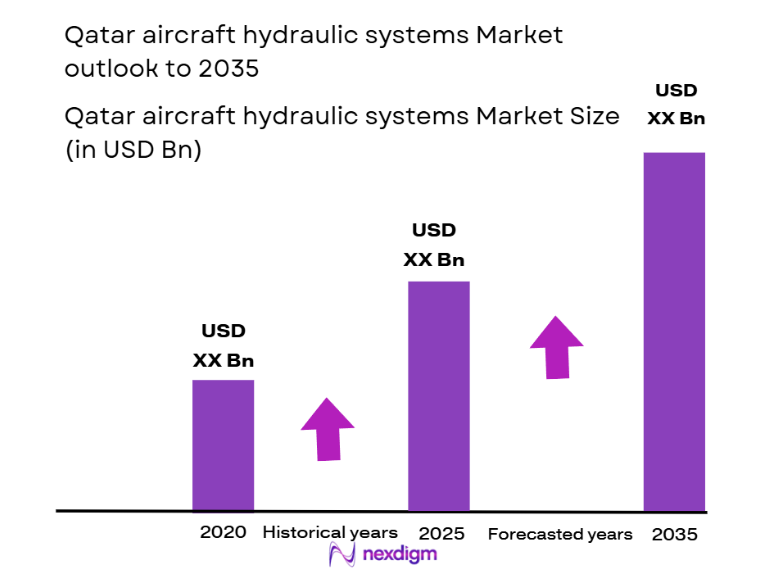
The Qatar aircraft hydraulic systems market is valued at approximately USD ~ billion in 2025, with substantial demand driven by the expansion of Qatar Airways’ fleet and increasing MRO (Maintenance, Repair, and Overhaul) activities within the region. The market is propelled by a growing need for sophisticated hydraulic systems for commercial aircraft, military, and private jets, underpinned by Qatar’s strategic role in aviation. Technological advancements in hydraulic components, such as lightweight actuators, are also contributing to the market’s positive trajectory.
The Qatar aircraft hydraulic systems market is dominated by Qatar, the UAE, and Saudi Arabia, with Qatar Airways leading the demand for hydraulic systems due to its rapidly expanding fleet. These countries have established themselves as aviation hubs, driven by their massive investments in infrastructure, modern airports, and aircraft fleets. Qatar Airways is one of the fastest-growing airlines globally, increasing the demand for high-performance hydraulic systems, both for new aircraft deliveries and MRO services. This dominance is supported by regional aviation regulations and robust government support for the aviation sector.
Market Segmentation
By System Type
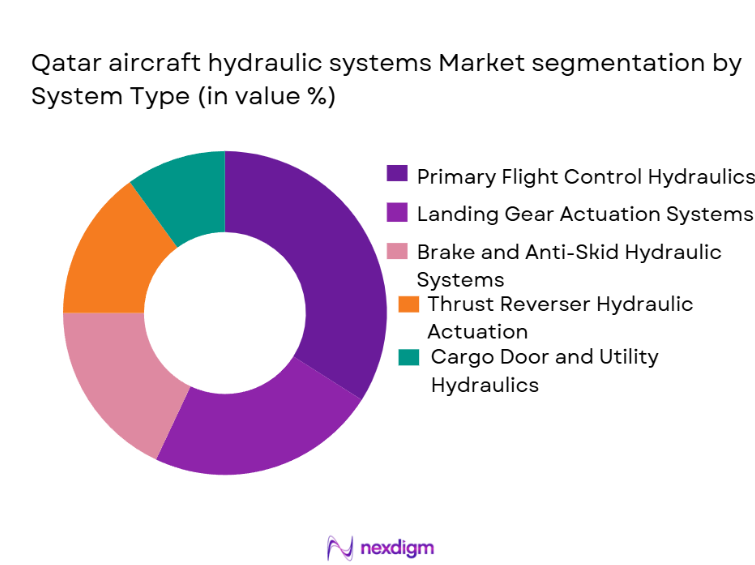
The Qatar aircraft hydraulic systems market is segmented into primary flight control hydraulics, landing gear actuation systems, brake and anti-skid hydraulic systems, thrust reverser hydraulic actuation, and cargo door and utility hydraulics. Among these, primary flight control hydraulics holds the dominant market share. This segment is crucial due to the ever-increasing demand for aircraft that ensure high safety and efficiency standards. Aircraft manufacturers and fleet operators in Qatar, particularly Qatar Airways, prioritize reliable and advanced primary flight control systems, which are critical for smooth and safe operations of various flight control surfaces.
By Platform Type
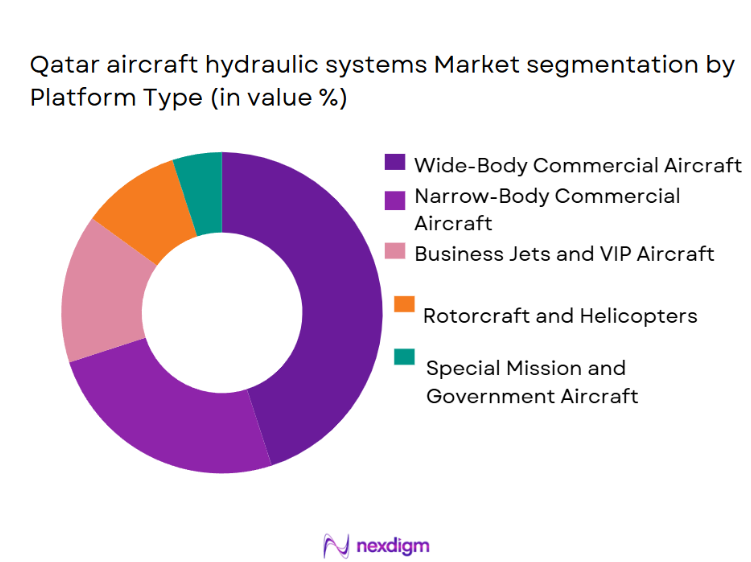
In the Qatar aircraft hydraulic systems market, aircraft platforms are divided into narrow-body commercial aircraft, wide-body commercial aircraft, business jets and VIP aircraft, rotorcraft and helicopters, and special mission and government aircraft. The wide-body commercial aircraft segment dominates the market. This is primarily due to the significant investments by Qatar Airways in large-capacity, long-haul aircraft like the Boeing 777 and Airbus A350, both of which require advanced hydraulic systems for efficient performance. Additionally, wide-body aircraft are essential for Qatar Airways’ global operations, further boosting demand for specialized hydraulic components designed for larger aircraft.
Competitive Landscape
The Qatar aircraft hydraulic systems market is dominated by a few major global players, including firms such as Parker Aerospace, Eaton Aerospace, and Collins Aerospace. These companies have established strong footholds due to their innovation, extensive service networks, and long-standing relationships with original equipment manufacturers (OEMs). They provide highly reliable, state-of-the-art hydraulic systems critical for the operation of large commercial aircraft and military platforms. The market is also influenced by regional players that cater to the unique demands of the Middle Eastern aviation market.
| Company | Establishment Year | Headquarters | Hydraulic System Product Portfolio | Market Specialization | Key Clients | Partnerships & Collaborations |
| Parker Aerospace | 1917 | Cleveland, USA | ~ | ~ | ~ | ~ |
| Eaton Aerospace | 1911 | Dublin, Ireland | ~ | ~ | ~ | ~ |
| Collins Aerospace | 1999 | Charlotte, USA | ~ | ~ | ~ | ~ |
| Moog Aircraft Systems | 1951 | East Aurora, USA | ~ | ~ | ~ | ~ |
| Liebherr Aerospace | 1949 | Lindenberg, Germany | ~ | ~ | ~ | ~ |
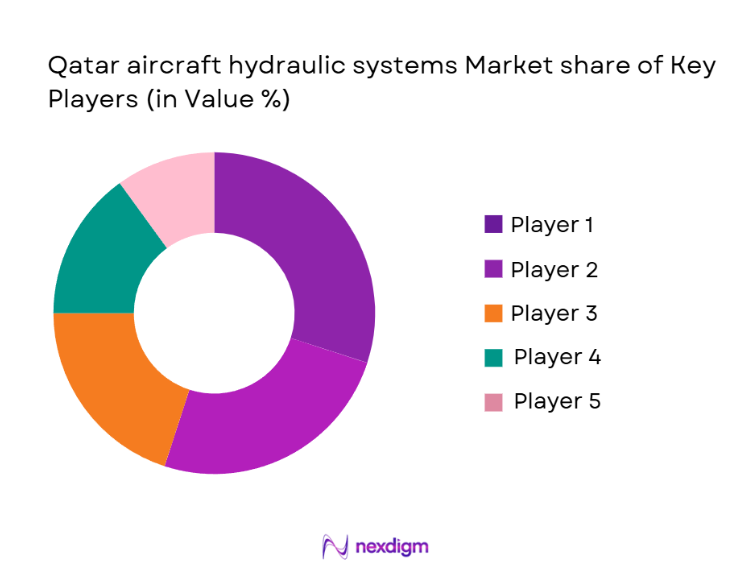
Qatar Aircraft Hydraulic Systems Market Analysis
Growth Drivers
Fleet Expansion and Aircraft Modernization
The continued growth and modernization of regional airline fleets, particularly with Qatar Airways expanding its operations, significantly drive the demand for advanced hydraulic systems. As airlines increasingly adopt new aircraft models with complex hydraulic requirements, manufacturers see a rise in demand for cutting-edge hydraulic components and systems.
MRO Industry Growth
The expanding Maintenance, Repair, and Overhaul (MRO) sector in the Middle East plays a critical role in the market’s growth. With the increasing number of aircraft requiring hydraulic system maintenance and upgrades, the growing number of MRO facilities in the region ensures a steady demand for hydraulic system components and services.
Market Challenges
High Maintenance Costs
One of the key challenges is the high cost associated with maintaining hydraulic systems, including parts replacement and routine checks. The need for specialized knowledge and the complex nature of hydraulic components can create operational inefficiencies and high costs for operators, especially when dealing with life-limited components.
Supply Chain Disruptions
The global supply chain disruptions, particularly related to aerospace components, pose a challenge to the market. Issues such as delays in component shipments and component shortages, especially during peak demand periods, can cause delays in production, increasing costs, and potentially affecting delivery timelines for customers.
Opportunities
Technological Advancements
Ongoing advancements in hydraulic technologies, such as more efficient, lighter systems and digital monitoring tools for predictive maintenance, present significant opportunities for growth. These innovations enable airlines and MRO providers to reduce maintenance costs, improve system reliability, and extend component life, making them attractive to fleet operators.
Growing Demand for Regional Air Travel
As regional air travel continues to expand in the Middle East, the demand for reliable, high-performance hydraulic systems is expected to increase. Regional carriers and private jet operators require advanced hydraulic systems to meet safety and performance standards, providing growth opportunities for manufacturers in this sector.
Future Outlook
Over the next 5 years, the Qatar aircraft hydraulic systems market is expected to show significant growth driven by continuous fleet expansion, particularly by Qatar Airways, and the increasing demand for high-tech hydraulic systems for both commercial and military aircraft. The market will benefit from ongoing advancements in hydraulic system design, with a focus on reducing weight, improving reliability, and enhancing system performance to meet the growing aviation demands in the region. Additionally, advancements in digital hydraulic systems and predictive maintenance technologies will further drive the growth of the market.
Major Players
- Parker Aerospace
- Eaton Aerospace
- Collins Aerospace
- Moog Aircraft Systems
- Liebherr Aerospace
- Honeywell Aerospace
- Safran Landing Systems
- Ametek MRO Solutions
- Triumph Actuation Systems
- Meggitt Aircraft Braking Systems
- Kawasaki Precision Machinery
- Woodward Aerospace
- Marotta Controls
- Senior Aerospace
- HAECO Component Overhaul
Key Target Audience
- Investments and Venture Capitalist Firms
- Government and Regulatory Bodies
- Airline Operators
- Aircraft Manufacturers
- Aerospace Component Suppliers
- MRO Service Providers
- Aviation Consulting Firms
- Aircraft Leasing and Asset Management Firms
Research Methodology
Step 1: Identification of Key Variables
The initial phase involves constructing an ecosystem map of key stakeholders in the Qatar aircraft hydraulic systems market. Through extensive desk research, secondary sources such as industry reports and proprietary databases are utilized to gather data about market drivers, challenges, and segmentation. The objective is to define critical variables influencing the market’s growth trajectory.
Step 2: Market Analysis and Construction
Historical data is compiled and analyzed to identify trends, revenue patterns, and market penetration for Qatar’s aircraft hydraulic systems. This involves evaluating segment performance and forecasting market dynamics across various categories such as system types and platform types. This step ensures accurate data compilation and reliable analysis.
Step 3: Hypothesis Validation and Expert Consultation
To validate the market hypotheses, consultations are conducted with industry experts via interviews and surveys. This process involves engaging with professionals from top aerospace manufacturers and MRO service providers in Qatar. These interactions help refine the accuracy of the market data and offer insight into operational practices and business strategies.
Step 4: Research Synthesis and Final Output
The final phase involves synthesizing the collected data and comparing it with market observations. Through direct engagements with OEMs, suppliers, and key industry players, the data is verified and refined to ensure the final report is comprehensive, accurate, and reflective of the actual market conditions. This final output includes a detailed analysis of both historical and forecasted trends in the market.

- Executive Summary
- Research Methodology (Definitions, Scope, Industry Assumptions, Market Sizing Approach, Primary & Secondary Research Framework, Data Collection & Verification Protocol, Analytic Models & Forecast Methodology, Limitations & Research Validity Checks)

- Market Definition and Scope
- Value Chain & Stakeholder Ecosystem
- Regulatory / Certification Landscape
- Sector Dynamics Affecting Demand
- Strategic Initiatives & Infrastructure Growth

- Growth Drivers
Fleet expansion and renewal programs by Qatar-based operators increasing demand for modern hydraulic actuation and braking systems
Rising heavy maintenance activity and component overhaul cycles driving recurring aftermarket purchases of pumps, valves, actuators, and seals
Operational reliability requirements encouraging higher spend on predictive maintenance, spares provisioning, and certified replacement components - Market Challenges
Long lead times and supply-chain constraints for certified hydraulic components creating AOG risk and inventory cost pressure
Strict airworthiness compliance and certification documentation requirements limiting alternative sourcing and increasing qualification timelines
Skill and tooling requirements for hydraulic testing, contamination control, and overhaul capacity constraining local throughput - Market Opportunities
Expansion of in-country MRO capabilities enabling localized hydraulic component repair, test benches, and spares pooling partnerships
Adoption of health-monitoring and contamination-sensing solutions to reduce unscheduled removals and optimize component life
Growing demand for lightweight, high-pressure, and low-leakage architectures supporting more-electric aircraft initiatives and efficiency targets - Trends
Shift toward performance-based logistics and power-by-the-hour contracts for hydraulic LRUs and rotable pools
Increased focus on hydraulic fluid cleanliness management, filtration upgrades, and contamination diagnostics across fleets
Greater use of digital MRO systems integrating part traceability, service bulletins, and component life tracking for hydraulics

- By Market Value 2020-2025
- By Installed Units 2020-2025
- By Average System Price 2020-2025
- By System Complexity Tier 2020-2025

- By System Type (In Value%)
Primary Flight Control Hydraulics
Landing Gear Actuation Systems
Brake and Anti-Skid Hydraulic Systems
Thrust Reverser Hydraulic Actuation
Cargo Door and Utility Hydraulics - By Platform Type (In Value%)
Narrow-Body Commercial Aircraft
Wide-Body Commercial Aircraft
Business Jets and VIP Aircraft
Rotorcraft and Helicopters
Special Mission and Government Aircraft - By Fitment Type (In Value%)
Linefit on New Aircraft Deliveries
Retrofit and Modification Programs
Overhaul Replacement During Heavy Checks
On-Condition Component Swap
Life-Limited Component Replacement - By EndUser Segment (In Value%)
Commercial Airlines and Fleet Operators
MRO Service Providers
Government and Defense Aviation Units
Business Aviation Operators
Aircraft Leasing and Asset Management Firms - By Procurement Channel (In Value%)
OEM Direct Contracts
Authorized Aftermarket Distributors
MRO Bundled Procurement Agreements
Long-Term Service Agreements and PBH
Tenders via Government and Flag-Carrier Procurement

- Market Share Analysis
- CrossComparison Parameters (Hydraulic LRU portfolio breadth, Local MRO and test capability, Certification and traceability compliance, Lead time and AOG logistics support, Total cost of ownership and PBH pricing, Fleet coverage across platforms)
- SWOT Analysis of Key Competitors
- Pricing & Procurement Analysis
- Key Players
Safran Landing Systems
Parker Aerospace
Eaton Aerospace
Collins Aerospace
Honeywell Aerospace
Moog Aircraft Group
Liebherr-Aerospace
Meggitt Aircraft Braking Systems
Kawasaki Precision Machinery
Triumph Actuation Systems
Woodward Aerospace
Marotta Controls
Ametek MRO Solutions
Senior Aerospace (Hydraulics)
HAECO Component Overhaul

- Commercial operators prioritize dispatch reliability, rapid AOG support, and high-availability rotable pools for critical hydraulic LRUs
- MRO providers differentiate via certified test capability, contamination control processes, and turnaround time for actuators, pumps, and servo valves
- Government and special-mission fleets emphasize ruggedization, supply assurance, and configuration control for bespoke hydraulic architectures
- Business aviation users favor premium OEM-aligned support, quick replacement logistics, and high-quality seals/hoses to minimize downtime

- Forecast Market Value 2026-2035
- Forecast Installed Units 2026-2035
- Price Forecast by System Tier 2026-2035
- Future Demand by Platform 2026-2035


 Request a Sample
 Ask for Customization
 Get a Quote
 Enquire Now