
 Download PDF
Market Overview
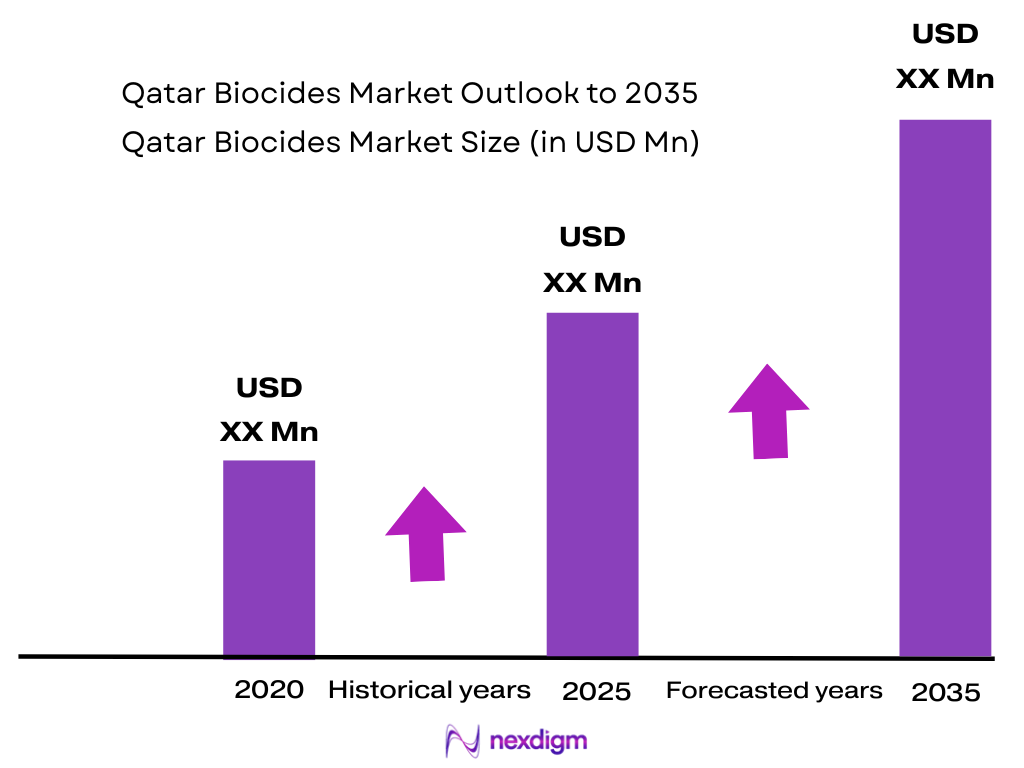
The Qatar Biocides Market is valued at approximately USD XX million, with demand supported by desalination, wastewater treatment, cooling-water systems, oil and gas production, LNG processing, petrochemicals, food processing and institutional sanitation. Qatar’s potable desalinated-water production reached 538 million imperial gallons per day, while the national water network extended beyond 11,000 km. These infrastructure requirements create recurring microbial-control needs across membranes, pipelines, cooling systems, process water and wastewater treatment.
Qatar’s biocides demand is concentrated around Doha, Ras Laffan, Mesaieed, Umm Al Houl and other industrial and energy-linked zones. Doha provides the largest concentration of commercial, healthcare, hospitality and municipal-water demand, while Ras Laffan is strategically important for LNG and gas processing and Mesaieed for refining, petrochemicals and heavy industry. The Umm Al Houl water infrastructure further strengthens demand for membrane and desalination microbial-control chemistry.
Market Segmentation
By Product Type
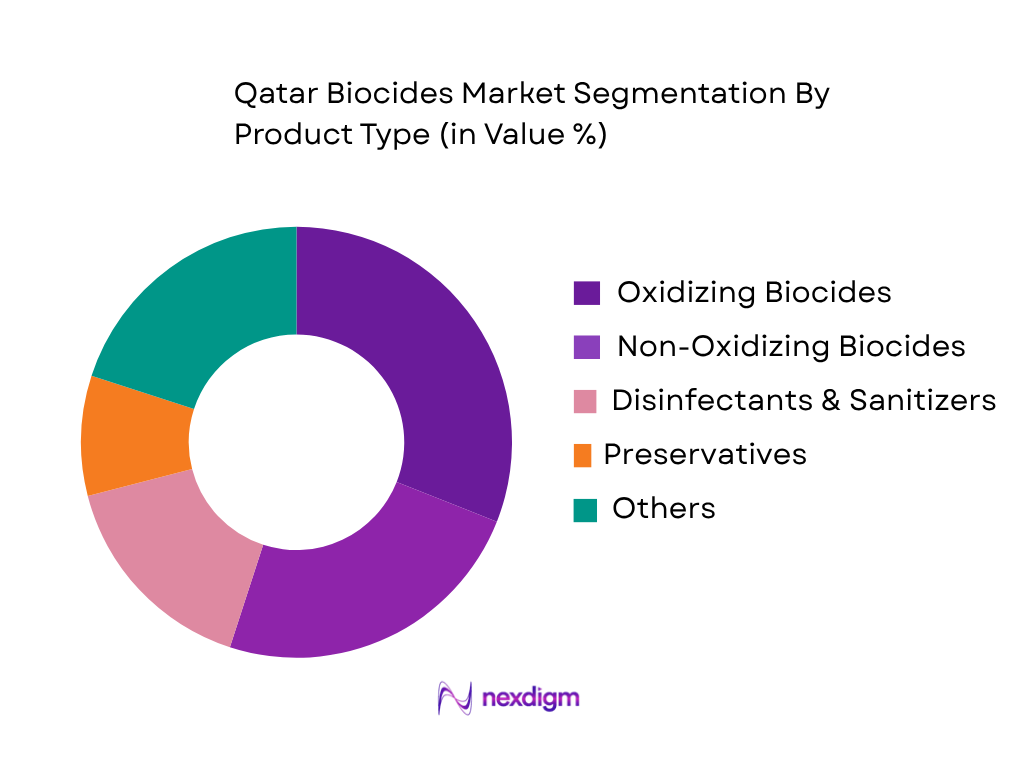
The Qatar Biocides Market is segmented by product type into oxidizing biocides, non-oxidizing biocides, disinfectants and sanitizers, preservatives, algaecides, fungicides, antimicrobial additives and specialty microbial-control agents. Oxidizing biocides are expected to maintain the dominant position under this segmentation because they are particularly suited to high-throughput water-treatment environments requiring rapid microbial reduction. Chlorine-, bromine-, chlorine-dioxide- and peroxide-based systems can be deployed across municipal water, desalination pretreatment, cooling towers and industrial process-water systems. Qatar’s 538 million imperial gallons per day of potable desalinated-water production demonstrates the scale of water infrastructure requiring reliable microbial management. Oxidizing chemistry also supports applications where rapid treatment response and established dosing infrastructure are important. Non-oxidizing products remain significant for oilfield, industrial and cooling-water applications because they can provide longer-lasting microbial control and complement oxidizing treatment programs.
By Application
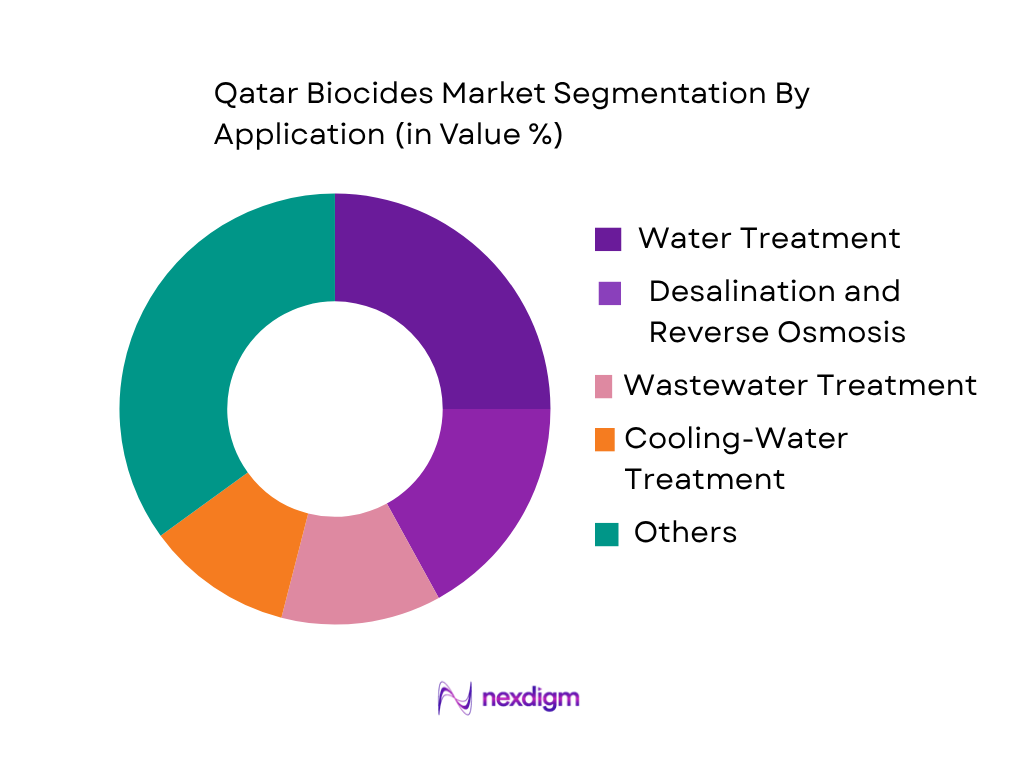
The Qatar Biocides Market is segmented by application into water treatment, desalination and reverse osmosis, wastewater treatment, cooling-water treatment, oilfield microbial control, industrial and institutional cleaning, food and beverage sanitation, paints and coatings preservation, healthcare disinfection and marine antifouling. Water treatment is expected to remain the leading application because Qatar’s arid environment makes desalinated and treated water central to residential, commercial and industrial activity. Kahramaa reports potable desalinated-water production of 538 million imperial gallons per day and a water-distribution network exceeding 11,000 km, creating extensive opportunities for microbial control from production through distribution. Water-intensive oil and gas and industrial facilities add process-water and cooling-water requirements, while wastewater treatment and reuse introduce additional microbial-control needs. The combination of municipal infrastructure, desalination, industrial water and cooling systems makes water treatment the broadest recurring application for biocides.
Competitive Landscape
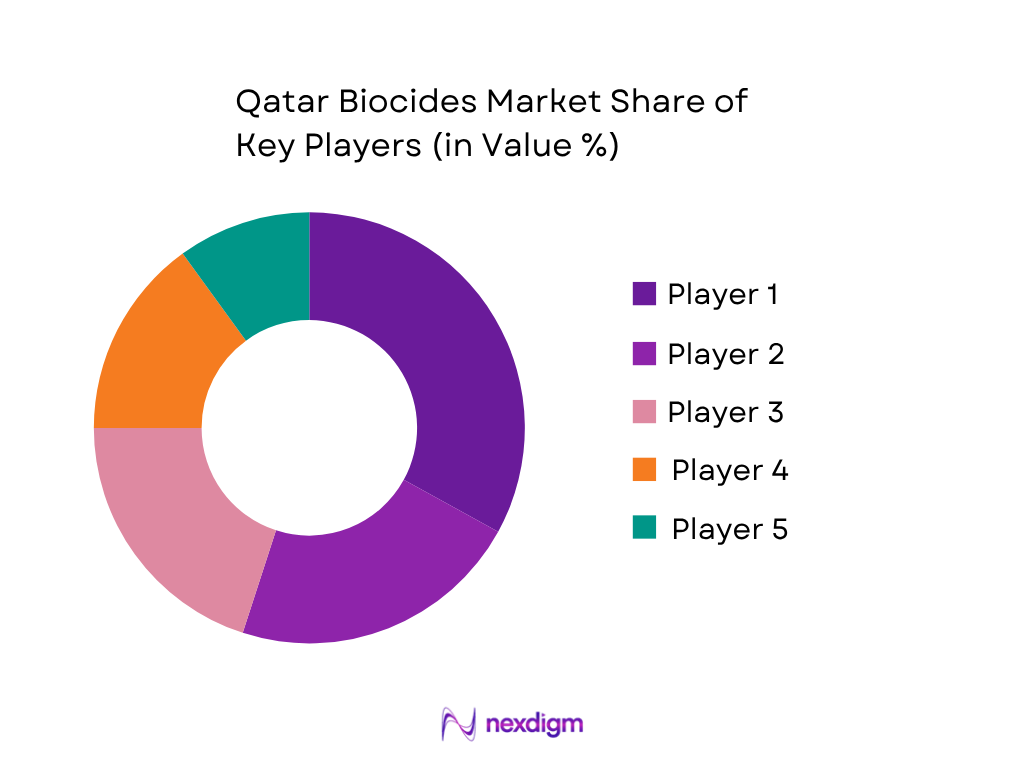
The Qatar Biocides Market is characterized by a combination of global specialty-chemical manufacturers, water-treatment companies and oilfield-chemical suppliers. Competition is influenced not only by product breadth but also by technical service, active-ingredient availability, regulatory support, desalination expertise, industrial water-treatment capability and supply reliability. Companies with established international production networks can address Qatar’s dependence on imported specialty chemicals, while water-treatment specialists are positioned to capture integrated treatment contracts. Ecolab, BASF, Kemira, Veolia and LANXESS represent relevant international competitive benchmarks across water treatment, specialty chemistry, microbial control and industrial applications. Ecolab identifies water, hygiene and infection prevention as core businesses, while Kemira positions itself around chemical solutions for water-intensive industries.
| Company | Establishment | Headquarters | Water Treatment | Biocide Portfolio | Desalination/RO | Oil & Gas | Technical Services |
| BASF SE | 1865 | Ludwigshafen, Germany | ~ | ~ | ~ | ~ | ~ |
| Ecolab Inc. | 1920 | St. Paul, USA | ~ | ~ | ~ | ~ | ~ |
| Kemira Oyj | 1920 | Helsinki, Finland | ~ | ~ | ~ | ~ | ~ |
| Veolia | 1853 | Paris, France | ~ | ~ | ~ | ~ | ~ |
| LANXESS AG | 2004 | Cologne, Germany | ~ | ~ | ~ | ~ | ~ |
Qatar Biocides Market Analysis
Growth Drivers
Desalination Capacity Expansion
Qatar’s dependence on desalinated water creates a structurally strong requirement for microbial-control chemistry across seawater intake, pretreatment, reverse-osmosis membranes, storage and distribution. Kahramaa reports that potable desalinated-water production reached 538 million imperial gallons per day in 2024, following expansion of the Umm Al Houl plant, while the national water network exceeded 11,000 km. These systems require continuous management of bacteria, algae, biofilm and other microorganisms that can impair membrane performance, increase fouling and affect downstream water quality. Qatar’s economic scale further supports this infrastructure-intensive demand: World Bank data record USD 219.16 billion of GDP and USD 76,688.7 of GDP per capita in 2024, alongside a population of 2,857,822. The same source records 2.4 real GDP growth, indicating continued economic activity across water-intensive industrial and service sectors. For biocide suppliers, the combination of large desalination output and an extensive distribution network creates recurring requirements for oxidizing and non-oxidizing treatment programs. Demand is particularly relevant for membrane-compatible chemistry, biofouling prevention, cooling-water treatment and microbial control within water-production infrastructure.
Oil and Gas Production, LNG and Petrochemical Processing
Qatar’s hydrocarbon-processing base creates substantial recurring microbial-control requirements in production water, water injection, cooling systems, pipelines, storage and associated industrial utilities. QatarEnergy reports current North Field LNG production capacity of 77 million tonnes per annum, while the North Field expansion program is designed to raise capacity to 110 million tonnes per annum in its first expansion phase and subsequently to 142 million tonnes per annum. QatarEnergy also identifies a new petrochemical complex in Ras Laffan with an ethane cracker capacity of 1.9 million tonnes of ethylene per annum and states that associated polyethylene projects raise existing polyethylene production capacity by 82 by the fourth quarter of 2025. These facilities require microbial management because process-water systems, cooling circuits and hydrocarbon-associated water can support biofilm formation and microbiologically influenced corrosion. The wider economic environment reinforces the industrial base: the World Bank records Qatar’s 2024 GDP at USD 219.16 billion, GDP per capita at USD 76,688.7, and real GDP growth at 2.4. Consequently, expansion and operation of LNG, gas-processing and petrochemical assets provide a sustained industrial-use case for oilfield biocides, cooling-water products and specialty microbial-control formulations.
Market Challenges
Arid Climate and High Water Demand
Qatar’s extremely water-constrained environment makes microbial control operationally important while simultaneously increasing the consequences of treatment failure, contamination and inefficient water use. Kahramaa reports 538 million imperial gallons per day of potable desalinated-water production in 2024 and a water-distribution network exceeding 11,000 km, demonstrating the scale of infrastructure exposed to microbial fouling, biofilm development and contamination risks. World Bank data show Qatar had 2,857,822 residents in 2024, while GDP reached USD 219.16 billion, creating a high-value economy that depends on reliable water availability for households, commercial facilities and industrial operations. The challenge for biocide suppliers is that treatment programs must operate effectively under demanding water-treatment conditions while controlling residuals and maintaining compatibility with membranes, pipelines, cooling equipment and downstream processes. High treatment intensity can also require careful selection between oxidizing and non-oxidizing chemistry, dosing optimization and monitoring of microbial populations. Because desalination and reuse systems are integral to national water security, failures associated with biofouling or microbial growth can have consequences beyond individual industrial facilities. This makes efficacy, dosing precision, membrane compatibility and environmental performance critical purchasing criteria for Qatar’s water-intensive users.
Regulatory Compliance, Environmental Discharge and Imported Specialty-Chemical Dependency
Qatar’s biocides market faces a combination of chemical-compliance, environmental-management and supply-chain requirements that can increase complexity for suppliers and end users. The scale of industrial activity is substantial: Qatar’s 2024 GDP reached USD 219.16 billion, while GDP per capita was USD 76,688.7, according to the World Bank. QatarEnergy’s industrial expansion also includes LNG capacity moving from 77 million tonnes per annum toward 110 million tonnes per annum through the North Field East project, alongside a 1.9 million tonnes per annum ethylene cracker planned for Ras Laffan. Such facilities require specialized microbial-control products, but suppliers must demonstrate appropriate efficacy, safe handling, chemical compatibility and environmental performance for individual applications. The challenge is particularly significant where treated water is discharged, reused or incorporated into sensitive industrial systems. Active-ingredient selection must balance microbial performance against residual toxicity and environmental exposure, while imported specialty chemicals introduce additional dependence on international manufacturing, logistics and inventory availability. This creates a competitive advantage for suppliers with established regional distribution, regulatory expertise, technical support and multiple active-ingredient alternatives capable of maintaining treatment continuity when individual products face approval or supply constraints.
Market Opportunities
Advanced Desalination Biocides and Reverse-Osmosis Biofouling Control
Qatar’s desalination infrastructure provides a strong opportunity for specialized biocides designed around membrane protection, biofilm prevention and controlled microbial loading. Kahramaa records 538 million imperial gallons per day of potable desalinated-water production in 2024 and a water network exceeding 11,000 km, providing a large installed infrastructure base in which microbial management is operationally relevant. The opportunity extends beyond conventional disinfection toward chemistry specifically designed for reverse-osmosis pretreatment, membrane-compatible microbial control and reduced-residual treatment. World Bank data show Qatar generated USD 219.16 billion of GDP in 2024, with GDP per capita of USD 76,688.7, supporting continued investment in high-performance infrastructure and industrial water systems. Suppliers can therefore differentiate through products that address biofilm formation without creating unacceptable membrane or downstream-water impacts. Opportunities also exist for integrated treatment programs combining biocides with online monitoring, automated dosing and microbial-load assessment. Such solutions can help operators optimize treatment intensity rather than relying solely on fixed dosing. The strongest commercial potential is likely to be in products that combine rapid microbial control, membrane compatibility, manageable residuals and technical-service support for desalination operators and industrial users dependent on reverse-osmosis systems.
Cooling-Tower Microbial Management, Wastewater Reuse and Oilfield Biocides
Qatar’s expanding industrial infrastructure creates opportunities for application-specific microbial-control products across cooling towers, wastewater systems and hydrocarbon production facilities. QatarEnergy reports that current North Field LNG capacity is 77 million tonnes per annum, with planned expansion toward 110 million tonnes per annum and subsequently 142 million tonnes per annum. The company also reports a new Ras Laffan petrochemical complex with an ethane cracker capacity of 1.9 million tonnes of ethylene per annum. These facilities increase the relevance of biocides for cooling-water circuits, process-water systems, microbial corrosion control and production-water treatment. Qatar’s 2024 GDP of USD 219.16 billion and GDP per capita of USD 76,688.7, according to the World Bank, indicate a large high-value industrial economy capable of supporting technically sophisticated treatment programs. The opportunity is therefore shifting toward specialized formulations that address biofilm, slime, algae and microbiologically influenced corrosion while minimizing unnecessary chemical residuals. Wastewater reuse adds another application pathway because microbial management becomes important when treated water is returned to industrial processes. Suppliers capable of combining chemistry with dosing optimization, monitoring and technical service can differentiate themselves from commodity biocide providers and capture demand from energy, petrochemical, power-generation and industrial-water customers.
Future Outlook
The Qatar Biocides Market is expected to benefit from sustained investment in desalination, water infrastructure, LNG, oil and gas, petrochemicals, industrial cooling and wastewater treatment. Qatar’s water infrastructure creates a structurally recurring requirement for microbial control, while the country’s industrial base provides additional demand from process-water and cooling systems. Growth opportunities are likely to increasingly favor higher-efficiency formulations, membrane-compatible products, biofilm-specific treatments and lower-residual chemistry. The market should also see greater integration of chemical dosing, monitoring and water-treatment services.
Major Players
- BASF SE
- Ecolab Inc.
- Kemira Oyj
- Veolia
- SUEZ
- LANXESS AG
- Solvay SA
- Dow Inc.
- Nouryon
- Clariant AG
- Kurita Water Industries Ltd.
- SNF Group
- Metito
- Baker Hughes
- Halliburton
Key Target Audience
- Oil and gas operators and production companies
- LNG, gas-processing and petrochemical companies
- Water and desalination utilities
- Industrial water-treatment and wastewater operators
- Power-generation and cooling-system operators
- Investments and venture capitalist firms (Qatar Investment Authority, regional infrastructure investors, industrial investment funds)
- Government and regulatory bodies (Ministry of Environment and Climate Change, Ministry of Municipality, Qatar General Electricity & Water Corporation – Kahramaa)
- Chemical distributors, EPC contractors and industrial chemical procurement organizations
Research Methodology
Step 1: Identification of Key Variables
The initial stage develops a Qatar-specific biocides ecosystem covering desalination, municipal water, wastewater, oil and gas, LNG, petrochemicals, power generation, food processing, coatings and institutional hygiene. Variables include active ingredients, formulations, applications, end users, import dependency, regulatory requirements and treatment intensity.
Step 2: Market Analysis and Construction
Historical market information is compiled using a combination of official economic statistics, water-sector data, industrial indicators, trade information, company disclosures and industry-level operating data. The analysis separates product demand by biocide type, application, end-use industry and formulation to construct a bottom-up market model.
Step 3: Hypothesis Validation and Expert Consultation
Market hypotheses are validated through discussions with professionals across water treatment, desalination, oilfield chemicals, industrial chemical distribution and end-user industries. Technical inputs are used to assess active-ingredient selection, dosage requirements, product substitution, regulatory constraints and procurement practices.
Step 4: Research Synthesis and Final Output
The final stage triangulates supply-side and demand-side findings with company-level information, industrial infrastructure indicators and trade flows. The resulting framework is tested for internal consistency across product, application and end-use segments before the final market estimates and forecast assumptions are prepared.

- Executive Summary
- Research Methodology (Market Definition and Scope, Biocidal Active-Ingredient Mapping, Market Sizing Framework, Top-Down Assessment, Bottom-Up Assessment, Demand-Side Validation, Supply-Side Validation, Import-Export Analysis, Primary Industry Interviews, Regulatory Validation, Data Triangulation, Forecasting Framework, Scenario Analysis, Assumptions and Limitations)

- Definition and Scope
- Qatar Biocides Industry Structure
- Biocidal Active-Ingredient and Formulation Ecosystem
- Evolution of the Qatar Biocides Industry
- Key Industry Development Milestones
- Qatar Biocides Value Chain Analysis

- Market Growth Drivers (Desalination Capacity Expansion, Water Treatment Intensification, Oil and Gas Production, LNG and Gas Processing, Refining and Petrochemical Activity, Industrial Cooling-Water Demand, Construction Expansion, Food and Beverage Processing)
- Market Challenges (Arid Climate and High Water Demand, Extreme Operating Temperatures, Regulatory Compliance, Environmental Discharge Requirements, Imported Specialty-Chemical Dependency, Active-Ingredient Restrictions, Aquatic Toxicity, Biocide Resistance, Hazardous Chemical Handling)
- Market Opportunities (Advanced Desalination Biocides, Reverse-Osmosis Biofouling Control, Cooling-Tower Microbial Management, Wastewater-Reuse Biocides, Oilfield Biocides, Low-Residual Chemistry, Biofilm-Specific Technologies, Marine Biofouling Control, Local Formulation and Regional Distribution)
- Market Trends (Low-Residual Biocide Chemistry, Sustainable Active Ingredients, Biofilm-Specific Treatment, Automated Chemical Dosing, Online Microbial Monitoring, Water-Reuse Treatment, Membrane Protection, Integrated Microbial Management, Reduced-Dosage Formulations)
- Qatar Biocides Regulatory Framework (Product Registration, Import Requirements, Chemical Approval, Disinfectant Registration, Active-Ingredient Controls, Labelling, Packaging)
- SWOT Analysis
- Porter’s Five Forces Analysis
- PESTLE Analysis

- By Market Value (2020-2025)
- By Biocidal Active-Ingredient Consumption Volume (2020-2025)
- By Formulated Biocide Consumption Volume (2020-2025)
- By Domestic Supply (2020-2025)
- By Imports (2020-2025)
- By Exports (2020-2025)
- By Product Type (2020-2025)
- By Application (2020-2025)
- By End-Use Industry (2020-2025)

- By Product Type (In Value %)
Oxidizing Biocides
Non-Oxidizing Biocides
Disinfectants and Sanitizers
Preservatives
Algaecides
Fungicides
Antimicrobial Additives
Biofilm-Control Agents
Antifouling Biocides
Other Specialty Biocides - By Active Ingredient (In Value %)
Chlorine-Based Biocides
Bromine-Based Biocides
Chlorine Dioxide
Hydrogen Peroxide
Peracetic Acid
Glutaraldehyde
Isothiazolinones
Quaternary Ammonium Compounds
DBNPA
Bronopol
Copper-Based Biocides
Organic-Acid Biocides
Other Active Ingredients - By Application (In Value %)
Water Treatment
Desalination and Reverse Osmosis
Wastewater Treatment
Cooling-Water Treatment
Oilfield Microbial Control
Industrial and Institutional Cleaning
Food and Beverage Sanitation
Paints and Coatings Preservation
Wood Preservation
Healthcare Disinfection
Marine Antifouling
Agricultural and Animal Hygiene - By End-Use Industry (In Value %)
Municipal Water Treatment
Desalination Plants
Oil and Gas
LNG and Gas Processing
Petrochemicals and Refining
Power Generation
Food and Beverage
Construction and Building Materials
Paints and Coatings
Healthcare
Agriculture and Animal Production - By Formulation Type (In Value %)
Liquid Biocides
Concentrated Liquid Formulations
Powder and Granular Biocides
Ready-to-Use Disinfectants
Water-Soluble Formulations
Emulsion and Dispersion Formulations
Controlled-Release Formulations - By Functional Requirement (In Value %)
Bacterial Control
Fungal Control
Algae Control
Biofilm Control
Slime Control
Disinfection
Product Preservation
Membrane Biofouling Control
Antifouling Protection
Microbiologically Influenced Corrosion Control

- Market Share of Major Players (By Value, Volume, Product Type, Active Ingredient, Application, End-Use Industry, Distribution Channel)
- Cross Comparison Parameters (Active-Ingredient Portfolio Breadth, Water-Treatment Application Breadth, Desalination and RO Capability, Oilfield Biocide Capability, Cooling-Water Treatment Capability, Local Distribution and Technical-Service Reach, Regulatory and Product-Registration Capability, Local Formulation and Supply-Chain Capability)
- SWOT Analysis of Major Player
- Detailed Profiles of Major Companies
BASF SE
Ecolab Inc. / Nalco Water
Kemira Oyj
SNF Group
Solvay SA
Dow Inc.
Nouryon
Clariant AG
Veolia Water Technologies
SUEZ
Kurita Water Industries Ltd.
Metito
LANXESS AG
Baker Hughes
Halliburton

- Municipal and Desalination Procurement Analysis
- Oil and Gas Procurement Analysis
- LNG and Gas-Processing Procurement Analysis
- Power-Generation Customer Analysis
- Petrochemical and Refining Customer Analysis
- Food and Beverage Customer Analysis
- Construction and Coatings Customer Analysis

- By Market Value (2026-2035)
- By Biocidal Active-Ingredient Consumption Volume (2026-2035)
- By Formulated Biocide Consumption Volume (2026-2035)
- By Domestic Supply (2026-2035)
- By Imports (2026-2035)
- By Exports (2026-2035)
- By Product Type (2026-2035)
- By Application (2026-2035)
- By End-Use Industry (2026-2035)


 Request a Sample
 Ask for Customization
 Get a Quote
 Enquire Now