

 Download PDF
 Download PDF
Market Overview
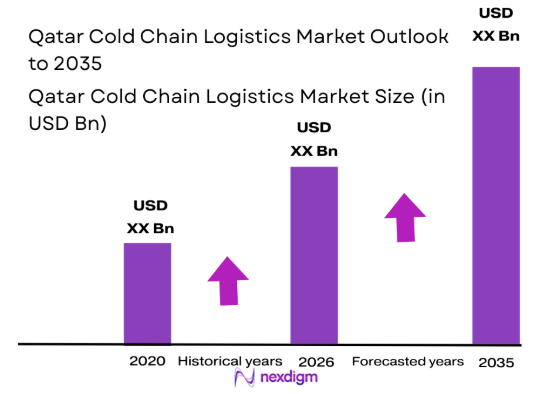
Based on a recent historical assessment, the Qatar Cold Chain Logistics Market recorded a market size of approximately USD ~ billion according to data referenced from the Qatar Planning and Statistics Authority and logistics infrastructure reports associated with Hamad Port and Qatar Free Zones Authority. Market expansion is primarily driven by strong demand for temperature-controlled transportation and storage for food imports, pharmaceuticals, and healthcare products. Qatar relies heavily on imported perishable food products, which requires reliable refrigerated logistics networks.
Doha and Al Wakrah dominate the Qatar Cold Chain Logistics Market because they host the country’s largest logistics infrastructure clusters and integrated transport networks. Hamad Port handles cargo valued at more than USD ~ billion in annual trade flows, enabling large volumes of refrigerated food imports that require cold storage and distribution services. Hamad International Airport supports temperature-controlled air cargo facilities for pharmaceutical and high-value medical shipments, strengthening logistics capabilities across metropolitan distribution centers and healthcare supply chains.
Market Segmentation
By Product Type
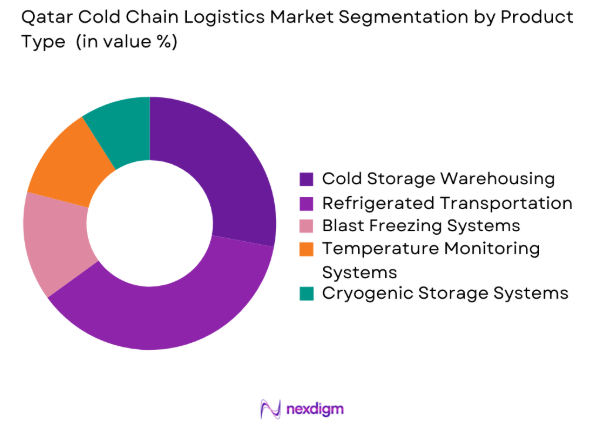
Qatar Cold Chain Logistics Market is segmented by product type into cold storage warehousing, refrigerated transportation, blast freezing systems, temperature monitoring systems, and cryogenic storage systems. Recently, refrigerated transportation has a dominant market share due to factors such as demand patterns, logistics network expansion, and infrastructure availability. Qatar imports large quantities of perishable food including dairy products, meat, seafood, and fresh produce which require continuous temperature-controlled transport from ports and airports to distribution facilities. Refrigerated trucks and containers form the backbone of cold chain logistics because they ensure temperature stability across long distances within the country. Rapid expansion of retail supermarkets, food distribution companies, and pharmaceutical logistics providers has further strengthened demand for refrigerated transport services. Companies operating distribution fleets are investing in modern refrigeration technology and real-time temperature monitoring to maintain compliance with food safety and pharmaceutical handling regulations.
By End User
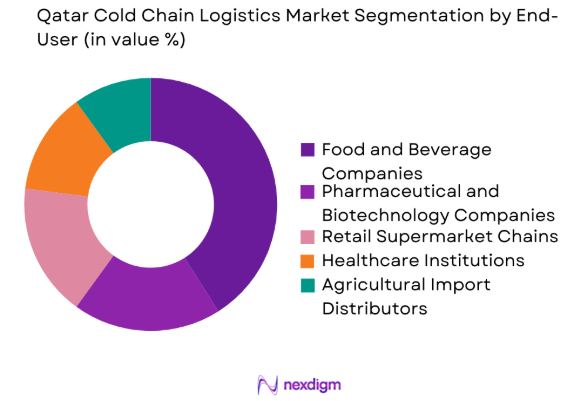
Qatar Cold Chain Logistics Market is segmented by end user into food and beverage companies, pharmaceutical and biotechnology companies, retail supermarket chains, healthcare institutions, and agricultural import distributors. Recently, food and beverage companies have a dominant market share due to factors such as consumer demand, supply chain requirements, and national food security initiatives. Qatar imports the majority of its food supply, including fresh produce, dairy products, frozen foods, and meat products, which require controlled temperature conditions throughout transportation and storage. Large retail chains and food distributors depend heavily on cold storage warehouses and refrigerated transportation to maintain product quality and shelf life. Government policies supporting strategic food reserves and improved food supply resilience have further strengthened cold chain infrastructure development. Supermarkets, wholesalers, and restaurant supply distributors collectively generate consistent demand for temperature-controlled logistics services.
Competitive Landscape
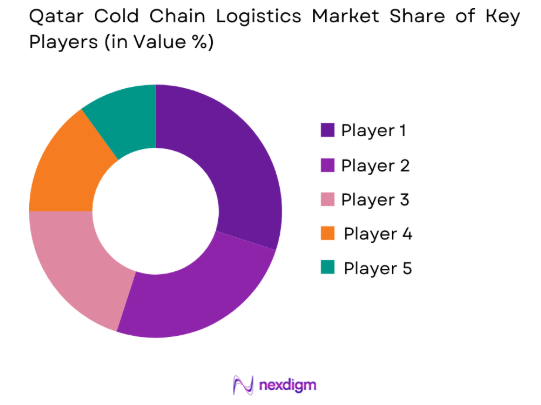
The Qatar Cold Chain Logistics Market demonstrates a moderately consolidated competitive structure in which a limited number of global logistics firms and regional logistics operators dominate temperature-controlled transportation and warehousing services. Large international logistics providers operate integrated cold storage facilities and refrigerated transportation networks linked to seaports, airports, and industrial distribution zones. Local logistics companies also play a significant role in domestic distribution and warehousing operations. Partnerships between logistics providers, food importers, and pharmaceutical companies contribute to stable long-term service contracts.
| Company Name | Establishment Year | Headquarters | Technology Focus | Market Reach | Key Products | Revenue | Cold Storage Capacity |
| DHL Supply Chain | 1969 | Germany | ~ | ~ | ~ | ~ | ~ |
| Agility Logistics | 1979 | Kuwait | ~ | ~ | ~ | ~ | ~ |
| Gulf Warehousing Company | 2004 | Qatar | ~ | ~ | ~ | ~ | ~ |
| Kuehne + Nagel | 1890 | Switzerland | ~ | ~ | ~ | ~ | ~ |
| Milaha Logistics | 1957 | Qatar | ~ | ~ | ~ | ~ | ~ |
Qatar Cold Chain Logistics Market Analysis
Growth Drivers
Expansion of Food Import Supply Chains and Retail Distribution Infrastructure
Expansion of food import supply chains and modern retail distribution infrastructure is a major driver for the Qatar Cold Chain Logistics Market because the country depends heavily on imported perishable food products requiring temperature controlled storage and transportation. Large volumes of fruits, vegetables, dairy products, seafood, and frozen foods arrive through logistics gateways such as Hamad Port and Hamad International Airport equipped with refrigerated cargo handling facilities. Retail supermarket chains, wholesalers, and hospitality suppliers rely on cold chain logistics to maintain food safety and product freshness. Rising disposable incomes and urban consumption patterns have increased demand for imported premium foods. Government initiatives supporting food security and strategic reserves continue to encourage investment in cold storage infrastructure and refrigerated transport networks.
Rising Demand for Pharmaceutical Cold Chain Logistics and Healthcare Supply Networks
Expansion of pharmaceutical distribution networks and healthcare supply chains is a major driver supporting growth in the Qatar Cold Chain Logistics Market because many medical products require strict temperature controlled transportation and storage. Vaccines, biological medicines, insulin, and laboratory materials must be maintained within precise temperature ranges to preserve efficacy and meet regulatory standards. Qatar’s healthcare sector is expanding through new hospitals, research facilities, and pharmaceutical distribution networks that depend on reliable cold chain logistics. Hamad International Airport operates specialized pharmaceutical cargo facilities equipped with temperature controlled handling zones. Logistics companies increasingly provide validated transport systems, monitoring technologies, and pharmaceutical grade storage solutions to ensure product integrity throughout medical supply chains.
Market Challenges
High Energy Consumption and Operational Costs of Refrigerated Logistics Infrastructure
High energy consumption and operational costs associated with refrigerated logistics infrastructure remain a major challenge for the Qatar Cold Chain Logistics Market because temperature controlled warehouses and refrigerated transport systems require continuous electricity to maintain stable storage conditions. Cold storage facilities operate large refrigeration units, climate control systems, and monitoring equipment that consume substantial power throughout the year. Refrigerated trucks and containers also require energy intensive cooling during transportation. Qatar’s hot desert climate further increases refrigeration demand, raising electricity usage and operational expenses. Logistics providers must invest heavily in insulation systems, advanced refrigeration technologies, and backup power solutions to ensure uninterrupted cooling, which increases capital expenditure and operational cost pressures.
Limited Skilled Workforce and Technical Expertise in Cold Chain Operations
Limited availability of specialized workforce and technical expertise in cold chain operations remains a key challenge for the Qatar Cold Chain Logistics Market because temperature controlled logistics systems require trained personnel capable of managing refrigeration technologies and strict quality control procedures. Cold storage warehouses and refrigerated transport operations require workers who understand monitoring systems, product handling protocols, and regulatory compliance requirements for food and pharmaceutical logistics. Operational errors or improper handling can cause temperature fluctuations that damage sensitive products and create financial losses. Rapid logistics infrastructure expansion has increased demand for technicians, refrigeration engineers, and warehouse specialists. However, regional training programs remain limited, forcing companies to rely on expatriate expertise and internal training initiatives.
Opportunities
Expansion of Integrated Logistics Free Zones and Temperature Controlled Distribution Hubs
Expansion of integrated logistics free zones and temperature controlled distribution hubs presents a major opportunity for the Qatar Cold Chain Logistics Market by enabling logistics providers to consolidate storage, distribution, and value added services within centralized industrial zones. Facilities developed by the Qatar Free Zones Authority provide modern cold storage infrastructure near major transport gateways such as Hamad Port and Hamad International Airport. These locations enable efficient cargo handling and faster distribution of imported food and pharmaceutical products. Cold storage warehouses within these zones support services including refrigerated storage, cargo consolidation, packaging, and distribution management. Integrated logistics hubs also encourage collaboration between transport operators, warehouse providers, and supply chain companies, strengthening overall cold chain efficiency across Qatar.
Development of Smart Cold Chain Technologies and Digital Temperature Monitoring Systems
Development of smart cold chain technologies and digital temperature monitoring systems creates strong opportunities for the Qatar Cold Chain Logistics Market by enabling logistics companies to maintain precise control over temperature sensitive supply chains. Refrigerated logistics operations increasingly use Internet of Things sensors, automated monitoring platforms, and real time tracking systems to supervise cargo conditions during storage and transportation. These tools help detect temperature fluctuations quickly and prevent spoilage or product damage. Digital monitoring also supports regulatory compliance for pharmaceutical and food distribution. Integration with warehouse management systems improves inventory tracking, shipment visibility, and operational efficiency while enhancing reliability across temperature controlled logistics networks.
Future Outlook
The Qatar Cold Chain Logistics Market is expected to experience steady expansion as demand for temperature controlled logistics services increases across food distribution, pharmaceutical supply chains, and healthcare infrastructure. Continued investment in logistics free zones, port infrastructure, and advanced cold storage facilities will strengthen the country’s logistics ecosystem. Adoption of digital temperature monitoring technologies and energy efficient refrigeration systems will improve operational efficiency. Government initiatives supporting food security and healthcare logistics will further expand cold chain demand.
Major Players
- DHL Supply Chain
- Agility Logistics
- Gulf Warehousing Company
- Kuehne + Nagel
- DB Schenker
- DSV
- CEVA Logistics
- Qatar NavigationMilahaLogistics
- Aramex
- UPS Supply Chain Solutions
- FedEx Logistics
- Yusen Logistics
- Al Jaber Logistics
- NAQEL Express
- AlWataniaLogistics
Key Target Audience
- Logistics and supply chain companies
- Food and beverage distribution companies
- Pharmaceutical and biotechnology companies
- Retail supermarket chains
- Transportation infrastructure developers
- Investments and venture capitalist firms
- Government and regulatory bodies
- Health carelogistics providers
Research Methodology
Step 1: Identification of Key Variables
The research process begins with identifying the core variables influencing the Qatar Cold Chain Logistics Market including infrastructure capacity, refrigerated transport fleets, cold storage facilities, trade flows, and regulatory frameworks. Market drivers and operational factors influencing logistics demand are mapped across the supply chain ecosystem.
Step 2: Market Analysis and Construction
Market sizing is developed using logistics infrastructure statistics, cargo throughput data, pharmaceutical import flows, and retail food supply chain volumes. Industry reports, government publications, and logistics sector datasets are analyzed to construct a comprehensive market model.
Step 3: Hypothesis Validation and Expert Consultation
Industry assumptions are validated through consultations with logistics experts, supply chain managers, and infrastructure specialists. These insights ensure accurate interpretation of cold chain infrastructure investments and demand patterns across the logistics ecosystem.
Step 4: Research Synthesis and Final Output
All validated data is synthesized to produce the final market report including segmentation analysis, competitive landscape evaluation, and market dynamics assessment. The report integrates quantitative analysis with industry insights to present a comprehensive market outlook.

- Executive Summary
- Research Methodology (Definitions, Scope, Industry Assumptions, Market Sizing Approach, Primary & Secondary Research Framework, Data Collection & Verification Protocol, Analytic Models & Forecast Methodology, Limitations & Research Validity Checks)

- Market Definition and Scope
- Value Chain & Stakeholder Ecosystem
- Regulatory / Certification Landscape
- Sector Dynamics Affecting Demand
- Strategic Initiatives & Infrastructure Growth

- Growth Drivers
Expansion of Pharmaceutical and Vaccine Distribution Infrastructure
Rising Demand for Temperature-Controlled Food Supply Chains
Growth of Modern Retail and Food Import Logistics - Market Challenges
High Capital Investment for Refrigerated Infrastructure
Energy Consumption and Operational Cost Pressures
Limited Skilled Workforce for Cold Chain Operations - Market Opportunities
Expansion of Pharmaceutical Logistics Hubs
Growth of E-commerce Grocery Distribution
Development of Integrated Logistics Free Zones - Trends
Adoption of IoT-Based Temperature Monitoring Systems
Automation in Cold Storage Warehousing
Integration of Multimodal Cold Chain Transport - Government Regulations
- SWOT Analysis of Key Competitors
- Porter’s Five Forces

- By Market Value, 2020-2025
- By Installed Units, 2020-2025
- By Average System Price, 2020-2025
- By System Complexity Tier, 2020-2025

- By System Type (In Value%)
Cold Storage Warehousing
Refrigerated Transportation
Temperature Monitoring Systems
Blast Freezing Systems
Cryogenic Storage Systems - By Platform Type (In Value%)
Road-Based Refrigerated Logistics
Air Cargo Cold Chain Logistics
Sea Freight Refrigerated Logistics
Integrated Multimodal Cold Chain Logistics
Warehouse Distribution Cold Chain Platforms - By Fitment Type (In Value%)
Standalone Refrigerated Warehouses
Integrated Distribution Centers
Mobile Refrigerated Containers
On-Site Industrial Cold Storage Systems
Modular Temperature-Controlled Units - By End User Segment (In Value%)
Food and Beverage Companies
Pharmaceutical and Biotechnology Firms
Retail and Supermarket Chains
Agricultural Exporters
Hospital and Healthcare Institutions - By Procurement Channel (In Value%)
Direct Logistics Service Contracts
Government Infrastructure Procurement
Third-Party Logistics Providers
Strategic Supply Chain Partnerships
Private Sector Logistics Tenders

- Market Share Analysis
- Cross Comparison Parameters (Cold Storage Capacity, Refrigerated Fleet Size, Temperature Monitoring Technology, Distribution Network Coverage, Pharmaceutical Logistics Capability)
- SWOT Analysis of Key Competitors
- Pricing & Procurement Analysis
- Key Players
Agility Logistics
DHL Supply Chain
Kuehne + Nagel
DB Schenker
DSV
CEVA Logistics
Qatar Navigation Milaha Logistics
Gulf Warehousing Company
Aramex
UPS Supply Chain Solutions
FedEx Logistics
Yusen Logistics
Al Jaber Logistics
NAQEL Express
Al Watania Logistics

- Pharmaceutical companies increasing demand for controlled-temperature logistics
- Retail supermarket chains expanding refrigerated distribution networks
- Food importers requiring specialized cold storage facilities
- Healthcare institutions relying on cold chain logistics for vaccines and biologics

- Forecast Market Value, 2026-2035
- Forecast Installed Units, 2026-2035
- Price Forecast by System Tier, 2026-2035
- Future Demand by Platform, 2026-2035


 Request a Sample
 Ask for Customization
 Get a Quote
 Enquire Now