
 Download PDF
Market Overview
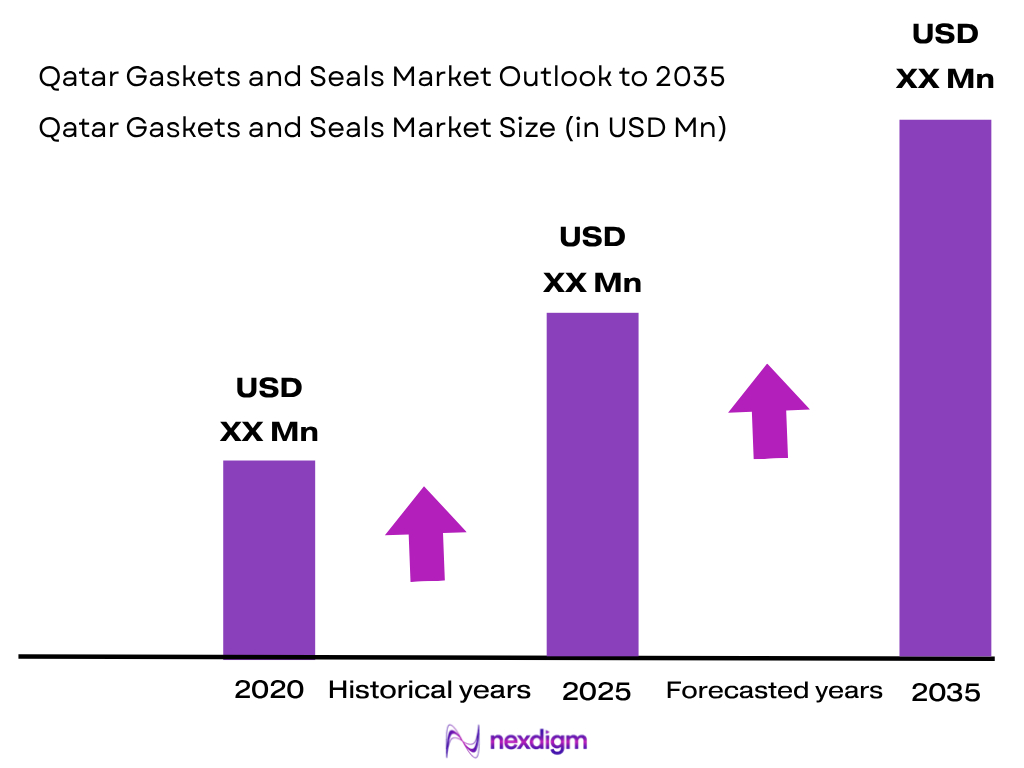
The Qatar Gaskets and Seals Market is valued at approximately USD ~X.X million, based on historical demand analysis. Market demand is driven by LNG, natural gas processing, refining, petrochemicals, offshore production, desalination and power infrastructure. QatarEnergy’s total natural-gas production moved from 7,697 Bscf to 7,492 Bscf, while total refinery throughput changed from 385.12 thousand barrels/day to 353.14 thousand barrels/day, sustaining substantial gasket, mechanical-seal and compressor-seal replacement requirements.
Ras Laffan, Mesaieed and Doha dominate the Qatar Gaskets and Seals Market because they concentrate LNG trains, gas processing, refining, petrochemicals, fertilizer plants, metals, utilities, local gasket manufacturing and industrial service facilities. Ras Laffan anchors Qatar’s existing 77 million tonnes/year LNG system, while Mesaieed contains refining and heavy industrial assets. Doha supports local MRO and manufacturing, including a gasket plant capable of producing 60,000 gaskets per month, reinforcing domestic emergency-supply capability.
Market Segmentation
By Product Category
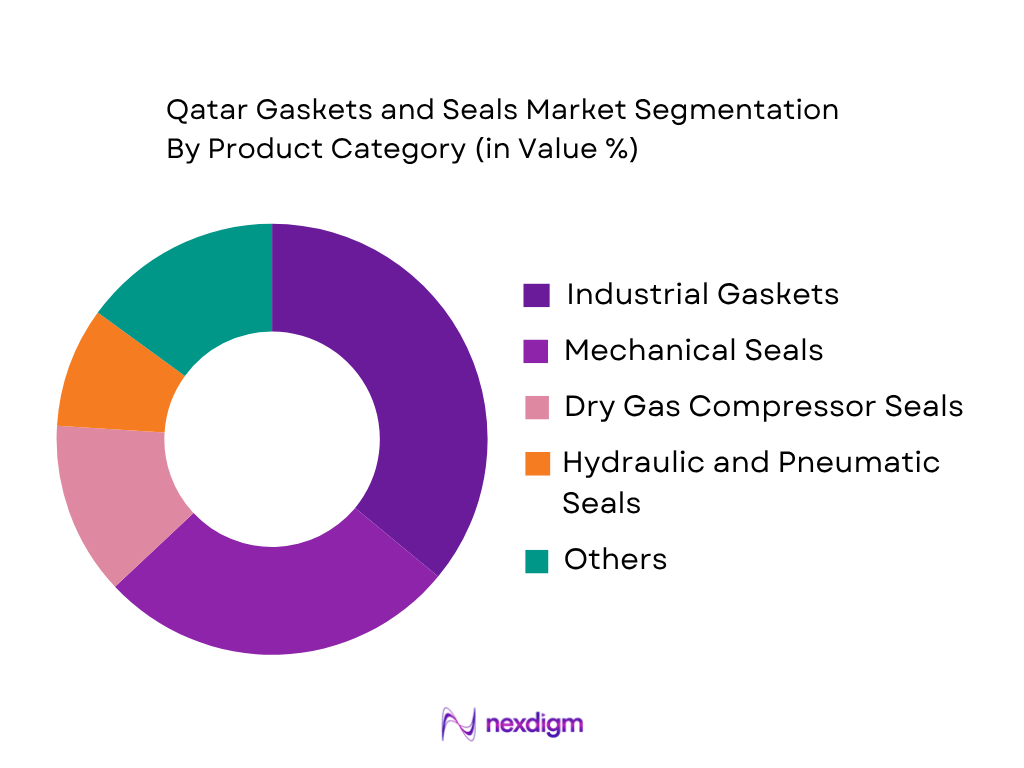
The Qatar Gaskets and Seals Market is segmented into industrial gaskets, mechanical seals, dry gas seals, hydraulic and pneumatic seals, rotary seals and other engineered sealing products. Industrial gaskets hold the dominant market position because Qatar has an unusually concentrated installed base of LNG trains, gas-processing facilities, refineries, petrochemical units and high-pressure piping systems. These facilities contain extensive flange populations across process vessels, piping, heat exchangers and utility systems, creating recurring demand for spiral-wound, ring-type-joint, kammprofile, graphite and PTFE gasketing. Qatar’s LNG system currently operates at 77 million tonnes per annum, supported by 14 LNG trains, while QatarEnergy-operated and non-operated refining assets processed a combined 353.14 thousand barrels/day in the latest reported period. Local manufacturing capability further reinforces gasket availability: Qatar German Gasket Factory reports production capacity of 60,000 gaskets per month. Mechanical seals and dry gas seals remain strategically important for pumps and compressors, but the sheer installed flange population across LNG and process plants supports gasket leadership.
By End-Use Industry
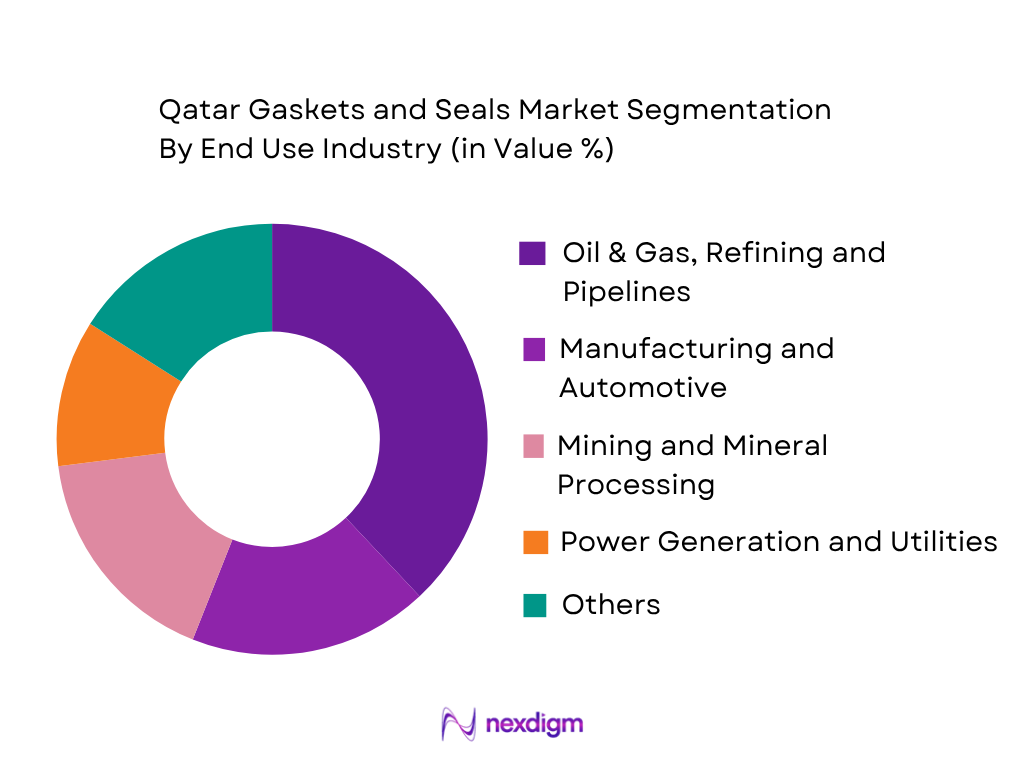
The Qatar Gaskets and Seals Market is segmented into LNG and natural gas processing, offshore oil and gas, refining and petrochemicals, power and desalination, fertilizers and chemicals, and other industrial applications. LNG and natural gas processing dominate the market because Qatar’s industrial economy is centered on the North Field and Ras Laffan processing complex. Existing LNG production capacity is 77 million tonnes per annum, supported by 14 trains, while the North Field East project adds 4 trains of 8 million tonnes per annum each. These facilities use large fleets of centrifugal compressors, cryogenic pumps, valves, heat exchangers and high-pressure piping requiring dry gas seals, cartridge mechanical seals, cryogenic gaskets and flange sealing. QatarEnergy also reported total natural-gas production of 7,492 billion standard cubic feet from operated and non-operated domestic fields in the latest reporting period. This operating intensity gives LNG and gas processing structurally higher sealing demand than other end uses, particularly for critical-service and OEM-qualified products.
Competitive Landscape
The Qatar Gaskets and Seals Market combines multinational mechanical-seal and gasket specialists with locally embedded manufacturers, distributors and repair centres. Competition is concentrated around QatarEnergy-qualified applications, LNG criticality, dry-gas-seal engineering, API-compliant mechanical seals, rapid turnaround capability and local inventory availability. International OEMs have an advantage in compressor and rotating-equipment sealing, while local manufacturers and service companies compete through shorter lead times, emergency stocks, machining capability and proximity to Ras Laffan and Mesaieed industrial customers.
| Company | Establishment Year | Headquarters | Industrial Gaskets | Mechanical/Dry Gas Seals | LNG & Gas Processing Exposure | Local Qatar Service Capability | Critical-Service Engineering | MRO & Turnaround Capability |
| John Crane | 1917 | Chicago, USA | ~ | ~ | ~ | ~ | ~ | ~ |
| EagleBurgmann | 1884 heritage | Wolfratshausen, Germany | ~ | ~ | ~ | ~ | ~ | ~ |
| Flowserve | 1997 | Irving, USA | ~ | ~ | ~ | ~ | ~ | ~ |
| Flexitallic | 1912 | Houston, USA | ~ | ~ | ~ | ~ | ~ | ~ |
| Qatar German Gasket Factory | 2007 | Doha, Qatar | ~ | ~ | ~ | ~ | ~ | ~ |
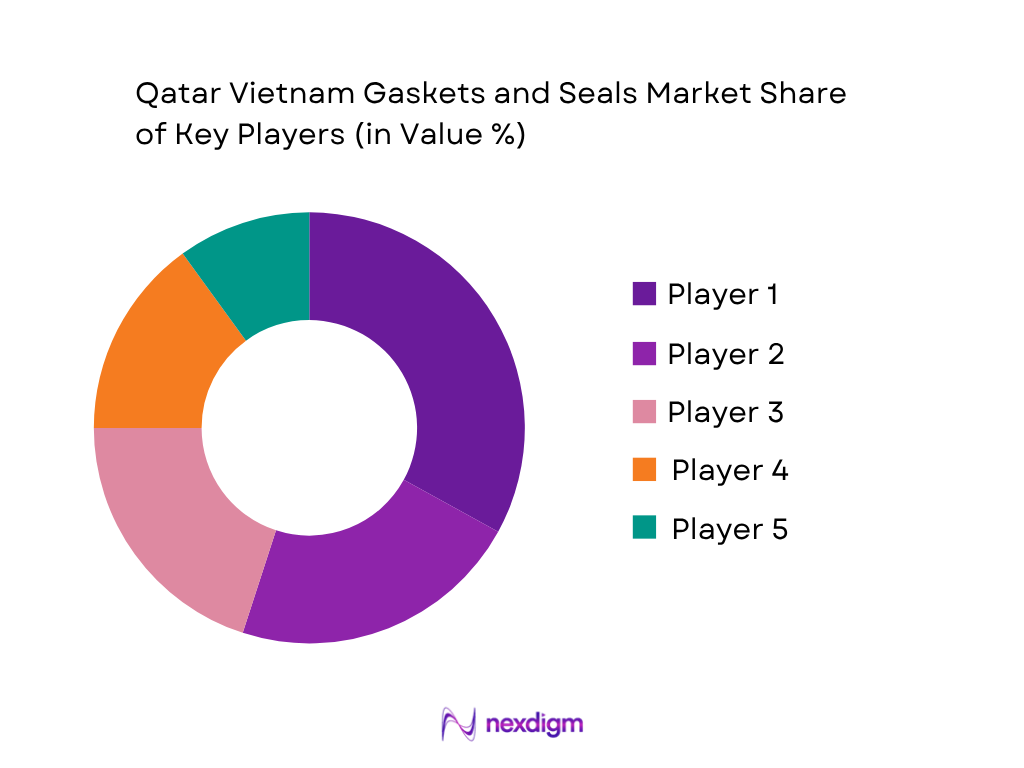
Qatar Gaskets and Seals Market Analysis
Growth Drivers
North Field LNG Expansion and Rising Critical Rotating-Equipment Installed Base
Qatar’s North Field expansion is a major demand driver for industrial gaskets, mechanical seals, dry-gas seals and cryogenic sealing systems because every LNG train adds compressors, pumps, valves, heat exchangers, pressure vessels and extensive high-pressure flanged piping. Qatar’s existing LNG system operates 14 trains with 77 million tonnes per annum of capacity, while North Field East comprises 4 additional trains of 8 million tonnes per annum each, North Field South adds 2 trains of 8 million tonnes each, and North Field West adds another 2 trains of 8 million tonnes each. QatarEnergy also confirmed in 2024 that North Field gas reserves exceed 2,000 trillion cubic feet, providing a substantial feedstock base for sustained LNG infrastructure development. Total natural-gas production from QatarEnergy-operated and non-operated domestic fields reached 7,492 billion standard cubic feet in 2024, while operated-field production reached 367 billion standard cubic feet. These operating volumes directly increase duty cycles for compressor seals, cartridge mechanical seals, cryogenic gaskets and flange systems. Qatar’s 2024 GDP reached USD 219.16 billion, with GDP per capita of USD 76,688.7, supporting continued investment in capital-intensive energy infrastructure and associated sealing reliability requirements.
Petrochemical, Refinery, GTL, Power and Desalination Equipment Maintenance
Qatar’s diversified hydrocarbon-processing and utilities infrastructure creates another substantial driver for gaskets and seals through continuous operation, maintenance shutdowns and replacement of wear-intensive components. QatarEnergy-operated Mesaieed refinery throughput reached 105.14 thousand barrels per day in 2024, while non-operated Laffan refinery throughput reached 248 thousand barrels per day, creating demand for spiral-wound gaskets, RTJ gaskets, graphite sealing, pump mechanical seals and valve packing. Ras Laffan’s new petrochemical complex is designed around a 1.9 million-tonne-per-year ethane cracker and 2 high-density polyethylene derivative units, adding another large population of pumps, compressors and flanged process equipment. Qatar’s utilities system generated 58,493 GWh of electricity in 2024, with maximum electrical demand reaching 10,220 MW. Potable desalinated-water production capacity reached 538 million imperial gallons per day, supported by 42 reservoirs and pumping stations and 2,417 million gallons of water-storage capacity. These assets require frequent mechanical-seal and gasket replacement in pumps, turbines, cooling circuits and desalination trains. Qatar’s 2024 GDP of USD 219.16 billion and GDP per capita of USD 76,688.7 further support intensive industrial maintenance activity.
Market Challenges
Cryogenic, High-Pressure and Sour-Gas Operating Conditions Increase Qualification Complexity
Qatar’s concentration in LNG and high-pressure gas processing creates demanding qualification requirements for gaskets and seals because products must perform reliably across cryogenic temperatures, high rotational speeds, elevated pressures and hydrocarbon-rich operating environments. Existing LNG capacity encompasses 14 trains producing 77 million tonnes per annum, while the expansion program adds 8 new trains of 8 million tonnes per annum each across North Field East, South and West. QatarEnergy reported total domestic natural-gas production of 7,492 billion standard cubic feet in 2024, meaning large volumes move through compressor systems, separators, pipelines and process equipment where a seal failure can interrupt critical production. The technical challenge is particularly significant for dry-gas seals and API-oriented mechanical seals, which must maintain tight tolerances at very high shaft speeds and pressures. Local repair infrastructure reflects this complexity: Qatar-based dry-gas-seal facilities are designed to undertake dynamic testing at approximately 25,000 revolutions per minute and around 300 bar. Suppliers must therefore provide traceable materials, specialist engineering and validated repair capability rather than commodity components. Qatar’s 2024 GDP of USD 219.16 billion and GDP per capita of USD 76,688.7 demonstrate the economic scale of the assets dependent on these highly engineered sealing systems.
Broad Inventory Requirements and Harsh Utility-Service Conditions
Qatar’s gasket and seal suppliers face inventory and service challenges because industrial customers operate equipment across LNG, refining, GTL, petrochemicals, electricity generation and desalination, each requiring different pressure classes, gasket dimensions, elastomers, seal faces and metallurgy. Electricity generation reached 58,493 GWh in 2024, electricity sent to the grid reached 55,116 GWh, and peak system demand reached 10,220 MW, reflecting a large population of turbines, pumps, cooling systems and auxiliary rotating equipment. Water infrastructure adds another severe-duty environment: Qatar produced 675.8 million cubic metres of water in 2024, while desalinated potable-water production capacity reached 538 million imperial gallons per day and the transmission network exceeded 11,000 kilometres. Saline source water, continuous pump operation and high ambient temperatures create demanding conditions for mechanical seals, elastomers and metallic components. Hydrocarbon processing adds further specification diversity, with refinery throughput totaling 353.14 thousand barrels per day across QatarEnergy-operated Mesaieed and non-operated Laffan assets. Maintaining emergency stocks across these different applications creates working-capital and logistics pressure, particularly for imported OEM components. Qatar’s USD 219.16 billion GDP and USD 76,688.7 GDP per capita in 2024 underline the economic importance of maintaining reliable industrial infrastructure despite this sealing complexity.
Market Opportunities
LNG Expansion Creates Scope for Cryogenic Gaskets, Dry-Gas Seals and Local Repair Services
Qatar’s current LNG and gas-processing infrastructure creates a strong platform for future growth in premium gasket and seal categories, particularly dry-gas seals, cartridge mechanical seals, cryogenic valve seals, RTJ gaskets and high-integrity flange products. The country currently operates 14 LNG trains with 77 million tonnes per annum of capacity, while North Field East includes 4 trains of 8 million tonnes each, North Field South includes 2 trains of 8 million tonnes each, and North Field West includes another 2 trains of 8 million tonnes each. The underlying North Field resource exceeds 2,000 trillion cubic feet of confirmed gas, supporting a substantial long-duration operating base for compressors, cryogenic pumps and process piping. QatarEnergy’s 2024 production data also show 7,492 billion standard cubic feet of natural gas from operated and non-operated domestic fields. These current assets create future opportunity not only for original sealing equipment but for refurbishment, failure analysis, dynamic testing and emergency spare inventories as installed equipment ages. Local dry-gas-seal servicing can address machinery operating around 25,000 rpm and 300 bar, improving turnaround responsiveness. Qatar’s 2024 GDP of USD 219.16 billion and GDP per capita of USD 76,688.7 provide the macroeconomic foundation for continued localization of high-value sealing services.
Petrochemical and Water Infrastructure Supports Localized Gasket and Mechanical-Seal Manufacturing
Qatar’s existing petrochemical, refining, desalination and utility assets provide a strong base for future expansion of locally manufactured gaskets, CNC-machined seals, pump-seal refurbishment and flange-integrity services. The Ras Laffan petrochemical development includes an ethane cracker with 1.9 million tonnes per year of ethylene capacity and 2 high-density polyethylene derivative units, creating new requirements for reactor, compressor, pump and heat-exchanger sealing. Refining assets simultaneously processed 353.14 thousand barrels per day in 2024, including 105.14 thousand barrels per day at Mesaieed and 248 thousand barrels per day at Laffan, providing recurring turnaround demand for metallic and semi-metallic gaskets. Water infrastructure is equally important: potable desalination capacity reached 538 million imperial gallons per day, while Qatar operated 42 reservoirs and pumping stations, 2,417 million gallons of storage and more than 11,000 kilometres of water network. Electricity generation totaled 58,493 GWh, expanding the installed pump and turbine maintenance base. These current operating statistics support future opportunities for domestic spiral-wound gasket production, seal-face refurbishment, rapid CNC replacement and local critical-MRO inventories. Qatar’s 2024 GDP of USD 219.16 billion and GDP per capita of USD 76,688.7 reinforce the financial capacity supporting localized industrial reliability services.
Future Outlook
The Qatar Gaskets and Seals Market is projected to expand at approximately ~X.X% CAGR during 2026-2035, supported primarily by Qatar’s North Field development program, LNG capacity expansion, petrochemical investment, compressor installations and increased demand for localized industrial maintenance. Future demand is expected to become more technically specialized as new LNG trains, cryogenic systems and high-pressure gas-processing facilities enter operation. Qatar’s North Field expansion is the largest structural demand catalyst. Existing LNG production capacity is 77 million tonnes per annum, while North Field East adds 32 million tonnes per annum through 4 new trains, and North Field South adds another 16 million tonnes per annum through 2 trains. North Field West has also been designed around another 2 trains of 8 million tonnes per annum each. Every additional train increases requirements for compressor dry-gas seals, cryogenic pump seals, high-performance valve sealing and large volumes of metallic and semi-metallic flange gaskets.
Major Players
- John Crane Qatar
- EagleBurgmann Qatar
- Flowserve / Petrotec Qatar
- AESSEAL Qatar
- A.W. Chesterton
- Flexitallic
- Garlock Sealing Technologies
- KLINGER Group
- Lamons
- Trelleborg Sealing Solutions
- Parker Hannifin
- SKF
- Freudenberg Sealing Technologies
- Seals Center Qatar
- Qatar German Gasket Factory
Key Target Audience
- Industrial Gasket and Engineered Sealing Product Manufacturers
- Mechanical Seal, Dry Gas Seal and Compressor Seal Manufacturers
- LNG, Natural Gas Processing and Offshore Oil and Gas Operators
- Refinery, Petrochemical, GTL and Fertilizer Operators
- Power Generation, Desalination and Industrial Utility Operators
- Investments and Venture Capitalist Firms
- Private Equity Firms and Strategic Industrial Investors
- Government and Regulatory Bodies (QatarEnergy, Ministry of Commerce and Industry, Ministry of Environment and Climate Change, Qatar General Electricity and Water Corporation, Qatar Development Bank, General Authority of Customs)
Research Methodology
Step 1: Identification of Key Variables
The initial phase constructs a complete ecosystem map of the Qatar Gaskets and Seals Market, including gasket manufacturers, mechanical-seal OEMs, dry-gas-seal suppliers, local distributors, repair centres, EPC contractors and industrial end users. Key variables include installed LNG trains, compressor populations, refinery throughput, flange density, pump installed base, replacement cycles, material grades, import reliance, localization, shutdown frequency and critical-service qualification.
Step 2: Market Analysis and Construction
Historical market demand is developed using top-down and bottom-up methodologies. Top-down analysis assesses sealing intensity across LNG, natural gas processing, offshore production, refining, petrochemicals, desalination and power, while bottom-up analysis evaluates supplier revenues, gasket volumes, mechanical-seal replacement, dry-gas-seal servicing, installed equipment and MRO consumption. Domestic manufacturing and trade flows are incorporated to reconcile supply with end-user demand.
Step 3: Hypothesis Validation and Expert Consultation
Initial hypotheses are validated through structured interviews with gasket manufacturers, mechanical-seal engineers, rotating-equipment specialists, LNG maintenance personnel, EPC contractors, MRO companies and industrial procurement teams. These consultations validate product qualification, replacement intervals, dry-gas-seal service requirements, gasket material selection, emergency inventory, shutdown procurement and the relative importance of OEM versus locally manufactured sealing products.
Step 4: Research Synthesis and Final Output
Primary findings are triangulated with QatarEnergy operating data, government publications, company disclosures, equipment-installation information and international standards. Top-down industrial demand is reconciled with bottom-up supplier and application estimates. The final framework determines market value, segmentation, competitive structure, localization potential, critical-service requirements and future demand opportunities across the Qatar Gaskets and Seals Market.

- Executive Summary
- Research Methodology (Market Definition and Scope, Qatar Gaskets and Seals Market Classification, Industrial Gasket Demand Assessment, Mechanical Seal Consumption Mapping, Hydraulic and Pneumatic Seal Demand Assessment, LNG Train Seal Requirement Assessment, Dry Gas Compressor Seal Mapping, Offshore Platform Sealing Assessment, Refinery and Petrochemical Turnaround Demand Assessment, Desalination Plant Pump Seal Mapping, Power Generation Sealing Assessment, Domestic Manufacturing and Machining Capacity Assessment, Import Dependency Analysis, Graphite PTFE Elastomer Metallic and Engineered Polymer Material Assessment, Spiral Wound RTJ Kammprofile and Soft Gasket Mapping, API 682 Mechanical Seal Assessment, Installed Pump Compressor Valve Heat Exchanger and Flange Base Assessment, Replacement and MRO Demand Mapping, Application-Level Demand Assessment, End-Use Industry Demand Mapping, Primary Industry Interviews, Top-Down Market Sizing, Bottom-Up Company Revenue and Sales Volume Assessment, Trade Flow Analysis, Data Triangulation, Pricing Assessment, Forecasting Framework)

- Definition and Scope
- Qatar Gaskets and Seals Industry Evolution
- Qatar Gaskets and Seals Value Chain Analysis
- Qatar Gaskets and Seals Supply Chain Analysis

- Growth Drivers (North Field LNG Expansion, Expansion of Ras Laffan Gas Processing Capacity, New LNG Train Construction, Petrochemical Complex Development, Growth in Cryogenic Pump and Compressor Installed Base, Mechanical Seal Demand from LNG and Gas Processing Equipment, Refinery and GTL Maintenance Demand, Offshore Production Equipment Sealing Requirements, Desalination Pump Seal Replacement, Power Plant Rotating Equipment Maintenance, Industrial Turnaround and Shutdown Activity, Local MRO and Service-Centre Expansion)
- Market Challenges (High Dependence on Imported Specialty Sealing Materials, Long Qualification Cycles for LNG and Critical Energy Applications, Cryogenic Service Requirements, High-Pressure Sour Gas Operating Conditions, Dry Gas Seal Reliability Requirements, Fugitive Emission Compliance, Inventory Complexity Across Pressure Classes and Materials, Emergency Shutdown Lead-Time Requirements, Small Domestic Manufacturing Base, Skilled Mechanical Seal Repair Requirements, Global OEM Dependence, Harsh Heat and Salinity Exposure)
- Market Opportunities (North Field Expansion LNG Gaskets, Cryogenic Valve and Pump Seals, Dry Gas Compressor Seal Services, Low-Emission Refinery Gaskets and Packings, Ras Laffan Petrochemical Sealing Solutions, LNG Train Turnaround Gasket Management, Offshore Compressor Seal Upgrades, Desalination Pump Mechanical Seals, Local Mechanical Seal Refurbishment, Precision CNC Seal Manufacturing, Flange Integrity Services, Hydrogen-Compatible Sealing Materials, Carbon Capture Compressor Seals, Domestic Critical-MRO Inventory, Localized Gasket Manufacturing)
- Market Trends (API 682 Cartridge Seal Adoption, Dry Gas Seal Technology, Cryogenic-Compatible Gaskets, Low-Emission Flange Sealing, High-Purity Flexible Graphite, ePTFE Sealing Materials, Predictive Seal Condition Monitoring, Local Seal Refurbishment, Flange Integrity Management, Seal Support System Optimization, Advanced FKM and HNBR Elastomers, Digital Reliability Monitoring, Local CNC Machining, OEM-Approved Repair Services)
- Regulatory and Standards Landscape (QatarEnergy Technical Specifications, Ras Laffan Industrial City Requirements, Mesaieed Industrial City Requirements, API 682 Mechanical Seal Requirements, API 6A Ring Joint Requirements, ASME B16.20 Metallic Gasket Requirements, ASME B16.21 Non-Metallic Gasket Requirements, ASME PCC-1 Bolted Flange Joint Requirements, ISO Mechanical Seal Requirements, Pressure Equipment Requirements, HSE Requirements, Fugitive Emission Requirements)
- SWOT Analysis
- Porter’s Five Forces Analysis
- PESTLE Analysis
- Stakeholder Ecosystem
- Competition Ecosystem

- By Market Value (2020-2025)
- By Industrial Gasket Consumption Volume (2020-2025)
- By Mechanical Seal Consumption Volume (2020-2025)
- By Dry Gas Compressor Seal Consumption Volume (2020-2025)
- By Hydraulic and Pneumatic Seal Consumption Volume (2020-2025)
- By LNG and Gas Processing Sealing Product Value (2020-2025)

- By Product Category (In Value %)
Industrial Gaskets
Mechanical Seals
Dry Gas Compressor Seals
Hydraulic Seals
Pneumatic Seals
Rotary Shaft and Oil Seals
O-Rings and Backup Rings
Compression and Gland Packings
Seal Support Systems
Custom Machined Sealing Components - By Gasket Type (In Value %)
Spiral Wound Gaskets
Ring Type Joint Gaskets
Kammprofile Gaskets
Metal Jacketed Gaskets
Heat Exchanger Gaskets
Flexible Graphite Gaskets
Compressed Non-Asbestos Fibre Gaskets
Expanded PTFE Gaskets
Rubber and Elastomeric Gaskets
Flange Insulation Gasket Kits
Cryogenic Gaskets
Large-Diameter Custom Gaskets - By Seal Type (In Value %)
Single Mechanical Seals
Dual Mechanical Seals
Cartridge Mechanical Seals
Dry Gas Compressor Seals
Metal Bellows Seals
Split Mechanical Seals - By Material Type (In Value %)
Flexible Graphite
Expanded PTFE and Filled PTFE
Compressed Non-Asbestos Fibre
Stainless Steel
Carbon Steel and Soft Iron
Nickel-Based Corrosion-Resistant Alloys
NBR
HNBR
Polyurethane
Engineered Thermoplastics - By End-Use Industry (In Value %)
LNG Liquefaction and Export
Natural Gas Processing
Offshore Oil and Gas
Petroleum Refining
Petrochemicals and Chemicals
Gas-to-Liquids
Pipelines and Gas Transmission
Fertilizers and Ammonia
Power Generation
Desalination and Water Treatment
Metals and Aluminium
Marine and Port Operations
Construction and Heavy Equipment
General Industrial Manufacturing - By Application Type (In Value %)
LNG Compressors
Process Gas Compressors
Cryogenic Pumps
Hydrocarbon Process Pumps
Pipeline Pumps
Heat Exchangers
Pressure Vessels
Valves
Flanged Pipeline Joints
Reactors
Agitators and Mixers
Boilers and Steam Systems
Desalination Pumps
Cooling Water Pumps

- Market Share of Major Players (By Qatar Revenue, Industrial Gasket Sales Volume, Mechanical Seal Sales Volume, Dry Gas Seal Sales Volume, Product Category, End-Use Industry, Ras Laffan-Mesaieed Customer Exposure, Qatar Service and Repair Footprint)
- Cross Comparison Parameters (Qatar Gaskets and Seals Revenue, Industrial Gasket and Mechanical Seal Portfolio Breadth, LNG Cryogenic High-Pressure and Sour-Gas Sealing Capability, QatarEnergy Ras Laffan Mesaieed and Major EPC Qualification Exposure, Qatar Manufacturing CNC Machining and Seal Refurbishment Capability, LNG Refinery Petrochemical Desalination and Power Customer Exposure, Local Emergency Shutdown Inventory and MRO Service Footprint, Dry Gas Seal Engineering Failure Analysis Flange Integrity and On-Site Technical Support Capability)
- SWOT Analysis of Major Players (Product Breadth, Qatar Footprint, LNG Expertise, Engineering Capability, Customer Qualification, Service Network)
- Detailed Profiles of Major Companies
John Crane Qatar
EagleBurgmann Qatar
Flowserve / Petrotec Qatar
AESSEAL Qatar
A.W. Chesterton
Flexitallic
Garlock Sealing Technologies
KLINGER Group
Lamons
Trelleborg Sealing Solutions
Parker Hannifin
SKF
Freudenberg Sealing Technologies
Seals Center Qatar
Qatar German Gasket Factory

- Desalination Plant Pump Seal Procurement Assessment
- Power Generation Rotating Equipment Seal Requirement Assessment
- Fertilizer and Ammonia Plant Sealing Requirement Analysis
- EPC Contractor Project Gasket and Seal Procurement Assessment
- Turnaround Contractor Gasket and Packing Procurement Assessment
- Rotating Equipment Service Company Seal Replacement Assessment

- By Market Value (2026-2035)
- By Industrial Gasket Consumption Volume (2026-2035)
- By Mechanical Seal Consumption Volume (2026-2035)
- By Dry Gas Compressor Seal Consumption Volume (2026-2035)
- By Hydraulic and Pneumatic Seal Consumption Volume (2026-2035)
- By LNG and Gas Processing Sealing Product Value (2026-2035)


 Request a Sample
 Ask for Customization
 Get a Quote
 Enquire Now