
 Download PDF
Market Overview
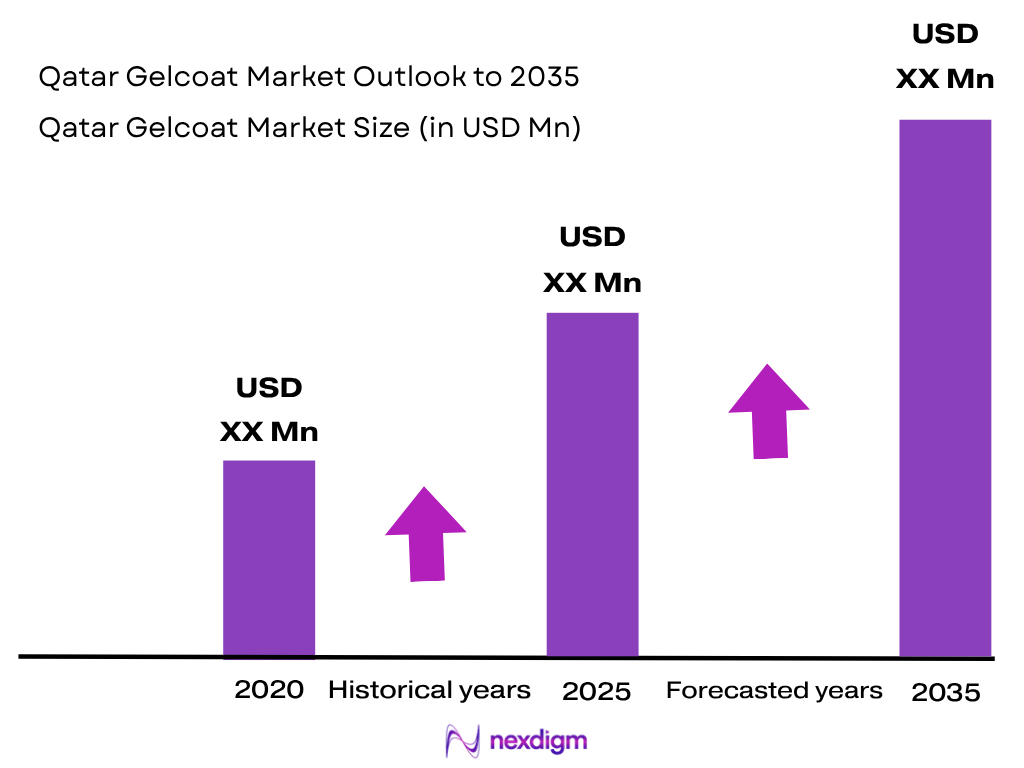
The Qatar Gelcoat Market is valued at approximately USD ~XX million, based on historical market analysis. Demand is supported by water infrastructure, desalination, oil and gas facilities, marine applications and construction-related GRP fabrication. Qatar’s nominal GDP increased from QAR 775.3 billion to QAR 813.6 billion, while non-hydrocarbon GDP expanded from QAR 470.8 billion to QAR 496.6 billion, supporting downstream industrial, infrastructure and composite-material consumption.
Doha, Mesaieed and Ras Laffan represent the most important demand clusters for the Qatar Gelcoat Market because they combine construction, utilities, energy processing, industrial fabrication and marine activity. Qatar’s potable desalinated-water production reached 538 million imperial gallons per day, while the national water network exceeds 11,000 kilometers. Ras Laffan’s LNG and petrochemical concentration and Mesaieed’s industrial manufacturing base further stimulate requirements for corrosion-resistant GRP pipes, tanks, ducts and engineered composite surfaces.
Market Segmentation
By Resin Chemistry
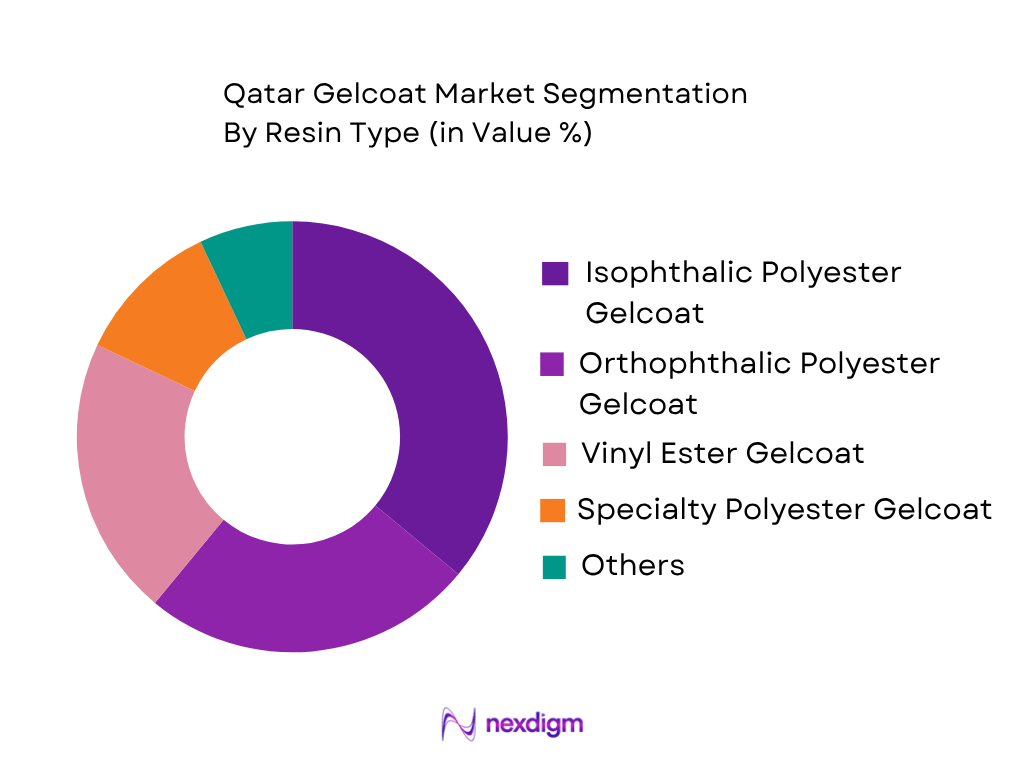
Qatar Gelcoat Market is segmented by resin chemistry into isophthalic/ISO-NPG polyester, orthophthalic polyester, vinyl ester, specialty polyester and low-styrene systems. Isophthalic and ISO-NPG gelcoats maintain the dominant position because Qatar combines intense solar exposure, high ambient temperatures, marine conditions and large-scale water infrastructure, requiring superior hydrolysis resistance, weatherability and surface durability. ISO-NPG systems are particularly suitable for marine craft, exterior architectural composites and GRP water-storage products. Vinyl ester gelcoats occupy an important specialist position because Qatar’s oil, gas, petrochemical and process industries require higher resistance to corrosive chemicals. Orthophthalic products remain relevant for general-purpose fabrication where demanding chemical or weathering performance is less important. Fire-retardant and specialty formulations are increasingly significant for architectural GRP, public infrastructure and industrial installations where performance specifications extend beyond cosmetic surface quality.
By End-Use Industry
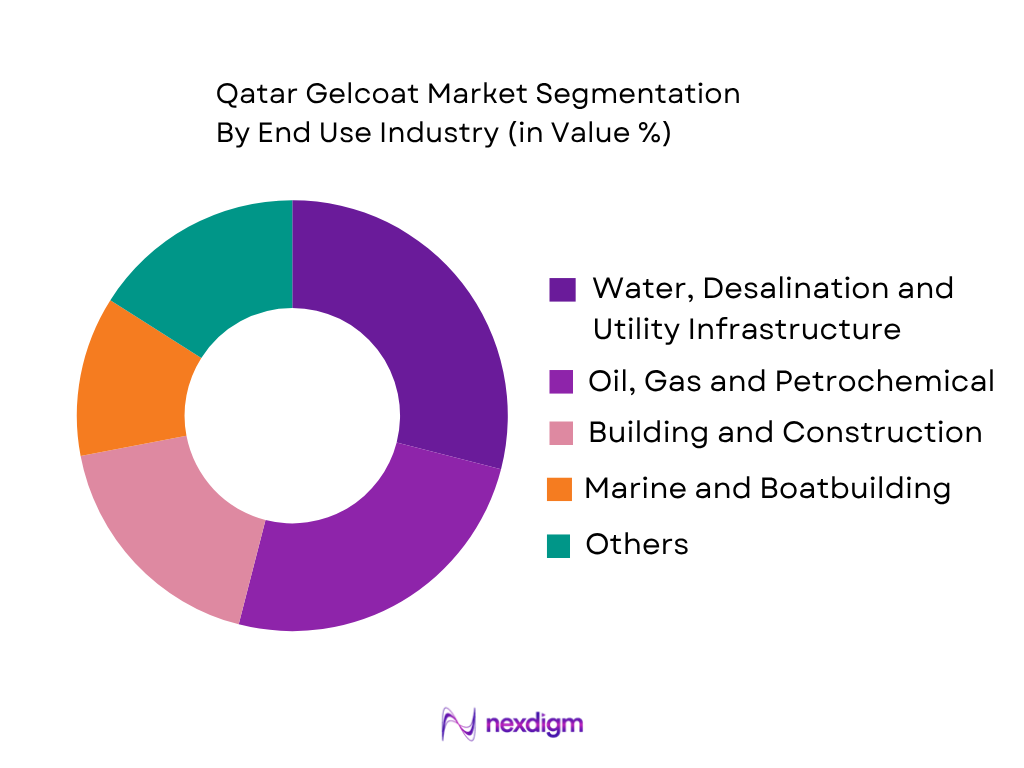
Qatar Gelcoat Market is segmented into water and desalination infrastructure, oil and gas, construction, marine, industrial manufacturing and recreational applications. Water and desalination applications hold the dominant position because Qatar relies extensively on desalinated water and operates a large transmission, storage and distribution network where corrosion-resistant composite products have practical advantages. Gelcoats are used on GRP tanks, associated moulded products and protective surfaces requiring smoothness, hydrolysis resistance and durability. Oil, gas and petrochemical applications form another significant segment because vinyl ester and chemical-resistant polyester systems are suitable for tanks, scrubbers, ducts, process equipment and corrosion barriers. Construction demand derives from architectural GRP panels, cladding, roofing structures, decorative components and utility enclosures. Marine demand includes pleasure craft, workboats, repair applications and high-gloss exterior surfaces, while hospitality-related demand includes swimming pools, water features and sanitary composite products.
Competitive Landscape
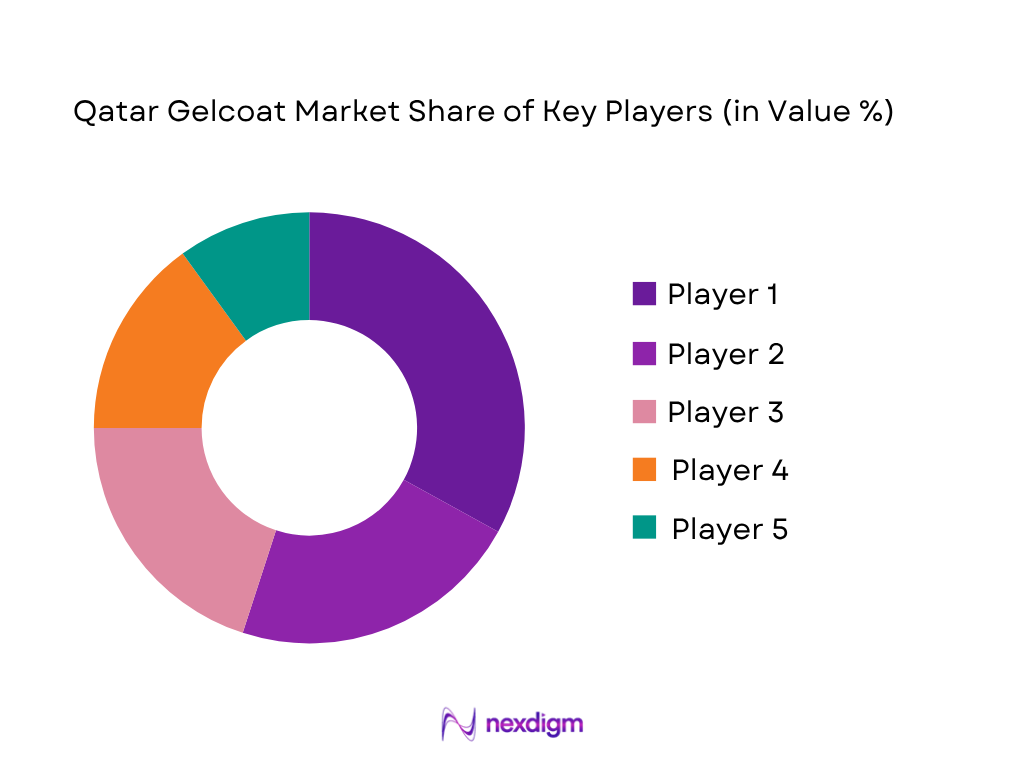
The Qatar Gelcoat Market combines local resin and GRP manufacturing companies with international gelcoat and composite-resin suppliers serving the country through distributors, project contractors and regional Gulf networks. Domestic companies benefit from proximity to water, construction and industrial customers, whereas international manufacturers compete through specialized ISO-NPG, vinyl ester, marine, tooling and fire-retardant formulations. Competition is therefore determined by chemistry breadth, project qualification, technical support, colour customization, chemical resistance and the ability to serve Qatar’s demanding water and hydrocarbon infrastructure applications.
| Company | Establishment Year | Headquarters | Gelcoat / Resin Capability | Key Qatar Applications | Specialty Chemistry | Marine Capability | Industrial FRP Exposure |
| Laffan Resin Production Factory | 2012 | Doha, Qatar | ~ | ~ | ~ | ~ | ~ |
| Gulf Energy Technology & Projects | 2000s | Doha, Qatar | ~ | ~ | ~ | ~ | ~ |
| Polynt Composites | 1950s heritage | Scanzorosciate, Italy | ~ | ~ | ~ | ~ | ~ |
| Scott Bader | 1921 | Wollaston, UK | ~ | ~ | ~ | ~ | ~ |
| AOC | 1994 | Tennessee, USA | ~ | ~ | ~ | ~ | ~ |
Qatar Gelcoat Market Analysis
Growth Drivers
Expansion of Desalination, Water Distribution and Domestic GRP Manufacturing
Expansion of Qatar’s desalination, water-storage and transmission infrastructure is a major structural driver for the Qatar Gelcoat Market because GRP tanks, pipes, covers, housings and corrosion-resistant components require durable surface layers with strong hydrolysis resistance and controlled interaction with stored water. Qatar’s potable desalinated-water production stood at 538 million imperial gallons per day in 2024, while the national water network extended beyond 11,000 kilometres, creating a large installed infrastructure base requiring new composite products as well as maintenance and replacement materials. The scale of this system is particularly relevant to gelcoat because water tanks and related GRP components demand smooth internal surfaces, resistance to continuous moisture exposure and protection of the underlying laminate. Qatar also maintains domestic unsaturated polyester resin and GRP fabrication capabilities, allowing part of the composite value chain to operate locally instead of depending entirely on imported finished components.
LNG, Petrochemical, Marine and Corrosion-Resistant Industrial Composite Activity
Qatar’s large LNG, petrochemical and maritime industrial base creates another significant driver for specialized gelcoats, particularly vinyl ester, chemical-resistant, marine-grade and high-performance polyester systems. Qatar produced 118.7 million tonnes of natural gas in 2024, including 76.5 million tonnes of LNG, while crude-oil production was approximately 580 thousand barrels per day. These volumes support extensive operating infrastructure around Ras Laffan and Mesaieed, including processing facilities, utility systems, storage areas, seawater handling, chemical treatment and auxiliary industrial equipment where FRP and GRE solutions can be selected to address corrosion. QatarEnergy’s North Field expansion involves multiple LNG trains, with existing LNG capacity of 77 million tonnes per annum and expansion projects centered on large-scale additional liquefaction infrastructure. The associated North Field East development includes 4 LNG trains, each designed at 8 million tonnes per annum, while project specifications also include approximately 4,000 tonnes per day of ethane, 260,000 barrels per day of condensate, 11,000 tonnes per day of LPG and around 20 tonnes per day of helium. This industrial concentration creates downstream opportunities for corrosion-resistant FRP tanks, ducts, covers, scrubbers, enclosures and process-support structures requiring protective gelcoat or barrier systems.
Market Challenges
Styrene Management, Imported Specialty Inputs and Application-Skill Requirements
Styrene exposure management and dependence on specialized imported raw materials remain important operating challenges for the Qatar Gelcoat Market. Conventional unsaturated polyester gelcoat formulations commonly rely on styrene as a reactive diluent, meaning fabricators using spray or open-mould processing must maintain disciplined storage, ventilation, catalyst control and worker-protection practices. These requirements become particularly important in Qatar because gelcoat is applied across enclosed workshops, GRP tank plants, marine repair facilities and industrial fabrication sites where high ambient temperatures can affect viscosity, gel time and curing behaviour. Qatar’s industrial activity is substantial enough for these issues to be commercially meaningful: nominal non-hydrocarbon GDP reached QAR 496.6 billion in 2024, while national GDP stood at QAR 813.6 billion, reflecting a sizable construction, manufacturing, logistics and service economy using specialized chemical products. Domestic resin capability reduces dependence on imported base UPR in some applications, but high-performance gelcoat production still requires pigments, UV stabilizers, rheology modifiers, inhibitors, specialty fire retardants, catalysts and performance additives that may originate outside Qatar.
Extreme Heat, UV Exposure, Blistering and Qualification for Water and Fire-Sensitive Applications
Qatar’s operating environment creates unusually demanding durability requirements for gelcoat systems, making heat resistance, UV stability, colour retention, moisture resistance and project qualification significant market challenges. Exterior GRP used in architectural panels, tanks, boats, utility structures and industrial installations experiences sustained solar exposure and elevated surface temperatures, increasing the risk of colour fading, gloss loss, microcracking and premature weathering where unsuitable formulations are used. Water-related applications present another performance challenge because Qatar’s desalinated-water system operates at 538 million imperial gallons per day, supported by a network exceeding 11,000 kilometres. GRP tanks and related components in this infrastructure require surfaces capable of remaining intact during continuous water contact; inadequate formulation or application can contribute to blistering, pinholes, osmotic effects or reduced laminate protection. The scale of Qatar’s building activity similarly increases the importance of qualification. Official data recorded 747 building permits in March 2024, with Doha accounting for 179 permits, Al Rayyan 210 permits, Al Wakrah 120 permits, and Al Daayen 111 permits. May data included 232 new villa permits, 28 apartment-building permits and 28 industrial workshop or factory permits. Architectural FRP used across these developments may require UV resistance, colour consistency and, in public or commercial projects, fire-performance characteristics that general-purpose gelcoats cannot automatically provide. Energy applications raise the technical threshold further.
Market Opportunities
ISO-NPG Marine, High-UV and Localized Specialty Gelcoat Development
Qatar offers a strong future opportunity for ISO-NPG, UV-resistant, low-styrene and locally customized gelcoat systems as the country develops higher-value marine services and expands the installed base of outdoor composite products. The clearest current indicator is the QAR 80 million Milaha yacht and shipyard project announced in 2024 at Marsa Port. The facility covers 22,000 square metres, incorporates 2 covered sheds and 3 workshops, and is intended for luxury yachts, naval vessels and traditional wooden boats requiring maintenance, refits, exterior upgrades, modifications and repair. Marsa Port itself has a 7.5-metre draught, while its synchro lift can accommodate vessels longer than 70 metres and weighing more than 2,200 tonnes; a separate travel lift can handle craft up to 30 metres long and 300 tonnes. This creates a technically attractive platform for future demand for marine-grade gelcoat because repair and refit work requires colour-matched surface materials, barrier coats, localized patch systems, high-gloss finishes and products that resist seawater, hydrolysis and intensive sunlight.
Vinyl Ester, Potable-Water, Desalination and LNG-Related Specialty Gelcoat Applications
Future development of the Qatar Gelcoat Market can also be driven by vinyl ester, potable-water-compatible, fire-retardant and high-chemical-resistance surface systems serving desalination, LNG, petrochemical and industrial infrastructure. Current operating indicators demonstrate the scale of this addressable environment. Qatar’s desalinated-water production stood at 538 million imperial gallons per day in 2024, while the water network extended for more than 11,000 kilometres. These assets require extensive storage, transmission and auxiliary infrastructure in a country where corrosion management is critical, supporting future use of GRP tanks, pipes, covers, housings and other components protected with suitable surface systems. Energy infrastructure provides another major application platform. Qatar produced 118.7 million tonnes of natural gas in 2024, of which 76.5 million tonnes was LNG.
Future Outlook
The Qatar Gelcoat Market is expected to expand at approximately ~XX.X% CAGR during 2026–2035, supported by continued investment in water security, energy infrastructure, industrial diversification and specialty composite fabrication. Demand is expected to shift progressively toward ISO-NPG, vinyl ester, fire-retardant and low-styrene products designed for Qatar’s demanding operating conditions. Water and desalination applications should remain structurally important because GRP components provide resistance to corrosion, moisture and chemical attack while reducing maintenance requirements compared with some traditional materials. Qatar’s continued emphasis on water security strengthens the addressable market for surface-protection systems used in tanks and related composite equipment.
Major Players
- Laffan Resin Production Factory
- Gulf Energy Technology & Projects
- Gulf Glass Fibre W.L.L.
- Amiantit Qatar Pipes Company
- RIGID Fiberglass
- Khalid Plastic Industries Complex
- Falcon Fibre Glass
- Almalitha Fiberglass
- NovaTec Qatar
- Doha Cladding Solutions Factory
- Polynt Composites
- Scott Bader
- AOC
- BÜFA Composite Systems
- Swancor
Key Target Audience
- Gelcoat and Unsaturated Polyester Resin Manufacturers
- GRP and GRE Pipe, Tank and Industrial Composite Manufacturers
- Water and Desalination Infrastructure Developers
- Oil, Gas, LNG and Petrochemical Operators
- Marine Fabricators, Shipyards and Boat Repair Operators
- Construction, Architectural GRP and Infrastructure Contractors
- Investments and Venture Capitalist Firms
- Government and Regulatory Bodies (Ministry of Commerce and Industry; Ministry of Environment and Climate Change; Qatar General Electricity & Water Corporation – KAHRAMAA; Qatar Civil Defence; Ministry of Public Health; QatarEnergy)
Research Methodology
Step 1: Identification of Key Variables
The initial phase involves constructing an ecosystem map covering Qatar’s resin producers, gelcoat suppliers, composite distributors, GRP fabricators, water infrastructure operators, marine companies and industrial end users. Extensive secondary research identifies critical variables such as gelcoat chemistry, domestic production, imports, downstream FRP activity, project specifications, application mix and regional demand concentration.
Step 2: Market Analysis and Construction
Historical Qatar Gelcoat Market demand is assessed through domestic resin manufacturing, trade flows, downstream GRP production and consumption across water, energy, construction and marine applications. A bottom-up model evaluates demand generated by tanks, pipes, marine craft, architectural products and industrial equipment, while a top-down approach reconciles these findings against macroeconomic and sector-level indicators.
Step 3: Hypothesis Validation and Expert Consultation
Market hypotheses are validated through computer-assisted telephone interviews with resin producers, gelcoat suppliers, composite distributors, FRP fabricators, EPC contractors and industrial users. Consultations examine resin chemistry preferences, project qualification requirements, procurement structures, application processes, distribution practices and customer expectations regarding UV resistance, chemical resistance, colour consistency and technical service.
Step 4: Research Synthesis and Final Output
Primary findings are triangulated with government statistics, company disclosures, industrial project information, international trade indicators and downstream infrastructure activity. Supplier-level findings are reconciled with application-level consumption through top-down and bottom-up methodologies. The resulting analysis establishes segmentation, competitive positioning, market drivers, constraints and long-term opportunities within the Qatar Gelcoat Market.

- Executive Summary
- Research Methodology (Market Definition and Scope, Gelcoat Product Classification, Orthophthalic-Isophthalic-ISO-NPG-Vinyl Ester Demand Mapping, Domestic UPR Production Assessment, Gelcoat Consumption Mapping, Import-Export Analysis, Resin and Styrene Feedstock Assessment, Composite Raw Material Distribution Mapping, Marine and Industrial FRP Demand Assessment, Water Infrastructure Demand Mapping, Primary Industry Interviews, Top-Down Market Sizing, Bottom-Up Company Revenue and Volume Assessment, End-Use Consumption Reconciliation, Data Triangulation, Pricing Assessment, Forecasting Framework)

- Definition and Scope
- Qatar Gelcoat Value Chain Analysis
- Qatar Gelcoat Supply Chain Analysis
- Doha Industrial Area Composite Manufacturing and Distribution Cluster Assessment
- Ras Laffan and Mesaieed Industrial Application Demand Assessment
- Domestic Gelcoat Production Versus Imported Specialty Gelcoat Supply Structure

- Growth Drivers (Domestic UPR Manufacturing Capability, Expansion of Desalination and Water Distribution Infrastructure, GRP Tank Demand, Oil and Gas Corrosion-Resistant Composite Applications, LNG Infrastructure, Marine Fabrication and Repair, Construction and Architectural FRP Demand, Chemical Storage Requirements, Utility Infrastructure Expansion, Preference for Low-Maintenance Corrosion-Resistant Materials)
- Market Challenges (Styrene Exposure Management, Imported Specialty Pigment and Additive Dependency, Petrochemical Feedstock Volatility, Extreme Heat and UV Exposure, Colour Fading Risk, Gelcoat Cracking and Blistering, Skilled Spray Application Requirements, Fire Performance Compliance, Potable-Water Qualification Requirements, Imported Premium Gelcoat Competition)
- Market Opportunities (ISO-NPG Marine Gelcoat Expansion, Vinyl Ester Chemical-Resistant Systems, Potable-Water Compatible Gelcoats, Fire-Retardant Architectural Gelcoats, Low-Styrene Formulations, High-UV Desert-Climate Gelcoats, LNG and Petrochemical FRP Applications, Desalination Infrastructure Applications, Domestic Specialty Gelcoat Localization, Custom Pigmentation, Tooling Gelcoat Development, Marine Repair and Re-Gelcoating)
- Market Trends (Domestic Resin Localization, Higher ISO-NPG Adoption, Increased Vinyl Ester Use in Corrosive Service, High-UV Formulations, Potable-Water Compatible Surface Systems, Low-Styrene Technology, Fire-Retardant Composite Surfaces, Custom Pigmentation, High-Gloss Marine Finishes, Chemical-Resistant Barrier Layers, Project-Specific Gelcoat Formulation)
- Regulatory and Standards Landscape (Qatar Ministry of Environment and Climate Change Requirements, Ministry of Public Health Potable-Water Requirements, Qatar Civil Defence Fire-Safety Requirements, QatarEnergy Project Specifications, KAHRAMAA Water Infrastructure Requirements, Safety Data Sheet Compliance, Chemical Storage and Handling Requirements, International GRP-GRE Performance Standards)
- SWOT Analysis
- Porter’s Five Forces Analysis
- PESTLE Analysis

- By Market Value (2020-2025)
- By Gelcoat Consumption Volume (2020-2025)
- By Gelcoat Import Value (2020-2025)
- By Gelcoat Import Volume (2020-2025)
- By Gelcoat Export Value (2020-2025)

- By Resin Chemistry (In Value %)
Orthophthalic Polyester Gelcoat
Isophthalic Polyester Gelcoat
ISO-NPG Gelcoat
Vinyl Ester Gelcoat
DCPD-Modified Polyester Gelcoat
Low-Styrene Gelcoat
Styrene-Reduced Gelcoat
Specialty Hybrid Gelcoat - By Product Function (In Value %)
General Purpose Gelcoat
Marine Grade Gelcoat
Chemical-Resistant Gelcoat
Tooling Gelcoat
Fire-Retardant Gelcoat
UV- and Weather-Resistant Gelcoat
Potable-Water Application Gelcoat
High-Temperature Gelcoat - By Application Method (In Value %)
Brush-Applied Gelcoat
Roller-Applied Gelcoat
Conventional Spray Gelcoat
Air-Assisted Spray Gelcoat
Airless Spray Gelcoat
Automated Spray Gelcoat
Mould-Applied Gelcoat
Repair and Refinish Gelcoat - By End-Use Application (In Value %)
GRP Potable Water Tanks
GRP Sectional Water Tanks
Chemical Storage Tanks
Septic Tanks
FRP and GRP Pipes
GRE Piping Systems
Marine Boats and Vessel Components
Architectural Panels and Cladding
GRP Roofing and Canopies
Ducting and Scrubbers
Electrical and Utility Enclosures
Swimming Pools and Water Features - By End-Use Industry (In Value %)
Water and Desalination Infrastructure
Oil and Gas
LNG and Petrochemical
Marine and Boatbuilding
Building and Construction

- Market Share of Major Players (By Qatar Revenue, Gelcoat Sales Volume, Resin Chemistry, Water Infrastructure Exposure, Oil and Gas Exposure, Marine Exposure, Construction Exposure and Distribution Coverage)
- Cross Comparison Parameters (Qatar Gelcoat Revenue, Domestic Gelcoat and UPR Manufacturing Capability, Orthophthalic-Isophthalic-ISO-NPG-Vinyl Ester Portfolio Breadth, Water-Oil & Gas-Marine-Construction Application Coverage, High-UV and Fire-Retardant Formulation Capability, Custom Pigmentation and Colour-Matching Capability, Qatar Manufacturing and Distribution Footprint, Application Laboratory and FRP Technical-Service Capability)
- SWOT Analysis of Major Players
- Detailed Profiles of Major Companies
Laffan Resin Production Factory – Domestic Unsaturated Polyester Resin, Orthophthalic and Isophthalic Gelcoat, DCPD Resin and Local Composite Raw Material Manufacturing
Gulf Energy Technology & Projects – ISO Resin, General Purpose Resin, Fire-Retardant Resin, Industrial and Marine Gelcoats, Tooling Gelcoat, Pigments and Composite Raw Materials
Gulf Glass Fibre W.L.L. – Locally Manufactured GRP Water Tanks, Chemical Tanks, Platforms and Industrial Fiberglass Products
Amiantit Qatar Pipes Company – GRP, GRV and GRE Pipes, Composite Tanks, Industrial Vessels and Engineered Water-Energy Composite Systems
RIGID Fiberglass – GRP and FRP Tanks, Pipes, Enclosures, Gratings, Cable Trays and Custom Industrial Composite Solutions
Khalid Plastic Industries Complex – GRP Water Tanks, Chemical Tanks, Septic Tanks, Manhole Liners, Utility Products and Industrial Fiberglass Fabrication
Falcon Fibre Glass – GRP Tanks, Cladding Panels, Ducting, Roofing, Enclosures, Cable Trays and Custom FRP Components
Almalitha Fiberglass – Chemical Tanks, Heavy-Duty Piping, Corrosion-Resistant Systems and Industrial GRP Infrastructure Solutions
NovaTec Qatar – GRP Sectional Tanks, Water and Septic Tanks, Roof Curbs, Doors, Gratings, Handrails and Construction Composite Products
Doha Cladding Solutions Factory – GFRP Architectural Cladding, Panels and Custom Construction Composite Components
Polynt Composites – Polyester and Vinyl Ester Resins, Marine and Industrial Gelcoats, Tooling Systems and Chemical-Resistant Composite Technologies
Scott Bader – Crystic Polyester and Vinyl Ester Resins, Marine Gelcoats, Tooling Gelcoats, Fire-Retardant and Chemical-Resistant Composite Systems
AOC – Polyester and Vinyl Ester Resin Systems, ISO-NPG Gelcoats, Marine Surface Technologies, Infrastructure and Corrosion-Resistant Applications
BÜFA Composite Systems – Gelcoats, Topcoats, Pigment Pastes, Tooling Materials, Fire-Retardant Systems and Marine-Industrial Surface Technologies
Swancor – Epoxy Vinyl Ester Resins, High-Performance Corrosion-Resistant Composite Systems, Industrial Chemical and Energy Applications

- GRP Water Tank Manufacturer Procurement Assessment
- FRP-GRE Pipe Manufacturer Assessment
- Oil and Gas FRP Fabricator Assessment
- Marine Fabricator Assessment
- Architectural FRP Fabricator Assessment
- Composite Distributor Procurement Assessment

- By Market Value (2026-2035)
- By Gelcoat Consumption Volume (2026-2035)
- By Gelcoat Import Value (2026-2035)
- By Gelcoat Import Volume (2026-2035)
- By Gelcoat Export Value (2026-2035)


 Request a Sample
 Ask for Customization
 Get a Quote
 Enquire Now