
 Download PDF
Market Overview
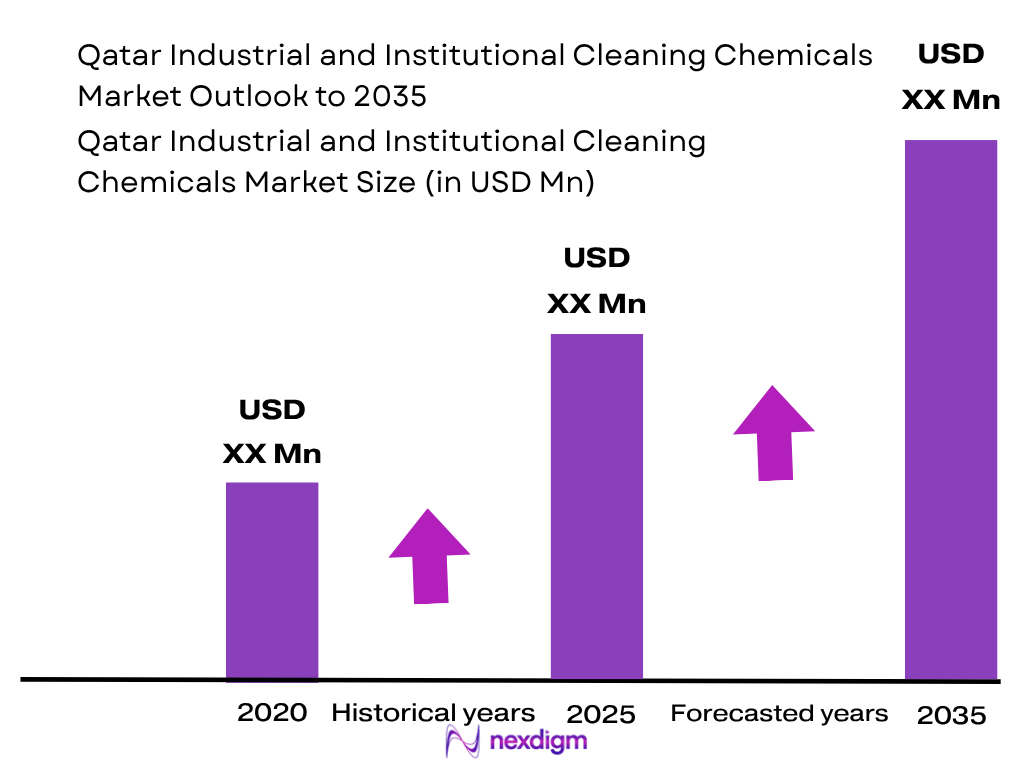
The Qatar Industrial and Institutional Cleaning Chemicals Market is valued at approximately USD ~ million, supported by recurring sanitation requirements across hospitality, healthcare, foodservice, aviation, commercial facilities and energy installations. Qatar’s economy generated USD 219.16 billion in GDP, with GDP per capita reaching USD 76,688.7. The country accommodated 5 million international visitors, compared with roughly 4 million visitors in the preceding period, expanding cleaning intensity across hotels, restaurants, airports and public facilities.
Doha, Lusail, Ras Laffan and Mesaieed form the principal demand centres for Qatar’s industrial and institutional cleaning chemicals. Doha dominates institutional consumption because it concentrates hotels, hospitals, restaurants, offices and government facilities, while Lusail adds premium hospitality and commercial assets. Ras Laffan and Mesaieed are strategically important for industrial cleaning because of their energy and petrochemical infrastructure. Qatar’s hospitality inventory exceeded 40,000 hotel keys, while nearly 10 million room nights were sold, reinforcing cleaning-chemical consumption around Doha and adjoining hospitality districts.
Market Segmentation
By Product Type
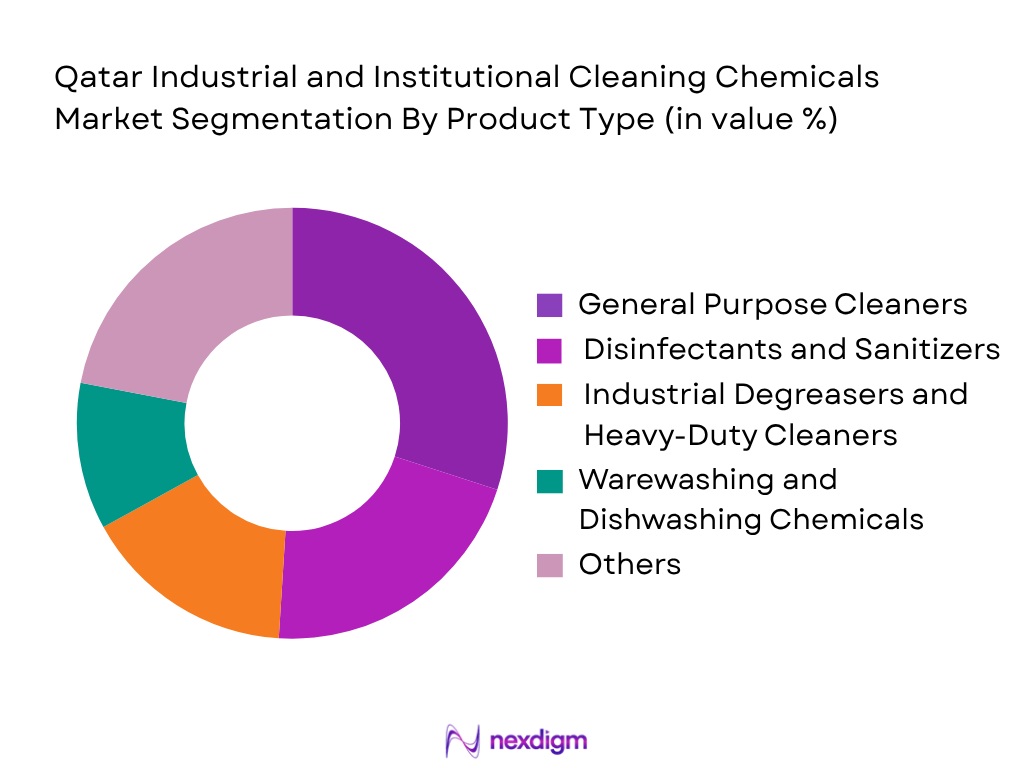
The Qatar Industrial and Institutional Cleaning Chemicals Market is segmented by product type into general-purpose cleaners, disinfectants and sanitizers, industrial degreasers and heavy-duty cleaners, warewashing chemicals, laundry chemicals, floor-care products and specialty cleaning chemicals. General-purpose cleaners hold the dominant position because of their high-frequency application across hotels, shopping centres, offices, airports, restaurants, healthcare facilities and other professionally managed properties. Qatar’s hospitality industry alone recorded nearly 10 million room nights sold, creating continuous housekeeping requirements across guest rooms, corridors, washrooms and common areas. The country also welcomed 5 million international visitors, increasing utilization of restaurants, transport facilities and commercial venues. Disinfectants and sanitizers maintain a strategically important position because healthcare and foodservice establishments require microbial control in addition to conventional soil removal. Industrial degreasers are comparatively specialized but benefit from Qatar’s substantial oil, gas, petrochemical, transportation and industrial infrastructure, where equipment and maintenance cleaning requires higher-performance chemical formulations.
By End-Use Industry
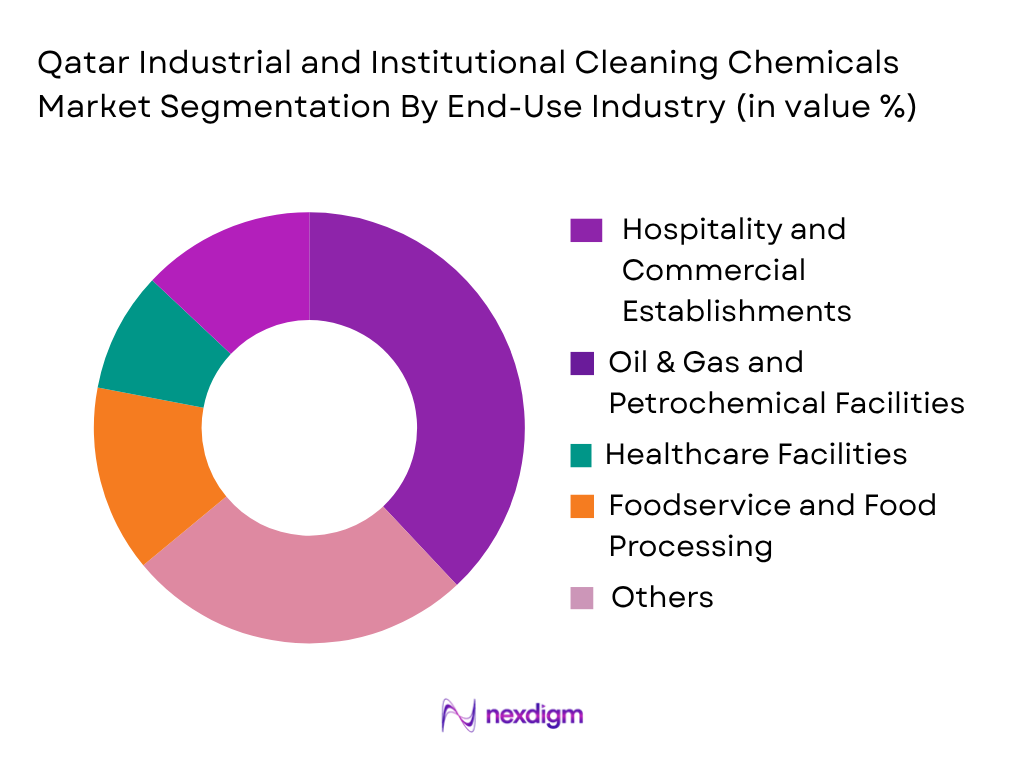
The Qatar Industrial and Institutional Cleaning Chemicals Market is segmented by end-use industry into hospitality and commercial establishments, oil and gas and petrochemical facilities, healthcare facilities, foodservice and food processing, transportation and aviation, and government and institutional facilities. Hospitality and commercial establishments represent the dominant demand segment, supported by Qatar’s extensive hotel infrastructure and international visitor economy. The country recorded 5 million international visitors and nearly 10 million hotel room nights, while hospitality capacity exceeded 40,000 hotel keys. Hotels consume housekeeping chemicals, laundry detergents, disinfectants, floor cleaners, glass cleaners, washroom chemicals and commercial kitchen products every day, making chemical consumption highly repetitive. Doha and Lusail contain particularly dense concentrations of upscale hotels, commercial properties and entertainment facilities. Oil and gas facilities constitute another strategically important segment because Qatar’s hydrocarbon infrastructure requires heavy-duty degreasing, process-equipment cleaning and specialty industrial chemicals. Healthcare facilities generate recurring requirements for surface disinfectants and institutional sanitation products because infection prevention requires standardized environmental cleaning protocols.
Competitive Landscape
The Qatar Industrial and Institutional Cleaning Chemicals Market combines international professional-hygiene brands with domestic manufacturers, distributors and specialist chemical suppliers. Global companies compete primarily through integrated hygiene programs, dispensing equipment and specialized formulations, while local participants benefit from domestic availability, shorter supply chains, institutional relationships and customized product offerings. Competition is particularly strong in hospitality, foodservice, facility management and industrial cleaning, where buyers increasingly evaluate chemical performance alongside dosing technology, technical support, regulatory compliance and supply reliability.
| Major Player | Establishment Year | Headquarters | Product Portfolio | Qatar Presence | Key End-Use Coverage | Local Manufacturing/Blending | Dispensing Capability | Technical Support |
| Ecolab | 1923 | St. Paul, USA | ~ | ~ | ~ | ~ | ~ | ~ |
| Diversey / Solenis | 1923 / 1907 | USA | ~ | ~ | ~ | ~ | ~ | ~ |
| Betco Middle East | 1950 | USA / Regional Operations | ~ | ~ | ~ | ~ | ~ | ~ |
| Hi-Care Detergents & Disinfectant Factory | — | Qatar | ~ | ~ | ~ | ~ | ~ | ~ |
| Intercare Hygiene | 1969 | UAE | ~ | ~ | ~ | ~ | ~ | ~ |
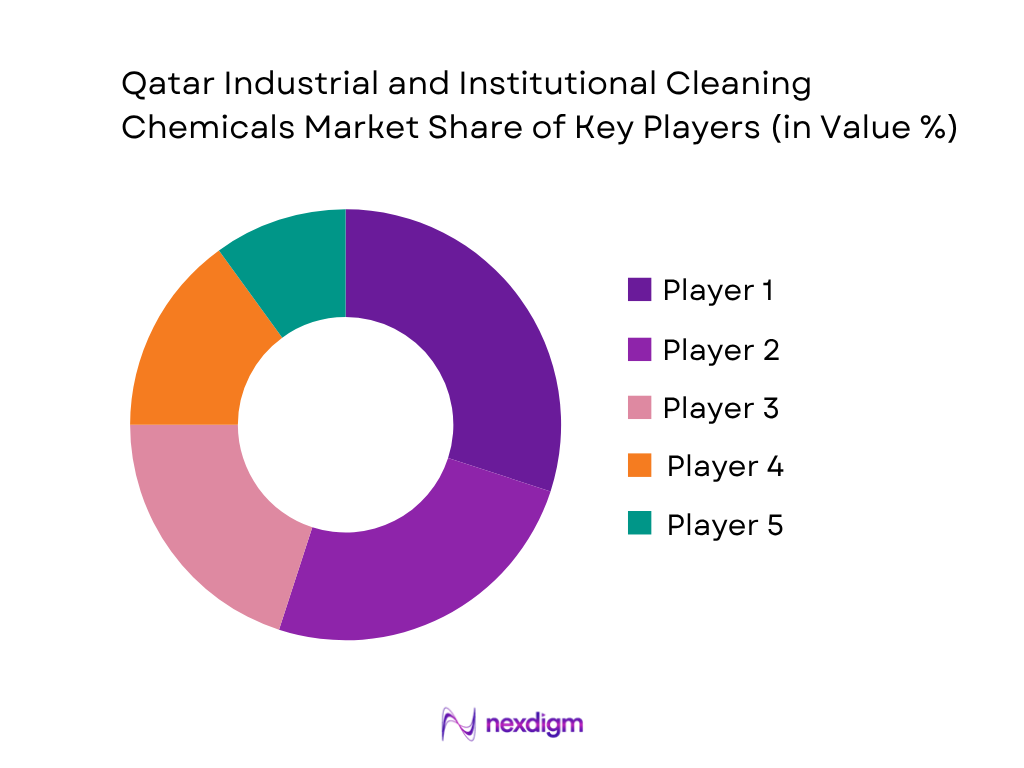
Qatar Industrial and Institutional Cleaning Chemicals Market Analysis
Growth Drivers
Expanding Hospitality and Tourism Sector Driving Institutional Cleaning Chemical Demand
Qatar’s expanding hospitality and tourism ecosystem is generating recurring demand for institutional detergents, disinfectants, warewashing chemicals, laundry formulations, floor cleaners and washroom sanitation products. The country welcomed more than 5 million international visitors in 2024, while hotels recorded nearly 10 million room nights sold and the hospitality inventory exceeded 40,000 hotel keys. Tourism activity also generated approximately QAR 55 billion in economic contribution, while visitor in-destination spending approached QAR 40 billion. These figures are directly relevant to cleaning chemicals because hotels, restaurants, convention venues and commercial kitchens require repeated cleaning across guest rooms, laundries, food-contact areas, public spaces and washrooms. Qatar’s wider macroeconomic base supports this institutional demand, with GDP reaching USD 219.16 billion in 2024, GDP per capita standing at USD 76,688.7, and the national population reaching 2,857,822. The hospitality platform remained substantial in 2025, when 10.8 million room nights were sold, reinforcing sustained utilization of professional cleaning and hygiene systems across the country.
Growing Energy and Petrochemical Operations Supporting Industrial Cleaning Chemical Demand
Qatar’s energy and petrochemical infrastructure creates substantial requirements for heavy-duty degreasers, descalers, process cleaners, tank-cleaning chemicals, heat-exchanger cleaning solutions and corrosion-control formulations. QatarEnergy maintained uninterrupted LNG production in 2024 while advancing North Field expansion projects that are designed to raise domestic LNG production capacity to 142 million tonnes per annum. The company also entered ownership and long-term charter arrangements covering 128 LNG carriers, creating a broader operating ecosystem spanning liquefaction plants, terminals, storage facilities, marine assets and maintenance infrastructure. In addition, Qatar awarded approximately USD 6 billion in engineering, procurement and construction contracts related to the Al-Shaheen field development, which is designed to add approximately 100,000 barrels per day of production capacity. These industrial assets require frequent removal of hydrocarbons, scale, residues and process contaminants from pipelines, vessels, machinery and utilities. The underlying economy provides substantial capacity to support these operations, with Qatar recording USD 219.16 billion in GDP and a population of 2,857,822 in 2024, reinforcing industrial-service demand around Ras Laffan, Mesaieed and other energy clusters.
Market Challenges
High Dependence on Imported Cleaning Preparations and Functional Ingredients Creates Supply-Chain Exposure
Qatar’s professional cleaning-chemical sector remains highly exposed to imported finished formulations and specialty raw materials, creating supply continuity risks for institutional and industrial users. The country imported exactly 35,956,800 kilograms of retail-packed washing and cleaning preparations in 2024, alongside another 13,004,200 kilograms of washing and cleaning preparations not packed for retail sale. Imports of anionic surface-active agents reached 3,255,990 kilograms, while non-ionic surface-active agent imports reached 745,873 kilograms. Major supply sources included Saudi Arabia, the United Arab Emirates, Lebanon, Turkey, China, India, the United Kingdom and the United States, highlighting the number of international supply corridors required to maintain Qatar’s formulation and finished-product availability. This dependence is especially important for industrial and institutional applications because product substitution can be difficult when cleaners are specified for microbial efficacy, food-contact sanitation, foam characteristics, corrosion control or process compatibility. Qatar’s GDP stood at USD 219.16 billion and its population at 2,857,822 in 2024, meaning a relatively small domestic population supports a disproportionately large industrial and institutional economy that depends heavily on internationally sourced chemical products and inputs.
Regulatory, Environmental and Technical Requirements Raise Barriers for Professional Chemical Suppliers
Industrial and institutional cleaning-chemical suppliers in Qatar must meet increasingly demanding requirements related to hazardous-chemical handling, chemical storage, environmental management, documentation and end-use suitability. The operating environment is especially complex because Qatar combines hospitality and healthcare applications with petrochemical, LNG and oilfield facilities that require different safety and technical specifications. QatarEnergy’s LNG expansion program involves production capacity moving toward 142 million tonnes per annum, while the company’s LNG fleet program covers 128 carriers, illustrating the scale of facilities where chemical handling, industrial maintenance and environmental controls are commercially important. At the institutional end, Qatar’s hospitality infrastructure exceeds 40,000 hotel keys and handled nearly 10 million room nights in 2024, creating parallel requirements for food-safe chemicals, disinfectants and controlled cleaning procedures. Qatar also maintained a GDP of USD 219.16 billion and GDP per capita of USD 76,688.7, indicating sophisticated institutional buyers capable of demanding stronger documentation and technical support. Suppliers therefore need more than basic product availability; they require application expertise, safety documentation, compatible dispensing systems and sector-specific technical service capabilities.
Market Opportunities
Localization and Import Substitution Offer Scope for Domestic Formulation and Blending Expansion
Qatar’s substantial dependence on imported professional cleaning products creates a clear future opportunity for local manufacturing, blending, contract formulation and private-label production. In 2024, imports of retail-packed washing and cleaning preparations reached 35,956,800 kilograms, while non-retail cleaning preparations added another 13,004,200 kilograms. The raw-material opportunity is also visible in imports of 3,255,990 kilograms of anionic surfactants and 745,873 kilograms of non-ionic surfactants, indicating an existing stream of functional ingredients capable of supporting domestic formulation activity. Qatar’s population of 2,857,822 sits alongside a much larger economic base of USD 219.16 billion GDP, creating concentrated demand from hotels, hospitals, foodservice establishments, airports, commercial buildings and industrial facilities. Local production could therefore focus on high-volume categories such as general-purpose cleaners, degreasers, institutional detergents, floor cleaners and disinfectant formulations while reserving imported specialty chemistry for technically demanding applications. The presence of Ras Laffan, Mesaieed and Doha Industrial Area also provides industrial clustering that can support blending, warehousing and distribution. This creates room for suppliers to shorten lead times and strengthen supply security.
Hospitality, Healthcare and Professional Facility Management Create Scope for Advanced Dosing and Hygiene Systems
Qatar’s existing institutional base provides substantial room for suppliers to expand beyond conventional chemicals into concentrated products, automated dispensing, closed-loop systems and standardized hygiene programs. The country recorded more than 5 million international visitors in 2024, approximately 10 million hotel room nights, and over 40,000 hotel keys, creating large numbers of repetitive cleaning cycles across guest rooms, commercial kitchens, laundries and public spaces. Qatar’s tourism activity also generated approximately QAR 55 billion in economic contribution, while in-destination visitor spending approached QAR 40 billion, demonstrating the operating scale of hospitality and related service establishments. The country maintained 2,857,822 residents and GDP per capita of USD 76,688.7, supporting premium healthcare, commercial property and institutional service environments. The opportunity is therefore not limited to supplying additional litres of chemicals. Suppliers can expand into dilution-control equipment, concentrated detergent cartridges, commercial laundry dosing, warewashing dispensers, antimicrobial surface programs and operator training. These solutions are particularly suited to hotel groups, hospitals and facility-management companies seeking consistent cleaning performance across multiple properties and standardized operating procedures.
Future Outlook
The Qatar Industrial and Institutional Cleaning Chemicals Market is projected to expand at approximately ~X.X% CAGR during 2026-2035, supported by tourism development, LNG and industrial activity, healthcare modernization and the expansion of professionally managed commercial properties. Demand is expected to shift progressively from conventional cleaning products toward concentrated formulations, automated dispensing systems, application-specific chemicals and integrated hygiene programs.
Hospitality will remain central to institutional demand as Qatar builds on an established base exceeding 40,000 hotel keys and nearly 10 million annual room nights sold. Hotels and resorts create recurring consumption across housekeeping, commercial laundry, warewashing, kitchens, washrooms, floors and public areas. Increasing utilization of these properties provides suppliers with opportunities to expand controlled-dilution systems and standardized multi-property hygiene programs.
Major Players
- Ecolab Qatar
- Diversey / Solenis Qatar
- Betco Middle East
- Hi-Care Detergents & Disinfectant Factory
- Intercare Hygiene
- Excel Trading
- Unichem Limited WLL
- RASTEC Chemical Division
- FITCO Detergents Factory
- ELife Detergent Factory
- NADHIF Detergent
- Dream Deal Qatar
- Care Source Trading
- Floral Detergent Factory
- Alaska Cleaning Centre
Key Target Audience
- Industrial and Institutional Cleaning Chemical Manufacturers
- Professional Hygiene and Cleaning Chemical Distributors
- Facility Management and Contract Cleaning Companies
- Hospitality, Healthcare and Foodservice Procurement Organizations
- Oil & Gas, Petrochemical and Industrial Facility Operators
- Investments and Venture Capitalist Firms
- Banks, Private Equity Firms and Institutional Investors
- Government and Regulatory Bodies (Ministry of Public Health, Ministry of Environment and Climate Change, Ministry of Commerce and Industry, Qatar General Organization for Standards and Metrology)
Research Methodology
Step 1: Identification of Key Variables
The initial phase involves developing a comprehensive ecosystem map for the Qatar Industrial and Institutional Cleaning Chemicals Market. Manufacturers, importers, distributors, facility-management companies and major institutional and industrial buyers are identified. Critical variables include chemical consumption, import dependence, hospitality capacity, industrial activity, healthcare infrastructure, product concentration, procurement structures, dispensing penetration and regulatory requirements.
Step 2: Market Analysis and Construction
Historical market information is compiled through top-down and bottom-up assessment. Demand is mapped across hospitality, healthcare, foodservice, commercial real estate, aviation, oil and gas, petrochemicals and government facilities. Supply-side analysis examines domestic formulation, imported finished products, distribution structures and raw-material availability to construct market and segment-level estimates.
Step 3: Hypothesis Validation and Expert Consultation
Market hypotheses are validated through computer-assisted telephone interviews and structured consultations with cleaning-chemical manufacturers, importers, professional hygiene distributors, facility managers and procurement professionals. Discussions assess chemical consumption patterns, purchasing frequency, concentration preferences, supplier-selection criteria, dosing technology adoption, import dependence and technical-service requirements to refine preliminary market estimates.
Step 4: Research Synthesis and Final Output
The final phase integrates demand-side consumption assessment with manufacturer, distributor, trade and regulatory information. Product segmentation and end-user consumption are cross-validated against institutional infrastructure and industrial activity. Competitive positioning and future market assumptions are subsequently triangulated to develop a comprehensive assessment of the Qatar Industrial and Institutional Cleaning Chemicals Market.

- Executive Summary
- Research Methodology (Market Definition and Scope, Qatar Industrial and Institutional Cleaning Chemicals Taxonomy, Industrial Cleaning Chemical Classification, Institutional Cleaning Chemical Classification, Professional Hygiene Solution Mapping, Cleaning Chemical Application Framework, Raw Material Assessment, Sustainable Cleaning Chemistry Evaluation, Market Sizing Framework, Top-Down Analysis, Bottom-Up Analysis, Domestic Manufacturing Assessment, Import Dependency Assessment)

- Definition and Scope
- Qatar Industrial and Institutional Cleaning Chemicals Industry Evolution and Professional Hygiene Development
- Industrial and Institutional Cleaning Chemicals Manufacturing and Formulation Process
- Cleaning Chemicals Value Chain Analysis
- Qatar Industrial and Institutional Cleaning Chemicals Supply Chain Analysis
- Cleaning Chemical Raw Material Ecosystem Analysis
- Qatar Cleaning Chemicals Import Dependency and Localization Assessment
- Industrial Cleaning Application Architecture and Institutional Hygiene Solution Framework

- Growth Drivers (Expansion of Hospitality and Tourism Infrastructure, Increasing Hygiene Standards in Healthcare Facilities, Growth of Foodservice and Commercial Kitchens, Rising Demand for Professional Facility Management Services, Oil and Gas Industrial Maintenance Requirements, Growth of Commercial Infrastructure, Workplace Hygiene Requirements, Demand for Concentrated Cleaning Formulations)
- Market Challenges (Dependence on Imported Specialty Chemicals, High Exposure to International Chemical Supply Chains, Limited Domestic Specialty Chemical Production, Regulatory Compliance Requirements, High Technical Service Requirements, Chemical Storage and Handling Constraints, Price Competition from Local and Imported Brands, Approved Vendor Qualification Requirements)
- Market Opportunities (Local Manufacturing and Import Substitution, Bio-Based Cleaning Chemicals, Automated Chemical Dispensing Systems, Digital Hygiene Monitoring Platforms, Customized Oil and Gas Cleaning Programs, Sustainable Institutional Hygiene Solutions, Healthcare Infection Prevention Solutions, Expansion of Facility Management Services)
- Market Trends (Low-VOC Cleaning Chemicals, Concentrated Product Adoption, Eco-Friendly Formulations, Automated Dosing Systems, Water-Efficient Cleaning Technologies, Premium Disinfection Solutions, Sustainable Packaging, Advanced CIP and Hygiene Monitoring Systems)
- Regulatory and Standards Landscape (Ministry of Public Health Requirements, Ministry of Environment and Climate Change Regulations, Hazardous Chemical Import and Export Requirements, Chemical Storage and Handling Guidelines, Food Safety and Food-Contact Sanitation Requirements, Material Safety Data Sheet Requirements, Waste Disposal Compliance, Industrial Hygiene Standards)
- SWOT Analysis
- Porter’s Five Forces Analysis
- PESTLE Analysis
- Stakeholder Ecosystem
- Competition Ecosystem

- By Market Value (2020-2025)
- By Cleaning Chemical Consumption Volume (2020-2025)
- By Domestic Production Volume (2020-2025)
- By Import Volume (2020-2025)
- By Export Volume (2020-2025)
- By Average Selling Price (2020-2025)
- By Industrial Facility Chemical Consumption Intensity (2020-2025)
- By Institutional Facility Chemical Consumption Intensity (2020-2025)

- By Product Type (In Value %)
General Purpose Cleaners
Disinfectants and Sanitizers
Industrial Degreasers and Heavy-Duty Cleaners
Warewashing and Dishwashing Chemicals
Laundry Care Chemicals
Floor Care Chemicals
Vehicle Wash Chemicals
Food Processing Cleaning Chemicals
Healthcare Cleaning Chemicals
Oil and Gas Cleaning Chemicals
Specialty Industrial Cleaning Chemicals
Surface and Glass Cleaning Chemicals - By Raw Material Type (In Value %)
Surfactants
Chlor-Alkali Chemicals
Solvents
Biocides
Phosphates
Enzymes
Acids and Alkalis
Chelating Agents
Fragrances and Preservatives
Bio-Based Raw Materials - By End-Use Industry (In Value %)
Hospitality and Commercial Establishments
Healthcare Facilities
Food and Beverage Processing
Oil and Gas Facilities
Petrochemical and Industrial Plants
Educational Institutions
Retail Facilities
Transportation and Aviation Facilities
Commercial Laundry Facilities
Government and Public Institutions - By Distribution Channel (In Value %)
Direct Manufacturer Sales
Industrial Chemical Distributors
Professional Cleaning Product Distributors
Facility Management Companies
Janitorial Supply Providers
Hospitality Supply Distributors
B2B Digital Platforms
Institutional Procurement Contracts
Specialty Hygiene Solution Providers - By Region (In Value %)
Doha
Al Rayyan
Al Wakrah
Al Daayen
Umm Salal
Al Khor and Al Thakhira
Al Shahaniya
Al Shamal
Ras Laffan Industrial City
Mesaieed Industrial City
Dukhan
Lusail
West Bay
Doha Industrial Area

- Market Share of Major Players (By Revenue, Volume, Product Category, Raw Material Type, End-Use Industry, Market Type, Distribution Channel)
- Cross Comparison Parameters (Product Portfolio Breadth, Industrial Cleaning Chemical Capability, Institutional Hygiene Solution Coverage, Qatar Manufacturing and Local Blending Capacity, Distribution and Facility Management Network Reach, Automated Dosing and CIP Technology Capability, Sustainable Cleaning Technology Capability, Technical Service and On-Site Support Strength)
- SWOT Analysis of Major Players
- Competitive Positioning Matrix
- Pricing and Distribution Network Benchmarking
- Detailed Profiles of Major Companies
Ecolab Qatar
Diversey / Solenis Qatar
Betco Middle East
Hi-Care Detergents & Disinfectant Factory
Intercare Hygiene
Excel Trading
Unichem Limited WLL
RASTEC Chemical Division
FITCO Detergents Factory
ELife Detergent Factory
NADHIF Detergent
Dream Deal Qatar
Care Source Trading
Floral Detergent Factory
Alaska Cleaning Centre

- Buyer Segmentation
- Procurement Behaviour
- Supplier Selection Criteria
- Buyer Pain Points
- Technology Adoption Assessment
- Replacement and Repurchase Behaviour

- By Market Value (2026-2035)
- By Cleaning Chemical Consumption Volume (2026-2035)
- By Domestic Production Volume (2026-2035)
- By Import Volume (2026-2035)
- By Export Volume (2026-2035)
- By Average Selling Price (2026-2035)
- By Industrial Facility Chemical Consumption Intensity (2026-2035)
- By Institutional Facility Chemical Consumption Intensity (2026-2035)


 Request a Sample
 Ask for Customization
 Get a Quote
 Enquire Now