
 Download PDF
Market Overview
The Qatar Oleochemicals Market is valued at USD 1.1 billion, based on a 5-year historical analysis, with growth supported by increasing demand for biodegradable chemical products and expansion of food, personal-care and industrial applications. The Ministry of Commerce and Industry has identified ethylene oxide and fatty alcohols as an opportunity for local chemical manufacturing, with fatty alcohols sourced internationally and ethoxylates serving detergents, emulsifiers and industrial applications. Qatar’s GDP reached USD 218.5 billion in 2024, supporting downstream industrial activity.
Doha, Al Rayyan, Al Wakrah, Mesaieed and Ras Laffan are the principal demand and industrial centers for Qatar’s oleochemical ecosystem. Doha and Al Rayyan concentrate commercial, personal-care, food-processing and distribution activity, while Al Wakrah connects industrial and logistics demand. Mesaieed provides access to major industrial and chemical infrastructure, and Ras Laffan supports Qatar’s large-scale energy and downstream processing ecosystem. Qatar had 2,857,822 residents in 2024, while GDP per capita reached USD 75,685.1, strengthening the economic base for industrial and consumer applications.
 Market Segmentation
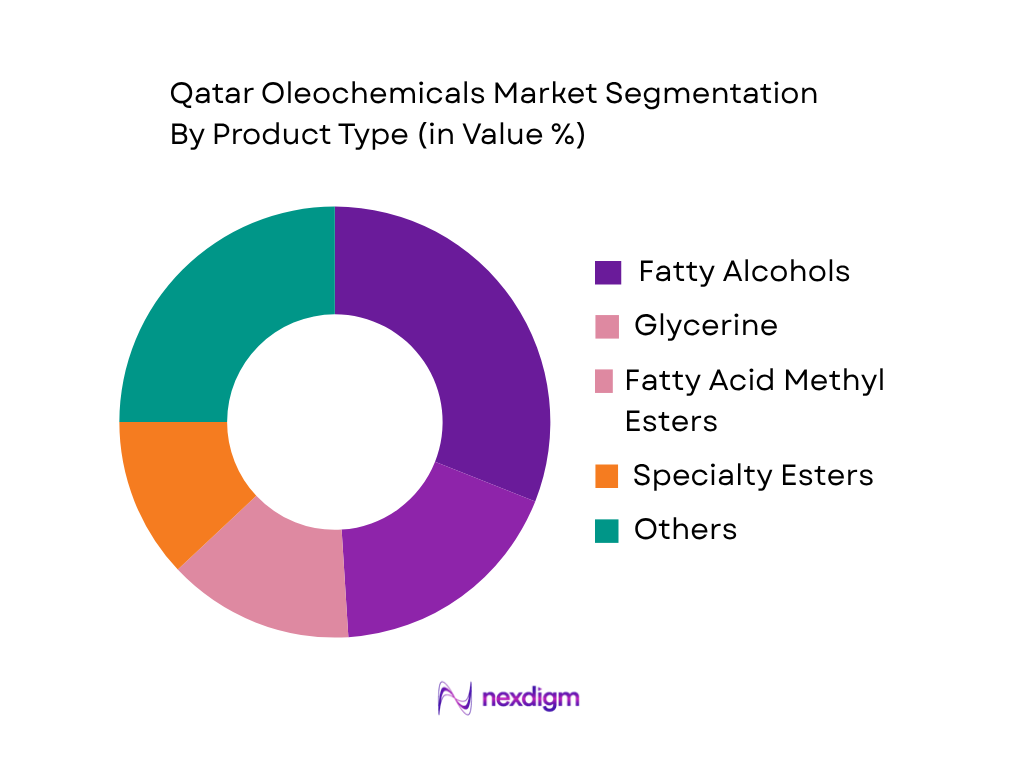
By Product Type
The Qatar Oleochemicals Market is segmented by product type into fatty acids, fatty alcohols, glycerine, fatty acid methyl esters, specialty esters, fatty amines, alkoxylates, oleochemical surfactants and other derivatives. Fatty acids represent the dominant sub-segment because they provide the primary building blocks for multiple downstream derivatives and are used in soaps, detergents, personal care, lubricants, coatings and specialty chemicals. Qatar’s domestic strategy for downstream chemical development specifically identifies fatty alcohols as an internationally sourced feedstock for ethoxylate production, demonstrating the importance of fatty-acid and fatty-alcohol intermediates within the country’s chemical-development roadmap. The Ministry of Commerce and Industry identifies ethoxylates as serving detergents, emulsifiers, wetting agents and dispersants, with additional regional demand from construction chemicals and oilfield applications. This broad downstream application base supports continued demand for oleochemical intermediates and creates opportunities for Qatar to move from imported raw materials toward higher-value derivative processing.
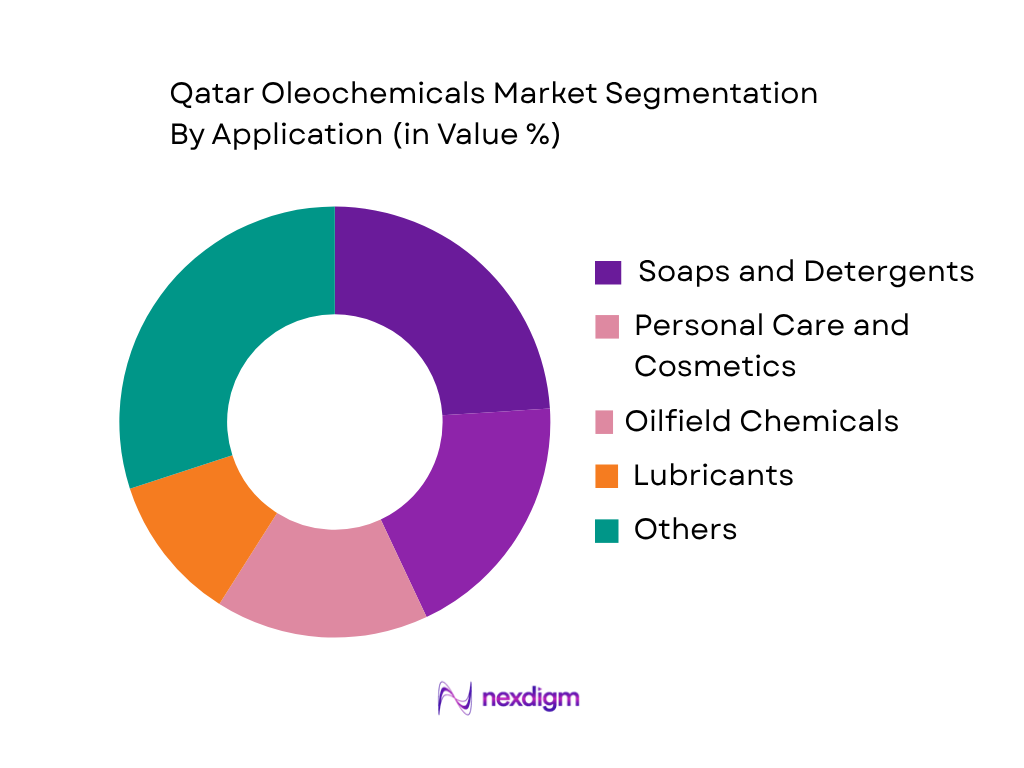
By Application
The Qatar Oleochemicals Market is segmented by application into personal care and cosmetics, soaps and detergents, food and beverage, pharmaceuticals, lubricants, plastics and polymers, paints and coatings, agricultural chemicals, oilfield chemicals, and biofuels. Soaps and detergents represent the leading application because fatty acids, fatty alcohols, glycerine and oleochemical surfactants provide core formulation functionality across household and industrial cleaning products. Qatar’s Ministry of Commerce and Industry specifically identifies detergents, emulsifiers, wetting agents and dispersants as major applications for ethoxylates. The same strategy identifies regional applications in construction chemicals and enhanced oil recovery, providing an additional industrial demand base. Qatar’s large energy sector also supports demand for specialty chemicals used in industrial and oilfield operations. The country’s strategic industrial infrastructure around Mesaieed and Ras Laffan provides access to manufacturing, storage and logistics capabilities, supporting chemical distribution to both domestic customers and GCC markets.
Competitive Landscape
The Qatar Oleochemicals Market includes international oleochemical manufacturers, specialty chemical companies, regional distributors and integrated chemical producers competing through product breadth, specialty derivatives, feedstock sourcing, technical specifications and GCC distribution capabilities. Qatar’s industrial strategy is increasingly oriented toward downstream chemical production, while international suppliers remain important because several oleochemical feedstocks and specialty derivatives are sourced externally. The competitive environment therefore combines import-driven supply with opportunities for domestic conversion and regional distribution.
| Company | Establishment Year | Headquarters | Product Portfolio | Oleochemical Capability | Feedstock Capability | Primary Applications | GCC/Regional Reach | Specialty Capability |
| Emery Oleochemicals | 1840 | Cincinnati, USA | ~ | ~ | ~ | ~ | ~ | ~ |
| KLK OLEO | 1995 | Malaysia | ~ | ~ | ~ | ~ | ~ | ~ |
| Wilmar International | 1991 | Singapore | ~ | ~ | ~ | ~ | ~ | ~ |
| BASF | 1865 | Ludwigshafen, Germany | ~ | ~ | ~ | ~ | ~ | ~ |
| Croda International | 1925 | Snaith, UK | ~ | ~ | ~ | ~ | ~ | ~ |
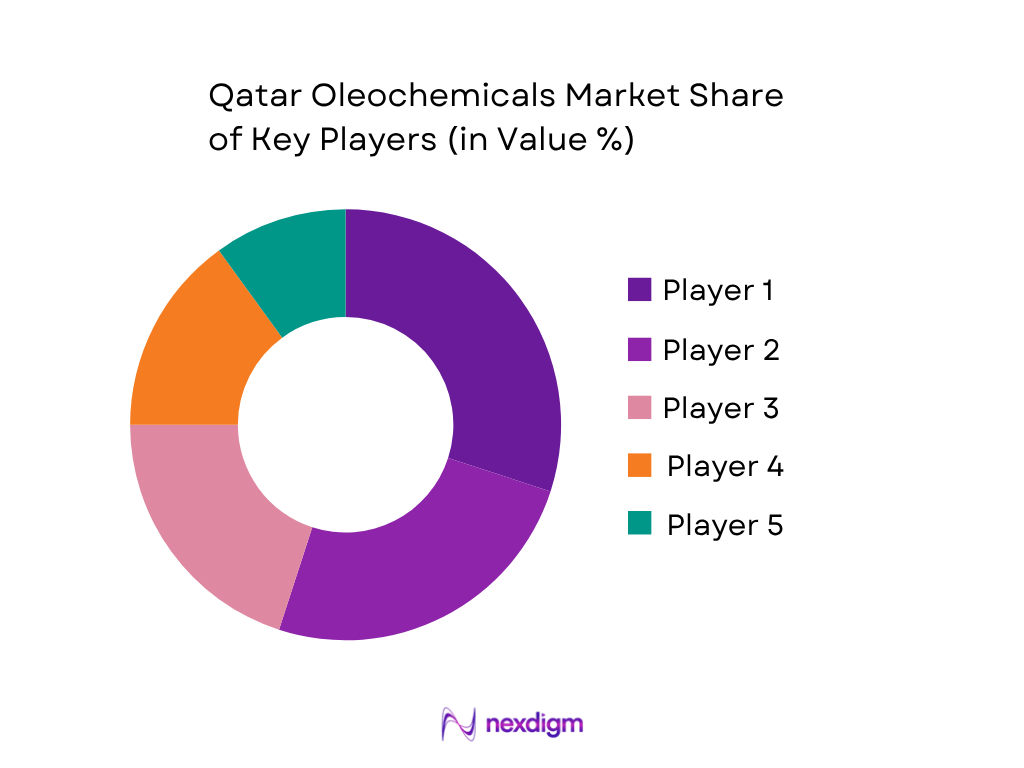
Qatar Oleochemicals Market Analysis
Growth Drivers
Petrochemical and Chemical Industry Expansion and Availability of Integrated Industrial Infrastructure
Qatar’s large-scale hydrocarbon and downstream chemical ecosystem provides a strong industrial foundation for oleochemical development, particularly where imported fatty alcohols, fatty acids and vegetable oils can be converted into higher-value surfactants, esters and specialty derivatives. The IMF recorded QAR 813.6 billion in nominal GDP for Qatar in 2024, including QAR 317.0 billion from hydrocarbon activities and QAR 496.6 billion from non-hydrocarbon activities, demonstrating the scale of the wider economic base available to downstream industries. Real non-hydrocarbon GDP expanded by 1.9% in 2024, while natural-gas production reached 118.7 million tonnes. Qatar’s National Manufacturing Strategy identifies ethoxylates as a specific investment opportunity, with a proposed facility capacity of 70,000 metric tonnes, USD 120 million in capital expenditure and applications spanning detergents, emulsifiers, wetting agents and dispersants. The strategy also identifies international sourcing of fatty alcohols and on-site production of ethylene oxide, creating a potential integrated conversion pathway. Qatar’s industrial infrastructure around Mesaieed and Ras Laffan further supports bulk chemical handling, utilities, storage and logistics. These conditions are market-specific because they allow Qatar to leverage existing petrochemical infrastructure while developing oleochemical-adjacent specialty chemicals rather than relying exclusively on imported finished derivatives.
Personal Care, Detergent, Food-Processing and Industrial Chemical Demand
Qatar’s expanding non-hydrocarbon economy and high-income consumer environment provide downstream demand conditions for oleochemical-derived ingredients used in personal care, household cleaning, food processing, lubricants and industrial formulations. The IMF recorded QAR 496.6 billion of nominal non-hydrocarbon GDP in 2024, while real non-hydrocarbon GDP increased by 1.9%, indicating continued economic activity outside hydrocarbons. Qatar’s population was approximately 3.1 million in 2024 according to international demographic and economic datasets, creating a concentrated but relatively affluent consumer base for soaps, detergents, cosmetics and personal-care products. The country’s National Manufacturing Strategy specifically identifies ethoxylates as inputs for detergents, emulsifiers, wetting agents and dispersants, while also identifying applications in construction chemicals, cleaning agents, industrial uses and enhanced oil recovery. Qatar’s imported vegetable-oil flows provide evidence of an established lipid supply chain: the country imported 12.30 million kg of crude palm oil in 2024, including 12.11 million kg from Malaysia, and imported 2.77 million kg of soybean oil. Palm-kernel or babassu-oil imports added another 613,224 kg. These volumes support food and formulation industries while creating a potential feedstock base for downstream oleochemical conversion. The combination of domestic industrial demand imported lipid availability and established chemical infrastructure creates opportunities for producers supplying surfactants, fatty-acid derivatives, glycerine and specialty esters. (IMF eLibrary)
Market Challenges
High Dependence on Imported Vegetable Oils and Limited Domestic Oleochemical Feedstock Production
Qatar’s lack of a large domestic agricultural oilseed base makes the oleochemicals industry structurally dependent on imported vegetable oils and other lipid feedstocks. Trade data shows that Qatar imported 12,295,500 kg of crude palm oil in 2024, of which 12,114,200 kg came from Malaysia, demonstrating substantial concentration in a single international supply source. The country additionally imported 613,224 kg of palm-kernel or babassu oil, with the full quantity sourced from Malaysia. Soybean-oil imports reached 2,767,790 kg, with 1,230,400 kg supplied by Canada, 676,864 kg by the United Arab Emirates and 428,828 kg by the United States. This dependence creates exposure to international agricultural conditions, shipping availability, geopolitical disruptions and changes in supplier-country export policies. The challenge is particularly relevant for oleochemical manufacturers because feedstock specifications directly affect fatty-acid composition, processing yields and the performance of downstream derivatives. Qatar’s National Manufacturing Strategy itself identifies fatty alcohols and related feedstocks as materials that would be sourced internationally for proposed downstream chemical production. Consequently, domestic oleochemical development would need reliable import terminals, storage infrastructure, supplier diversification and feedstock quality-control systems. The market therefore faces a structural limitation: Qatar has extensive downstream chemical infrastructure but comparatively limited domestic renewable lipid production, making feedstock security a critical determinant of oleochemical manufacturing feasibility.
Feedstock Competition, Specialty Product Import Dependency and Petrochemical Alternatives
Qatar’s oleochemical industry must compete for imported lipid feedstocks with food processing, consumer products and other industrial applications, while specialty oleochemical derivatives may remain dependent on international suppliers. In 2024, Qatar imported 2,346,720 kg of refined or non-crude soybean oil and fractions, including 1,230,400 kg from Canada and 676,864 kg from the United Arab Emirates. It also imported 16,826,700 kg of non-crude palm oil and liquid fractions, demonstrating that the country already operates substantial imported-oil supply chains serving downstream applications. At the same time, Qatar has a highly developed petrochemical ecosystem that provides alternative hydrocarbon-derived intermediates for surfactants, lubricants, polymers and specialty chemicals. The IMF reported QAR 317.0 billion of nominal hydrocarbon GDP in 2024 and natural-gas production of 118.7 million tonnes, illustrating the scale of the competing petrochemical resource base. For oleochemical producers, this means bio-based derivatives must deliver appropriate functionality, supply reliability and compatibility with existing industrial formulations to displace established petrochemical alternatives. Specialty products also require tighter technical specifications, including fatty-acid profile, purity, moisture, acid value and oxidation stability, which can increase dependence on qualified international suppliers. Qatar’s relatively small domestic population of approximately 3.1 million further limits the scale of purely domestic demand, making regional GCC sales and export-oriented manufacturing important for achieving sufficient production scale.
Market Opportunities
Imported Feedstock-to-Derivative Conversion and Specialty Chemical Manufacturing
Qatar’s dependence on imported vegetable oils can be converted from a structural constraint into an opportunity by establishing domestic facilities that transform imported fatty feedstocks into higher-value oleochemical derivatives. Qatar imported 12.30 million kg of crude palm oil in 2024, 16.83 million kg of non-crude palm oil and liquid fractions, 2.77 million kg of soybean oil and 613,224 kg of palm-kernel or babassu oil. These established import flows demonstrate that the country already has access to multiple lipid feedstocks and international supplier relationships. The National Manufacturing Strategy specifically identifies 70,000 metric tonnes of proposed ethoxylate capacity requiring internationally sourced fatty alcohols and on-site ethylene oxide, with an indicated USD 120 million capital requirement. The proposed product portfolio includes alcohol ethoxylates, fatty amine ethoxylates, fatty acid ethoxylates and specialty ethoxylates, demonstrating a clear policy-level pathway toward higher-value downstream chemical manufacturing. The strategy identifies detergents, emulsifiers, wetting agents and dispersants as applications, while regional demand includes construction chemicals, cleaning agents and enhanced oil recovery. This creates an opportunity for Qatar to use its established ports, industrial utilities, petrochemical integration and logistics network to convert imported lipid feedstocks into specialty products rather than exporting value through unprocessed or minimally processed materials. Domestic conversion could also improve supply responsiveness for GCC customers and provide opportunities to develop specialized fatty acids, esters, glycerine and surfactant intermediates for personal care, industrial and oilfield applications. (World Integrated Trade Solution)
Bio-Based Lubricants, Waste Cooking Oil Valorization and GCC Re-Export Opportunities
Qatar’s industrial structure provides an opportunity to develop higher-value bio-based oleochemicals while using waste lipid streams and regional trade connectivity to expand beyond the domestic market. The country recorded QAR 496.6 billion in nominal non-hydrocarbon GDP in 2024, while real non-hydrocarbon GDP increased by 1.9%, supporting continued diversification into manufacturing and services. Qatar’s National Manufacturing Strategy emphasizes sustainable manufacturing and identifies downstream chemical opportunities with regional and international demand. The strategy’s ethoxylate opportunity identifies 100% export as the targeted revenue structure for the proposed facility, while the regional market is associated with detergents, construction chemicals, industrial applications and enhanced oil recovery. This export orientation is particularly relevant because Qatar’s domestic population is approximately 3.1 million, limiting the scale of domestic consumption for specialized oleochemical products. Waste cooking oil and recovered lipid streams can provide additional feedstock opportunities for fatty-acid methyl esters, specialty esters and bio-based lubricant intermediates, although dedicated collection and purification infrastructure would be required. Qatar’s established industrial and port infrastructure can support bulk storage and regional distribution, while the country’s location within the GCC provides access to larger downstream markets in Saudi Arabia, the United Arab Emirates, Oman, Kuwait and Bahrain. The opportunity therefore extends beyond replacing imported products within Qatar: an integrated facility could use imported and recovered feedstocks to manufacture specialty oleochemicals for domestic users and GCC customers, increasing local chemical value addition and supporting Qatar’s manufacturing-diversification objectives. (Ministry of Commerce and Industry)
Future Outlook
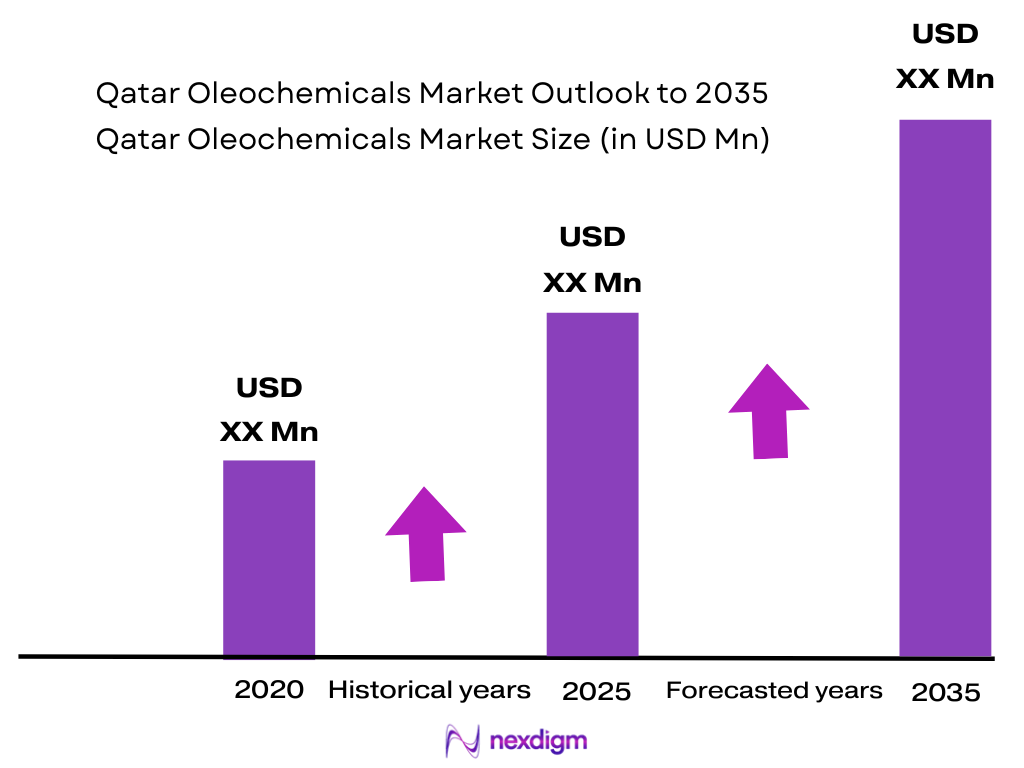
The Qatar Oleochemicals Market is expected to expand as the country develops higher-value chemical manufacturing and strengthens its downstream industrial ecosystem. Qatar’s Ministry of Commerce and Industry has identified ethylene oxide and fatty alcohols as a potential integrated manufacturing opportunity, with applications spanning detergents, emulsifiers, wetting agents and dispersants. The same industrial strategy identifies regional demand from construction chemicals, cleaning agents, industrial applications and enhanced oil recovery, creating opportunities beyond Qatar’s domestic consumption base. The market is also positioned to benefit from Qatar’s established chemical, energy and logistics infrastructure, particularly around Mesaieed and Ras Laffan. The Qatar Oleochemicals Market is expected to grow at a ~% CAGR during 2026-2035, reaching approximately USD ~ billion by 2035.
Major Players
- Emery Oleochemicals
- KLK OLEO
- Wilmar International
- IOI Oleochemical Industries
- Oleon
- BASF
- Croda International
- Kao Corporation
- Evonik Industries
- Godrej Industries
- Ecogreen Oleochemicals
- Evyap Oleo
- Vantage Specialty Chemicals
- Eastman Chemical Company
- PCC Group
Key Target Audience
- Oleochemical Manufacturers and Specialty Chemical Producers — fatty-acid, fatty-alcohol, glycerine, ester, fatty-amine and alkoxylate manufacturers
- Vegetable-Oil Importers and Feedstock Suppliers — palm-oil, palm-kernel-oil, soybean-oil, coconut-oil and other lipid-feedstock suppliers
- Personal Care, Cosmetics and Home-Care Manufacturers — manufacturers purchasing fatty alcohols, esters, glycerine and oleochemical surfactants
- Food and Pharmaceutical Manufacturers — companies requiring food-grade, pharmaceutical-grade and high-purity glycerine and specialty oleochemical ingredients
- Lubricant, Polymer and Industrial Chemical Manufacturers — users of specialty esters, fatty acids and bio-based chemical intermediates
- Investments and Venture Capitalist Firms — specialty chemical investors, bioeconomy funds, industrial investment firms and circular-economy investors
- Government and Regulatory Bodies — Ministry of Commerce and Industry, Ministry of Municipality, QatarEnergy, Qatar Free Zones Authority, Qatar General Organization for Standards and Metrology
- Oilfield and Energy-Chemical Companies — oilfield chemical suppliers, enhanced-oil-recovery operators, drilling-service companies and industrial chemical procurement teams
Research Methodology
Step 1: Identification of Key Variables
The initial stage involves constructing a Qatar-specific oleochemical ecosystem covering 8 major stakeholder groups, including feedstock suppliers, importers, chemical manufacturers, distributors, personal-care producers, detergent manufacturers, industrial users and regulatory authorities. The analysis identifies product categories, feedstock dependencies, downstream applications, trade flows and domestic manufacturing opportunities.
Step 2: Market Analysis and Construction
Historical market information is compiled across product categories, applications, feedstocks and end-use industries. Qatar’s official trade data is incorporated to assess vegetable-oil availability and import dependency. In 2024, Qatar imported 12,295,500 kg of crude palm oil and 613,224 kg of palm-kernel or babassu oil, providing direct evidence of imported lipid feedstock availability. (World Integrated Trade Solution)
Step 3: Hypothesis Validation and Expert Consultation
Market hypotheses are validated through discussions with oleochemical producers, chemical distributors, vegetable-oil importers, personal-care manufacturers, detergent producers, lubricant formulators and oilfield chemical companies. The consultation framework evaluates 6 areas: procurement, product specifications, feedstock sourcing, downstream demand, supplier selection and manufacturing opportunities.
Step 4: Research Synthesis and Final Output
The final stage triangulates market estimates with trade statistics, government industrial strategies, company information and primary industry insights. Qatar’s official industrial strategy is used to identify downstream chemical opportunities, while international trade data validates imported feedstock flows. The final model reconciles product demand, applications, import dependency and potential domestic manufacturing.

- Executive Summary
- Research Methodology (Market Definition and Scope, Qatar Oleochemical Product Taxonomy, Feedstock Mapping, Domestic Supply-Demand Reconciliation, Top-Down Market Sizing, Bottom-Up Market Sizing, Production and Import Analysis, Consumption Assessment, Primary Industry Interviews, Trade-Flow Validation, Data Triangulation, Forecasting Framework, Scenario Analysis, Assumptions and Limitations)

- Definition and Scope
- Qatar Oleochemicals Industry Evolution and Development Timeline
- Oleochemical Value Chain in Qatar
- Feedstock-to-Derivative Conversion Ecosystem
- Imported Feedstock Dependency and Sourcing Landscape
- Ras Laffan–Mesaieed Industrial Corridor Analysis

- Growth Drivers (Petrochemical and Chemical Industry Expansion, Availability of Integrated Industrial Infrastructure, Personal Care and Detergent Demand, Food-Processing Expansion, Lubricant Consumption, Bio-Based Chemical Adoption, Import Substitution Opportunities)
- Market Challenges (High Dependence on Imported Vegetable Oils, Limited Domestic Oleochemical Feedstock Production, Feedstock Price Volatility, Competition from Petrochemical-Based Alternatives, Specialty Product Import Dependency, Small Domestic Consumption Base, Extreme-Climate Processing Requirements)
- Market Opportunities (Imported Feedstock-to-Derivative Conversion, Specialty Fatty Acids, High-Purity Glycerine, Personal Care Ingredients, Bio-Based Lubricants, Waste Cooking Oil Valorization, Oleochemical Import Substitution, GCC Re-Export Opportunities, Specialty Chemical Manufacturing)
- Market Trends (Shift Toward Specialty Oleochemicals, Renewable Feedstock Utilization, Bio-Based Personal Care Ingredients, Sustainable Surfactants, Specialty Ester Development, Circular Feedstock Processing, Import Substitution, Integration With Downstream Chemical Manufacturing)
- Regulatory and Standards Landscape (Environmental Regulations, Chemical Import Requirements, Industrial Safety Standards, Food-Grade Ingredient Requirements, Cosmetic Ingredient Requirements, Pharmaceutical-Grade Requirements, Waste-Oil Regulations, Product Labelling, Hazardous Chemical Handling)
- Porter’s Five Forces Analysis
- PESTLE Analysis
- SWOT Analysis

- By Market Value (2020-2025)
- By Production Volume (2020-2025)
- By Consumption Volume (2020-2025)
- By Import Volume (2020-2025)
- By Export Volume (2020-2025)
- By Domestic Production (2020-2025)
- By Average Realized Selling Price (2020-2025)
- By Oleochemical Derivative Output (2020-2025)

- By Product Type (In Value %)
Fatty Acids
Fatty Alcohols
Glycerine
Fatty Acid Methyl Esters
Specialty Esters
Fatty Amines
Alkoxylates
Oleochemical Surfactants
Other Specialty Oleochemical Derivatives - By Fatty Acid Type (In Value %)
Stearic Acid
Oleic Acid
Palmitic Acid
Lauric Acid
Linoleic Acid
Other Specialty Fatty Acids
By Fatty Alcohol Type (In Value %)
Lauryl Alcohol
Cetyl Alcohol
Stearyl Alcohol
Oleyl Alcohol
Mixed Fatty Alcohols
Specialty Fatty Alcohols - By Glycerine Type (In Value %)
Crude Glycerine
Refined Glycerine
Technical-Grade Glycerine
Food-Grade Glycerine
Pharmaceutical-Grade Glycerine - By Feedstock Type (In Value %)
Palm Oil
Palm Kernel Oil
Coconut Oil
Soybean Oil
Canola Oil
Animal Fats and Tallow
Used Cooking Oil
Other Vegetable Oils
Waste and Recovered Lipid Feedstocks - By Imported Vegetable-Oil Feedstock (In Value %)
Crude Palm Oil
Refined Palm Oil
Palm Kernel Oil
Coconut Oil
Soybean Oil
Other Imported Vegetable Oils - By Animal-Fat Feedstock (In Value %)
Beef Tallow
Poultry Fat
Lard
Rendered Animal Fats
Technical-Grade Animal Fats
By Recovered Feedstock (In Value %)
Used Cooking Oil
Waste Oils
Recovered Industrial Lipids
Other Recycled Feedstocks

- Market Share of Major Players (By Revenue, Production Volume, Product Type, Feedstock, Application, End-Use Industry, Distribution Channel)
- Cross Comparison Parameters (Oleochemical Product Portfolio Breadth, Fatty Acid Production Capability, Glycerine Refining Capability, Specialty Ester Portfolio, Feedstock Flexibility, Production and Processing Capacity, GCC Distribution Network Reach, Renewable and Waste Feedstock Capability)
- Pricing and Contract Structure Analysis
- SWOT Analysis Of Major Players
- Detailed Profiles of Major Companies
Emery Oleochemicals
Vantage Specialty Chemicals
KLK OLEO
Wilmar International
IOI Oleochemical Industries
Oleon
BASF
Kao Corporation
Croda International
Evonik Industries
Godrej Industries
Eastman Chemical Company
PCC Group
Ecogreen Oleochemicals
Evyap Oleo

- Industrial Buyer Segmentation
- Procurement Behaviour
- Product Selection Criteria
- Buyer Pain Points
- Sustainability Requirements
- Import Versus Domestic Sourcing Preference

- By Market Value (2026-2035)
- By Production Volume (2026-2035)
- By Consumption Volume (2026-2035)
- By Import Volume (2026-2035)
- By Export Volume (2026-2035)
- By Domestic Production (2026-2035)
- By Average Realized Selling Price (2026-2035)
- By Oleochemical Derivative Output (2026-2035)


 Request a Sample
 Ask for Customization
 Get a Quote
 Enquire Now