

 Download PDF
 Download PDF
- Insurance companies
- Insurtech providers
- Banks and financial institutions
- Automotive dealerships
- E-commerce platforms
- Investment and venture capitalist firms
- Government and regulatory bodies
- Telecom operators
Market Overview
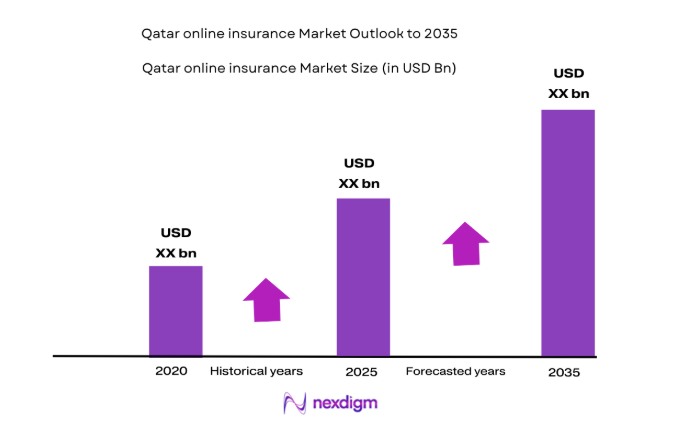
Based on a recent historical assessment, Qatar’s online insurance market reached approximately USD ~ million in gross written premiums through digital channels, driven by high internet penetration, compulsory motor and health coverage, and expanding insurer digitalization initiatives. Growth has been supported by mobile-first policy purchase behavior and aggregator adoption across motor and travel insurance categories. Insurers’ migration to cloud policy administration and automated underwriting has improved distribution scalability and cost efficiency, accelerating online premium volumes across retail and SME customer segments nationwide.
Doha remains the dominant hub for Qatar’s online insurance ecosystem due to concentration of insurers, fintech partnerships, and advanced digital infrastructure supporting e-commerce and financial services adoption. The city hosts most national insurers’ headquarters and regulatory institutions, enabling rapid deployment of digital distribution platforms and insurtech collaborations. Regional technology partnerships with the UAE and broader Gulf markets further reinforce platform development, while expatriate-heavy urban districts sustain high demand for online motor, health, and travel insurance purchasing channels.
Market Segmentation
By Product Type
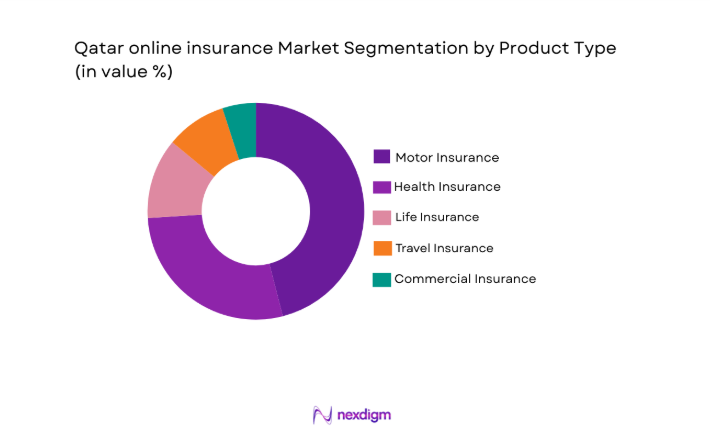
Qatar online insurance market is segmented by product type into motor insurance, health insurance, life insurance, travel insurance, and commercial insurance. Recently, motor insurance has a dominant market share due to compulsory coverage regulations, high vehicle ownership, and strong aggregator comparison adoption enabling rapid online purchase. Insurers prioritize motor digitization because standardized underwriting and pricing enable automation and instant policy issuance. Claims processing digitalization and telematics integration further enhance customer preference for online motor policies, reinforcing its leadership across digital insurance product portfolios in Qatar.
By Platform Type
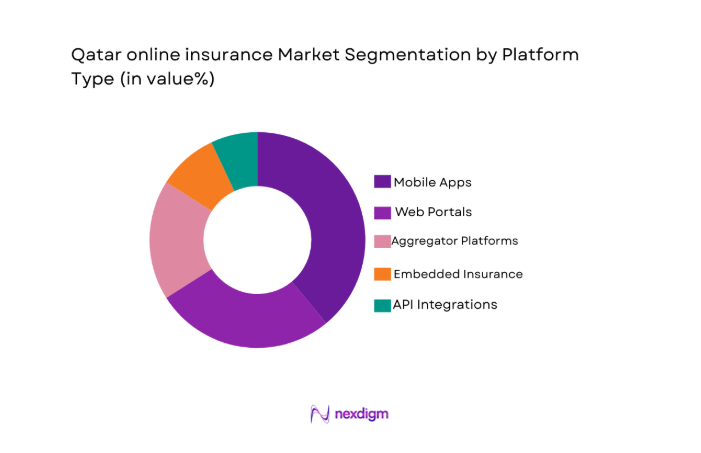
Qatar online insurance market is segmented by platform type into web portals, mobile apps, aggregator platforms, embedded insurance platforms, and API-based integrations. Recently, mobile apps have a dominant market share due to smartphone-first consumer behavior, multilingual interfaces, and insurers’ investment in app-based policy servicing and claims submission. Mobile channels enable instant notifications, document uploads, and payment integration aligned with digital banking usage patterns. The convenience of self-service renewals and claims tracking through apps has accelerated migration from web-only platforms toward mobile-centric insurance distribution in Qatar.
Competitive Landscape
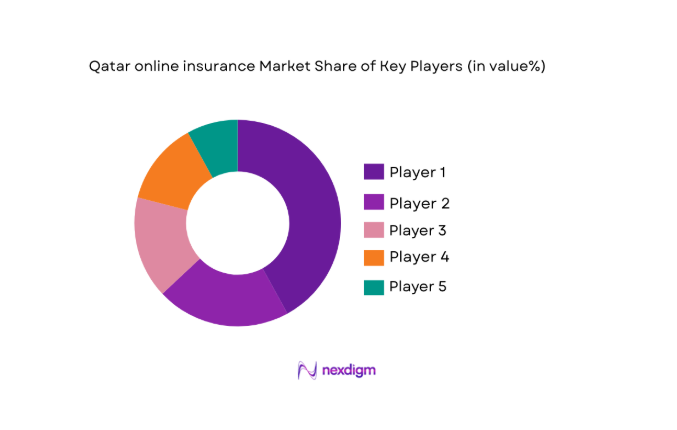
Qatar’s online insurance market is moderately consolidated, led by domestic insurers with strong brand equity and regulatory familiarity alongside multinational insurers offering advanced digital platforms. National insurers dominate motor and health segments, while global players contribute technology innovation and embedded insurance partnerships. Competitive intensity centers on digital user experience, pricing transparency, and claims automation capabilities, with insurers investing heavily in mobile apps and aggregator integrations to strengthen online distribution reach across retail and SME customers.
| Company Name | Establishment Year | Headquarters | Technology Focus | Market Reach | Key Products | Revenue | Digital Channel Strength |
| Qatar Insurance Company | 1964 | Doha | ~ | ~ | ~ | ~ | ~ |
| Doha Insurance Group | 1979 | Doha | ~ | ~ | ~ | ~ | ~ |
| QLM Life & Medical | 2011 | Doha | ~ | ~ | ~ | ~ | ~ |
| AXA Gulf | 1949 | Paris | ~ | ~ | ~ | ~ | ~ |
| GIG Gulf | 1962 | Kuwait | ~ | ~ | ~ | ~ | ~ |
Qatar Online insurance Market Analysis
Growth Drivers
Mandatory Motor and Health Insurance Digitalization
Qatar’s compulsory motor insurance regime and expanding employer-sponsored health coverage have created a structurally guaranteed demand base that increasingly migrates toward digital purchase channels as insurers digitize distribution journeys and regulatory frameworks permit electronic policy issuance and verification across licensing and healthcare systems. Insurers have invested substantially in online underwriting engines, instant pricing models, and mobile-based policy servicing platforms to handle high-volume standardized products such as motor and basic health coverage, enabling customers to complete purchases without physical documentation or branch interaction. The presence of national vehicle registration databases and centralized healthcare provider networks allows seamless integration of underwriting data into insurer platforms, reducing manual processing costs and improving policy issuance speed, which incentivizes insurers to prioritize digital channels over traditional intermediated sales models. Aggregator platforms have amplified this shift by enabling consumers to compare motor and health policies across insurers instantly, increasing price transparency and encouraging insurers to maintain competitive digital offerings and simplified policy structures suitable for online purchase. Expatriate residents, who form a large portion of the insured population, demonstrate strong preference for online transactions due to language options, remote documentation submission, and ease of renewal without in-person visits, further reinforcing digital adoption across compulsory insurance segments. Insurers also benefit from lower acquisition costs and improved retention through app-based renewal reminders and automated claims notifications, which strengthen customer lifecycle engagement within digital ecosystems. Regulatory acceptance of electronic documentation and digital signatures has removed historical barriers to online insurance contracting, enabling full policy lifecycle digitization from quotation to claims settlement across motor and health lines. As digital motor and health penetration deepens, insurers leverage cross-selling opportunities into travel and life insurance within the same digital platforms, expanding overall online insurance market value. The combined effect of compulsory coverage demand, digital infrastructure integration, and insurer cost optimization continues to structurally anchor the growth trajectory of Qatar’s online insurance market.
Smartphone-Centric Consumer Behavior and Fintech Integration
Qatar exhibits one of the highest smartphone penetration and mobile banking usage environments globally, creating a natural behavioral foundation for mobile-first insurance purchasing and servicing as consumers increasingly manage financial activities through apps integrated with payment systems and digital identity verification tools. Insurers and insurtech providers have capitalized on this ecosystem by developing mobile insurance platforms that integrate payment gateways, digital wallets, and document storage, enabling end-to-end policy management within a single application environment aligned with broader fintech usage patterns. Partnerships between insurers and telecom operators, banks, and e-commerce platforms have enabled embedded insurance offerings that are purchased seamlessly during travel booking, vehicle purchase, or service subscriptions, reinforcing consumer familiarity with digital insurance transactions and expanding market reach beyond traditional insurance touchpoints. Mobile platforms also enable real-time notifications, claims tracking, and chatbot assistance, enhancing perceived convenience and trust compared with legacy branch-based processes, thereby accelerating channel migration toward online distribution across retail and SME users. Younger demographics and expatriate professionals demonstrate particularly strong adoption of app-based insurance due to frequent mobility, preference for self-service transactions, and comfort with digital documentation, reinforcing long-term demand for mobile insurance ecosystems. Insurers benefit from data analytics capabilities embedded in mobile platforms, enabling behavioral segmentation, personalized pricing, and targeted cross-selling campaigns that improve conversion rates and customer lifetime value within digital channels. The integration of telematics and health monitoring data into mobile insurance apps further enhances product innovation potential, supporting usage-based insurance and wellness-linked health policies tailored to individual behavior. Government digital economy strategies and fintech regulatory sandboxes have encouraged experimentation with insurtech models, allowing insurers to pilot new digital distribution approaches without extensive regulatory delays. The convergence of consumer mobile behavior, fintech infrastructure, and insurer digital investment therefore constitutes a structural growth engine for Qatar’s online insurance market expansion.
Market Challenges
Regulatory Complexity and Compliance Constraints in Digital Distribution
Qatar’s insurance sector operates within a tightly regulated financial environment overseen by national financial authorities that impose stringent licensing, data protection, and product approval requirements, which create complexity for insurers attempting to scale fully digital distribution models across multiple product lines and customer segments. Online insurance platforms must comply with cybersecurity standards, consumer protection rules, and documentation verification protocols equivalent to traditional channels, requiring substantial investment in compliance systems and legal oversight that increases operational costs and slows innovation cycles compared with less regulated digital commerce sectors. Cross-border digital insurance offerings or partnerships with foreign insurtech providers encounter additional regulatory scrutiny related to data residency and local licensing, limiting the speed at which global digital insurance models can be deployed within Qatar’s market. The requirement for approved policy wordings and regulated pricing structures, particularly in compulsory motor and health lines, constrains insurers’ ability to experiment with dynamic pricing or simplified online product designs that are common in mature digital insurance markets. Regulatory authorities also maintain strict oversight of intermediary licensing, affecting aggregator and embedded insurance partnerships that rely on multi-party digital distribution chains, thereby complicating platform expansion strategies. Compliance with personal data protection regulations necessitates secure storage and processing of sensitive customer and health information, requiring insurers to implement advanced cybersecurity architectures and audit processes that raise technology investment thresholds for digital platforms. Smaller insurers and emerging insurtech firms face disproportionate compliance burdens relative to their scale, limiting competitive diversity and slowing innovation within the online insurance ecosystem. Regulatory change processes can be gradual, creating uncertainty around approval timelines for new digital products or features, which discourages rapid iteration and experimentation in user experience design and automated underwriting models. While regulation ensures market stability and consumer protection, the cumulative compliance obligations and approval constraints remain a structural challenge moderating the pace of online insurance market expansion in Qatar.
Consumer Trust Deficit and Preference for Traditional Intermediaries
Despite high digital readiness, segments of Qatar’s population continue to exhibit cautious attitudes toward purchasing insurance exclusively online, particularly for higher-value health or life policies where advisory interaction and perceived assurance of authenticity remain important decision factors influencing channel choice. Insurance historically relies on trust and relationship-building, and many consumers associate physical agents or branch offices with reliability, personalized guidance, and support during claims processes, which digital interfaces must replicate convincingly to achieve full adoption across all product categories. Concerns regarding policy transparency, coverage interpretation, and claim settlement fairness can deter consumers from relying solely on digital documentation or automated communication channels, especially among older demographics and small business owners less familiar with online insurance processes. Instances of misunderstanding policy terms or digital claims submission requirements can reinforce skepticism toward self-service platforms, encouraging continued reliance on brokers or agents who provide face-to-face clarification and assistance. Language diversity within expatriate populations also necessitates multilingual support and culturally tailored communication, and insufficient localization in some digital platforms may hinder trust and usability among certain user groups. Perceived cybersecurity risks and fear of data misuse remain latent barriers, particularly for health insurance where sensitive personal information is involved, requiring insurers to invest heavily in security communication and user education to alleviate concerns. Traditional intermediaries retain influence through established corporate and SME relationships, offering bundled advisory services and negotiated coverage that digital platforms struggle to replicate without advanced customization capabilities. Marketing and awareness efforts for online insurance remain less mature than in banking or e-commerce sectors, limiting consumer familiarity with digital insurance purchasing norms. The persistence of trust gaps and intermediary preference therefore constrains the speed at which Qatar’s insurance demand can transition fully toward online channels despite favorable digital infrastructure conditions.
Opportunities
Expansion of Embedded Insurance Across Digital Commerce and Mobility Ecosystems
Qatar’s rapidly digitalizing consumer economy encompassing e-commerce, travel booking, mobility services, and subscription platforms presents substantial opportunity for insurers to integrate embedded insurance offerings directly into non-insurance digital journeys, allowing policies to be purchased contextually at the point of need rather than through standalone insurance platforms. Travel insurance integrated into airline or hotel booking systems, device protection bundled with electronics purchases, and micro motor or mobility coverage embedded within ride-sharing or vehicle leasing platforms exemplify use cases that can significantly expand online insurance penetration by aligning purchase timing with consumer intent. Such embedded models reduce customer acquisition costs and decision friction by eliminating separate search and comparison processes, while enabling insurers to access previously underserved micro-segments and episodic insurance needs that traditional annual policies do not address effectively. Qatar’s strong digital payment infrastructure and regulatory openness to fintech partnerships facilitate secure transaction processing and data sharing between insurers and partner platforms, supporting scalable embedded distribution architectures. Retailers, telecom operators, and financial institutions increasingly seek ancillary revenue streams and customer engagement tools, making insurance partnerships commercially attractive and mutually beneficial across digital ecosystems. Insurers can leverage partner platform data to refine risk assessment and personalize coverage, improving pricing accuracy and product relevance while maintaining seamless user experience. Embedded insurance also enables innovation in short-duration, on-demand, or usage-based coverage tailored to travel, mobility, or lifestyle events prevalent in Qatar’s urban consumer environment. Government initiatives promoting digital services adoption further support ecosystem integration across sectors, encouraging insurers to collaborate with non-insurance platforms. The systematic expansion of embedded insurance across commerce and mobility ecosystems therefore represents a major structural opportunity to accelerate Qatar’s online insurance market growth.
Development of Digital Takaful and Personalized Microinsurance Solutions
Qatar’s cultural and regulatory environment supports Islamic finance principles, creating opportunity for insurers to develop fully digital Takaful insurance platforms that align with Sharia-compliant risk-sharing models while leveraging modern insurtech capabilities to enhance accessibility, transparency, and operational efficiency. Digital Takaful solutions can address both religious compliance preferences and underserved low-ticket insurance needs among individuals and small businesses by offering simplified microinsurance products with affordable premiums and flexible coverage durations distributed through mobile channels. Personalized microinsurance, enabled by data analytics and behavioral insights from digital platforms, allows insurers to tailor coverage levels, pricing, and benefits to individual risk profiles or lifestyle patterns, improving affordability and relevance compared with standardized traditional policies. Qatar’s expatriate workforce and gig economy participants often require short-term or situational coverage for health, travel, or liability risks, which digital microinsurance products can deliver efficiently without extensive underwriting processes. Digital Takaful platforms also enhance transparency through real-time contribution tracking and surplus distribution visibility, strengthening consumer trust and differentiation from conventional insurance offerings. Partnerships with Islamic banks, fintech providers, and community organizations can expand distribution reach while maintaining compliance credibility within the financial ecosystem. Technological advancements in blockchain and smart contracts further enable automated compliance verification and claims settlement consistent with Takaful principles, improving operational trust and efficiency. Government support for Islamic finance innovation and digital financial services provides regulatory alignment for such initiatives. The convergence of digitalization, cultural alignment, and microinsurance demand thus creates a significant opportunity for differentiated growth within Qatar’s online insurance market.
Major Players
- Qatar Insurance Company
- Doha Insurance Group
- Al Khaleej Takaful Insurance
- Qatar General Insurance & Reinsurance
- QLM Life & Medical Insurance
- Islamic Insurance Company
- General Takaful Company
- Beema Insurance
- AXA Gulf
- Allianz Partners
- GIG Gulf
- Oman Insurance Company
- MetLife Alico
- Seib Insurance & Reinsurance
- Policybazaar UAE
Key Target Audience
Research Methodology
Step 1: Identification of Key Variables
Key market variables such as digital premium volume, product mix, platform adoption, regulatory factors, and consumer behavior were identified through secondary research and industry databases. These variables formed the analytical framework for market sizing and segmentation modeling. Primary validation ensured relevance to Qatar’s insurance digitalization context.
Step 2: Market Analysis and Construction
Market size estimation combined insurer financial disclosures, regulator statistics, and digital adoption indicators to construct a bottom-up model of online insurance premiums by product and platform. Cross-verification across multiple data sources ensured consistency and reliability of estimates aligned with national insurance market structure.
Step 3: Hypothesis Validation and Expert Consultation
Preliminary findings and assumptions were validated through consultations with insurance executives, digital distribution specialists, and regional insurtech experts. Feedback refined segmentation, adoption drivers, and competitive dynamics to ensure practical alignment with Qatar’s online insurance ecosystem and regulatory environment.
Step 4: Research Synthesis and Final Output
All validated data and insights were synthesized into a structured analytical framework covering market size, segmentation, competitive landscape, and future outlook. Final outputs were reviewed for methodological consistency, accuracy, and relevance to stakeholders evaluating Qatar’s online insurance market opportunities.

- Executive Summary
- Research Methodology (Definitions, Scope, Industry Assumptions, Market Sizing Approach, Primary & Secondary Research Framework, Data Collection & Verification Protocol, Analytic Models & Forecast Methodology, Limitations & Research Validity Checks)

- Market Definition and Scope
- Value Chain & Stakeholder Ecosystem
- Regulatory / Certification Landscape
- Sector Dynamics Affecting Demand
- Strategic Initiatives & Infrastructure Growth

- Growth Drivers
High smartphone and internet penetration enabling digital insurance adoption
Government push toward digital financial services and cashless ecosystems
Rising expatriate population requiring accessible insurance products
Growth of e-commerce and digital platforms embedding insurance offerings
Insurers’ cost optimization through automated underwriting and servicing - Market Challenges
Low consumer awareness of digital-only insurance purchasing processes
Regulatory compliance complexity for online distribution models
Trust concerns around digital claims and policy authenticity
Limited local insurtech ecosystem maturity
Integration challenges with legacy insurer IT systems - Market Opportunities
Expansion of embedded insurance across travel, mobility, and e-commerce sectors
Development of Sharia-compliant digital Takaful insurance platforms
AI-driven personalized insurance pricing and microinsurance products - Trends
Shift toward mobile-first insurance purchase and policy servicing
Adoption of aggregator comparison models for motor and health insurance
Integration of telematics and usage-based insurance products
Growth of instant digital policy issuance and claims settlement
Partnerships between insurers and fintech or telecom platforms - Government Regulations & Defense Policy
Digital insurance licensing and distribution regulations by financial authorities
Data protection and cybersecurity compliance requirements for insurers
National fintech and digital economy strategies supporting insurtech growth - SWOT Analysis
- Stakeholder and Ecosystem Analysis
- Porter’s Five Forces Analysis
- Competition Intensity and Ecosystem Mapping

- By Market Value, 2020-2025
- By Installed Units, 2020-2025
- By Average System Price, 2020-2025
- By System Complexity Tier, 2020-2025

- By System Type (In Value%)
Motor Insurance Platforms
Health Insurance Marketplaces
Life Insurance Digital Portals
Travel Insurance Aggregators
Commercial Insurance Digital Suites - By Platform Type (In Value%)
Web-based Insurance Portals
Mobile App-based Insurance Platforms
Aggregator and Comparison Websites
Embedded Insurance Platforms
Insurtech API Integration Platforms - By Fitment Type (In Value%)
Standalone Digital Insurer Platforms
Insurer-Aggregator Integrated Platforms
Bankassurance Digital Channels
Telecom-Embedded Insurance Channels
Super App Integrated Insurance - By End User Segment (In Value%)
Individual Retail Policyholders
SME and Business Owners
Corporate Enterprises
Expatriate Population Segments
Government and Public Sector Entities - By Procurement Channel (In Value%)
Direct Insurer Online Sales
Aggregator and Comparison Portals
Broker-assisted Digital Sales
Bank Digital Channels
Embedded E-commerce Insurance - By Material / Technology (in Value %)
AI-driven Underwriting Engines
Cloud-based Policy Administration
Blockchain-enabled Policy Systems
API-based Integration Frameworks
Data Analytics and Telematics Systems

- Market structure and competitive positioning
Market share snapshot of major players - Cross Comparison Parameters (Product Portfolio Breadth, Digital UX Capability, Pricing Transparency, Claims Automation Level, Partner Ecosystem Strength)
- SWOT Analysis of Key Competitors
- Pricing & Procurement Analysis
- Key Players
Qatar Insurance Company
Doha Insurance Group
Al Khaleej Takaful Insurance
General Takaful Company
Qatar General Insurance & Reinsurance
Seib Insurance & Reinsurance
QLM Life & Medical Insurance
Islamic Insurance Company
Beema Insurance
MetLife Alico Qatar
AXA Gulf Qatar
Allianz Partners Qatar
Oman Insurance Company Qatar
GIG Gulf Qatar
Policybazaar UAE

- Retail consumers increasingly prefer self-service digital insurance purchase journeys
- SMEs demand simplified online commercial insurance procurement and renewal
- Corporate buyers integrate digital platforms with risk management workflows
- Expatriate users rely on multilingual mobile insurance interfaces

- Forecast Market Value, 2026-2035
- Forecast Installed Units, 2026-2035
- Price Forecast by System Tier, 2026-2035
- Future Demand by Platform, 2026-2035
The Qatar online insurance market is valued at about USD ~ million in digital gross written premiums. This reflects strong digital motor and health policy adoption. The value is derived from insurer disclosures and national insurance statistics. Online channels account for a growing share of new policies. Digitalization continues to expand premium volumes.
Motor insurance leads the Qatar online insurance market with about 46% digital share. Mandatory vehicle coverage drives online purchasing. Aggregator platforms simplify comparisons. Standardized pricing supports automation. Insurers prioritize motor digitization strategies.
Mobile apps dominate with around 39% share in the Qatar online insurance market. Smartphone usage is extremely high. Apps enable policy management and claims tracking. Payment integration supports instant purchases. Insurers invest heavily in mobile UX.
Key players include Qatar Insurance Company, Doha Insurance Group, QLM, AXA Gulf, and GIG Gulf. These insurers offer strong digital platforms. They dominate motor and health segments. International firms provide technology innovation. Competition centers on UX and pricing.
Digital adoption and compulsory insurance drive the Qatar online insurance market. Smartphone penetration enables online purchase. Insurers reduce costs via automation. Embedded insurance expands distribution. Regulatory digital acceptance supports growth.


 Request a Sample
 Ask for Customization
 Get a Quote
 Enquire Now