
 Download PDF
Market Overview
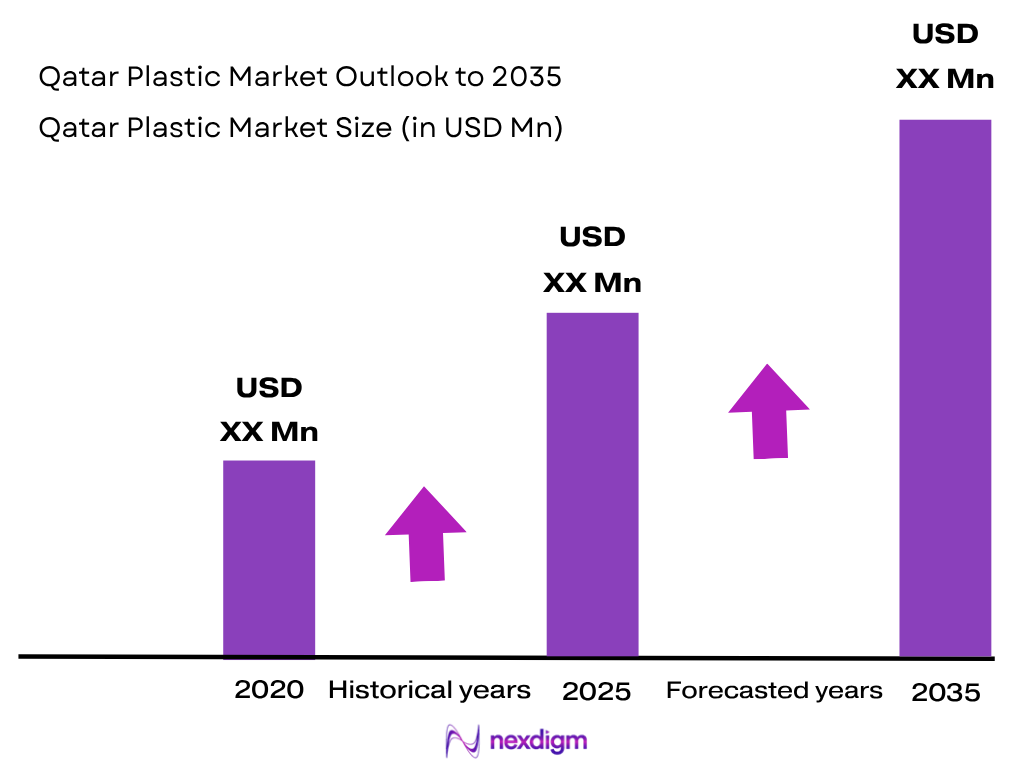
The Qatar Plastics Market is valued at USD ~XX billion in 2024, compared with USD ~XX billion in 2023, with demand supported by the country’s integrated petrochemical base, availability of natural-gas-derived feedstock, construction activity, packaging consumption, food and beverage processing, and oil and gas operations. Qatar’s position as a major LNG producer also supports an integrated hydrocarbon ecosystem in which polymer production and downstream plastic conversion can benefit from established feedstock, industrial infrastructure, logistics, and export capabilities. The market is forecast to expand at a CAGR of ~XX% during 2026–2035.
Qatar’s plastics industry is concentrated around Doha, Mesaieed, Ras Laffan, and Al Rayyan, reflecting the country’s industrial geography and concentration of petrochemical, manufacturing, construction, logistics, and commercial activities. Mesaieed is particularly important for petrochemical and downstream industrial activity, while Ras Laffan anchors the country’s large-scale energy and gas-processing ecosystem. Doha and surrounding municipalities generate substantial demand from packaging, construction, consumer products, food and beverage, healthcare, and industrial applications, supported by concentrated infrastructure and distribution networks.
Market Segmentation
By Polymer Type
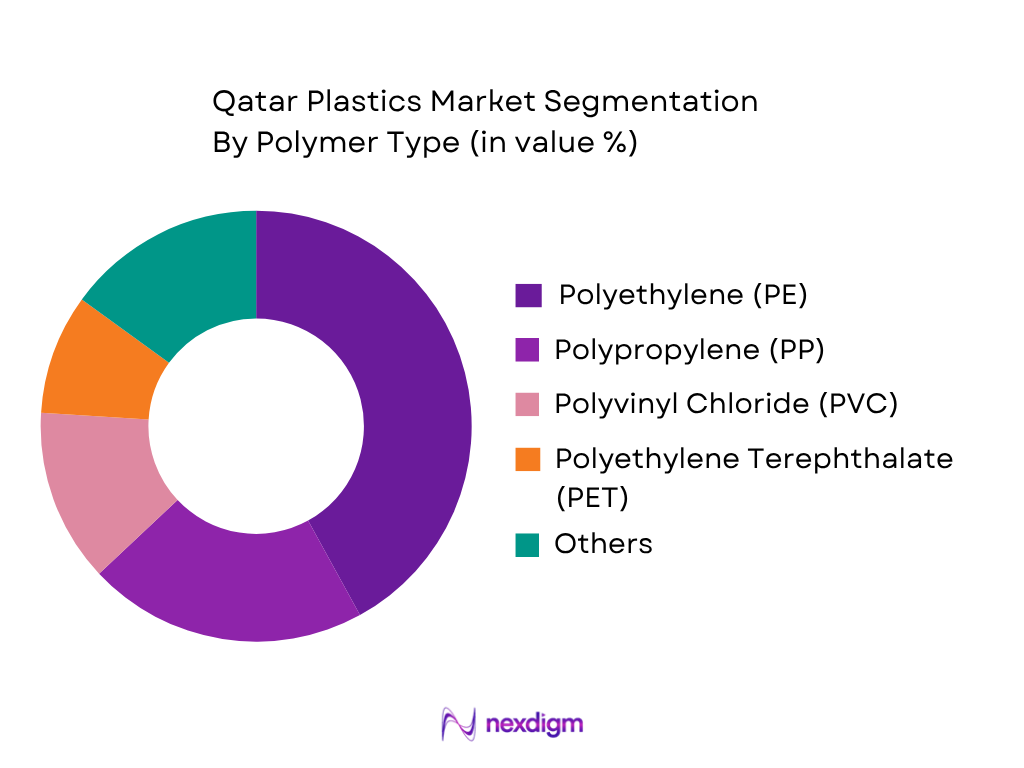
The Qatar Plastics Market is segmented by polymer type into polyethylene, polypropylene, polyvinyl chloride, polyethylene terephthalate, polystyrene, engineering plastics, and other specialty polymers. Polyethylene is expected to represent the dominant sub-segment, supported by its extensive use in packaging films, containers, pipes, industrial packaging, household products, and construction applications. Qatar’s integrated petrochemical ecosystem provides a strong foundation for polyethylene availability, while the material’s versatility enables converters to serve multiple downstream industries with the same polymer family. HDPE, LDPE, and LLDPE address different requirements ranging from rigid containers and pipes to flexible films and packaging. Demand from food and beverage packaging, industrial packaging, construction, and consumer products further reinforces polyethylene consumption. Its processing flexibility through extrusion, blow moulding, injection moulding, and film production also supports broad converter adoption. The segment’s combination of established supply, diverse applications, and compatibility with Qatar’s downstream manufacturing structure makes it a central polymer category.
By End-Use Industry
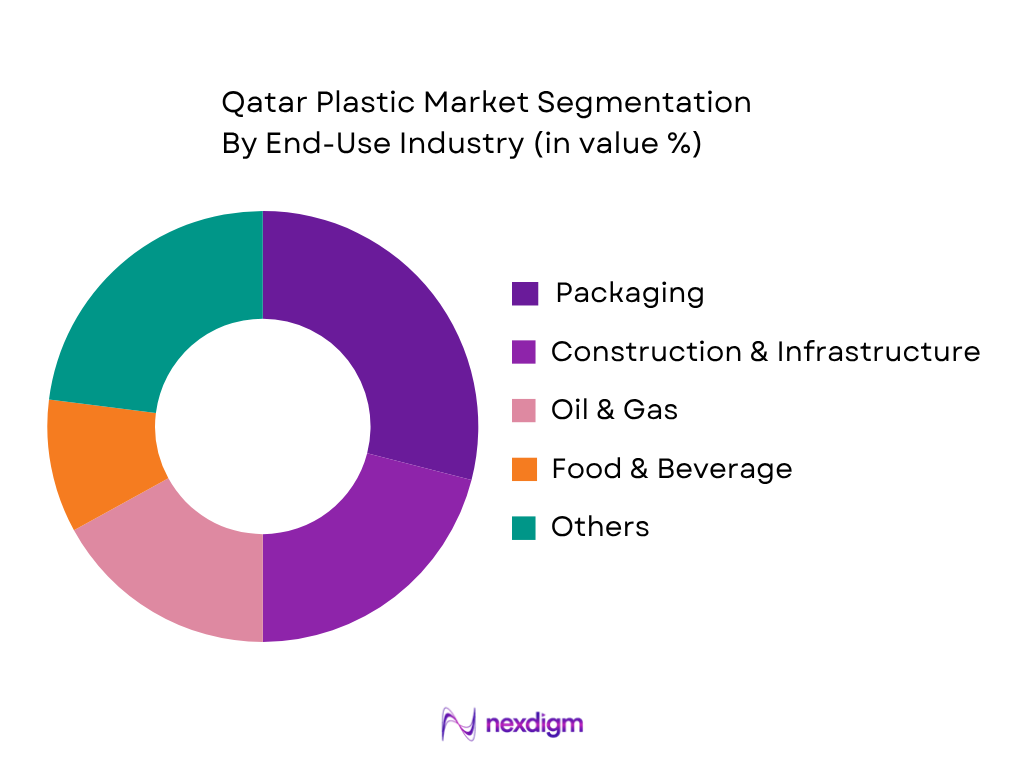
The Qatar Plastics Market is segmented by end-use industry into packaging, construction and infrastructure, oil and gas, petrochemicals and chemicals, food and beverage, healthcare and pharmaceuticals, electrical and electronics, automotive and transportation, agriculture, industrial manufacturing, and consumer products. Packaging is expected to maintain the leading position because plastics provide lightweight, durable, hygienic, and adaptable solutions for food, beverages, household goods, industrial materials, and consumer products. Qatar’s concentrated food and beverage distribution system and high dependence on packaged products create recurring requirements for bottles, containers, films, trays, closures, and flexible packaging. Construction also remains a major downstream application because plastic pipes, fittings, insulation materials, profiles, membranes, and protective products are used across infrastructure and building projects. Oil and gas contributes additional demand for technically specified polymer products used in industrial environments. The combination of recurring packaging consumption and diversified industrial applications gives packaging a broad customer base while allowing plastic converters to serve multiple end-use industries.
Competitive Landscape
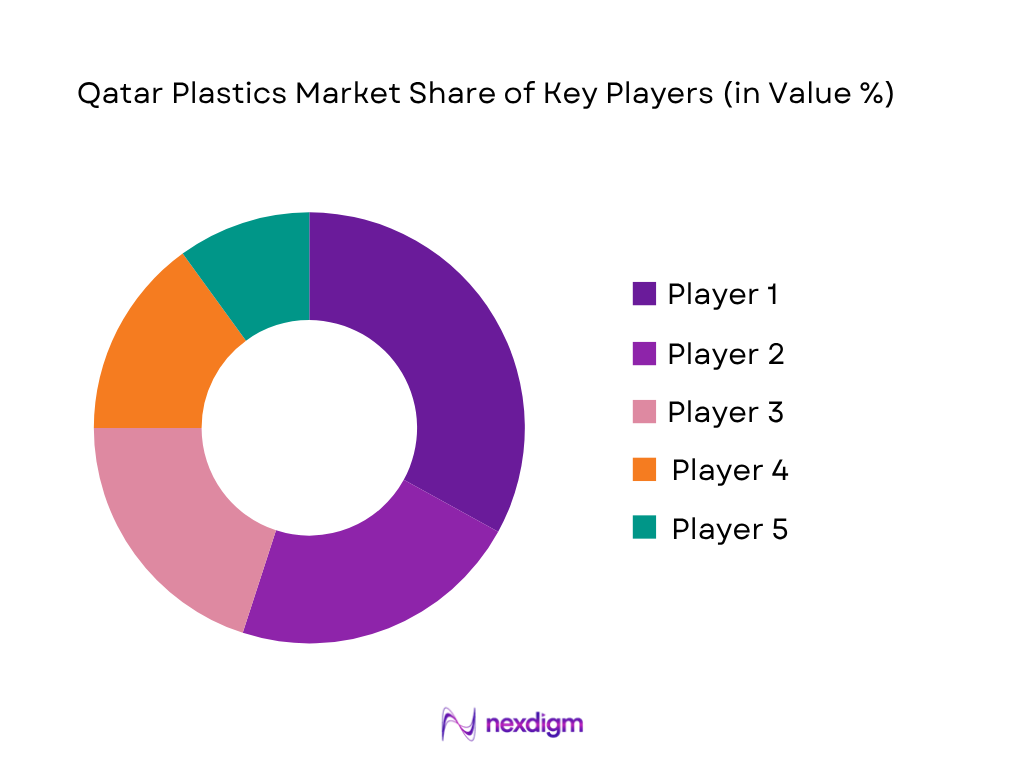
The Qatar Plastics Market includes integrated petrochemical producers, polymer manufacturers, plastic converters, packaging companies, industrial product manufacturers, and recycling operators. Competition is influenced by access to feedstock, polymer availability, conversion capabilities, product customization, industrial customer relationships, export connectivity, and technological capabilities. Large integrated participants benefit from proximity to Qatar’s hydrocarbon infrastructure, while downstream converters compete through specialized packaging, industrial products, processing capabilities, and customer-specific.
| Company | Establishment | Headquarters | Primary Plastics Focus | Polymer / Product Portfolio | Production / Conversion Capability | Key End-Use Markets | Geographic Reach | Sustainability Focus |
| QatarEnergy | 1974 | Doha, Qatar | ~ | ~ | ~ | ~ | ~ | ~ |
| QAPCO | 1974 | Doha, Qatar | ~ | ~ | ~ | ~ | ~ | ~ |
| Q-Chem | 1997 | Doha, Qatar | ~ | ~ | ~ | ~ | ~ | ~ |
| Qatofin | 2005 | Doha, Qatar | ~ | ~ | ~ | ~ | ~ | ~ |
| Qatar Vinyl Company | 1997 | Mesaieed, Qatar | ~ | ~ | ~ | ~ | ~ | ~ |
Qatar Plastics Market Analysis
Growth Drivers
Petrochemical Feedstock Availability
Qatar’s hydrocarbon-intensive economic structure provides a strong upstream foundation for domestic plastics and polymer manufacturing. The World Bank records Qatar’s 2024 GDP at US$219.16 billion and GDP per capita at US$76,688.7, indicating substantial economic capacity to support capital-intensive industrial operations. The IMF reports hydrocarbon GDP of QAR 317.0 billion in 2024, while natural-gas production reached 118.7 million tons and crude-oil production reached 580,000 barrels per day (IMF, 2024). This feedstock ecosystem is particularly relevant to polyethylene, polypropylene and other petrochemical-derived polymers because ethane, natural gas liquids and hydrocarbons support integrated polymer production. QatarEnergy’s downstream expansion further strengthens this advantage, with the North Field expansion designed to raise LNG capacity from 77 million tons per annum to 110 million tons per annum, alongside approximately 4,000 tons per day of ethane production (QatarEnergy, 2024). The availability of ethane creates a direct upstream linkage with ethylene and polyethylene production, reducing structural dependence on imported feedstock. Qatar’s industrial sector, including construction, manufacturing and petrochemicals, represented 58.2% of GDP in 2024 according to the World Bank, reinforcing the economic importance of industrial materials and polymer-intensive activities.
Polyethylene Production Capacity
Qatar’s established polyethylene production base is a major structural driver for the domestic plastics ecosystem because it supports both local conversion industries and export-oriented polymer flows. QAPCO operates an ethylene plant with 840,000 tonnes per annum capacity and three LDPE plants with combined capacity exceeding 780,000 tonnes per annum (QAPCO, 2024). Qatofin adds more than 570,000 tonnes per annum of LLDPE capacity, while Q-Chem and Q-Chem II together provide 803,000 tonnes per annum of polyethylene capacity (QAPCO; Q-Chem, 2024). QatarEnergy has also developed the Ras Laffan Petrochemical Complex around a 2.1 million tonnes per annum ethylene cracker and 1.7 million tonnes per annum of HDPE capacity, substantially strengthening the country’s polymer platform (QatarEnergy, 2024). These industrial capabilities operate within an economy where manufacturing and construction are significant components of industrial activity; World Bank data place industry including construction at 58.2% of GDP in 2024. The IMF additionally records non-hydrocarbon GDP of QAR 496.6 billion in 2024, demonstrating the expanding economic base outside hydrocarbons. Together, upstream feedstock availability, integrated ethylene infrastructure and large polyethylene facilities create favorable conditions for downstream plastic films, containers, pipes, packaging materials and industrial polymer products.
Market Challenges
Small Domestic Market Base
Qatar’s relatively limited population creates a structural constraint for plastics companies that depend primarily on domestic consumption rather than export markets. The World Bank records Qatar’s population at 2,857,822 people in 2024, compared with 2,656,032 in 2023, illustrating the country’s small absolute consumer base despite strong population growth. The same source records GDP per capita of US$76,688.7 in 2024, indicating high purchasing capacity but not a sufficiently large population to generate the domestic demand volumes available in major plastics-consuming economies. This creates a particular challenge for converters producing standardized packaging, household plastics and consumer products, where plant economics can depend on sustained domestic throughput. The IMF reports nominal non-hydrocarbon GDP of QAR 496.6 billion in 2024, demonstrating meaningful diversification, but the country remains strongly oriented toward energy and large industrial projects rather than mass consumer manufacturing. Qatar’s small domestic demand base therefore makes export markets strategically important for polymer producers and converters. QAPCO states that Qatofin LLDPE is mainly produced for export, illustrating how local polymer infrastructure already relies on international markets. Consequently, fluctuations in overseas demand, freight conditions and regional competition can have a disproportionate effect on utilization rates and downstream investment decisions.
Feedstock and Polymer Price Volatility
Qatar’s plastics industry remains exposed to international hydrocarbon and polymer-market cycles because its upstream advantage is closely connected to global energy economics. The IMF reports Qatar’s Brent crude benchmark at US$82.7 per barrel in 2024, compared with US$82.3 per barrel in 2023, while hydrocarbon exports were US$82.9 billion in 2024 (IMF, 2025). The same IMF assessment records natural-gas production of 118.7 million tons in 2024 and hydrocarbon GDP of QAR 317.0 billion, demonstrating the continued importance of energy-linked activity to the broader industrial ecosystem. For plastics producers, movements in crude oil, natural gas liquids and ethane economics can influence polymer production economics and international benchmark prices even when domestic feedstock availability is strong. Qatar’s exposure is amplified by its export orientation: QAPCO reports LLDPE production of more than 570,000 tonnes per annum, primarily serving international markets, while Q-Chem reports 803,000 tonnes per annum of polyethylene capacity (QAPCO; Q-Chem, 2024). International price movements can therefore affect both polymer producers and downstream converters. The World Bank’s 2024 GDP growth figure of 2.4% also indicates that the wider economy is expanding at a moderate pace, making external industrial cycles an important consideration for plastics investment planning.
Market Opportunities
Advanced Recycling and Circular Plastics Infrastructure
Qatar’s high-income industrial economy and expanding non-hydrocarbon activity create a foundation for developing higher-value recycling and circular-plastics infrastructure. World Bank data show GDP of US$219.16 billion and GDP per capita of US$76,688.7 in 2024, providing substantial economic capacity for industrial infrastructure investment. The IMF reports non-hydrocarbon GDP of QAR 496.6 billion in 2024, while real non-hydrocarbon GDP expanded by 1.9, indicating continuing diversification beyond hydrocarbons. Qatar’s industrial sector, including construction, accounted for 58.2% of GDP according to the World Bank, creating a large base of industrial and commercial activities that consume packaging, construction plastics, pipes, films and polymer components. This combination supports opportunities for mechanical recycling, sorting, washing, pelletizing and higher-quality recycled-resin production. The country’s polymer ecosystem is also unusually concentrated around large petrochemical facilities, creating potential integration between virgin polymer production and recycled-material streams. QatarEnergy’s North Field expansion is expected to generate approximately 4,000 tons per day of ethane, reinforcing the country’s broader petrochemical infrastructure while creating an opportunity to complement virgin polymer production with circular-material capabilities. Advanced recycling can therefore support domestic waste reduction while creating differentiated polymer grades for packaging, industrial components and construction applications.
Advanced Plastic Packaging and Export-Oriented Conversion
Qatar’s combination of high industrial output, strong food and consumer demand and substantial polymer availability creates opportunities to expand sophisticated plastic conversion rather than relying primarily on commodity resin production. The World Bank records 98 internet users per 100 people in 2024, supporting digitally enabled supply chains, industrial procurement and increasingly sophisticated distribution networks. Qatar’s population reached 2,857,822 in 2024, while GDP per capita stood at US$76,688.7, indicating strong purchasing capacity for packaged food, beverages, household goods and premium consumer products. The IMF reports nominal non-hydrocarbon GDP of QAR 496.6 billion and total exports of US$82.9 billion in 2024, providing an economic platform for downstream manufacturing linked to both domestic consumption and international trade. Existing polymer capacity strengthens this opportunity: QAPCO has more than 780,000 tonnes per annum of LDPE capacity and Qatofin has more than 570,000 tonnes per annum of LLDPE capacity. These polymers are suited to films, flexible packaging, wraps, containers and industrial packaging. Qatar can therefore move further downstream into multilayer films, high-barrier packaging, lightweight containers and specialized industrial packaging, using locally available polymers while targeting neighboring GCC and international markets. This supports manufacturing diversification and greater value capture from the country’s established petrochemical base.
Future Outlook
Over the coming decade, the Qatar Plastics Market is expected to benefit from continued downstream industrial development, petrochemical integration, packaging requirements, construction activity, and diversification of manufacturing applications. The country’s established hydrocarbon infrastructure provides an important foundation for polymer production and downstream conversion. At the same time, sustainability requirements are likely to encourage greater attention toward recycling, recycled resin, material efficiency, and circular polymer solutions. Growth in higher-value plastic products, specialized industrial components, advanced packaging, and export-oriented conversion could further diversify the market beyond commodity polymer applications.
Major Players
- QatarEnergy
- Qatar Petrochemical Company (QAPCO)
- Qatar Chemical Company (Q-Chem)
- Qatofin
- Qatar Vinyl Company (QVC)
- Qatar Plastic Products Company (QPPC)
- Qatar Industrial Manufacturing Company (QIMC)
- Qatar National Plastic Factory
- Doha Plastic Company
- Qatar Plastic and Wooden Products Company
- Gulf Plastic Industries
- Al Muftah Fiberglass Products
- Aamal Company
- Al Watania Plastic Products
- Power International Holding
Key Target Audience
- Polymer and Petrochemical Producers
- Plastic Packaging Manufacturers and Converters
- Construction and Infrastructure Material Manufacturers
- Oil and Gas Equipment and Industrial Product Manufacturers
- Food and Beverage Packaging Procurement Companies
- Investments and Venture Capitalist Firms (Qatar Investment Authority, regional private equity and infrastructure investors)
- Government and Regulatory Bodies (Ministry of Commerce and Industry, Ministry of Environment and Climate Change, Qatar Free Zones Authority)
- Recycling, Waste Management and Circular Economy Companies
Research Methodology
Step 1: Identification of Key Variables
The initial stage involves mapping Qatar’s plastics ecosystem across polymer producers, petrochemical companies, plastic converters, packaging manufacturers, industrial consumers, distributors, recyclers, and government entities. Key variables include polymer consumption, domestic production, imports, exports, conversion capacity, end-use demand, recycling activity, and industrial investment.
Step 2: Market Analysis and Construction
Historical market information is consolidated using a combination of production, trade, industrial activity, polymer consumption, downstream conversion, and end-use indicators. A bottom-up model evaluates demand across packaging, construction, oil and gas, food and beverage, healthcare, industrial manufacturing, and consumer applications, while a top-down model validates the resulting market structure.
Step 3: Hypothesis Validation and Expert Consultation
Market hypotheses are assessed through consultations with polymer producers, plastic converters, packaging manufacturers, industrial procurement professionals, distributors, and recycling operators. Industry discussions are used to validate application-level demand, product mix, capacity utilization, customer requirements, technology adoption, and competitive positioning.
Step 4: Research Synthesis and Final Output
The final stage triangulates supply-side and demand-side findings to construct the Qatar Plastics Market database and forecast framework. Company-level information, trade flows, production indicators, industrial activity, end-use requirements, and recycling developments are reconciled to improve consistency across market value, volume, segmentation, and competitive analysis.

- Executive Summary
- Research Methodology (Market Definition and Scope, Qatar Industrial Classification, Market Sizing Framework, Top-Down Market Assessment, Bottom-Up Market Assessment, Polymer Consumption Mapping, Production and Capacity Assessment, Import-Export Reconciliation, Demand-Side Analysis, Supply-Side Analysis, Primary Industry Interviews, Data Triangulation, Forecasting Framework, Assumptions and Limitations)

- Definition and Scope
- Qatar Plastics Industry Evolution and Petrochemical Development
- Plastic Manufacturing Ecosystem and Industrial Structure
- Qatar Plastics Value Chain Analysis
- Qatar Plastics Supply Chain Analysis
- Qatar Plastics Manufacturing and Conversion Ecosystem
- Qatar Plastics Industrial Cluster Assessment

- Growth Drivers (Petrochemical Feedstock Availability, Polyethylene Production Capacity, Packaging Demand, Construction Activity, Food and Beverage Processing, Oil and Gas Industrial Applications, Infrastructure Development, Manufacturing Diversification)
- Market Challenges (Feedstock and Polymer Price Volatility, Small Domestic Market Base, Recycling Infrastructure Constraints, Imported Machinery Dependency, Plastic Waste Management, Energy-Intensive Processing, Skilled Workforce Requirements, Exposure to International Polymer Markets)
- Market Opportunities (Polymer Conversion Expansion, Advanced Plastic Packaging, Recycled Resin Production, Circular Plastics Infrastructure, High-Performance Engineering Plastics, Sustainable Packaging, Industrial Plastic Components, Export-Oriented Plastic Manufacturing, Advanced Recycling Technologies)
- Market Trends (Circular Economy Adoption, Recycled Polymer Utilization, Sustainable Packaging, Lightweight Plastic Products, Advanced Polymer Processing, Industrial Diversification, High-Value Polymer Conversion, Digital Manufacturing)
- Government Regulations and Policy Environment (Environmental Protection, Plastic Waste Management, Industrial Licensing, Product Standards, Packaging Requirements, Recycling Policies, Circular Economy, Chemical Safety)
- Petrochemical Feedstock and Polymer Ecosystem Analysis (Ethane Feedstock, Ethylene, LDPE, HDPE, LLDPE, Polymer Derivatives, Domestic Conversion)
- SWOT Analysis
- Porter’s Five Forces Analysis
- PESTLE Analysis

- By Market Value (2020-2025)
- By Production Volume (2020-2025)
- By Domestic Plastic Consumption (2020-2025)
- By Polymer Resin Consumption (2020-2025)
- By Recycled Polymer Consumption (2020-2025)
- By Imports (2020-2025)
- By Exports (2020-2025)

- By Polymer Type (In Value %)
Polyethylene
High-Density Polyethylene
Low-Density Polyethylene
Linear Low-Density Polyethylene
Polypropylene
Polyvinyl Chloride
Polyethylene Terephthalate
Polystyrene
Engineering Plastics
Other Specialty Polymers - By Plastic Product Type (In Value %)
Plastic Films and Sheets
Plastic Bags and Sacks
Plastic Bottles and Containers
Rigid Plastic Packaging
Flexible Plastic Packaging
Plastic Pipes and Fittings
Plastic Profiles and Tubes
Plastic Household Products
Plastic Industrial Products
Plastic Construction Products - By Processing Technology (In Value %)
Blow Moulding
Injection Moulding
Extrusion
Thermoforming
Rotational Moulding
Compression Moulding
Film Extrusion
Pipe Extrusion - By End-Use Industry (In Value %)
Packaging
Construction and Infrastructure
Oil and Gas
Petrochemicals and Chemicals
Food and Beverage
Healthcare and Pharmaceuticals
Automotive and Transportation
Electrical and Electronics
Agriculture
Industrial Manufacturing
Consumer and Household Products - By Application (In Value %)
Food Packaging
Beverage Packaging
Industrial Packaging
Construction Materials
Pipes and Fittings
Agricultural Films
Consumer Packaging
Oil and Gas Applications
Industrial Components
Medical and Pharmaceutical Products
Electrical and Electronic Components - By Sales Channel (In Value %)
Direct OEM and Industrial Procurement
Plastic Distributors
Petrochemical Trading Companies
Industrial Wholesalers
Packaging Suppliers
Retail Distribution
Online B2B Procurement

- Market Share of Major Players (By Revenue, Polymer Type, Product Type, End-Use Industry, Production Capacity, Domestic Sales, Export Exposure)
- Cross Comparison Parameters (Polymer Portfolio Breadth, Polymer Production Capacity, Plastic Conversion Capability, Product Portfolio Breadth, Feedstock Integration, Domestic Manufacturing Footprint, Export Market Reach, Recycling and Circular Plastics Capability)
- SWOT Analysis of Major Players
- Detailed Profiles of Major Companies
QatarEnergy
Qatar Petrochemical Company (QAPCO)
Qatar Chemical Company (Q-Chem)
Qatofin
Qatar Plastic Products Company (QPPC)
Qatar Industrial Manufacturing Company (QIMC)
Qatar National Plastic Factory
Doha Plastic Company
Qatar Plastic and Wooden Products Company
Gulf Plastic Industries
Al Muftah Fiberglass Products
Aamal Company
Al Watania Plastic Products
Power International Holding

- End-User Demand Assessment
- Packaging Industry Demand Analysis
- Construction Plastics Demand Analysis
- Oil and Gas Plastics Demand Analysis
- Food and Beverage Plastics Demand Analysis

- By Market Value (2026-2035)
- By Production Volume (2026-2035)
- By Domestic Plastic Consumption (2026-2035)
- By Polymer Resin Consumption (2026-2035)
- By Recycled Polymer Consumption (2026-2035)
- By Imports (2026-2035)
- By Exports (2026-2035)


 Request a Sample
 Ask for Customization
 Get a Quote
 Enquire Now