
 Download PDF
Market Overview
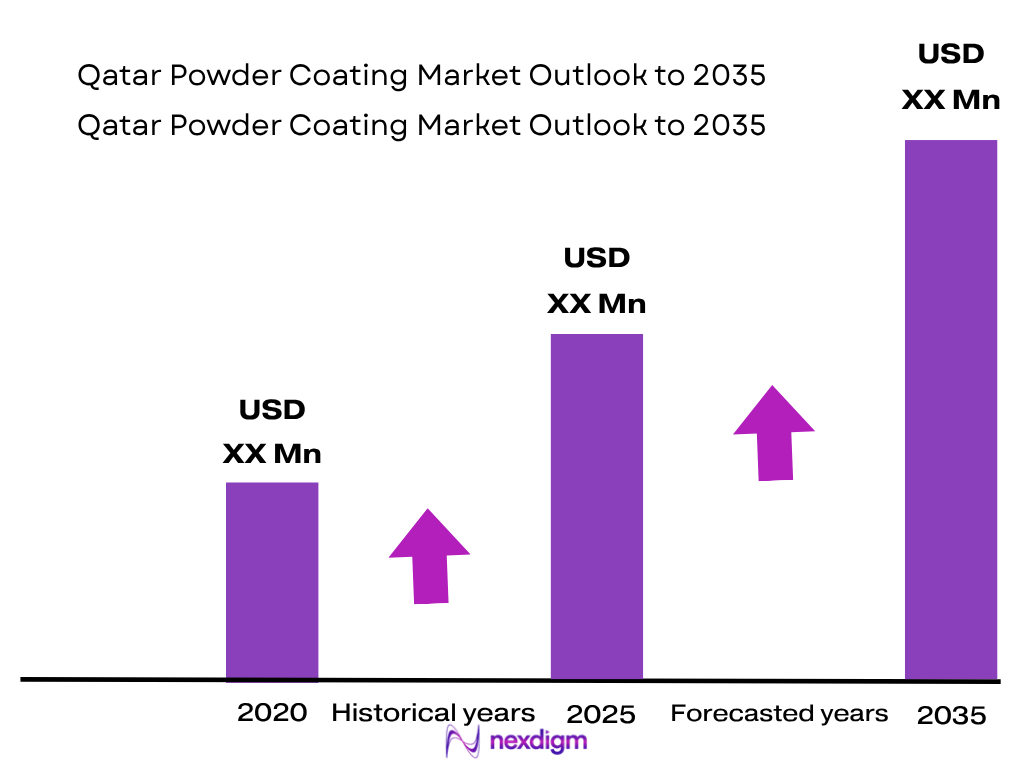
The Qatar Powder Coating Market is valued at approximately ~USD XX million, based on the requested placeholder valuation and historical market assessment. Demand is driven by architectural aluminium, LNG facilities, oil and gas equipment, HVAC systems, electrical enclosures, steel fabrication and infrastructure. Qatar’s real GDP increased from approximately QAR 697 billion in the preceding observation to QAR 713 billion in the latest observation, demonstrating an expanding economic base supporting construction and industrial coating requirements.
Doha, Ras Laffan Industrial City, Mesaieed Industrial City, Lusail and the Greater Doha industrial corridor represent Qatar’s most important powder-coating demand centres. Doha and Lusail concentrate architectural aluminium, façades and commercial construction, while Ras Laffan is central to LNG and energy infrastructure. Qatar’s LNG production base stands at 77 million tonnes annually, while Qatalum’s aluminium production capacity reaches 660,000 tonnes annually, creating downstream demand for coated aluminium, fabricated steel, cabinets, structures and industrial components.
Market Segmentation
By Resin Chemistry
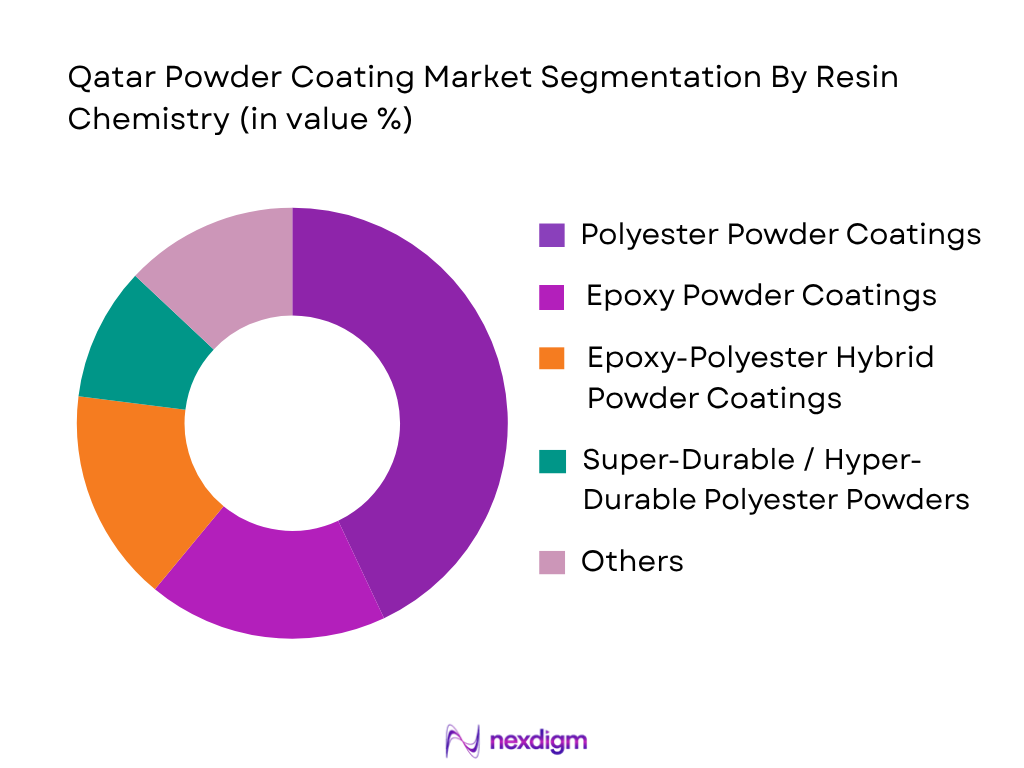
The Qatar Powder Coating Market is segmented into pure polyester, TGIC polyester, TGIC-free polyester, super-durable polyester, epoxy, epoxy-polyester hybrid, polyurethane and specialty powder systems. Polyester powder coatings dominate this segmentation because Qatar’s powder demand is heavily exposed to architectural aluminium, façades, windows, doors, louvers, railings, outdoor equipment and infrastructure operating under intense UV radiation, elevated temperatures, humidity and saline coastal conditions. These environmental conditions favour exterior-grade polyester technologies offering weathering and colour-retention performance. The architectural segment increasingly requires super-durable and higher-performance powders aligned with QUALICOAT and AAMA specifications. Products specifically offered for Qatar include architectural powders engineered for intense UV, high humidity and temperature exposure. Epoxy systems remain strategically important for pipelines, primers, electrical components and corrosion protection, while epoxy-polyester hybrids are used primarily for indoor furniture, cabinets and general industrial applications where exterior weatherability is less critical.
By End-Use Industry
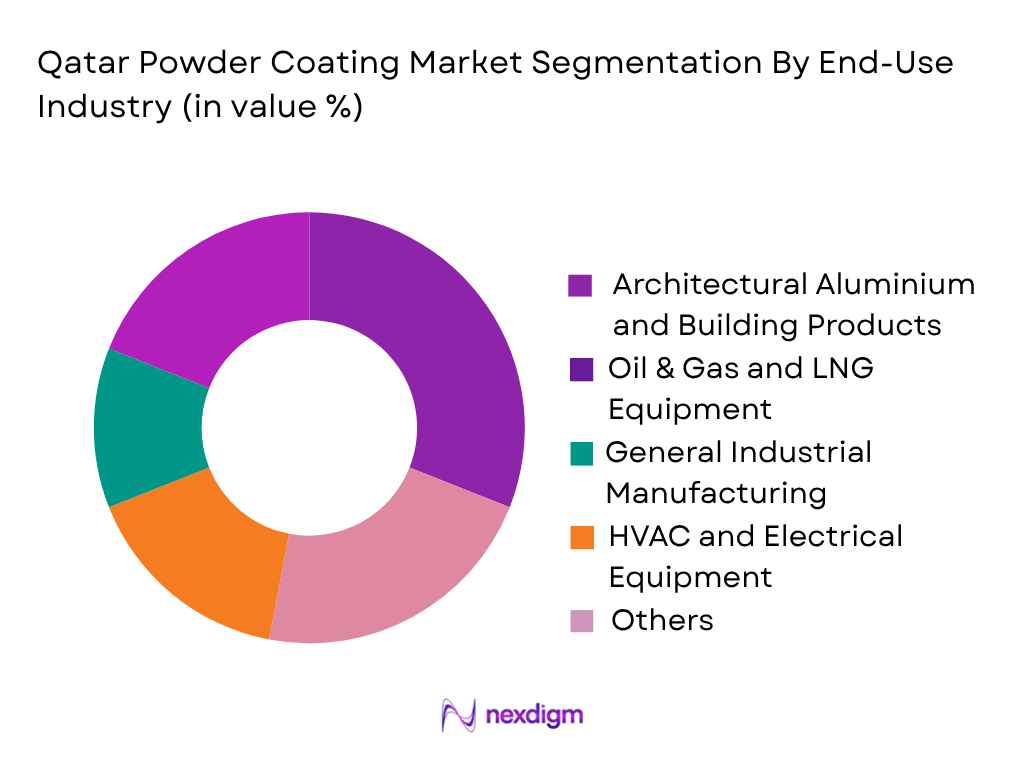
The Qatar Powder Coating Market is segmented into architectural aluminium and building products, oil and gas and LNG equipment, general industrial manufacturing, HVAC and electrical equipment, infrastructure and steel fabrication, and other applications. Architectural aluminium and building products hold the dominant position because Qatar’s urban development model extensively uses powder-coated aluminium in curtain walls, façades, windows, doors, louvers, railings and exterior architectural systems. Doha and Lusail generate substantial specification-led demand, while climatic exposure requires durable exterior finishing. Construction also remains an important component of Qatar’s non-hydrocarbon economy, with official national accounts showing continued expansion in construction activity. Oil and gas applications form another critical demand pool because Ras Laffan supports pipelines, valves, process skids, cabinets and fabricated infrastructure requiring corrosion-resistant coatings. Qatar’s LNG expansion further increases the strategic relevance of functional powders, FBE systems, powder primers and high-performance corrosion solutions for energy-related equipment and supporting infrastructure.
Competitive Landscape
The Qatar Powder Coating Market combines multinational powder-coating manufacturers, GCC-based producers and specialized regional suppliers serving Qatar through local offices, dealers, warehouses and approved applicators. Competition is particularly strong in architectural polyester, high-durability exterior powders, oil and gas protection systems and general industrial products. Jotun maintains a direct Qatar presence and powder dealer network, Axalta provides Qatar-specific powder-coating support, while Qemtex supplies Qatar from its UAE manufacturing base. Technical qualifications, local stock availability and project specification capability are therefore major competitive differentiators.
| Company | Establishment Year | Headquarters | Qatar Presence | Key Powder Portfolio | Architectural Capability | Oil & Gas / Corrosion Capability | Qatar / GCC Supply Footprint | Technical Positioning |
| Jotun | 1926 | Sandefjord, Norway | ~ | ~ | ~ | ~ | ~ | ~ |
| AkzoNobel | 1792 heritage | Amsterdam, Netherlands | ~ | ~ | ~ | ~ | ~ | ~ |
| National Paints | 1969 | Sharjah, UAE | ~ | ~ | ~ | ~ | ~ | ~ |
| Axalta Coating Systems | 1866 heritage | Philadelphia, USA | ~ | ~ | ~ | ~ | ~ | ~ |
| Qemtex | 2020s | Umm Al Quwain, UAE | ~ | ~ | ~ | ~ | ~ |
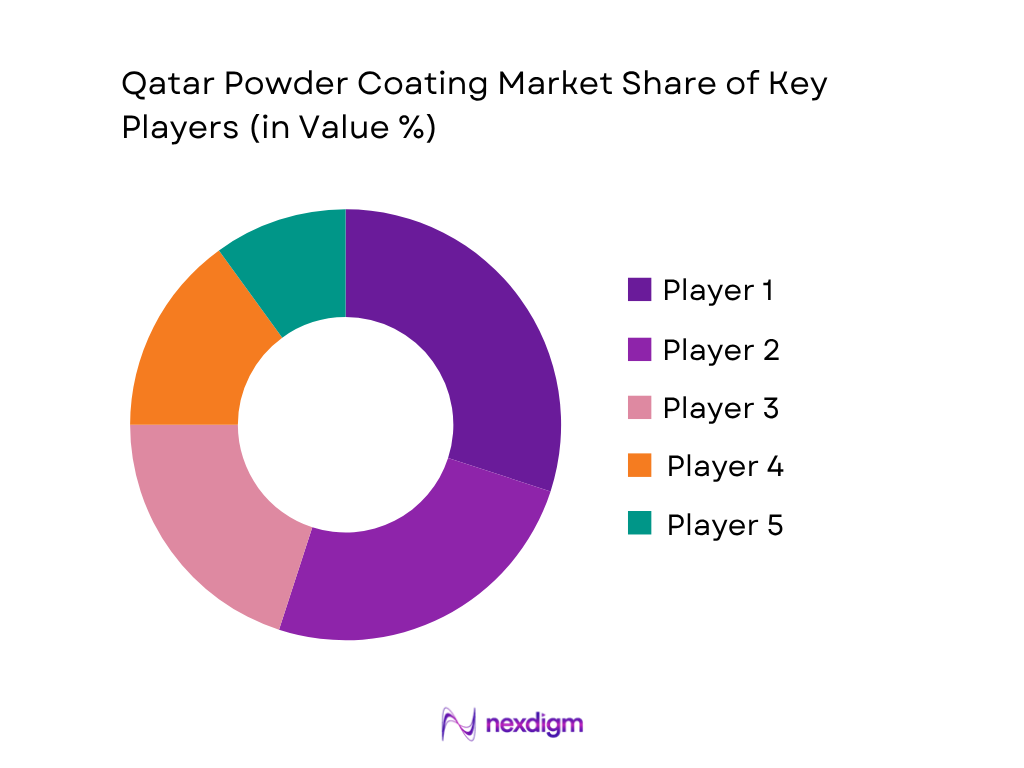
Qatar Powder Coating Market Analysis
Growth Drivers
LNG, Petrochemical and Energy Infrastructure Expansion
Qatar’s LNG and petrochemical investment cycle is a major growth driver for powder coatings because pipelines, valves, process skids, structural assemblies, electrical cabinets, support frames and fabricated equipment require durable corrosion-resistant finishes. Qatar’s current LNG production capacity stands at 77 million tonnes per annum, supported by 14 LNG trains, while North Field East involves 4 additional trains of 8 million tonnes per annum each. Qatar’s confirmed North Field gas resources exceed 2,000 trillion cubic feet, sustaining a large industrial equipment ecosystem around Ras Laffan. The Ras Laffan Petrochemical Complex broke ground in 2024 and includes an ethane cracker with 1.9 million tonnes of annual ethylene capacity, expanding downstream fabrication requirements for process and utility infrastructure. Qatar’s broader economy reinforces this demand base: nominal GDP reached QAR 813.6 billion in 2024, while nominal non-hydrocarbon GDP stood at QAR 496.6 billion. Manufacturing value added reached QAR 16.44 billion in the fourth quarter of 2024 and QAR 13.42 billion in the first quarter of 2025. These figures support recurring demand for fusion-bonded epoxy powders, high-temperature systems, corrosion-resistant primers, powder-on-powder systems and durable industrial polyester coatings across Qatar’s energy and downstream manufacturing infrastructure.
Construction, Architectural Aluminium and Infrastructure Activity
Qatar’s construction and architectural ecosystem provides another strong growth driver for powder coatings used on aluminium façades, curtain walls, windows, doors, railings, louvers, HVAC enclosures, street furniture and fabricated infrastructure. Construction value added reached QAR 23.948 billion in the fourth quarter of 2024, while it remained at QAR 19.20 billion in the first quarter of 2025, demonstrating a large continuing physical construction base. Building-permit activity also remained active: Al Rayyan issued 235 permits in August 2024, Al Daayen issued 147, Doha issued 123, and Al Wakrah issued 96. New-building permits in that month totaled 283, while building additions accounted for another 419 permits. Infrastructure programs further expand the coated-metal opportunity. Two road-development packages completed in Al Ebb and Leabaib during 2024 serve 1,910 residential plots, while the wider program covers 5,592 plots. Infrastructure services were also completed for 7,833 citizen subdivision plots across Qatar during 2024. With national nominal GDP at QAR 813.6 billion in 2024 and non-hydrocarbon GDP at QAR 496.6 billion, these construction indicators support continued demand for super-durable polyester, TGIC-free architectural powders, metallic finishes and corrosion-protection systems designed for Qatar’s exterior building environment.
Market Challenges
Project-Driven Volatility in Construction and Fabrication Demand
Qatar’s powder-coating market remains exposed to fluctuations in construction and project execution because a large proportion of demand originates from façades, aluminium profiles, structural steel, HVAC equipment, electrical cabinets and infrastructure components tied to individual developments. Construction value added reached QAR 23.948 billion in the fourth quarter of 2024, but stood at QAR 19.20 billion in the first quarter of 2025, illustrating how activity can shift materially between project phases. This volatility affects powder suppliers because architectural colours, qualified exterior systems and project-specific batches may be ordered in irregular volumes rather than through predictable continuous production. Building-permit data reinforce the uneven geographical nature of demand: 235 permits were issued in Al Rayyan during August 2024, compared with 147 in Al Daayen, 123 in Doha, 96 in Al Wakrah, 49 in Umm Salal, 40 in Al Khor, 23 in Al Shahaniya and 8 in Al Shamal. Qatar’s overall macroeconomic base remained substantial, with nominal GDP of QAR 813.6 billion in 2024 and non-hydrocarbon GDP of QAR 496.6 billion, but individual applicators can still face fluctuating line utilization when major architectural or EPC packages move between fabrication, installation and completion stages.
High Technical Requirements for Corrosion and Exterior Durability
Qatar’s operating environment creates a technical challenge for powder-coating suppliers because coated aluminium, steel, electrical cabinets, HVAC housings and industrial assets must perform reliably under intensive outdoor exposure and highly loaded utility infrastructure. Qatar’s electricity system reached a summer peak load of 10,220 MW in 2024, while thermal generation capacity stood at 10,573 MW at the end of 2024 alongside 800 MWDC of solar capacity. The national transmission system had 415 primary substations as of May 2024, while the distribution network reached 23,114 substations by the end of 2024. These assets create substantial coating requirements but also demand consistent corrosion resistance, edge coverage, adhesion and long-term exterior performance. Industrial operating conditions are similarly demanding around Ras Laffan, Mesaieed and coastal infrastructure, where functional powder systems must protect metal equipment used in energy, utilities and process industries. Qatar’s nominal GDP reached QAR 813.6 billion in 2024, including QAR 317.0 billion of hydrocarbon GDP, emphasizing the economic importance of environments where coating failure can have significant operational consequences. Suppliers therefore face higher qualification requirements than those serving primarily indoor decorative applications, including strict pretreatment control, film-build consistency, cure verification and specification-driven product selection.
Market Opportunities
Electrical Grid, Substation and Utility Equipment Coatings
Qatar’s expanding electricity infrastructure creates a forward growth opportunity for powder coatings used on switchgear, transformer enclosures, control cabinets, cable-support systems, substation equipment, lighting structures and fabricated electrical housings. The country’s maximum electricity load reached 10,220 MW in summer 2024, while available thermal generation capacity stood at 10,573 MW and solar capacity added another 800 MWDC. The number of primary substations reached 415 in May 2024, while the distribution network contained 23,114 substations at the end of 2024, demonstrating a substantial existing installed base requiring protective metal finishing. In 2025, Qatar signed 4 strategic electricity-network contracts valued at approximately QAR 3.1 billion covering 7 high-voltage substations and 212 kilometres of associated underground cables and overhead lines. This current investment creates opportunities for epoxy, polyester, dielectric, low-bake and corrosion-resistant powder technologies used across enclosure and support structures. Qatar’s nominal GDP reached QAR 813.6 billion in 2024, while non-hydrocarbon GDP reached QAR 496.6 billion, providing a broad economic base for utility expansion. Powder suppliers capable of providing thin-film systems, strong edge coverage, electrical insulation performance and rapid technical qualification can increasingly target switchgear manufacturers, panel builders, EPC contractors and utility-equipment fabricators.
Super-Durable Architectural and Infrastructure Powder Systems
Qatar’s continuing urban and infrastructure development creates a strong future opportunity for super-durable and high-corrosion-resistance powder coatings engineered for aluminium façades, external metalwork, street infrastructure, residential developments and public facilities. Current activity provides a substantial installed demand base: infrastructure services were completed for 7,833 residential subdivision plots in 2024, while the Al Ebb and Leabaib road and infrastructure program is designed to serve 5,592 plots, including 1,910 plots covered by two packages completed or substantially completed during 2024. Another infrastructure project in Al Egda, Al Heedan and Al Khor serves 738 plots. Building-permit activity further demonstrates continuing fabrication demand, with 235 permits in Al Rayyan, 147 in Al Daayen, 123 in Doha and 96 in Al Wakrah during August 2024. Construction value added reached QAR 23.948 billion in the fourth quarter of 2024, while national nominal GDP stood at QAR 813.6 billion. These current physical and economic indicators support future demand for QUALICOAT-oriented exterior polyester, super-durable powders, bonded metallic finishes, TGIC-free technologies, corrosion-resistant primers and powder-on-powder protection. Suppliers with rapid custom-colour development and strong applicator support can address Qatar’s expanding façade, aluminium extrusion, public-infrastructure and premium architectural finishing requirements.
Future Outlook
The Qatar Powder Coating Market is expected to expand at approximately ~X.X% CAGR during 2026–2035, using the requested placeholder assumption. Future growth will be supported by LNG infrastructure, architectural renovation and construction, aluminium fabrication, HVAC equipment, electrical infrastructure and high-corrosion industrial applications. Greater emphasis on super-durable exterior finishes, powder-on-powder corrosion systems and lower-temperature curing technologies should gradually increase the technical sophistication of the market.
Qatar’s energy investment pipeline is particularly important to this outlook. The North Field expansion is designed to raise national LNG capacity from 77 million tonnes annually to 142 million tonnes annually, creating a long-duration industrial development cycle around Ras Laffan. Such projects require extensive fabricated steel, pipe systems, electrical cabinets, support equipment, valves and associated infrastructure, expanding the addressable application base for functional and corrosion-resistant powder technologies.
Major Players
- Jotun Paints Qatar W.L.L. – Jotun Powder Coatings
- AkzoNobel – Interpon Powder Coatings
- National Paints Factories Co. Ltd. – National Powder Coatings
- PPG Industries – Envirocron
- Axalta Coating Systems – Alesta / Nap-Gard / Plascoat
- The Sherwin-Williams Company – Powdura / Inver
- Pulver Kimya – Pulver Powder Coatings
- TIGER Coatings – TIGER Drylac
- IGP Pulvertechnik AG – IGP Powder Coatings
- Qemtex Powder Coatings
- Protech Group – Oxyplast
- KANSAI HELIOS – Powder Coatings
- ST Powder Coatings
- Neokem – Powder Coatings
- Adapta Color – Architectural and Functional Powder Coatings
Key Target Audience
- Powder Coating Manufacturers
- Architectural Aluminium Extruders and Façade Fabricators
- Oil & Gas, LNG and Petrochemical Equipment Manufacturers
- Industrial Steel Fabricators and Powder Coating Job Coaters
- HVAC, Electrical Equipment and Switchgear Manufacturers
- Powder Resin, Pigment, Additive and Application Equipment Suppliers
- Investments and Venture Capitalist Firms
- Government and Regulatory Bodies (Ministry of Commerce and Industry, Ministry of Environment and Climate Change, Qatar General Organization for Standards and Metrology, Qatar Civil Defence, Ashghal – Public Works Authority)
Research Methodology
Step 1: Identification of Key Variables
The initial phase involves constructing an ecosystem map encompassing powder manufacturers, GCC suppliers, distributors, aluminium extruders, façade fabricators, steel processors, job coaters, EPC contractors and industrial end users within the Qatar Powder Coating Market. Secondary and proprietary databases are assessed to identify resin chemistry, coating volume, application technologies, import dependence, specification requirements, end-use industries and regional demand clusters influencing market performance.
Step 2: Market Analysis and Construction
Historical information is analyzed using complementary top-down and bottom-up approaches. The top-down model evaluates construction, aluminium, LNG, industrial manufacturing, infrastructure, HVAC and electrical-equipment activity, while the bottom-up framework assesses powder suppliers, distribution volumes, applicator throughput, coating-line capacities and project demand. Results are reconciled across resin chemistry, functional performance and end-use applications to construct the Qatar Powder Coating Market model.
Step 3: Hypothesis Validation and Expert Consultation
Market hypotheses are validated through structured interviews and computer-assisted telephone interviews with powder suppliers, aluminium processors, job coaters, fabricators, equipment providers and industrial buyers. Discussions assess powder consumption, film thickness, curing temperatures, powder recovery, pretreatment, project specifications, colour approvals and supplier-selection practices. These primary insights are used to validate secondary findings and refine assumptions concerning competition, consumption patterns and technology adoption.
Step 4: Research Synthesis and Final Output
The final stage triangulates supplier-level information with demand-side industry indicators and application-line metrics. Powder consumption is cross-checked against coated surface area, aluminium and steel processing, construction activity, project specifications and functional coating requirements. Direct interactions with applicators and end users are incorporated to verify bottom-up calculations, ensuring that the final Qatar Powder Coating Market assessment provides a consistent view of demand, competition, segmentation and future opportunities.

- Executive Summary
- Research Methodology (Market Definition and Scope, Qatar Powder Coating Taxonomy, Thermoset and Thermoplastic Powder Classification, Resin Chemistry Mapping, Architectural and Functional Powder Classification, Substrate Mapping, Surface Pretreatment Assessment, Electrostatic Application Technology Assessment, Cure Technology Assessment, Film Thickness Assessment, Powder Recovery and Reclaim Assessment, Market Sizing Framework)

- Definition and Scope
- Qatar Powder Coating Industry Evolution and Technology Development
- Powder Coating Manufacturing, Import and Application Ecosystem
Powder Coating Value Chain Analysis - Qatar Powder Coating Supply Chain Analysis
- Resin, Pigment, Additive and Filler Ecosystem Analysis
- Qatar Powder Coating Import Dependency and GCC Supply Assessment
- Architectural Aluminium, Fabricator and Job-Coater Application Framework

- Growth Drivers (Expansion of Architectural and Façade Construction, LNG and Gas Infrastructure Development, Growth of Oil and Gas Fabrication, Expansion of Aluminum and Steel Processing, Rising HVAC and Electrical Equipment Demand, Infrastructure Development, Liquid-to-Powder Conversion, Increasing Demand for Corrosion-Resistant Finishes)
- Market Challenges (High Dependence on Imported Powder and Raw Materials, Limited Domestic Powder Manufacturing Scale, Extreme Heat and UV Exposure, Marine and Saline Corrosion Conditions, Energy-Intensive Cure Requirements, Project-Driven Demand Cyclicality, Applicator Qualification Requirements, Price Competition from GCC Imports)
- Market Opportunities (Super-Durable and Hyper-Durable Architectural Powders, Low-Bake and Fast-Cure Powders, LNG and Pipeline Functional Powders, Fusion-Bonded Epoxy Systems, Marine Corrosion-Protection Powders, Powder-on-Powder Steel Protection, Automated Powder Application Systems, Local Stocking and Custom Color Capability)
- Market Trends (TGIC-Free Polyester Adoption, QUALICOAT Class 2 and Class 3 Architectural Powders, Low-Bake Fast-Cure Systems, Bonded Metallic and Fine-Texture Finishes, Functional Powder Coatings, Chrome-Free Pretreatment, Automated Powder Application, High-Efficiency Powder Recovery Systems)
- Regulatory and Standards Landscape (Ministry of Commerce and Industry Industrial Requirements, Ministry of Environment and Climate Change Environmental Requirements, Qatar Civil Defence Fire and Safety Requirements, Qatar Construction Specifications, Hazardous Chemical Handling Requirements, Industrial Air Emission Requirements, Occupational Safety Requirements, ASTM and ISO Powder Coating Test Standards)
- SWOT Analysis
- Porter’s Five Forces Analysis
- PESTLE Analysis
- Stakeholder Ecosystem
- Competition Ecosystem

- By Market Value (2020-2025)
- By Powder Coating Consumption Volume (2020-2025)
- By Coated Surface Area (2020-2025)
- By Domestic Application Volume (2020-2025)
- By Import Volume (2020-2025)
- By Re-Export Volume (2020-2025)
- By Average Selling Price (2020-2025)
- By Thermoset Powder Consumption (2020-2025)
- By Thermoplastic Powder Consumption (2020-2025)

- By Resin Chemistry (In Value %)
Pure Polyester Powder Coatings
TGIC Polyester Powder Coatings
TGIC-Free Polyester Powder Coatings
Super-Durable Polyester Powder Coatings
Hyper-Durable Polyester Powder Coatings
Epoxy Powder Coatings
Epoxy-Polyester Hybrid Powder Coatings
Polyurethane Powder Coatings
Acrylic Powder Coatings
Fluoropolymer Powder Coatings
Silicone Polyester Powder Coatings
Nylon Powder Coatings
Polyethylene Powder Coatings
Other Specialty Thermoplastic Powders - By Coating Technology (In Value %)
Thermosetting Powder Coatings
Thermoplastic Powder Coatings
Low-Temperature Cure Powder Coatings
Low-Bake Fast-Cure Powder Coatings
Ultra-Low-Bake Powder Coatings
UV-Curable Powder Coatings
Thin-Film Powder Coatings
High-Temperature Resistant Powder Coatings - By Functional Performance (In Value %)
Decorative Powder Coatings
Corrosion-Resistant Powder Coatings
Super-Durable Architectural Powders
Hyper-Durable Architectural Powders
High-Temperature Powder Coatings
Electrical Insulation and Dielectric Powders
Chemical-Resistant Powder Coatings
Scratch-Resistant Powder Coatings
Marine and Coastal Corrosion-Protection Powders
Oil and Gas Functional Powder Coatings
Fusion-Bonded Epoxy Powders
Rebar Powder Coatings
Zinc-Rich Powder Primers
Zinc-Free Corrosion-Protection Primers - By End-Use Industry (In Value %)
Architectural Aluminum and Façade Systems
Oil and Gas and LNG Equipment
General Industrial Manufacturing
Construction and Infrastructure
Steel Fabrication and Structural Components
HVAC and Air-Conditioning Equipment
Electrical Equipment and Switchgear
Furniture and Interior Metal Products
Automotive and Transportation Components
Pipes, Valves and Fluid-Handling Equipment
Marine and Port Equipment
Petrochemical Equipment
Renewable Energy Equipment
Telecommunication Equipment - By Distribution Channel (In Value %)
Direct Powder Manufacturer-to-Applicator Sales
Direct Manufacturer-to-Fabricator Sales
Authorized Powder Coating Distributors
Industrial Paint and Coating Distributors
Regional GCC Stocking Warehouses
Local Qatar Stocking Warehouses
Dealer and Reseller Networks
Project-Specific Supply Contracts
Applicator-Approved Powder Supply
Custom Color and Small-Batch Channels - By Region (In Value %)
Doha
Al Rayyan
Al Wakrah
Al Daayen and Lusail
Al Khor and Al Thakhira
Umm Salal
Al Shahaniya
Al Shamal
Ras Laffan Industrial City
Mesaieed Industrial City
Dukhan Industrial Area
Remaining Qatar

- Market Share of Major Players (By Revenue, Volume, Resin Chemistry, Powder Technology, End-Use Industry, Architectural versus Industrial Demand, Supply Origin, Distribution Channel)
- Cross Comparison Parameters (Qatar and GCC Manufacturing and Supply Footprint, Resin Chemistry and Powder Technology Breadth, Super-Durable and Hyper-Durable Architectural Powder Capability, QUALICOAT-Seaside and Harsh-Climate Qualification Strength, Oil and Gas and Fusion-Bonded Epoxy Capability, Marine and Heavy-Corrosion Protection Portfolio, Custom Color Matching and Local Technical Application Support, Sustainable TGIC-Free and Low-Energy Powder Portfolio)
- SWOT Analysis of Major Players
- Competitive Positioning Matrix
- Pricing and Distribution Network Benchmarking
- Detailed Profiles of Major Companies
Jotun Paints Qatar W.L.L. – Jotun Powder Coatings
AkzoNobel – Interpon Powder Coatings
National Paints Factories Co. Ltd. – National Powder Coatings
PPG Industries – Envirocron
Axalta Coating Systems – Alesta / Nap-Gard / Plascoat
The Sherwin-Williams Company – Powdura / Inver
Pulver Kimya – Pulver Powder Coatings
TIGER Coatings – TIGER Drylac
IGP Pulvertechnik AG – IGP Powder Coatings
Qemtex Powder Coatings
Protech Group – Oxyplast
KANSAI HELIOS – Powder Coatings
ST Powder Coatings
Neokem – Powder Coatings
Adapta Color – Architectural and Functional Powder Coatings

- Buyer Segmentation
- Architect and Consultant Specification Behaviour
- EPC Contractor Procurement Behaviour
- Aluminium Fabricator Procurement Behaviour
- Supplier Selection Criteria
- Buyer Pain Points
- Technology Adoption Assessment
- Replacement and Repurchase Behaviour

- By Market Value (2026-2035)
- By Powder Coating Consumption Volume (2026-2035)
- By Coated Surface Area (2026-2035)
- By Domestic Application Volume (2026-2035)
- By Import Volume (2026-2035)
- By Re-Export Volume (2026-2035)
- By Average Selling Price (2026-2035)
- By Thermoset Powder Consumption (2026-2035)
- By Thermoplastic Powder Consumption (2026-2035)


 Request a Sample
 Ask for Customization
 Get a Quote
 Enquire Now