

 Download PDF
Market Overview
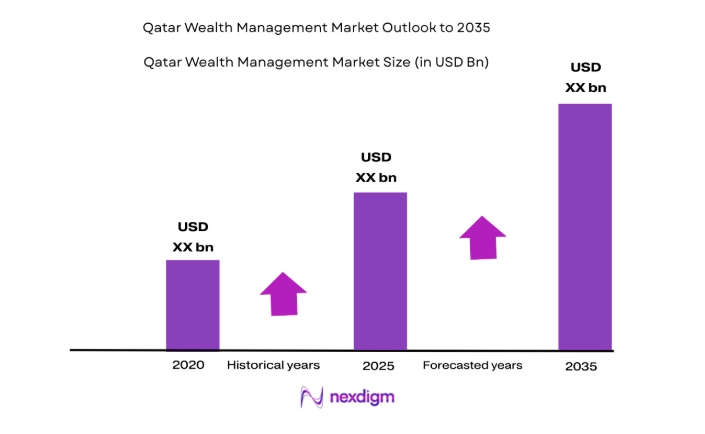
Qatar wealth management market recorded approximately USD ~ billion in assets under management based on disclosures from Qatar Central Bank and major domestic private banks, reflecting a concentrated high-net-worth client base and sovereign-linked wealth pools. Growth is driven by hydrocarbon-derived private capital accumulation, family-owned conglomerate liquidity events, and institutionalization of family offices seeking structured global portfolio diversification, advisory, and estate planning solutions within regulated financial centre frameworks.
Doha dominates Qatar wealth management market activity due to concentration of private banks, Qatar Financial Centre licensed firms, and proximity to sovereign and family holding headquarters managing regional assets. International wealth hubs including Geneva, London, and Dubai influence portfolio allocation preferences as Qatari investors maintain offshore custodial relationships and global investment mandates, supported by cross-border advisory networks and regulatory compatibility enabling international asset diversification and multi-jurisdiction wealth structuring.
Market Segmentation
By Product Type
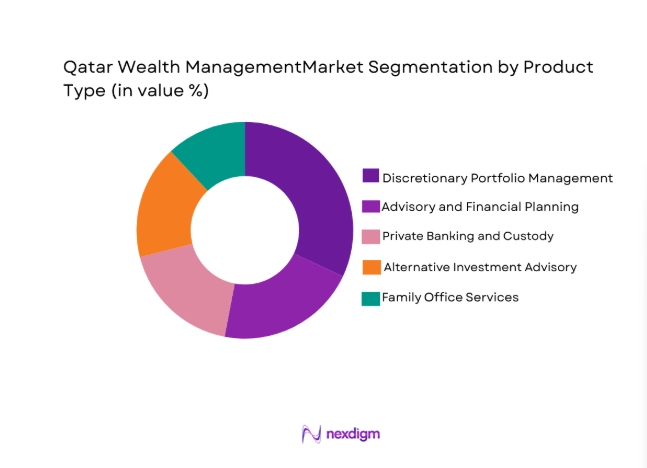
Qatar Wealth Management Market is segmented by product type into discretionary portfolio management, advisory and financial planning, private banking and custody, alternative investment advisory, and family office services. Recently, discretionary portfolio management has a dominant market share due to factors such as strong demand from ultra-high-net-worth families for institutional-style allocation, preference for delegated investment authority, global diversification needs, and access to private market opportunities through established private banking platforms and experienced portfolio management teams.
By Platform Type
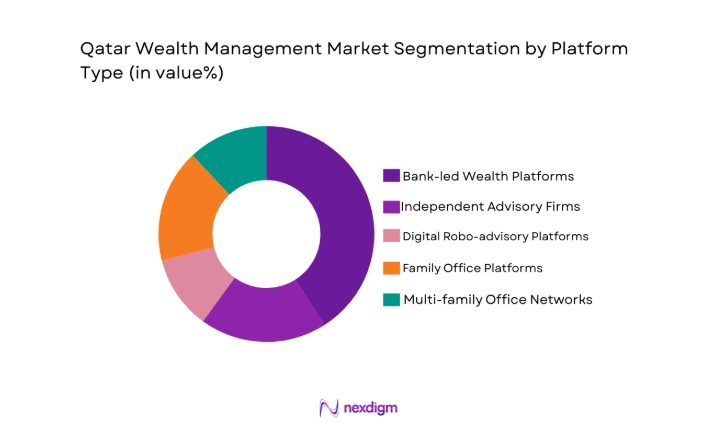
Qatar Wealth Management Market is segmented by platform type into bank-led wealth platforms, independent advisory firms, digital robo-advisory platforms, family office platforms, and multi-family office networks. Recently, bank-led wealth platforms have a dominant market share due to factors such as established client trust, integrated custody and lending services, regulatory familiarity, international investment access, and deep relationship management capabilities anchored in domestic financial institutions and global private banking alliances.
Competitive Landscape
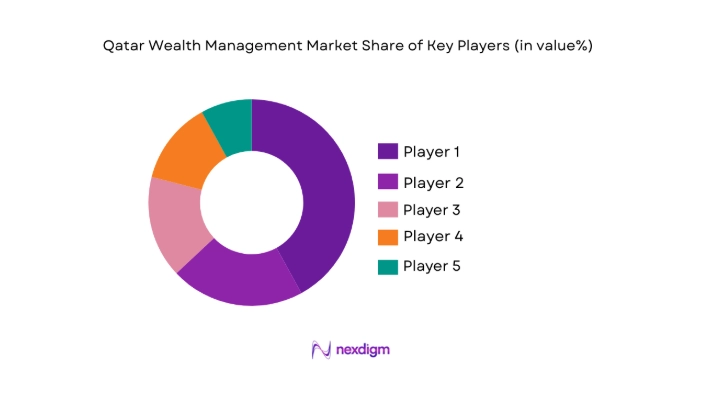
Qatar wealth management market is moderately concentrated, led by domestic private banks and regional subsidiaries of global private banking groups that compete on relationship depth, Sharia-compliant structuring capability, and international investment access. Market consolidation reflects high entry barriers from licensing, client trust requirements, and custody infrastructure, while major players leverage cross-border platforms and family office services to capture ultra-high-net-worth mandates.
| Company Name | Establishment Year | Headquarters | Technology Focus | Market Reach | Key Products | Revenue | Sharia Capability |
| QNB Private Banking | 1964 | Doha | ~ | ~ | ~ | ~ | ~ |
| Qatar Islamic Bank Private Banking | 1982 | Doha | ~ | ~ | ~ | ~ | ~ |
| UBS Wealth Management Qatar | 1862 | Zurich | ~ | ~ | ~ | ~ | ~ |
| HSBC Private Banking Qatar | 1865 | London | ~ | ~ | ~ | ~ | ~ |
| Julius Baer Middle East | 1890 | Zurich | ~ | ~ | ~ | ~ | ~ |
Qatar Wealth Management Market Analysis
Growth Drivers
Rising Ultra-High-Net-Worth Wealth from Hydrocarbon Capital Accumulation
Qatar wealth management market expansion is strongly anchored in sustained private wealth formation derived from hydrocarbon revenues, sovereign investment spillovers, and family-owned conglomerate profits that continue to accumulate within domestic holding structures and investment vehicles. The country’s energy export model has generated substantial distributable liquidity among merchant families and state-linked executives, leading to persistent demand for professional portfolio diversification and institutional asset allocation frameworks beyond local real estate and energy-linked assets. Wealth preservation priorities are intensifying as first-generation wealth creators transition ownership to heirs who require formal governance, reporting, and risk management structures that exceed traditional relationship-based banking services. Large family groups are monetizing stakes in regional infrastructure, logistics, and industrial assets, creating liquidity events that move capital toward structured discretionary mandates and global asset managers through private banking channels. Domestic capital markets remain relatively concentrated, encouraging investors to allocate offshore into global equities, private equity, and real assets through wealth management intermediaries capable of cross-border custody and regulatory compliance. Qatar Financial Centre licensing and international bank presence have institutionalized advisory frameworks, enabling local capture of mandates previously booked offshore. Increasing sophistication among clients is evident through demand for multi-asset portfolios, alternative investments, and structured products requiring professional oversight and discretionary execution authority. Competitive positioning among banks has shifted toward investment performance and advisory depth, reinforcing the structural importance of wealth management platforms in capturing expanding private capital pools.
Institutionalization of Family Offices and Intergenerational Wealth Structuring Needs
Qatar wealth management market growth is increasingly propelled by formalization of family office structures as wealthy households transition from founder-led decision making toward institutional governance, reporting, and long-term asset allocation strategies spanning multiple jurisdictions and asset classes. Second- and third-generation family members educated in global financial centres are demanding professionalized portfolio management, consolidated reporting, tax-efficient structuring, and succession planning frameworks aligned with international standards rather than informal advisory relationships. Concentrated ownership of diversified conglomerates creates complex liquidity flows, dividend streams, and investment reinvestment decisions that require centralized wealth platforms capable of managing operating and financial assets cohesively. Families are establishing single and multi-family offices within Qatar Financial Centre structures to coordinate investment strategy, philanthropy, estate planning, and governance charters, increasing reliance on wealth managers for advisory, custody, and investment access. Cross-border asset holdings spanning Europe, North America, and Asia necessitate regulatory-compliant structures and fiduciary oversight, reinforcing demand for private banking expertise and institutional portfolio construction. Intergenerational transition planning is expanding into trusts, foundations, and Sharia-compliant inheritance vehicles requiring legal and financial advisory integration with wealth management services. Competitive banks and advisory firms are embedding family governance consulting, reporting technology, and alternative investment sourcing into offerings to retain multigenerational client relationships. As family offices expand assets and operational sophistication, they act as anchor clients driving platform scale, product innovation, and consolidation within Qatar’s wealth management ecosystem.
Market Challenges
Limited Domestic Capital Market Depth and Concentration Risk
Qatar wealth management market development faces structural constraints from the relatively narrow breadth and sector concentration of domestic capital markets, which remain heavily weighted toward banking, energy, and state-linked enterprises, limiting diversification opportunities within local investment universes. High-net-worth portfolios historically concentrated in domestic real estate and regional equities face correlated risk exposures that increase volatility during energy price cycles and regional macroeconomic shifts, reducing risk-adjusted returns compared with global diversified allocations. Wealth managers must rely extensively on offshore instruments and custodial platforms to deliver diversification, increasing operational complexity, regulatory compliance burden, and client sensitivity regarding jurisdictional exposure and transparency requirements. Absence of deep private market ecosystems within Qatar restricts local access to venture capital, private equity, and infrastructure funds, compelling investors to allocate through foreign intermediaries and global asset managers, reducing domestic value capture. Limited secondary markets for private assets constrain liquidity options for wealthy investors seeking portfolio rebalancing or exit pathways, affecting asset allocation flexibility and discretionary management effectiveness. Domestic bond and fixed income markets lack sufficient corporate issuance diversity, narrowing income-generating options for conservative portfolios, particularly for Sharia-compliant mandates requiring sukuk supply depth. Wealth platforms therefore compete primarily on offshore access rather than local investment expertise, reinforcing reliance on international banks and custodians with established global networks. Addressing this structural limitation requires long-term capital market development, broader corporate participation, and regulatory incentives to expand domestic investment instruments.
Talent Shortage in Advanced Wealth Advisory and Portfolio Management
Qatar wealth management market growth is constrained by limited availability of highly experienced wealth advisors, portfolio managers, and family office specialists capable of serving ultra-high-net-worth clients with complex cross-border and multi-asset requirements. Domestic financial sector scale remains relatively small compared with global wealth hubs, restricting local talent pipelines and professional training ecosystems necessary to develop advanced investment advisory competencies. Wealth management relationships in Qatar are highly trust-based and personalized, requiring advisors with cultural fluency, Sharia structuring knowledge, and international portfolio expertise, a combination that is scarce in regional labor markets. Global private banks often rotate expatriate relationship managers through Gulf offices, reducing continuity and long-term relationship depth valued by wealthy families managing multigenerational assets. Shortage of alternative investment specialists and private market analysts limits local capability to originate and evaluate direct investments, co-investment opportunities, and private deals sought by sophisticated family offices. Regulatory and licensing requirements for financial professionals can further constrain recruitment flexibility and cross-border mobility of advisory talent. Competition from Dubai, London, and Geneva wealth hubs attracts experienced professionals away from Doha, increasing compensation costs and retention challenges for local institutions. Building sustainable advisory capacity requires long-term education, certification programs, and domestic wealth management career pathways, which remain underdeveloped relative to market sophistication.
Opportunities
Expansion of Qatar-Domiciled Alternative Investment and Fund Platforms
Qatar wealth management market has significant opportunity to capture higher value by developing domestic alternative investment ecosystems including private equity funds, venture capital vehicles, infrastructure funds, and real asset platforms domiciled within Qatar Financial Centre regulatory structures. Wealthy families increasingly seek direct exposure to private markets and co-investment opportunities aligned with long-term capital preservation and growth objectives, creating demand for locally structured investment vehicles offering governance familiarity and regulatory transparency. Establishing Qatar-based fund platforms enables retention of management fees, advisory income, and asset servicing revenue that currently flows to offshore financial centres such as London and Luxembourg. Domestic institutional investors including sovereign and pension entities can anchor funds, improving scale and credibility while attracting private wealth allocations from family offices and high-net-worth clients. Regional investment themes spanning logistics, technology, energy transition, and infrastructure align with Gulf economic diversification agendas, providing compelling private market pipelines for Qatar-domiciled funds. Wealth managers can integrate alternative investments into discretionary mandates, enhancing portfolio diversification and differentiation relative to traditional bank-led portfolios. Regulatory initiatives promoting fund formation, custody, and administration infrastructure within Qatar Financial Centre strengthen operational feasibility for local alternative asset ecosystems. As private wealth sophistication increases, localized fund platforms represent a strategic pathway to deepen Qatar’s role as a regional wealth management hub rather than solely an offshore asset source.
Digital Wealth Platforms Targeting Emerging Affluent and Next-Generation Investors
Qatar wealth management market presents opportunity in digital and hybrid advisory models designed for emerging affluent professionals and younger family members who demand technology-enabled engagement, transparency, and cost-efficient portfolio access alongside traditional relationship management. Growing population of salaried executives in finance, energy, aviation, and technology sectors accumulates investable assets below ultra-high-net-worth thresholds yet above retail banking levels, representing an underserved segment for scalable wealth solutions. Next-generation heirs of established family groups exhibit preference for mobile portfolio monitoring, ESG integration, and thematic investments, encouraging wealth providers to deploy digital advisory platforms, automated reporting, and personalized analytics interfaces. Hybrid models combining human advisors with algorithmic portfolio construction allow banks and advisory firms to expand client reach without proportional increases in relationship management staffing, addressing talent constraints while enhancing service consistency. Digital onboarding, risk profiling, and reporting tools improve compliance efficiency and client experience, aligning with regulatory transparency requirements within Qatar Financial Centre frameworks. International fintech partnerships and platform integration enable local institutions to access advanced analytics, robo-advisory engines, and global asset marketplaces without developing proprietary infrastructure. As generational wealth transitions accelerate and affluent segments expand, digital wealth platforms can significantly broaden Qatar wealth management market penetration and diversify revenue beyond traditional ultra-wealthy clientele.
Future Outlook
Qatar wealth management market is expected to expand steadily as private wealth accumulation continues and family offices formalize institutional investment frameworks across global asset classes. Technological integration in reporting, advisory analytics, and hybrid portfolio management will reshape client engagement and scalability. Regulatory initiatives supporting financial centre development and fund domiciliation are likely to deepen local asset capture. Demand for diversification, succession planning, and alternative investments will reinforce long-term advisory and discretionary mandate growth.
Major Players
- QNB Private Banking
- Qatar Islamic Bank Private Banking
- Masraf Al Rayan Private Banking
- Commercial Bank of Qatar Private Banking
- Doha Bank Wealth Management
- HSBC Private Banking Qatar
- UBS Wealth Management Qatar
- Julius Baer Middle East
- Credit Suisse Middle East Wealth
- EFG Hermes Private Wealth
- NBK Wealth Qatar
- Barclays Private Bank Middle East
- Standard Chartered Private Bank Qatar
- Rothschild & Co Middle East Wealth
- Qatar International Islamic Bank Wealth Management
Key Target Audience
- Ultra-high-net-worth individuals and family offices
- High-net-worth individuals
- Sovereign and quasi-sovereign investment entities
- Private banks and wealth management institutions
- Asset management firms
- Investment and venture capitalist firms
- Government and regulatory bodies
- Corporate holding companies
Research Methodology
Step 1: Identification of Key Variables
Key variables including private wealth pools, assets under management, client segments, and institutional wealth structures were identified using central bank disclosures, financial institution reports, and sovereign investment data to define the analytical scope and measurement framework.
Step 2: Market Analysis and Construction
Market size and segmentation were constructed through aggregation of assets under management across domestic and international wealth providers operating in Qatar, combined with client segment allocation modeling and product platform distribution analysis.
Step 3: Hypothesis Validation and Expert Consultation
Findings were validated through consultation with private banking professionals, family office advisors, and financial centre specialists to confirm structural drivers, competitive positioning, and segmentation accuracy within Qatar wealth management ecosystem.
Step 4: Research Synthesis and Final Output
Quantitative and qualitative insights were synthesized into a structured market model integrating regulatory, institutional, and client behavior factors, producing a comprehensive outlook and strategic assessment of Qatar wealth management market dynamics.

- Executive Summary
- Research Methodology (Definitions, Scope, Industry Assumptions, Market Sizing Approach, Primary & Secondary Research Framework, Data Collection & Verification Protocol, Analytic Models & Forecast Methodology, Limitations & Research Validity Checks)

- Market Definition and Scope
- Value Chain & Stakeholder Ecosystem
- Regulatory / Certification Landscape
- Sector Dynamics Affecting Demand
- Strategic Initiatives & Infrastructure Growth

- Growth Drivers
Expansion of domestic HNWI and UHNW population from hydrocarbon wealth accumulation
Rising demand for global diversification and offshore asset access among Qatari investors
Regulatory support for financial services growth under national diversification programs
Institutionalization of family offices and generational wealth transfer planning
Growth of Sharia-compliant and ESG-aligned investment mandates - Market Challenges
Limited domestic capital market depth constraining local asset allocation
Talent shortages in specialized wealth advisory and portfolio management roles
High concentration risk in regional real estate and energy-linked assets
Regulatory complexity across cross-border wealth structures
Client preference for global private banks reducing local share capture - Market Opportunities
Expansion of digital and hybrid advisory models targeting emerging affluent segment
Development of Qatar-domiciled alternative investment funds and vehicles
Growth of succession planning and family governance advisory services - Trends
Shift toward global private equity and venture allocations in portfolios
Increasing adoption of discretionary mandates over advisory-only models
Integration of ESG and impact investing in Gulf family office strategies
Digital client engagement and reporting platforms adoption
Rise of multi-family office structures for cost efficiency - Government Regulations & Defense Policy
Financial sector liberalization under Qatar National Vision 2030
Strengthening of AML and cross-border transparency frameworks
Promotion of Qatar Financial Centre as wealth management hub - SWOT Analysis
- Stakeholder and Ecosystem Analysis
- Porter’s Five Forces Analysis
- Competition Intensity and Ecosystem Mapping

- By Market Value, 2020-2025
- By Installed Units, 2020-2025
- By Average System Price, 2020-2025
- By System Complexity Tier, 2020-2025

- By System Type (In Value%)
Discretionary Portfolio Management
Advisory and Financial Planning Services
Private Banking and Custody Services
Alternative Investment Advisory
Family Office and Trust Structuring - By Platform Type (In Value%)
Bank-led Wealth Platforms
Independent Wealth Advisory Firms
Digital Robo-advisory Platforms
Family Office Platforms
Multi-family Office Network - By Fitment Type (In Value%)
Onshore Qatar-domiciled Structures
Offshore Wealth Structures
Hybrid Onshore-Offshore Mandates
Sharia-compliant Wealth Mandates
Institution-linked Wealth Programs - By End User Segment (In Value%)
Ultra-high-net-worth Individuals
High-net-worth Individuals
Mass Affluent Investors
Family Offices and Holding Groups
Institutional Private Client

- Market structure and competitive positioning
Market share snapshot of major players - Cross Comparison Parameters (Client Segment Focus, Product Breadth, Sharia Capability, Digital Platform Maturity, Global Custody Access, Advisory Depth, Alternative Investment Access, Family Office Services, Fee Structure
- SWOT Analysis of Key Competitors
- Pricing & Procurement Analysis
- Key Players
QNB Private Banking
Qatar International Islamic Bank Wealth Management
Doha Bank Wealth Management
Commercial Bank of Qatar Private Banking
Masraf Al Rayan Private Banking
Qatar Islamic Bank Private Banking
HSBC Private Banking Qatar
UBS Wealth Management Qatar
Credit Suisse Middle East Wealth
Julius Baer Middle East
EFG Hermes Private Wealth
NBK Wealth Qatar
Barclays Private Bank Middle East
Standard Chartered Private Bank Qatar
Rothschild & Co Middle East Wealth

- UHNW families prioritizing global diversification and succession structuring solutions
- Entrepreneurial HNW segment increasing demand for advisory and alternative investments
- Family offices institutionalizing governance and reporting frameworks
- Affluent professionals adopting digital and hybrid wealth platforms

- Forecast Market Value, 2026-2035
- Forecast Installed Units, 2026-2035
- Price Forecast by System Tier, 2026-2035
- Future Demand by Platform, 2026-2035


 Request a Sample
 Ask for Customization
 Get a Quote
 Enquire Now