
 Download PDF
 Download PDF
Market Overview
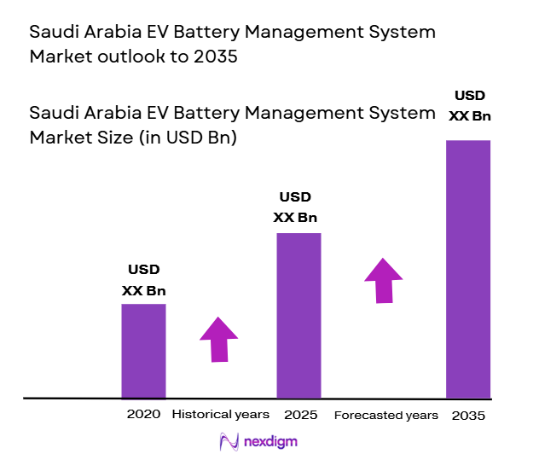
The Saudi Arabia EV Battery Management System market is projected to reach a market size of approximately USD ~ billion based on recent historical assessments. The demand for EV Battery Management Systems (BMS) is driven by the growing adoption of electric vehicles in Saudi Arabia, supported by government initiatives to reduce carbon emissions and the rising demand for cleaner energy solutions. As a result, the market for BMS in electric vehicles is seeing significant investments in infrastructure and technology.
The Saudi Arabian market is predominantly dominated by major cities like Riyadh, Jeddah, and Dammam. These urban centers are leading the EV adoption, mainly driven by the government’s Vision 2030 plan to diversify the economy and reduce dependence on oil. Additionally, the robust development of EV infrastructure, such as charging stations, coupled with the increasing number of public and private sector initiatives in sustainable mobility, is positioning these cities as the main hubs for EV adoption and BMS integration.
Market Segmentation
By Product Type:
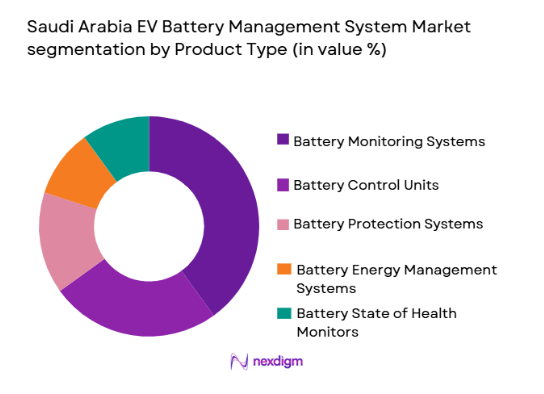
The Saudi Arabia EV Battery Management System market is segmented by product type into Battery Monitoring Systems, Battery Control Units, Battery Protection Systems, Battery Energy Management Systems, and Battery State of Health Monitors. Recently, Battery Monitoring Systems have a dominant market share due to their crucial role in providing real-time data and ensuring optimal battery performance in electric vehicles, which is vital for both consumer safety and battery longevity. These systems help in preventing overcharging and maintaining temperature regulation, thus enhancing the overall efficiency and lifespan of batteries.
By Platform Type:
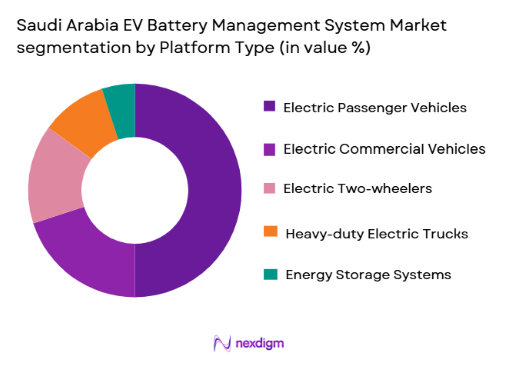
The Saudi Arabia EV Battery Management System market is segmented by platform type into Electric Passenger Vehicles, Electric Commercial Vehicles, Electric Two-wheelers, Heavy-duty Electric Trucks, and Energy Storage Systems. Recently, Electric Passenger Vehicles have a dominant market share due to factors such as increasing consumer demand for eco-friendly vehicles, government incentives for electric vehicle adoption, and the rapid expansion of EV charging infrastructure in urban centers like Riyadh and Jeddah. These factors have led to a rapid increase in the adoption of electric passenger vehicles, which is directly driving the demand for efficient and reliable battery management systems.
Competitive Landscape
The competitive landscape of the Saudi Arabia EV Battery Management System market is characterized by significant consolidation and the increasing influence of major global players. Several key players in the market are forming strategic partnerships with local and international automakers and energy providers to capture a larger share of the rapidly growing EV market. This consolidation is expected to drive further technological advancements, improved system performance, and cost reductions, which will benefit both manufacturers and end users. Additionally, government support for electric vehicle initiatives provides a favorable environment for the growth of these key players.
| Company Name | Establishment Year | Headquarters | Technology Focus | Market Reach | Key Products | Revenue (USD billion) | Additional Parameter |
| Tesla | 2003 | USA | ~ | ~ | ~ | ~ | ~ |
| BYD | 1995 | China | ~ | ~ | ~ | ~ | ~ |
| LG Chem | 1947 | South Korea | ~ | ~ | ~ | ~ | ~ |
| Panasonic | 1918 | Japan | ~ | ~ | ~ | ~ | ~ |
| CATL | 2011 | China | ~ | ~ | ~ | ~ | ~ |
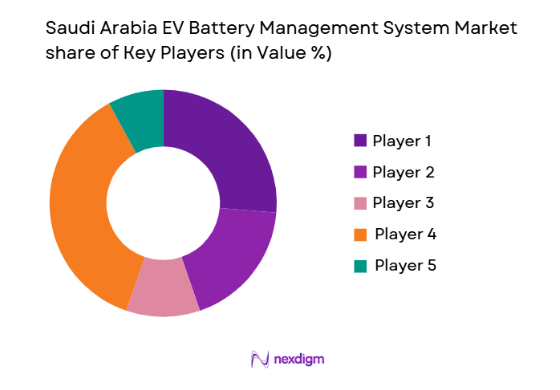
Saudi Arabia EV Battery Management System Market Analysis
Growth Drivers
Government Initiatives to Support EV Adoption:
Government policies in Saudi Arabia, particularly the Vision 2030 initiative, are driving the adoption of electric vehicles. The Saudi government has set ambitious targets for EV penetration, including the establishment of EV-friendly infrastructure like charging stations and financial incentives for both consumers and businesses. These policies aim to reduce the country’s carbon footprint and promote sustainability, which directly boosts the demand for electric vehicles and consequently, for efficient EV Battery Management Systems (BMS). As a result, the market is witnessing an increasing need for advanced BMS solutions that ensure optimal battery performance, safety, and energy efficiency, further accelerating the growth of the sector.
Technological Advancements in Battery Management Systems:
Technological advancements in battery management systems, including better energy efficiency, extended battery life, and enhanced safety features, are driving growth in the Saudi Arabian market. The development of state-of-the-art monitoring systems, state-of-health diagnostics, and integration of Artificial Intelligence (AI) for predictive maintenance are transforming the BMS industry. The rise of next-generation BMS solutions that provide real-time data analysis, battery protection, and efficient energy management is boosting the demand for high-performance systems in electric vehicles, leading to a more stable market growth.
Market Challenges
High Initial Costs of EV Battery Systems:
One of the main challenges hindering the growth of the Saudi Arabian EV Battery Management System market is the high initial cost of electric vehicle batteries, including the battery management systems. While EV technology is becoming more affordable, the costs associated with the development, manufacturing, and integration of BMS remain high. This makes EVs less affordable to a significant portion of the population, which may delay widespread adoption, especially in regions outside of major cities. The high capital expenditure required to implement and maintain EV battery systems poses a significant barrier to market expansion, despite government incentives.
Limited EV Charging Infrastructure:
The Saudi Arabian market faces a challenge in terms of the availability and accessibility of charging infrastructure, especially in remote areas. While major cities like Riyadh and Jeddah are witnessing rapid development in charging stations, the lack of charging points in less urbanized areas hinders the adoption of electric vehicles. This lack of infrastructure limits the potential market for EV battery systems, as consumers may hesitate to invest in electric vehicles without an extensive charging network. Overcoming this challenge will require significant investments in the expansion of EV charging stations and infrastructure, which is expected to take several years.
Opportunities
Integration of Renewable Energy with Electric Vehicles:
The integration of renewable energy sources, such as solar and wind, into electric vehicle charging infrastructure presents a significant opportunity for the EV Battery Management System market in Saudi Arabia. The government’s focus on renewable energy development under Vision 2030 aligns well with the growth of the EV market. By coupling EVs with renewable energy sources, there is potential for a sustainable, low-carbon transportation ecosystem that reduces dependence on fossil fuels. This integration can create a larger market for advanced battery management systems that can efficiently handle energy storage and power distribution in EVs, driving the growth of BMS solutions in the country.
Expansion of EV Charging Networks in Urban Areas:
Another opportunity in the Saudi Arabian market is the rapid expansion of electric vehicle charging infrastructure in urban areas. As the government and private players collaborate to roll out EV charging stations across the country, demand for electric vehicles and the associated battery management systems is expected to rise. Increased urbanization and government funding for green initiatives are pushing for a robust charging infrastructure, thus creating new growth opportunities for BMS manufacturers. The increasing availability of charging stations will provide the necessary infrastructure to accelerate EV adoption, which will, in turn, create a steady demand for efficient battery management systems.
Future Outlook
The future outlook of the Saudi Arabian EV Battery Management System market over the next five years is positive, with substantial growth expected. Key factors driving this growth include government initiatives promoting EV adoption, advancements in battery technology, and the development of a robust charging infrastructure. As the market matures, technological innovations in BMS, such as predictive maintenance and AI-powered systems, will continue to enhance battery performance and safety. The increasing demand for electric vehicles, particularly in urban centers, coupled with favorable regulatory support, will further boost the market, positioning Saudi Arabia as a key player in the global EV ecosystem.
Major Players
- Tesla
- BYD
- LG Chem
- Panasonic
- CATL
- Samsung SDI
- A123 Systems
- Bosch
- Delphi Technologies
- Siemens
- EATON
- Honeywell
- VARTA AG
- Schneider Electric
- ABB
Key Target Audience
- Investments and venture capitalist firms
- Government and regulatory bodies
- Automotive manufacturers
- Battery manufacturers
- EV charging infrastructure providers
- EV fleet operators
- Energy storage system providers
- Electric vehicle retailers
Research Methodology
Step 1: Identification of Key Variables
Identify key factors influencing the EV Battery Management System market in Saudi Arabia, including technological trends, market demand, and government regulations.
Step 2: Market Analysis and Construction
Conduct an in-depth analysis of market segmentation, competitive landscape, and historical market data to build a comprehensive market model.
Step 3: Hypothesis Validation and Expert Consultation
Validate market trends and growth assumptions through consultations with industry experts and key stakeholders.
Step 4: Research Synthesis and Final Output
Synthesize the research findings into actionable insights and final report output for stakeholders.

- Executive Summary
- Research Methodology (Definitions, Scope, Industry Assumptions, Market Sizing Approach, Primary & Secondary Research Framework, Data Collection & Verification Protocol, Analytic Models & Forecast Methodology, Limitations & Research Validity Checks)

- Market Definition and Scope
- Value Chain & Stakeholder Ecosystem
- Regulatory / Certification Landscape
- Sector Dynamics Affecting Demand
- Strategic Initiatives & Infrastructure Growth

- Growth Drivers
Increase in Government Policies Supporting EV Adoption
Rising Environmental Awareness Among Consumers
Technological Advancements in Battery Efficiency
Improvement in Charging Infrastructure
Expansion of Renewable Energy Integration in EVs - Market Challenges
High Initial Costs of EV Battery Systems
Limited Charging Infrastructure in Remote Areas
Technological Limitations in Battery Life and Durability
Fluctuating Raw Material Prices
Regulatory and Certification Barriers - Market Opportunities
Growing Adoption of EVs in Public Transport
Investment in Smart Grid and Energy Storage Systems
Partnerships Between Automakers and Battery Suppliers - Trends
Development of Fast-charging Battery Technologies
Integration of Artificial Intelligence in Battery Management
Increase in the Use of Recycling for Battery Materials
Shift Towards Second-life Battery Applications
Adoption of Wireless Charging Systems - Government Regulations & Defense Policy
EV Battery Recycling Regulations
Carbon Emission Reduction Targets
EV Charging Infrastructure Standards - SWOT Analysis
- Stakeholder and Ecosystem Analysis
- Porter’s Five Forces Analysis
- Competition Intensity and Ecosystem Mapping

- By Market Value, 2020-2025
- By Installed Units, 2020-2025
- By Average System Price, 2020-2025
- By System Complexity Tier, 2020-2025

- By System Type (In Value%)
Battery Monitoring Systems
Battery Control Units
Battery Protection Systems
Battery Energy Management Systems
Battery State of Health Monitors - By Platform Type (In Value%)
Electric Passenger Vehicles
Electric Commercial Vehicles
Electric Two-wheelers
Heavy-duty Electric Trucks
Energy Storage Systems - By Fitment Type (In Value%)
Onboard Systems
Offboard Systems
Integrated Systems
Modular Systems
Standalone Systems - By EndUser Segment (In Value%)
Automobile Manufacturers
Battery Manufacturers
Automotive Suppliers
Energy Storage Providers
Electric Vehicle Owners - By Procurement Channel (In Value%)
Direct Procurement
Government Tenders
Private Sector Procurement
Online Bidding Platforms
Third-party Distributors - By Material / Technology (in Value%)
Lithium-ion Battery Technology
Solid-state Battery Technology
Nickel-Metal Hydride (NiMH)
Lithium Iron Phosphate (LFP)
Advanced Lead-acid Batteries

- Market structure and competitive positioning
- Market share snapshot of major players
- CrossComparison Parameters (System Type, Platform Type, Procurement Channel, EndUser Segment, Fitment Type, Material / Technology, Market Value, Installed Units, Average Price, System Complexity Tier)
- SWOT Analysis of Key Players
- Pricing & Procurement Analysis
- Key Players
LG Chem
Samsung SDI
Panasonic
BYD Company
CATL
A123 Systems
Toshiba
Sanyo Electric
BYD Auto
Siemens
Eaton Corporation
Hitachi Chemical
Johnson Controls
Bosch
Delphi Technologies

- Automobile Manufacturers’ Shift Towards Electric Vehicles
- Battery Manufacturers’ Expansion into EV Battery Tech
- Energy Providers’ Focus on Integrating EVs into the Grid
- Government Support for EV Adoption and Infrastructure Development

- Forecast Market Value, 2026-2035
- Forecast Installed Units, 2026-2035
- Price Forecast by System Tier, 2026-2035
- Future Demand by Platform, 2026-2035


 Request a Sample
 Ask for Customization
 Get a Quote
 Enquire Now